The Best Klipsch Speakers
Klipsch publishes more useful numbers than most speaker makers and one misleading one. Here is the whole range by job, with the footnote that changes how three of these figures should be read.
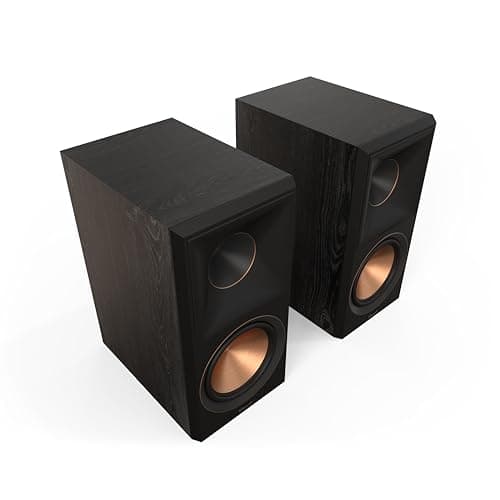
Top pick: Klipsch RP-600M II
Best step up. #ad Affiliate link — we earn a commission at no extra cost to you.
The short answer
The best Klipsch speaker is the RP-600M II — because it is the model where Klipsch’s published figures line up best with what a normal room can use. It reaches 44 Hz at ±3 dB from a bookshelf cabinet, carries a 6.5-inch Cerametallic woofer with Faraday rings, handles 100 W continuous, and crosses over at 1,500 Hz, the lowest crossover point in the whole Klipsch range we cover — which keeps the horn working over more of the midrange rather than less. The budget pick is the R-51M— the entry point of the range that still works as a full-range stereo pair on its own, and the easiest amplifier load Klipsch publishes in the R-series at 93 dB sensitivity. Its honest limit is the bottom end: 62 Hz at ±3 dB, where the RP-600M II manages 44 Hz.
One warning that applies to this whole page before you compare any two numbers on it. Klipsch publishes its sensitivity figures two different ways. The Reference Premiere sheets carry an explicit footnote — “SPL at 1 M, half-space anechoic with 2.83V input” — and the cheaper Reference-series sheets do not. A half-space measurement reads about 3 dB higher than a free-space one for the same speaker, so the R-620F’s 96 dB and the RP-6000F II’s 96 dB are not the same claim. We rank on what each sheet says and we flag the footnote every time it applies.
Disclosure: we earn a commission if you buy through the links on this page, at no extra cost to you. It does not influence what we pick — our criteria are published and reproducible, so you can check our work. How we pick · Full disclosure
These picks are spec-and-price analyses, not listening tests. We have not heard this gear and we do not pretend to have: every figure below is sourced to the manufacturer and linked, and every price is live or not shown at all. Here are the rules we followed.
Quick picks
Ranked on the published criteria in How We Pick. Prices are live as of November 12, 2026. Tap any row for the full write-up.
- 8.6
- 8.4
- 8.4
- 8.6
- 8.2$329.00View on Amazon
$599.0045% off
- 7.6
- 7.8
- 7.0
- 7.9
| # | Product | Best for | Score | Price |
|---|---|---|---|---|
| 1 | Klipsch RP-600M II Higher sensitivity and a bigger cabinet than the R-51M, which buys headroom rather than a different kind of speaker. | Best step up | 8.6 | |
| 2 | 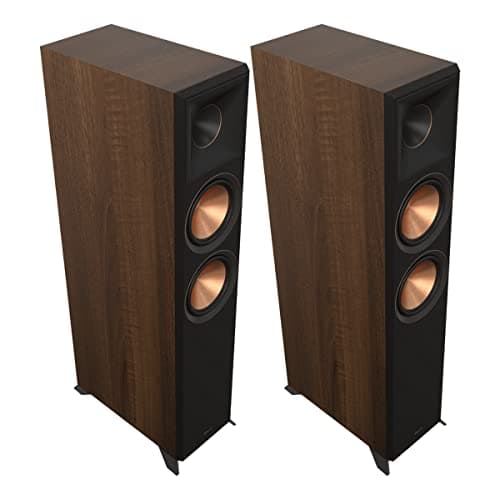 Klipsch RP-6000F II The only pair listing in the bracket and the easiest load in it — with a 96 dB sensitivity figure that carries Klipsch's own half-space asterisk, which is worth reading before you compare it to anything. | Best for a modest amplifier | 8.4 | |
| 3 | 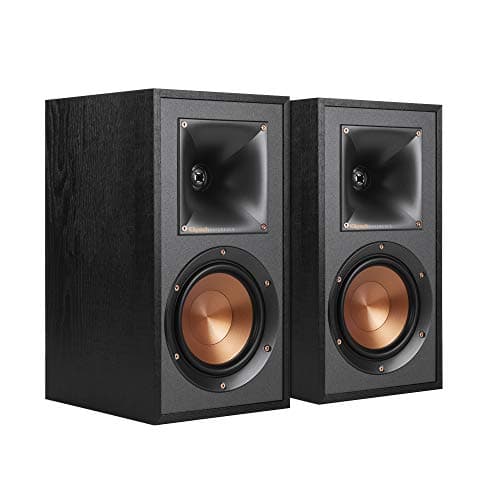 Klipsch R-51M High sensitivity means a modest amplifier drives these to a real volume — the practical answer when the amp is fixed and small. | Best for low-power amplifiers | 8.4 | |
| 4 | 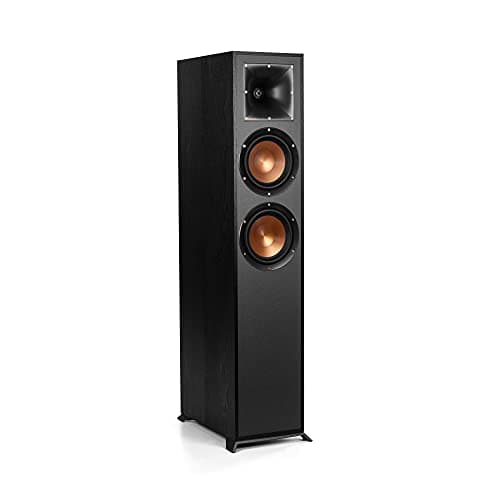 Klipsch R-620F 96 dB at 2.83 V/1 m and 38 Hz with a ±3 dB tolerance attached — the only speaker here that pairs the highest published sensitivity with a bass figure you can actually hold Klipsch to. | Best overall | 8.6 | |
| 5 | 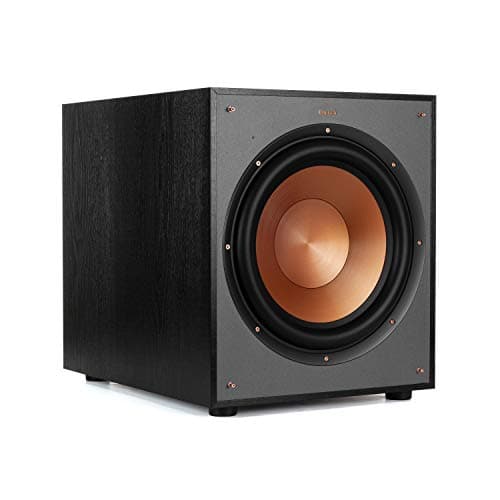 Klipsch R-120SW A 12-inch ported sub whose spec sheet publishes 200 W continuous next to the 400 W peak figure the listings quote — and whose only inputs are RCA, which is the spec that decides whether it works with your amplifier. | Best value 12-inch | 8.2 | $329.00View on Amazon $599.0045% off |
| 6 | 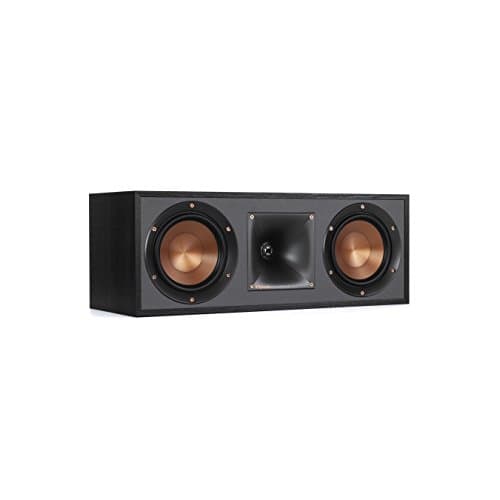 Klipsch R-52C A sealed dual-woofer center with a published 95 dB sensitivity, timbre-matched to the R-41M and R-51M so dialogue does not change character as it pans across the front. | Best center channel | 7.6 | |
| 7 | 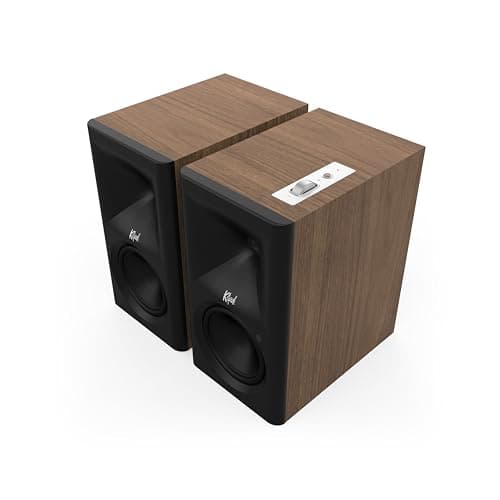 Klipsch The Fives II Powered speakers with HDMI-ARC and a phono input, built to replace both a soundbar and a stereo system in one box pair. | Most connected powered pair | 7.8 | |
| 8 | 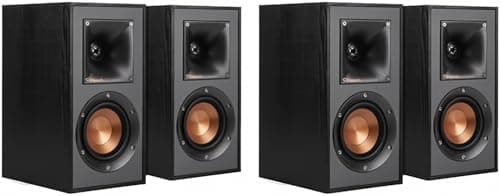 Klipsch R-41M A 4-inch two-way with a published 90 dB sensitivity, which means it goes loud on an amplifier that would embarrass most of its competition. | Best for a very small amplifier | 7.0 | |
| 9 | 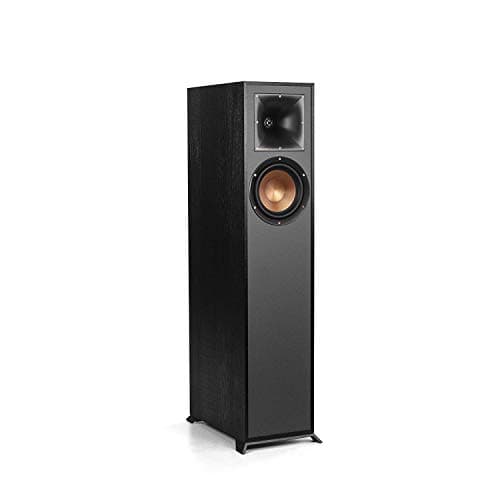 Klipsch R-610F 94 dB at 2.83 V/1 m from the cheapest cabinet here, with Klipsch filling in every field its R-620F sheet leaves blank — and stopping 7 Hz higher for it. | Best for a small room | 7.9 |
Klipsch sells one idea: a horn-loaded tweeter on a high-sensitivity cabinet, so a modest amplifier goes loud. That idea is real and it is measurable, and the company publishes enough to check it — sensitivity, frequency response with a tolerance, crossover frequency, driver materials, power handling, and on most sheets the enclosure type and the input terminals. That is more than several rivals in this registry publish.
It also publishes two things that are routinely misread, and both of them matter more than any single figure in the tables below. This page covers the whole range by job — which Klipsch for stereo, which for a center channel, which for bass, which if there is no amplifier in the room at all — and it reads the footnotes out loud.
The picks compared, spec by spec
The impedance column is identical on all seven passive models, and that is the point of showing it: “8 Ω compatible” is Klipsch’s own wording, it is not a measured nominal figure, and Klipsch publishes no minimum impedance for a single speaker in this range. Every row carries its own live price and buy link.
Every figure below is the manufacturer’s own published value and links to the document we read it from. “Not published” means the manufacturer does not publish that figure; an em dash means we have no published figure for that model. Prices are live as of November 12, 2026.
Best step up
- Sensitivity
- 94.5 dB — half-space footnote
- Frequency response
- 44 Hz – 25 kHz ± 3 dB
- Impedance
- 8 Ω “compatible”
- Crossover
- 1,500 Hz — lowest here
Best for a modest amplifier
- Sensitivity
- 96 dB — half-space footnote
- Frequency response
- 38 Hz – 25 kHz ± 3 dB
- Impedance
- 8 Ω “compatible”
- Crossover
- 1,770 Hz
Best for low-power amplifiers
- Sensitivity
- 93 dB (2.83 V / 1 m)
- Frequency response
- 62 Hz – 21 kHz ± 3 dB
- Impedance
- 8 Ω “compatible”
- Crossover
- 1,660 Hz
Best overall
- Sensitivity
- 96 dB (2.83 V / 1 m), no footnote
- Frequency response
- 38 Hz – 21 kHz ± 3 dB
- Impedance
- 8 Ω “compatible”
- Crossover
- 2,000 Hz — highest here
Best value 12-inch
- Sensitivity
- —
- Frequency response
- 29 Hz – 120 Hz ± 3 dB
- Impedance
- —
- Crossover
- —
Best center channel
- Sensitivity
- 95 dB (2.83 V / 1 m)
- Frequency response
- 89 Hz – 21 kHz ± 3 dB
- Impedance
- 8 Ω “compatible”
- Crossover
- 1,630 Hz
Most connected powered pair
- Sensitivity
- —
- Frequency response
- 50 Hz – 25 kHz ± 3 dB
- Impedance
- —
- Crossover
- —
Best for a very small amplifier
- Sensitivity
- 90 dB (2.83 V / 1 m)
- Frequency response
- 68 Hz – 21 kHz ± 3 dB
- Impedance
- 8 Ω “compatible”
- Crossover
- 1,730 Hz
Best for a small room
- Sensitivity
- 94 dB (2.83 V / 1 m)
- Frequency response
- 45 Hz – 21 kHz ± 3 dB
- Impedance
- 8 Ω “compatible”
- Crossover
- 1,800 Hz
| Pick | Sensitivity | Frequency response | Impedance | Crossover | Price |
|---|---|---|---|---|---|
| 1.Klipsch RP-600M IIBest step up | 94.5 dB — half-space footnote | 44 Hz – 25 kHz ± 3 dB | 8 Ω “compatible” | 1,500 Hz — lowest here | |
| 2.Klipsch RP-6000F IIBest for a modest amplifier | 96 dB — half-space footnote | 38 Hz – 25 kHz ± 3 dB | 8 Ω “compatible” | 1,770 Hz | |
| 3.Klipsch R-51MBest for low-power amplifiers | 93 dB (2.83 V / 1 m) | 62 Hz – 21 kHz ± 3 dB | 8 Ω “compatible” | 1,660 Hz | |
| 4.Klipsch R-620FBest overall | 96 dB (2.83 V / 1 m), no footnote | 38 Hz – 21 kHz ± 3 dB | 8 Ω “compatible” | 2,000 Hz — highest here | |
| 5.Klipsch R-120SWBest value 12-inch | — | 29 Hz – 120 Hz ± 3 dB | — | — | |
| 6.Klipsch R-52CBest center channel | 95 dB (2.83 V / 1 m) | 89 Hz – 21 kHz ± 3 dB | 8 Ω “compatible” | 1,630 Hz | |
| 7.Klipsch The Fives IIMost connected powered pair | — | 50 Hz – 25 kHz ± 3 dB | — | — | |
| 8.Klipsch R-41MBest for a very small amplifier | 90 dB (2.83 V / 1 m) | 68 Hz – 21 kHz ± 3 dB | 8 Ω “compatible” | 1,730 Hz | |
| 9.Klipsch R-610FBest for a small room | 94 dB (2.83 V / 1 m) | 45 Hz – 21 kHz ± 3 dB | 8 Ω “compatible” | 1,800 Hz |
Prices as of November 12, 2026; every “Check Price” link goes to Amazon and earns us a commission at no extra cost to you. #ad
The sensitivity footnote, and why it is the most important line on the page
Two speakers here publish 96 dB. One of them says how it was measured and the other does not.
The RP-6000F II’s spec sheet carries an asterisk on the sensitivity row, and Klipsch’s own footnote reads “SPL at 1 M, half-space anechoic with 2.83V input”. The RP-600M II carries the same footnote on its 94.5 dB figure. A half-space measurement places the speaker against an infinite reflecting boundary, which gives it roughly 3 dB of reinforcement it would not get sitting on a stand in the middle of a room. The R-series sheets — R-41M, R-51M, R-52C, R-610F, R-620F — print a bare “2.83 V / 1 m” with no half-space note at all. Note that “R-series” here means the sheets for the models on this page, four of which are the previous Reference generation; the section below sets out which, and what Klipsch now points buyers to instead.
So the honest reading is that the R-620F’s 96 dB and the RP-6000F II’s 96 dB are two different claims, and we do not know how far apart they really are, because Klipsch has not told us what the R-series condition was. What we can say is that comparing a Reference figure to a Reference Premiere figure as if they were interchangeable will mislead you, and that comparing either one to a rival brand that publishes a free-space figure will mislead you more. Our guide to speaker sensitivity works through what the measurement condition does to the number.
None of that makes Klipsch’s sensitivity advantage fictional. The brand is genuinely easier to drive than most of what we cover, and that is the single best practical reason to buy it. It just means the arithmetic should be done on the spread within one series, not across two.
What six decibels of sensitivity is actually worth
Inside the R-series, where the measurement condition is at least consistent, the spread runs from the R-41M at 90 dB to the R-620F at 96 dB. That is the biggest same-condition sensitivity gap in our entire speaker registry, and it is the whole Klipsch argument in one number.
power ratio = 10 ^ (ΔdB ÷ 10)
Inputs
- Klipsch R-620F sensitivity: 96 dB (2.83 V / 1 m) (Klipsch spec sheet (PDF))
- Klipsch R-41M sensitivity: 90 dB (2.83 V / 1 m) (Klipsch spec sheet (PDF))
Result
In practical terms, this is why Klipsch pairs so well with the sort of receiver most people actually own. A Denon or Yamaha rated 70–80 W a channel into 8 Ω is a modest amplifier on paper, and in front of a 93–96 dB Klipsch it is not. Denon’s whole sub-$1,000 range spans about half a decibel of power, which is nothing next to the six decibels sitting in this one speaker line. Our Klipsch amplifier page ranks the stereo options on the same reasoning.
Five of these nine are the previous Reference generation
This belongs before any of the rankings below, because Klipsch says it on its own product pages and almost no roundup repeats it. Klipsch has shipped a newer Reference line, and for five of the nine speakers here its own page for the model now carries a link to the replacement. On the R-51M page the wording is “Want the latest? Shop the New Reference R-50M Bookshelf Speakers Now.” The five, with the model Klipsch points to:
- R-51M→ Reference R-50M
- R-41M→ Reference R-40M
- R-52C→ Reference R-50C
- R-620F→ Reference R-600F
- R-120SW→ Reference R-121SW
Four things follow from that, and only one of them is a reason not to buy. First, all five are still sold and still carry live listings, so this is a which-generation question rather than an availability one. Second, every published figure on this page is the figure Klipsch publishes for the model named beside it, read from that model’s own spec sheet — so the sensitivity, response and crossover numbers below are not stale, they are simply the previous generation’s numbers. Third, the previous generation is usually where the discount sits, which is a real argument for it as long as you know that is what you are buying. Fourth, and this is the one to weigh: we have not put the new Reference models through our own sourcing process, so we cannot yet tell you what Klipsch publishes for an R-50M against an R-51M. Until we can, the honest position is that the figures here describe the outgoing model and the newer one may measure differently.
The four that are NOT superseded are worth naming for the same reason: the RP-600M II and RP-6000F II are current Reference Premiere II models, The Fives II is current, and Klipsch’s own R-610F page carries no “shop the latest” link at the time of writing. The top two picks on this page are both current models, which is not an accident — they are ranked on published figures, and the current generation is where Klipsch publishes the most.
The listing trap: one speaker or two
This is the single most expensive mistake available in the Klipsch range and it is a one-line spec. Klipsch states it plainly for the two R-series floorstanders here: the R-620F and the R-610F are each sold as ONE cabinet on their Amazon listings, so a stereo pair is two purchases. The RP-6000F II is the opposite — its listing is a two-speaker pack, and it is the only pair listing among the floorstanders we cover.
That turns an apparently large price gap into a much smaller one, and occasionally inverts it. The practical rule is to read the quantity on the listing before the price, every time, on any Klipsch floorstander. The live prices in the table above are per listing, which is exactly how you will be charged — so double the two single-cabinet rows in your head before comparing them with the pair row.
The same caution applies in a smaller way to the bookshelf models. Klipsch does not state a quantity in the R-51M or R-41M spec sheets, and the R-41M’s listing price has at times sat above the larger R-51M’s despite being the smaller speaker with the lower published sensitivity. Compare both live prices in the table rather than assuming the smaller model is the cheaper one.
Bookshelf: RP-600M II first, R-51M for value, R-41M only if the shelf is tiny
The RP-600M II is the best bookshelf Klipsch publishes figures for, and the crossover point is the reason. At 1,500 Hz it hands over to the horn lower than anything else here — the R-620F crosses at 2,000 Hz, a full third of an octave higher — which means more of the vocal range is reproduced by the waveguide rather than by a 6.5-inch cone working near the top of its band. It also reaches 44 Hz at ±3 dB and weighs 18.1 lb each, which is heavy for a bookshelf cabinet and usually a good sign.
The R-51M is third overall and the budget pick. 93 dB, 62 Hz – 21 kHz, a 5.25-inch spun-copper woofer, an 85 W continuous handling limit and 11 lb a cabinet. It is also one of the five previous-generation models above — Klipsch’s own page for it now points at the Reference R-50M — so check both before buying, and treat the discount on this one as the reason to choose it rather than an accident. It is the Klipsch most people should buy first, and we have a full review of it and a head-to-head against the Polk Monitor XT15 if it is the one you are weighing.
The R-41M is eighth, and it is on this page for one specific situation: a very small shelf and a very small amplifier. A single 4-inch woofer, 7 lb a cabinet, 90 dB, and 68 Hz at ±3 dB. Its 50 W continuous handling limit is the lowest here. If the enclosure has to be that small, it is the Klipsch that fits; if it does not, the R-51M is a better speaker for a similar outlay.
Floorstanding: the pair-listing RP-6000F II, or two R-series purchases
The RP-6000F II is second overall. 38 Hz – 25 kHz at ±3 dB, dual 6.5-inch Cerametallic woofers with Faraday rings, a titanium LTS tweeter on a hybrid cross-section expanded Tractrix horn, 125 W continuous handling, an internally braced MDF cabinet with dual-chamber rear Tractrix ports, dual binding posts for bi-wiring or bi-amping, and 49.4 lb each. It is also the only two-way here that Klipsch explicitly labels “no dedicated midrange driver” on its own sheet, which is the kind of disclosure most makers leave to the reader to work out.
The R-620F is fourth. Its published 38 Hz low end matches the RP-6000F II, its 96 dB sensitivity is the highest bare figure on this site, and it carries dual 6.5-inch spun-copper woofers behind a 2,000 Hz crossover. Two things keep it from ranking higher. Klipsch leaves the input-terminal and weight fields on its spec sheet BLANK — both fields exist on the template and both are filled in on the cheaper R-610F’s sheet, so this is Klipsch’s omission rather than a gap in the template. And it is a single-cabinet listing.
The R-610F is ninth and it is the cheapest route into a Klipsch tower. A single 6.5-inch woofer, 94 dB, 45 Hz at ±3 dB, single gold-plated binding posts, 36 lb. It is a smaller speaker than the R-620F in every published dimension, and it is the one whose sheet is actually complete. Our floorstanding bracket under $1,000 ranks these against ELAC, Polk, Fluance and JBL, which is the right page if the brand is not already settled.
Center channel and subwoofer: the two easiest decisions here
The R-52C is the only center channel we cover and at 95 dB it has the highest published sensitivity of any center on this site, which matters because the center does most of the dialogue work and wants to keep up with the towers beside it. It is also the one Klipsch here with a SEALED enclosure — the R-41M and R-51M are both ported — and its 89 Hz low-end limit is the highest on this page by a wide margin. That is not a flaw in a system with a subwoofer; it is a flaw in a system without one. Whether you need a center at all is a separate question and the answer is not always yes.
The R-120SW is the subwoofer, 29 Hz – 120 Hz at ±3 dB from a 12-inch front-firing woofer, with 200 W continuous and 400 W peak from an all-digital amplifier and a published 116 dB maximum acoustic output. Note which of those two power figures the listings quote: the 400 W peak. The compatibility trap is a single line in the spec sheet and it catches people with older amplifiers — line-level and LFE RCA jacks only, no speaker-level inputs at all. Klipsch also publishes no low-pass crossover range for it, only that a low-pass control exists. We put it against the SVS SB-1000 Pro on published figures.
The Fives II: the Klipsch with no amplifier required, and no wattage published
The Fives II is seventh, and it is a different kind of product — a powered stereo pair with the electronics built in. The feature list is the most complete of anything here: HDMI-ARC and eARC with CEC, so a television remote controls the volume; a dedicated analog input with a built-in phono stage, so a turntable connects with nothing in between; Bluetooth 5.4 with SBC and AAC; USB-C audio, USB-A, optical, and a second RCA analog input; an RCA line output for a subwoofer; and an HDMI output with 2.1 pass-through.
And one conspicuous absence. Klipsch publishes no amplifier wattage for this model at all. In place of a power figure the spec sheet gives “Max Output: 103 dB (1 m, stereo pair)”. We do not carry over the wattage from the original Fives, because the II is a different electronics platform, and we are not going to put a number on this page that Klipsch has not put on its own. The 50 Hz – 25 kHz response at ±3 dB and the 5.25-inch Jet Cerametallic woofer are published, and the sub output exists for the bottom end.
It is the right Klipsch for a desk or a television with no rack behind it, and the wrong one if you already own an amplifier you like. Our powered-speakers-for-TV roundup and our passive-versus-powered comparison cover that fork properly.
What Klipsch does not publish for any of these
Three gaps, and they are consistent across the entire range, which at least makes them predictable. A fourth is ours rather than Klipsch’s: we have not yet sourced the new Reference models, so this page cannot compare an R-50M with an R-51M on published figures.
Minimum impedance.Not one of the seven passive speakers here publishes it. Every sheet says 8 Ω “compatible” — Klipsch’s word, not a measured nominal figure — and none says what the impedance curve actually dips to. For a receiver rated into 8 Ω that is usually fine, and our impedance guide explains when it stops being fine.
A recommended amplifier range.The power handling figures above are handling LIMITS, not recommendations, and reading them as “this speaker needs 100 W” is backwards — a 96 dB speaker needs less amplifier than almost anything else on this site, not more.
Distortion. No Klipsch sheet here publishes a distortion figure at any level, which is normal for the category rather than unusual. If a published distortion specification is what you want from a bookshelf speaker, the brand that gives it to you is KEF, and our high-end bookshelf roundup is where that comparison lives.
Building a Klipsch system, in the order that matters
If the end goal is a full home theater, the order to buy in is front pair, then subwoofer, then center, then surrounds — and the front pair is where the published figures above should decide it. A pair of RP-600M II on stands with an R-120SW underneath is a better-measuring start than four R-41M and a center, for the same outlay. Our home theater speaker roundup sets out the full layout, and the stands page covers the part people skip.
If the end goal is stereo for records, the horn-loaded high-sensitivity approach is a genuinely good match for a modest valve or class-AB amplifier, for exactly the arithmetic above. Our bookshelf-for-vinyl roundup ranks the Klipsch models against the rest of the field on the figures a turntable system actually cares about, and the entry-turntable alternatives page is the other half of that system if the deck is not settled yet.
Every pick in detail
Every specification below links to the manufacturer document we read it from. Where a manufacturer does not publish a figure, we say so rather than estimating it.
Klipsch RP-600M II
Best step upPrice as of November 12, 2026. #ad
Higher sensitivity and a bigger cabinet than the R-51M, which buys headroom rather than a different kind of speaker.
- sensitivity
- 10/10
- bass extension
- 8/10
- amp friendliness
- 10/10
- value for money
- 7/10
- build quality
- 9/10
| Specification | Published value | Source |
|---|---|---|
| Sensitivity | 94.5 dB (2.83 V / 1 m, half-space anechoic — Klipsch's published footnote) | Klipsch spec sheet (PDF) |
| Impedance | 8 Ω “compatible” (Klipsch's wording) | Klipsch spec sheet (PDF) |
| Minimum impedance | Not published | — |
| Frequency response | 44 Hz – 25 kHz ± 3 dB | Klipsch spec sheet (PDF) |
| Power handling | 100 W continuous / 400 W peak | Klipsch spec sheet (PDF) |
| Woofer | 6.5 in Cerametallic with Faraday rings | Klipsch spec sheet (PDF) |
| Crossover | 1,500 Hz | Klipsch spec sheet (PDF) |
| Weight (each) | 18.1 lb / 8.2 kg | Klipsch spec sheet (PDF) |
Pros
- Very high sensitivity
- Larger cabinet and more extension than the R-51M
- Real wood-veneer finishes
Cons
- Well above the $500 bracket
- Large
- Rear port placement constraints remain
Skip it if you are shopping under $500 — this is a bracket up.
Klipsch RP-6000F II
Best for a modest amplifierPrice as of November 12, 2026. #ad
The only pair listing in the bracket and the easiest load in it — with a 96 dB sensitivity figure that carries Klipsch's own half-space asterisk, which is worth reading before you compare it to anything.
- published data
- 7/10
- sensitivity
- 9/10
- bass extension
- 8/10
- amp friendliness
- 10/10
- value for money
- 9/10
| Specification | Published value | Source |
|---|---|---|
| Design | Two-way bass reflex — no dedicated midrange driver | Klipsch spec sheet (PDF) |
| Sensitivity | 96 dB @ 2.83 V / 1 m, with Klipsch's own asterisk: “SPL at 1 M, half-space anechoic with 2.83V input” | Klipsch spec sheet (PDF) |
| Impedance | 8 Ω “compatible” (Klipsch's wording — not a measured nominal figure) | Klipsch spec sheet (PDF) |
| Minimum impedance | Not published | — |
| Frequency response | 38 Hz – 25 kHz ± 3 dB | Klipsch spec sheet (PDF) |
| Power handling | 125 W continuous / 500 W peak (a handling limit, not a recommended amplifier range) | Klipsch spec sheet (PDF) |
| Tweeter | 1 in titanium LTS vented tweeter on a hybrid cross-section expanded Tractrix horn | Klipsch spec sheet (PDF) |
| Woofers | Dual 6.5 in Cerametallic cone with Faraday rings | Klipsch spec sheet (PDF) |
| Crossover | 1,770 Hz | Klipsch spec sheet (PDF) |
| Enclosure | Internally braced MDF; bass reflex via dual-chamber rear-firing Tractrix ports | Klipsch spec sheet (PDF) |
| Input terminals | Dual binding posts — bi-wire and bi-amp capable | Klipsch spec sheet (PDF) |
| Dimensions (H × W × D) | 39.60 × 9.29 × 17.57 in (100.6 × 23.6 × 44.6 cm) | Klipsch spec sheet (PDF) |
| Weight (each) | 49.4 lb / 22.4 kg | Klipsch spec sheet (PDF) |
| Sold as | A pair — the Amazon listing is a two-speaker pack. The only pair listing in this bracket. | Klipsch product page |
Pros
- Sold as a pair, so the listed price is the price of a stereo front end
- 38 Hz – 25 kHz ± 3 dB — a real tolerance window on the deepest ± 3 dB figure in the bracket
- 8 Ω compatible and high sensitivity: the one speaker here a modest integrated amplifier will drive comfortably
- Dual binding posts for bi-wiring or bi-amping, which the ELACs and the KEF do not offer
- 125 W continuous handling and a divided, internally braced cabinet
Cons
- The 96 dB figure is footnoted “SPL at 1 M, half-space anechoic with 2.83V input” — a half-space measurement is conventionally about 3 dB optimistic against a free-space one, so it is NOT comparable to the KEF's or ELAC's numbers
- A two-way: the 6.5 in woofers cover midrange up to 1,770 Hz, where the ELACs and the KEF hand that band to a dedicated driver
- 17.57 in deep and 49.4 lb each — the deepest cabinet here before port clearance
- Rear-firing Tractrix ports need real space behind them
- Klipsch publishes no minimum impedance, and “8 ohms compatible” is not a measured nominal figure
Skip it if you are ranking on the headline sensitivity number. Read the asterisk first — it is the difference between a fair comparison and a wrong one.
Klipsch R-51M
Best for low-power amplifiersPrice as of November 12, 2026. #ad
High sensitivity means a modest amplifier drives these to a real volume — the practical answer when the amp is fixed and small.
- sensitivity
- 10/10
- bass extension
- 6/10
- amp friendliness
- 10/10
- value for money
- 9/10
- build quality
- 7/10
| Specification | Published value | Source |
|---|---|---|
| Sensitivity | 93 dB (2.83 V / 1 m) | Klipsch spec sheet (PDF) |
| Impedance | 8 Ω “compatible” (Klipsch's wording — not a measured nominal figure) | Klipsch spec sheet (PDF) |
| Minimum impedance | Not published | — |
| Frequency response | 62 Hz – 21 kHz ± 3 dB | Klipsch spec sheet (PDF) |
| Power handling | 85 W continuous / 340 W peak (a handling limit, not a recommended amplifier range) | Klipsch spec sheet (PDF) |
| Woofer | 5.25 in spun-copper IMG | Klipsch spec sheet (PDF) |
| Tweeter | 1 in aluminum LTS on a 90° × 90° Tractrix horn | Klipsch spec sheet (PDF) |
| Crossover | 1,660 Hz | Klipsch spec sheet (PDF) |
| Weight (each) | 11 lb / 5 kg | Klipsch spec sheet (PDF) |
Pros
- High sensitivity — plays loud on very little power
- The right answer for a low-wattage or tube amplifier
- Horn tweeter gives strong dispersion control
Cons
- Horn presentation is divisive and we cannot tell you how it sounds — we have not heard them
- Rear port needs breathing room from the wall
- Less low-end than the ELAC B6.2
- Previous generation — Klipsch's own page for it now points buyers to the newer Reference R-50M
Skip it if your amp already has power to spare — you are paying for sensitivity you do not need.
Klipsch R-620F
Best overallPrice as of November 12, 2026. #ad
96 dB at 2.83 V/1 m and 38 Hz with a ±3 dB tolerance attached — the only speaker here that pairs the highest published sensitivity with a bass figure you can actually hold Klipsch to.
- sensitivity
- 10/10
- published data
- 7/10
- bass extension
- 8/10
- amp friendliness
- 10/10
- value for money
- 9/10
| Specification | Published value | Source |
|---|---|---|
| Sensitivity | 96 dB (2.83 V / 1 m) — the highest published figure on this site | Klipsch spec sheet (PDF) |
| Impedance | 8 Ω “compatible” (Klipsch's wording — not a measured nominal figure) | Klipsch spec sheet (PDF) |
| Minimum impedance | Not published | — |
| Frequency response | 38 Hz – 21 kHz ± 3 dB | Klipsch spec sheet (PDF) |
| Power handling | 100 W continuous / 400 W peak (a handling limit, not a recommended amplifier range) | Klipsch spec sheet (PDF) |
| Woofers | Dual 6.5 in spun-copper IMG | Klipsch spec sheet (PDF) |
| Tweeter | 1 in aluminum LTS on a 90° × 90° square Tractrix horn | Klipsch spec sheet (PDF) |
| Crossover | 2,000 Hz | Klipsch spec sheet (PDF) |
| Enclosure | MDF, bass reflex via rear-firing Tractrix ports | Klipsch product page |
| Input terminals | Not published | — |
| Dimensions (H × W × D) | 40 × 9.4 × 15.2 in (1,017 × 240 × 386 mm) | Klipsch spec sheet (PDF) |
| Weight (each) | Not published | — |
| Sold as | One speaker. Klipsch's Amazon listing is a single cabinet; a stereo pair is two purchases. | Klipsch product page |
Pros
- 96 dB at 2.83 V / 1 m — the highest published sensitivity of any speaker on this site
- 38 Hz – 21 kHz is quoted ± 3 dB, so both endpoints mean something
- 100 W continuous / 400 W peak handling, published as handling rather than as a recommendation
- Dual 6.5 in woofers in a 40 in cabinet that is still under 9.5 in wide
Cons
- Klipsch's own spec sheet leaves the weight and the input-terminal fields BLANK — the R-610F sheet fills both in, so this is an omission, not an oversight on our part
- Rear-firing Tractrix ports need clearance behind them, which rules out a tight alcove
- The horn presentation is divisive and we cannot tell you how it sounds — we have not heard them
- The Amazon listing is one speaker, so the real cost of a stereo pair is double the number shown
- Previous generation — Klipsch's own page for it now points buyers to the newer Reference R-600F
Skip it if the speakers have to sit within a few inches of a back wall. Rear ports and a wall are a poor combination, and the front-ported Jamo exists for exactly that room.
Klipsch R-120SW
Best value 12-inchA 12-inch ported sub whose spec sheet publishes 200 W continuous next to the 400 W peak figure the listings quote — and whose only inputs are RCA, which is the spec that decides whether it works with your amplifier.
- extension
- 8/10
- published data
- 8/10
- room control
- 4/10
- value for money
- 9/10
- build quality
- 7/10
| Specification | Published value | Source |
|---|---|---|
| Frequency response | 29 Hz – 120 Hz ± 3 dB | Klipsch spec sheet (PDF) |
| Amplifier power (cont/peak) | 200 W / 400 W, all-digital. The 400 W is the peak figure and it is the one the listings quote. | Klipsch spec sheet (PDF) |
| Maximum acoustic output | 116 dB | Klipsch spec sheet (PDF) |
| Driver | 12 in high-excursion spun-copper IMG woofer, front-firing | Klipsch spec sheet (PDF) |
| Enclosure type | Bass-reflex via rear-firing port, MDF | Klipsch spec sheet (PDF) |
| Inputs | Line level / LFE RCA jacks only — NO speaker-level inputs | Klipsch spec sheet (PDF) |
| Controls | Volume, low-pass, 0/180 phase, auto power on | Klipsch spec sheet (PDF) |
| Dimensions | 16.5 in H × 14 in W × 19.2 in D (419 × 356 × 488 mm) | Klipsch spec sheet (PDF) |
| Weight | 31 lb (14.1 kg) | Klipsch spec sheet (PDF) |
| Low-pass crossover range | Not published | — |
Pros
- 200 W continuous IS published, alongside the 400 W peak — Klipsch prints both
- 29 Hz – 120 Hz ± 3 dB, a real tolerance rather than a bare number
- Maximum acoustic output published at 116 dB
- Front-firing driver with a rear port, so it is less fussy about how far it sits from a wall than a down-firing design
Cons
- Line/LFE RCA inputs ONLY — no speaker-level inputs, so an integrated amp with no subwoofer output cannot drive it without a converter
- The 400 W in every listing headline is the peak figure, not the rating
- A large box: 19.2 inches deep, 31 lb
- Klipsch does not publish the low-pass crossover range, only that a low-pass control exists
- Previous generation — Klipsch's own page for it now points buyers to the newer Reference R-121SW
Skip it if your amplifier has no subwoofer output. This one has no speaker-level input, and that is a hard stop rather than an inconvenience.
Klipsch R-52C
Best center channelPrice as of November 12, 2026. #ad
A sealed dual-woofer center with a published 95 dB sensitivity, timbre-matched to the R-41M and R-51M so dialogue does not change character as it pans across the front.
- specs
- 7/10
- sensitivity
- 10/10
- published data
- 6/10
- value for money
- 9/10
- bass extension
- 2/10
| Specification | Published value | Source |
|---|---|---|
| Sensitivity | 95 dB (2.83 V / 1 m) — the highest figure of any center channel on this site | Klipsch spec sheet (PDF) |
| Impedance | 8 Ω “compatible” (Klipsch's wording) | Klipsch spec sheet (PDF) |
| Minimum impedance | Not published | — |
| Frequency response | 89 Hz – 21 kHz ± 3 dB | Klipsch spec sheet (PDF) |
| Power handling | 100 W continuous / 400 W peak | Klipsch spec sheet (PDF) |
| Woofers | Dual 5.25 in spun-copper IMG | Klipsch spec sheet (PDF) |
| Tweeter | 1 in aluminum LTS on a 90° × 90° Tractrix horn | Klipsch spec sheet (PDF) |
| Crossover | 1,630 Hz | Klipsch spec sheet (PDF) |
| Enclosure | MDF, SEALED (the R-41M and R-51M are both ported) | Klipsch spec sheet (PDF) |
| Weight | 13.5 lb / 6.12 kg | Klipsch spec sheet (PDF) |
Pros
- 95 dB at 2.83 V/1 m — the highest published sensitivity of any center channel on this site
- Sealed enclosure, unlike the ported R-41M and R-51M, so it can sit inside a cabinet without port chuffing
- Same 1 in LTS tweeter and Tractrix horn as the R-series bookshelves, which is what timbre matching actually means
- 100 W continuous handling gives a receiver plenty of headroom for dialogue peaks
Cons
- 89 Hz low-end limit — a center channel this shallow depends entirely on the receiver's bass management
- 18.75 in wide, which will not fit under every television
- “8 ohms compatible” again, with no minimum impedance published
- Only useful in a multichannel system; it does nothing for a stereo setup
- Previous generation — Klipsch's own page for it now points buyers to the newer Reference R-50C
Skip it if you are building a stereo system. A center channel has no role in two-channel listening and adding one is not an upgrade.
Klipsch The Fives II
Most connected powered pairPrice as of November 12, 2026. #ad
Powered speakers with HDMI-ARC and a phono input, built to replace both a soundbar and a stereo system in one box pair.
- integration
- 10/10
- upgrade path
- 4/10
- value for money
- 6/10
- ease of setup
- 9/10
- connectivity
- 10/10
| Specification | Published value | Source |
|---|---|---|
| Type | Powered monitor (pair) | Klipsch spec sheet (PDF) |
| Amplifier output | Not published — Klipsch publishes “Max Output: 103 dB (1 m, stereo pair)” instead of any wattage figure | Klipsch spec sheet (PDF) |
| Built-in phono stage | Yes — a dedicated analog input with a built-in phono stage | Klipsch product page |
| Frequency response | 50 Hz – 25 kHz ± 3 dB | Klipsch spec sheet (PDF) |
| Woofer | 5.25 in Jet Cerametallic | Klipsch spec sheet (PDF) |
| Inputs | HDMI-ARC/eARC with CEC, Bluetooth, RCA phono, RCA analog, USB-C audio, USB-A, optical digital | Klipsch spec sheet (PDF) |
| Outputs | Single RCA line-level output for a subwoofer; HDMI output (HDMI 2.1 pass-through, eARC) | Klipsch spec sheet (PDF) |
| Bluetooth | 5.4 — A2DP, SBC and AAC codecs | Klipsch spec sheet (PDF) |
| Dimensions / weight | 12.9 × 7.2 × 10.7 in (327 × 181 × 273 mm) each; primary 18.2 lb, secondary 15.5 lb | Klipsch spec sheet (PDF) |
Pros
- HDMI-ARC — works as a TV system as well as a stereo
- Built-in phono stage, so a turntable plugs straight in
- Genuinely large drivers for a powered pair
Cons
- By far the most expensive option here
- Klipsch publishes NO amplifier wattage for these — only a “max output 103 dB” figure. You cannot compare their power to anything else here, because there is no number to compare.
- Fixed amplification, so the electronics are the ceiling
Skip it if the TV is not part of this system — most of what you are paying for is the HDMI board.
Klipsch R-41M
Best for a very small amplifierPrice as of November 12, 2026. #ad
A 4-inch two-way with a published 90 dB sensitivity, which means it goes loud on an amplifier that would embarrass most of its competition.
- specs
- 6/10
- sensitivity
- 9/10
- published data
- 6/10
- value for money
- 9/10
- bass extension
- 3/10
| Specification | Published value | Source |
|---|---|---|
| Sensitivity | 90 dB (2.83 V / 1 m) | Klipsch spec sheet (PDF) |
| Impedance | 8 Ω “compatible” (Klipsch's wording — not a measured nominal figure) | Klipsch spec sheet (PDF) |
| Minimum impedance | Not published | — |
| Frequency response | 68 Hz – 21 kHz ± 3 dB | Klipsch spec sheet (PDF) |
| Power handling | 50 W continuous / 200 W peak (a handling limit, not a recommended amplifier range) | Klipsch spec sheet (PDF) |
| Woofer | Single 4 in spun-copper IMG | Klipsch spec sheet (PDF) |
| Tweeter | 1 in aluminum LTS on a 90° × 90° Tractrix horn | Klipsch spec sheet (PDF) |
| Crossover | 1,730 Hz | Klipsch spec sheet (PDF) |
| Enclosure | MDF, bass-reflex via rear-firing ports | Klipsch spec sheet (PDF) |
| Weight (each) | 7 lb / 3.2 kg | Klipsch spec sheet (PDF) |
Pros
- 90 dB at 2.83 V/1 m — seven decibels more sensitive than the Micca RB42, which is about five times less amplifier for the same volume
- Klipsch publishes a real ±3 dB tolerance on the frequency response
- 7 lb each and 11.3 in tall: the smallest cabinet here by a clear margin
- Timbre-matched to the R-51M and R-52C if you later build a surround system around it
Cons
- 68 Hz is the shallowest bass extension of any speaker on this site
- “8 ohms compatible” is not a measured nominal impedance, and no minimum impedance is published
- Rear-ported, so it needs clearance behind it — an actual bookshelf will change its bass
- Klipsch publishes power handling, not a recommended amplifier range; those are different specs
- Amazon no longer lists a single pair: the live listing is a two-pair, four-speaker pack, so the price shown here buys four speakers
- Previous generation — Klipsch's own page for it now points buyers to the newer Reference R-40M
Skip it if you listen to anything with real low end and have no subwoofer. 68 Hz means the bottom octave and a half simply is not there.
Klipsch R-610F
Best for a small roomPrice as of November 12, 2026. #ad
94 dB at 2.83 V/1 m from the cheapest cabinet here, with Klipsch filling in every field its R-620F sheet leaves blank — and stopping 7 Hz higher for it.
- sensitivity
- 9/10
- published data
- 9/10
- bass extension
- 5/10
- amp friendliness
- 10/10
- value for money
- 9/10
| Specification | Published value | Source |
|---|---|---|
| Sensitivity | 94 dB (2.83 V / 1 m) | Klipsch spec sheet (PDF) |
| Impedance | 8 Ω “compatible” (Klipsch's wording — not a measured nominal figure) | Klipsch spec sheet (PDF) |
| Minimum impedance | Not published | — |
| Frequency response | 45 Hz – 21 kHz ± 3 dB | Klipsch spec sheet (PDF) |
| Power handling | 85 W continuous / 340 W peak (a handling limit, not a recommended amplifier range) | Klipsch spec sheet (PDF) |
| Woofer | Single 6.5 in spun-copper IMG | Klipsch spec sheet (PDF) |
| Tweeter | 1 in aluminum LTS on a 90° × 90° square Tractrix horn | Klipsch spec sheet (PDF) |
| Crossover | 1,800 Hz | Klipsch spec sheet (PDF) |
| Enclosure | MDF, bass reflex via a rear-firing Tractrix port | Klipsch product page |
| Input terminals | Single gold-plated binding posts | Klipsch spec sheet (PDF) |
| Dimensions (H × W × D) | 37 × 9.4 × 15.1 in (940 × 240 × 384 mm) | Klipsch spec sheet (PDF) |
| Weight (each) | 36 lb / 16.3 kg | Klipsch spec sheet (PDF) |
| Sold as | One speaker. Klipsch's Amazon listing is a single cabinet; a stereo pair is two purchases. | Klipsch product page |
Pros
- 94 dB at 2.83 V / 1 m — a single 6.5 in woofer that still plays loud on very little power
- 45 Hz – 21 kHz ± 3 dB: a tolerance window, unlike either Polk or the Fluance
- Klipsch publishes the weight (36 lb) and the input hardware here, both of which its R-620F sheet omits
- 37 in tall and 36 lb — the smallest real tower in the group
Cons
- 45 Hz is the shallowest published extension on this page, so a subwoofer is not optional for film
- One 6.5 in woofer against the R-620F's two, for less than double the saving
- Rear-firing Tractrix port, so it still needs clearance behind it
- The Amazon listing is one speaker, not a pair
Skip it if the room is large or the system will never have a subwoofer. The R-620F's extra woofer and 7 Hz are worth the step up.
Frequently asked questions
Which Klipsch speaker should I buy first?
Is the Klipsch R-620F really 96 dB sensitive?
Are Klipsch floorstanders sold as a pair?
Do Klipsch speakers need a powerful amplifier?
Will the Klipsch R-120SW work with my old stereo amplifier?
How much power do The Fives II have?
Read next
Klipsch R-51M Review
A spec-by-spec review of the Klipsch R-51M: 93 dB sensitivity, a 1,660 Hz crossover, and the impedance figure Klipsch calls 'compatible' rather than nominal.
The Best Amplifiers for Klipsch Speakers
Klipsch's 90-96 dB sensitivity settles the watts question at about 35 W, so this ranks on published signal-to-noise and damping factor instead. The Onkyo TX-8470's 106 dB is the highest on the site.
The Best High-Sensitivity Bookshelf Speakers
The speakers that make a small amplifier sound big, ranked on published sensitivity and the condition each figure was measured under.
Klipsch R-51M vs Polk Monitor XT15
Klipsch for a low-powered amplifier or a 5.1 system; Polk if the budget is the constraint. The tie-breaker is which specification each maker chose to publish.
Speaker Sensitivity Explained
2.83 V/1 m versus 1 W/1 m, what the conversion is worth in decibels, and the twelve-decibel spread that means sixteen times the power.
The Best Bookshelf Speakers Under $500
Six pairs under $500 — and only one publishes a minimum impedance and a recommended amp range.
Sources
Every specification on this page was read from one of these documents. If one of them has changed, or we have made an error, tell us — corrections are logged and dated per our editorial policy.