Do I Need a Center Channel Speaker?
If more than one person watches, or the seats are wider apart than the front speakers, yes. If you sit alone, dead center, every time, the money is better spent on the front pair — and this page shows the numbers behind both answers.

The short answer
If anyone ever watches from a seat that is not the middle one, buy the center channel — the Klipsch R-52C is the one we cover. A stereo pair can place dialogue in the middle of the screen for one listener sitting exactly between them, and for nobody else. If you genuinely always sit alone in the center seat, skip it and put the money into a better front pair, which is the Klipsch R-51M if you want the horn, the Polk Signature Elite ES15 if you want the wider recommended-power window. Those are the only two answers, and which one applies is decided by furniture, not by audio.
Disclosure: we earn a commission if you buy through the links on this page, at no extra cost to you. It does not influence what we pick — our criteria are published and reproducible, so you can check our work. How we pick · Full disclosure
These picks are spec-and-price analyses, not listening tests. We have not heard this gear and we do not pretend to have: every figure below is sourced to the manufacturer and linked, and every price is live or not shown at all. Here are the rules we followed.
Quick picks
Ranked on the published criteria in How We Pick. Prices are live as of October 10, 2026. Tap any row for the full write-up.
- 7.6$139.99View on Amazon
$149.997% off
- 8.4
- 7.0
| # | Product | Best for | Score | Price |
|---|---|---|---|---|
| 1 | 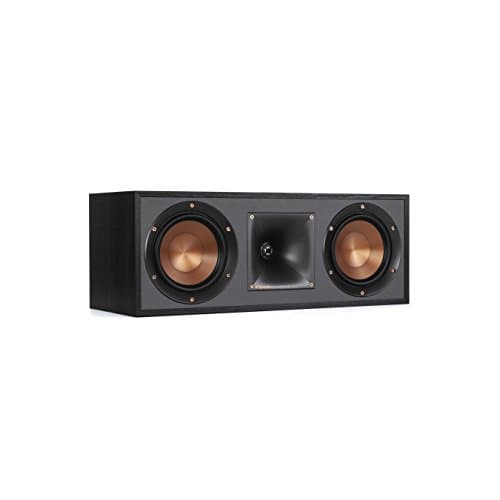 Klipsch R-52C A sealed dual-woofer center with a published 95 dB sensitivity, timbre-matched to the R-41M and R-51M so dialogue does not change character as it pans across the front. | Best center channel | 7.6 | $139.99View on Amazon $149.997% off |
| 2 | 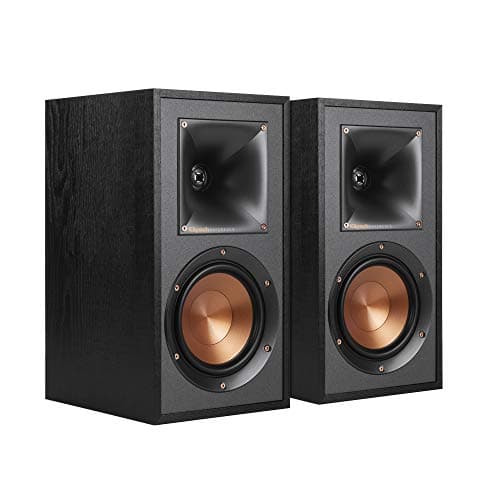 Klipsch R-51M High sensitivity means a modest amplifier drives these to a real volume — the practical answer when the amp is fixed and small. | Best for low-power amplifiers | 8.4 | |
| 3 | 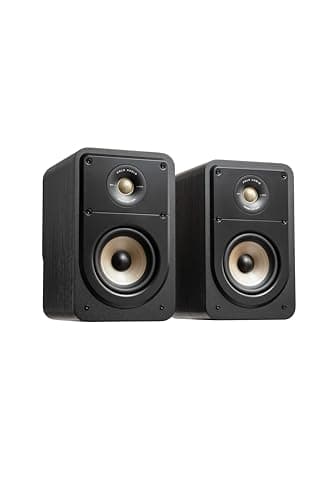 Polk Signature Elite ES15 Voiced and certified to sit in a surround system as easily as a stereo pair, which matters if this room has to do both jobs. | Best for double duty with home theater | 7.0 |
A center channel exists to do one thing: hold dialogue in the middle of the screen for a listener who is not sitting in the middle of the room. Everything else said about center channels follows from that, including the reasons to skip one. This page works through when it earns its place, and then through the two published figures that make a center channel behave differently from every other speaker you own.
What a stereo pair actually does with dialogue
Play the same signal out of two speakers at the same level and a listener exactly between them hears it as coming from a point in the middle. There is no speaker there; the image is constructed from the fact that the sound from both arrives at the same instant at the same level. Move one seat to the left and that stops being true. The left speaker is now nearer, so its sound arrives earlier and louder, and the voice slides left with you. At the end of a three-seat sofa the actor’s voice is coming out of the nearest box rather than out of the screen.
A real center channel removes the construction. The voice comes from a speaker that is physically under the screen, so it stays there no matter where you sit. That is the whole mechanism, and it is why the decision is a furniture question: how many seats, and how far apart.
The test, in one paragraph
Measure the distance between your front speakers, and the width of the seating. If the seats are wider than the speaker spacing — a three-seat sofa between two bookshelf speakers on a 6 ft TV stand, which is most living rooms — then at least one seat is substantially off-axis whenever more than one person is watching, and a center channel is the single most effective speaker you can add. If the seating is one chair, centered, and that is not going to change, the center channel is solving a problem you do not have, and a stereo pair will hold the dialogue perfectly.
There is a second case worth naming: a wide screen with speakers pushed out to the edges of the wall. The further apart the front pair, the wider the hole in the middle and the less stable the phantom center is even for the person sitting in it. Separation beyond about the screen width is where a center starts earning its place regardless of seating.
The finding: the center is the least extended speaker you own
This is the part no one mentions, and it is sitting in plain sight in Klipsch’s own specification sheets. In the R-series family, the bookshelf speakers are ported and the center channel is sealed— Klipsch prints “MDF, SEALED” for the R-52C and bass-reflex for the R-41M and R-51M. A center channel also has to be short and wide to fit under a screen, which caps its cabinet volume. The result is published:
- R-52C center:89 Hz – 21 kHz ± 3 dB
- R-51M bookshelf:62 Hz – 21 kHz ± 3 dB
- R-41M bookshelf:68 Hz – 21 kHz ± 3 dB
The speaker carrying the dialogue reaches 27 Hz less deepthan the small bookshelf speaker beside it and 21 Hz less deep than its own series’ larger one, at the same stated tolerance from the same maker’s lab. Male speech has fundamentals down near 85 Hz. So the one speaker you most need to be intelligible is the one with the least support exactly where a voice sits.
gap = center's published −3 dB point − the crossover you set
Inputs
- Klipsch R-52C (center) frequency response: 89 Hz – 21 kHz ± 3 dB (Klipsch spec sheet (PDF))
- Klipsch R-51M (bookshelf) frequency response: 62 Hz – 21 kHz ± 3 dB (Klipsch spec sheet (PDF))
- Klipsch R-52C enclosure type: MDF, SEALED — where the R-41M and R-51M are both ported (Klipsch spec sheet (PDF))
Result
The other published figure that catches people out
Sensitivity. Klipsch publishes 95 dB (2.83 V / 1 m)for the R-52C — the highest figure of any speaker on this site — against 93 dB for the R-51M and 90 dB for the R-41M. A center channel is usually the most sensitive speaker in its own family, because two woofers on one horn-loaded tweeter is an efficient arrangement. Fed the same voltage as the speakers either side of it, it plays louder, and dialogue that is too prominent is as wrong as dialogue that is buried.
This is exactly what a receiver’s level trim is for, and it is why the microphone calibration is not optional with a mixed set. It is also why mixing brands needs care: Polk publishes 86 dB for the Monitor XT15 and 88 dB for the ES15 with no measurement condition stated at all— no 2.83 V / 1 m, no 1 W / 1 m — so the gap between 95 and 86 is not a measured 9 dB and cannot be used to predict the trim. Set it with the microphone, then check it by ear on dialogue, not on effects.
Timbre matching, stated as a number rather than a vibe
“Timbre matched” usually arrives as marketing. Here is the version you can check. A voice panning from the left speaker to the center crosses from one speaker’s drivers to another’s, so the two should hand over at a similar frequency into a similar tweeter. Published crossover points:
- Klipsch R-52C center: 1,630 Hz, 1 in aluminum tweeter on a 90° × 90° Tractrix horn
- Klipsch R-51M: 1,660 Hz, the same tweeter on the same horn — a 30 Hz difference
- Klipsch R-41M: 1,730 Hz, same tweeter — 100 Hz
- Polk Monitor XT15: 2,200 Hz, 1 in Terylene dome — 570 Hz, and a different tweeter
- Polk Signature Elite ES15: 2.5 kHz, 1 in Terylene dome — 870 Hz
That is the whole argument for buying the center from the same series as the fronts, and it is also the honest size of the compromise if you do not: our under-$1,000 system build mixes a Klipsch center with Polk fronts on purpose, because the budget forces it, and says so.
If you skip it: what the receiver does with “center: none”
It does not discard the dialogue. Set the center to “none” and the receiver folds that channel equally into the left and right speakers, reconstructing the phantom center. Nothing is lost except the anchoring — which is exactly the thing a center channel was for. So skipping it is a legitimate choice with a known consequence, not a mistake, and it is the right choice for a single centered listening position. Put the money into the front pair instead; the ES15’s 20–100 W recommended window is the more forgiving match for a modest receiver, and the R-51M’s 93 dB sensitivity is the easier load for a low-powered one.
What a soundbar does about this
A soundbar has a dedicated center driver in the middle of its enclosure, which is the one thing it genuinely gets right — the dialogue really does come from the middle of the screen, for everyone on the sofa. What it gives up is the distance between the left and right drivers, and the stereo image is a function of that distance. Our soundbar comparison works through that trade in full.
The honest summary
A center channel is not an upgrade; it is a fix for a specific geometry. More than one seat, or seats wider than the front speakers, and it is the most useful speaker in the room. One centered seat, and it is a speaker solving nothing, whose published figures are worse than the pair you already have. Either way, if you buy one: match it to the fronts if you can, set its crossover higher than theirs, and calibrate its level with a microphone rather than by eye.
Every pick in detail
Every specification below links to the manufacturer document we read it from. Where a manufacturer does not publish a figure, we say so rather than estimating it.
Klipsch R-52C
Best center channelA sealed dual-woofer center with a published 95 dB sensitivity, timbre-matched to the R-41M and R-51M so dialogue does not change character as it pans across the front.
- specs
- 7/10
- sensitivity
- 10/10
- published data
- 6/10
- value for money
- 9/10
- bass extension
- 2/10
| Specification | Published value | Source |
|---|---|---|
| Sensitivity | 95 dB (2.83 V / 1 m) — the highest figure of any center channel on this site | Klipsch spec sheet (PDF) |
| Impedance | 8 Ω “compatible” (Klipsch's wording) | Klipsch spec sheet (PDF) |
| Minimum impedance | Not published | — |
| Frequency response | 89 Hz – 21 kHz ± 3 dB | Klipsch spec sheet (PDF) |
| Power handling | 100 W continuous / 400 W peak | Klipsch spec sheet (PDF) |
| Woofers | Dual 5.25 in spun-copper IMG | Klipsch spec sheet (PDF) |
| Tweeter | 1 in aluminum LTS on a 90° × 90° Tractrix horn | Klipsch spec sheet (PDF) |
| Crossover | 1,630 Hz | Klipsch spec sheet (PDF) |
| Enclosure | MDF, SEALED (the R-41M and R-51M are both ported) | Klipsch spec sheet (PDF) |
| Weight | 13.5 lb / 6.12 kg | Klipsch spec sheet (PDF) |
Pros
- 95 dB at 2.83 V/1 m — the highest published sensitivity of any center channel on this site
- Sealed enclosure, unlike the ported R-41M and R-51M, so it can sit inside a cabinet without port chuffing
- Same 1 in LTS tweeter and Tractrix horn as the R-series bookshelves, which is what timbre matching actually means
- 100 W continuous handling gives a receiver plenty of headroom for dialogue peaks
Cons
- 89 Hz low-end limit — a center channel this shallow depends entirely on the receiver's bass management
- 18.75 in wide, which will not fit under every television
- “8 ohms compatible” again, with no minimum impedance published
- Only useful in a multichannel system; it does nothing for a stereo setup
- Previous generation — Klipsch's own page for it now points buyers to the newer Reference R-50C
Skip it if you are building a stereo system. A center channel has no role in two-channel listening and adding one is not an upgrade.
Klipsch R-51M
Best for low-power amplifiersPrice as of October 10, 2026. #ad
High sensitivity means a modest amplifier drives these to a real volume — the practical answer when the amp is fixed and small.
- sensitivity
- 10/10
- bass extension
- 6/10
- amp friendliness
- 10/10
- value for money
- 9/10
- build quality
- 7/10
| Specification | Published value | Source |
|---|---|---|
| Sensitivity | 93 dB (2.83 V / 1 m) | Klipsch spec sheet (PDF) |
| Impedance | 8 Ω “compatible” (Klipsch's wording — not a measured nominal figure) | Klipsch spec sheet (PDF) |
| Minimum impedance | Not published | — |
| Frequency response | 62 Hz – 21 kHz ± 3 dB | Klipsch spec sheet (PDF) |
| Power handling | 85 W continuous / 340 W peak (a handling limit, not a recommended amplifier range) | Klipsch spec sheet (PDF) |
| Woofer | 5.25 in spun-copper IMG | Klipsch spec sheet (PDF) |
| Tweeter | 1 in aluminum LTS on a 90° × 90° Tractrix horn | Klipsch spec sheet (PDF) |
| Crossover | 1,660 Hz | Klipsch spec sheet (PDF) |
| Weight (each) | 11 lb / 5 kg | Klipsch spec sheet (PDF) |
Pros
- High sensitivity — plays loud on very little power
- The right answer for a low-wattage or tube amplifier
- Horn tweeter gives strong dispersion control
Cons
- Horn presentation is divisive and we cannot tell you how it sounds — we have not heard them
- Rear port needs breathing room from the wall
- Less low-end than the ELAC B6.2
- Previous generation — Klipsch's own page for it now points buyers to the newer Reference R-50M
Skip it if your amp already has power to spare — you are paying for sensitivity you do not need.
Polk Signature Elite ES15
Best for double duty with home theaterPrice as of October 10, 2026. #ad
Voiced and certified to sit in a surround system as easily as a stereo pair, which matters if this room has to do both jobs.
- sensitivity
- 7/10
- bass extension
- 7/10
- amp friendliness
- 7/10
- value for money
- 7/10
- build quality
- 7/10
| Specification | Published value | Source |
|---|---|---|
| Sensitivity | 88 dB — Polk publishes NO measurement condition (no 2.83 V/1 m or 1 W/1 m qualifier), so this figure is not directly comparable to the others in this table | Polk info sheet (PDF) |
| Impedance | “Compatible with 4- and 8-ohm outputs” — Polk publishes no nominal impedance value | Polk info sheet (PDF) |
| Minimum impedance | Not published | — |
| Frequency response | 48 Hz – 40 kHz (no tolerance published) | Polk info sheet (PDF) |
| Recommended amplification | 20–100 W per channel | Polk info sheet (PDF) |
| Woofer | 5.25 in mica-fortified polypropylene | Polk info sheet (PDF) |
| Tweeter | 1 in Terylene dome | Polk info sheet (PDF) |
| Crossover | 2.5 kHz | Polk info sheet (PDF) |
| Weight (each) | 13 lb / 5.9 kg | Polk info sheet (PDF) |
Pros
- Designed to integrate with a matching surround range
- Hi-Res certified
- Keyhole mount for wall use
Cons
- Less distinctive than the ELAC or Klipsch at the price
- Rear port
- Not the best pure-stereo value here
Skip it if this is a stereo-only system — the ELAC B6.2 gives more for the money.
Frequently asked questions
Do I need a center channel speaker?
Can I use two bookshelf speakers instead of a center channel?
Does the center channel have to be the same brand as my other speakers?
What crossover should I use for a center channel?
Why is my center channel louder than my other speakers?
Is a soundbar's center channel as good as a separate one?
Have you listened to these speakers?
Read next
The Best Home Theater Speakers
A timbre-matched 5.1 built from published specs — fronts, center, surrounds and a subwoofer that actually connects.
The Best Home Theater System Under $1,000
A four-box build that totals under $1,000 at live prices — and the arithmetic showing why the fifth and sixth speakers are what the ceiling takes away, not the subwoofer.
How to Set Speaker Levels in a Home Theater
The order of operations for channel levels and distances, what the automatic run decides for you, and the three settings to verify afterwards.
Soundbar vs Speakers
What a soundbar can and cannot physically do, and the honest case for each format.
The Best Bookshelf Speakers for a Home Theater
Ranked on AV receiver duty rather than hi-fi criteria: the measurement condition on each sensitivity figure, published minimum impedance, and whether a timbre-matched center channel exists.
Dolby Atmos Speaker Placement
Dolby's published height angles, ceiling versus up-firing, and what each needs from your room.
Sources
Every specification on this page was read from one of these documents. If one of them has changed, or we have made an error, tell us — corrections are logged and dated per our editorial policy.