Klipsch R-51M Review
The cheapest horn-loaded bookshelf speaker Klipsch publishes a full specification for — and the most amplifier-friendly speaker in our registry. This is what its numbers say, and what they do not.
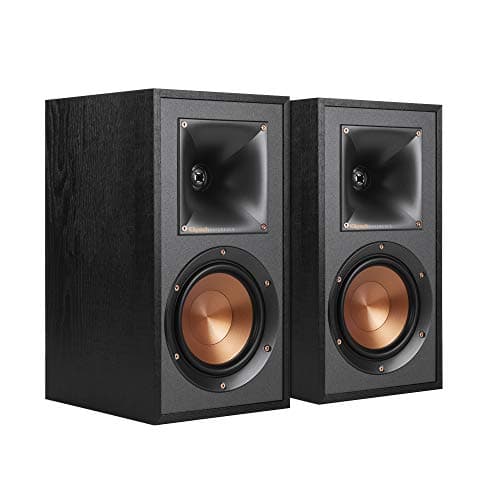
Top pick: Klipsch R-51M
Best for low-power amplifiers. #ad Affiliate link — we earn a commission at no extra cost to you.
The short answer
The Klipsch R-51M is the speaker to buy if your amplifier is small — because its published 93 dB sensitivity at 2.83 V and 1 m is the highest figure of any bookshelf speaker in our registry, and sensitivity is the specification that decides how much amplifier you need. It is the pick for someone pairing a pair of bookshelf speakers with a 20–50 W integrated, a valve amplifier, or a budget AV receiver driving five channels at once. Within the single-pick scope of this review it is also the budget pick, and that is the honest summary of the product: it is the cheapest route to horn-loaded sensitivity that Klipsch publishes real numbers for.
What you give up is bass and precision of disclosure. Its ± 3 dB low corner is 62 Hz, which is the shallowest of the Klipsch bookshelf models we rank, and Klipsch describes its impedance as “8 Ω compatible” rather than publishing a nominal or minimum figure. If you need the bass, the bracket above has cabinets that go lower; if you need a measured impedance curve, nobody at this price publishes one.
Disclosure: we earn a commission if you buy through the links on this page, at no extra cost to you. It does not influence what we pick — our criteria are published and reproducible, so you can check our work. How we pick · Full disclosure
These picks are spec-and-price analyses, not listening tests. We have not heard this gear and we do not pretend to have: every figure below is sourced to the manufacturer and linked, and every price is live or not shown at all. Here are the rules we followed.
Quick picks
Ranked on the published criteria in How We Pick. Prices are live as of November 12, 2026. Tap any row for the full write-up.
- 8.4
| # | Product | Best for | Score | Price |
|---|---|---|---|---|
| 1 | Klipsch R-51M High sensitivity means a modest amplifier drives these to a real volume — the practical answer when the amp is fixed and small. | Best for low-power amplifiers | 8.4 |
The R-51M is a two-way bookshelf speaker with a 5.25 in spun-copper IMG woofer and a 1 in aluminium LTS tweeter on a 90° × 90° Tractrix horn, crossed at 1,660 Hz. Klipsch publishes 93 dB sensitivity at 2.83 V and 1 m, a frequency response of 62 Hz–21 kHz ± 3 dB, power handling of 85 W continuous and 340 W peak, and a weight of 11 lb each.
This review exists because the R-51M is the number-one pick on two of our roundups — under $300 and high-sensitivity bookshelf — and the site had nowhere to send someone searching for the model by name. It adds no new measurements: these are spec-and-price analyses, not listening tests, and every figure below is Klipsch’s own and linked.
Every figure quoted below also appears, with its source link, in the full specification table in the “Every pick in detail” section at the foot of this page.
93 dB is the whole argument, and here is what it buys
Sensitivity is how loud a speaker plays for a given input. Klipsch publishes 93 dB at 2.83 V and 1 m, and 2.83 V into a nominal 8 Ω is 1 W, so this is as close to a true watt-referenced figure as the convention gets. For comparison, the Polk Monitor XT15 publishes 86 dB with no measurement condition at all, and the Micca RB42 publishes 83 dB explicitly at 1 W / 1 m.
power ratio = 10^(ΔdB ÷ 10)
Inputs
- Klipsch R-51M sensitivity: 93 dB (2.83 V / 1 m) (Klipsch spec sheet (PDF))
- Micca RB42 sensitivity: 83 dB (1 W / 1 m) (Micca spec page)
Result
The practical consequence is the reason this speaker keeps winning our roundups. A 20 W amplifier — a small valve integrated, a Class D box, a receiver driving five channels — reaches 93 + 10 × log10(20) = about 106 dB at 1 m into these. The same amplifier into an 83 dB speaker reaches about 96 dB. Our amplifier roundup for Klipsch speakers is built around exactly this, and the general bookshelf amplifier roundup covers the case where the speaker is less forgiving.
The 1,660 Hz crossover is low, and that is deliberate
Klipsch publishes a 1,660 Hz crossover. Most two-way bookshelf speakers in our registry cross between 2.0 and 2.5 kHz — the KEF Q3 Meta at 2.0 kHz, the Q Acoustics 5020 at 2.5 kHz, the Polk Monitor XT15 at 2,200 Hz — and the Dynaudio Emit 20 goes the other way at 3,800 Hz.
A low crossover hands more of the vocal range to the tweeter and less to the woofer. That is a reasonable thing to do when the tweeter is horn-loaded, because a horn raises the tweeter’s efficiency and lets it work lower without strain; it is also how the speaker gets to 93 dB. The cost is that a 1 in dome is doing work from 1.66 kHz upward, and Klipsch publishes no distortion figure at any frequency, so there is no number to check that against. Nobody at this price publishes one — KEF is the only maker in our registry that publishes harmonic distortion with a measurement condition at all, and its cheapest speaker that does is several times this one.
The bass corner, stated plainly
62 Hz–21 kHz ± 3 dB is a real tolerance-qualified figure and it is the number to judge this speaker’s bass by. It is shallower than the Polk Monitor XT15’s published 48 Hz–40 kHz — except that Polk publishes no tolerance at all for that range, so the two are not comparable, which is the central finding of our R-51M versus Monitor XT15 comparison.
What 62 Hz means in practice: the bottom octave of a kick drum and the low notes of a bass guitar are below it. In a small room, boundary gain will put some of that back. In a larger one it will not, and the right fix is a subwoofer crossed at 80 Hz rather than a bigger pair of bookshelf speakers — we work through when that is true and when it is not.
The one figure Klipsch declines to publish properly
Impedance. Klipsch’s own wording is “8 Ω compatible”, which is not a nominal impedance and is certainly not a minimum. That matters for two reasons. It makes the 2.83 V sensitivity reference approximate rather than exact, as noted above. And it leaves an amplifier owner without the one number that predicts trouble: a speaker that dips to 3 Ω somewhere in the bass is a different load from one that holds 8 Ω, and no amount of “compatible” tells you which this is.
In fairness, almost nobody in this price class publishes a minimum impedance either. Polk writes “compatible with 4- and 8-ohm outputs” and no nominal value; Micca publishes a 4–8 Ω range rather than a value. The makers that do publish a minimum — KEF at 3.2–3.5 Ω, Q Acoustics at 3.3 Ω — are all several times the price of this one. That is a disclosure pattern rather than a quality pattern, and it is worth knowing which one you are reading.
Power handling is not an amplifier recommendation
Klipsch publishes 85 W continuous and 340 W peak. Both are handling limits: they describe what the speaker survives, not what it wants. Klipsch publishes no recommended amplifier range for the R-51M, which is a shame, because on a 93 dB speaker the recommendation would be unusually low and that is the selling point.
Read against the sensitivity figure, 85 W continuous into 93 dB is about 112 dB at 1 m, which is louder than anyone sensibly listens in a domestic room. So the practical ceiling here is not the speaker’s power handling. It is the horn’s directivity — 90° × 90°, which Klipsch publishes — and the 62 Hz corner.
Klipsch now points buyers at the R-50M
Read before the verdict below, because it is Klipsch’s own wording and it is on the R-51M’s own product page: “Want the latest? Shop the New Reference R-50M Bookshelf Speakers Now.” The R-51M is the previous Reference generation.
It is still sold and still carries a live listing, so this is a which-generation decision rather than a dead-product one, and the previous generation is usually where the discount sits. Two things it does not change. Every figure on this page is read from Klipsch’s own R-51M spec sheet and is the R-51M’s own number, so nothing here has gone stale. And the 93 dB sensitivity and 1,660 Hz crossover that put this speaker on two of our roundups are still what Klipsch publishes for it.
What we cannot yet tell you is how the R-50M compares, because we have not put it through our own sourcing process — no Klipsch figure for it appears anywhere on this site. If the newer model is what you want, read Klipsch’s sheet for it rather than this page. Our Klipsch range roundup lists all five models in our registry that Klipsch has superseded, with the replacement it names for each.
Where it sits, and who should skip it
The R-51M is ranked first on our under-$300 bracket and on high-sensitivity bookshelf, and it is one of six picks on our home theater speaker page, where its sensitivity matters for a different reason: an AV receiver’s published power is rated with two channels driven, and a seven-channel scene drives seven. It is also third of nine on our Klipsch range roundup, which compares it with the rest of the brand on Klipsch’s own sheets — including the half-space footnote that the Reference Premiere models carry and this one does not.
Skip it if your amplifier is already generous and you would rather have the bass — at 40–100 W a cabinet with a deeper published corner is the better buy. Skip it if you sit well off-axis, because a 90° × 90° horn is a deliberate directivity choice and it is narrower than a dome on a flat baffle. And skip it if you want a published distortion figure, because at this price no such figure exists from anyone.
Every pick in detail
Every specification below links to the manufacturer document we read it from. Where a manufacturer does not publish a figure, we say so rather than estimating it.
Klipsch R-51M
Best for low-power amplifiersPrice as of November 12, 2026. #ad
High sensitivity means a modest amplifier drives these to a real volume — the practical answer when the amp is fixed and small.
- sensitivity
- 10/10
- bass extension
- 6/10
- amp friendliness
- 10/10
- value for money
- 9/10
- build quality
- 7/10
| Specification | Published value | Source |
|---|---|---|
| Sensitivity | 93 dB (2.83 V / 1 m) | Klipsch spec sheet (PDF) |
| Impedance | 8 Ω “compatible” (Klipsch's wording — not a measured nominal figure) | Klipsch spec sheet (PDF) |
| Minimum impedance | Not published | — |
| Frequency response | 62 Hz – 21 kHz ± 3 dB | Klipsch spec sheet (PDF) |
| Power handling | 85 W continuous / 340 W peak (a handling limit, not a recommended amplifier range) | Klipsch spec sheet (PDF) |
| Woofer | 5.25 in spun-copper IMG | Klipsch spec sheet (PDF) |
| Tweeter | 1 in aluminum LTS on a 90° × 90° Tractrix horn | Klipsch spec sheet (PDF) |
| Crossover | 1,660 Hz | Klipsch spec sheet (PDF) |
| Weight (each) | 11 lb / 5 kg | Klipsch spec sheet (PDF) |
Pros
- High sensitivity — plays loud on very little power
- The right answer for a low-wattage or tube amplifier
- Horn tweeter gives strong dispersion control
Cons
- Horn presentation is divisive and we cannot tell you how it sounds — we have not heard them
- Rear port needs breathing room from the wall
- Less low-end than the ELAC B6.2
- Previous generation — Klipsch's own page for it now points buyers to the newer Reference R-50M
Skip it if your amp already has power to spare — you are paying for sensitivity you do not need.
Frequently asked questions
What amplifier does the Klipsch R-51M need?
How deep does the R-51M go?
Is the R-51M 8 ohms?
R-51M or Polk Monitor XT15?
Read next
The Best Klipsch Speakers
Nine Klipsch speakers across five categories, ranked on Klipsch's own spec sheets — including the sensitivity footnote that only some of those sheets carry.
The Best Bookshelf Speakers Under $300
Five passive pairs at the $300 mark, and a ten-decibel sensitivity spread that decides which amplifier each one needs.
The Best High-Sensitivity Bookshelf Speakers
The speakers that make a small amplifier sound big, ranked on published sensitivity and the condition each figure was measured under.
Klipsch R-51M vs Polk Monitor XT15
Klipsch for a low-powered amplifier or a 5.1 system; Polk if the budget is the constraint. The tie-breaker is which specification each maker chose to publish.
The Best Amplifiers for Klipsch Speakers
Klipsch's 90-96 dB sensitivity settles the watts question at about 35 W, so this ranks on published signal-to-noise and damping factor instead. The Onkyo TX-8470's 106 dB is the highest on the site.
Speaker Sensitivity Explained
2.83 V/1 m versus 1 W/1 m, what the conversion is worth in decibels, and the twelve-decibel spread that means sixteen times the power.
The Best Amplifiers for Bookshelf Speakers
Six amplifiers for bookshelf speakers, ranked on published 4-ohm power, subwoofer outputs and phono inputs rather than on headline wattage.
The Best Home Theater Speakers
A timbre-matched 5.1 built from published specs — fronts, center, surrounds and a subwoofer that actually connects.
Sources
Every specification on this page was read from one of these documents. If one of them has changed, or we have made an error, tell us — corrections are logged and dated per our editorial policy.