The Best Powered Speakers for a TV
The specification that decides this category is not wattage. It is which socket is on the back, because that decides whether your TV remote controls the volume and whether the speakers can hear the TV at all.
Disclosure: we earn a commission if you buy through the links on this page, at no extra cost to you. It does not influence what we pick — our criteria are published and reproducible, so you can check our work. How we pick · Full disclosure
These picks are spec-and-price analyses, not listening tests. We have not heard this gear and we do not pretend to have: every figure below is sourced to the manufacturer and linked, and every price is live or not shown at all. Here are the rules we followed.
Quick picks
Ranked on the published criteria in How We Pick. Prices are live as of September 17, 2026. Tap any row for the full write-up.
- 7.8
- 7.6
- 8.2
- 7.2
| # | Product | Best for | Score | Price |
|---|---|---|---|---|
| 1 | 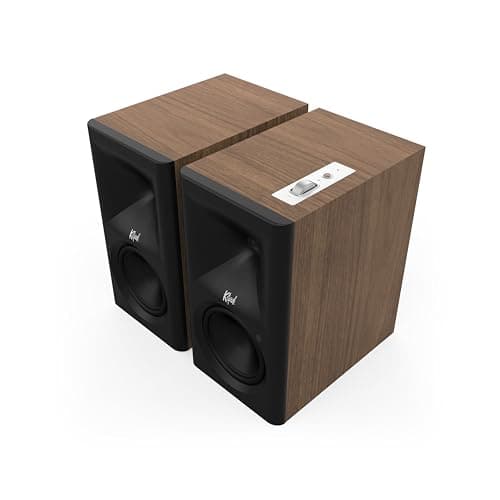 Klipsch The Fives II Powered speakers with HDMI-ARC and a phono input, built to replace both a soundbar and a stereo system in one box pair. | Most connected powered pair | 7.8 | |
| 2 | 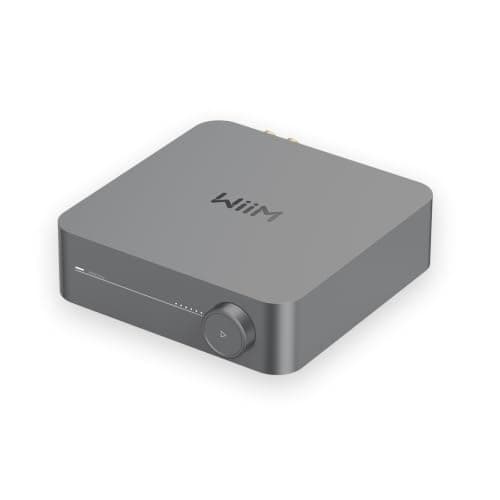 WiiM Amp A streamer with a power amplifier bolted on, which replaces two boxes — and gives up an order of magnitude of measured noise performance to do it. | Best one-box system for passive speakers | 7.6 | |
| 3 | 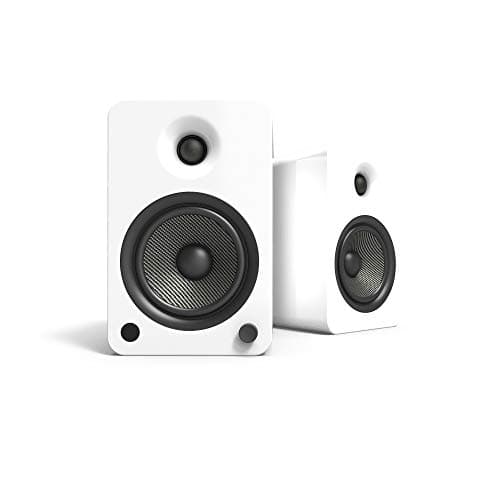 Kanto YU6 Powered speakers with a phono stage already inside, which collapses amp, phono stage and speakers into one purchase and one power cable. | Best all-in-one for a turntable | 8.2 | |
| 4 | 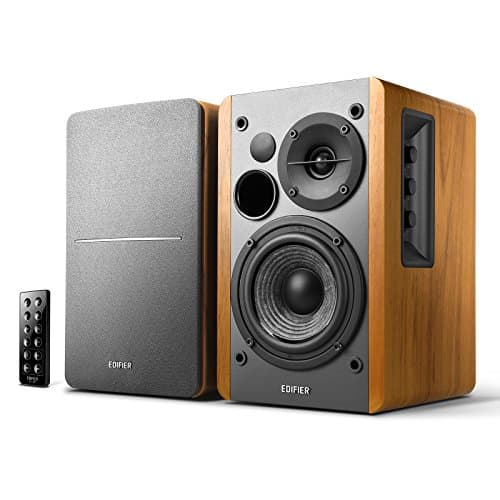 Edifier R1280DB The R1280T plus Bluetooth and optical/coaxial inputs — still no phono stage, but a far more useful set of sockets. | Best budget powered pair with digital inputs | 7.2 |
A powered speaker pair is the stereo alternative to a soundbar, and the only spec that decides between candidates is the connection. A television has, in practice, two audio outputs: HDMI ARC or eARC, and optical. A speaker with the first can be controlled by the TV remote through CEC. A speaker with only the second cannot, and you will live with two remotes. A speaker with neither needs a headphone-jack cable and a television that still has one.
The three connections, and what each one gives up
HDMI ARC / eARC.One cable, and the television’s remote controls the speaker volume over CEC. eARC carries more bandwidth than ARC. It is the connection a soundbar uses, and it is the reason a soundbar is easy to live with. Our eARC guide explains the difference between the two.
Optical (TOSLINK).Nearly every television still has one. It carries stereo PCM and compressed surround formats but not the lossless ones, and it carries no control signal, so the TV remote does nothing. Some sets can be told to output PCM over optical, which every speaker here can decode; left on “auto” or “bitstream”, a set may send Dolby Digital, which a two-channel speaker may not decode.
Analog.A 3.5 mm or RCA line input, fed from a television headphone jack if it has one. It works, and it is the connection every cheap powered pair has, but televisions are dropping the jack, and the level is set by the TV’s own headphone circuit.
How we ranked this
On connection first: eARC with CEC beats ARC, ARC beats two optical inputs, two optical inputs beat one. Then on whether a subwoofer output is published, because a 4 or 5 in woofer is doing the work a television’s film soundtrack was mixed for a larger driver to do. Then on whether a turntable can also plug in, because “speakers for a turntable and TV” is the question a lot of people are really asking. Wattage is not a ranking criterion: Klipsch does not publish one for its top pick at all, and the figures the others publish are not measured the same way.
One entry is not a powered speaker. The WiiM Amp is a streaming amplifier with an HDMI ARC input and speaker terminals, and it ranks second because for anyone who already owns a passive pair it is the cheapest route to a TV-remote-controlled stereo system in the registry. We have included it because leaving it out would hide the better answer for that reader.
The pair with HDMI eARC and CEC
Klipsch’s spec sheet for The Fives II lists “HDMI-ARC/eARC with CEC” first among its inputs, followed by Bluetooth 5.4, an RCA phono input, an RCA line input, USB-C audio, USB-A and optical. The outputs are a single RCA subwoofer output and an HDMI output that passes 8K video through. It publishes a 50 Hz to 25 kHz ± 3 dB response and, instead of a wattage, a maximum output of 103 dB at one meter for the pair. The product page states plainly that the HDMI connection lets the TV remote control volume.
That list is the reason it ranks first by a distance. It is the only powered speaker in our registry with HDMI, the only one with eARC, the only one where the TV remote controls the volume, and it also has the phono stage that makes it the turntable-and-TV answer. Its cons are the price, which is several times the next pick, and that its Atmos support is virtual height from two cabinets rather than discrete channels.
HDMI ARC for passive speakers you already own
The WiiM Amp publishes an HDMI ARC input, an optical input, an RCA line input, a subwoofer output with a user-adjustable 30 to 250 Hz crossover, and 60 W per channel into 8 ohms (120 W into 4 ohms, with no measurement condition attached). Its spec page states that home theater formats are stereo PCM only — Dolby Digital and DTS are not supported — so the television must be set to output PCM over ARC. It has no phono input.
Add the ELAC Debut 2.0 B6.2 pair from our under-$500 roundup and the total is a stereo TV system with ARC volume control, a subwoofer output and a room-EQ app, for less than the Klipsch pair. That is why it ranks above the Kanto and the Edifier despite not being a speaker: for a reader who owns or wants passive speakers, it is the right answer, and our passive-versus-powered comparison covers the trade.
Two optical inputs and a phono stage
The Kanto YU6 publishes two optical inputs, an RCA input with a phono switch, a 3.5 mm aux input, Bluetooth 4.0 with aptX, a subwoofer output and 100 W total RMS. Kanto’s own product page describes connecting it to a television via one of the two optical inputs. There is no HDMI, so the TV remote cannot control it; the Kanto remote does that, and switches sources.
It ranks third because two optical inputs is genuinely useful — a television and a games console or disc player can both be connected digitally — and because the phono switch means it is the other turntable-and-TV answer, the one our turntable-speaker roundupranks first. Its live price is not always available from the price layer; when the tile says “check price”, that is why.
One optical input, for the least money
The Edifier R1280DB publishes optical, coaxial, Bluetooth and two RCA inputs, 21 W + 21 W RMS, and a 4 in woofer with a 55 Hz lower limit on the US spec table. It is the cheapest way in the registry to connect a television digitally to a stereo pair. It has no subwoofer output, no HDMI, and Edifier does not state either way whether there is a phono stage, so assume not. For a bedroom or kitchen television, that is a complete answer; for the main room, the missing subwoofer output is the limit.
What we would not buy for a television
The Audioengine A5+ and A2+, the Kanto ORA and the Edifier R1280T are all in our registry and none is here, for the same reason: no optical and no HDMI. The A2+ and ORA have USB inputs, which are for a computer, not a television. Each is a good desktop or turntable speaker — the ORA leads our desk-listener guide— and each would connect to a television only by a headphone jack that your next television may not have.
Speakers or a soundbar?
A soundbar decodes surround formats and, on the better ones, places sound with more drivers than two. A stereo pair separates left from right by the width of the television rather than the width of a bar, and it plays music as a stereo system should. Neither is a five-speaker system, and our soundbar comparison is honest about which rooms want which. If you are choosing between two of these and a receiver-based system, that pagelays out what the receiver’s extra money buys.
Every pick in detail
Every specification below links to the manufacturer document we read it from. Where a manufacturer does not publish a figure, we say so rather than estimating it.
Klipsch The Fives II
Most connected powered pairPrice as of September 17, 2026. #ad
Powered speakers with HDMI-ARC and a phono input, built to replace both a soundbar and a stereo system in one box pair.
- integration
- 10/10
- upgrade path
- 4/10
- value for money
- 6/10
- ease of setup
- 9/10
- connectivity
- 10/10
| Specification | Published value | Source |
|---|---|---|
| Type | Powered monitor (pair) | Klipsch spec sheet (PDF) |
| Amplifier output | Not published — Klipsch publishes “Max Output: 103 dB (1 m, stereo pair)” instead of any wattage figure | Klipsch spec sheet (PDF) |
| Built-in phono stage | Yes — a dedicated analog input with a built-in phono stage | Klipsch product page |
| Frequency response | 50 Hz – 25 kHz ± 3 dB | Klipsch spec sheet (PDF) |
| Woofer | 5.25 in Jet Cerametallic | Klipsch spec sheet (PDF) |
| Inputs | HDMI-ARC/eARC with CEC, Bluetooth, RCA phono, RCA analog, USB-C audio, USB-A, optical digital | Klipsch spec sheet (PDF) |
| Outputs | Single RCA line-level output for a subwoofer; HDMI output (HDMI 2.1 pass-through, eARC) | Klipsch spec sheet (PDF) |
| Bluetooth | 5.4 — A2DP, SBC and AAC codecs | Klipsch spec sheet (PDF) |
| Dimensions / weight | 12.9 × 7.2 × 10.7 in (327 × 181 × 273 mm) each; primary 18.2 lb, secondary 15.5 lb | Klipsch spec sheet (PDF) |
Pros
- HDMI-ARC — works as a TV system as well as a stereo
- Built-in phono stage, so a turntable plugs straight in
- Genuinely large drivers for a powered pair
Cons
- By far the most expensive option here
- Klipsch publishes NO amplifier wattage for these — only a “max output 103 dB” figure. You cannot compare their power to anything else here, because there is no number to compare.
- Fixed amplification, so the electronics are the ceiling
Skip it if the TV is not part of this system — most of what you are paying for is the HDMI board.
WiiM Amp
Best one-box system for passive speakersPrice as of September 17, 2026. #ad
A streamer with a power amplifier bolted on, which replaces two boxes — and gives up an order of magnitude of measured noise performance to do it.
- measured performance
- 6/10
- connectivity
- 8/10
- features
- 9/10
- value for money
- 9/10
- published data
- 5/10
| Specification | Published value | Source |
|---|---|---|
| Power output | 60 W per channel into 8 Ω · 120 W per channel into 4 Ω | WiiM spec page |
| Rated-power measurement condition (THD figure, both channels driven) | Not published | — |
| Audio output quality | SNR 98 dB · THD+N 0.0025% (−92 dB) — an order of magnitude worse than the Pro Plus's line-out, which is what a Class-D power stage costs you | WiiM spec page |
| Inputs | HDMI ARC · optical · RCA line-in | WiiM spec page |
| Outputs | Passive speaker terminals · subwoofer out with auto cable detection and a user-adjustable 30–250 Hz crossover | WiiM spec page |
| Network | Wi-Fi 802.11 b/g/n/ac dual band · 10/100 Mbps LAN · Bluetooth 5.1 | WiiM spec page |
| Protocols | AirPlay 2, Chromecast, Spotify Connect, TIDAL Connect, Alexa Cast, DLNA, Roon Ready | WiiM spec page |
| EQ | 10-band graphic EQ, 10-band parametric EQ, 26 presets | WiiM spec page |
| Home theater formats | Stereo PCM only — Dolby Digital and DTS are NOT supported | WiiM spec page |
| Dimensions / weight | 190 × 190 × 63 mm; 1.84 kg (4.1 lb) | WiiM spec page |
| Phono input | No | WiiM spec page |
Pros
- 60 W into 8 Ω and 120 W into 4 Ω published, which drives every passive speaker we recommend
- Subwoofer output with a user-adjustable 30–250 Hz crossover, so a 2.1 system needs nothing else
- HDMI ARC in, so a television can feed it directly
- Same app, same EQ, same Roon Ready and AirPlay 2 support as the standalone streamers
Cons
- WiiM publishes the wattage with no THD figure and no “both channels driven” condition, so the rating cannot be compared to a Yamaha or Marantz spec
- 98 dB SNR and 0.0025% THD+N — roughly twenty decibels noisier than the Pro Plus's line-out
- Stereo PCM only over HDMI ARC: no Dolby Digital, no DTS
- No phono input, and no analog preamp output to escape the internal amplifier
Skip it if you already own an amplifier you like. This is a worse DAC than the Pro Plus attached to an amplifier you did not need.
Kanto YU6
Best all-in-one for a turntableNo live price right now. #ad
Powered speakers with a phono stage already inside, which collapses amp, phono stage and speakers into one purchase and one power cable.
- integration
- 10/10
- upgrade path
- 4/10
- value for money
- 8/10
- ease of setup
- 10/10
- connectivity
- 9/10
| Specification | Published value | Source |
|---|---|---|
| Type | Powered (amplifier built in) | Kanto spec page |
| Amplifier output | 100 W total RMS (200 W peak) | Kanto spec page |
| Built-in phono stage | Yes — RCA input with a phono switch; a turntable connects directly | Kanto spec page |
| Frequency response | 50 Hz – 20 kHz (no tolerance published) | Kanto spec page |
| Woofer | 5.25 in Kevlar | Kanto spec page |
| Tweeter | 1 in silk dome | Kanto spec page |
| Weight | Active 11.4 lb / 5.2 kg; passive 8.7 lb / 4.0 kg | Kanto spec page |
| Inputs | 2 × optical (TOSLINK), RCA with phono switch, 3.5 mm aux, Bluetooth 4.0 with Qualcomm aptX. No HDMI | Kanto product page |
| Outputs | Subwoofer out; USB charge port (5 V / 1 A) | Kanto product page |
Pros
- Built-in phono preamp — a turntable plugs straight in with nothing between
- No separate amplifier or phono box to buy, match or house
- Bluetooth and a subwoofer output as well
Cons
- The amplifier is fixed — you cannot upgrade it without replacing the speakers
- One speaker needs mains power and a cable to the other
- No live price at the moment, so check before you commit
Skip it if you already own an amplifier. You would be paying for a second one and leaving the first switched off.
Edifier R1280DB
Best budget powered pair with digital inputsPrice as of September 17, 2026. #ad
The R1280T plus Bluetooth and optical/coaxial inputs — still no phono stage, but a far more useful set of sockets.
- integration
- 7/10
- upgrade path
- 3/10
- value for money
- 9/10
- ease of setup
- 9/10
- connectivity
- 8/10
| Specification | Published value | Source |
|---|---|---|
| Type | Powered (amplifier built in) | Edifier spec page |
| Amplifier output | 21 W + 21 W RMS | Edifier spec page |
| Frequency response | 55 Hz – 20 kHz per the US spec table (Edifier's global site markets 51 Hz in body copy — the two disagree) | Edifier US spec page |
| Inputs | Optical, coaxial, Bluetooth, dual RCA | Edifier spec page |
| Built-in phono stage | Not stated either way by Edifier — assume none | Edifier spec page |
| Woofer | 4 in | Edifier spec page |
Pros
- Optical and coaxial digital inputs as well as analog
- Bluetooth
- Still inexpensive
Cons
- NO built-in phono stage
- Same modest drivers as the R1280T
- Bluetooth codec support is basic
Skip it if your turntable has no phono stage of its own.
Frequently asked questions
Can my TV remote control powered speakers?
Should I connect powered speakers by optical or HDMI?
Do I need a subwoofer with powered speakers for a TV?
Which of these also works with a turntable?
Why is the WiiM Amp on a powered-speaker page?
Have you listened to these speakers on a TV?
Read next

Soundbar vs Speakers
What a soundbar can and cannot physically do, and the honest case for each format.
HDMI eARC and HDMI 2.1, Explained
What eARC carries that optical cannot, and the published per-input tables showing that an 8K receiver is 8K on three ports out of six or seven.
The Best Speakers for a Turntable
Which speakers need an amplifier, which need a phono stage, and the one that needs neither.
Passive vs Powered Speakers
Total cost, upgrade path, and why powered speakers correctly refuse to publish a sensitivity figure.
Are AV Receivers Worth It?
Four products in one chassis, priced as one. Which of the four you actually need decides whether a receiver is the right purchase at all.
Optical vs Coaxial vs USB
Per-input sample rate limits for every DAC we cover, the ground-loop problem only optical solves, and the surround-format trap on TV optical outputs.
Sources
Every specification on this page was read from one of these documents. If one of them has changed, or we have made an error, tell us — corrections are logged and dated per our editorial policy.