The Best Denon Receiver
Denon rates every receiver here across the full audio band at the same distortion limit, so the ladder is directly comparable. The surprise is how short it is — the whole range spans about half a decibel.

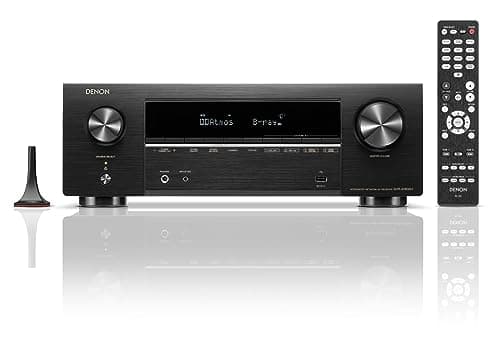
Top pick: Denon AVR-X1800H
Best overall under $1,000. #ad Affiliate link — we earn a commission at no extra cost to you.
The short answer
The best Denon receiver is the AVR-X1800H — because it is the only model in Denon’s sub-$1,000 range that combines seven power amplifiers with Audyssey MultEQ XT, and the room correction is the feature that changes what you actually hear. Seven channels mean a 5.2.2 Atmos layout is possible rather than theoretical, and the phono input is specified to a standard nothing else in the range matches. The real ceiling is one line in Denon’s info sheet: 2.2 pre-outs, front left and right plus subwoofers, so the surround channels can never be handed to an outboard amplifier. The budget pick is the AVR-S570BT — genuinely the cheapest Denon here, with 70 W a channel measured on the same basis as its dearer siblings, 8K and 4K/120 passthrough, and eARC. What it gives up is stated plainly below: no room correction of any kind, no phono input, no network streaming, and no Atmos named anywhere on Denon’s page for it.
If the receiver is mostly going to play records and CDs, the honest answer in this range is not an AV receiver at all. The PMA-600NE is a two-channel integrated amplifier — no HDMI, no tuner, no surround decoding — and it is the only Denon here that publishes a 4 Ω power figure and a phono signal-to-noise ratio. It is third on this page for that reason, and it would be first on a page about music.
Disclosure: we earn a commission if you buy through the links on this page, at no extra cost to you. It does not influence what we pick — our criteria are published and reproducible, so you can check our work. How we pick · Full disclosure
These picks are spec-and-price analyses, not listening tests. We have not heard this gear and we do not pretend to have: every figure below is sourced to the manufacturer and linked, and every price is live or not shown at all. Here are the rules we followed.
Quick picks
Ranked on the published criteria in How We Pick. Prices are live as of November 12, 2026. Tap any row for the full write-up.
- 9.0
- 7.4
- 7.8
- 7.6
| # | Product | Best for | Score | Price |
|---|---|---|---|---|
| 1 | Denon AVR-X1800H Seven channels, 8K passthrough and Audyssey MultEQ XT — the room correction being the feature that actually changes what you hear in a real room. | Best overall under $1,000 | 9.0 | |
| 2 | 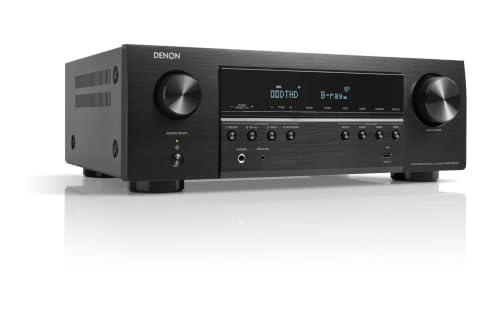 Denon AVR-S670H The X1800H's five-channel sibling: the same 8K plumbing and Audyssey correction, minus the two channels an Atmos height pair would need. | Best 5.2 option | 7.4 | |
| 3 | 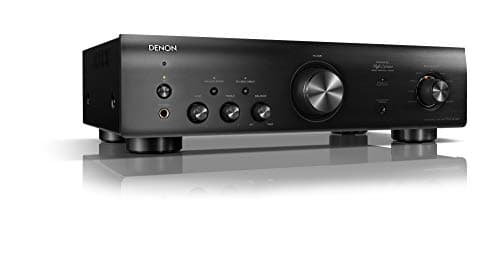 Denon PMA-600NE An integrated with a phono stage, a DAC and Bluetooth in one chassis — the fewest boxes for a mixed vinyl-and-streaming system. | Best with Bluetooth | 7.8 | |
| 4 | 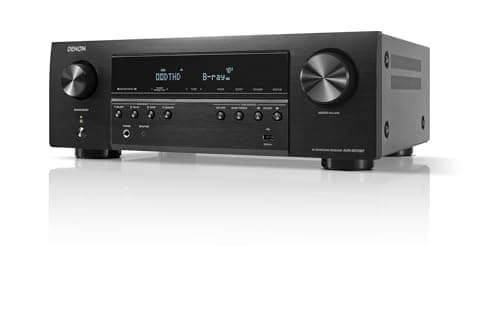 Denon AVR-S570BT The one receiver in this bracket that publishes a single power rating and no flattering second one — and it pays for that restraint by giving up Atmos, room correction and a phono input. | Cleanest single power rating under $500 | 7.6 |
Comparing receivers across brands is mostly an exercise in comparing measurement conditions. Comparing Denon to Denon is not. Every AV receiver on this page carries the same power specification format in Denon’s own documents — watts into 8 Ω, from 20 Hz to 20 kHz, at 0.08% THD, with two channels driven. Same load, same bandwidth, same distortion limit, same number of channels working. That makes the ladder real, and it makes what the ladder shows worth knowing.
It shows that power is not the reason to spend more on a Denon. Three other things are: how many channels the box has, how good the room correction is, and whether there is a phono input. This page ranks on those, in that order, and states the gap that each model leaves behind.
The picks compared, spec by spec
Four columns, and the first one is deliberately first so you can see how little it decides. The PMA-600NE row is the odd one out in every column because it is a different kind of product — a stereo integrated amplifier — and it earns its place on a Denon page rather than on an AV page. Every row carries its own live price and buy link.
Every figure below is the manufacturer’s own published value and links to the document we read it from. “Not published” means the manufacturer does not publish that figure; an em dash means we have no published figure for that model. Prices are live as of November 12, 2026.
Best overall under $1,000
- Power (8 Ω, full band)
- 80 W + 80 W, 0.08% THD
- Room correction
- Audyssey MultEQ XT
- Phono input
- MM 2.5 mV · RIAA ±1 dB · S/N 74 dB
- Pre-outs
- 2.2 only — front L/R + 2 subs
Best 5.2 option
- Power (8 Ω, full band)
- 75 W + 75 W, 0.08% THD
- Room correction
- Audyssey MultEQ
- Phono input
- MM, 2.5 mV sensitivity
- Pre-outs
- Subwoofer only (0.2)
Best with Bluetooth
- Power (8 Ω, full band)
- 45 W + 45 W, 0.07% THD
- Room correction
- —
- Phono input
- MM 2.5 mV / 47 kΩ · S/N 84 dB
- Pre-outs
- Subwoofer pre-out, 1 V / 100 Hz
Cleanest single power rating under $500
- Power (8 Ω, full band)
- 70 W per channel, 0.08% THD
- Room correction
- None published
- Phono input
- None in Denon's spec table
| Pick | Power (8 Ω, full band) | Room correction | Phono input | Pre-outs | Price |
|---|---|---|---|---|---|
| 1.Denon AVR-X1800HBest overall under $1,000 | 80 W + 80 W, 0.08% THD | Audyssey MultEQ XT | MM 2.5 mV · RIAA ±1 dB · S/N 74 dB | 2.2 only — front L/R + 2 subs | |
| 2.Denon AVR-S670HBest 5.2 option | 75 W + 75 W, 0.08% THD | Audyssey MultEQ | MM, 2.5 mV sensitivity | Subwoofer only (0.2) | |
| 3.Denon PMA-600NEBest with Bluetooth | 45 W + 45 W, 0.07% THD | — | MM 2.5 mV / 47 kΩ · S/N 84 dB | Subwoofer pre-out, 1 V / 100 Hz | |
| 4.Denon AVR-S570BTCleanest single power rating under $500 | 70 W per channel, 0.08% THD | None published | None in Denon's spec table | 0.2 — two sub outputs, nothing else |
Prices as of November 12, 2026; every “Check Price” link goes to Amazon and earns us a commission at no extra cost to you. #ad
The power ladder is worth about half a decibel
Denon publishes 70 W per channel for the AVR-S570BT, 75 W + 75 W for the AVR-S670H and 80 W + 80 W for the AVR-X1800H, all into 8 Ω from 20 Hz to 20 kHz at 0.08% THD with two channels driven. Those are three honest, directly comparable numbers, which is exactly why it is worth doing the arithmetic on them.
dB = 10 × log10(P1 ÷ P2)
Inputs
- Denon AVR-X1800H: 80 W + 80 W (8 Ω, 20 Hz – 20 kHz, 0.08% THD, 2 ch driven) (Denon info sheet (PDF))
- Denon AVR-S570BT: 70 W per channel (8 Ω, 20 Hz – 20 kHz, 0.08% THD) (Denon specifications (owner's manual))
Result
The PMA-600NE sits lower still at 45 W + 45 W, and lower on a slightly harder test — 0.07% THD rather than 0.08%. It is also the only Denon in our registry that publishes a 4 Ω figure at all: 70 W + 70 W. Read the condition before you get excited, because Denon prints it honestly and most retellings drop it. The 4 Ω number is measured at 1 kHz and 0.7% THD, which is a single tone at ten times the distortion. The 8 Ω number is the full band at 0.07%. They are not the same kind of claim and they should not be compared as if they were.
Room correction is the real ladder
Denon runs three different tiers of Audyssey across these models and the difference between them is larger than anything in the power column. The AVR-S570BT has none — Denon publishes “Audyssey Dynamic EQ: No” and “Audyssey Dynamic Volume: No” for it. The AVR-S670H gets Audyssey MultEQ with Dynamic EQ and Dynamic Volume. The AVR-X1800H gets MultEQ XT, also with Dynamic EQ and Dynamic Volume.
In a normal domestic room with a sofa against a wall, that is the feature most likely to change what you hear, because room modes and boundary reinforcement do far more damage to a frequency response than any amplifier in this price class does. Our guide to AV receiver room correction explains what each tier actually measures and corrects, and why the XT suffix matters more than the watts do.
This is also the clearest reason the AVR-S570BT is ranked last rather than second on price. A receiver with no correction in an untreated room is not a bargain version of a corrected one; it is a different outcome. Treating the room is the alternative and it is a better one, but it is not free either.
Denon’s phono stage is the best-documented in our whole registry
This is the finding that surprised us. Plenty of receivers have a phono input. Denon is the only maker in this registry that tells you how good it is.
For the AVR-X1800H, Denon’s owner’s manual publishes a moving-magnet input at 2.5 mV sensitivity, an RIAA deviation of ±1 dB from 20 Hz to 20 kHz, a signal-to-noise ratio of 74 dB (IHF-A) and distortion of 0.03% at 1 kHz and 3 V. Sensitivity alone only tells you a phono stage exists. The RIAA deviation tells you whether records come out of it the right shape, and ±1 dB across the band is a real specification rather than a marketing line.
The AVR-S670H publishes the sensitivity figure but not the curve accuracy. The AVR-S570BT has no phono input at all — none appears in Denon’s specification table for the model, and that is worth knowing before you buy, because its two dearer siblings both have one. The PMA-600NE publishes its own numbers: MM at 2.5 mV into 47 kΩ, with a phono signal-to-noise of 84 dB against 105 dB on its line inputs.
If a turntable is part of the plan, those figures are the ones to read, and they are the reason the usual advice to add an outboard phono preamp is weaker against a Denon than against most receivers. It is not nothing — a dedicated stage under $200 will publish better noise figures than 74 dB — but the gap is smaller than the usual advice assumes.
The pre-out line nobody reads
Denon publishes this and it only bites years later. The AVR-X1800H has 2.2 pre-outs: front left, front right, and two subwoofer outputs. That is not a full 7.2 pre-out set. If the plan is ever to add an outboard power amplifier for the surround or height channels, this receiver cannot do it — those channels have no line-level output to tap.
The AVR-S670H and the AVR-S570BT are narrower still: subwoofer outputs only, no main-channel pre-outs on either. So across Denon’s whole sub-$1,000 range, the answer to “can I add amplification later” is no, with the single partial exception of the X1800H’s front pair.
This is not a Denon-specific failing — it is normal at this tier, and the Yamaha RX-V6A publishes exactly the same 2.2 arrangement. It is worth stating because the one receiver in our registry that breaks the pattern sits in the same corporate family: the Marantz Cinema 70s publishes a full 7.2 pre-out set in a half-height chassis, at a price well above this bracket. Our pre-outs roundup ranks the field on exactly this specification if an upgrade path is the point.
The Atmos question on the AVR-S670H, which Denon has not settled
We publish source conflicts rather than resolving them quietly, and this one is Denon against Denon. Denon’s own US product page for the AVR-S670H is titled “5.2 Ch. 75W 8K AV Receiver Powered by HEOS with Dolby Atmos”. Denon’s own info sheet for the same model enumerates Dolby TrueHD, Dolby Digital, Dolby Digital Plus and Dolby Pro Logic II, carries a “Dolby Audio” logo, and names neither Atmos nor DTS:X anywhere.
We lean on the info sheet, because a specification table beats a page title. But there is a second argument that settles the practical question regardless of which document wins: the AVR-S670H has five power amplifiers. Dolby Atmos height information needs channels to come out of, and five channels cannot produce height whether or not the box decodes the format. So if overhead effects are the reason you are buying, this is not the model, and the AVR-X1800H’s seven amplifiers — enough for a 5.2.2 layout — are the cheapest Denon answer. Where those two height speakers go matters more than which decoder drives them.
The AVR-S570BT is clearer and the answer is also no: neither Atmos nor DTS:X is named anywhere on Denon’s product page for it. The formats Denon does name are Dolby Digital, Dolby TrueHD and DTS-HD.
Gaming: read the table, not the copy
Denon prints the four HDMI 2.1 gaming features as an explicit yes or no per feature, which is the clearest disclosure any maker in this registry makes. On both the AVR-X1800H and the AVR-S670H it reads ALLM yes, QMS no, QFT yes, VRR yes. Both pass 8K/60 and 4K/120, and Denon states a count of three 8K inputs out of six on each.
The AVR-S570BT is where it gets interesting. Denon’s specification table for that model carries VRR yes, QFT yes and QMS no — and no ALLM row at all, while the marketing copy on the same page claims ALLM. Denon also stops stating how many of its four inputs carry 8K and 4K/120, where it prints an explicit count on every dearer model. If auto low latency mode is a requirement, that silence is the thing to check with a retailer before buying, not the bullet list. Our gaming receiver roundup ranks the whole field on input counts rather than feature logos.
What Denon does not publish for any of these
Two gaps, both worth knowing. There is no all-channels-driven power figure for any model here, so the two-channel numbers above are the only comparable power data that exists. And there is no idle power figure: Denon publishes 430 W maximum consumption for the AVR-X1800H and a 0.1 W standby figure, but the standby number comes with conditions most people will not meet — it requires Network Control set to “Off In Standby” with HDMI Pass Through off, and CEC standby is 0.5 W. What the box draws powered on and not playing is published nowhere.
So which Denon, by what you are actually doing
Films, and you might add height later: the AVR-X1800H. Seven amplifiers, MultEQ XT, and the best-documented phono stage of the three if a turntable joins later. Accept the 2.2 pre-outs as the ceiling.
Films, five speakers, no height ever: the AVR-S670H. Same 8K plumbing, Audyssey MultEQ, a phono input, and a meaningful saving for two amplifiers you were not going to use. Treat the Atmos label as unresolved.
Music first, with a turntable: the PMA-600NE, which is an integrated amplifier rather than a receiver. A published 4 Ω rating, an 84 dB phono signal-to-noise, Bluetooth 5.1 with SBC and AAC, coaxial and optical digital inputs, and a subwoofer pre-out at 1 V and 100 Hz. No HDMI, so a television needs its own path. Our integrated amplifier bracket ranks it against Yamaha, Marantz and Cambridge Audio on the same figures.
Cheapest Denon that still passes a modern television signal: the AVR-S570BT. 70 W a channel on the same honest condition as the dearer two, 8K and 4K/120, eARC, Bluetooth. No correction, no phono, no streaming, no Atmos. It is a competent switch and amplifier, and the under-$500 bracket shows what the rest of the market offers at the same money.
One last note on brand loyalty, since that is what brings most people to a page like this. Denon’s documentation is better than most of its rivals’ — the identical power conditions, the RIAA deviation figure, the per-feature gaming table, and the fact that its own two documents visibly disagree about the AVR-S670H rather than quietly papering over it. That is a real reason to prefer the brand, and it is not the reason the marketing gives. If you want the cross-brand view instead, the under-$1,000 roundup and the X1800H against the Yamaha RX-V6A are the two pages to read next. A Denon also makes a sensible core for a horn-loaded Klipsch system, because high-sensitivity speakers are exactly what a 70–80 W receiver wants.
Every pick in detail
Every specification below links to the manufacturer document we read it from. Where a manufacturer does not publish a figure, we say so rather than estimating it.
Denon AVR-X1800H
Best overall under $1,000Price as of November 12, 2026. #ad
Seven channels, 8K passthrough and Audyssey MultEQ XT — the room correction being the feature that actually changes what you hear in a real room.
- channels
- 9/10
- room correction
- 9/10
- connectivity
- 9/10
- value for money
- 9/10
- future proofing
- 9/10
| Specification | Published value | Source |
|---|---|---|
| Channels | 7.2 (7 power amplifiers — 7.2 or 5.2.2) | Denon info sheet (PDF) |
| Power output | 80 W + 80 W (8 Ω, 20 Hz – 20 kHz, 0.08% THD, 2 ch driven) | Denon info sheet (PDF) |
| Room correction | Audyssey MultEQ XT, with Dynamic EQ and Dynamic Volume | Denon info sheet (PDF) |
| Dolby Atmos / DTS:X | Yes / Yes | Denon info sheet (PDF) |
| Phono input | Yes — MM, 2.5 mV input sensitivity; RIAA deviation ±1 dB (20 Hz – 20 kHz); S/N 74 dB (IHF-A); distortion 0.03% (1 kHz, 3 V) | Denon owner's manual, audio section |
| Analog input sensitivity | 200 mV; frequency response 10 Hz – 100 kHz (+1, −3 dB, Direct mode); S/N 98 dB (IHF-A, Direct mode) | Denon owner's manual, audio section |
| Power consumption | 430 W. Standby 0.1 W — but only with Network Control set to “Off In Standby” and HDMI Pass Through off; CEC standby is 0.5 W. Denon publishes no idle (powered-on, not playing) figure at all. | Denon owner's manual, general section |
| HDMI in / out | 6 in (3 are 8K) / 1 out (eARC) | Denon info sheet (PDF) |
| Video passthrough | 8K/60 Hz, 4K/120 Hz; VRR, QFT, ALLM | Denon product page |
| HDMI 2.1 gaming features | ALLM / QMS / QFT / VRR — Yes / No / Yes / Yes. Denon does not state which of the six inputs carry them beyond the “3 x 8K” count. | Denon product page |
| Pre-outs | 2.2 only (front L/R + 2 subwoofer) — NOT a full 7.2 pre-out | Denon info sheet (PDF) |
| Streaming | HEOS built-in; AirPlay 2, Spotify Connect, Amazon Music HD, TIDAL | Denon info sheet (PDF) |
Pros
- Audyssey MultEQ XT room correction — a step above the plain MultEQ on the cheaper models
- 7.2 channels — enough for a 5.2.2 Atmos layout
- MM phono input, so a turntable connects without a separate stage
- 8K/60 and 4K/120 passthrough with VRR and ALLM
Cons
- Only 2.2 pre-outs (front L/R plus subwoofers) — you cannot add external amplification to the surround channels later
- Menus are dense
- Runs warm in a closed cabinet
Skip it if you only need 5 channels — the AVR-S670H shares the same core for less.
Denon AVR-S670H
Best 5.2 optionPrice as of November 12, 2026. #ad
The X1800H's five-channel sibling: the same 8K plumbing and Audyssey correction, minus the two channels an Atmos height pair would need.
- channels
- 6/10
- room correction
- 9/10
- connectivity
- 8/10
- value for money
- 8/10
- future proofing
- 6/10
| Specification | Published value | Source |
|---|---|---|
| Channels | 5.2 (5 power amplifiers) | Denon info sheet (PDF) |
| Power output | 75 W + 75 W (8 Ω, 20 Hz – 20 kHz, 0.08% THD, 2 ch driven) | Denon info sheet (PDF) |
| Dolby Atmos | Sources conflict. Denon's info sheet lists NO Atmos and NO DTS:X (Dolby Audio logo, TrueHD/Digital Plus/Pro Logic II only); Denon's own product-page TITLE says “with Dolby Atmos”. We trust the info sheet's spec table over the page title — verify before buying if Atmos is the reason you are buying. | Denon info sheet (PDF) |
| Room correction | Audyssey MultEQ, with Dynamic EQ and Dynamic Volume | Denon info sheet (PDF) |
| Phono input | Yes — MM, 2.5 mV input sensitivity | Denon owner's manual |
| Video passthrough | 8K/60 Hz, 4K/120 Hz | Denon product page |
| HDMI in / out | 6 in (3 x 8K) / 1 out (Main, eARC). No front-panel HDMI | Denon product page |
| HDMI 2.1 gaming features | ALLM / QMS / QFT / VRR — Yes / No / Yes / Yes | Denon product page |
| Pre-outs | Subwoofer only (0.2) — no main-channel pre-outs | Denon info sheet (PDF) |
Pros
- 8K/60 passthrough and HEOS streaming at a lower price
- Audyssey MultEQ room correction
- MM phono input, 2.5 mV / 47 kΩ
- Simpler to set up than a 7.2
Cons
- Denon's own sources conflict on Dolby Atmos: their info sheet lists none, their product-page title says it has it. Verify before buying if Atmos is the point.
- 5.2 only — five channels cannot produce height regardless of decoding
- Subwoofer pre-outs only, so no path to external amplification
Skip it if Dolby Atmos matters to you — both because five channels cannot do height, and because Denon's own documentation does not agree on whether this unit decodes it.
Denon PMA-600NE
Best with BluetoothPrice as of November 12, 2026. #ad
An integrated with a phono stage, a DAC and Bluetooth in one chassis — the fewest boxes for a mixed vinyl-and-streaming system.
- power
- 7/10
- phono stage
- 8/10
- value for money
- 8/10
- build quality
- 7/10
- connectivity
- 9/10
| Specification | Published value | Source |
|---|---|---|
| Power output (8 Ω) | 45 W + 45 W (8 Ω, 20 Hz – 20 kHz, 0.07% THD) | Denon owner's manual |
| Power output (4 Ω) | 70 W + 70 W (4 Ω, 1 kHz, 0.7% THD) — note the softer condition: 1 kHz at 0.7% THD is a much easier test than the 8 Ω figure's 20 Hz – 20 kHz at 0.07% | Denon owner's manual |
| Phono input | Yes — MM only, 2.5 mV / 47 kΩ | Denon owner's manual |
| Signal-to-noise | 105 dB (line, input shorted); phono MM 84 dB | Denon owner's manual |
| Bluetooth | Yes — version 5.1; SBC and AAC codecs | Denon owner's manual |
| Digital inputs | Coaxial and optical, linear PCM | Denon owner's manual |
| Subwoofer out | Yes — pre-out, 1 V / 100 Hz | Denon owner's manual |
| Damping factor | Not published | — |
Pros
- Phono stage, DAC and Bluetooth all included
- Optical and coaxial inputs
- Analog Mode shuts down digital circuits
Cons
- Less power than the Yamaha A-S501
- Bluetooth is receive-only, SBC-class
- Plainer build than its price implies
Skip it if you need maximum power for hard-to-drive speakers.
Denon AVR-S570BT
Cleanest single power rating under $500Price as of November 12, 2026. #ad
The one receiver in this bracket that publishes a single power rating and no flattering second one — and it pays for that restraint by giving up Atmos, room correction and a phono input.
- published data
- 9/10
- power
- 8/10
- features
- 5/10
- connectivity
- 7/10
- value for money
- 8/10
| Specification | Published value | Source |
|---|---|---|
| Channels | 5.2 — Denon's own product title is “AVR-S570BT - 5.2 Ch. 70W 8K AV Receiver” | Denon product page |
| Power output | Front 70 W + 70 W, center 70 W, surround 70 W + 70 W (8 Ω, 20 Hz – 20 kHz, 0.08% THD) | Denon specifications (owner's manual) |
| Signal-to-noise | 98 dB (IHF-A weighted, Direct mode) | Denon specifications (owner's manual) |
| Frequency response | 10 Hz – 100 kHz, +1 / −3 dB (Direct mode) | Denon specifications (owner's manual) |
| Analog input sensitivity | 200 mV / 47 kΩ | Denon specifications (owner's manual) |
| Phono input | None — no phono input appears in Denon's specification table for this model. Its dearer siblings, the AVR-S670H and AVR-X1800H, both have one. | Denon specifications (owner's manual) |
| Dolby Atmos / DTS:X | Neither is named anywhere on Denon's product page for this model. The formats Denon does name are Dolby Digital, Dolby TrueHD and DTS-HD. If height channels are why you are buying, this is not the receiver. | Denon product page |
| Room correction | None. Denon publishes “Audyssey Dynamic EQ: No” and “Audyssey Dynamic Volume: No” for this model — it sits a step below the AVR-S670H's Audyssey MultEQ. | Denon product page |
| HDMI in / out | 4 in / 1 out (eARC) | Denon product page |
| Video passthrough | 8K/60 Hz and 4K/120 Hz; Dolby Vision, HDR10+, HLG and Dynamic HDR | Denon product page |
| HDMI 2.1 gaming features | VRR Yes, QFT Yes, QMS No. ALLM does NOT appear in Denon's specification table for this model — it is claimed only in the marketing copy on the same page. Denon also does not state how many of the four inputs carry 8K/4K120, where it prints an explicit count on every dearer model. | Denon product page |
| Pre-outs | 0.2 — two subwoofer outputs and nothing else. No main-channel pre-outs. | Denon product page |
| Network streaming | None published — Bluetooth only. This model sits outside Denon's HEOS range. | Denon product page |
Pros
- 70 W per channel rated 20 Hz – 20 kHz at 0.08% THD — the honest condition, published by Denon
- 8K/60 and 4K/120 passthrough with Dolby Vision, HDR10+ and HLG on four HDMI inputs
- HDMI eARC output, so a modern television can send it a lossless stream
- Two subwoofer outputs, which is unusual at this price
Cons
- No Dolby Atmos and no DTS:X named anywhere by Denon for this model
- No room correction at all — Audyssey Dynamic EQ and Dynamic Volume are both published as “No”
- No phono input, so a turntable needs its own phono stage
- No network streaming; Bluetooth is the only wireless input
Skip it if you want height channels or automatic room correction. Both start one model up, at the AVR-S670H.
Frequently asked questions
Is the AVR-X1800H worth it over the AVR-S670H?
Does the Denon AVR-S670H have Dolby Atmos?
Which Denon receiver has a phono input for a turntable?
Can I add a power amplifier to a Denon receiver later?
How much power does a Denon receiver actually need to be?
Read next
Denon AVR-X1800H Review
80 W two-channels-driven, Audyssey MultEQ XT, 8K passthrough, MM phono — and only 2.2 pre-outs.
The Best AV Receivers Under $1,000
Five receivers under $1,000, compared on FTC-rated power and the pre-out spec almost nobody mentions.
The Best AV Receivers Under $500
Three receivers under $500, compared on the condition attached to each power figure — and all three come out at the same seventy watts.
Denon AVR-X1800H vs Yamaha RX-V6A
Yamaha: 100 W at 0.06% THD and seven HDMI inputs. Denon: Audyssey MultEQ XT, four published phono specs, and the only explicit per-feature HDMI 2.1 table of the two.
AV Receiver Room Correction, Honestly
What Audyssey, YPAO and AccuEQ tiers actually publish, the one difference that is documented, and the physics room correction cannot beat.
The Best AV Receivers With Pre-Outs
Ranked on the one spec the query is about: how many channels of pre-out each receiver actually publishes. One full 7.2, two front-only, and one whose pre-out is a subwoofer socket.
Sources
Every specification on this page was read from one of these documents. If one of them has changed, or we have made an error, tell us — corrections are logged and dated per our editorial policy.