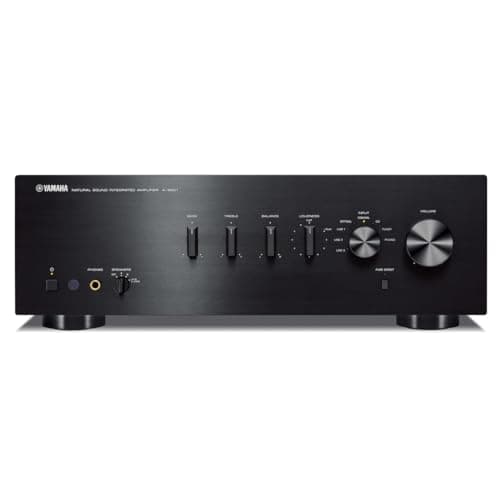
Best integrated under $1,000
The Best Integrated Amplifiers Under $1,000
Six amps under $1,000, and the dynamic-power trap that overstates the popular pick by roughly 2x.
The Valve half. Integrated amps, tube amps, and whether the one you want will drive the speakers you own.
An amplifier has one job: take a signal of about two volts and give it enough current to move a speaker cone. Everything else — the phono stage, the DAC, the Bluetooth, the tone controls — is a convenience bolted onto that. Which is why the specification that decides an amplifier purchase is not the one on the front of the box.
Power buys volume very slowly. Doubling the watts adds 3 dB. Perceived “twice as loud” is roughly 10 dB, which needs ten times the power. So the difference between a 35-watt amplifier and an 85-watt one is under 4 dB — real, but far less than the numbers suggest.
Meanwhile the difference between two speakers can easily be 7 dB, which is a factor of five in power. Your speakers decide your volume; your amplifier mostly decides whether they misbehave. That is why our matching guide is the most important page in this hub, and why we would rather you read it before any of the roundups.
Dynamic power is not RMS power.Yamaha’s A-S501 is rated at 85 W + 85 W into 8 ohms across the full 20 Hz–20 kHz band at 0.019% THD. That is a real, hard rating. Search for its 4-ohm power, though, and you will find “185 W” everywhere — which is Yamaha’s published High Dynamic Power, a short-burst measurement. Yamaha publishes no continuous 4-ohm rating at all. Treating the dynamic figure as continuous overstates the amplifier roughly two-fold.
Conditions are the specification.Denon rates the PMA-600NE at 45 W into 8 ohms across the full band at 0.07% THD — and at 70 W into 4 ohms at 1 kHz and 0.7% THD. Both are Denon’s figures and both are honest, but they are measured under completely different conditions and reading them as a straight comparison is a mistake. Marantz publishes both of the PM6007’s figures under the same full-band condition, which is why it ranks so well with us despite publishing less power than the Yamaha.
A wattage with no conditions is not a specification. The Fosi V3 advertises 300 W × 2 at about $110. That figure is into 4 ohms, has no THD condition attached, and depends on which power supply you feed it — Fosi publishes an input range of 24–48 V. They publish no 8-ohm rating at all. It is a genuinely useful little amplifier and an object lesson in reading fine print.
An integrated amplifier is a preamp and a power amp in one box. A stereo receiver is an integrated with a radio tuner added — the Sony STR-DH190 is one. If you will never use the tuner it is weight and cost doing nothing, which is a reasonable argument against it and not much more.
Separates — a preamp and a power amp in different boxes — buy you flexibility and cost you money and shelf space. At this budget we do not think it is the right trade for most people, and we do not rank separates. Preamp vs power amp explains what each box does, and the pre-out spec that decides whether you can split them later.
Two questions that arrive before any of that have their own pages. If the speakers are a 4 ohm load, our 4 ohm amplifier guide ranks the amplifiers here on the quality of their 4 ohm disclosure, which varies from a full-band continuous rating to nothing. And if the question is whether any of this is worth the money, our hi-fi-worth-it page separates the parts of the hobby that move a published number from the parts that do not.
Note that several integrated amplifiers already contain a DAC. The Onkyo TX-8470, Denon PMA-600NE and Marantz PM6007 all publish optical and coaxial inputs. If yours does, buying a separate DAC is buying a second one.
We do not yet have a tube amplifier roundup, and we would rather tell you why than leave a suspicious gap on the hub named after them. We could not verify a set of tube amplifiers as currently purchasable through the retailer we link to, at prices that make sense, with published specifications we could actually read. When we can, we will build it.
In the meantime, tube versus solid state covers what genuinely differs — including the output-impedance mechanism that explains why a tube amplifier measures differently on different speakers — and where we have to stop, because we have not heard any of it.
One practical note while you shop: search for “tube amp” and most results are guitar equipment, where distortion is the goal rather than the problem. Search “tube integrated amplifier” instead.
Buying power you have computed you do not need. Run the arithmetic on your actual speakers at your actual listening distance. If you clear 95 dB with headroom — and most pairings do — spend the difference on the speakers, because that is where the audible difference lives.
An amplifier is a difficult present, because the speakers it has to drive decide which amplifiers are even candidates. If you are shopping for someone else, powered speakers sidestep the whole question by putting the amplifier inside the cabinet — our under-$250 gift guide leads with exactly that, and the no-budget guide ranks its picks by how few demands each one makes on the system it joins. Our Black Friday page covers which classes of gear actually move in November.
Each card shows that roundup’s top pick and its live price, as of October 15, 2026.
Best integrated under $1,000
Six amps under $1,000, and the dynamic-power trap that overstates the popular pick by roughly 2x.
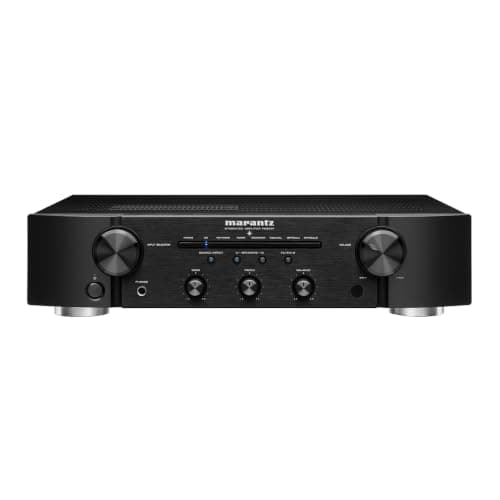
Best amp for a turntable
Amplifiers with a phono stage inside, ranked on published MM sensitivity and phono signal-to-noise — not watts.
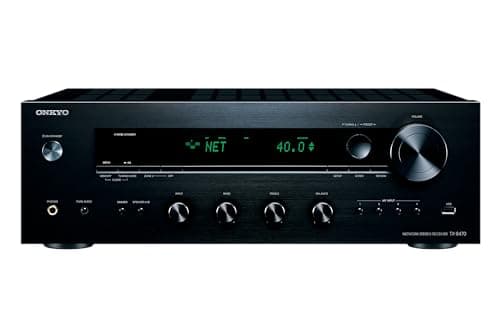
Best integrated under $500
Four amplifiers under $500, ranked on the power figure each maker actually publishes — and on which of them will drive a 4-ohm speaker.
Two published numbers, one formula, and the answer is almost always less power than you expected.
What actually differs in measurable terms, what is preference, and where we have to stop.
Two-channel integrated versus multichannel receiver, judged on published power ratings and what each spec actually promises.
How each topology works, what each one publishes, and the power-supply fine print behind Class D wattage claims.
85 W into 8 Ω, damping factor 240, an MM phono input — and the 4-ohm rating Yamaha does not publish.
Impedance, bandwidth, distortion, channels driven — the four conditions that turn a watts number into a spec, and which manufacturers publish all four.
Voltage versus current, what damping factor tells you in ohms, and the pre-out spec that decides whether you can ever split them later.
Three connection routes, which subs support each, and why a stereo amp adds bass rather than redirecting it.
The two amplification stages a turntable needs, which components already contain which, and the three routes that let you skip a box.
What a 4 ohm speaker asks of an amplifier, the four kinds of 4 ohm rating makers publish, and which of ours states a real one.
What hi-fi means, which of its claims can be measured, where the money moves a published number, and a starter system chosen on those numbers rather than on adjectives.
Every pick here is a spec-and-price analysis, not a listening test. We compile what the manufacturer publishes, link each figure to the document we read it from, show the arithmetic where it applies, and price everything live. We have not heard this gear and we do not pretend to have. The full method is here.