The Best Floorstanding Speakers Under $1,000
Four of these six listings sell you one speaker. Two sell you a pair. That single fact reorders the entire bracket before a specification is read — so it is where this page starts.
Disclosure: we earn a commission if you buy through the links on this page, at no extra cost to you. It does not influence what we pick — our criteria are published and reproducible, so you can check our work. How we pick · Full disclosure
These picks are spec-and-price analyses, not listening tests. We have not heard this gear and we do not pretend to have: every figure below is sourced to the manufacturer and linked, and every price is live or not shown at all. Here are the rules we followed.
Quick picks
Ranked on the published criteria in How We Pick. Prices are live as of September 5, 2026. Tap any row for the full write-up.
- 8.6
- 8.3
- 7.8$319.00View on Amazon
$349.009% off
- 8.0
- 7.9
- 7.3$209.00View on Amazon
$229.009% off
| # | Product | Best for | Score | Price |
|---|---|---|---|---|
| 1 | 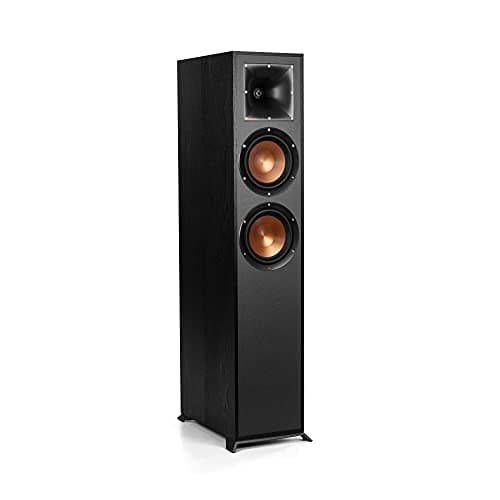 Klipsch R-620F 96 dB at 2.83 V/1 m and 38 Hz with a ±3 dB tolerance attached — the only speaker here that pairs the highest published sensitivity with a bass figure you can actually hold Klipsch to. | Best overall | 8.6 | |
| 2 | 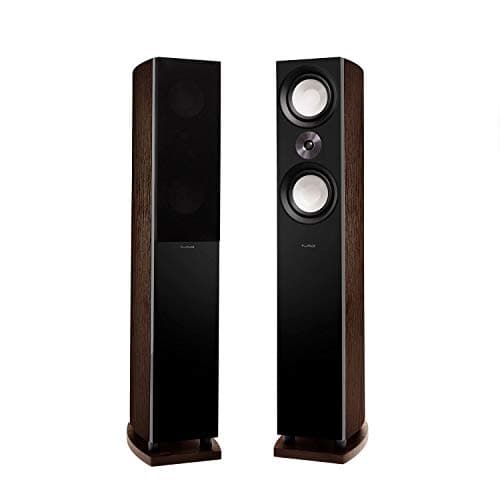 Fluance XL8F Reference The only genuine three-way here, with a dedicated down-firing 8 in woofer and a published 100 Hz crossover — and the price on the listing already buys two of them. | Best true pair price | 8.3 | |
| 3 | 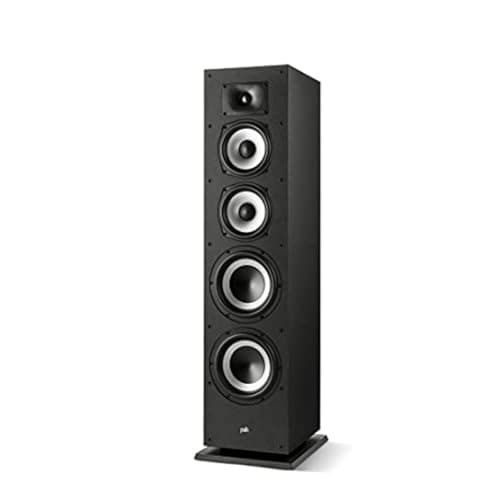 Polk Monitor XT70 Two 6.5 in woofers, two 8 in passive radiators and a 25–200 W recommendation from a maker that tells you what to drive it with — then declines to say what impedance it presents or how the bass figure was measured. | Best published amplifier range | 7.8 | $319.00View on Amazon $349.009% off |
| 4 | 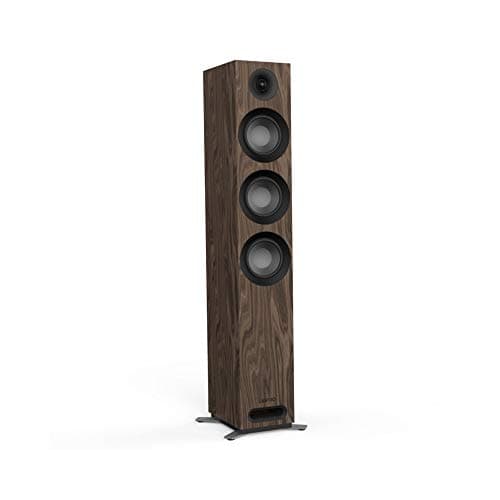 Jamo Studio S 809 The only front-ported tower here, sold as a pair, with a ± 3 dB tolerance on its 37 Hz claim — the answer when the speakers cannot come out into the room. | Best near a wall | 8.0 | |
| 5 | 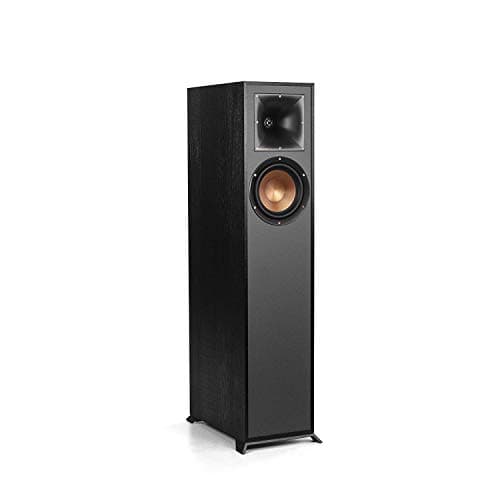 Klipsch R-610F 94 dB at 2.83 V/1 m from the cheapest cabinet here, with Klipsch filling in every field its R-620F sheet leaves blank — and stopping 7 Hz higher for it. | Best for a small room | 7.9 | |
| 6 | 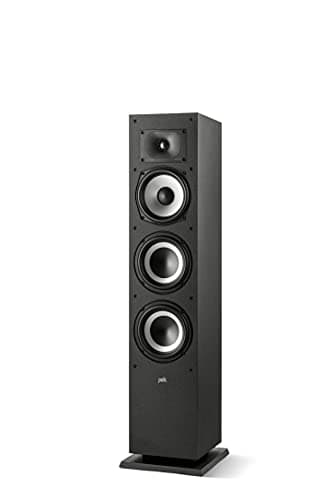 Polk Monitor XT60 7.5 in wide and 20 lb — a tower for a room that has no floor to spare, at the cost of the lowest published sensitivity in the group. | Narrowest footprint | 7.3 | $209.00View on Amazon $229.009% off |
In this bracket the most consequential specification is not on any spec sheet: whether the price you are reading buys one speaker or two. Four of the six towers below are listed as a single cabinet. Two are listed as a pair. A reader comparing the six prices side by side is comparing two different products — half a stereo system against a whole one.
So the bracket on this page is defined explicitly, and it is not the usual one. “Under $1,000” here means a stereo pair under $1,000 — two cabinets, in the room, playing left and right. That rule removed several speakers that would otherwise be obvious inclusions, and we name them at the end rather than leaving you to wonder whether we forgot them.
Everything below is a published manufacturer figure with the document it came from linked beside it. We have not heard any of these speakers and we do not tell you how they sound. What we can do is read six spec sheets properly, convert the numbers onto a common footing where that is possible, and say plainly where a maker has left a field blank.
How we ranked these
The rubric is the published one on how we pick, applied in this order:
- Does the listing sell a pair? Not a performance question — a budget question, and it comes first because it changes what the reader can afford.
- Published sensitivity, with its measurement condition. A bare decibel figure is not comparable to another bare decibel figure, and three of these makers quote a different condition from the other three.
- A bass figure with a tolerance.“35 Hz” on its own is a marketing number. “38 Hz ± 3 dB” is a specification, because it can be wrong.
- Where the port or radiator fires. This decides whether the speaker can live where you intend to put it, and it is the constraint most likely to make an otherwise good speaker sound bad.
- Floor area. A tower is furniture. Two of these occupy less than half the floor of the others.
1. One speaker, or two?
Start here, because it is the difference between a $500 decision and a $1,000 one:
| Speaker | The listing sells | Cabinets needed for stereo |
|---|---|---|
| Fluance XL8F Reference | A matched pair | One purchase |
| Jamo Studio S 809 | A pair | One purchase |
| Klipsch R-620F | One cabinet | Two purchases |
| Klipsch R-610F | One cabinet | Two purchases |
| Polk Monitor XT70 | One cabinet (“Single”) | Two purchases |
| Polk Monitor XT60 | One cabinet (“Single”) | Two purchases |
The live price beside each speaker further down this page is the listing price, refreshed from Amazon’s API. For the four singles, double it before you compare. That is not a criticism of the makers — selling towers individually is normal, because center channels and surrounds are bought in odd numbers — but it is the single most common way to overspend in this bracket.
It also explains why several well-regarded towers are missing. A speaker priced around $500 to $650 for one cabinet is a fine speaker and a $1,000-to-$1,300 stereo pair, which is a different page.
2. The sensitivity numbers are not on the same footing
Sensitivity is the specification that decides how much amplifier you need, and it is also the one most often quoted in a way that prevents comparison. Klipsch and Jamo publish theirs at 2.83 volts into one meter. Polk and Fluance publish theirs at 1 watt into one meter. Those are the same measurement only into 8 ohms.
P = V² ÷ R; 2.83² ÷ 8 = 1.00 W; 2.83² ÷ 4 = 2.00 W (+3.01 dB)
Inputs
- Klipsch R-620F: 96 dB @ 2.83 V / 1 m (Klipsch spec sheet (PDF))
- Klipsch R-610F: 94 dB @ 2.83 V / 1 m (Klipsch spec sheet (PDF))
- Jamo Studio S 809: 90 dB @ 2.83 V / 1 m (Jamo spec table)
- Polk Monitor XT70: 89 dB @ 1 W / 1 m (Polk product page)
- Fluance XL8F: 87 dB @ 1 W / 1 m (Fluance spec list)
- Polk Monitor XT60: 86 dB @ 1 W / 1 m (Polk product page)
Result
This is why the Klipsch R-620F heads the page. Ninety-six decibels at a stated condition is the highest published sensitivity of any speaker on this site, and high sensitivity is the specification that makes a cheap amplifier sound expensive. If your amplifier is fixed and modest — an integrated in the under-$500 bracket, say — that number is worth more to you than any other on this page.
3. Which bass figures come with a tolerance
Every speaker here publishes a low-frequency limit. Half of them publish it with a window, and half do not:
| Speaker | Published response | Tolerance stated? |
|---|---|---|
| Klipsch R-620F | 38 Hz – 21 kHz | Yes — ± 3 dB |
| Klipsch R-610F | 45 Hz – 21 kHz | Yes — ± 3 dB |
| Jamo Studio S 809 | 37 Hz – 26 kHz | Yes — ± 3 dB |
| Polk Monitor XT70 | 35 Hz – 40 kHz | No |
| Fluance XL8F | 35 Hz – 25 kHz | No |
| Polk Monitor XT60 | 38 Hz – 40 kHz | No |
The two deepest claims on the page are the two with no window attached. That is not an accusation that Polk and Fluance are wrong — it is the observation that their figures cannot be checked, while Klipsch’s and Jamo’s can. A response quoted ± 3 dB says the speaker is within 3 dB of its reference level at that frequency. A bare number says the maker chose a frequency, and does not say what the output was doing when it got there.
Read the table in that light and the ordering changes. Jamo’s 37 Hz ± 3 dB is a stronger claim than Polk’s 35 Hz with nothing attached, from a speaker with three 5-inch drivers rather than two 6.5-inch ones and a pair of 8-inch radiators — which is a surprising result, and the sort of thing that only appears when you insist on the tolerance column.
4. Where the port fires decides where the speaker can live
Every one of these is a ported or radiator-loaded design; none is sealed. That matters, because a rear port pushed up against a wall is not the speaker its maker measured — the trade is covered in full in ported vs sealed speakers.
| Speaker | Loading | What it means for placement |
|---|---|---|
| Jamo Studio S 809 | Bass reflex, front-firing slot port | The only one designed to work close to a back wall |
| Klipsch R-620F | Rear-firing Tractrix ports | Needs clearance behind it |
| Klipsch R-610F | Rear-firing Tractrix port | Needs clearance behind it |
| Fluance XL8F | Rear dual ports, down-firing 8 in woofer | Needs clearance behind; also needs its feet on a firm floor |
| Polk Monitor XT70 | Two 8 in passive radiators — face not published | Unknowable from Polk’s documents |
| Polk Monitor XT60 | Two 6.5 in passive radiators — face not published | Unknowable from Polk’s documents |
The Polk gap is a real one and it is worth dwelling on. A passive radiator behaves like a port: it moves air, it is tuned, and it needs room to do it. Polk names the radiators, the driver sizes and the tuning frequency they are claimed to reach, and never says which face they are mounted on. We will not infer it from a product photograph, so it renders on both Polk spec tables as an explicit gap.
If your speakers must sit within a few inches of a wall — an extremely common constraint and the reason the Jamo is ranked where it is — that one specification outranks every other number on this page.
5. A tower is furniture, and these differ by a factor of two
Height is the number everyone looks at. Floor area is the number that decides whether the speaker fits, and no maker publishes it, because it is a multiplication nobody does:
Area = width × depth
Inputs
- Polk Monitor XT60: 7.5 × 9.09 in (Polk info sheet (PDF))
- Jamo Studio S 809: 7.52 × 9.92 in (Jamo spec table)
- Polk Monitor XT70: 9.25 × 12.5 in (Polk info sheet (PDF))
- Fluance XL8F: 9.25 × 12.99 in (Fluance spec list)
- Klipsch R-610F: 9.4 × 15.1 in (Klipsch spec sheet (PDF))
- Klipsch R-620F: 9.4 × 15.2 in (Klipsch spec sheet (PDF))
Result
What none of them publish
Four gaps run through this entire bracket, and the fact that no competitor page mentions them is not evidence that they do not matter:
- Minimum impedance. Not one of the six publishes it. Nominal impedance is an average; minimum impedance is what your amplifier actually has to survive, and it is the figure that decides whether a marginal amp goes into protection. All six leave it blank, so all six render it as a gap.
- Klipsch’s R-620F weight and input terminals. Both fields exist on Klipsch’s spec-sheet template and both are filled in on the R-610F sheet — 36 lb, single gold-plated binding posts. On the R-620F sheet, from the same year and the same template, both are blank. Retailer listings quote a weight for it; none of those numbers is Klipsch’s, so we publish the gap instead of somebody else’s guess.
- Polk’s radiator orientation, discussed above, on both the XT60 and the XT70.
- Jamo’s crossover frequency.The S 809 has three identically sized 5-inch woofers. Whether that is a two-way with three parallel drivers, a 2.5-way, or the 3.5-way the marketing suggests depends entirely on how they are filtered — and Jamo’s specification table has no crossover row at all. Every other speaker here publishes at least one crossover point; the Fluance publishes two.
What to drive them with
The published sensitivities span 86 dB to 96 dB, which is a factor of ten in amplifier power at the extremes. That single spread is why there is no one answer here.
For the two Klipsch models, almost anything works: at 94 to 96 dB, a modest integrated reaches serious volume with headroom in hand. For the Fluance at 87 dB and the Polk XT60 at 86 dB, power is not optional — Polk’s own recommendation starts at 25 W per channel and Fluance publishes 80 to 160 W RMS handling, and the bottom of those ranges is where a small amplifier runs out first. The arithmetic that turns a sensitivity figure into a real amplifier requirement is worked through in will this amplifier drive my speakers?
If the system is for film rather than stereo, the towers here are the front left and right of a larger build, and the receiver decides the rest of it — our home theater speaker builds page covers the center and surround matching, and AV receivers under $500 covers what to plug them into.
Should it be a floorstander at all?
This page assumes you have already decided. If you have not, the honest answer is that a good bookshelf pair plus a subwoofer usually beats a tower at the same total spend, because it lets you put the bass somewhere other than where the stereo image has to be. That argument is made properly, with numbers, in bookshelf vs floorstanding speakers, and the alternative is priced in the best bookshelf speakers under $1,000.
The case for a tower is real, though, and it is mostly practical. It arrives at the right height without stands. It is one purchase instead of three boxes. And in a large room, cone area is the direct answer to output capability, which no amount of clever placement substitutes for.
What we left out, and why
Six more towers resolved to live, in-stock Amazon listings during this research and were excluded on the bracket rule, not on quality: the ELAC Debut 3.0 DF53, JBL Stage 2 260F and 280F, Klipsch R-605FA, Q Acoustics 3050i and Wharfedale Diamond 12.3. Every one of them is priced at or above roughly $500 per cabinet, which puts a stereo pair over the line this page draws.
A further group could not be verified at all: the ELAC Debut 2.0 F5.2 and F6.2, the JBL Stage A180, the Dayton Audio T652, the Pioneer SP-FS52 and the Sony SSCS3. In each case the resolver either found no listing whose title matched the brand and model, or — in the Sony’s case — found only an eight-speaker system bundle rather than the tower. We do not publish a pick we cannot verify is purchasable, so none of them appears above.
Every pick in detail
Every specification below links to the manufacturer document we read it from. Where a manufacturer does not publish a figure, we say so rather than estimating it.
Klipsch R-620F
Best overallPrice as of September 5, 2026. #ad
96 dB at 2.83 V/1 m and 38 Hz with a ±3 dB tolerance attached — the only speaker here that pairs the highest published sensitivity with a bass figure you can actually hold Klipsch to.
- sensitivity
- 10/10
- published data
- 7/10
- bass extension
- 8/10
- amp friendliness
- 10/10
- value for money
- 9/10
| Specification | Published value | Source |
|---|---|---|
| Sensitivity | 96 dB (2.83 V / 1 m) — the highest published figure on this site | Klipsch spec sheet (PDF) |
| Impedance | 8 Ω “compatible” (Klipsch's wording — not a measured nominal figure) | Klipsch spec sheet (PDF) |
| Minimum impedance | Not published | — |
| Frequency response | 38 Hz – 21 kHz ± 3 dB | Klipsch spec sheet (PDF) |
| Power handling | 100 W continuous / 400 W peak (a handling limit, not a recommended amplifier range) | Klipsch spec sheet (PDF) |
| Woofers | Dual 6.5 in spun-copper IMG | Klipsch spec sheet (PDF) |
| Tweeter | 1 in aluminum LTS on a 90° × 90° square Tractrix horn | Klipsch spec sheet (PDF) |
| Crossover | 2,000 Hz | Klipsch spec sheet (PDF) |
| Enclosure | MDF, bass reflex via rear-firing Tractrix ports | Klipsch product page |
| Input terminals | Not published | — |
| Dimensions (H × W × D) | 40 × 9.4 × 15.2 in (1,017 × 240 × 386 mm) | Klipsch spec sheet (PDF) |
| Weight (each) | Not published | — |
| Sold as | One speaker. Klipsch's Amazon listing is a single cabinet; a stereo pair is two purchases. | Klipsch product page |
Pros
- 96 dB at 2.83 V / 1 m — the highest published sensitivity of any speaker on this site
- 38 Hz – 21 kHz is quoted ± 3 dB, so both endpoints mean something
- 100 W continuous / 400 W peak handling, published as handling rather than as a recommendation
- Dual 6.5 in woofers in a 40 in cabinet that is still under 9.5 in wide
Cons
- Klipsch's own spec sheet leaves the weight and the input-terminal fields BLANK — the R-610F sheet fills both in, so this is an omission, not an oversight on our part
- Rear-firing Tractrix ports need clearance behind them, which rules out a tight alcove
- The horn presentation is divisive and we cannot tell you how it sounds — we have not heard them
- The Amazon listing is one speaker, so the real cost of a stereo pair is double the number shown
Skip it if the speakers have to sit within a few inches of a back wall. Rear ports and a wall are a poor combination, and the front-ported Jamo exists for exactly that room.
Fluance XL8F Reference
Best true pair pricePrice as of September 5, 2026. #ad
The only genuine three-way here, with a dedicated down-firing 8 in woofer and a published 100 Hz crossover — and the price on the listing already buys two of them.
- sensitivity
- 5/10
- published data
- 7/10
- bass extension
- 9/10
- amp friendliness
- 5/10
- value for money
- 10/10
| Specification | Published value | Source |
|---|---|---|
| Sensitivity | 87 dB @ 1 W / 1 m — Fluance states the condition, and it is the 1-watt condition, not 2.83 V | Fluance spec list |
| Impedance | “8 Ohm Compatible” (Fluance's wording — not a measured nominal figure) | Fluance spec list |
| Minimum impedance | Not published | — |
| Frequency response | 35 Hz – 25 kHz, quoted with no tolerance window | Fluance spec list |
| Power handling | 80 – 160 W RMS | Fluance spec list |
| Tweeter | 1 in neodymium balanced silk dome, ferrofluid cooled | Fluance spec list |
| Midrange | Dual 6.5 in woven glass fiber composite with butyl rubber surrounds | Fluance spec list |
| Woofer | Isolated down-firing 8 in polymer-treated high-excursion driver — the only dedicated bass driver on this page | Fluance spec list |
| Crossover | 100 Hz / 3,000 Hz — a genuine three-way, and the only published low crossover point here | Fluance spec list |
| Enclosure | Tuned rear dual-port bass reflex tower, dampened | Fluance spec list |
| Dimensions (H × W × D) | 45.86 × 9.25 × 12.99 in (116.5 × 23.5 × 33 cm) | Fluance spec list |
| Weight (each) | 47.7 lb / 21.64 kg — the heaviest cabinet on this page by 12 lb | Fluance spec list |
| Sold as | A matched pair. One purchase puts two speakers in the room. | Fluance product page |
Pros
- Sold as a matched pair, so the listed price is the price of a stereo system's front end
- A real three-way: 1 in silk dome, dual 6.5 in midranges and an isolated 8 in down-firing woofer
- Publishes both crossover points (100 Hz and 3,000 Hz), which nobody else on this page does
- 47.7 lb per cabinet — the heaviest and most inert box here by a wide margin
Cons
- 87 dB at 1 W / 1 m is the lowest published sensitivity on this page, so it wants the most amplifier power
- 35 Hz – 25 kHz is published with no tolerance window, which makes the 35 Hz endpoint unverifiable
- 45.86 in tall and 12.99 in deep — physically the largest thing here, and it looks it
- Rear dual ports, so it needs wall clearance despite the down-firing woofer
Skip it if your amplifier is a low-power tube or Class A design. Of everything here this is the one that most wants watts.
Polk Monitor XT70
Best published amplifier rangeTwo 6.5 in woofers, two 8 in passive radiators and a 25–200 W recommendation from a maker that tells you what to drive it with — then declines to say what impedance it presents or how the bass figure was measured.
- sensitivity
- 6/10
- published data
- 5/10
- bass extension
- 9/10
- amp friendliness
- 7/10
- value for money
- 8/10
| Specification | Published value | Source |
|---|---|---|
| Sensitivity | 89 dB, published by Polk at “1 watt @ 1 meter” — NOT at 2.83 V, so it is not directly comparable to the Klipsch and Jamo figures on this page | Polk product page |
| Impedance | “Compatible with 4- and 8-ohm outputs” — Polk publishes no nominal impedance figure for this speaker | Polk info sheet (PDF) |
| Minimum impedance | Not published | — |
| Frequency response | 35 Hz – 40 kHz, quoted with NO tolerance window — the deepest published figure on this page and the one with the least to back it | Polk info sheet (PDF) |
| Recommended amplification | 25 – 200 W per channel | Polk info sheet (PDF) |
| Woofers | 2 × 6.5 in bi-laminate paper | Polk info sheet (PDF) |
| Bass radiators | 2 × 8 in passive radiators — Polk's feature list claims “deep effortless bass below 35 Hz” | Polk info sheet (PDF) |
| Tweeter | 1 in Terylene dome | Polk info sheet (PDF) |
| Crossover | 2,700 Hz | Polk info sheet (PDF) |
| Input terminals | 5-way nickel-plated binding posts | Polk info sheet (PDF) |
| Passive radiator firing direction | Not published | — |
| Dimensions (H × W × D) | 40.4 × 9.25 × 12.5 in (1,026.6 × 235 × 317.9 mm) | Polk info sheet (PDF) |
| Weight (each) | 35 lb / 15.88 kg | Polk info sheet (PDF) |
| Sold as | One speaker — Polk's Amazon listing is labelled “Single”. A stereo pair is two purchases. | Polk product page |
Pros
- Polk publishes a recommended amplification range (25 – 200 W per channel); Klipsch and Jamo publish handling limits instead
- Dual 8 in passive radiators — the largest radiating area for bass on this page
- 35 Hz is the deepest published low-frequency figure in the bracket
- 9.25 in wide and 40.4 in tall, so it disappears into a room better than its driver count suggests
Cons
- The 89 dB sensitivity is published at 1 watt, not 2.83 V, so it cannot be compared like-for-like with the Klipsch and Jamo numbers
- “Compatible with 4- and 8-ohm outputs” is not a nominal impedance, and no minimum is published
- 35 Hz – 40 kHz carries no tolerance, so the endpoints are unfalsifiable
- Polk never says which face the passive radiators are on, which is the one fact you need to place a radiator-loaded cabinet
- The Amazon listing is one speaker, not a pair
Skip it if you need to know exactly how close to the wall it can go. Polk does not publish the radiator orientation, and we will not guess it.
Jamo Studio S 809
Best near a wallPrice as of September 5, 2026. #ad
The only front-ported tower here, sold as a pair, with a ± 3 dB tolerance on its 37 Hz claim — the answer when the speakers cannot come out into the room.
- sensitivity
- 8/10
- published data
- 6/10
- bass extension
- 8/10
- amp friendliness
- 8/10
- value for money
- 10/10
| Specification | Published value | Source |
|---|---|---|
| Sensitivity | 90 dB (2.83 V @ 1 m) | Jamo spec table |
| Impedance | 8 Ω — stated flatly, with no “compatible” hedge | Jamo spec table |
| Minimum impedance | Not published | — |
| Frequency response | 37 Hz – 26 kHz ± 3 dB | Jamo spec table |
| Power handling | 120 W / 240 W | Jamo spec table |
| Tweeter | 1 × 25 mm (1 in) soft dome with Anti-Diffraction Waveguide | Jamo spec table |
| Woofers | 3 × 127 mm (5 in) polyfiber | Jamo spec table |
| Crossover frequency | Not published | — |
| Enclosure | Bass reflex via a front-firing slot port — the only front-ported speaker on this page | Jamo spec table |
| Input terminals | Single binding post | Jamo spec table |
| Dimensions (H × W × D) | 41.02 × 7.52 × 9.92 in (1,042 × 191 × 252 mm) | Jamo spec table |
| Weight (each) | 30 lb / 13.6 kg | Jamo spec table |
| Sold as | A pair. Jamo prices the S 809 per pair on its own store, and the Amazon listing is a pair. | Jamo product page |
Pros
- Front-firing slot port — the only speaker on this page that is designed to work close to a back wall
- 37 Hz – 26 kHz ± 3 dB: a tolerance window on the deepest-but-one bass claim here
- 8 Ω stated flatly, with none of the “compatible” hedging Klipsch, Polk and Fluance all use
- Sold as a matched pair, so the listing price is the pair price
Cons
- Jamo publishes NO crossover frequency, so how three 5 in woofers are filtered is undisclosed
- Three 5 in drivers is less cone area than the dual 6.5 in designs it is priced against
- Single binding post — no bi-wiring or bi-amping, which the Polks' 5-way posts allow
- It is the oldest design here, and Jamo's current catalog has moved to other series
Skip it if you want to know how the speaker is filtered. There is no crossover row on Jamo's spec table and no manual figure we can link.
Klipsch R-610F
Best for a small roomPrice as of September 5, 2026. #ad
94 dB at 2.83 V/1 m from the cheapest cabinet here, with Klipsch filling in every field its R-620F sheet leaves blank — and stopping 7 Hz higher for it.
- sensitivity
- 9/10
- published data
- 9/10
- bass extension
- 5/10
- amp friendliness
- 10/10
- value for money
- 9/10
| Specification | Published value | Source |
|---|---|---|
| Sensitivity | 94 dB (2.83 V / 1 m) | Klipsch spec sheet (PDF) |
| Impedance | 8 Ω “compatible” (Klipsch's wording — not a measured nominal figure) | Klipsch spec sheet (PDF) |
| Minimum impedance | Not published | — |
| Frequency response | 45 Hz – 21 kHz ± 3 dB | Klipsch spec sheet (PDF) |
| Power handling | 85 W continuous / 340 W peak (a handling limit, not a recommended amplifier range) | Klipsch spec sheet (PDF) |
| Woofer | Single 6.5 in spun-copper IMG | Klipsch spec sheet (PDF) |
| Tweeter | 1 in aluminum LTS on a 90° × 90° square Tractrix horn | Klipsch spec sheet (PDF) |
| Crossover | 1,800 Hz | Klipsch spec sheet (PDF) |
| Enclosure | MDF, bass reflex via a rear-firing Tractrix port | Klipsch product page |
| Input terminals | Single gold-plated binding posts | Klipsch spec sheet (PDF) |
| Dimensions (H × W × D) | 37 × 9.4 × 15.1 in (940 × 240 × 384 mm) | Klipsch spec sheet (PDF) |
| Weight (each) | 36 lb / 16.3 kg | Klipsch spec sheet (PDF) |
| Sold as | One speaker. Klipsch's Amazon listing is a single cabinet; a stereo pair is two purchases. | Klipsch product page |
Pros
- 94 dB at 2.83 V / 1 m — a single 6.5 in woofer that still plays loud on very little power
- 45 Hz – 21 kHz ± 3 dB: a tolerance window, unlike either Polk or the Fluance
- Klipsch publishes the weight (36 lb) and the input hardware here, both of which its R-620F sheet omits
- 37 in tall and 36 lb — the smallest real tower in the group
Cons
- 45 Hz is the shallowest published extension on this page, so a subwoofer is not optional for film
- One 6.5 in woofer against the R-620F's two, for less than double the saving
- Rear-firing Tractrix port, so it still needs clearance behind it
- The Amazon listing is one speaker, not a pair
Skip it if the room is large or the system will never have a subwoofer. The R-620F's extra woofer and 7 Hz are worth the step up.
Polk Monitor XT60
Narrowest footprint7.5 in wide and 20 lb — a tower for a room that has no floor to spare, at the cost of the lowest published sensitivity in the group.
- sensitivity
- 4/10
- published data
- 5/10
- bass extension
- 7/10
- amp friendliness
- 6/10
- value for money
- 8/10
| Specification | Published value | Source |
|---|---|---|
| Sensitivity | 86 dB, published by Polk at “1 watt @ 1 meter” — NOT at 2.83 V, so it is not directly comparable to the Klipsch and Jamo figures on this page | Polk product page |
| Impedance | “Compatible with 4- and 8-ohm outputs” — Polk publishes no nominal impedance figure for this speaker | Polk info sheet (PDF) |
| Minimum impedance | Not published | — |
| Frequency response | 38 Hz – 40 kHz, quoted with NO tolerance window, which leaves both endpoints unverifiable | Polk info sheet (PDF) |
| Recommended amplification | 25 – 200 W per channel (a recommendation, not a handling limit — Polk publishes this where Klipsch publishes handling) | Polk info sheet (PDF) |
| Woofer | 1 × 6.5 in bi-laminate paper | Polk info sheet (PDF) |
| Bass radiators | 2 × 6.5 in passive radiators — Polk's feature list claims “deep effortless bass below 38 Hz” | Polk info sheet (PDF) |
| Tweeter | 1 in Terylene dome | Polk info sheet (PDF) |
| Crossover | 2,200 Hz | Polk info sheet (PDF) |
| Input terminals | 5-way nickel-plated binding posts | Polk info sheet (PDF) |
| Passive radiator firing direction | Not published | — |
| Dimensions (H × W × D) | 36.4 × 7.5 × 9.09 in (925 × 190.5 × 230.8 mm) | Polk info sheet (PDF) |
| Weight (each) | 20 lb / 9.07 kg | Polk info sheet (PDF) |
| Sold as | One speaker — Polk's Amazon listing is labelled “Single”. A stereo pair is two purchases. | Polk product page |
Pros
- 7.5 in wide and 9.09 in deep — by some margin the smallest floor footprint here
- Same 25 – 200 W published amplifier recommendation as the larger XT70
- 1 in Terylene dome tweeter, the same driver family Polk uses further up the range
- 20 lb per cabinet makes it the only speaker here one person can position without help
Cons
- 86 dB is the lowest published sensitivity on this page, and it is quoted at 1 watt rather than 2.83 V
- 38 Hz – 40 kHz with no tolerance window, from a single 6.5 in woofer and two 6.5 in radiators
- No nominal impedance and no minimum impedance published
- Radiator firing direction unpublished, same as the XT70
- The Amazon listing is one speaker, not a pair
Skip it if your amplifier is small. The lowest sensitivity in the group is the wrong end to start from with limited power.
Frequently asked questions
Is $1,000 for one floorstanding speaker or a pair?
Do I still need a subwoofer with floorstanding speakers?
Why is the Klipsch R-620F ranked above speakers with deeper bass?
Can floorstanding speakers go against a wall?
Why do the sensitivity ratings use different measurement conditions?
Have you listened to any of these speakers?
Read next
Bookshelf vs Floorstanding Speakers
Cabinet volume buys extension; a subwoofer buys extension you can place independently. The trade, with each maker's own numbers.
The Best Bookshelf Speakers Under $1,000
Five pairs under $1,000, and the measurement footnote that makes the headline sensitivity figures non-comparable.
Speaker Sensitivity Explained
2.83 V/1 m versus 1 W/1 m, what the conversion is worth in decibels, and the twelve-decibel spread that means sixteen times the power.
Ported vs Sealed Speakers
What a port buys in efficiency and extension, what it costs in placement and roll-off, and how the sealed and ported subwoofers we cover actually compare.
Will This Amplifier Drive My Speakers?
Two published numbers, one formula, and the answer is almost always less power than you expected.

The Best Home Theater Speakers
A timbre-matched 5.1 built from published specs — fronts, center, surrounds and a subwoofer that actually connects.
Sources
Every specification on this page was read from one of these documents. If one of them has changed, or we have made an error, tell us — corrections are logged and dated per our editorial policy.
- Klipsch R-620F — spec sheet (PDF)
- Klipsch R-620F — product page (enclosure and port type)
- Klipsch R-610F — spec sheet (PDF)
- Klipsch R-610F — product page (enclosure and port type)
- Polk Audio Monitor XT60 and XT70 — info sheet (PDF)
- Polk Audio Monitor XT70 — product page
- Polk Audio Monitor XT60 — product page
- Fluance XL8F Reference — specifications
- Jamo Studio S 809 — specifications