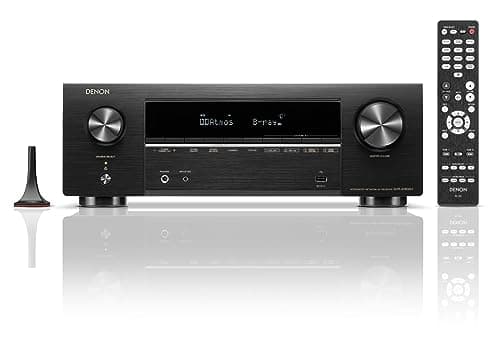
Best AV receiver under $1,000
The Best AV Receivers Under $1,000
Five receivers under $1,000, compared on FTC-rated power and the pre-out spec almost nobody mentions.

Receivers, layouts and Atmos — built on Dolby's published spec, not on vibes.
Home theater is the one category in hi-fi where the layout matters more than the equipment, and where the manufacturer of the format publishes the layout. Dolby tells you the angles. Most people ignore them and then buy a better receiver.
1. A complete channel count. A 5.1 system of modest speakers beats a 2.0 of expensive ones for film, and it is not close. The reason is the center channel: in a typical mix, most dialogue lives there. Without one your receiver synthesizes a phantom center from the front pair, which works only if you sit exactly in the middle. On a three-seat sofa, two seats are wrong.
2. A subwoofer, placed by crawl. Where you put it changes the response enormously, and you cannot calculate your way out of it — room modes depend on your exact dimensions. The subwoofer crawl (sub on the seat, crawl the floor, listen for the most even spot) costs nothing and does more than any upgrade at this budget. The method is in the setup guide. Our subwoofer roundup compares six of them — including two whose manufacturers publish no amplifier power rating at all, and the input spec that decides whether one will connect to your amplifier.
3. Room correction, run properly. It is already in the box — Audyssey on the Denons and Marantz, YPAO on the Yamahas, AccuEQ on the Onkyo. It measures your room with a microphone and corrects for it, and it is the single most effective feature on any receiver. More than any power figure.
4. Room treatment. Cheaper than electronics and it fixes problems electronics cannot. Room correction is very good above about 80 Hz and only adequate below it, because down there the problem is physical rather than electrical.
5. Better speakers. Last. Not first.
That order is close to the reverse of how most people spend, which is why most home theaters underperform their price.
Not the wattage. Every figure at this price is rated with two channels driven — Denon publishes 80 W + 80 W for the AVR-X1800H under exactly that condition. A seven-channel action scene drives seven, from one shared power supply. Nobody publishes an all-channels-driven figure here, so the real number is lower and undisclosed. The FTC-rated spread across the whole bracket is 75 W to 100 W — about 1.2 dB, which is nothing next to a 6 dB difference between speakers.
Room correction quality. Audyssey MultEQ XT on the Denon AVR-X1800H is a step above the plain MultEQ elsewhere. This is the real differentiator.
Pre-outs.The spec nobody mentions and the one that ends upgrades. The AVR-X1800H has 2.2 pre-outs — front left/right plus subs. The AVR-S670H and Yamaha RX-V4A have subwoofer outputs only, so there is no path to external amplification at all. If “I will add an amp later” is your plan, that spec is your plan, and it is buried in a manual.
A phono input, if this doubles as your stereo. Four of the five receivers we cover have one — the Denons at 2.5 mV MM, the Yamaha RX-V6A at 3.5 mV, the Onkyo at 3.5 mV. The Yamaha RX-V4A does not.
How many HDMI inputs are actually fast, if a console is involved. Every receiver here advertises 4K/120, and on most of them that applies to three of six inputs. Onkyo is the only maker that says which three. Two receivers publish all four HDMI 2.1 gaming features by name, Denon prints an explicit No against Quick Media Switching, and the receiver with the most HDMI inputs on the site names none of them in its specification at all. Our gaming roundup ranks them on that alone — and covers the route that skips the receiver entirely.
Our receiver roundup works through all of it — including the 210-watt figure that is not a rating, and a case where Denon’s own sources disagree about whether a receiver decodes Dolby Atmos.
The third number in “5.1.2” is height channels. They need real amplifiers: a 7.2 receiver can do 5.2.2, and a 5.2 receiver cannot do height at all, whatever it decodes. No firmware fixes that.
Height speakers go overhead — in the ceiling, or as up-firing modules bouncing off it. The commonest mistake is mounting them high on the front wall, which produces an elevated front channel rather than a height channel, because it is not above you. The published angles and the up-firing requirements are here.
Buying a receiver on its wattage. Buying 7.1 when 5.1.2 uses the same seven amplifiers better in a small room. And putting acoustic panels on the ceiling if you run up-firing Atmos — you will absorb the exact reflection those speakers depend on, which is two good ideas canceling each other out.
One thing we do not cover: soundbars. Not because they are bad, but because we have not verified a set of them against the criteria we use here, and a soundbar is a different argument — it trades the layout above for not having a layout at all.
We would also skip buying a receiver for pre-outs it does not have. Every receiver has a socket labeled pre-out, and on most of ours it is the subwoofer output; our pre-outs page ranks the receivers here on how many channels each actually publishes, and covers what an external amplifier does with them.
Home theater is the category where a thoughtful gift most often arrives and turns out to be unusable — a subwoofer with no matching output, a centre channel too wide for the cabinet, a receiver that omits the one feature they wanted. Our gifts for home theater fans page is organised around those checks rather than around a ranking, and our Black Friday page explains why the receiver carrying the deepest November discount is usually the outgoing model year.
Each card shows that roundup’s top pick and its live price, as of October 15, 2026.
Best AV receiver under $1,000
Five receivers under $1,000, compared on FTC-rated power and the pre-out spec almost nobody mentions.
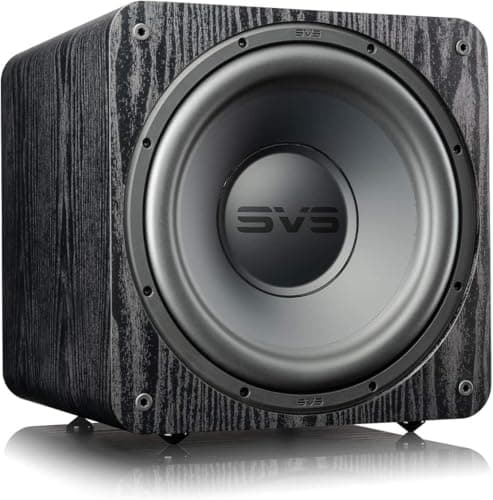
Best home theater subwoofer
Six subwoofers ranked on continuous power and published response, including two that publish neither.
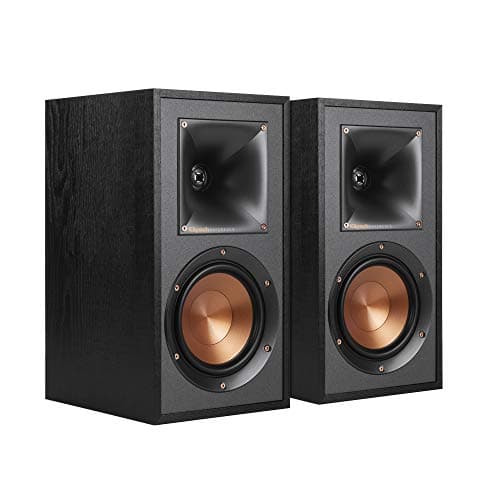
Best home theater speakers
A timbre-matched 5.1 built from published specs — fronts, center, surrounds and a subwoofer that actually connects.
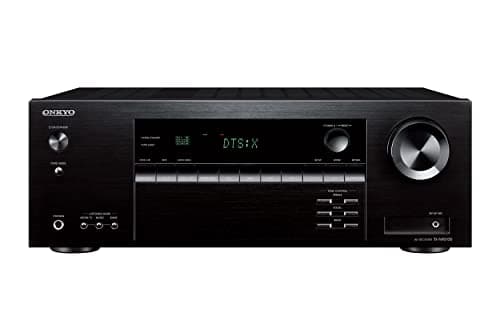
Best AV receiver under $500
Three receivers under $500, compared on the condition attached to each power figure — and all three come out at the same seventy watts.
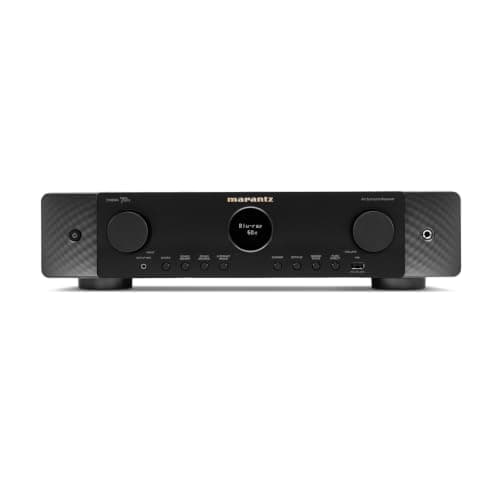
Best AV receiver for music
The receivers that take two-channel seriously, ranked on pre-outs, published phono specs and a power rating measured across the whole band.
Best AV receiver with pre-outs
Ranked on the one spec the query is about: how many channels of pre-out each receiver actually publishes. One full 7.2, two front-only, and one whose pre-out is a subwoofer socket.
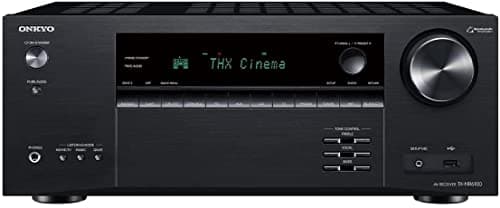
Best AV receiver for gaming
Ranked on published 4K/120 input count and whether VRR is in the maker's spec table, not its ad copy. The receiver with the most HDMI inputs is not on the list, and the reason is the whole page.
Best 7.2 receiver under $1,000
Four 7.2 receivers under $1,000, ranked on the speaker layouts their own manuals document rather than on the number printed on the box.
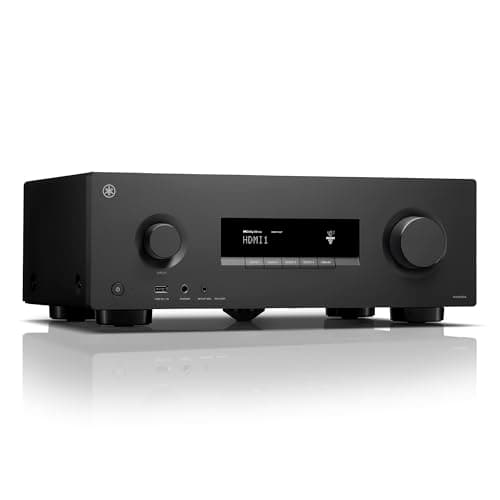
Best complete system under $1,000
A four-box build that totals under $1,000 at live prices — and the arithmetic showing why the fifth and sixth speakers are what the ceiling takes away, not the subwoofer.
The complete setup, built on Dolby's published layout angles rather than on vibes — plus what to do when your room disagrees.
Dolby's published height angles, ceiling versus up-firing, and what each needs from your room.
What a soundbar can and cannot physically do, and the honest case for each format.
80 W two-channels-driven, Audyssey MultEQ XT, 8K passthrough, MM phono — and only 2.2 pre-outs.
What eARC carries that optical cannot, and the published per-input tables showing that an 8K receiver is 8K on three ports out of six or seven.
What Audyssey, YPAO and AccuEQ tiers actually publish, the one difference that is documented, and the physics room correction cannot beat.
Every line item in a 5.1 build, in the order you have to buy them — and the three costs that are always left out of the estimate.
Four products in one chassis, priced as one. Which of the four you actually need decides whether a receiver is the right purchase at all.
Where the two designs actually conflict, where they do not, and the single configuration that lets one room serve both without compromise.
The order of operations for channel levels and distances, what the automatic run decides for you, and the three settings to verify afterwards.
The two most-compared receivers under $1,000, split across the four specifications where they actually differ - and the one that is pure marketing.
Seating width decides it. Plus the finding nobody mentions: the center channel is the least extended speaker in the family it belongs to, so its crossover needs setting by hand.
Cone diameter is the wrong number. Cabinet volume and the stated measurement condition decide how low a subwoofer actually goes — with the cubic-foot arithmetic to prove it.
Every pick here is a spec-and-price analysis, not a listening test. We compile what the manufacturer publishes, link each figure to the document we read it from, show the arithmetic where it applies, and price everything live. We have not heard this gear and we do not pretend to have. The full method is here.