The Best Amplifiers for Klipsch Speakers
Klipsch horns are the most sensitive speakers on this site by a wide margin, and that changes which amplifier specification matters. Watts stop being the question at about 35 of them. What takes over is the one number a very sensitive speaker amplifies along with the music: the amplifier's own residual noise.
The short answer
The Onkyo TX-8470 is the pick, because it publishes the highest signal-to-noise figure of any amplifier on this site — 106 dB — and with a Klipsch speaker that is the specification that decides things. Klipsch publishes 90 to 96 dB at 2.83 V across its range, which means a 35 W amplifier already reaches about 102 dB at three metres; adding watts past that buys nothing you will use. What a 96 dB speaker doesdo is reproduce the amplifier’s own hiss about 8.5 dB louder than the least sensitive speaker in our registry would, so the quiet amplifier wins. The Denon PMA-600NE is a close second at 105 dB with Bluetooth; the Marantz PM6007 is the pick if you want a published damping factor as well, at 102 dB and 100.
Disclosure: we earn a commission if you buy through the links on this page, at no extra cost to you. It does not influence what we pick — our criteria are published and reproducible, so you can check our work. How we pick · Full disclosure
These picks are spec-and-price analyses, not listening tests. We have not heard this gear and we do not pretend to have: every figure below is sourced to the manufacturer and linked, and every price is live or not shown at all. Here are the rules we followed.
Quick picks
Ranked on the published criteria in How We Pick. Prices are live as of October 16, 2026. Tap any row for the full write-up.
- 8.8
- 7.8
- 7.8
- 8.6
- 6.0
| # | Product | Best for | Score | Price |
|---|---|---|---|---|
| 1 | 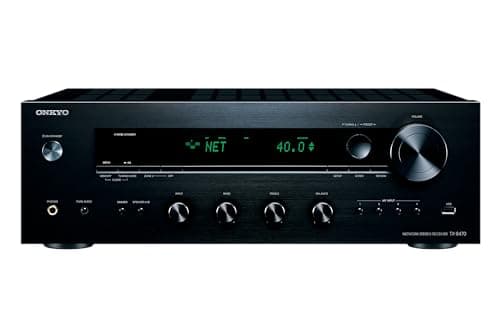 Onkyo TX-8470 The only amplifier we can verify under $500 with a moving-coil phono position as well as a moving-magnet one, and the only one whose maker states its power the FTC way. | Best phono stage under $500 | 8.8 | |
| 2 | 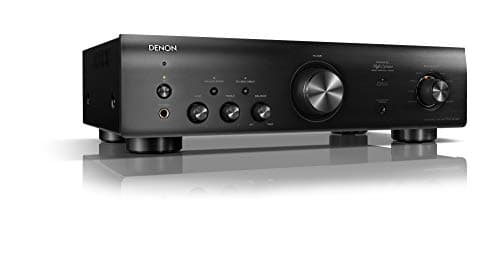 Denon PMA-600NE An integrated with a phono stage, a DAC and Bluetooth in one chassis — the fewest boxes for a mixed vinyl-and-streaming system. | Best with Bluetooth | 7.8 | |
| 3 | 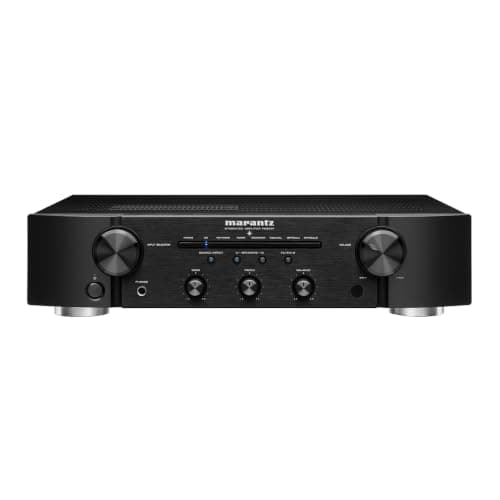 Marantz PM6007 A phono stage plus a proper DAC section in a well-made chassis, at the top of what this bracket will bear. | Best built-in DAC | 7.8 | |
| 4 | 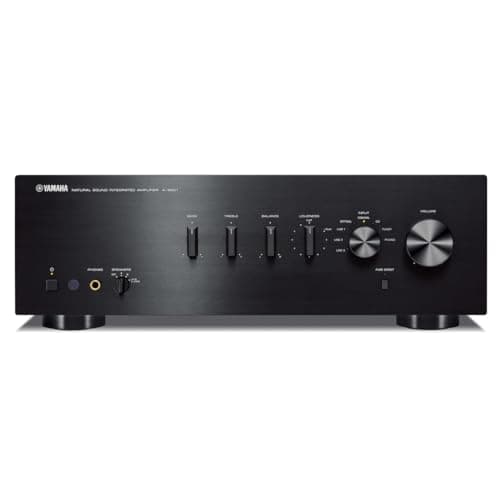 Yamaha A-S501 85 watts per channel into 8 ohms with a damping factor of 240 and an MM phono input fitted — the most amplifier here for the money, provided your speakers are an 8-ohm load. | Best overall under $1,000 | 8.6 | |
| 5 | 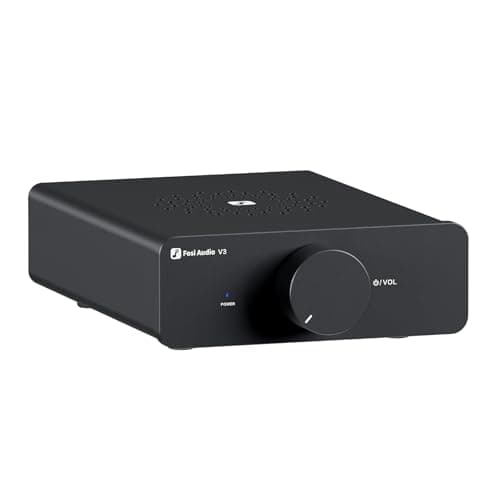 Fosi Audio V3 A class-D power amplifier the size of a paperback whose headline wattage depends entirely on the power supply you feed it. | Best tiny amplifier | 6.0 |
Almost every “best amplifier for Klipsch” recommendation starts from watts, and watts are the one thing a Klipsch speaker needs least. The whole point of a horn tweeter is efficiency: Klipsch publishes 96 dB at 2.83 V for the R-620F and the RP-6000F II, 95 dB for the R-52C centre, 94.5 dB for the RP-600M II, 93 dB for the R-51M and 90 dB for the little R-41M. Those are the highest figures on this site, and the cheapest amplifier we cover already runs out of listening room before it runs out of power. So this page ranks on what is left.
First, the watts question, so we can retire it
SPL = sensitivity + 10 × log₁₀(watts) − 20 × log₁₀(distance in m)
Inputs
- Klipsch R-620F sensitivity: 96 dB (2.83 V / 1 m) — the highest published figure on this site (Klipsch spec sheet (PDF))
- Klipsch R-41M sensitivity (the least sensitive Klipsch here): 90 dB (2.83 V / 1 m) (Klipsch spec sheet (PDF))
- Cambridge Audio AXA35 rated power: 35 W into 8 Ω (Cambridge Audio spec page)
- Onkyo TX-8470 rated power: 110 W + 110 W — “With 8 ohm loads, both channels driven, from 20 Hz – 20 kHz; rated 110 watts per channel minimum RMS power, with no more than 0.08% total harmonic distortion” (FTC) (Onkyo owner's manual (PDF))
Result
R-620F + 35 W at 3 m: 96 + 15.4 − 9.5 = 101.9 dB
R-620F + 110 W at 3 m: 96 + 20.4 − 9.5 = 106.9 dB
R-41M + 35 W at 3 m: 90 + 15.4 − 9.5 = 95.9 dB
Watts needed for 100 dB at 3 m from an R-620F: about 22 W
The 110 W amplifier’s advantage over the 35 W one: 5 dB
Tripling the price of the amplifier buys five decibels you will almost certainly never use, on a speaker that reaches 102 dB on 35 watts. That is why the watts argument ends here and why every amplifier in the picks below is powerful enough. The exception worth naming is the R-41M at 90 dB, which is 6 dB down on the tower and genuinely does want the bigger amplifier if your room is large.
What takes over: the noise floor, and why it matters more here
Sensitivity is symmetrical. A speaker that turns one watt of music into 96 dB turns one watt of hiss into 96 dB as well. Our least sensitive floorstanding speaker, the ELAC Debut 3.0 DF63, publishes 87.5 dB at the same 2.83 V — so an identical amplifier is 8.5 dB noisier through the Klipsch than through the ELAC, at the same volume setting, in the same room. Residual hiss between tracks is the single most common complaint about high-sensitivity speakers and this is the whole mechanism.
Here is what the amplifiers publish, with the reference each maker chose, because the references are not the same and that matters:
| Amplifier | Signal-to-noise (line) | Damping factor | Rated power, 8 Ω, full band |
|---|---|---|---|
| Onkyo TX-8470 | 106 dB (IHF-A, line in to speaker out) | Not published | 110 W, 0.08% THD (FTC) |
| Denon PMA-600NE | 105 dB (line, input shorted) | Not published | 45 W, 0.07% THD |
| Marantz PM6007 | 102 dB (line) | 100(8 Ω, 40 Hz – 20 kHz) | 45 W, 0.08% THD |
| Yamaha A-S501 | 99 dB (CD, input shorted) | 240— the highest here | 85 W, 0.019% THD |
| Fosi Audio V3 | ≥ 110 dB, SINAD ≥ 88 dB | Not published | Not published at all |
| Cambridge Audio AXA35 | > 82 dB (unweighted, referenced to 1 W) | > 50 | 35 W |
Read the last row carefully. Cambridge’s 82 dB is unweighted and referenced to one watt; everyone else’s is A-weighted or IHF-A and referenced to rated output. Those are different measurements and the gap between 82 and 106 is not a 24 dB gap in audible noise — it is partly a difference in how the question was asked. We are not going to convert between them, because any conversion would require assumptions Cambridge has not published. What we will say is that it is the one figure on this page we cannot place, which on a page about noise floors is a reason it is not in the picks.
1. Onkyo TX-8470 — the quietest published figure, and it is a receiver
106 dB IHF-A from line in to speaker out, 110 W per channel rated on the FTC form across 20 Hz – 20 kHz at no more than 0.08% THD, and an isolated phono board with MM and MC positions. For a Klipsch owner that is the right set of priorities in the right order. It also has four HDMI inputs with ARC and 8K passthrough, a subwoofer pre-out and a main pre-out, which makes it the obvious box if the speakers do television duty as well — see our receiver roundup for records and TV.
Two gaps: Onkyo publishes no damping factor, and no continuous 4 Ω rating. The only other power figure on its table is 210 W at 6 Ω, 1 kHz, 10% THD — a burst measurement, not a rating. With an 8 Ω-compatible Klipsch that absence is low-risk; with a 4 Ω speaker it would not be.
2. Denon PMA-600NE — one decibel behind, with Bluetooth
105 dB with the input shorted, 45 W into 8 Ω across the full band at 0.07% THD, and Bluetooth 5.1 built in. On this page’s criterion it is a point behind the Onkyo and well ahead of everything else, and 45 W into a 96 dB speaker reaches about 103 dB at three metres, which is more than enough.
Denon is also one of only two amplifiers here that publishes a 4 Ω figure at all — 70 W at 1 kHz and 0.7% THD — and the condition deserves the asterisk Denon gives it, because 1 kHz at 0.7% is a far softer test than the 8 Ω figure’s 20 Hz – 20 kHz at 0.07%. No damping factor is published.
3. Marantz PM6007 — the one that publishes both numbers
102 dB line signal-to-noise and a damping factor of 100, stated across 40 Hz – 20 kHz into 8 Ω. It is the only amplifier here with a respectable figure on both of this page’s axes, and it is also the only one on the site that rates 4 Ω across the full band: 60 W into 4 Ω, 20 Hz – 20 kHz, both channels driven, against 45 W into 8 Ω. Every rival’s 4 Ω figure, where it exists at all, is a 1 kHz measurement.
It ranks third rather than first because three decibels of published noise floor is three decibels, and on a 96 dB speaker you will hear the difference between tracks before you hear the difference a damping factor of 100 against 240 makes.
4. Yamaha A-S501 — the highest damping factor, the lowest S/N
A damping factor of 240 is the best published figure on this site by well over double, and damping factor is the specification that describes how firmly the amplifier controls a woofer’s motion after the signal stops. Yamaha also publishes the lowest distortion here, 0.019% at 50 W into 8 Ω across the full band, and the most power of the true integrated amplifiers at 85 W.
Against that: 99 dB signal-to-noise, referenced to the CD input with the input shorted — the lowest of the four conventional amplifiers, and 7 dB behind the Onkyo. On a Klipsch that 7 dB is the trade you are making, and it is the reason this amplifier ranks first on our under-$1,000 roundup and fourth here. Note also the 4 Ω trap on its sheet: the “185 W” figure that circulates is High Dynamic Power, a short burst measurement, and Yamaha publishes no continuous 4 Ω rating at all.
5. Fosi Audio V3 — the best noise number, and it cannot tell you its power
≥ 110 dB signal-to-noise with a published SINAD of ≥ 88 dB is the best measurement claim on this page, from the cheapest product on it. The reason it ranks last is the row that is blank: Fosi publishes no 8 Ω power rating whatsoever. It publishes 300 W × 2 into 4 Ω with no distortion condition attached, states a terminating impedance range of 2 – 8 Ω, and says an 8 Ω speaker will see “meaningfully less” without saying how much less. The headline number also depends on which power supply you buy, since the published input range is DC 24 – 48 V.
Every Klipsch speaker on this site is 8 Ω compatible. So on the one amplifier with the best noise figure, the load you own is the load its maker declined to characterise. It is still a remarkable amount of amplifier for the money, it has no phono input, and we would buy it with clear eyes.
The impedance gap all of this rests on
One caveat applies to every pick above, and it is Klipsch’s to fix rather than ours. No Klipsch speaker on this site publishes a minimum impedance. The impedance row on every spec sheet we read says 8 Ω “compatible” — Klipsch’s own word, and not a measured nominal figure. A real speaker’s impedance dips below its nominal value somewhere, and the depth of that dip is what actually stresses an amplifier. Not knowing it is why the two amplifiers that publish full-band 4 Ω behaviour (Marantz) or any 4 Ω figure at all (Denon) carry a little insurance the others do not.
Klipsch is not alone in this. Of all the passive speakers in our registry only the Q Acoustics 3030i publishes a minimum impedance, and our impedance explainer covers what the gap means in practice. Our sensitivity explainer covers why 2.83 V and “1 watt” are not the same claim.
How we would choose
Records, television and the quietest published noise floor: the Onkyo TX-8470. Records and streaming over Bluetooth, in a smaller room: the Denon PMA-600NE. A speaker whose impedance you suspect dips, or a desire for both numbers to be good: the Marantz PM6007. Lowest distortion and firmest woofer control, accepting 7 dB more published noise: the Yamaha A-S501. The least money by a long way, accepting that you will not know what it makes into 8 Ω: the Fosi V3.
And if your Klipsch speakers are the small ones — the R-41M at 90 dB rather than the towers at 96 — the sensitivity advantage shrinks by 6 dB and the ordinary power argument starts to matter again. Our high-sensitivity roundup ranks the speaker side of this question.
Every pick in detail
Every specification below links to the manufacturer document we read it from. Where a manufacturer does not publish a figure, we say so rather than estimating it.
Onkyo TX-8470
Best phono stage under $500Price as of October 16, 2026. #ad
The only amplifier we can verify under $500 with a moving-coil phono position as well as a moving-magnet one, and the only one whose maker states its power the FTC way.
- power
- 9/10
- phono stage
- 9/10
- value for money
- 8/10
- build quality
- 8/10
- connectivity
- 10/10
| Specification | Published value | Source |
|---|---|---|
| Power output (8 Ω) | 110 W + 110 W — “With 8 ohm loads, both channels driven, from 20 Hz – 20 kHz; rated 110 watts per channel minimum RMS power, with no more than 0.08% total harmonic distortion from 250 milliwatts to rated output” (FTC form, North American models) | Onkyo owner's manual (PDF) |
| Power output (4 Ω) | Not published as a continuous rating for the North American model. The only other North American figure on Onkyo's table is 210 W at 6 Ω, 1 kHz, 2 ch driven at 10% THD — a maximum-output burst measurement, not an RMS rating. | Onkyo owner's manual (PDF) |
| Phono input | Yes — MM or MC on a rear-panel switch, on a dedicated isolated phono board. Maximum input 70 mV (MM, 1 kHz, 0.5%) and 7 mV (MC, 1 kHz, 0.5%). | Onkyo owner's manual (PDF) |
| Phono signal-to-noise | 76 dB (IHF-A, MM 5 mV in, speaker out) · 60 dB (IHF-A, MC 0.5 mV in, speaker out) | Onkyo owner's manual (PDF) |
| THD | 0.08% (20 Hz – 20,000 Hz, at rated output power) | Onkyo owner's manual (PDF) |
| Damping factor | Not published | — |
| DAC | AKM AK4452, 32-bit / 768 kHz stereo; Class G amplifier stage | Onkyo product page |
| Digital inputs | 3 — one coaxial and two optical — plus 4 HDMI in / 1 HDMI out with ARC and 8K passthrough | Onkyo spec sheet (PDF) |
| Subwoofer out | Yes — one subwoofer pre-out, plus a main pre-out L/R and a Zone 2 pre/line out | Onkyo owner's manual (PDF) |
| Signal-to-noise (line) | 106 dB (IHF-A, line in, speaker out) | Onkyo owner's manual (PDF) |
| Dimensions and weight | 435 × 149.5 × 329 mm; 9 kg (19.8 lb) | Onkyo owner's manual (PDF) |
Pros
- 110 W per channel rated the strict way — 8 Ω, 20 Hz to 20 kHz, both channels driven, 0.08% THD — which nothing else in this bracket publishes
- MM and MC phono on a rear-panel switch, with a published signal-to-noise for each: 76 dB on MM and 60 dB on MC
- Four HDMI inputs with ARC, one coaxial and two optical digital inputs, and an AKM AK4452 32-bit/768 kHz DAC
- Subwoofer pre-out, main pre-out and a Zone 2 pre/line out all published
Cons
- Onkyo publishes no damping factor for it anywhere we can find
- The second figure on Onkyo's own North American table — 210 W at 6 Ω, 1 kHz, 10% THD — is a burst measurement at a distortion level nobody listens at
- It is a receiver: an AM/FM tuner and a second zone are part of what you are paying for whether you use them or not
- 9 kg and 435 mm wide, so it needs a rack shelf rather than a desk
Skip it if you want the shortest signal path your money will buy. This is a networked receiver with a tuner, HDMI switching and two zones, and a plain integrated puts more of the budget into the amplifier.
Denon PMA-600NE
Best with BluetoothPrice as of October 16, 2026. #ad
An integrated with a phono stage, a DAC and Bluetooth in one chassis — the fewest boxes for a mixed vinyl-and-streaming system.
- power
- 7/10
- phono stage
- 8/10
- value for money
- 8/10
- build quality
- 7/10
- connectivity
- 9/10
| Specification | Published value | Source |
|---|---|---|
| Power output (8 Ω) | 45 W + 45 W (8 Ω, 20 Hz – 20 kHz, 0.07% THD) | Denon owner's manual |
| Power output (4 Ω) | 70 W + 70 W (4 Ω, 1 kHz, 0.7% THD) — note the softer condition: 1 kHz at 0.7% THD is a much easier test than the 8 Ω figure's 20 Hz – 20 kHz at 0.07% | Denon owner's manual |
| Phono input | Yes — MM only, 2.5 mV / 47 kΩ | Denon owner's manual |
| Signal-to-noise | 105 dB (line, input shorted); phono MM 84 dB | Denon owner's manual |
| Bluetooth | Yes — version 5.1; SBC and AAC codecs | Denon owner's manual |
| Digital inputs | Coaxial and optical, linear PCM | Denon owner's manual |
| Subwoofer out | Yes — pre-out, 1 V / 100 Hz | Denon owner's manual |
| Damping factor | Not published | — |
Pros
- Phono stage, DAC and Bluetooth all included
- Optical and coaxial inputs
- Analog Mode shuts down digital circuits
Cons
- Less power than the Yamaha A-S501
- Bluetooth is receive-only, SBC-class
- Plainer build than its price implies
Skip it if you need maximum power for hard-to-drive speakers.
Marantz PM6007
Best built-in DACPrice as of October 16, 2026. #ad
A phono stage plus a proper DAC section in a well-made chassis, at the top of what this bracket will bear.
- power
- 7/10
- phono stage
- 8/10
- value for money
- 7/10
- build quality
- 9/10
- connectivity
- 8/10
| Specification | Published value | Source |
|---|---|---|
| Power output (8 Ω) | 45 W × 2 (8 Ω, 20 Hz – 20 kHz, both channels driven, 0.08% THD) | Marantz owner's manual |
| Power output (4 Ω) | 60 W × 2 (4 Ω, 20 Hz – 20 kHz, both channels driven) — rated across the full band, unlike most rivals' 1 kHz-only 4 Ω figures | Marantz owner's manual |
| Phono input | Yes — MM only, 2.2 mV / 47 kΩ | Marantz owner's manual |
| Signal-to-noise | 102 dB (line); 83 dB (phono MM) | Marantz owner's manual |
| Damping factor | 100 (8 Ω, 40 Hz – 20 kHz) | Marantz owner's manual |
| Digital inputs | Coaxial and optical | Marantz owner's manual |
| Subwoofer out | Yes — 2.8 V (200 mV input, volume max) | Marantz owner's manual |
Pros
- Good DAC section with optical and coaxial in
- MM phono stage
- Solid build and finish
Cons
- Most expensive here
- No Bluetooth
- Power output is mid-pack for the money
Skip it if you already own a DAC — you are buying a second one.
Yamaha A-S501
Best overall under $1,000Price as of October 16, 2026. #ad
85 watts per channel into 8 ohms with a damping factor of 240 and an MM phono input fitted — the most amplifier here for the money, provided your speakers are an 8-ohm load.
- power
- 9/10
- phono stage
- 8/10
- value for money
- 9/10
- build quality
- 9/10
- connectivity
- 6/10
| Specification | Published value | Source |
|---|---|---|
| Power output (8 Ω) | 85 W + 85 W (8 Ω, 20 Hz – 20 kHz, 0.019% THD) — minimum RMS | Yamaha spec page |
| Power output (4 Ω) | Not published as a continuous rating. Yamaha publishes only “High Dynamic Power/Channel (8/6/4/2 Ω): 130 / 150 / 185 / 220 W” — a short-burst IHF measurement, NOT an RMS rating. The “185 W into 4 Ω” figure circulating for this amp is that dynamic number, and treating it as continuous overstates the amplifier by roughly two-fold. | Yamaha spec page |
| Phono input | Yes — MM, 3.0 mV / 47 kΩ | Yamaha owner's manual (PDF) |
| THD | 0.019% (50 W into 8 Ω, 20 Hz – 20 kHz) | Yamaha spec page |
| Signal-to-noise | 99 dB (CD, input shorted); phono MM 82 dB or more | Yamaha spec page |
| Damping factor | 240 | Yamaha spec page |
| Digital inputs | Yes — optical and coaxial (Yamaha does not publish the DAC part number) | Yamaha spec page |
| Bluetooth | Not published — no Bluetooth row appears in Yamaha's specification table | Yamaha spec page |
| Subwoofer out | Yes | Yamaha spec page |
Pros
- 85 W + 85 W into 8 Ω rated across the full 20 Hz – 20 kHz band at 0.019% THD — a real rating, not a 1 kHz-only one
- Damping factor 240, the highest published here
- MM phono input and optical/coaxial digital inputs included
Cons
- Yamaha publishes NO continuous 4 Ω rating — only a “High Dynamic Power” burst figure, so its behavior into a 4 Ω speaker is genuinely unknown from the spec sheet
- No Bluetooth or network streaming
- Large and heavy
Skip it if your speakers dip to 4 Ω and you want to know what you are getting. Marantz and Denon both publish real 4 Ω ratings; Yamaha does not.
Fosi Audio V3
Best tiny amplifierPrice as of October 16, 2026. #ad
A class-D power amplifier the size of a paperback whose headline wattage depends entirely on the power supply you feed it.
- power
- 6/10
- phono stage
- 0/10
- value for money
- 10/10
- build quality
- 6/10
- connectivity
- 4/10
| Specification | Published value | Source |
|---|---|---|
| Power output (4 Ω) | 300 W × 2 at 4 Ω (Fosi's headline “600 W total”). No THD condition is attached to this figure, and it depends on the supply: published power input range is DC 24–48 V, with 32 V/5 A and 48 V/5 A supplies listed. | Fosi Audio spec page |
| Power output (8 Ω) | Not published. Fosi publishes a 4 Ω figure only, though it states a terminating impedance of 2–8 Ω — so an 8 Ω speaker will see meaningfully less than the headline number, and Fosi does not say how much less. | Fosi Audio spec page |
| Amplifier chip | TPA3255; TI NE5532 × 2 op-amps | Fosi Audio spec page |
| THD | ≤ 0.003% (measurement condition not published) | Fosi Audio spec page |
| Signal-to-noise | ≥ 110 dB (SINAD ≥ 88 dB) | Fosi Audio spec page |
| Inputs | RCA line level only | Fosi Audio spec page |
| Phono input | None — a turntable needs its own phono stage before this amplifier | Fosi Audio spec page |
Pros
- Very cheap and very small
- Class D efficiency — runs cool
- Genuinely useful power for the size
Cons
- The advertised power figure requires a power supply that may be sold separately — read the fine print
- No phono stage
- Power amp with a volume knob, not a full integrated
Skip it if you need a phono input. This has none, so a turntable needs its own stage before it.
Frequently asked questions
What is the best amplifier for Klipsch speakers?
How many watts do Klipsch speakers need?
Why do my Klipsch speakers hiss?
Do I need a high-current amplifier for Klipsch speakers?
Is the Cambridge Audio AXA35 enough for Klipsch speakers?
What does damping factor do, and which amplifier has the best one?
Why is the Fosi V3 ranked last when it has the best noise figure?
Have you listened to these combinations?
Read next
Will This Amplifier Drive My Speakers?
Two published numbers, one formula, and the answer is almost always less power than you expected.
The Best Integrated Amplifiers Under $1,000
Six amps under $1,000, and the dynamic-power trap that overstates the popular pick by roughly 2x.
The Best Integrated Amplifiers Under $500
Four amplifiers under $500, ranked on the power figure each maker actually publishes — and on which of them will drive a 4-ohm speaker.
Speaker Sensitivity Explained
2.83 V/1 m versus 1 W/1 m, what the conversion is worth in decibels, and the twelve-decibel spread that means sixteen times the power.
The Best High-Sensitivity Bookshelf Speakers
The speakers that make a small amplifier sound big, ranked on published sensitivity and the condition each figure was measured under.
Bi-Wiring Speakers: Is It Worth It?
One of eleven towers in our registry publishes bi-wire-capable dual posts. '5-way binding post' describes the connector, not two pairs — and the JBL's second terminal set feeds an Atmos module.
Sources
Every specification on this page was read from one of these documents. If one of them has changed, or we have made an error, tell us — corrections are logged and dated per our editorial policy.
- Klipsch R-620F — spec sheet (96 dB sensitivity, 8 Ω “compatible”, no minimum impedance)
- Klipsch R-41M — spec sheet (90 dB sensitivity)
- Onkyo TX-8470 — owner's manual (106 dB S/N, FTC power rating, phono board)
- Denon PMA-600NE — owner's manual (105 dB S/N, 4 Ω condition, Bluetooth)
- Marantz PM6007 — owner's manual (102 dB S/N, damping factor 100, full-band 4 Ω rating)
- Yamaha A-S501 — specifications (99 dB S/N, damping factor 240, the 185 W trap)
- Fosi Audio V3 — specifications (110 dB S/N; no 8 Ω rating published)
- Cambridge Audio AXA35 — specifications (82 dB unweighted, ref 1 W; damping > 50)
- ELAC Debut 3.0 DF63 — specifications (87.5 dB, the least sensitive tower here)