The Best High-Sensitivity Bookshelf Speakers
Every three decibels of sensitivity halves the amplifier you need. Four speakers here publish 90 dB or better, and one of them publishes the footnote that makes its figure the highest on the site.
Disclosure: we earn a commission if you buy through the links on this page, at no extra cost to you. It does not influence what we pick — our criteria are published and reproducible, so you can check our work. How we pick · Full disclosure
These picks are spec-and-price analyses, not listening tests. We have not heard this gear and we do not pretend to have: every figure below is sourced to the manufacturer and linked, and every price is live or not shown at all. Here are the rules we followed.
Quick picks
Ranked on the published criteria in How We Pick. Prices are live as of October 14, 2026. Tap any row for the full write-up.
- 8.6
- 8.4
- 7.0
- 8.2
| # | Product | Best for | Score | Price |
|---|---|---|---|---|
| 1 | 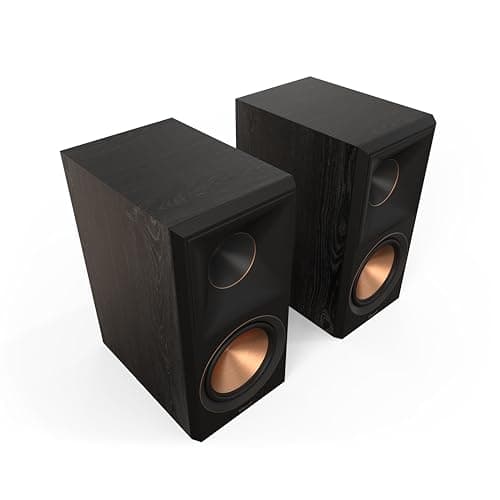 Klipsch RP-600M II Higher sensitivity and a bigger cabinet than the R-51M, which buys headroom rather than a different kind of speaker. | Best step up | 8.6 | |
| 2 | 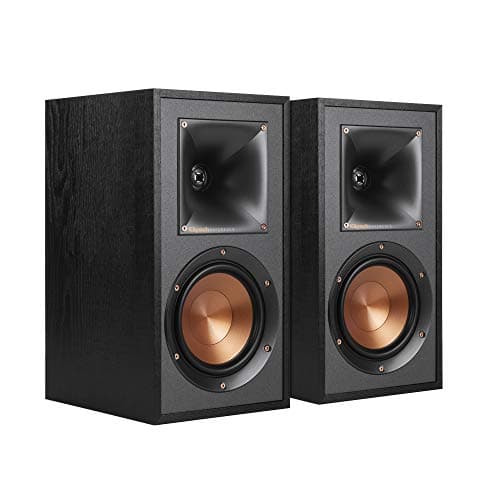 Klipsch R-51M High sensitivity means a modest amplifier drives these to a real volume — the practical answer when the amp is fixed and small. | Best for low-power amplifiers | 8.4 | |
| 3 | 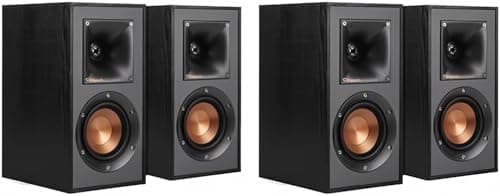 Klipsch R-41M A 4-inch two-way with a published 90 dB sensitivity, which means it goes loud on an amplifier that would embarrass most of its competition. | Best for a very small amplifier | 7.0 | |
| 4 | 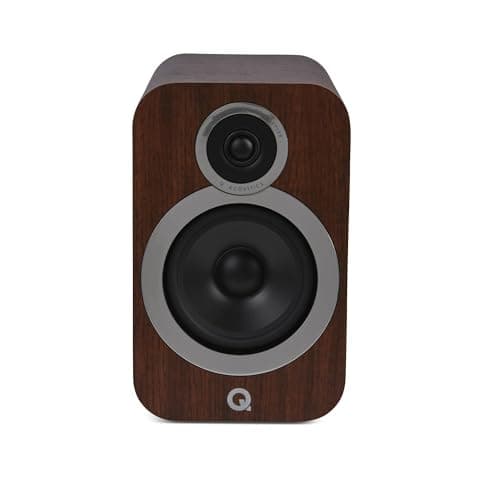 Q Acoustics 3030i The only speaker in this bracket that publishes both a minimum impedance and a recommended amplifier range, on top of a cabinet that is its whole design argument. | Best cabinet | 8.2 |
Sensitivity is the cheapest amplifier upgrade available, because it is free at the point of purchase. A speaker three decibels more sensitive reaches the same level on half the power. Six decibels, a quarter. That arithmetic is why this page exists.
It is also why the figures need reading carefully. Three of the four speakers here are Klipsch, and Klipsch publishes something about its top model that most manufacturers would leave off.
The published figures, with their conditions
| Speaker | Sensitivity | Condition published | Impedance as published |
|---|---|---|---|
| Klipsch RP-600M II | 94.5 dB | 2.83 V / 1 m, half-space anechoic — Klipsch prints the footnote | 8 Ω “compatible” |
| Klipsch R-51M | 93 dB | 2.83 V / 1 m | 8 Ω “compatible” |
| Klipsch R-41M | 90 dB | 2.83 V / 1 m | 8 Ω “compatible” |
| Q Acoustics 3030i | 88 dB | 2.83 V / 1 m | 6 Ω nominal, 4 Ω MINIMUM published |
Two things in that table are unusual and both are disclosures rather than weaknesses.
Klipsch publishes “half-space anechoic” for the RP-600M II. Half-space means the speaker was measured against a boundary, which raises the figure relative to a full-space measurement. Klipsch says so; most manufacturers publishing a high number do not name the condition at all. The 94.5 dB is real for what it describes, and it is not directly comparable to a full-space figure.
Q Acoustics publishes a minimumimpedance of 4 Ω against a 6 Ω nominal. That is the number that actually tells an amplifier what it is in for, and it is published by exactly two speakers on this entire site. It is why the 3030i is here at 88 dB rather than being excluded for not clearing 90.
What the spread is worth
power ratio = 10^(ΔdB ÷ 10) · reference: Klipsch RP-600M II at 94.5 dB
Inputs
- Klipsch RP-600M II: 94.5 dB (2.83 V / 1 m, half-space anechoic) (Klipsch spec sheet (PDF))
- Q Acoustics 3030i: 88 dB (2.83 V / 1 m) (Q Acoustics spec page)
- ELAC Debut 2.0 B6.2, for contrast: 87 dB (2.83 V / 1 m) (ELAC spec page)
Result
RP-600M II → Q Acoustics 3030i: 10^(6.5 ÷ 10) = 4.5× the power
RP-600M II → ELAC B6.2: 10^(7.5 ÷ 10) = 5.6×
R-41M → RP-600M II: 10^(4.5 ÷ 10) = 2.8×
In practical terms: the Cambridge AXA35’s published 35 watts drives the RP-600M II like a 155-watt amplifier drives the ELAC. Nothing about the amplifier changed. The speaker did.
The RP-600M II figure is half-space, so this overstates the real-world gap somewhat — a full-space figure for the same speaker would be lower. Klipsch is the only maker here that publishes enough to know that, which is a point in its favor rather than against. Sensitivity conditions and how to convert between them covers the rest.
Why this matters for tube amplifiers specifically
Tube amplifiers make less power than solid-state ones at the same price and size, and high-sensitivity speakers are the historical answer to that. It is not a coincidence that horn-loaded designs and valve amplification grew up together.
We do not currently rank a hi-fi tube integrated, because we could not verify a set of them as purchasable through our channel with readable published specs — that gap is documented rather than papered over. The tube versus solid-state comparison, on published measurements covers what the two topologies actually differ on.
The same logic applies to any low-power amplifier: a desktop class-D unit, a vintage receiver, or the 35-watt Cambridge. Sensitivity is what makes those systems work.
What high sensitivity does not tell you
It is not a quality figure. A sensitive speaker reaches a given level on less power. That is all it says. It says nothing about frequency response, distortion or dispersion, and we have not heard any of these speakers.
It does not describe the load.Sensitivity and impedance are different specs, and a sensitive speaker with a difficult impedance curve can still be hard work for an amplifier. Three of the four here publish “8 Ω compatible”, which is Klipsch’s wording rather than a measured nominal figure, and none of the three publishes a minimum. Impedance is the other half of the question.
It does not fix the room. Six decibels of sensitivity is worth four times the amplifier power and nothing at all against a room mode.
Ranked, and why
Klipsch RP-600M IIfirst, on the highest published figure and the only measurement footnote in the group. It also publishes 100 W continuous power handling and a 44 Hz ± 3 dB low end, so it is not only sensitive.
Klipsch R-51M second, at 93 dB with a plain 2.83 V / 1 m condition and a much lower price. For a small amplifier this is the value pick of the group.
Klipsch R-41Mthird, at 90 dB. The smallest cabinet here, and the 68 Hz ± 3 dB extension is the price of that.
Q Acoustics 3030ifourth on sensitivity and first on disclosure. Its published 25–75 W recommendation and 4 Ω minimum tell you more about what amplifier to buy than the other three combined.
Every pick in detail
Every specification below links to the manufacturer document we read it from. Where a manufacturer does not publish a figure, we say so rather than estimating it.
Klipsch RP-600M II
Best step upPrice as of October 14, 2026. #ad
Higher sensitivity and a bigger cabinet than the R-51M, which buys headroom rather than a different kind of speaker.
- sensitivity
- 10/10
- bass extension
- 8/10
- amp friendliness
- 10/10
- value for money
- 7/10
- build quality
- 9/10
| Specification | Published value | Source |
|---|---|---|
| Sensitivity | 94.5 dB (2.83 V / 1 m, half-space anechoic — Klipsch's published footnote) | Klipsch spec sheet (PDF) |
| Impedance | 8 Ω “compatible” (Klipsch's wording) | Klipsch spec sheet (PDF) |
| Minimum impedance | Not published | — |
| Frequency response | 44 Hz – 25 kHz ± 3 dB | Klipsch spec sheet (PDF) |
| Power handling | 100 W continuous / 400 W peak | Klipsch spec sheet (PDF) |
| Woofer | 6.5 in Cerametallic with Faraday rings | Klipsch spec sheet (PDF) |
| Crossover | 1,500 Hz | Klipsch spec sheet (PDF) |
| Weight (each) | 18.1 lb / 8.2 kg | Klipsch spec sheet (PDF) |
Pros
- Very high sensitivity
- Larger cabinet and more extension than the R-51M
- Real wood-veneer finishes
Cons
- Well above the $500 bracket
- Large
- Rear port placement constraints remain
Skip it if you are shopping under $500 — this is a bracket up.
Klipsch R-51M
Best for low-power amplifiersPrice as of October 14, 2026. #ad
High sensitivity means a modest amplifier drives these to a real volume — the practical answer when the amp is fixed and small.
- sensitivity
- 10/10
- bass extension
- 6/10
- amp friendliness
- 10/10
- value for money
- 9/10
- build quality
- 7/10
| Specification | Published value | Source |
|---|---|---|
| Sensitivity | 93 dB (2.83 V / 1 m) | Klipsch spec sheet (PDF) |
| Impedance | 8 Ω “compatible” (Klipsch's wording — not a measured nominal figure) | Klipsch spec sheet (PDF) |
| Minimum impedance | Not published | — |
| Frequency response | 62 Hz – 21 kHz ± 3 dB | Klipsch spec sheet (PDF) |
| Power handling | 85 W continuous / 340 W peak (a handling limit, not a recommended amplifier range) | Klipsch spec sheet (PDF) |
| Woofer | 5.25 in spun-copper IMG | Klipsch spec sheet (PDF) |
| Tweeter | 1 in aluminum LTS on a 90° × 90° Tractrix horn | Klipsch spec sheet (PDF) |
| Crossover | 1,660 Hz | Klipsch spec sheet (PDF) |
| Weight (each) | 11 lb / 5 kg | Klipsch spec sheet (PDF) |
Pros
- High sensitivity — plays loud on very little power
- The right answer for a low-wattage or tube amplifier
- Horn tweeter gives strong dispersion control
Cons
- Horn presentation is divisive and we cannot tell you how it sounds — we have not heard them
- Rear port needs breathing room from the wall
- Less low-end than the ELAC B6.2
- Previous generation — Klipsch's own page for it now points buyers to the newer Reference R-50M
Skip it if your amp already has power to spare — you are paying for sensitivity you do not need.
Klipsch R-41M
Best for a very small amplifierPrice as of October 14, 2026. #ad
A 4-inch two-way with a published 90 dB sensitivity, which means it goes loud on an amplifier that would embarrass most of its competition.
- specs
- 6/10
- sensitivity
- 9/10
- published data
- 6/10
- value for money
- 9/10
- bass extension
- 3/10
| Specification | Published value | Source |
|---|---|---|
| Sensitivity | 90 dB (2.83 V / 1 m) | Klipsch spec sheet (PDF) |
| Impedance | 8 Ω “compatible” (Klipsch's wording — not a measured nominal figure) | Klipsch spec sheet (PDF) |
| Minimum impedance | Not published | — |
| Frequency response | 68 Hz – 21 kHz ± 3 dB | Klipsch spec sheet (PDF) |
| Power handling | 50 W continuous / 200 W peak (a handling limit, not a recommended amplifier range) | Klipsch spec sheet (PDF) |
| Woofer | Single 4 in spun-copper IMG | Klipsch spec sheet (PDF) |
| Tweeter | 1 in aluminum LTS on a 90° × 90° Tractrix horn | Klipsch spec sheet (PDF) |
| Crossover | 1,730 Hz | Klipsch spec sheet (PDF) |
| Enclosure | MDF, bass-reflex via rear-firing ports | Klipsch spec sheet (PDF) |
| Weight (each) | 7 lb / 3.2 kg | Klipsch spec sheet (PDF) |
Pros
- 90 dB at 2.83 V/1 m — seven decibels more sensitive than the Micca RB42, which is about five times less amplifier for the same volume
- Klipsch publishes a real ±3 dB tolerance on the frequency response
- 7 lb each and 11.3 in tall: the smallest cabinet here by a clear margin
- Timbre-matched to the R-51M and R-52C if you later build a surround system around it
Cons
- 68 Hz is the shallowest bass extension of any speaker on this site
- “8 ohms compatible” is not a measured nominal impedance, and no minimum impedance is published
- Rear-ported, so it needs clearance behind it — an actual bookshelf will change its bass
- Klipsch publishes power handling, not a recommended amplifier range; those are different specs
- Amazon no longer lists a single pair: the live listing is a two-pair, four-speaker pack, so the price shown here buys four speakers
- Previous generation — Klipsch's own page for it now points buyers to the newer Reference R-40M
Skip it if you listen to anything with real low end and have no subwoofer. 68 Hz means the bottom octave and a half simply is not there.
Q Acoustics 3030i
Best cabinetNo live price right now. #ad
The only speaker in this bracket that publishes both a minimum impedance and a recommended amplifier range, on top of a cabinet that is its whole design argument.
- sensitivity
- 8/10
- bass extension
- 8/10
- amp friendliness
- 7/10
- value for money
- 8/10
- build quality
- 10/10
| Specification | Published value | Source |
|---|---|---|
| Sensitivity | 88 dB (2.83 V / 1 m) | Q Acoustics spec page |
| Impedance (nominal) | 6 Ω | Q Acoustics spec page |
| Minimum impedance | 4 Ω | Q Acoustics spec page |
| Frequency response | 46 Hz – 30 kHz (+3 dB / −6 dB) | Q Acoustics spec page |
| Recommended amplifier power | 25–75 W (stereo amplifier); 50–145 W (AV receiver, 2 ch driven) | Q Acoustics spec page |
| Bass unit | 165 mm (6.5 in) | Q Acoustics spec page |
| Treble unit | 22 mm (0.9 in) decoupled | Q Acoustics spec page |
| Crossover | 2.4 kHz | Q Acoustics spec page |
| Dimensions (H × W × D) | 325 × 200 × 329 mm (12.8 × 7.9 × 13.0 in), including grille and terminals | Q Acoustics spec page |
| Weight (each) | 6.4 kg / 14.1 lb | Q Acoustics spec page |
Pros
- Publishes a minimum impedance (4 Ω) and a recommended amplifier range (25–75 W) — almost nobody else at this price does
- 88 dB sensitivity, the highest here outside the horn-loaded Klipsch
- Unusually inert cabinet for the price, with P2P bracing
- A published 46 Hz low end, which is real extension rather than a bigger box
Cons
- Dips to 4 Ω, so a weak amplifier will struggle despite the friendly sensitivity figure
- Large and deep for a bookshelf at 325 × 200 × 329 mm and 6.4 kg each — this wants a stand
- Reflex port, so it needs clearance behind it
Skip it if your amplifier is rated only into 8 Ω and says nothing about 4 Ω. This speaker's published 4 Ω minimum is exactly the case that exposes it.
Frequently asked questions
What are the most sensitive bookshelf speakers?
Of the speakers we cover, the Klipsch RP-600M II at a published 94.5 dB (2.83 V / 1 m, half-space anechoic), followed by the Klipsch R-51M at 93 dB and the R-41M at 90 dB, both at 2.83 V / 1 m. Klipsch is the only maker here that publishes the half-space footnote for its highest figure.
How much does 3 dB of speaker sensitivity save in amplifier power?
Half. Power scales as 10^(ΔdB ÷ 10), so 3 dB is a factor of two, 6 dB is a factor of four and 10 dB is a factor of ten. The 6.5 dB between the Klipsch RP-600M II and the Q Acoustics 3030i is about four and a half times the amplifier power for the same level.
Are high-sensitivity speakers better for tube amplifiers?
They are the standard answer to low-power amplification, tube or otherwise. A tube amplifier typically makes less power than a solid-state one at the same price, and sensitivity buys that power back for free. The same applies to a small class-D amplifier or a vintage receiver.
Does high sensitivity mean a speaker sounds better?
No. Sensitivity says how loud a speaker plays for a given input and nothing else. It does not describe frequency response, distortion or dispersion, and it does not describe the impedance load the amplifier sees. We have not heard any of these speakers and do not assert a sonic verdict on them.
Read next
Speaker Sensitivity Explained
2.83 V/1 m versus 1 W/1 m, what the conversion is worth in decibels, and the twelve-decibel spread that means sixteen times the power.
Will This Amplifier Drive My Speakers?
Two published numbers, one formula, and the answer is almost always less power than you expected.
Tube vs Solid State Amplifiers
What actually differs in measurable terms, what is preference, and where we have to stop.
The Best Bookshelf Speakers Under $500
Six pairs under $500 — and only one publishes a minimum impedance and a recommended amp range.
The Best Bookshelf Speakers Under $200
Four bookshelf pairs at the $200 mark, and a seven-decibel sensitivity gap that is worth five times the amplifier power.
The Best Integrated Amplifiers Under $500
Four amplifiers under $500, ranked on the power figure each maker actually publishes — and on which of them will drive a 4-ohm speaker.
Sources
Every specification on this page was read from one of these documents. If one of them has changed, or we have made an error, tell us — corrections are logged and dated per our editorial policy.