The Best Speaker Stands for Bookshelf Speakers
Every stand listing leads with a weight rating that no bookshelf speaker comes close to, and none of them tell you the number that decides the purchase: how deep the top plate is, and whether your cabinet fits on it.
The short answer
The Kanto SX26 is the pick, because its published top plate is the only one here long enough to carry the cabinets we actually recommend. Kanto publishes 6.5 × 9.25 in for the SX series against 7 × 7 in for the cheaper SP series — and a Klipsch R-51M is 8.5 in deep, a KEF Q3 Meta 12.0 in, a Q Acoustics 3030i 13.0 in. It is also the only stand here that is fillable, publishes the highest capacity (40 lb per stand, fill included) and separates its cable column from its structural one. It costs close to double what the Kanto SP26 does, and the SP26 is the honest answer for most rooms: the same 26 in height, a rotating plate, a 30 lb rating nothing in our registry threatens, and a cabinet that overhangs the plate at the back. The Kanto SP32is the SP26 with six more inches, which is right for a bar stool or a raised rear row and wrong for a sofa — put a 13.3 in speaker on it and the top of the cabinet is over 45 in off the floor.
Disclosure: we earn a commission if you buy through the links on this page, at no extra cost to you. It does not influence what we pick — our criteria are published and reproducible, so you can check our work. How we pick · Full disclosure
These picks are spec-and-price analyses, not listening tests. We have not heard this gear and we do not pretend to have: every figure below is sourced to the manufacturer and linked, and every price is live or not shown at all. Here are the rules we followed.
Quick picks
Ranked on the published criteria in How We Pick. Prices are live as of November 12, 2026. Tap any row for the full write-up.
- 8.4
- 7.8
- 6.8
| # | Product | Best for | Score | Price |
|---|---|---|---|---|
| 1 | 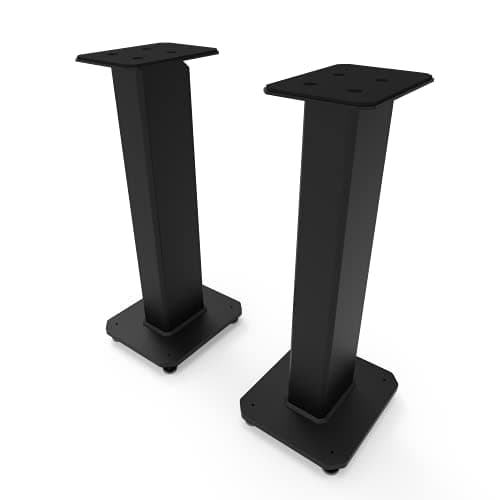 Kanto SX26 The only stand here whose published top plate is long enough to sit a 9 in deep cabinet fully on the plate, and the only one that publishes its 40 lb capacity as including the fill you add. | Best overall for bookshelf speakers | 8.4 | |
| 2 | 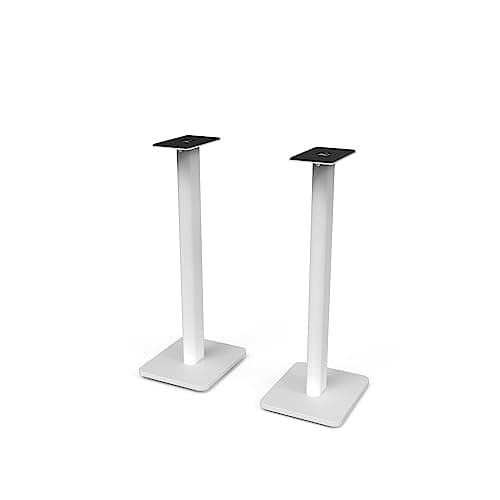 Kanto SP26 At 26 in with a rotating 7 x 7 in plate and a 30 lb rating, this is the height and the capacity that actually match the bookshelf speakers we rank, for a fraction of what the SX costs. | Best value, and the right height for most seating | 7.8 | |
| 3 | 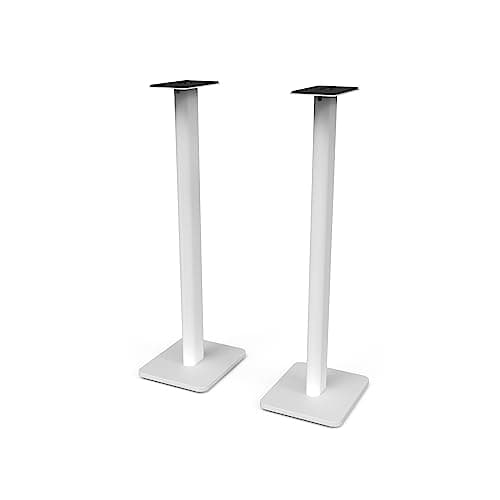 Kanto SP32 Mechanically the SP26 with six more inches of column, which is either exactly what your room needs or six inches too many - and for a normal sofa it is the latter. | Best for high seating or a raised second row | 6.8 |
Open any speaker stand listing and the first specification you see is a weight rating. Ours publish 30 lb and 40 lb per stand. The heaviest bookshelf speaker in this site's entire registry is the Klipsch RP-600M IIat 18.1 lb, and the KEF Q3 Meta matches it. So the headline number has somewhere between 12 and 22 lb of slack on every pair we would recommend, which makes it the least useful figure in the whole purchase — and it is the only one most listings publish clearly.
The figures that do decide it are the top plate dimensions and the stand height, and both have to be read against your own speaker's published cabinet dimensions rather than against each other. That is the whole method on this page: two published numbers per stand, two published numbers per speaker, and arithmetic you can redo with a tape measure.
Why only three stands are ranked here
Six stands were resolved to live Amazon listings for this page on 24 October 2026. Three of them are not ranked, and the reason is documentary rather than acoustic:
- Monoprice Monolith (32 in)— monoprice.com returns HTTP 403 to every request for the stand's product page. The figures circulating in search results for it (100 lb capacity, an MDF top plate) trace back to retailer listings, and retailer spec fields are wrong often enough that this site treats them as unsourced. Same failure mode we already document for Sony on the integrated amplifier roundup.
- Sanus BF24B— the listing is live on Amazon, but sanus.com redirects the BF24B product URL to its speaker-mount category index. The product page is gone, and the Amazon listing returned an empty availability field on the same pass.
- ECHOGEAR floor stands— echogear.com has no specification page for them at all. Every height, plate size and capacity figure for these in search results originates with a reseller.
None of those three is necessarily a bad stand. We simply cannot tell you a single verified number about any of them, and a pick we cannot describe with the maker's own figures is an advertisement. So the list is short and the reason is printed.
Criterion 1: the top plate against your cabinet depth
A bookshelf speaker is usually deeper than it is wide. A stand's top plate is usually square or wider than it is deep. Those two facts collide, and the collision is the single most common mistake in this purchase.
| Speaker | Published W × D | On a 7 × 7 in SP plate | On a 6.5 × 9.25 in SX plate |
|---|---|---|---|
| Klipsch R-51M | 7.0 × 8.5 in | 1.5 in of cabinet past the plate | Fully on the plate |
| ELAC Debut 3.0 DB63 | 7.7 × 11.7 in | 4.7 in past the plate | 2.45 in past the plate |
| KEF Q3 Meta | 8.3 × 12.0 in | 5.0 in past the plate, and 1.3 in wider than it | 2.75 in past the plate, and 1.8 in wider |
| Q Acoustics 3030i | 7.9 × 13.0 in | 6.0 in past the plate | 3.75 in past the plate |
| Micca RB42 | 4.9 × 7.9 in | 0.9 in past the plate | Fully on the plate |
Cabinet dimensions as published by each manufacturer: Klipsch R-51M spec sheet, ELAC DB63, KEF Q3 Meta, Q Acoustics 3030i, Micca RB42. Plate sizes from Kanto's own SP and SX tables.
overhang = cabinet depth − top plate depth
Inputs
- Klipsch R-51M depth: 8.5 in (215 mm) (Klipsch spec sheet (PDF))
- Kanto SP series largest plate: 7 × 7 in (17.8 × 17.8 cm) (Kanto SP-series table)
- Kanto SX series larger plate: 6.5 in W × 9.25 in L (Kanto SX-series table)
Result
On the SP plate: 8.5 − 7 = 1.5 in of cabinet unsupported. On the SX plate: 8.5 − 9.25 = −0.75 in, i.e. the plate is longer than the cabinet and there is nothing hanging off it. The 3030i is the worst case in our registry at 13.0 − 7 = 6.0 in of overhang on the SP plate.
Criterion 2: height, which is not a taste question
Stand height is sold as a preference and it is really arithmetic. The target is the tweeter roughly level with your ear when you are seated, so the usable equation is straightforward — and the term nobody publishes is the one that matters most.
cabinet top height = stand height + cabinet height
Inputs
- Kanto SP26 / SX26 height: 26 in (66 cm) (Kanto SP-series table)
- Kanto SP32 height: 32 in (81.3 cm) (Kanto SP-series table)
- Klipsch R-51M cabinet height: 13.3 in (338 mm) (Klipsch spec sheet (PDF))
- KEF Q3 Meta cabinet height: 14.1 in (357 mm) (KEF spec page)
Result
R-51M on a 26 in stand: 39.3 in to the top of the cabinet. The same speaker on the 32 in stand: 45.3 in. KEF Q3 Meta on 26 in: 40.1 in. Six inches of column moves the whole speaker six inches, and on a sofa that is the difference between the tweeter near your ear and the tweeter above your head.
Run that equation for a normal sofa and 26 in keeps winning. Run it for a kitchen island, a bar stool, a standing desk or a second row of raised home-theater seating and 32 in starts to make sense. That is the entire case for the taller stand, and it is why the SP32 ranks third here despite being the same stand as our second pick. If your speakers are going on a desk rather than the floor, neither is the answer — that is a different product category and a different page.
Criterion 3: mass, and the only one of these that is fillable
A stand resists the cabinet pushing back at it. More mass lower down means less of that energy becomes stand movement. Kanto publishes two fill bags with the SX series and publishes its 40 lb capacity as including the fill, which is unusually careful wording — a capacity figure that counted only the speaker would let you load the stand past its real limit. The SP series is not fillable at all: its columns are hollow for cable routing, and Kanto publishes no fill bags and no fill capacity for them.
Two published-data complaints, both on Kanto rather than on the stands. First, the SP product weight is published as 34.4 lb for the 26 in and 35.9 lb for the 32 in with no statement of whether that is per stand or per pair— which makes it impossible to compare against anything. Second, on the SX series Kanto publishes 44.5 lb for the 26 in model and 42.8 lb for both the 22 in and the 30 in, so the published weight does not rise with height. We print both figures as published and we do not invent an explanation for either.
headroom = published capacity per stand − published speaker weight
Inputs
- Kanto SP26 / SP32 capacity: 30 lb (13.6 kg) per stand (Kanto SP-series table)
- Kanto SX26 capacity: 40 lb (18.1 kg) per stand including fill (Kanto SX-series table)
- KEF Q3 Meta weight (each): 18.1 lb (8.2 kg) (KEF spec page)
- Klipsch R-51M weight (each): 11 lb (5 kg) (Klipsch spec sheet (PDF))
Result
Heaviest bookshelf speaker we rank on the cheapest stand here: 30 − 18.1 = 11.9 lb spare. A Klipsch R-51M on the same stand: 19 lb spare. The capacity spec is never the binding constraint on a bookshelf speaker, which is exactly why it should not be the number you shop on.
What a stand does not fix
A stand gets the cabinet off a sideboard, away from the boundary reinforcement of a shelf, and up to the height where the tweeter aims at you. It does not change the room. The reflection off the wall beside the speaker arrives a fraction of a millisecond after the direct sound whether the speaker is on a stand or not, and that is a first-reflection problem, not a furniture problem. If you have just put speakers on stands and the imaging is still vague, the next thing to buy is not a better stand — it is two panels on the side walls, and we have reviewed the panel most people end up buying including the 125 Hz figure its NRC rating hides.
A stand also does not change what your speakers do below their published cutoff. A Klipsch R-51M is −3 dB at 62 Hz on a stand and −3 dB at 62 Hz on a shelf. If what you want is the bottom octave, that is a subwoofer question.
Spikes or rubber feet
All three stands here publish both in the box, so this is a decision and not a purchase. Spikes on carpet, because the point is to get through the pile to the subfloor and stop the stand rocking on a soft layer. Rubber on hardwood, tile or laminate, because a spike on a hard floor is a dent and because the rubber is what actually decouples there. Kanto calls the spikes “isolating floor spikes”; on carpet they are coupling the stand to the floor, not isolating it from the floor, and the distinction is worth keeping straight when you read marketing copy. Neither Kanto nor anyone else publishes a measurement for what either option does, so treat both as mechanical fit rather than performance.
Bolt the speaker down, or do not
The SP series gives you one central quarter-inch-20 screw up through the plate. The SX series publishes four corner holes instead, which is better in principle because the fixing can follow the cabinet's own footprint rather than its center — but only if your speaker has threaded inserts in its base, and almost none of the bookshelf speakers we rank do. In practice most readers will be relying on friction plus the pad, which is fine and is also the reason not to buy the tallest stand available. A 45 in tower of speaker and stand held together by a foam pad is a different proposition to a 39 in one, especially with toe-in angled in and a cable pulling at the back.
How we ranked them
Published top plate fit against the cabinets this site actually recommends, first. Then height against the arithmetic above. Then mass and whether it can be increased. Then whether the cable routing is a structural compromise or a dedicated channel. Then price, last — which is why the cheapest stand here is not bottom of the list and the most expensive one is not automatically top. We have not measured any of these stands and we do not claim to have heard a difference between them; every figure above is the manufacturer's own, with the table it was read from linked beside it.
Every pick in detail
Every specification below links to the manufacturer document we read it from. Where a manufacturer does not publish a figure, we say so rather than estimating it.
Kanto SX26
Best overall for bookshelf speakersNo live price right now. #ad
The only stand here whose published top plate is long enough to sit a 9 in deep cabinet fully on the plate, and the only one that publishes its 40 lb capacity as including the fill you add.
- published data
- 8/10
- top plate fit
- 10/10
- mass and stability
- 9/10
- cable routing
- 9/10
- value for money
- 5/10
| Specification | Published value | Source |
|---|---|---|
| Height | 26 in (66 cm) | Kanto SX-series spec table |
| Product dimensions | 9.5 × 11.2 × 26 in (24.1 × 28.5 × 66 cm) | Kanto SX-series spec table |
| Top plate | 5.25 in W × 6.5 in L (13.3 × 16.5 cm) or 6.5 in W × 9.25 in L. Kanto publishes this row once for the whole SX series with “or” between the two sizes and does not break it out per model | Kanto SX-series spec table |
| Maximum speaker weight | 40 lb (18.1 kg) per stand including fill — the highest published figure of any stand here, and the only one that states the fill is counted inside it | Kanto SX-series spec table |
| Product weight | 44.5 lb (20.2 kg). Kanto publishes 42.8 lb for BOTH the 22 in and the 30 in models, so the published weight does not rise with height | Kanto SX-series spec table |
| Material | Heavy duty aluminum, steel and plastic construction | Kanto SX-series spec table |
| Fill | 2 × bags for filling material included | Kanto SX-series spec table |
| Cable routing | A separate, spacious column routes multiple power cables | Kanto SX-series spec table |
| Feet | Isolating floor spikes or domed rubber feet included | Kanto SX-series spec table |
| Speaker fixing | 4 corner holes for direct speaker mounting | Kanto SX-series spec table |
| Warranty | 5 years | Kanto SX-series spec table |
| Fill mass in lb or kg | Not published | — |
| Recommended filling material | Not published | — |
Pros
- Published top plate of up to 6.5 x 9.25 in - the only one here long enough to fully carry a cabinet 9 in deep
- Highest published capacity at 40 lb (18.1 kg) per stand, and Kanto states the fill is counted inside that figure
- Two fill bags are in the box, so the mass is a deliberate specification rather than a hollow tube
- A dedicated cable column separate from the structural column, published as routing multiple power cables - the only stand here that separates the two
- Four corner mounting holes rather than one central screw, which lets the fixing follow the cabinet's own footprint
- Five-year published warranty, the only warranty figure published for any stand here
Cons
- By far the most expensive stand here, and the gap is not small
- Kanto publishes 44.5 lb for this 26 in model but 42.8 lb for BOTH the 22 in and the 30 in, so the published weight does not rise with height - we report the figure, we cannot explain it
- No fill mass is published at all, so you cannot know what the stand weighs once loaded or how close you are to the 40 lb figure
- Kanto does not say which filling material it recommends
- The two published top plate sizes are listed once for the whole SX series with 'or' between them, so whether both are in the box for this model is not stated
- Four corner holes only help if your speaker has threaded inserts - most bookshelf speakers do not, and then it is a friction fit like any other stand
Skip it if your speakers are small and light. A Klipsch R-41M is 7 lb on a 5 in wide cabinet, and nothing about a 40 lb-rated fillable stand is earned by it.
Kanto SP26
Best value, and the right height for most seatingPrice as of November 12, 2026. #ad
At 26 in with a rotating 7 x 7 in plate and a 30 lb rating, this is the height and the capacity that actually match the bookshelf speakers we rank, for a fraction of what the SX costs.
- published data
- 7/10
- top plate fit
- 6/10
- mass and stability
- 7/10
- cable routing
- 7/10
- value for money
- 9/10
| Specification | Published value | Source |
|---|---|---|
| Height | 26 in (66 cm) | Kanto SP-series spec table |
| Top plate (two included) | 4.3 × 7.1 in (11 × 18 cm) or 7 × 7 in (17.8 × 17.8 cm), interchangeable and rotating | Kanto SP-series spec table |
| Base footprint | 8.9 × 10.6 in (22.5 × 26.8 cm) | Kanto SP-series spec table |
| Maximum speaker weight | 30 lb (13.6 kg) per stand | Kanto SP-series spec table |
| Product weight | 34.4 lb (15.6 kg) — Kanto does not state whether this figure is per stand or per pair | Kanto SP-series spec table |
| Material | Solid steel construction with durable powder-coated finish | Kanto SP-series spec table |
| Cable routing | Hollow columns | Kanto SP-series spec table |
| Feet | Isolating floor spikes or domed rubber feet included | Kanto SP-series spec table |
| Speaker fixing | Bottom 1/4"-20 mounting screw | Kanto SP-series spec table |
| Fillable column | No — the columns are hollow for cables, and Kanto publishes no fill bags and no fill capacity for the SP series | Kanto SP-series spec table |
| Top plate load rating stated separately from stand capacity | Not published | — |
| Tweeter-axis height with any given speaker | Not published | — |
Pros
- 26 in is the height the arithmetic keeps landing on for a normal sofa with a 13 in cabinet on top
- Two interchangeable top plates published - 4.3 x 7.1 in and 7 x 7 in - and the plate rotates, so you can aim the speaker without moving the base
- 30 lb (13.6 kg) per stand clears every bookshelf speaker in our registry with room to spare; the heaviest we cover is 18.1 lb
- Hollow steel columns take the speaker cable out of sight
- Both spikes and domed rubber feet are in the box, so carpet and hardwood are each covered
- Solid steel with a powder-coated finish, and a published 8.9 x 10.6 in base - a wider footprint than the cabinet it carries
Cons
- The larger plate is 7 x 7 in, and four of the bookshelf speakers we rank are deeper than 7 in, so the cabinet will overhang the plate front to back
- Not fillable: Kanto publishes no fill bags and no fill capacity for the SP series, so the mass is whatever the steel weighs
- The 34.4 lb product weight is published without saying whether it is per stand or per pair, which makes it useless for comparing against a filled stand
- One central quarter-inch-20 screw, so the fixing point sits at the plate center whether or not that is under your cabinet's center of mass
- No warranty figure is published for the SP series
Skip it if your listening seat is high - a bar stool, a raised second row - in which case the 32 in SP32 is the same stand at the height you need.
Kanto SP32
Best for high seating or a raised second rowPrice as of November 12, 2026. #ad
Mechanically the SP26 with six more inches of column, which is either exactly what your room needs or six inches too many - and for a normal sofa it is the latter.
- published data
- 7/10
- top plate fit
- 6/10
- mass and stability
- 5/10
- cable routing
- 7/10
- value for money
- 7/10
| Specification | Published value | Source |
|---|---|---|
| Height | 32 in (81.3 cm) | Kanto SP-series spec table |
| Top plate (two included) | 4.3 × 7.1 in (11 × 18 cm) or 7 × 7 in (17.8 × 17.8 cm), interchangeable and rotating | Kanto SP-series spec table |
| Base footprint | 8.9 × 10.6 in (22.5 × 26.8 cm) — identical to the 26 in model despite standing 6 in taller | Kanto SP-series spec table |
| Maximum speaker weight | 30 lb (13.6 kg) per stand | Kanto SP-series spec table |
| Product weight | 35.9 lb (16.3 kg) — 1.5 lb more than the 26 in model, and again with no per-stand or per-pair qualifier | Kanto SP-series spec table |
| Material | Solid steel construction with durable powder-coated finish | Kanto SP-series spec table |
| Cable routing | Hollow columns | Kanto SP-series spec table |
| Feet | Isolating floor spikes or domed rubber feet included | Kanto SP-series spec table |
| Speaker fixing | Bottom 1/4"-20 mounting screw | Kanto SP-series spec table |
| Fillable column | No — hollow for cables only | Kanto SP-series spec table |
| Tweeter-axis height with any given speaker | Not published | — |
Pros
- 32 in is the only height here that suits a bar stool, a kitchen island or a raised rear row of seating
- Same two interchangeable rotating top plates as the SP26, 4.3 x 7.1 in and 7 x 7 in
- Same published 30 lb (13.6 kg) per stand capacity, which is more than any bookshelf speaker we cover needs
- Same hollow-column cable routing, and the same spikes-or-rubber feet in the box
- Published base footprint is identical to the 26 in model at 8.9 x 10.6 in
Cons
- Too tall for the job most people buy it for - put a 13.3 in cabinet on it and the top of the speaker is over 45 in off the floor
- Kanto keeps the base footprint identical to the 26 in model while adding 6 in of height, so the stand is proportionally less stable and the published weight rises only 1.5 lb
- Not fillable, same as the SP26, so nothing can be done about the mass
- Same 7 x 7 in maximum plate, so the same overhang on every cabinet deeper than 7 in
- Same missing per-stand or per-pair qualifier on the published weight, and no published warranty
Skip it if you listen from a normal sofa or armchair. Buy the SP26 - it is the same stand at the height the arithmetic actually asks for.
Frequently asked questions
What are the best speaker stands for bookshelf speakers?
How tall should speaker stands be for bookshelf speakers?
Does the top plate have to be as big as the speaker?
Does speaker stand weight capacity matter?
Should I fill my speaker stands with sand?
Spikes or rubber feet on speaker stands?
Why do you only rank three stands, and all from one brand?
Have you tested these stands?
Read next
Stereo Speaker Placement
Dolby's 22-30 degree window turned into a listening-distance rule, plus height, toe-in, boundaries and the port clearance most people miss.
Speaker Toe-In: How Much, and Does It Matter?
The toe-in angle is arctan of half the speaker separation over the listening distance. Klipsch publishes a 90 by 90 degree horn on five models; nobody else on this site publishes a dispersion figure at all.
The Best Bookshelf Speakers Under $500
Six pairs under $500 — and only one publishes a minimum impedance and a recommended amp range.
The Best Bookshelf Speakers Under $300
Five passive pairs at the $300 mark, and a ten-decibel sensitivity spread that decides which amplifier each one needs.
Bookshelf vs Floorstanding Speakers
Cabinet volume buys extension; a subwoofer buys extension you can place independently. The trade, with each maker's own numbers.
Find Your First Reflection Points
The mirror trick, in five minutes and for free — plus why those two points matter more than six panels elsewhere.
Sources
Every specification on this page was read from one of these documents. If one of them has changed, or we have made an error, tell us — corrections are logged and dated per our editorial policy.
- Kanto SP series — specification table (heights, both top plate sizes, 30 lb capacity, base footprint, feet, mounting screw)
- Kanto SX series — specification table (heights, top plate sizes, 40 lb including fill, fill bags, cable column, 5-year warranty)
- Klipsch R-51M — spec sheet (13.3 × 7 × 8.5 in, 11 lb, 62 Hz − 21 kHz ± 3 dB)
- KEF Q3 Meta — specifications (357 × 210 × 305 mm, 8.2 kg / 18.1 lb)
- Q Acoustics 3030i — specifications (325 × 200 × 329 mm, 6.4 kg)
- ELAC Debut 3.0 DB63 — specifications (13.3 × 7.7 × 11.7 in, 17.3 lb)
- Micca RB42 — specifications (8.7 × 4.9 × 7.9 in; weight not published)