SVS SB-1000 Pro vs Klipsch R-120SW
Two 12 in subwoofers that get recommended in the same breath and are not interchangeable. The published numbers split them on three things: what the frequency response was measured under, how high the low-pass reaches, and whether the amplifier you own can connect to it at all.

The short answer
The SVS SB-1000 Pro, and the deciding factor is not the 20 Hz — it is that every figure on its spec sheet can be checked and two of the figures you need are missing from the Klipsch's. SVS publishes 20–270 Hz ±3 dB with the measurement condition stated(2 m ground plane, quasi-anechoic), 325 W RMS continuous, a 13.3 mm Xmax, and both input impedances — 16 kΩ line and 1 kΩ speaker-level. Klipsch publishes 29–120 Hz ±3 dB with no condition, 200 W continuous against a 400 W peak, a 116 dB maximum output figure SVS does not publish at all, and no low-pass crossover range for a control that is fitted to the back panel. Buy the R-120SW if you want the bigger cabinet and the louder published SPL for film in a larger room and your receiver has a subwoofer output. Buy the SB-1000 Pro if your room is small, your amplifier may not have a subwoofer output, or you intend to integrate it with bookshelf speakers properly.
Disclosure: we earn a commission if you buy through the links on this page, at no extra cost to you. It does not influence what we pick — our criteria are published and reproducible, so you can check our work. How we pick · Full disclosure
These picks are spec-and-price analyses, not listening tests. We have not heard this gear and we do not pretend to have: every figure below is sourced to the manufacturer and linked, and every price is live or not shown at all. Here are the rules we followed.
Quick picks
Ranked on the published criteria in How We Pick. Prices are live as of November 12, 2026. Tap any row for the full write-up.
- 9.0
- 8.2$329.00View on Amazon
$599.0045% off
| # | Product | Best for | Score | Price |
|---|---|---|---|---|
| 1 | 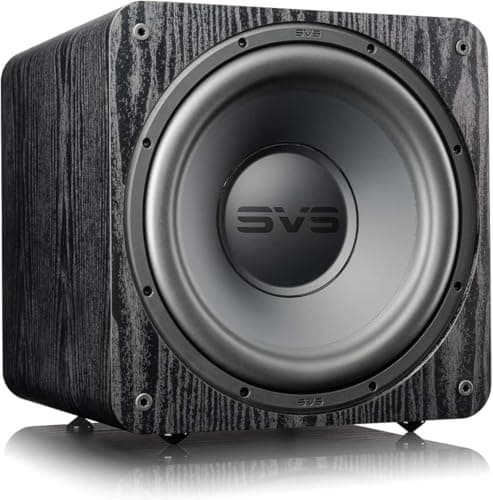 SVS SB-1000 Pro The only subwoofer here whose manufacturer publishes both a continuous power rating and the measurement condition behind its frequency response — 20–270 Hz ± 3 dB at 2 m ground plane — which is what makes its numbers comparable to anything. | Best overall | 9.0 | |
| 2 | 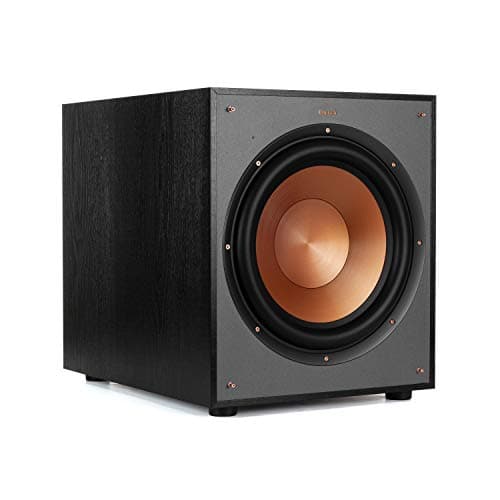 Klipsch R-120SW A 12-inch ported sub whose spec sheet publishes 200 W continuous next to the 400 W peak figure the listings quote — and whose only inputs are RCA, which is the spec that decides whether it works with your amplifier. | Best value 12-inch | 8.2 | $329.00View on Amazon $599.0045% off |
These two get recommended together constantly, and on paper they look like the same purchase: a 12 in driver, a class D plate amplifier, a similar price bracket. They are not the same purchase. One is a small sealed box with a published measurement condition and a DSP app; the other is a substantially larger rear-ported box with a louder published SPL and a specification sheet that leaves out the number you need to set it up.
The published numbers, side by side
| Specification | SVS SB-1000 Pro | Klipsch R-120SW |
|---|---|---|
| Frequency response | 20–270 Hz ±3 dB, 2 m ground plane (quasi-anechoic) | 29–120 Hz ±3 dB, no condition stated |
| Enclosure | Sealed, thick MDF front baffle, internally braced | Bass reflex, rear-firing port, MDF |
| Amplifier | 325 W RMS continuous (820+ W peak), Sledge STA-325D | 200 W continuous / 400 W peak, all-digital |
| Maximum output | Not published | 116 dB |
| Driver detail | 13.3 mm Xmax, 26.9 mm Xmech, 1.5 in voice coil | 12 in spun-copper IMG, front-firing — no excursion figure |
| Inputs | RCA in/out at 16 kΩ plus speaker-level at 1 kΩ; 3–12 V trigger | Line level / LFE RCA only — no speaker-level inputs |
| Low-pass crossover | App-adjustable, plus 3 parametric EQ bands per preset | Control fitted, range NOT published |
| Dimensions (H × W × D) | 13.5 × 13 × 14.76 in | 16.5 × 14 × 19.2 in |
| Weight | 26 lb | 31 lb |
SVS SB-1000 Pro product page and Klipsch R-120SW spec sheet (PDF).
The 9 Hz nobody should buy on
SVS says 20 Hz. Klipsch says 29 Hz. That looks like the whole comparison and it is the least safe number in it, because only one of the two tells you how it was obtained. SVS's figure carries its condition: 2 m ground plane, away from reflective structures, which is a quasi-anechoic measurement. Klipsch's 29 Hz ±3 dB carries nothing. A figure measured close to boundaries and a figure measured away from them are not the same kind of figure, and without the condition you cannot tell which you are reading.
That is not an accusation — Klipsch may well have measured it the same way. It is the point that our home theater subwoofer roundup ranks on: SVS is the only manufacturer in the group we cover that publishes a measurement condition at all, and a number you can audit is worth more than a number that is 9 Hz lower and cannot be.
The 120 Hz ceiling, which is the real split
Look at the top of the published range instead of the bottom. SVS publishes up to 270 Hz. Klipsch publishes up to 120 Hz. For a 5.1 system fed an LFE channel that ceiling is irrelevant — LFE is band-limited well below it. For anyone integrating a subwoofer with small main speakers it is the number that decides the job, because the handover has to happen where the main speakers actually stop.
crossover ≈ main speaker −3 dB point (then check it is inside the subwoofer's published range)
Inputs
- Klipsch R-51M response: 62 Hz – 21 kHz ± 3 dB (Klipsch spec sheet (PDF))
- ELAC Debut 3.0 DB63 response (−3 dB): 50 Hz – 34 kHz (ELAC owner's manual figure)
- SVS SB-1000 Pro published range: 20–270 Hz ± 3 dB (SVS product page)
- Klipsch R-120SW published range: 29–120 Hz ± 3 dB (Klipsch spec sheet (PDF))
Result
A Klipsch R-51M wants the handover near 62–65 Hz; an ELAC DB63 near 50–55 Hz. Both sit comfortably inside both subwoofers' published ranges, so on extension alone either works. The difference appears at the other end: a receiver set to the common 80 Hz or a small satellite crossed at 100–120 Hzis at or past the top of the Klipsch's published range, while the SVS has 150 Hz of published headroom above it.
Whether your amplifier can connect to it at all
This is the one that sends subwoofers back. The Klipsch R-120SW spec sheet lists line level / LFE RCA jacks only — no speaker-level inputs. If your amplifier is an AV receiver that is a non-issue, because a receiver always has a subwoofer output. If it is a two-channel integrated amplifier, many of which have no subwoofer output at all, the R-120SW cannot be connected without adding something — and the SB-1000 Pro can, because SVS publishes a speaker-level stereo input and even states its impedance at 1 kΩ alongside the 16 kΩ line input.
Published input impedances are rarer than they should be in this category, and they are the difference between knowing a connection is appropriate and hoping. It is also why the R-120SW is our second pick for a film room and is not in the picks at all on the subwoofer roundup written for a stereo amplifier.
Sealed and small, or ported and large
The enclosure difference is real and it is mostly a room decision rather than a quality one. The Klipsch cabinet is 19.2 in deep against the SVS's 14.76 in, and its port fires backwards, so it needs clearance behind it that the sealed SVS does not. Neither maker publishes a recommended wall clearance or a port tuning frequency, which means nobody can tell you how much space is enough — a rear port in a tight corner is the one placement this comparison would actually warn you off, and the reasoning is on our subwoofer placement page.
Against that, the bigger box is published louder. Klipsch states a 116 dB maximum acoustic output; SVS publishes no maximum SPL figure for the SB-1000 Pro at all, so this is one comparison where the Klipsch has the number and the SVS has the gap. In a large open-plan film room that is a genuine argument for the Klipsch, and we are not going to pretend otherwise because the sealed box wins the rest of the sheet. The category argument — what sealed and ported actually trade against each other — is on our ported versus sealed page, and cabinet size against extension is worked through on what size subwoofer you need.
Power ratings that are not the same rating
SVS publishes 325 W RMS continuous with an 820+ W peak figure beside it. Klipsch publishes 200 W continuous and 400 W peak, and the 400 W is the number that appears in retail listings. Compare continuous to continuous and the gap is 325 W against 200 W; compare the peaks and it is 820 W against 400 W. Either way the SVS is the bigger amplifier, but the reason to read the pair carefully is that these two makers label the figures differently, and a listing quoting “400 W” against “325 W” inverts the comparison. The same trick appears throughout this category and we take it apart on how to read an amplifier power rating.
SVS also publishes a 13.3 mm Xmax and 26.9 mm Xmechfor its driver, which is the specification that tells you how much linear excursion the motor actually has. Klipsch publishes “12 in high-excursion spun-copper IMG woofer” and no excursion figure. “High-excursion” is a description; 13.3 mm is a number.
What the SVS gives you that is not on the spec sheet
The SB-1000 Pro's DSP is published as a 50 MHz Analog Devices part driving a Bluetooth app with three nameable presets, three parametric EQ bands per preset, and adjustable low-pass, phase, polarity and room-gain compensation. Three EQ bands will not fix a room mode — nothing on a subwoofer's back panel will — but they let you pull down the single loudest peak, which is usually the complaint people describe as “boomy”. The Klipsch gives you volume, low-pass, a 0/180 phase switch and auto power-on, which is the conventional set and is also the set that cannot be saved, recalled or read off a screen.
Both are easier to get right once the subwoofer is in a sensible place, and placement is worth more than either amplifier or either app. If the room still booms after you have moved it, the next purchase is corner absorption rather than a different subwoofer — and we have reviewed the panel most people buy first, including why its NRC rating tells you nothing about the band a subwoofer lives in.
Which one to buy
Choose the SVS SB-1000 Pro if your room is small or your listening is two-channel, if your amplifier might not have a subwoofer output, if your main speakers are bookshelf-sized and you want the handover set to a number you can see, or if you simply prefer buying from the one maker in this category that prints its measurement conditions. It is also the smaller box by a wide margin, which matters more in practice than most people expect.
Choose the Klipsch R-120SW if the room is large, the use is film, the receiver has a subwoofer output, and you want the published 116 dB maximum output and the bigger cabinet for the money. Give the rear port room to breathe, and accept that you are setting the low-pass by ear because the range is not published.
Both are in our picks for a reason, and the full six-way ranking — including the two sealed alternatives and the one subwoofer in the group that publishes a 50 Hz low-pass floor — is on the best subwoofers for a home theater.
Every pick in detail
Every specification below links to the manufacturer document we read it from. Where a manufacturer does not publish a figure, we say so rather than estimating it.
SVS SB-1000 Pro
Best overallPrice as of November 12, 2026. #ad
The only subwoofer here whose manufacturer publishes both a continuous power rating and the measurement condition behind its frequency response — 20–270 Hz ± 3 dB at 2 m ground plane — which is what makes its numbers comparable to anything.
- extension
- 9/10
- published data
- 10/10
- room control
- 10/10
- value for money
- 6/10
- build quality
- 9/10
| Specification | Published value | Source |
|---|---|---|
| Frequency response | 20–270 Hz ± 3 dB, measured 2 m ground plane away from reflective structures (quasi-anechoic). SVS is the only manufacturer in this group that publishes the measurement condition. | SVS product page |
| Amplifier power | 325 W RMS continuous (820+ W peak dynamic), Sledge STA-325D class D | SVS product page |
| Driver | 12 in long-throw, 13.3 mm Xmax / 26.9 mm Xmech, 1.5 in voice coil | SVS product page |
| Enclosure type | Sealed, extra-thick MDF front baffle with internal bracing | SVS product page |
| Inputs | Unbalanced stereo RCA in/out (16 kΩ) plus speaker-level stereo input (1 kΩ); 3–12 V AC/DC trigger | SVS product page |
| DSP / app | 50 MHz Analog Devices DSP; Bluetooth app for iOS/Android with 3 nameable presets, 3 parametric EQ bands per preset, adjustable low pass, phase, polarity and room-gain compensation | SVS product page |
| Dimensions (with grille) | 13.5 in H × 13 in W × 14.76 in D (342 × 330 × 375 mm) | SVS product page |
| Weight | 26 lb (11.9 kg) unboxed with grille | SVS product page |
Pros
- 325 W RMS continuous is a continuous rating, not a peak figure dressed as one
- 20–270 Hz ± 3 dB published WITH its measurement condition — nobody else here does that
- App DSP with three parametric EQ bands per preset and room-gain compensation, which is real control over the one band room correction handles worst
- Speaker-level inputs as well as RCA, so an integrated amp with no sub output can still drive it
- Sealed 13-inch cabinet — it fits where a ported 12 will not
Cons
- The most expensive pick here
- Sealed alignment trades raw output near tuning for a gentler roll-off — a ported box of the same size will play louder at 30 Hz
- The app is the interface for the good features; the front panel alone is not
- One of these in a large open-plan room will run out before a bigger ported sub does
Skip it if your room is large and open-plan and output matters more to you than measured accuracy. A ported 12 costs less and moves more air down low.
Klipsch R-120SW
Best value 12-inchA 12-inch ported sub whose spec sheet publishes 200 W continuous next to the 400 W peak figure the listings quote — and whose only inputs are RCA, which is the spec that decides whether it works with your amplifier.
- extension
- 8/10
- published data
- 8/10
- room control
- 4/10
- value for money
- 9/10
- build quality
- 7/10
| Specification | Published value | Source |
|---|---|---|
| Frequency response | 29 Hz – 120 Hz ± 3 dB | Klipsch spec sheet (PDF) |
| Amplifier power (cont/peak) | 200 W / 400 W, all-digital. The 400 W is the peak figure and it is the one the listings quote. | Klipsch spec sheet (PDF) |
| Maximum acoustic output | 116 dB | Klipsch spec sheet (PDF) |
| Driver | 12 in high-excursion spun-copper IMG woofer, front-firing | Klipsch spec sheet (PDF) |
| Enclosure type | Bass-reflex via rear-firing port, MDF | Klipsch spec sheet (PDF) |
| Inputs | Line level / LFE RCA jacks only — NO speaker-level inputs | Klipsch spec sheet (PDF) |
| Controls | Volume, low-pass, 0/180 phase, auto power on | Klipsch spec sheet (PDF) |
| Dimensions | 16.5 in H × 14 in W × 19.2 in D (419 × 356 × 488 mm) | Klipsch spec sheet (PDF) |
| Weight | 31 lb (14.1 kg) | Klipsch spec sheet (PDF) |
| Low-pass crossover range | Not published | — |
Pros
- 200 W continuous IS published, alongside the 400 W peak — Klipsch prints both
- 29 Hz – 120 Hz ± 3 dB, a real tolerance rather than a bare number
- Maximum acoustic output published at 116 dB
- Front-firing driver with a rear port, so it is less fussy about how far it sits from a wall than a down-firing design
Cons
- Line/LFE RCA inputs ONLY — no speaker-level inputs, so an integrated amp with no subwoofer output cannot drive it without a converter
- The 400 W in every listing headline is the peak figure, not the rating
- A large box: 19.2 inches deep, 31 lb
- Klipsch does not publish the low-pass crossover range, only that a low-pass control exists
- Previous generation — Klipsch's own page for it now points buyers to the newer Reference R-121SW
Skip it if your amplifier has no subwoofer output. This one has no speaker-level input, and that is a hard stop rather than an inconvenience.
Frequently asked questions
Is the SVS SB-1000 Pro better than the Klipsch R-120SW?
Why does the Klipsch R-120SW go lower on paper but rank second?
Can I use a Klipsch R-120SW with a stereo amplifier?
What should I set the crossover to with either of these?
Does the rear port on the Klipsch mean it needs space behind it?
Is 325 W really more than 400 W?
Will either of these fix a boomy room?
Have you measured either subwoofer?
Read next
The Best Subwoofers for a Home Theater
Six subwoofers ranked on continuous power and published response, including two that publish neither.
The Best Subwoofers for Music
Ranked for a stereo amplifier, not a receiver: speaker-level inputs first, then how low the low-pass control reaches. The Klipsch that places second for film is excluded here, and the reason is its input panel.
What Size Subwoofer Do You Need for a Home Theater?
Cone diameter is the wrong number. Cabinet volume and the stated measurement condition decide how low a subwoofer actually goes — with the cubic-foot arithmetic to prove it.
Subwoofer Placement
Port orientation and cabinet depth set the minimum wall clearance; the published control set decides whether a corner is survivable. Two of our six subwoofers are sealed, one ports to the rear, and three publish no low-pass range.
Ported vs Sealed Speakers
What a port buys in efficiency and extension, what it costs in placement and roll-off, and how the sealed and ported subwoofers we cover actually compare.
How to Add a Subwoofer to a Stereo Amplifier
Three connection routes, which subs support each, and why a stereo amp adds bass rather than redirecting it.
Sources
Every specification on this page was read from one of these documents. If one of them has changed, or we have made an error, tell us — corrections are logged and dated per our editorial policy.
- SVS SB-1000 Pro — product page (20–270 Hz ±3 dB with 2 m ground plane condition, 325 W RMS, 13.3 mm Xmax, input impedances, DSP app)
- Klipsch R-120SW — spec sheet PDF (29–120 Hz ±3 dB, 200/400 W, 116 dB max output, RCA-only inputs, no crossover range)
- Klipsch R-51M — spec sheet PDF (62 Hz – 21 kHz ±3 dB, used for the crossover arithmetic)
- ELAC Debut 3.0 DB63 — specifications (50 Hz at −3 dB, used for the crossover arithmetic)