Klipsch R-51M vs Polk Monitor XT15
The two most-ranked bookshelf speakers on this site, compared on the published figures. The headline gap is 7 dB of sensitivity — and neither maker publishes enough to confirm it is really 7 dB.
The short answer
Take the Klipsch R-51M if your amplifier is modest or a center channel is anywhere in your plans; take the Polk Monitor XT15 if the budget is the binding constraint and your amplifier has power to spare. Klipsch publishes 93 dB sensitivity with its measurement condition and a ± 3 dB tolerance on its frequency response, and sells a matching center and surrounds. Polk publishes a lower price, a deeper bass figure with no tolerance attached, and a recommended amplifier window rather than a survival limit. If you want a speaker that publishes both a real nominal impedance and a stated-condition sensitivity, neither of these does it — the ELAC Debut 2.0 B5.2 is the third pick for exactly that reason.
Disclosure: we earn a commission if you buy through the links on this page, at no extra cost to you. It does not influence what we pick — our criteria are published and reproducible, so you can check our work. How we pick · Full disclosure
These picks are spec-and-price analyses, not listening tests. We have not heard this gear and we do not pretend to have: every figure below is sourced to the manufacturer and linked, and every price is live or not shown at all. Here are the rules we followed.
Quick picks
Ranked on the published criteria in How We Pick. Prices are live as of October 10, 2026. Tap any row for the full write-up.
- 8.4
- 7.4$149.00View on Amazon
$179.0017% off
- 7.0$269.00View on Amazon
$379.0029% off
| # | Product | Best for | Score | Price |
|---|---|---|---|---|
| 1 | 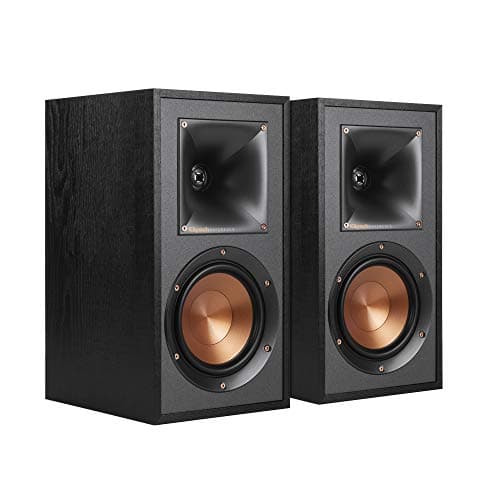 Klipsch R-51M High sensitivity means a modest amplifier drives these to a real volume — the practical answer when the amp is fixed and small. | Best for low-power amplifiers | 8.4 | |
| 2 | 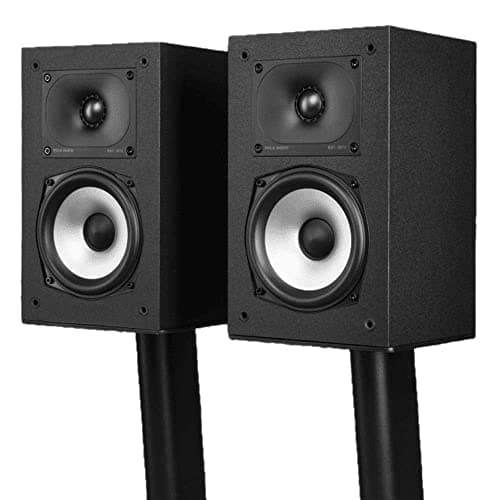 Polk Monitor XT15 48 Hz of published extension and a stated 30–150 W amplifier range, from a maker who tells you what to drive it with but not how they measured its sensitivity. | Best all-rounder under $200 | 7.4 | $149.00View on Amazon $179.0017% off |
| 3 | 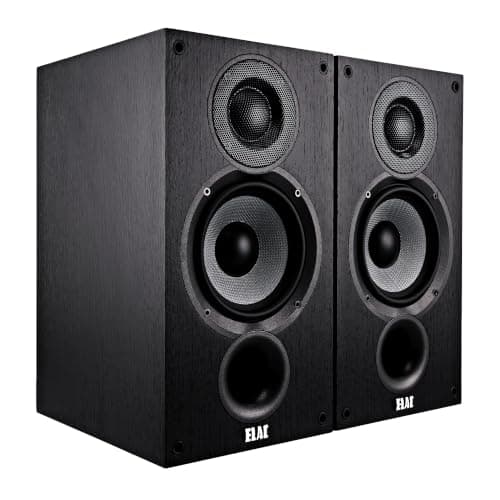 ELAC Debut 2.0 B5.2 The B6.2's smaller sibling — less bass extension in exchange for a cabinet that actually fits on a real bookshelf. | Best for small rooms | 7.0 | $269.00View on Amazon $379.0029% off |
These two appear on more roundups on this site than any other bookshelf speakers, they sit in adjacent price brackets, and they are the pair readers ask about against each other. A roundup has to place them among six; this page only has to separate two, which means it can go further into the five figures where they actually diverge — and into the two places where the published data runs out before the question is settled.
The two, on the figures that differ
Every figure below is the manufacturer’s own published value and links to the document we read it from. “Not published” means the manufacturer does not publish that figure; an em dash means we have no published figure for that model. Prices are live as of October 10, 2026.
Best for low-power amplifiers
- Sensitivity
- 93 dB (2.83 V / 1 m)
- Low end
- 62 Hz ± 3 dB
- Power spec
- 85 W cont. (handling limit)
- Crossover
- 1,660 Hz
Best all-rounder under $200
- Sensitivity
- 86 dB (no condition stated)
- Low end
- 48 Hz (no tolerance)
- Power spec
- 30–150 W (recommendation)
- Crossover
- 2,200 Hz
| Pick | Sensitivity | Low end | Power spec | Crossover | Price |
|---|---|---|---|---|---|
| 1.Klipsch R-51MBest for low-power amplifiers | 93 dB (2.83 V / 1 m) | 62 Hz ± 3 dB | 85 W cont. (handling limit) | 1,660 Hz | |
| 2.Polk Monitor XT15Best all-rounder under $200 | 86 dB (no condition stated) | 48 Hz (no tolerance) | 30–150 W (recommendation) | 2,200 Hz |
Prices as of October 10, 2026; every “Check Price” link goes to Amazon and earns us a commission at no extra cost to you. #ad
1. The sensitivity gap is 7 dB on paper and unverifiable in fact
Klipsch publishes 93 dB at 2.83 V / 1 m. Polk publishes 86 dBand states no measurement condition anywhere on its info sheet — no 2.83 V / 1 m, no 1 W / 1 m. Those are the two conventions in use, and they diverge the moment the speaker is not 8 Ω, because 2.83 V into 8 Ω is 1 W but into 4 Ω it is 2 W, a 3 dB difference in the speaker’s favour.
So the real gap is bounded rather than known. If Polk’s figure is a 1 W / 1 m measurement and Klipsch’s 8 Ω claim holds, the two conventions coincide and the gap is the full 7 dB. If Polk’s is a 2.83 V figure on a speaker that is nearer 4 Ω — and Polk says only “compatible with 4- and 8-ohm outputs”, publishing no nominal value at all — then part of that 86 dB is the measurement rather than the speaker. Neither maker publishes a minimum impedance. The honest statement is that the gap is somewhere between about 4 and 7 dB and cannot be narrowed from what either company prints.
power ratio = 10 ^ (ΔdB ÷ 10)
Inputs
- Klipsch R-51M sensitivity: 93 dB (2.83 V / 1 m) (Klipsch spec sheet (PDF))
- Polk Monitor XT15 sensitivity: 86 dB — Polk publishes NO measurement condition (Polk info sheet (PDF))
- Polk Monitor XT15 recommended amplification: 30–150 W per channel (Polk info sheet (PDF))
Result
2. Polk reaches 14 Hz lower, on a figure with nothing attached to it
Polk publishes 48 Hz – 40 kHz and no tolerance. Klipsch publishes 62 Hz – 21 kHz ± 3 dB. Read naively, Polk wins the bass by 14 Hz and the treble by 19 kHz. Read properly, Klipsch has made a falsifiable claim — the response stays inside a 6 dB window across that range — and Polk has made an unfalsifiable one, because without a tolerance “48 Hz” can mean 3 dB down, 6 dB down or 10 dB down and the figure is identical either way.
The 40 kHz figure is the tell. A 1 in Terylene dome producing useful output at 40 kHz, two octaves above the limit of human hearing, is a statement about where the response becomes unmeasurable rather than where it stops being flat. Klipsch stopping at 21 kHz with a tolerance is the more conservative document, and it is the one you can check.
3. One publishes what it survives, the other what to feed it
Klipsch publishes power handling: 85 W continuous, 340 W peak. That is the limit at which the drivers are expected to fail, not advice. Polk publishes recommended amplification: 30–150 W per channel, which is advice and not a limit.
These get compared constantly and they are not the same kind of number. The practical consequence is at the bottom, not the top: Polk is telling you 30 W is the minimumit expects to work properly, and Klipsch tells you nothing about a minimum because its figure is not about that. Combined with the sensitivity, this is the clearest result on the page — a low-powered amplifier is a Klipsch proposition, and Polk has effectively said so about its own speaker.
4. Different tweeters, 540 Hz apart, and what it means for a center channel
Klipsch crosses over at 1,660 Hzinto a 1 in aluminum LTS tweeter on a 90° × 90° Tractrix horn. Polk crosses at 2,200 Hzinto a 1 in Terylene dome. The 540 Hz difference sits in the band where voices do most of their work, and the horn is a directivity-controlling device where the dome is not — so the two speakers put different amounts of energy into the room’s side walls at the same frequency. Whether that is better or worse depends on the room and on what is on those walls; it is not a quality ranking and we are not going to claim to have heard it.
Where it does settle something: the Klipsch R-52C center channel crosses at 1,630 Hz into the same tweeter on the same horn, 30 Hz from the R-51M. There is no Polk center channel in our registry. If a center channel is coming, the Klipsch is the only one of these two with a verified match, and that is the single biggest practical difference between them.
5. What neither of them publishes
Neither publishes a minimum impedance, which is the figure an AV receiver actually cares about. Neither publishes a nominal impedance you can use: Klipsch says “8 Ω compatible”, which is its own careful wording for a compatibility claim rather than a measurement, and Polk says “compatible with 4- and 8-ohm outputs”, which is not a value. Neither publishes an off-axis response, a distortion figure, or an impedance curve.
That is why there is a third pick on this page. The ELAC Debut 2.0 B5.2publishes 6 Ω nominal and 86 dB at a stated 2.83 V / 1 m, which is more than either of these two manages, and it reaches 46 Hz on its own figure. It costs more than the Polk and has no center channel in our registry, so it is not the answer to “which of these two” — it is the answer to “what if I want both numbers properly stated”.
How we would choose between them
A tube amplifier, a 35 W integrated, or anything where watts are scarce: the Klipsch, decisively. A 5.1 system now or later: the Klipsch, because the R-52C and R-41M exist. A mainstream receiver with 70 W or more per channel, a subwoofer taking the bottom end, and the lowest possible price: the Polk, which is a lot of speaker for the money and whose weaknesses are mostly in the documentation rather than the design. Neither choice is wrong; they are answers to different questions about the amplifier, not about the speaker.
Every pick in detail
Every specification below links to the manufacturer document we read it from. Where a manufacturer does not publish a figure, we say so rather than estimating it.
Klipsch R-51M
Best for low-power amplifiersPrice as of October 10, 2026. #ad
High sensitivity means a modest amplifier drives these to a real volume — the practical answer when the amp is fixed and small.
- sensitivity
- 10/10
- bass extension
- 6/10
- amp friendliness
- 10/10
- value for money
- 9/10
- build quality
- 7/10
| Specification | Published value | Source |
|---|---|---|
| Sensitivity | 93 dB (2.83 V / 1 m) | Klipsch spec sheet (PDF) |
| Impedance | 8 Ω “compatible” (Klipsch's wording — not a measured nominal figure) | Klipsch spec sheet (PDF) |
| Minimum impedance | Not published | — |
| Frequency response | 62 Hz – 21 kHz ± 3 dB | Klipsch spec sheet (PDF) |
| Power handling | 85 W continuous / 340 W peak (a handling limit, not a recommended amplifier range) | Klipsch spec sheet (PDF) |
| Woofer | 5.25 in spun-copper IMG | Klipsch spec sheet (PDF) |
| Tweeter | 1 in aluminum LTS on a 90° × 90° Tractrix horn | Klipsch spec sheet (PDF) |
| Crossover | 1,660 Hz | Klipsch spec sheet (PDF) |
| Weight (each) | 11 lb / 5 kg | Klipsch spec sheet (PDF) |
Pros
- High sensitivity — plays loud on very little power
- The right answer for a low-wattage or tube amplifier
- Horn tweeter gives strong dispersion control
Cons
- Horn presentation is divisive and we cannot tell you how it sounds — we have not heard them
- Rear port needs breathing room from the wall
- Less low-end than the ELAC B6.2
- Previous generation — Klipsch's own page for it now points buyers to the newer Reference R-50M
Skip it if your amp already has power to spare — you are paying for sensitivity you do not need.
Polk Monitor XT15
Best all-rounder under $20048 Hz of published extension and a stated 30–150 W amplifier range, from a maker who tells you what to drive it with but not how they measured its sensitivity.
- specs
- 7/10
- sensitivity
- 6/10
- published data
- 6/10
- value for money
- 9/10
- bass extension
- 8/10
| Specification | Published value | Source |
|---|---|---|
| Sensitivity | 86 dB — Polk publishes NO measurement condition (no 2.83 V/1 m or 1 W/1 m qualifier) | Polk info sheet (PDF) |
| Impedance | “Compatible with 4- and 8-ohm outputs” — Polk publishes no nominal impedance value | Polk info sheet (PDF) |
| Minimum impedance | Not published | — |
| Frequency response | 48 Hz – 40 kHz (no tolerance published) | Polk info sheet (PDF) |
| Recommended amplification | 30–150 W per channel | Polk info sheet (PDF) |
| Woofer | 5.25 in bi-laminate paper | Polk info sheet (PDF) |
| Tweeter | 1 in Terylene dome | Polk info sheet (PDF) |
| Crossover | 2,200 Hz | Polk info sheet (PDF) |
| Weight (each) | 9 lb / 4.08 kg | Polk info sheet (PDF) |
Pros
- 48 Hz – 40 kHz published extension, the deepest bass figure in this bracket
- Polk publishes a recommended amplification range (30–150 W), which Klipsch and ELAC do not
- 1 in Terylene dome tweeter, the same driver family as the more expensive Signature Elite ES15
- Explicitly rated for Dolby Atmos height duty as well as stereo, so it does double service
Cons
- The 86 dB sensitivity is published with NO measurement condition, so it cannot honestly be compared to Klipsch's 2.83 V figures
- “Compatible with 4- and 8-ohm outputs” is not a nominal impedance, and no minimum is published
- 48 Hz – 40 kHz is quoted with no tolerance, which makes the endpoints unverifiable
- The 30 W lower bound rules out several of the smallest amplifiers we recommend
Skip it if your amplifier delivers under 30 W. Polk's own recommendation excludes it, and that is Polk's number, not ours.
ELAC Debut 2.0 B5.2
Best for small roomsThe B6.2's smaller sibling — less bass extension in exchange for a cabinet that actually fits on a real bookshelf.
- sensitivity
- 6/10
- bass extension
- 6/10
- amp friendliness
- 6/10
- value for money
- 7/10
- build quality
- 8/10
| Specification | Published value | Source |
|---|---|---|
| Sensitivity | 86 dB (2.83 V / 1 m) | ELAC spec page |
| Impedance | 6 Ω | ELAC spec page |
| Minimum impedance | Not published | — |
| Frequency response | 46 Hz – 35 kHz (no tolerance published) | ELAC spec page |
| Maximum power input | 120 W (a handling limit, not a recommended amplifier range) | ELAC spec page |
| Woofer | 5.25 in woven aramid-fiber cone | ELAC spec page |
| Tweeter | 1 in cloth dome | ELAC spec page |
| Crossover | 2,200 Hz | ELAC spec page |
| Weight (each) | 13.0 lb / 5.9 kg | ELAC spec page |
Pros
- Genuinely shelf-sized
- Same driver and cabinet design language as the B6.2
- Easier to place
Cons
- Less low-end extension than the B6.2
- Still not an easy load
- The outgoing generation — ELAC's Debut 3.0 DB53 now builds on it
Skip it if you have the space for the B6.2. It reaches lower and is a decibel more sensitive, so compare the two live prices before choosing — which one costs less has already flipped once.
Frequently asked questions
Klipsch R-51M or Polk Monitor XT15 — which should I buy?
Is the Klipsch R-51M really 7 dB more sensitive than the Polk XT15?
The Polk reaches 48 Hz and the Klipsch only 62 Hz — isn't the Polk better?
Why does Klipsch publish 85 W and Polk publish 150 W?
Can I use the Klipsch R-52C center with Polk Monitor XT15 fronts?
Do either of these publish a minimum impedance?
Have you compared these two by listening?
Read next
The Best Bookshelf Speakers for a Home Theater
Ranked on AV receiver duty rather than hi-fi criteria: the measurement condition on each sensitivity figure, published minimum impedance, and whether a timbre-matched center channel exists.
The Best Bookshelf Speakers Under $300
Five passive pairs at the $300 mark, and a ten-decibel sensitivity spread that decides which amplifier each one needs.
The Best Bookshelf Speakers Under $200
Four bookshelf pairs at the $200 mark, and a seven-decibel sensitivity gap that is worth five times the amplifier power.
The Best High-Sensitivity Bookshelf Speakers
The speakers that make a small amplifier sound big, ranked on published sensitivity and the condition each figure was measured under.
Will This Amplifier Drive My Speakers?
Two published numbers, one formula, and the answer is almost always less power than you expected.

The Best Home Theater Speakers
A timbre-matched 5.1 built from published specs — fronts, center, surrounds and a subwoofer that actually connects.
Sources
Every specification on this page was read from one of these documents. If one of them has changed, or we have made an error, tell us — corrections are logged and dated per our editorial policy.