Best acoustic panels
The Best Acoustic Panels for a Home Theater
Panels ranked on published per-frequency absorption — and why an NRC of 1.00 can still absorb 12% at 125 Hz.
The cheapest upgrade in hi-fi, and the one where the marketing is furthest from the physics.
Your room is the last component in the signal chain and the only one you did not choose. It is also, in most homes, the largest single distortion in the system — larger than the difference between any two amplifiers, and larger than the difference between most speakers.
Treating it is the cheapest meaningful upgrade in hi-fi. It is also the category where the headline specification is structurally misleading, so this hub spends most of its time on one number.
The Noise Reduction Coefficient is the average of a panel’s absorption at four frequencies: 250 Hz, 500 Hz, 1 kHz and 2 kHz. It excludes 125 Hz. It excludes everything below 250 Hz.
So a panel can absorb almost nothing in the bass and still publish a perfect NRC of 1.00, because the bass bands are not in the average. This is not a loophole anyone is exploiting — it is the definition of the measurement.
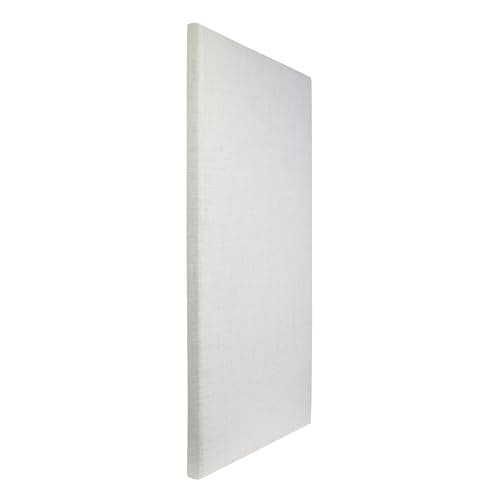
Our top pick demonstrates it. ATS publishes an NRC of 1.00 for its 24×48×2 panel, and the arithmetic checks out exactly: (0.67 + 1.17 + 1.12 + 1.08) / 4 = 1.01. The same page publishes its 125 Hz absorption: 0.12. About twelve percent. Both numbers are ATS’s own, printed together, and the headline one structurally cannot show you the other.
A porous absorber converts air movement into heat. Air movement is zero at a hard wall and peaks a quarter-wavelength away from it. At 125 Hz a quarter-wavelength is about 69 cm. A two-inch panel is 5 cm — about 7% of the way into the region where the air is actually moving. At 1 kHz the quarter-wavelength is 8.6 cm, so that same 5 cm panel is most of the way there, and it absorbs strongly.
That ratio is the entire explanation for every absorption curve in this category. Nothing about the material changes between 125 Hz and 1 kHz. Only its thickness relative to the wavelength does. The arithmetic is worked through here.
Since every panel is limited by the same physics, the real question is which manufacturer tells you.
ATS Acoustics publishes the full curve including the unflattering 125 Hz figure. Auralex deserves genuine credit — they sell foam and they publish that their 2-inch DST-114 measures 0.16 at 125 Hz, a number that makes their own product look transparent to bass. Most foam sellers omit that row. Primacousticpublishes the full curve and marks which rows are lab-measured and which are calculated — their London 8 kit’s main panels turn out to have theoretical low-frequency figures, and they say so in a footnote.
Arrowzoomis the instructive case, and the omission is the finding. Their technical page states that ASTM C423 tests from 125 Hz while NRC uses only 250 Hz upward — they tell you the standard starts at 125 Hz — and then their table starts at 250 Hz. The page is headed “NRC Data Table” and contains no NRC column.
BXI publishes nothing at all. We could not find a manufacturer website or datasheet. Every figure circulating for it lives in retailer listings.
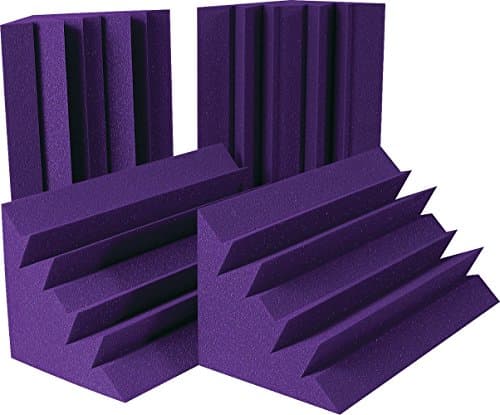
Corner traps first. Bass accumulates at boundaries and most of all where they meet, so a corner is a pressure maximum for essentially every room mode. A trap there meets more energy than the same trap anywhere else — the placement does as much work as the material.
First reflection points next. Find them with a mirror in five minutes, for free. Two panels there do more for imaging than six panels scattered decoratively, because the first reflection is the loudest and earliest one and killing it gets most of the available win.
Then stop. An over-damped room sounds dead and unpleasant, and it is harder to diagnose than a bright one. You cannot absorb your way to a good room.
That order is for a listening room with one seat. A theater with a row of seats, surround speakers, a screen wall and a subwoofer has more surfaces and a different order, and our home-theater treatment guide works through each of them.
It will not soundproof anything. This is the most expensive misunderstanding in the category. Absorption reduces reflections inside a room. Soundproofing stops sound passing betweenrooms and needs mass, decoupling and sealing. Foam on a wall will not stop your neighbor hearing your films, and products sold for “soundproofing” that are two inches of foam are sold on a false premise.
It will not fix bad speaker placement. If your speakers are jammed in corners, move them first. It is free and it is a bigger effect.
Any product that will not show you its 125 Hz number. And — a real conflict worth knowing — do not put absorption on the ceiling above your seat if you run up-firing Atmos speakers. They work by bouncing off the ceiling, and a panel there absorbs precisely the reflection they depend on. Two individually correct ideas, canceling each other out.
One thing we do not rank: DIY panels. Building your own rigid fiberglass absorbers is genuinely cheaper and well documented elsewhere, but we cannot link a live price for a thing you build, and we are not going to pretend a materials list is a product recommendation. What we can tell you is what a bought panel gives you that a built one does not — DIY vs store-bought panels covers the material, the lab data and the fire rating.
Acoustic panels are the safest present in hi-fi, and it is worth saying why: they have no sockets, no impedance and no brand-matching requirement, so there is nothing for them to be incompatible with. That makes them the pick in our under-$100 gift guidewhen you know nothing at all about the recipient’s equipment, and the fallback in the home theater gift guide for the same reason. Treatment is also, per the physics above, the cheapest real improvement on this site.
Each card shows that roundup’s top pick and its live price, as of October 15, 2026.
Best acoustic panels
Panels ranked on published per-frequency absorption — and why an NRC of 1.00 can still absorb 12% at 125 Hz.
Best bass traps
Ranked on published 125 Hz absorption rather than NRC — and only one maker publishes it for a corner trap.
Best wall panels
Six wall panels ranked on published absorption per band, then on the thing nobody specs: how they attach, and whether they come off again.
The mirror trick, in five minutes and for free — plus why those two points matter more than six panels elsewhere.
Same material, different thickness and placement — and that decides whether your room gets fixed or just quieter in the treble.
The Sabine equation, applied to a real room with real published coefficients — and what the answer costs.
Absorption is not isolation. ATS's own 125 Hz coefficient works out to about 0.6 dB of reduction — and that is not what soundproofing means.
Material, lab data, fire rating — the three things you are paying for, and which of them the manufacturers actually publish.
What changes when a room has one seat instead of a console: the four surfaces that matter, in the order that returns the most per panel.
The room-mode arithmetic that explains why small rooms sound boomy, and the corner trapping that partially fixes it.
Finding the ceiling reflection point, sizing the cloud, and the mounting problem that is the real reason it goes untreated.
The whole-room version for a theater: side walls for every seat, the wall behind the seats, the screen wall, the corners for the subwoofer, and the ceiling last.
A qualified yes. One trap publishes a 1.30 coefficient at 125 Hz against a flat panel's 0.12 — and the wavelength arithmetic shows why nobody publishes a figure below that.
Every pick here is a spec-and-price analysis, not a listening test. We compile what the manufacturer publishes, link each figure to the document we read it from, show the arithmetic where it applies, and price everything live. We have not heard this gear and we do not pretend to have. The full method is here.