Speaker Sensitivity Explained
The most decisive specification in a speaker's spec sheet, published under two different conditions that flatter different speakers, and by three makers under no condition at all.
Disclosure: we earn a commission if you buy through the links on this page, at no extra cost to you. It does not influence what we pick — our criteria are published and reproducible, so you can check our work. How we pick · Full disclosure
These picks are spec-and-price analyses, not listening tests. We have not heard this gear and we do not pretend to have: every figure below is sourced to the manufacturer and linked, and every price is live or not shown at all. Here are the rules we followed.
Quick picks
Ranked on the published criteria in How We Pick. Prices are live as of October 14, 2026. Tap any row for the full write-up.
- 8.4
- 7.0
- 7.2
- 7.4$149.00View on Amazon
$179.0017% off
| # | Product | Best for | Score | Price |
|---|---|---|---|---|
| 1 | 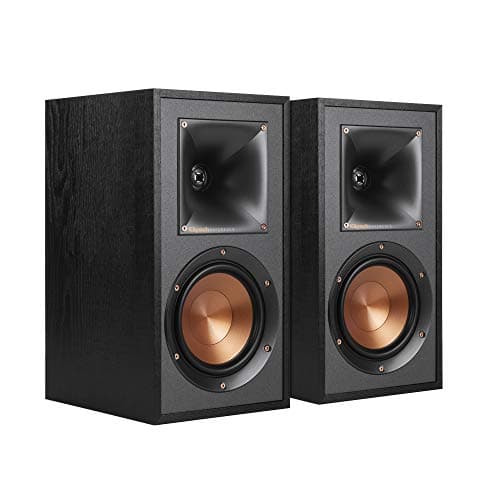 Klipsch R-51M High sensitivity means a modest amplifier drives these to a real volume — the practical answer when the amp is fixed and small. | Best for low-power amplifiers | 8.4 | |
| 2 | 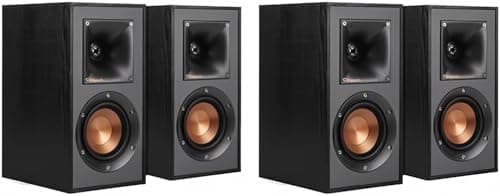 Klipsch R-41M A 4-inch two-way with a published 90 dB sensitivity, which means it goes loud on an amplifier that would embarrass most of its competition. | Best for a very small amplifier | 7.0 | |
| 3 | 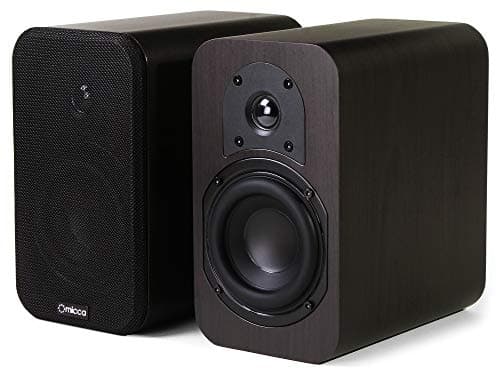 Micca RB42 A 4-inch speaker that publishes 50 Hz of extension and an honest 83 dB at 1 W — the two facts are the same fact, and Micca is unusual in showing you both. | Most bass from the smallest box | 7.2 | |
| 4 | 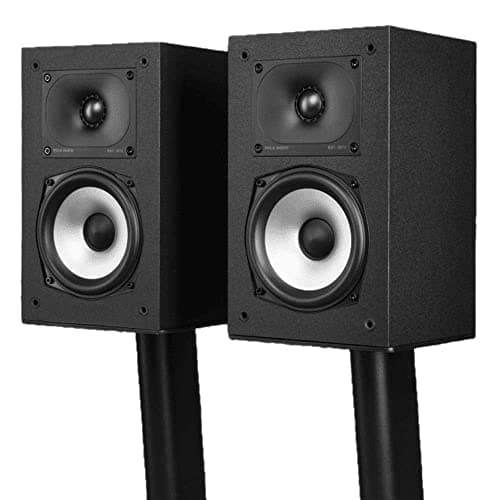 Polk Monitor XT15 48 Hz of published extension and a stated 30–150 W amplifier range, from a maker who tells you what to drive it with but not how they measured its sensitivity. | Best all-rounder under $200 | 7.4 | $149.00View on Amazon $179.0017% off |
Sensitivity is how loud a speaker plays for a given electrical input, measured one meter away. It is the single most decisive specification in the sheet, because it determines how much amplifier the speaker needs — and it is published under two incompatible conditions that almost nobody flags.
The two conditions, and why they differ
The two you will encounter are 2.83 V / 1 m and 1 W / 1 m. They look interchangeable. They are only interchangeable for an 8 Ω speaker, and here is the reason.
P = V² ÷ Z · ΔdB = 10 × log₁₀(P ÷ 1 W)
Inputs
- Test voltage used by the 2.83 V convention: 2.83 V RMS (2.83² = 8.01) (Klipsch spec sheet — 2.83 V/1 m convention (PDF))
- ELAC Debut 2.0 B6.2 published impedance: 6 Ω (ELAC spec page)
- Micca RB42 published impedance: 4–8 Ω (a range, not a nominal value) (Micca spec page)
Result
Into 8 Ω: P = 8.01 ÷ 8 = 1.00 W → the two conventions agree exactly, 0 dB apart
Into 6 Ω: P = 8.01 ÷ 6 = 1.34 W → 10 × log₁₀(1.34) = +1.25 dB of flattery
Into 4 Ω: P = 8.01 ÷ 4 = 2.00 W → 10 × log₁₀(2.00) = +3.01 dB of flattery
So a 4 Ω speaker quoted at 2.83 V looks three decibels better than the same speaker quoted at 1 W, without anything about the speaker changing. The 2.83 V convention is not dishonest — it is a constant-voltage test, which is arguably closer to how an amplifier behaves. It is simply not comparable to a 1 W figure unless the speaker is 8 Ω.
This conversion assumes a resistive load at the nominal impedance, which no real speaker is. Micca publishes “4–8 Ω” as a range with no nominal value, so the exact correction for the RB42 is indeterminate — somewhere between 0 and 3 dB. That indeterminacy is itself the point.
What every speaker we cover actually publishes
| Speaker | Published sensitivity | Condition stated |
|---|---|---|
| Klipsch R-52C | 95 dB | 2.83 V / 1 m |
| Klipsch RP-600M II | 94.5 dB | 2.83 V / 1 m, half-space anechoic |
| Klipsch R-51M | 93 dB | 2.83 V / 1 m |
| Klipsch R-41M | 90 dB | 2.83 V / 1 m |
| Q Acoustics 3030i | 88 dB | 2.83 V / 1 m |
| Polk Signature Elite ES15 | 88 dB | None published |
| ELAC Debut 2.0 B6.2 | 87 dB | 2.83 V / 1 m |
| KEF Q3 Meta | 87 dB | 2.83 V / 1 m |
| ELAC Debut 2.0 B5.2 | 86 dB | 2.83 V / 1 m |
| Polk Monitor XT15 | 86 dB | None published |
| Micca RB42 | 83 dB | 1 W / 1 m — the harder condition |
Three things that table is telling you
Polk publishes a number with no condition at all
The ES15 at 88 dB and the Monitor XT15 at 86 dB both appear with no 2.83 V or 1 W qualifier. Without knowing which, the figures cannot honestly be compared to Klipsch’s or ELAC’s. Polk does publish something the others do not — a recommended amplifier range, 20–100 W for the ES15 and 30–150 W for the XT15 — so this is not a manufacturer being unhelpful in general. It is one row missing its units.
Micca is penalized for being honest
The RB42’s 83 dB is the lowest figure on this site, and it is the only one quoted at 1 W. Micca also publishes “4–8 Ω”. Had they quoted 2.83 V into 4 Ω, the same speaker would have printed 86 dB and sat level with the Polk XT15.
We rate that honesty and it still costs the speaker the ranking in our under-$300 roundup, because a buyer with a 20 W amplifier is genuinely worse off with it. Both things are true.
Klipsch adds a footnote to its best number
The RP-600M II’s 94.5 dB carries Klipsch’s own footnote: half-space anechoic. A half-space measurement includes the reinforcement of one boundary, so it reads higher than a free-field measurement of the same speaker. Klipsch prints that qualifier and almost nobody reads it — it is worked through in our under-$1,000 roundup.
Why three decibels here matters more than thirty watts there
Doubling amplifier power gains you 3 dB. Always. It does not matter which amplifier.
So the spread across the speakers above — 95 dB at the top, 83 dB at the bottom — is twelve decibels, which is four consecutive doublings of power:
10^(12 ÷ 10) = 15.85× the amplifier power, for the same loudness.
A 20 W amplifier driving a Klipsch R-52C produces the same level as a 317 W amplifier driving a Micca RB42. There is no amplifier on this site that closes that gap, and the entire published spread across every integrated amplifier we cover — 35 W to 85 W — is under 4 dB.
The speaker decides how much amplifier you need. The amplifier barely participates in the decision.
Where a high sensitivity figure usually comes from
Look at the top of that table. The four highest figures on this site all belong to Klipsch, and Klipsch publishes the reason in the same spec sheet: a 1 in aluminum LTS tweeter on a 90° × 90° Tractrix horn on the R-41M, R-51M and R-52C alike.
A horn does not create energy. It constrains the angle over which the driver radiates, so more of the output goes forward and less goes sideways. Measured on-axis at one meter — which is where sensitivity is measured — that reads as a higher number.
So a high sensitivity figure is often a directivity figure in disguise. That is a genuine advantage: more direct sound relative to reflected sound means the room contributes less, which is the same goal absorbing first reflections has. It also means the speaker behaves differently off-axis from a wide-dispersion design like KEF’s Uni-Q coaxial, and responds differently to toe-in.
None of that is visible in the sensitivity number. It is visible in the driver description two rows down.
Sensitivity is not power handling, and both get published
These two specifications sit near each other on every sheet and answer opposite questions. Sensitivity says how little power the speaker needs. Power handling says how much it can survive. Neither tells you what the manufacturer recommends you drive it with — and only some of them publish that third thing.
| Speaker | Power figure published | Which question it answers |
|---|---|---|
| Q Acoustics 3030i | 25–75 W (stereo amp); 50–145 W (AVR, 2 ch driven) | A recommendation — the useful one |
| KEF Q3 Meta | 15–150 W | A recommendation |
| Polk Monitor XT15 | 30–150 W | A recommendation |
| Polk Signature Elite ES15 | 20–100 W | A recommendation |
| Micca RB42 | 15–100 W each | Handling, but the lower bound works as a de facto minimum |
| Klipsch R-51M | 85 W continuous / 340 W peak | Handling only — no recommended range published |
| Klipsch R-41M | 50 W continuous / 200 W peak | Handling only |
| ELAC Debut 2.0 B6.2 | 120 W maximum power input | Handling only — a limit, not a recommendation |
Conflating those two is how buyers end up under-powering a speaker. ELAC’s “120 W maximum power input’’ is a ceiling; it says nothing about the floor. Micca’s 15 W lower bound and Polk’s 30 W lower bound do say something about the floor, and Polk’s in particular rules out several of the smallest amplifiers we recommend.
What sensitivity does not tell you
- How low it goes. The Klipsch R-41M is 90 dB sensitive and stops at 68 Hz ± 3 dB. The Micca RB42 is 83 dB and reaches 50 Hz. Bass extension and sensitivity trade against each other in a box of a given size, which is most of why that pairing looks the way it does.
- Whether the amplifier can drive it. That is impedance, and it is a separate question with a separate answer — including the minimum impedance figure almost nobody publishes. See speaker impedance explained.
- How it sounds. Sensitivity is one number describing output level. It says nothing about balance, dispersion or distortion, and we have not heard any of these speakers.
What to do with the figure
Work out how much power you actually need before choosing either component. The full arithmetic — sensitivity, listening distance, target level, and the power that falls out of it — is on will this amplifier drive my speakers, and the answer is almost always less power than people expect.
The short version: if you already own a small amplifier, buy sensitivity. If you already own the speakers, the wattage difference between candidate amplifiers is worth less than you think. If you are buying speakers specifically to go with a small amplifier, our high-sensitivity roundup ranks four pairs on the published figure with its stated condition attached.
Every pick in detail
Every specification below links to the manufacturer document we read it from. Where a manufacturer does not publish a figure, we say so rather than estimating it.
Klipsch R-51M
Best for low-power amplifiersPrice as of October 14, 2026. #ad
High sensitivity means a modest amplifier drives these to a real volume — the practical answer when the amp is fixed and small.
- sensitivity
- 10/10
- bass extension
- 6/10
- amp friendliness
- 10/10
- value for money
- 9/10
- build quality
- 7/10
| Specification | Published value | Source |
|---|---|---|
| Sensitivity | 93 dB (2.83 V / 1 m) | Klipsch spec sheet (PDF) |
| Impedance | 8 Ω “compatible” (Klipsch's wording — not a measured nominal figure) | Klipsch spec sheet (PDF) |
| Minimum impedance | Not published | — |
| Frequency response | 62 Hz – 21 kHz ± 3 dB | Klipsch spec sheet (PDF) |
| Power handling | 85 W continuous / 340 W peak (a handling limit, not a recommended amplifier range) | Klipsch spec sheet (PDF) |
| Woofer | 5.25 in spun-copper IMG | Klipsch spec sheet (PDF) |
| Tweeter | 1 in aluminum LTS on a 90° × 90° Tractrix horn | Klipsch spec sheet (PDF) |
| Crossover | 1,660 Hz | Klipsch spec sheet (PDF) |
| Weight (each) | 11 lb / 5 kg | Klipsch spec sheet (PDF) |
Pros
- High sensitivity — plays loud on very little power
- The right answer for a low-wattage or tube amplifier
- Horn tweeter gives strong dispersion control
Cons
- Horn presentation is divisive and we cannot tell you how it sounds — we have not heard them
- Rear port needs breathing room from the wall
- Less low-end than the ELAC B6.2
- Previous generation — Klipsch's own page for it now points buyers to the newer Reference R-50M
Skip it if your amp already has power to spare — you are paying for sensitivity you do not need.
Klipsch R-41M
Best for a very small amplifierPrice as of October 14, 2026. #ad
A 4-inch two-way with a published 90 dB sensitivity, which means it goes loud on an amplifier that would embarrass most of its competition.
- specs
- 6/10
- sensitivity
- 9/10
- published data
- 6/10
- value for money
- 9/10
- bass extension
- 3/10
| Specification | Published value | Source |
|---|---|---|
| Sensitivity | 90 dB (2.83 V / 1 m) | Klipsch spec sheet (PDF) |
| Impedance | 8 Ω “compatible” (Klipsch's wording — not a measured nominal figure) | Klipsch spec sheet (PDF) |
| Minimum impedance | Not published | — |
| Frequency response | 68 Hz – 21 kHz ± 3 dB | Klipsch spec sheet (PDF) |
| Power handling | 50 W continuous / 200 W peak (a handling limit, not a recommended amplifier range) | Klipsch spec sheet (PDF) |
| Woofer | Single 4 in spun-copper IMG | Klipsch spec sheet (PDF) |
| Tweeter | 1 in aluminum LTS on a 90° × 90° Tractrix horn | Klipsch spec sheet (PDF) |
| Crossover | 1,730 Hz | Klipsch spec sheet (PDF) |
| Enclosure | MDF, bass-reflex via rear-firing ports | Klipsch spec sheet (PDF) |
| Weight (each) | 7 lb / 3.2 kg | Klipsch spec sheet (PDF) |
Pros
- 90 dB at 2.83 V/1 m — seven decibels more sensitive than the Micca RB42, which is about five times less amplifier for the same volume
- Klipsch publishes a real ±3 dB tolerance on the frequency response
- 7 lb each and 11.3 in tall: the smallest cabinet here by a clear margin
- Timbre-matched to the R-51M and R-52C if you later build a surround system around it
Cons
- 68 Hz is the shallowest bass extension of any speaker on this site
- “8 ohms compatible” is not a measured nominal impedance, and no minimum impedance is published
- Rear-ported, so it needs clearance behind it — an actual bookshelf will change its bass
- Klipsch publishes power handling, not a recommended amplifier range; those are different specs
- Amazon no longer lists a single pair: the live listing is a two-pair, four-speaker pack, so the price shown here buys four speakers
- Previous generation — Klipsch's own page for it now points buyers to the newer Reference R-40M
Skip it if you listen to anything with real low end and have no subwoofer. 68 Hz means the bottom octave and a half simply is not there.
Micca RB42
Most bass from the smallest boxPrice as of October 14, 2026. #ad
A 4-inch speaker that publishes 50 Hz of extension and an honest 83 dB at 1 W — the two facts are the same fact, and Micca is unusual in showing you both.
- specs
- 7/10
- sensitivity
- 3/10
- published data
- 7/10
- value for money
- 8/10
- bass extension
- 8/10
| Specification | Published value | Source |
|---|---|---|
| Sensitivity | 83 dB (1 W / 1 m) — note the condition: this is the TRUE 1 W figure, not the flattering 2.83 V one most brands quote | Micca spec page |
| Impedance | 4–8 Ω (Micca publishes a range rather than a nominal value) | Micca spec page |
| Minimum impedance | Not published | — |
| Frequency response | 50 Hz – 20 kHz, stated as “typical in-room” — an in-room figure is not an anechoic one and carries no tolerance | Micca spec page |
| Power handling | 15–100 W each — Micca's lower bound doubles as a de facto minimum amplifier recommendation | Micca spec page |
| Woofer | 4 in coated paper cone, rubber surround | Micca spec page |
| Tweeter | 0.75 in silk dome | Micca spec page |
| Crossover | 18 dB/octave slope — Micca publishes the SLOPE but not the crossover FREQUENCY | Micca spec page |
| Dimensions | 8.7 in H × 4.9 in W × 7.9 in D | Micca spec page |
| Weight | Not published | — |
Pros
- Micca quotes sensitivity at 1 W/1 m, the harder and more honest condition — most brands quote 2.83 V, which flatters a low-impedance speaker
- 50 Hz from a 4-inch driver in an 8.7-inch cabinet is genuinely unusual
- A 10-element crossover with film capacitors and air-core coils, described in detail on Micca's own page
- Micca publishes a 15 W lower power bound, which functions as a minimum amplifier recommendation
Cons
- 83 dB is the lowest sensitivity on this site — it needs roughly five times the power of the Klipsch R-41M for the same level
- The 50 Hz figure is qualified “typical in-room”, which is not an anechoic measurement and carries no tolerance
- Micca publishes the crossover SLOPE (18 dB/octave) but not the crossover FREQUENCY
- “4–8 ohms” is a range, not a nominal impedance, and no minimum is published
Skip it if your amplifier is small. A 20 W amp that drives the Klipsch R-41M to a satisfying level will not do the same job here — the arithmetic is on our amp-matching page and it is not close.
Polk Monitor XT15
Best all-rounder under $20048 Hz of published extension and a stated 30–150 W amplifier range, from a maker who tells you what to drive it with but not how they measured its sensitivity.
- specs
- 7/10
- sensitivity
- 6/10
- published data
- 6/10
- value for money
- 9/10
- bass extension
- 8/10
| Specification | Published value | Source |
|---|---|---|
| Sensitivity | 86 dB — Polk publishes NO measurement condition (no 2.83 V/1 m or 1 W/1 m qualifier) | Polk info sheet (PDF) |
| Impedance | “Compatible with 4- and 8-ohm outputs” — Polk publishes no nominal impedance value | Polk info sheet (PDF) |
| Minimum impedance | Not published | — |
| Frequency response | 48 Hz – 40 kHz (no tolerance published) | Polk info sheet (PDF) |
| Recommended amplification | 30–150 W per channel | Polk info sheet (PDF) |
| Woofer | 5.25 in bi-laminate paper | Polk info sheet (PDF) |
| Tweeter | 1 in Terylene dome | Polk info sheet (PDF) |
| Crossover | 2,200 Hz | Polk info sheet (PDF) |
| Weight (each) | 9 lb / 4.08 kg | Polk info sheet (PDF) |
Pros
- 48 Hz – 40 kHz published extension, the deepest bass figure in this bracket
- Polk publishes a recommended amplification range (30–150 W), which Klipsch and ELAC do not
- 1 in Terylene dome tweeter, the same driver family as the more expensive Signature Elite ES15
- Explicitly rated for Dolby Atmos height duty as well as stereo, so it does double service
Cons
- The 86 dB sensitivity is published with NO measurement condition, so it cannot honestly be compared to Klipsch's 2.83 V figures
- “Compatible with 4- and 8-ohm outputs” is not a nominal impedance, and no minimum is published
- 48 Hz – 40 kHz is quoted with no tolerance, which makes the endpoints unverifiable
- The 30 W lower bound rules out several of the smallest amplifiers we recommend
Skip it if your amplifier delivers under 30 W. Polk's own recommendation excludes it, and that is Polk's number, not ours.
Frequently asked questions
What is the difference between 2.83V/1m and 1W/1m sensitivity?
2.83 V into 8 Ω is exactly 1 W, so for an 8 Ω speaker the two are identical. Into 6 Ω, 2.83 V delivers 1.34 W — worth +1.25 dB. Into 4 Ω it delivers 2 W — worth +3.01 dB. So a low-impedance speaker quoted at 2.83 V reads up to three decibels better than the same speaker quoted at 1 W, with nothing about the speaker having changed.
Is higher speaker sensitivity better?
It means less amplifier power for the same level, which is a real practical advantage. The spread across the speakers we cover is 83 dB to 95 dB — twelve decibels, or a factor of about 15.9 in required power. It generally trades against bass extension in a cabinet of a given size: the 90 dB Klipsch R-41M stops at 68 Hz, the 83 dB Micca RB42 reaches 50 Hz.
Why do some speakers not publish a sensitivity measurement condition?
We do not know, and we would rather say so than speculate. Polk publishes 88 dB for the Signature Elite ES15 and 86 dB for the Monitor XT15 with no 2.83 V or 1 W qualifier attached to either. Without the condition, neither figure can honestly be compared with Klipsch’s or ELAC’s, so we flag it rather than assuming which convention was used.
How many watts do I need for 87 dB speakers?
Fewer than you would guess, and the answer depends on listening distance and target level rather than on the speaker alone. The full arithmetic is on our amp and speaker matching page, which works it through with published figures. As a reference point: doubling amplifier power is always exactly 3 dB.
Read next
Will This Amplifier Drive My Speakers?
Two published numbers, one formula, and the answer is almost always less power than you expected.
Speaker Impedance Explained
Nominal versus minimum impedance, why 2.83 V is not 1 watt, and how to check your amplifier can cope.
The Best Bookshelf Speakers Under $300
Five passive pairs at the $300 mark, and a ten-decibel sensitivity spread that decides which amplifier each one needs.
How to Read an Amplifier Power Rating
Impedance, bandwidth, distortion, channels driven — the four conditions that turn a watts number into a spec, and which manufacturers publish all four.
The Best Bookshelf Speakers Under $500
Six pairs under $500 — and only one publishes a minimum impedance and a recommended amp range.
Ported vs Sealed Speakers
What a port buys in efficiency and extension, what it costs in placement and roll-off, and how the sealed and ported subwoofers we cover actually compare.
Sources
Every specification on this page was read from one of these documents. If one of them has changed, or we have made an error, tell us — corrections are logged and dated per our editorial policy.
- Klipsch R-51M — sensitivity and response (spec sheet, PDF)
- Klipsch R-41M — sensitivity and response (spec sheet, PDF)
- Klipsch R-52C — sensitivity (spec sheet, PDF)
- Klipsch RP-600M II — half-space anechoic footnote (spec sheet, PDF)
- Micca RB42 — sensitivity at 1 W / 1 m
- ELAC Debut 2.0 B6.2 — sensitivity and impedance
- Q Acoustics 3030i — sensitivity, impedance, amplifier range
- KEF Q3 Meta — sensitivity and impedance
- Polk Monitor XT15 — sensitivity (info sheet, PDF)