The Best AV Receivers for Gaming
Nine receivers in our registry say 4K/120 on the box. On most of them that applies to three of six inputs, and on one of them the gaming features are in the marketing copy and not the spec sheet. This page ranks what each maker will actually put in writing.

Disclosure: we earn a commission if you buy through the links on this page, at no extra cost to you. It does not influence what we pick — our criteria are published and reproducible, so you can check our work. How we pick · Full disclosure
These picks are spec-and-price analyses, not listening tests. We have not heard this gear and we do not pretend to have: every figure below is sourced to the manufacturer and linked, and every price is live or not shown at all. Here are the rules we followed.
Quick picks
Ranked on the published criteria in How We Pick. Prices are live as of September 26, 2026. Tap any row for the full write-up.
- 8.2$649.00View on Amazon
$899.9928% off
- 9.0
- 8.4
- 7.4
- 7.6
- 7.6
| # | Product | Best for | Score | Price |
|---|---|---|---|---|
| 1 | 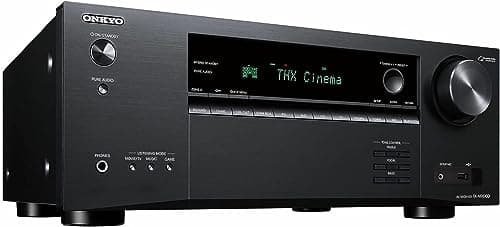 Onkyo TX-NR6100 THX certified with three 4K120 HDMI inputs, which is the specific spec that matters if two consoles and a PC share the same receiver. | Best for gaming | 8.2 | $649.00View on Amazon $899.9928% off |
| 2 | 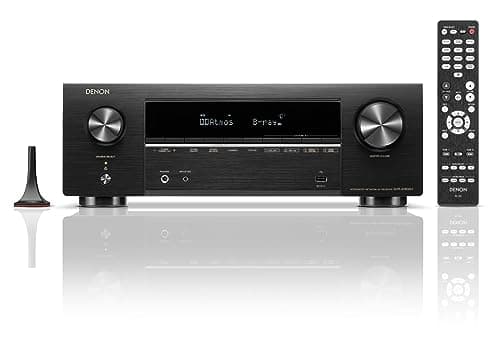 Denon AVR-X1800H Seven channels, 8K passthrough and Audyssey MultEQ XT — the room correction being the feature that actually changes what you hear in a real room. | Best overall under $1,000 | 9.0 | |
| 3 | 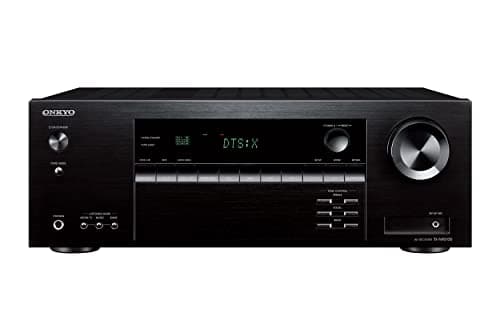 Onkyo TX-NR5100 Eighty honest watts, seven amplifier channels, Dolby Atmos and DTS:X together — and a marketing headline of 165 watts that its own manual measures at ten percent distortion. | Most receiver under $500 | 8.4 | |
| 4 | 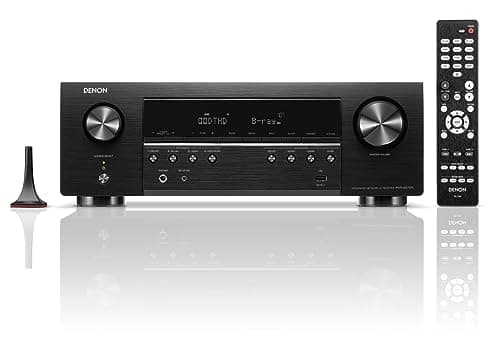 Denon AVR-S670H The X1800H's five-channel sibling: the same 8K plumbing and Audyssey correction, minus the two channels an Atmos height pair would need. | Best 5.2 option | 7.4 | |
| 5 | 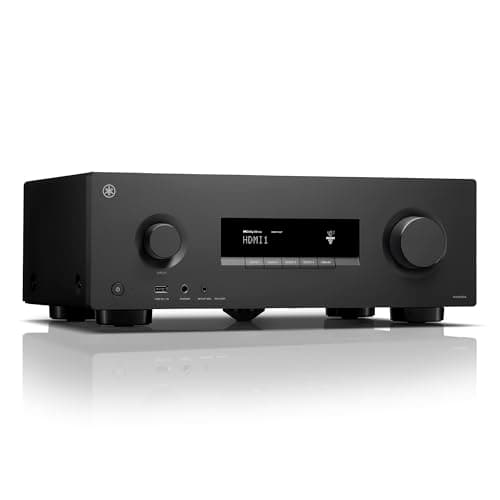 Yamaha RX300A The first receiver in this bracket to put Dolby Atmos and a full-band, two-channels-driven power rating on the same specification table — and it still prints a 145-watt burst figure one line away from the real one. | Cheapest Atmos with a full-band power rating | 7.6 | |
| 6 | 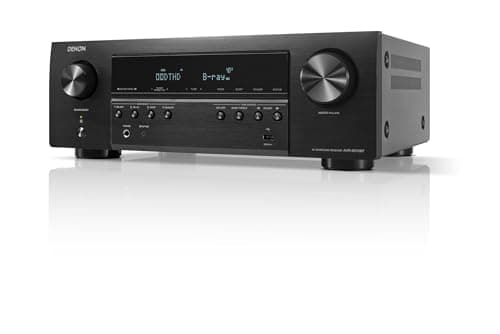 Denon AVR-S570BT The one receiver in this bracket that publishes a single power rating and no flattering second one — and it pays for that restraint by giving up Atmos, room correction and a phono input. | Cleanest single power rating under $500 | 7.6 |
“4K/120” on an AV receiver is almost never a statement about the receiver. It is a statement about three of its HDMI inputs. Every receiver we cover advertises 8K and 4K/120 passthrough. On the Onkyo TX-NR6100 that applies to inputs 1–3, and Onkyo says so in one sentence; inputs 4 to 6 are HDMI 2.0 and stop at 4K/60. On the Denon AVR-X1800H it is “6 HDMI Inputs (3 x 8k)”. On the Yamaha RX-V6A it is HDMI 1–3 out of seven. If you own a PlayStation 5, an Xbox Series X and a gaming PC, the number on the front of the box is not the number that decides whether you have to reach behind the rack.
The four gaming features, and which of them a maker will put in writing
HDMI 2.1 introduced four things a gamer cares about, and HDMI Licensing Administrator describes them briefly on its own specification page. VRR(Variable Refresh Rate) “reduces or eliminates lag, stutter and frame tearing for more fluid gameplay”. ALLM(Auto Low Latency Mode) “allows the ideal latency setting to automatically be set” — the console tells the display to drop out of its picture-processing mode without anyone touching a menu. QFT(Quick Frame Transport) “reduces latency for smoother no-lag gaming”, and QMS(Quick Media Switching) “eliminates the delay when a device changes from one HDMI frame rate” to another — the black screen between a menu and a cut scene.
Those four are a menu, not a package. A receiver can pass 4K/120 and publish none of them. Of the nine receivers in our registry, exactly one publishes all four by name. One publishes three and prints an explicit Noagainst the fourth. One publishes VRR and QFT in the specification table while claiming ALLM only in the marketing paragraph above it. And one — the receiver with more HDMI inputs than anything else here — names none of them anywhere in its specification.
How we ranked this
Two rules, applied in order, and nothing else.
Rule one: a pick must publish VRR in its own specification table. Not in a feature bullet, not in a firmware release note, not in a press release. If the maker will not print it in the table it prints the power rating in, we do not rank the receiver here. This is the rule that keeps the seven-input Yamaha RX-V6A off the list, and we explain that case below rather than burying it.
Rule two: how many inputs, and does the maker say which.A receiver that enumerates — “inputs 1–3”, “6 (3 x 8K)” — ranks above one that prints a bare Yes against a 4K/120 row and leaves you to guess which socket to use. Enumeration is not a courtesy; it is the difference between plugging in a console and troubleshooting one.
After those two, the tie-breaks are what the receiver is when the game is off: amplifier channels, whether Dolby Atmos and DTS:X are named, and which room-correction system it runs. Those are covered at length on the under-$1,000 page and the under-$500 page, and this page does not re-rank them. Price does not move the order at all — the cheapest receiver here publishes a gaming feature the dearest one does not.
We have not tested any of this. We do not own these receivers, we have not put a signal analyzer on an HDMI terminal, and nothing on this page is a listening or gameplay impression. What we have done is read nine manufacturers’ specification tables and print what is in them, including the gaps. Our method is published in full.
bit rate = horizontal pixels × vertical pixels × refresh rate × bits per pixel
Inputs
- Resolution (4K UHD): 3840 × 2160 pixels — the resolution behind the “4K/120Hz” row on every receiver here (Denon AVR-X1800H product page)
- Refresh rate: 120 Hz (Sony PS5 support: “supports 4K 120Hz video output”)
- Bits per pixel: 30 — 10 bits each for red, green and blue, uncompressed 4:4:4. Yamaha's own HDMI feature list for the RX-V6A specifies “4K/120 Hz, 100 Hz 10-bit”. (Yamaha owner's manual, specifications)
Result
1. Onkyo TX-NR6100 — the only one that enumerates everything
Onkyo publishes a single sentence that no other maker here matches: “HDMI 2.1 features are supported on HDMI inputs 1–3, Main Out, and Sub/Zone 2 Out in Sub Mode output including VRR, ALLM, QFT (Quick Frame Transport), DSC (Display Stream Compression), QMS (Quick Media Switching), and eARC (Main Out).” That is all four gaming features by name, plus DSC, plus the exact terminals they apply to — and it is the only place on this page where the fast specification is documented as reaching the outputsas well as the inputs. With three HDMI 2.1 inputs it is also the only receiver here that can take a PS5, a Series X and a PC at 4K/120 without swapping a cable.
It is a 7.2-channel receiver rated, on the FTC line rather than the marketing line, at 100 W per channel into 8 Ω from 20 Hz to 20 kHz at 0.08% THD with two channels driven. It decodes Dolby Atmos and DTS:X, it is THX certified, and it has an MM phono input at 3.5 mV / 47 kΩ, which is unusual on a receiver bought for consoles.
The honest cons.Inputs 4–6 are HDMI 2.0 and cap at 4K/60, so a fourth fast source means re-plugging. Room correction is AccuEQ, not Dirac Live — Onkyo starts Dirac at the TX-NR7100 and this model has no upgrade path to it, which matters because room correction changes what you hear far more than any HDMI feature does. The “210 W per channel” figure in most search results is a dynamic-power marketing number, not the rating. Onkyo also publishes 65 W idle draw — powered on and playing nothing — which is the only idle figure any maker in this bracket prints, and it is roughly a hundred times the standby number everyone advertises. And it has no main-channel pre-outs at all, only a subwoofer output and a zone line-out; our pre-outs page ranks it last for exactly that reason.
2. Denon AVR-X1800H — the clearest gaming row, and the better receiver
Denon prints the four features as one row with a verdict on each: ALLM / QMS / QFT / VRR — Yes / No / Yes / Yes. Publishing an explicit Nois rarer than publishing a Yes, and it tells you something real: if you play on a machine that changes frame rate between menus and gameplay, this receiver will give you the black screen that QMS exists to remove. Denon enumerates the input count as “6 HDMI Inputs (3 x 8k)” and the maximum as “8k/60 – 4k/120”, with HDCP 2.3, Dolby Vision and HDR10+.
It ranks second rather than first on rule two: three fast inputs, same as the Onkyo, but Denon does not say whichthree, and it does not document the HDMI 2.1 feature set as reaching the output. On everything after the HDMI rows it is the better receiver. It is 7.2 channels at 80 W + 80 W full-band, it runs Audyssey MultEQ XT rather than the plain MultEQ on the cheaper models, and it has the best-documented phono stage in the bracket — 2.5 mV MM with a published RIAA deviation of ± 1 dB. Our full review covers the rest.
The honest cons.QMS is a published No. Only three of six inputs are fast and Denon will not say which. The pre-outs are 2.2 — front L/R plus subwoofers — so there is no path to external amplification on the surround channels later. Denon publishes no idle figure at all, and its 0.1 W standby claim holds only with Network Control set to “Off In Standby” and HDMI Pass Through off, which is not how a console owner will run it. The menus are dense and it runs warm in a closed cabinet.
3. Onkyo TX-NR5100 — the most amplifier behind a published VRR
Onkyo publishes “HDR10+, Dolby Vision and BT.2020 color; VRR (Variable Refresh Rate), ALLM (Auto Low Latency Mode), and QFT (Quick Frame Transport); eARC (Main Out), and HDCP 2.3” for this model, and 4K120 and 8K60 support via HDMI 2.1. Three of the four features, published in the specification, on the cheapest receiver here with seven amplifier channels. It decodes Dolby Atmos and DTS:X, and it is the only receiver on this page with two HDMI outputs.
It drops below the Denon on rule two. Onkyo enumerates the fast inputs for the TX-NR6100 and does not do it for this one — there are four HDMI inputs and no published statement of how many carry 4K/120. QMS is not named. Its rated output is the FTC line: “With 8 ohm loads, both channels driven, from 20 – 20,000 Hz; rated 80 watts per channel minimum RMS power, with no more than 0.08% total harmonic distortion”. The 165 W figure on Onkyo’s own product page is measured at 6 Ω, 1 kHz, one channel driven, at 10% distortion.
The honest cons.Four HDMI inputs is tight the moment a console, a streaming stick and a disc player are all connected. Onkyo’s own manual publishes speaker layouts only up to 5.1.2 despite the seven amplifier channels, so there is no 7.1 or 5.1.4 arrangement in the documentation. No phono input — the analog side is three RCA inputs and a 3.5 mm jack. Room correction is AccuEQ again. And Onkyo’s own store showed this model out of stock when we checked on 2026-09-27; the live price above is the Amazon listing, and if it reads as unavailable there too, the TX-NR6100 is the same family one step up.
4. Denon AVR-S670H — the same HDMI sheet as the X1800H, two channels short
Denon publishes “HDMI Inputs: Back/Front 6 (3x 8K) / 0” and the same four-feature row — ALLM / QMS / QFT / VRR — Yes / No / Yes / Yes— as the dearer AVR-X1800H, with Dolby Vision, HDR10+, Dynamic HDR and HLG. On the two rules this page ranks by, it is the equal of the number two pick and it costs less. It runs Audyssey MultEQ and has an MM phono input at 2.5 mV.
It ranks fourth on the tie-breaks, and the tie-breaks are serious here. It is a 5.2 receiver: five amplifier channels cannot produce height, whatever the decoder does, so the Atmos layer in a PS5 or Series X game has nowhere to go. Worse, Denon’s own sources disagree about whether it decodes Atmos at all. The info sheet enumerates Dolby TrueHD, Digital, Digital Plus and Pro Logic II with a “Dolby Audio” logo and names neither Atmos nor DTS:X; the product-page title says “with Dolby Atmos”. We trust the spec table over the page title and we print both. What height channels actually require is on its own page.
The honest cons. Five channels, no height, and a documentation conflict about the format most game consoles output. QMS is a published No. Subwoofer pre-outs only. And, as with every Denon here, no statement of which three of the six inputs are the fast ones.
5. Yamaha RX300A — the cheapest one that publishes QMS
Yamaha’s specification page for the RX300A lists the HDMI row as “4 in / 1 out — HDMI 2.1, eARC/ARC, VRR, ALLM, QMS, HDCP 2.3”, with 8K/60 and 4K/120 passthrough, Dolby Vision, HDR10+ and Hybrid Log-Gamma. Three of the four features named in the table, including the one the Denons print a No against. It is also the only receiver here where Yamaha publishes gaming features in the specification at all — the contrast with its own dearer RX-V6A is the sharpest thing on this page.
Its rated output is 70 W (8 Ω, 20 Hz – 20 kHz, 0.09% THD, two channels driven). The 145 W printed on the same line is measured at 6 Ω, 1 kHz, one channel, 10% distortion, and is not a listening rating. Yamaha’s spec server returns HTTP 403 to our tooling, so these figures date from our last successful read rather than from 2026-09-27.
The honest cons.Four HDMI inputs, and Yamaha does not say how many carry 4K/120. It is 5.2, so no height channels. Dolby Atmos yes, DTS:X no — DTS:X appears only in the RX500A column of Yamaha’s own table. There is no network streaming of any kind: Yamaha publishes a dash against Wi-Fi, Ethernet and every streaming service, leaving Bluetooth 5.3 as the only wireless input. No phono input. No main-channel pre-outs. And room correction is listed only as “Room Correction” — Yamaha does not name YPAO for this model anywhere.
6. Denon AVR-S570BT — the cheapest published VRR, and a gap in the same table
Denon’s specification table for the AVR-S570BT prints “HDMI 2.1: 8K/60Hz, 4K/120Hz — Yes, Yes”, VRR Yes, QFT Yes and QMS No, with Dolby Vision, HDR10+ and HDCP 2.3, across four rear HDMI inputs and one eARC output. That clears rule one at the lowest price on this page, which is why it is here rather than in the excluded list.
And then the gap.There is no ALLM row in that table. The marketing paragraph on the same Denon page claims ALLM; the specification does not carry it, while the specification for every dearer Denon here does. We are not calling that a No — we are telling you that Denon puts ALLM in writing for the AVR-S670H and the AVR-X1800H and does not put it in writing for this one. Denon also prints a bare “4” for the input count with no 8K qualification, where it prints an explicit “3 x 8K” on every dearer model. On a four-input receiver the likeliest reading is that all four are fast, but Denon does not say it, and we are not going to say it for them.
The honest cons.ALLM is unpublished. No room correction at all: Denon prints “Audyssey Dynamic EQ: No” and “Audyssey Dynamic Volume: No”, so this receiver sits a full step below the AVR-S670H in the thing that most changes what a room sounds like. Neither Dolby Atmos nor DTS:X is named anywhere on its product page. No phono input, no network streaming — it sits outside Denon’s HEOS range — and subwoofer pre-outs only. It is a good HDMI switch with amplifiers attached, and on this page that is enough for sixth.
The receiver with seven HDMI inputs that is not on this list
The Yamaha RX-V6Ahas seven HDMI inputs, more than anything else we cover, and it is a 7.2 receiver rated 100 W per channel across the full band — the highest full-band rating in the registry. It accepts 4K/120 and 8K, with 8K on inputs 1–3. On paper it is the receiver a gamer with four consoles should want.
It fails rule one. Yamaha’s HDMI feature list in the owner’s manual reads “8K, 4K Ultra HD (include 8K/60, 50 Hz, 4K/120, 100 Hz 10-bit), 3D Video, ARC, eARC, HDMI Control (CEC), Auto Lip Sync, Deep Color, x.v.Color, HDR10+, Dolby Vision, Hybrid Log-Gamma, DSC FRL, FRL” with HDCP 1.4/2.3 — and VRR, ALLM, QMS and QFT appear nowhere in it. They appear nowhere on Yamaha’s 4K/8K MODE page for the model either, which is the page that explains which jacks take which signal and says “The HDMI 1-3 jacks support 8K signals… ‘8K Mode’ is applied to only the HDMI 1-3 jacks.”
The reason is that ALLM and VRR were not shipped on this model. Yamaha added them by firmware and documents them in a separate support note rather than in the specification, and Yamaha’s US support server returns HTTP 403 to our tooling, so we could not read that note ourselves and will not summarize a document we have not opened. If you already own an RX-V6A, the feature is reportedly a firmware update away and Yamaha’s own support pages are where to confirm it. If you are buying one for gaming, you are buying on a claim the specification does not make, and that is the difference between this receiver and the six above it.
Three more are excluded and it is worth saying why. The Yamaha RX-V4Aaccepts 4K/120 on four HDMI inputs and names none of the four gaming features in its manual either, and Yamaha’s own table lists Dolby Atmos and DTS:X as N/A. The Marantz Cinema 70spublishes “Total HDMI Inputs / No. Support 8K — 6 / 3”, ALLM “pass-through for gaming” Yes, and VRR / QFT Yes / Yes — it clears both rules cleanly. It is off the list on price and power: it is the most expensive receiver on the site and rated 50 W + 50 W, a slim-chassis trade that makes sense for a furniture problem and not for a console. Its full 7.2 pre-outs are the reason to buy it, and that is a different page. The Denon AVR-S570BT made the list at number six; nothing cheaper in our registry publishes VRR at all.
The route that skips the receiver, and why Sony brings it up first
There is a way to own a five-year-old receiver and still game at 4K/120: plug the console straight into the television and send the audio back to the receiver over eARC. The TV handles VRR and ALLM because the TV is the display; the receiver only ever sees an audio stream. Every receiver on this page has an eARC output, and so do several that are not on it.
This is not a fringe workaround. Sony’s own troubleshooting page for PS5 4K/120 output asks, as one of its checks, “Is the PS5 console directly connected to the TV by HDMI, or to a receiver or other piece of intermediary equipment that could be affecting the signal?” — the console maker treats the AV receiver as a suspect before it treats the television as one. The same page asks whether you are using “the cable included with the PS5 console or an Ultra High-Speed Cable that is rated for 4K 120Hz output”, which is worth checking before you replace a receiver over a cable.
What you give up going direct is real: eARC carries the audio but the receiver no longer switches the video, so source switching happens on the TV, and any format the TV will not pass over eARC does not reach the receiver. What you gain is that the console’s signal path has one fewer device in it. If your current receiver is otherwise fine and the only complaint is HDMI, try this before spending anything.
What we would buy
For two or three fast sources on one receiver, the Onkyo TX-NR6100, and not by a small margin — it is the only one that names all four features, the only one that says which terminals carry them, and the only one that documents them on the output. Accept AccuEQ as the cost.
For one console in a system that is also a home theater, the Denon AVR-X1800H. You will use one fast input, the QMS absence will cost you a black screen occasionally, and in exchange you get Audyssey MultEQ XT, seven channels for a 5.2.2 Atmos layout and a phono stage with published RIAA accuracy. Room correction is worth more to how the system sounds than any HDMI row on this page, and we have written honestly about what it does and does not fix.
On a tight budget, the Yamaha RX300A if you want QMS and can live with five channels and no streaming, or the Denon AVR-S570BT if the receiver is mostly an HDMI switch and you will treat room correction as a later upgrade. And if you already own a receiver with eARC, spend nothing: run the console into the television, send the sound back, and put the money into treating the room, which will change what you hear more than any of this.
Every pick in detail
Every specification below links to the manufacturer document we read it from. Where a manufacturer does not publish a figure, we say so rather than estimating it.
Onkyo TX-NR6100
Best for gamingTHX certified with three 4K120 HDMI inputs, which is the specific spec that matters if two consoles and a PC share the same receiver.
- channels
- 9/10
- room correction
- 6/10
- connectivity
- 10/10
- value for money
- 8/10
- future proofing
- 8/10
| Specification | Published value | Source |
|---|---|---|
| Channels | 7.2, THX certified | Onkyo product page |
| Power output | 100 W/ch (8 Ω, 20 Hz – 20 kHz, 0.08% THD, 2 ch driven, FTC). The “210 W per channel” figure circulating in search results is a dynamic-power marketing number, not the FTC rating. | Onkyo product page |
| Room correction | AccuEQ with AccuReflex. Dirac Live is NOT available on this model — Onkyo starts Dirac at the TX-NR7100. | Onkyo receiver buying guide |
| Dolby Atmos / DTS:X | Yes / Yes (5.2.2 playback) | Onkyo spec page |
| Phono input | Yes — MM, 3.5 mV rms / 47 kΩ | Onkyo spec page |
| HDMI in / out | 6 in / 2 out. HDMI 2.1 (8K/60, 4K/120) on inputs 1–3 and both outputs; inputs 4–6 are 2.0 up to 4K/60 | Onkyo spec page |
| Streaming | Chromecast built-in, AirPlay 2, DTS Play-Fi, works with Sonos | Onkyo spec page |
| HDMI 2.1 gaming features | “HDMI 2.1 features are supported on HDMI inputs 1–3, Main Out, and Sub/Zone 2 Out in Sub Mode output including VRR, ALLM, QFT (Quick Frame Transport), DSC (Display Stream Compression), QMS (Quick Media Switching), and eARC (Main Out).” Inputs 4–6 carry HDMI 2.0 features only. | Onkyo spec page |
| Power consumption | 635 W operating, 65 W idle (on, not playing), 0.1 W standby | Onkyo spec page |
| Pre-outs | Subwoofer pre-out (1 V rms / 470 Ω) and a Zone 2/Zone B line-out (200 mV rms / 470 Ω). No main-channel pre-outs are listed | Onkyo spec page |
Pros
- Three HDMI 2.1 inputs at 8K/60 and 4K/120 — the most console-friendly receiver here
- THX certified
- MM phono input, which is unusual on a gaming-focused receiver
- 100 W/ch FTC-rated into 8 Ω across the full band
Cons
- Room correction is AccuEQ, NOT Dirac Live — Onkyo starts Dirac at the TX-NR7100, and this model has no upgrade path to it
- The “210 W per channel” figure in most search results is dynamic-power marketing; the FTC rating is 100 W
- HDMI inputs 4–6 are only HDMI 2.0, capped at 4K/60
Skip it if you have one source — you are paying for HDMI 2.1 inputs you will never fill.
Denon AVR-X1800H
Best overall under $1,000Price as of September 26, 2026. #ad
Seven channels, 8K passthrough and Audyssey MultEQ XT — the room correction being the feature that actually changes what you hear in a real room.
- channels
- 9/10
- room correction
- 9/10
- connectivity
- 9/10
- value for money
- 9/10
- future proofing
- 9/10
| Specification | Published value | Source |
|---|---|---|
| Channels | 7.2 (7 power amplifiers — 7.2 or 5.2.2) | Denon info sheet (PDF) |
| Power output | 80 W + 80 W (8 Ω, 20 Hz – 20 kHz, 0.08% THD, 2 ch driven) | Denon info sheet (PDF) |
| Room correction | Audyssey MultEQ XT, with Dynamic EQ and Dynamic Volume | Denon info sheet (PDF) |
| Dolby Atmos / DTS:X | Yes / Yes | Denon info sheet (PDF) |
| Phono input | Yes — MM, 2.5 mV input sensitivity; RIAA deviation ±1 dB (20 Hz – 20 kHz); S/N 74 dB (IHF-A); distortion 0.03% (1 kHz, 3 V) | Denon owner's manual, audio section |
| Analog input sensitivity | 200 mV; frequency response 10 Hz – 100 kHz (+1, −3 dB, Direct mode); S/N 98 dB (IHF-A, Direct mode) | Denon owner's manual, audio section |
| Power consumption | 430 W. Standby 0.1 W — but only with Network Control set to “Off In Standby” and HDMI Pass Through off; CEC standby is 0.5 W. Denon publishes no idle (powered-on, not playing) figure at all. | Denon owner's manual, general section |
| HDMI in / out | 6 in (3 are 8K) / 1 out (eARC) | Denon info sheet (PDF) |
| Video passthrough | 8K/60 Hz, 4K/120 Hz; VRR, QFT, ALLM | Denon product page |
| HDMI 2.1 gaming features | ALLM / QMS / QFT / VRR — Yes / No / Yes / Yes. Denon does not state which of the six inputs carry them beyond the “3 x 8K” count. | Denon product page |
| Pre-outs | 2.2 only (front L/R + 2 subwoofer) — NOT a full 7.2 pre-out | Denon info sheet (PDF) |
| Streaming | HEOS built-in; AirPlay 2, Spotify Connect, Amazon Music HD, TIDAL | Denon info sheet (PDF) |
Pros
- Audyssey MultEQ XT room correction — a step above the plain MultEQ on the cheaper models
- 7.2 channels — enough for a 5.2.2 Atmos layout
- MM phono input, so a turntable connects without a separate stage
- 8K/60 and 4K/120 passthrough with VRR and ALLM
Cons
- Only 2.2 pre-outs (front L/R plus subwoofers) — you cannot add external amplification to the surround channels later
- Menus are dense
- Runs warm in a closed cabinet
Skip it if you only need 5 channels — the AVR-S670H shares the same core for less.
Onkyo TX-NR5100
Most receiver under $500Price as of September 26, 2026. #ad
Eighty honest watts, seven amplifier channels, Dolby Atmos and DTS:X together — and a marketing headline of 165 watts that its own manual measures at ten percent distortion.
- published data
- 8/10
- power
- 8/10
- features
- 9/10
- connectivity
- 9/10
- value for money
- 8/10
| Specification | Published value | Source |
|---|---|---|
| Channels | 7.2 amplifier channels. Onkyo's own manual publishes speaker layouts up to 5.1.2 — 3.1, 5.1, 3.1.2 and 5.1.2 — so there is no 7.1 or 5.1.4 arrangement in the documentation. | Onkyo owner's manual (PDF) |
| Rated output power | “With 8 ohm loads, both channels driven, from 20 – 20,000 Hz; rated 80 watts per channel minimum RMS power, with no more than 0.08% total harmonic distortion from 250 milliwatts to rated output.” (FTC, North American models) | Onkyo owner's manual (PDF) |
| The other published figure | 165 W at 6 Ω, 1 kHz, 1 ch driven, 10% THD (North American models) — a burst measurement at a distortion level nobody listens at, and the number on Onkyo's own product page | Onkyo owner's manual (PDF) |
| THD+N | 0.08% (20 Hz – 20,000 Hz, at rated output power) | Onkyo owner's manual (PDF) |
| Signal-to-noise | 106 dB (IHF-A, line in, speaker out) | Onkyo owner's manual (PDF) |
| Frequency response | 10 Hz – 100 kHz, +1 / −3 dB (Direct/Pure Audio) | Onkyo owner's manual (PDF) |
| Dolby Atmos / DTS:X | Both — Onkyo's bitstream list carries Dolby Atmos and DTS:X, along with Dolby TrueHD, Dolby Digital Plus and DTS-HD Master Audio, and eARC passes both | Onkyo owner's manual (PDF) |
| Room correction | AccuEQ, with AccuReflex and subwoofer EQ; the setup microphone is in the box | Onkyo product page |
| Phono input | None — the analog side is three RCA inputs and a 3.5 mm jack. A turntable needs its own phono stage. | Onkyo owner's manual (PDF) |
| HDMI in / out | 4 in / 2 out (MAIN and SUB), 24 Gbps, with HDCP 2.3 on every terminal and eARC on the main output | Onkyo product page |
| Video passthrough | 8K/24p 4:2:0 uncompressed and 8K/60p 4:4:4 with DSC (the TV must support DSC); 4K inputs accepted at 100/120 Hz. HDR10, HDR10+, HLG, Dolby Vision and BT.2020, with VRR, ALLM and QFT. | Onkyo owner's manual (PDF) |
| Pre-outs | Two subwoofer pre-outs carrying the same signal, plus a Zone B pre/line output | Onkyo owner's manual (PDF) |
| Bluetooth | Yes, in and out — receives SBC and AAC, transmits SBC, aptX and aptX HD | Onkyo owner's manual (PDF) |
| Network streaming | Dual-band Wi-Fi (802.11 a/b/g/n/ac) and Ethernet, with AirPlay 2, Chromecast built-in, DTS Play-Fi, Roon Tested and Works with Sonos | Onkyo product page |
Pros
- 80 W per channel rated the FTC way — 8 Ω, 20 Hz to 20 kHz, both channels driven, 0.08% THD — which is more honest power than anything else under $500
- Dolby Atmos AND DTS:X, where the Denon at this price has neither and the Yamaha has only Atmos
- AccuEQ room correction with a microphone in the box, named and documented rather than listed as an unnamed feature
- Two subwoofer pre-outs, two HDMI outputs, and full network streaming with AirPlay 2, Chromecast and Works with Sonos
Cons
- Onkyo's own product page headlines “165 Watts per channel”; the manual measures that at 6 Ω, 1 kHz, one channel driven and 10% distortion
- Seven amplifier channels, but the manual's published speaker layouts stop at 5.1.2 — there is no 7.1 or 5.1.4 layout in it
- No phono input — the analog side is three RCA inputs and a 3.5 mm jack
- The most expensive receiver in this bracket, and close enough to $500 that a price move puts it outside
Skip it if you want the cheapest competent 5.1 you can buy. The Yamaha RX300A does Atmos for ninety dollars less, and the extra two amplifier channels here have no published layout to use them in.
Denon AVR-S670H
Best 5.2 optionPrice as of September 26, 2026. #ad
The X1800H's five-channel sibling: the same 8K plumbing and Audyssey correction, minus the two channels an Atmos height pair would need.
- channels
- 6/10
- room correction
- 9/10
- connectivity
- 8/10
- value for money
- 8/10
- future proofing
- 6/10
| Specification | Published value | Source |
|---|---|---|
| Channels | 5.2 (5 power amplifiers) | Denon info sheet (PDF) |
| Power output | 75 W + 75 W (8 Ω, 20 Hz – 20 kHz, 0.08% THD, 2 ch driven) | Denon info sheet (PDF) |
| Dolby Atmos | Sources conflict. Denon's info sheet lists NO Atmos and NO DTS:X (Dolby Audio logo, TrueHD/Digital Plus/Pro Logic II only); Denon's own product-page TITLE says “with Dolby Atmos”. We trust the info sheet's spec table over the page title — verify before buying if Atmos is the reason you are buying. | Denon info sheet (PDF) |
| Room correction | Audyssey MultEQ, with Dynamic EQ and Dynamic Volume | Denon info sheet (PDF) |
| Phono input | Yes — MM, 2.5 mV input sensitivity | Denon owner's manual |
| Video passthrough | 8K/60 Hz, 4K/120 Hz | Denon product page |
| HDMI in / out | 6 in (3 x 8K) / 1 out (Main, eARC). No front-panel HDMI | Denon product page |
| HDMI 2.1 gaming features | ALLM / QMS / QFT / VRR — Yes / No / Yes / Yes | Denon product page |
| Pre-outs | Subwoofer only (0.2) — no main-channel pre-outs | Denon info sheet (PDF) |
Pros
- 8K/60 passthrough and HEOS streaming at a lower price
- Audyssey MultEQ room correction
- MM phono input, 2.5 mV / 47 kΩ
- Simpler to set up than a 7.2
Cons
- Denon's own sources conflict on Dolby Atmos: their info sheet lists none, their product-page title says it has it. Verify before buying if Atmos is the point.
- 5.2 only — five channels cannot produce height regardless of decoding
- Subwoofer pre-outs only, so no path to external amplification
Skip it if Dolby Atmos matters to you — both because five channels cannot do height, and because Denon's own documentation does not agree on whether this unit decodes it.
Yamaha RX300A
Cheapest Atmos with a full-band power ratingPrice as of September 26, 2026. #ad
The first receiver in this bracket to put Dolby Atmos and a full-band, two-channels-driven power rating on the same specification table — and it still prints a 145-watt burst figure one line away from the real one.
- published data
- 8/10
- power
- 7/10
- features
- 8/10
- connectivity
- 7/10
- value for money
- 8/10
| Specification | Published value | Source |
|---|---|---|
| Channels | 5.2 — five amplifier channels, 5.1 decodable | Yamaha spec page |
| Rated output power | 70 W (8 Ω, 20 Hz – 20 kHz, 0.09% THD, 2 ch driven) | Yamaha spec page |
| Second published power figure | 145 W (6 Ω, 1 kHz, 10% THD, 1 ch driven) — printed on the same line as the 70 W. Ten percent distortion, one channel, one frequency: it is a burst figure, not a listening rating. | Yamaha spec page |
| Dolby Atmos / DTS:X | Atmos yes / DTS:X no. Yamaha's decoder list for this model is Dolby Atmos, Dolby TrueHD, Dolby Digital Plus, Dolby Digital and DTS — DTS:X appears only in the RX500A column. The overview page separately claims “DTS Virtual:X”, which is not in the specification table. | Yamaha spec page |
| Room correction | Listed only as “Room Correction”, with a setup microphone and stand in the box. Yamaha does not name YPAO for this model anywhere on its product or specification page — the RX-V385 one bracket down is named YPAO. | Yamaha spec page |
| HDMI in / out | 4 in / 1 out — HDMI 2.1, eARC/ARC, VRR, ALLM, QMS, HDCP 2.3 | Yamaha spec page |
| Video passthrough | 8K/60 and 4K/120; Dolby Vision, HDR10+ and Hybrid Log-Gamma | Yamaha spec page |
| Pre-outs | Two subwoofer pre-outs. No main-channel pre-outs. | Yamaha spec page |
| Phono input | None — Yamaha's connection list is two analog RCA inputs, one optical, one coaxial and one USB, with no phono row | Yamaha spec page |
| Network streaming | None — Yamaha publishes a dash against Wi-Fi, Ethernet and every streaming service for this model. Bluetooth 5.3 with Multipoint is the only wireless input. | Yamaha spec page |
| Tuner | FM yes, AM no | Yamaha spec page |
| Dimensions / weight | 434 × 157 × 319 mm (17-1/8 × 6-1/8 × 12-1/2 in); 7.6 kg / 16.8 lb | Yamaha spec page |
| Power consumption | 260 W in use, ≤ 0.3 W standby | Yamaha spec page |
Pros
- 70 W rated 20 Hz – 20 kHz at 0.09% THD with two channels driven — the comparable condition, published
- Dolby Atmos with in-ceiling, up-firing or virtual height layouts, which nothing else under $500 here offers
- HDMI 2.1 throughout: 8K/60, 4K/120, VRR, ALLM and eARC on four inputs
- Two subwoofer pre-outs and bi-amp capability at the bottom of Yamaha's range
Cons
- No DTS:X — Yamaha's decoder list for this model stops at DTS, and DTS:X is the RX500A's
- Yamaha's overview page claims DTS Virtual:X, which does not appear in its own specification table
- The calibration system is listed only as “Room Correction”; Yamaha does not name YPAO for this model
- No Wi-Fi, no Ethernet and no streaming services — Bluetooth is the only wireless input
- No phono input, so a turntable needs its own phono stage
Skip it if you want DTS:X, network streaming, or seven channels. All three start at the RX500A, one model up.
Denon AVR-S570BT
Cleanest single power rating under $500Price as of September 26, 2026. #ad
The one receiver in this bracket that publishes a single power rating and no flattering second one — and it pays for that restraint by giving up Atmos, room correction and a phono input.
- published data
- 9/10
- power
- 8/10
- features
- 5/10
- connectivity
- 7/10
- value for money
- 8/10
| Specification | Published value | Source |
|---|---|---|
| Channels | 5.2 — Denon's own product title is “AVR-S570BT - 5.2 Ch. 70W 8K AV Receiver” | Denon product page |
| Power output | Front 70 W + 70 W, center 70 W, surround 70 W + 70 W (8 Ω, 20 Hz – 20 kHz, 0.08% THD) | Denon specifications (owner's manual) |
| Signal-to-noise | 98 dB (IHF-A weighted, Direct mode) | Denon specifications (owner's manual) |
| Frequency response | 10 Hz – 100 kHz, +1 / −3 dB (Direct mode) | Denon specifications (owner's manual) |
| Analog input sensitivity | 200 mV / 47 kΩ | Denon specifications (owner's manual) |
| Phono input | None — no phono input appears in Denon's specification table for this model. Its dearer siblings, the AVR-S670H and AVR-X1800H, both have one. | Denon specifications (owner's manual) |
| Dolby Atmos / DTS:X | Neither is named anywhere on Denon's product page for this model. The formats Denon does name are Dolby Digital, Dolby TrueHD and DTS-HD. If height channels are why you are buying, this is not the receiver. | Denon product page |
| Room correction | None. Denon publishes “Audyssey Dynamic EQ: No” and “Audyssey Dynamic Volume: No” for this model — it sits a step below the AVR-S670H's Audyssey MultEQ. | Denon product page |
| HDMI in / out | 4 in / 1 out (eARC) | Denon product page |
| Video passthrough | 8K/60 Hz and 4K/120 Hz; Dolby Vision, HDR10+, HLG and Dynamic HDR | Denon product page |
| HDMI 2.1 gaming features | VRR Yes, QFT Yes, QMS No. ALLM does NOT appear in Denon's specification table for this model — it is claimed only in the marketing copy on the same page. Denon also does not state how many of the four inputs carry 8K/4K120, where it prints an explicit count on every dearer model. | Denon product page |
| Pre-outs | 0.2 — two subwoofer outputs and nothing else. No main-channel pre-outs. | Denon product page |
| Network streaming | None published — Bluetooth only. This model sits outside Denon's HEOS range. | Denon product page |
Pros
- 70 W per channel rated 20 Hz – 20 kHz at 0.08% THD — the honest condition, published by Denon
- 8K/60 and 4K/120 passthrough with Dolby Vision, HDR10+ and HLG on four HDMI inputs
- HDMI eARC output, so a modern television can send it a lossless stream
- Two subwoofer outputs, which is unusual at this price
Cons
- No Dolby Atmos and no DTS:X named anywhere by Denon for this model
- No room correction at all — Audyssey Dynamic EQ and Dynamic Volume are both published as “No”
- No phono input, so a turntable needs its own phono stage
- No network streaming; Bluetooth is the only wireless input
Skip it if you want height channels or automatic room correction. Both start one model up, at the AVR-S670H.
Frequently asked questions
What makes an AV receiver good for gaming?
Do I need HDMI 2.1 on an AV receiver for a PS5 or Xbox Series X?
Which AV receiver has the most 4K/120 HDMI inputs?
Does the Yamaha RX-V6A support VRR and ALLM?
What is QMS and does any receiver here have it?
Can I game at 4K/120 with an older AV receiver?
Is 8K passthrough worth paying for?
Have you tested these receivers with a games console?
Read next
HDMI eARC and HDMI 2.1, Explained
What eARC carries that optical cannot, and the published per-input tables showing that an 8K receiver is 8K on three ports out of six or seven.
The Best AV Receivers Under $1,000
Five receivers under $1,000, compared on FTC-rated power and the pre-out spec almost nobody mentions.
The Best AV Receivers Under $500
Three receivers under $500, compared on the condition attached to each power figure — and all three come out at the same seventy watts.
The Best AV Receivers With Pre-Outs
Ranked on the one spec the query is about: how many channels of pre-out each receiver actually publishes. One full 7.2, two front-only, and one whose pre-out is a subwoofer socket.
Dolby Atmos Speaker Placement
Dolby's published height angles, ceiling versus up-firing, and what each needs from your room.
Home Theater Setup: The Complete Guide
The complete setup, built on Dolby's published layout angles rather than on vibes — plus what to do when your room disagrees.
Sources
Every specification on this page was read from one of these documents. If one of them has changed, or we have made an error, tell us — corrections are logged and dated per our editorial policy.
- HDMI Licensing Administrator — specification page (48 Gbps Ultra High Speed cable; VRR, ALLM, QFT, QMS descriptions)
- Onkyo TX-NR6100 — specifications (HDMI 2.1 on inputs 1–3 and both outputs; VRR, ALLM, QFT, DSC, QMS)
- Onkyo TX-NR5100 — product page (VRR, ALLM, QFT, eARC, HDCP 2.3; 4K120 and 8K60)
- Onkyo TX-NR5100 — owner's manual (PDF, FTC rated output, HDMI terminals, layouts)
- Denon AVR-X1800H — product page (6 HDMI inputs / 3 x 8K; ALLM / QMS / QFT / VRR row)
- Denon AVR-S670H — product page (6 inputs / 3 x 8K; ALLM / QMS / QFT / VRR row)
- Denon AVR-S670H — info sheet (PDF, the Dolby Atmos conflict)
- Denon AVR-S570BT — product page (4 HDMI inputs; VRR and QFT Yes, QMS No, no ALLM row)
- Yamaha RX-V6A — owner's manual, specifications (HDMI x 7; 8K on inputs 1–3; no VRR/ALLM/QMS/QFT named)
- Yamaha RX-V6A — 4K/8K MODE page ("'8K Mode' is applied to only the HDMI 1-3 jacks")
- Yamaha RX-V4A — owner's manual, specifications (HDMI x 4; no gaming features named)
- Yamaha RX300A — specifications (HDMI 2.1, VRR, ALLM, QMS) — Yamaha's server returns HTTP 403 to our tooling; figures from our last successful read
- Marantz Cinema 70s — product page (6 HDMI inputs / 3 support 8K; ALLM, VRR, QFT)
- Sony PlayStation 5 — 4K resolution support page (4K 120Hz output, Ultra High-Speed cable, the receiver-in-the-path check)