The Best AV Receivers Under $500
Two of these print a much bigger number than they actually make: 165 watts that is really 80, and 145 that is really 70. The third publishes one figure and sticks to it, which turns out to be the most useful thing on this page.

Disclosure: we earn a commission if you buy through the links on this page, at no extra cost to you. It does not influence what we pick — our criteria are published and reproducible, so you can check our work. How we pick · Full disclosure
These picks are spec-and-price analyses, not listening tests. We have not heard this gear and we do not pretend to have: every figure below is sourced to the manufacturer and linked, and every price is live or not shown at all. Here are the rules we followed.
Quick picks
Ranked on the published criteria in How We Pick. Prices are live as of October 15, 2026. Tap any row for the full write-up.
- 8.4
- 7.6
- 7.6
| # | Product | Best for | Score | Price |
|---|---|---|---|---|
| 1 | 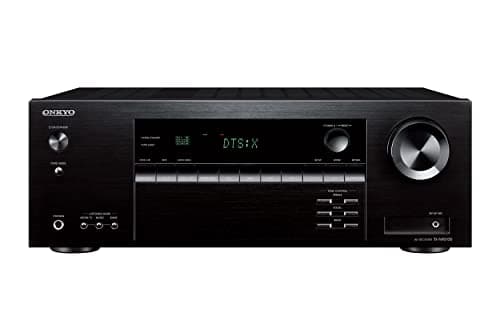 Onkyo TX-NR5100 Eighty honest watts, seven amplifier channels, Dolby Atmos and DTS:X together — and a marketing headline of 165 watts that its own manual measures at ten percent distortion. | Most receiver under $500 | 8.4 | |
| 2 | 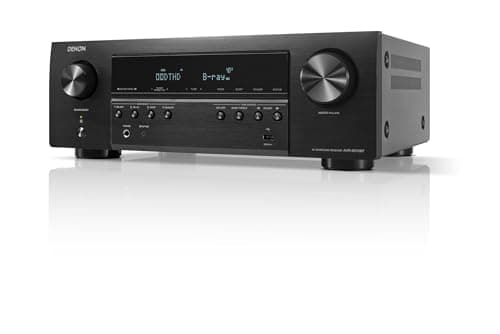 Denon AVR-S570BT The one receiver in this bracket that publishes a single power rating and no flattering second one — and it pays for that restraint by giving up Atmos, room correction and a phono input. | Cleanest single power rating under $500 | 7.6 | |
| 3 | 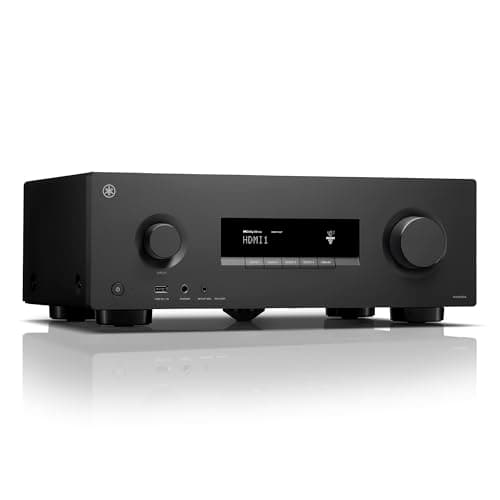 Yamaha RX300A The first receiver in this bracket to put Dolby Atmos and a full-band, two-channels-driven power rating on the same specification table — and it still prints a 145-watt burst figure one line away from the real one. | Cheapest Atmos with a full-band power rating | 7.6 |
Under $500 you are choosing which compromise you can live with, and the specification sheets make that choice harder than it needs to be. Three receivers cleared our verification at this price. Each one withholds something different, and the figures that let you compare them — full band, two channels driven — are 80, 70 and 70 watts. Two of the boxes say 165 and 145.
The power figures, and the conditions attached to them
Every wattage on this page is published by its manufacturer. They are not comparable to each other until you read what each one was measured under, and the two biggest numbers on this page were measured under conditions that flatter them.
rated power is meaningless without: impedance · frequency range · THD · channels driven
Inputs
- Onkyo TX-NR5100, headline figure: 165 W (6 Ω, 1 kHz, 10% THD, 1 channel driven) (Onkyo owner's manual (PDF))
- Onkyo TX-NR5100, FTC figure in the same manual: 80 W (8 Ω, 20 Hz – 20 kHz, 0.08% THD, both channels driven) (Onkyo owner's manual (PDF))
- Denon AVR-S570BT: 70 W + 70 W (8 Ω, 20 Hz – 20 kHz, 0.08% THD) (Denon specifications)
Result
Onkyo, marketing condition: 165 W
Onkyo, comparable condition: 80 W
Denon, comparable condition: 70 W
Under the condition that can be compared, the most powerful receiver on this page is ten watts ahead of the cheapest one, not ninety-five. The gap in the listings is a difference in test method, not a difference in output: one channel instead of two, one frequency instead of the whole band, a six-ohm load instead of eight, and a hundred and twenty-five times the distortion allowed.
Credit where it is due — Onkyo publishes both numbers, in the same manual, a few lines apart. Nothing here is hidden. It is simply that Onkyo's own product page, the listings and the search results all quote the first one, and the first one is not the one that describes what the amplifier does while you are watching a film. The four conditions that make a power rating mean something are the same four here as on a stereo amplifier.
The Atmos receiver that does publish its power rating
For most of this page’s life the only sub-$500 receiver we could verify with Dolby Atmos was the Onkyo TX-SR3100, and it was also the only one whose manufacturer published no power rating at all— not a low one, none. That receiver is no longer buyable: it has no live listing we can link to, and Onkyo’s own store shows it out of stock behind a Notify Me button. We do not keep a buy link pointed at a dead page, so it has come off this list.
The Yamaha RX300A takes the slot, and it settles the question the Onkyo left open. Yamaha publishes 70 W into 8 ohms, 20 Hz to 20 kHz, 0.09% THD, two channels driven — the same condition as the Denon, on a receiver that also decodes Dolby Atmos and passes 8K/60 and 4K/120. Yamaha calls it the direct successor to the discontinued RX-V385 and lists Atmos, 4K/120, 8K/60, VRR and ALLM among the things it adds.
It is not a free win. Yamaha prints 145 W (6 Ω, 1 kHz, 10% THD, one channel driven) on the same line as the 70 W, and ten percent distortion is a condition no one listens under; Yamaha’s own table labels that one JEITA. The specification table lists DTS but not DTS:X — that is the RX500A’s — while the overview page for the same model advertises “DTS Virtual:X”, which appears nowhere in the table. And the calibration system is named only as “Room Correction”: Yamaha does not call it YPAO for this model.
The receiver that publishes the most, and advertises the most
The Onkyo TX-NR5100 arrived on this page in September 2026, when the Yamaha RX-V385 we had at third lost its last live listing. It is now our first pick, and it is the clearest example on the site of the same machine described two ways by the same company.
Onkyo’s product page headlines 165 watts per channel. Onkyo’s North American owner’s manual rates it at 80 watts per channel into 8 ohms, 20 Hz to 20 kHz, both channels driven, at no more than 0.08% distortion, in the FTC wording. The 165 is measured into 6 ohms, at one frequency, with one channel driven, at ten percent distortion. Both numbers are Onkyo’s; only the second is a rating.
Eighty honest watts is still the most on this page, and it arrives with things neither Yamaha nor Denon offers at the price: Dolby Atmos andDTS:X, a named room correction system in AccuEQ, two HDMI outputs and full network streaming. What it does not bring is a use for all seven amplifier channels — Onkyo’s manual publishes speaker layouts up to 5.1.2 and no further — or a phono input, and at $489 a small price move puts it outside the bracket entirely.
What each one gives up
| Spec | Onkyo TX-NR5100 | Denon AVR-S570BT | Yamaha RX300A |
|---|---|---|---|
| Rated power (comparable condition) | 80 W, 20 Hz – 20 kHz, 0.08% THD | 70 W, 20 Hz – 20 kHz, 0.08% THD | 70 W, 20 Hz – 20 kHz, 0.09% THD |
| The other published figure | 165 W (6 Ω, 1 kHz, 10% THD, 1 ch) | None — Denon publishes one rating | 145 W (6 Ω, 1 kHz, 10% THD, 1 ch) |
| Amplifier channels | 7.2, with published layouts to 5.1.2 | 5.2 | 5.2 |
| Dolby Atmos / DTS:X | Both | Neither named | Atmos yes / DTS:X no |
| Room correction | AccuEQ, named and documented | None (Dynamic EQ and Dynamic Volume both “No”) | Unnamed — listed as “Room Correction” |
| Phono input | None | None | None |
| Video passthrough | 8K/24p, or 8K/60p with DSC; 4K/120, VRR, ALLM, QFT | 8K/60, 4K/120 | 8K/60, 4K/120, VRR, ALLM |
| HDMI in / out | 4 / 2 (MAIN and SUB, eARC) | 4 / 1 (eARC) | 4 / 1 (HDMI 2.1, eARC) |
| Pre-outs | Two subwoofer outputs, plus a Zone B line out | 0.2 — two subwoofer outputs | 0.2 — two subwoofer outputs |
| Network streaming | Wi-Fi and Ethernet; AirPlay 2, Chromecast, Sonos | None — Bluetooth only | None |
Two rows decide most purchases. If height channels are the point of the exercise, the Denon is out — it names neither Atmos nor DTS:X anywhere. And if you want the receiver to be the streaming box as well, only the Onkyo does that; the other two are Bluetooth or nothing.
Is 70 watts enough? Do the arithmetic
Seventy watts sounds modest against the three-figure numbers on the boxes, and it is the lowest rating on this page. Against a real speaker at a real distance it is not a problem, and the calculation is short.
SPL = sensitivity + 10 × log₁₀(P) − 20 × log₁₀(distance ÷ 1 m)
Inputs
- Klipsch R-51M published sensitivity: 93 dB (2.83 V / 1 m) (Klipsch spec sheet (PDF))
- Denon AVR-S570BT rated power: 70 W (8 Ω, 20 Hz – 20 kHz, 0.08% THD) (Denon specifications)
- Listening distance assumed: 3 m (our assumption; the 1 m reference is Klipsch's)
Result
10 × log₁₀(70) = 18.5 dB above the 1 W reference
20 × log₁₀(3) = 9.5 dB lost to distance
93 + 18.5 − 9.5 = 102 dB at the seat, one speaker
A hundred and two decibels from one speaker, before the other four and the subwoofer contribute anything. Film reference level is 105 dB peak on any single channel, so 70 honest watts lands within a few decibels of it with a 93 dB speaker — and comfortably past it with the whole system playing.
Two caveats and both matter. Klipsch publishes 2.83 V / 1 m, which equals one watt only into 8 ohms, and Klipsch describes the R-51M as “8 Ω compatible” rather than publishing a measured nominal impedance. And a receiver’s two-channel rating is not what it delivers with five channels driven; no manufacturer on this page publishes an all-channels-driven figure. Sensitivity conditions differ between makers, so run this arithmetic with your own speaker’s published figure rather than borrowing the answer.
Turn the arithmetic around and it explains a common disappointment. Put the same 70 watts on a speaker rated 86 dB and you lose seven decibels, which is most of a five-fold reduction in effective power. Sensitivity is why we lean toward horn-loaded speakers for home theater at this end of the market: it buys back the headroom the receiver cannot.
None of them has a phono input
Denon does not publish one for the AVR-S570BT, Yamaha lists none for the RX300A, and Onkyo lists none for the TX-NR5100 — the RX300A’s analog side is two line-level RCA inputs and nothing else, and the Onkyo’s is three RCA inputs and a 3.5 mm jack. That is a change from one tier up, where the Denon AVR-S670H, the Denon AVR-X1800H, the Yamaha RX-V6A and the Onkyo TX-NR6100 all publish a moving-magnet phono stage.
If a turntable is going into this system, budget for a separate phono stage and read the thirty-second version of whether you need one first. It is a real extra line item, not a footnote.
The ones that just miss
Two receivers we already cover sit just above this bracket, and one of them changes the answer if your budget stretches. The Yamaha RX-V4A publishes 80 W under the same full-band, two-channel condition — which is exactly what the Onkyo on this page publishes, for sixty dollars less, so stretching for it buys MusicCast rather than power. The Denon AVR-S670H publishes 75 W and adds Audyssey MultEQ and a phono input, which is the one thing nothing under $500 has — though Denon’s own info sheet and product title disagree about whether it has Atmos, which we document rather than resolve.
What we would buy
The Onkyo TX-NR5100.It has the most rated power on the page under the condition that can be compared, it is the only one here that decodes both Dolby Atmos and DTS:X, its room correction has a name and a manual, and it is the only one that streams without a box in front of it. Buy it knowing two things: the 165 watts on Onkyo’s own page is not a rating, and the seventh amplifier channel has no published layout to live in. What room correction actually corrects, and what it does not is worth reading before you let AccuEQ decide the ranking for you.
The Denon AVR-S570BT if you do not need Atmos or room correction and you would rather not pay for them. It is the only receiver here that publishes one power figure and leaves it at that, its video section is current, and 70 honest watts into a sensitive speaker is more headroom than most rooms will use. It is also forty dollars cheaper than the Onkyo.
The Yamaha RX300Aif you want height channels at the lowest price on the page. It publishes the same 70 watts as the Denon, adds Dolby Atmos and automatic room correction, and gives up DTS:X and network streaming to do it — which is a reasonable trade at ninety dollars below the Onkyo.
If a games console is the reason you are buying, all three of these publish VRR and the order changes: the Yamaha is the only one on this page that names Quick Media Switching, and the Denon has no ALLM row in its specification table at all despite the marketing copy above it. Our gaming roundup ranks every receiver we cover on published 4K/120 input count and on what each maker will put in writing.
If the receiver is the first box of a system rather than a replacement for one, our under-$1,000 system build starts from the Yamaha RX300A on this page and totals the speakers and subwoofer around it at live prices — and shows why that ceiling buys 3.1 rather than 5.1.
Every pick in detail
Every specification below links to the manufacturer document we read it from. Where a manufacturer does not publish a figure, we say so rather than estimating it.
Onkyo TX-NR5100
Most receiver under $500Price as of October 15, 2026. #ad
Eighty honest watts, seven amplifier channels, Dolby Atmos and DTS:X together — and a marketing headline of 165 watts that its own manual measures at ten percent distortion.
- published data
- 8/10
- power
- 8/10
- features
- 9/10
- connectivity
- 9/10
- value for money
- 8/10
| Specification | Published value | Source |
|---|---|---|
| Channels | 7.2 amplifier channels. Onkyo's own manual publishes speaker layouts up to 5.1.2 — 3.1, 5.1, 3.1.2 and 5.1.2 — so there is no 7.1 or 5.1.4 arrangement in the documentation. | Onkyo owner's manual (PDF) |
| Rated output power | “With 8 ohm loads, both channels driven, from 20 – 20,000 Hz; rated 80 watts per channel minimum RMS power, with no more than 0.08% total harmonic distortion from 250 milliwatts to rated output.” (FTC, North American models) | Onkyo owner's manual (PDF) |
| The other published figure | 165 W at 6 Ω, 1 kHz, 1 ch driven, 10% THD (North American models) — a burst measurement at a distortion level nobody listens at, and the number on Onkyo's own product page | Onkyo owner's manual (PDF) |
| THD+N | 0.08% (20 Hz – 20,000 Hz, at rated output power) | Onkyo owner's manual (PDF) |
| Signal-to-noise | 106 dB (IHF-A, line in, speaker out) | Onkyo owner's manual (PDF) |
| Frequency response | 10 Hz – 100 kHz, +1 / −3 dB (Direct/Pure Audio) | Onkyo owner's manual (PDF) |
| Dolby Atmos / DTS:X | Both — Onkyo's bitstream list carries Dolby Atmos and DTS:X, along with Dolby TrueHD, Dolby Digital Plus and DTS-HD Master Audio, and eARC passes both | Onkyo owner's manual (PDF) |
| Room correction | AccuEQ, with AccuReflex and subwoofer EQ; the setup microphone is in the box | Onkyo product page |
| Phono input | None — the analog side is three RCA inputs and a 3.5 mm jack. A turntable needs its own phono stage. | Onkyo owner's manual (PDF) |
| HDMI in / out | 4 in / 2 out (MAIN and SUB), 24 Gbps, with HDCP 2.3 on every terminal and eARC on the main output | Onkyo product page |
| Video passthrough | 8K/24p 4:2:0 uncompressed and 8K/60p 4:4:4 with DSC (the TV must support DSC); 4K inputs accepted at 100/120 Hz. HDR10, HDR10+, HLG, Dolby Vision and BT.2020, with VRR, ALLM and QFT. | Onkyo owner's manual (PDF) |
| Pre-outs | Two subwoofer pre-outs carrying the same signal, plus a Zone B pre/line output | Onkyo owner's manual (PDF) |
| Bluetooth | Yes, in and out — receives SBC and AAC, transmits SBC, aptX and aptX HD | Onkyo owner's manual (PDF) |
| Network streaming | Dual-band Wi-Fi (802.11 a/b/g/n/ac) and Ethernet, with AirPlay 2, Chromecast built-in, DTS Play-Fi, Roon Tested and Works with Sonos | Onkyo product page |
Pros
- 80 W per channel rated the FTC way — 8 Ω, 20 Hz to 20 kHz, both channels driven, 0.08% THD — which is more honest power than anything else under $500
- Dolby Atmos AND DTS:X, where the Denon at this price has neither and the Yamaha has only Atmos
- AccuEQ room correction with a microphone in the box, named and documented rather than listed as an unnamed feature
- Two subwoofer pre-outs, two HDMI outputs, and full network streaming with AirPlay 2, Chromecast and Works with Sonos
Cons
- Onkyo's own product page headlines “165 Watts per channel”; the manual measures that at 6 Ω, 1 kHz, one channel driven and 10% distortion
- Seven amplifier channels, but the manual's published speaker layouts stop at 5.1.2 — there is no 7.1 or 5.1.4 layout in it
- No phono input — the analog side is three RCA inputs and a 3.5 mm jack
- The most expensive receiver in this bracket, and close enough to $500 that a price move puts it outside
Skip it if you want the cheapest competent 5.1 you can buy. The Yamaha RX300A does Atmos for ninety dollars less, and the extra two amplifier channels here have no published layout to use them in.
Denon AVR-S570BT
Cleanest single power rating under $500No live price right now. #ad
The one receiver in this bracket that publishes a single power rating and no flattering second one — and it pays for that restraint by giving up Atmos, room correction and a phono input.
- published data
- 9/10
- power
- 8/10
- features
- 5/10
- connectivity
- 7/10
- value for money
- 8/10
| Specification | Published value | Source |
|---|---|---|
| Channels | 5.2 — Denon's own product title is “AVR-S570BT - 5.2 Ch. 70W 8K AV Receiver” | Denon product page |
| Power output | Front 70 W + 70 W, center 70 W, surround 70 W + 70 W (8 Ω, 20 Hz – 20 kHz, 0.08% THD) | Denon specifications (owner's manual) |
| Signal-to-noise | 98 dB (IHF-A weighted, Direct mode) | Denon specifications (owner's manual) |
| Frequency response | 10 Hz – 100 kHz, +1 / −3 dB (Direct mode) | Denon specifications (owner's manual) |
| Analog input sensitivity | 200 mV / 47 kΩ | Denon specifications (owner's manual) |
| Phono input | None — no phono input appears in Denon's specification table for this model. Its dearer siblings, the AVR-S670H and AVR-X1800H, both have one. | Denon specifications (owner's manual) |
| Dolby Atmos / DTS:X | Neither is named anywhere on Denon's product page for this model. The formats Denon does name are Dolby Digital, Dolby TrueHD and DTS-HD. If height channels are why you are buying, this is not the receiver. | Denon product page |
| Room correction | None. Denon publishes “Audyssey Dynamic EQ: No” and “Audyssey Dynamic Volume: No” for this model — it sits a step below the AVR-S670H's Audyssey MultEQ. | Denon product page |
| HDMI in / out | 4 in / 1 out (eARC) | Denon product page |
| Video passthrough | 8K/60 Hz and 4K/120 Hz; Dolby Vision, HDR10+, HLG and Dynamic HDR | Denon product page |
| HDMI 2.1 gaming features | VRR Yes, QFT Yes, QMS No. ALLM does NOT appear in Denon's specification table for this model — it is claimed only in the marketing copy on the same page. Denon also does not state how many of the four inputs carry 8K/4K120, where it prints an explicit count on every dearer model. | Denon product page |
| Pre-outs | 0.2 — two subwoofer outputs and nothing else. No main-channel pre-outs. | Denon product page |
| Network streaming | None published — Bluetooth only. This model sits outside Denon's HEOS range. | Denon product page |
Pros
- 70 W per channel rated 20 Hz – 20 kHz at 0.08% THD — the honest condition, published by Denon
- 8K/60 and 4K/120 passthrough with Dolby Vision, HDR10+ and HLG on four HDMI inputs
- HDMI eARC output, so a modern television can send it a lossless stream
- Two subwoofer outputs, which is unusual at this price
Cons
- No Dolby Atmos and no DTS:X named anywhere by Denon for this model
- No room correction at all — Audyssey Dynamic EQ and Dynamic Volume are both published as “No”
- No phono input, so a turntable needs its own phono stage
- No network streaming; Bluetooth is the only wireless input
Skip it if you want height channels or automatic room correction. Both start one model up, at the AVR-S670H.
Yamaha RX300A
Cheapest Atmos with a full-band power ratingPrice as of October 15, 2026. #ad
The first receiver in this bracket to put Dolby Atmos and a full-band, two-channels-driven power rating on the same specification table — and it still prints a 145-watt burst figure one line away from the real one.
- published data
- 8/10
- power
- 7/10
- features
- 8/10
- connectivity
- 7/10
- value for money
- 8/10
| Specification | Published value | Source |
|---|---|---|
| Channels | 5.2 — five amplifier channels, 5.1 decodable | Yamaha spec page |
| Rated output power | 70 W (8 Ω, 20 Hz – 20 kHz, 0.09% THD, 2 ch driven) | Yamaha spec page |
| Second published power figure | 145 W (6 Ω, 1 kHz, 10% THD, 1 ch driven) — printed on the same line as the 70 W. Ten percent distortion, one channel, one frequency: it is a burst figure, not a listening rating. | Yamaha spec page |
| Dolby Atmos / DTS:X | Atmos yes / DTS:X no. Yamaha's decoder list for this model is Dolby Atmos, Dolby TrueHD, Dolby Digital Plus, Dolby Digital and DTS — DTS:X appears only in the RX500A column. The overview page separately claims “DTS Virtual:X”, which is not in the specification table. | Yamaha spec page |
| Room correction | Listed only as “Room Correction”, with a setup microphone and stand in the box. Yamaha does not name YPAO for this model anywhere on its product or specification page — the RX-V385 one bracket down is named YPAO. | Yamaha spec page |
| HDMI in / out | 4 in / 1 out — HDMI 2.1, eARC/ARC, VRR, ALLM, QMS, HDCP 2.3 | Yamaha spec page |
| Video passthrough | 8K/60 and 4K/120; Dolby Vision, HDR10+ and Hybrid Log-Gamma | Yamaha spec page |
| Pre-outs | Two subwoofer pre-outs. No main-channel pre-outs. | Yamaha spec page |
| Phono input | None — Yamaha's connection list is two analog RCA inputs, one optical, one coaxial and one USB, with no phono row | Yamaha spec page |
| Network streaming | None — Yamaha publishes a dash against Wi-Fi, Ethernet and every streaming service for this model. Bluetooth 5.3 with Multipoint is the only wireless input. | Yamaha spec page |
| Tuner | FM yes, AM no | Yamaha spec page |
| Dimensions / weight | 434 × 157 × 319 mm (17-1/8 × 6-1/8 × 12-1/2 in); 7.6 kg / 16.8 lb | Yamaha spec page |
| Power consumption | 260 W in use, ≤ 0.3 W standby | Yamaha spec page |
Pros
- 70 W rated 20 Hz – 20 kHz at 0.09% THD with two channels driven — the comparable condition, published
- Dolby Atmos with in-ceiling, up-firing or virtual height layouts, which nothing else under $500 here offers
- HDMI 2.1 throughout: 8K/60, 4K/120, VRR, ALLM and eARC on four inputs
- Two subwoofer pre-outs and bi-amp capability at the bottom of Yamaha's range
Cons
- No DTS:X — Yamaha's decoder list for this model stops at DTS, and DTS:X is the RX500A's
- Yamaha's overview page claims DTS Virtual:X, which does not appear in its own specification table
- The calibration system is listed only as “Room Correction”; Yamaha does not name YPAO for this model
- No Wi-Fi, no Ethernet and no streaming services — Bluetooth is the only wireless input
- No phono input, so a turntable needs its own phono stage
Skip it if you want DTS:X, network streaming, or seven channels. All three start at the RX500A, one model up.
Frequently asked questions
How many watts do I need in an AV receiver under $500?
Fewer than the boxes suggest. Seventy watts into a 93 dB speaker produces about 102 dB at three meters from a single channel, which is within a few decibels of film reference level before the other channels contribute. The number that matters is not the wattage but the condition attached to it: look for a rating measured 20 Hz to 20 kHz with two channels driven, not a 1 kHz single-channel figure.
Is there an AV receiver under $500 with Dolby Atmos?
Two of them. The Onkyo TX-NR5100 publishes Dolby Atmos and DTS:X in its bitstream list, with speaker layouts up to 5.1.2. The Yamaha RX300A, which Yamaha launched into this bracket in June 2026, publishes Dolby Atmos with in-ceiling, up-firing and virtual height layouts, but not DTS:X — that starts at the RX500A. The Denon AVR-S570BT names neither format anywhere.
What happened to the Onkyo TX-SR3100?
It was our sub-$500 Atmos pick and it is no longer buyable — there is no live retail listing we can link to, and Onkyo’s own store shows it out of stock behind a Notify Me button. We removed it rather than keep a buy link pointed at a dead page. The finding we published about it stands on the record: Onkyo carried no power rating for that model on any page we could reach, and the support article holding the general specifications returned HTTP 403 to us on 19 August 2026. Our current pick in that slot is the Yamaha RX300A, which publishes the rating Onkyo did not.
Do cheap AV receivers have a phono input for a turntable?
Not at this price. None of the three here publishes one: not the Onkyo TX-NR5100, not the Denon AVR-S570BT, not the Yamaha RX300A. Phono inputs appear one tier up, on the Denon AVR-S670H, Denon AVR-X1800H, Yamaha RX-V6A and Onkyo TX-NR6100. Below that, budget for a separate phono stage.
Why is a 165 W receiver only ten watts ahead of a 70 W one?
Because the 165 is a different measurement, not a different amplifier. Onkyo’s product page headlines 165 watts per channel for the TX-NR5100; Onkyo’s own manual measures that into 6 ohms, at 1 kHz, with one channel driven, at ten percent distortion. The rating in the same manual is 80 watts into 8 ohms, 20 Hz to 20 kHz, both channels driven, at 0.08% distortion. The Denon AVR-S570BT publishes 70 watts under that same condition. Compared like for like the gap is ten watts, which is about half a decibel.
What happened to the Yamaha RX-V385?
It is no longer buyable — the listing reads “currently unavailable” and there is no live one under any other listing. There was no successor to move the link to either, because Yamaha’s own successor to it, the RX300A, was already on this page. The Onkyo TX-NR5100 took the slot, and took first place with it. The RX-V385 findings we published stand on the record: Yamaha rated it at 70 W full band with two channels driven, printed “100 W” at 1 kHz on the same table, and named its calibration YPAO, which the RX300A that replaced it in Yamaha’s range does not.
Read next
The Best 7.2 AV Receivers Under $1,000
Four 7.2 receivers under $1,000, ranked on the speaker layouts their own manuals document rather than on the number printed on the box.
The Best AV Receivers Under $1,000
Five receivers under $1,000, compared on FTC-rated power and the pre-out spec almost nobody mentions.
Are AV Receivers Worth It?
Four products in one chassis, priced as one. Which of the four you actually need decides whether a receiver is the right purchase at all.
Home Theater Setup: The Complete Guide
The complete setup, built on Dolby's published layout angles rather than on vibes — plus what to do when your room disagrees.
AV Receiver Room Correction, Honestly
What Audyssey, YPAO and AccuEQ tiers actually publish, the one difference that is documented, and the physics room correction cannot beat.
How to Read an Amplifier Power Rating
Impedance, bandwidth, distortion, channels driven — the four conditions that turn a watts number into a spec, and which manufacturers publish all four.
The Best Home Theater Speakers
A timbre-matched 5.1 built from published specs — fronts, center, surrounds and a subwoofer that actually connects.
The Best AV Receivers for Gaming
Ranked on published 4K/120 input count and whether VRR is in the maker's spec table, not its ad copy. The receiver with the most HDMI inputs is not on the list, and the reason is the whole page.
Sources
Every specification on this page was read from one of these documents. If one of them has changed, or we have made an error, tell us — corrections are logged and dated per our editorial policy.
- Denon AVR-S570BT — specifications (owner's manual)
- Denon AVR-S570BT — product page (features, HDMI, pre-outs, Audyssey rows)
- Onkyo TX-NR5100 — owner's manual (FTC 80 W rating, 165 W burst figure, HDMI, layouts) (PDF)
- Onkyo TX-NR5100 — product page (the 165 W headline, AccuEQ, HDCP 2.3, streaming)
- Yamaha RX-V385 — specification table (the model we removed; figures remain on the record)
- Yamaha RX300A — specification table (RX300A column)
- Yamaha RX300A — launch announcement (direct successor to the RX-V385)
- Onkyo TX-SR3100 — product page (the model we removed; carries no power rating)
- Klipsch R-51M — spec sheet (sensitivity used in the arithmetic)