The Best Phono Preamps Under $200
A phono stage does two jobs: add about 40 dB of gain, and undo the RIAA curve. Here is what separates a $17 box from a $188 one, in published numbers.
Disclosure: we earn a commission if you buy through the links on this page, at no extra cost to you. It does not influence what we pick — our criteria are published and reproducible, so you can check our work. How we pick · Full disclosure
These picks are spec-and-price analyses, not listening tests. We have not heard this gear and we do not pretend to have: every figure below is sourced to the manufacturer and linked, and every price is live or not shown at all. Here are the rules we followed.
Quick picks
Ranked on the published criteria in How We Pick. Prices are live as of October 15, 2026. Tap any row for the full write-up.
- 8.6
- 6.6
- 6.8$140.00View on Amazon
$149.006% off
- 6.6$52.49View on Amazon
$69.9925% off
- 5.4
- 3.4$20.69View on Amazon
$21.996% off
| # | Product | Best for | Score | Price |
|---|---|---|---|---|
| 1 | 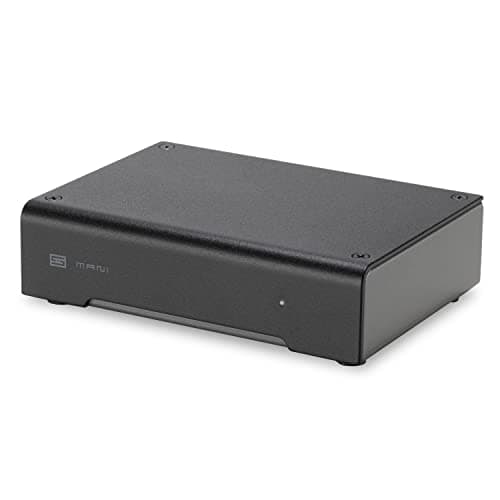 Schiit Mani 2 Four gain settings covering MM, MC and MI cartridges, which means it is the one box here that will still fit whatever cartridge you buy next. | Best overall under $200 | 8.6 | |
| 2 | 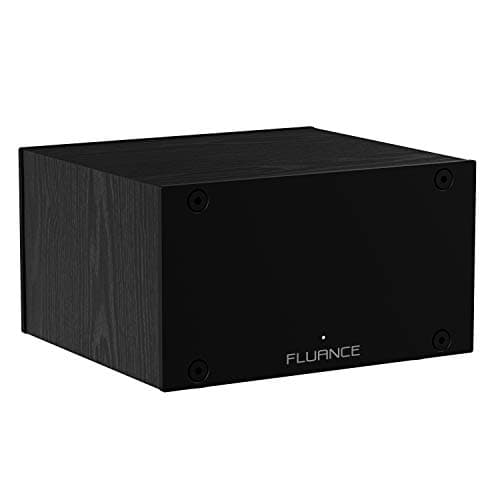 Fluance PA10 A moving-magnet stage priced to sit under a Fluance RT82 or RT85, which is precisely the gap those decks leave by shipping without one. | Best match for a Fluance deck | 6.6 | |
| 3 | 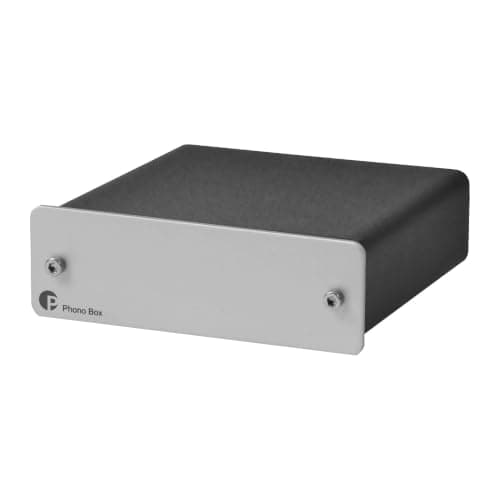 Pro-Ject Phono Box DC A 40 dB moving-magnet stage with a 60 dB moving-coil position on a rear-panel switch, at roughly what the MM-only boxes on this page ask. | Cheapest MM and MC in one box | 6.8 | $140.00View on Amazon $149.006% off |
| 4 | 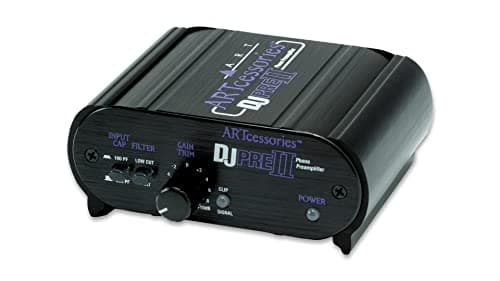 ART DJPRE II A cheap MM stage with a rumble filter and a gain trim, which is more adjustment than anything else at the price offers. | Best budget pick | 6.6 | $52.49View on Amazon $69.9925% off |
| 5 | 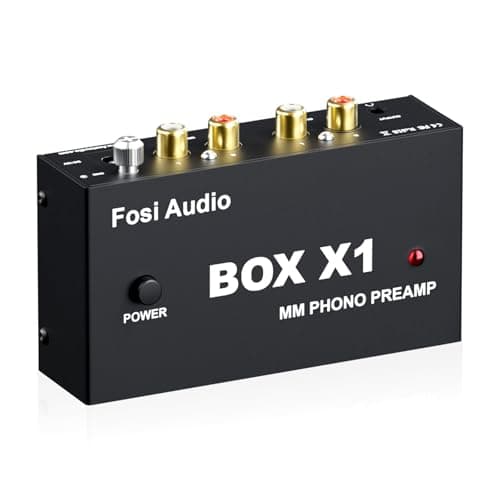 Fosi Audio Box X1 A palm-sized moving-magnet stage with a headphone output, and the only box under $50 here whose maker publishes a distortion and noise figure at all. | Best under $50 | 5.4 | |
| 6 | 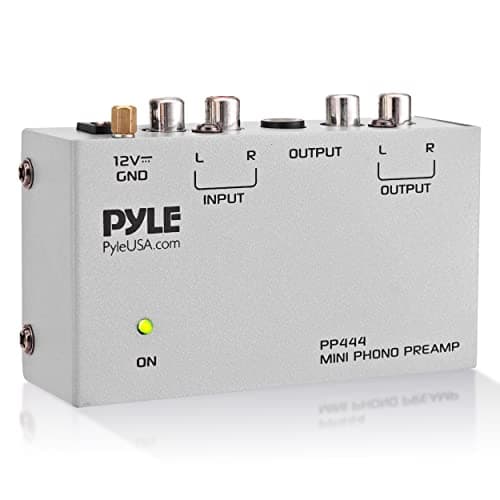 Pyle PP444 The cheapest way to get a phono signal into a line input, and the clearest example in this bracket of what that saving actually costs you. | The one we would skip | 3.4 | $20.69View on Amazon $21.996% off |
Every phono stage on this page does the same two things: it adds gain, and it applies the inverse RIAA curve to put back the bass that was removed when the record was cut. The difference between them is not whether they do that. It is how much gain, into what cartridge, with how much noise — and whether the manufacturer will tell you.
The number that decides everything: gain
A moving-magnet cartridge outputs around 5 mV — Ortofon publishes 5.5 mV for the 2M Red and 2M Blue. A moving-coil cartridge can output a tenth of that or less. Line level is roughly 500 mV. So an MM cartridge needs about 40 dB of gain and a low-output MC needs 60 dB or more.
That single fact sorts this entire page. The Fluance PA10 gives you 38 dB and the ART DJPRE II a maximum of 45 dB with a ±10 dB front-panel trim — correct for a moving magnet and short of what a low-output moving coil needs. The Pro-Ject Phono Box DC gives you 40 dB on MM and 60 dB on MC from a switch on the back. The Schiit Mani 2 gives you a choice of 33, 42, 48 or 60 dB. The iFi ZEN Phono 3 goes to 72 dB.
If you own one moving-magnet cartridge and always will, the extra settings are money spent on flexibility you will never use, and the PA10 at around $100 is the sensible buy. If there is any chance you move to a moving coil, a 38 dB-only box becomes landfill the day you do.
Loading, and why the Mani 2 wins
A cartridge expects to see a particular resistance and capacitance. Ortofon recommends 47 kΩ and 150–300 pF for the 2M series. Most boxes here fix that for you: Pro-Ject gives you 47 kΩ / 120 pF and Fluance gives you 100 pF, take it or leave it.
The Schiit Mani 2 lets you select 47, 100, 150 or 200 pF of capacitance and 47 kΩ, 200 Ω, 47 Ω or 38 Ω of resistance. That is the difference between a box that fits your current cartridge and a box that will fit your next three. It is also why it is our pick despite costing roughly double the PA10.
Subsonic filters are more useful than they sound
If your woofers visibly pump on warped records, or a footstep across the room makes the bass jump, you are seeing subsonic energy — below about 20 Hz — being amplified. A subsonic filter removes it.
Three of these publish one: the Mani 2 (selectable 6 or 12 dB/octave at 15 Hz, fully passive), the ART DJPRE II (switchable, −3 dB at 22 Hz), and the Fluance PA10 (selectable, rolling off below 20 Hz). Pro-Ject publishes none. If your turntable sits on a suspended floor, this feature is worth more to you than any distortion figure on the page.
Where the published numbers run out
The two boxes at the bottom of this page are not there because we measured them badly. They are there because of what their makers leave out.
Fosi Audio Box X1:Fosi does publish a spec table — 70 dB signal-to-noise, THD of ≤ 0.08% at 1 kHz and 3 mV, and a 2 V maximum output into 10 kΩ. What it does not publish is gain, and gain is the number this entire page turns on: without it you cannot tell whether the box suits your cartridge before you own it. Fosi also gives “Standard RIAA” for frequency response with no deviation figure attached, which is a statement of intent rather than a measurement, and we do not promote it to one. There is no published input loading and no subsonic filter.
Pyle PP444:Pyle does publish two figures, to their credit — 70 dB signal-to-noise and 0.08% THD. Both are the worst on this page by a wide margin. The Fluance PA10, at roughly six times the price, publishes greater than 90 dB and 0.004%. Pyle publishes no gain figure and no cartridge type at all, describing it only as accommodating “magnetic pickups”.
What we would pair them with
If you are buying a stage because your deck lacks one, the likely candidates are the Fluance RT82 or the RT85 or Debut Carbon EVO — all three ship without a phono stage and all three ship with moving-magnet cartridges, so 38–42 dB is all you need. Not sure whether you need one at all? Start here.
None of the seven stages on this page has a USB output. If the reason you are buying one is to get records into a computer, the boxes that put a converter behind the stage are a separate category with a different question to ask — every converter in it is the same 16-bit ceiling, so what separates them is what the maker publishes about the stage. Our USB phono preamp roundup ranks four of them on that.
Every pick in detail
Every specification below links to the manufacturer document we read it from. Where a manufacturer does not publish a figure, we say so rather than estimating it.
Schiit Mani 2
Best overall under $200No live price right now. #ad
Four gain settings covering MM, MC and MI cartridges, which means it is the one box here that will still fit whatever cartridge you buy next.
- flexibility
- 10/10
- noise
- 9/10
- value for money
- 8/10
- build quality
- 8/10
- connectivity
- 7/10
| Specification | Published value | Source |
|---|---|---|
| Gain | 33, 42, 48 or 60 dB (factory default 42 dB) | Schiit spec page |
| Cartridge support | MM, MC or MI | Schiit spec page |
| Loading | Capacitance 47, 100, 150 or 200 pF (default 47 pF); resistive 47 kΩ, 200 Ω, 47 Ω, 38 Ω | Schiit spec page |
| Signal-to-noise | > 108 dB at 33 dB gain; > 98 dB at 42 dB; > 96 dB at 48 dB; > 87 dB at 60 dB (A-weighted, ref 2 V RMS) | Schiit spec page |
| THD | < 0.0003% at 33 dB gain; < 0.0015% at 60 dB | Schiit spec page |
| Subsonic filter | Yes — selectable 6 or 12 dB/octave at 15 Hz, fully passive | Schiit spec page |
| Power | External 16 VAC transformer; dual-filtered regulated ±16 V rails | Schiit manual (PDF) |
Pros
- Four gain settings (33/42/48/60 dB) covering MM, MC and MI
- Four capacitance and four resistance loading options — the most adjustable box here by a distance
- A selectable, fully passive subsonic filter at 15 Hz
- Publishes a full spec sheet including THD and signal-to-noise at every gain setting
Cons
- Gain and loading are set by switches on the underside, so changing them means picking the unit up
- External wall-wart transformer
- Costs roughly double the entry options here
Skip it if you own one moving-magnet cartridge and will never change it — the extra gain settings are the thing you are paying for.
Fluance PA10
Best match for a Fluance deckPrice as of October 15, 2026. #ad
A moving-magnet stage priced to sit under a Fluance RT82 or RT85, which is precisely the gap those decks leave by shipping without one.
- flexibility
- 4/10
- noise
- 8/10
- value for money
- 8/10
- build quality
- 7/10
- connectivity
- 6/10
| Specification | Published value | Source |
|---|---|---|
| Gain | 38 dB | Fluance spec page |
| Cartridge support | Moving magnet only | Fluance spec page |
| Loading | 100 pF | Fluance spec page |
| Signal-to-noise | > 90 dB | Fluance spec page |
| THD | 0.004% | Fluance spec page |
| Subsonic filter | Yes — selectable high-pass, rolls off below 20 Hz | Fluance spec page |
| Power | External 24 V / 500 mA adapter; 0.4 W consumption | Fluance spec page |
Pros
- Fills the exact gap the RT82/RT85 leave
- Aluminum chassis
- Simple and quiet
Cons
- MM only
- No gain adjustment
- No subsonic filter
Skip it if you need MC support now or later.
Pro-Ject Phono Box DC
Cheapest MM and MC in one boxA 40 dB moving-magnet stage with a 60 dB moving-coil position on a rear-panel switch, at roughly what the MM-only boxes on this page ask.
- flexibility
- 6/10
- noise
- 8/10
- value for money
- 7/10
- build quality
- 7/10
- connectivity
- 6/10
| Specification | Published value | Source |
|---|---|---|
| Gain | 40 dB (MM) · 60 dB (MC) | Pro-Ject spec page |
| Cartridge support | MM or MC, selected by a switch on the rear panel | Pro-Ject spec page |
| Loading | MM 47 kΩ / 120 pF · MC 100 Ω / 120 pF | Pro-Ject spec page |
| Noise floor | 94 dBA (MM) · 75 dBA (MC) | Pro-Ject spec page |
| THD | 0.01% (MM) · 0.05% (MC) | Pro-Ject spec page |
| RIAA accuracy | 20 Hz – 20 kHz / max. 0.5 dB | Pro-Ject spec page |
| Subsonic filter | Not published | — |
| Power | Outboard 18 V / 200 mA DC supply; under 1 W standby | Pro-Ject spec page |
Pros
- Moving magnet and moving coil on one switch — 40 dB or 60 dB from the same box
- Pro-Ject publishes a noise figure for both positions: 94 dBA on MM, 75 dBA on MC
- RIAA accuracy published as max. 0.5 dB across 20 Hz – 20 kHz, which nothing else near this price states
Cons
- Loading is fixed in both positions — 47 kΩ / 120 pF on MM, 100 Ω on MC, with no adjustment either way
- No subsonic filter published
- One moving-coil setting only, so a cartridge that wants anything other than 100 Ω has to live with it
Skip it if your cartridge is a moving magnet and always will be. The Fluance PA10 does that job for less and you would be paying for a switch position you never use.
ART DJPRE II
Best budget pickA cheap MM stage with a rumble filter and a gain trim, which is more adjustment than anything else at the price offers.
- flexibility
- 5/10
- noise
- 7/10
- value for money
- 9/10
- build quality
- 6/10
- connectivity
- 6/10
| Specification | Published value | Source |
|---|---|---|
| Gain | Maximum 45 dB at 1 kHz; front-panel trim boosts or cuts up to 10 dB | ART manual (PDF) |
| Cartridge support | Not stated — the manual refers only to “magnetic cartridges” and “selectable cartridge loading”, and never says MM or MC | ART manual (PDF) |
| Loading | 47 kΩ in parallel with a switchable 100 or 200 pF | ART manual (PDF) |
| Hum and noise | > 90 dB below clipping (ART publishes this rather than a signal-to-noise figure) | ART manual (PDF) |
| THD | 0.01% typical at 1 kHz | ART manual (PDF) |
| Subsonic filter | Yes — switchable low-cut, −3 dB at 22 Hz | ART manual (PDF) |
| Power | External 7–12 V DC or 9–12 V AC at 150 mA | ART manual (PDF) |
Pros
- Gain trim and a low-cut rumble filter at a budget price
- Metal chassis
- Long track record
Cons
- MM only
- External wall wart
- Utilitarian looks
Skip it if you want moving-coil support — this is a moving-magnet box.
Fosi Audio Box X1
Best under $50Price as of October 15, 2026. #ad
A palm-sized moving-magnet stage with a headphone output, and the only box under $50 here whose maker publishes a distortion and noise figure at all.
- flexibility
- 3/10
- noise
- 5/10
- value for money
- 7/10
- build quality
- 5/10
- connectivity
- 7/10
| Specification | Published value | Source |
|---|---|---|
| Gain | Not published | — |
| Cartridge type | Moving magnet (MM turntable input, with a grounding post) | Fosi Audio spec table |
| Signal-to-noise | 70 dB | Fosi Audio spec table |
| THD | ≤ 0.08% at 1 kHz and 3 mV | Fosi Audio spec table |
| Frequency response | “Standard RIAA” — Fosi publishes no deviation figure, so this is a statement of intent rather than a measured tolerance | Fosi Audio spec table |
| Outputs | RCA line out plus a 3.5 mm headphone output | Fosi Audio spec table |
| Output level | 2 V max (P-P) into 10 kΩ | Fosi Audio spec table |
| Input loading (impedance and capacitance) | Not published | — |
| Subsonic filter | Not published | — |
| Power | External 12 V / 1.5 A supply (100–240 V AC input) | Fosi Audio spec table |
| Dimensions / weight | 3.94 × 0.98 × 2.17 in; 0.35 lb (161 g) | Fosi Audio spec table |
Pros
- The only stage on this page with a 3.5 mm headphone output as well as RCA — a turntable and this box alone make a working system
- Fosi publishes a THD figure with its measurement condition (≤ 0.08% at 1 kHz and 3 mV), which the Pyle beneath it does not qualify at all
- Genuinely tiny at 3.94 × 0.98 × 2.17 in and 0.35 lb, with a proper grounding post
Cons
- Fosi publishes no gain figure — on a page where gain is the number that decides everything, that is the one omission that matters
- 70 dB signal-to-noise and 0.08% THD are the same modest figures the $22 Pyle publishes, at roughly twice the money
- Moving magnet only, with no loading options and no subsonic filter published
Skip it if you will ever fit a moving-coil cartridge, or you need to know the gain before you buy. Neither question is answered here.
Pyle PP444
The one we would skipThe cheapest way to get a phono signal into a line input, and the clearest example in this bracket of what that saving actually costs you.
- flexibility
- 2/10
- noise
- 3/10
- value for money
- 5/10
- build quality
- 2/10
- connectivity
- 5/10
| Specification | Published value | Source |
|---|---|---|
| Signal-to-noise | 70 dB (A-weighted) at 2 V output | Pyle spec page |
| THD | 0.08% at 1 kHz and 3 mV input | Pyle spec page |
| Input sensitivity / impedance | 3 mV / 50 kΩ (phono) | Pyle spec page |
| Cartridge support | Not stated — the page says only “accommodates magnetic pickups”, with no MM or MC designation | Pyle spec page |
| Gain | Not published | — |
| Input capacitance | Not published | — |
| Subsonic filter | Not published | — |
| Power | 12 V DC adapter (included) | Pyle spec page |
Pros
- Extremely cheap
- Pyle does publish a signal-to-noise figure and a THD figure, which is more than Behringer manages
- Compact
Cons
- 70 dB signal-to-noise and 0.08% THD are the weakest published figures here by a wide margin — the Fluance PA10 publishes > 90 dB and 0.004%
- No gain figure and no cartridge type published — the page says only “accommodates magnetic pickups”
- No adjustment of any kind and no subsonic filter
Skip it if you care about the result. We list it because it ranks and because you deserve to know what the $17 buys: a published noise floor roughly 20 dB worse than a box costing six times as much.
Frequently asked questions
How much gain do I need in a phono preamp?
About 40 dB for a moving-magnet cartridge, and 60 dB or more for a low-output moving coil. A moving magnet outputs roughly 5 mV (Ortofon publishes 5.5 mV for the 2M Red and Blue) against a line level of around 500 mV, which is the ~40 dB gap. If you do not know which cartridge you have, it is almost certainly a moving magnet — every turntable we recommend ships with one.
Is an expensive phono preamp worth it over a cheap one?
We cannot tell you what they sound like. We can tell you what they publish. The Fluance PA10 (~$100) publishes greater than 90 dB signal-to-noise and 0.004% THD; the Pyle PP444 (~$17) publishes 70 dB and 0.08%. That is roughly a 20 dB noise difference and a twenty-fold distortion difference, in the manufacturers’ own figures. Whether you can hear it in your room is a separate question that we are not in a position to answer.
Do I need a subsonic filter?
Only if you have the problem it solves. If your woofers visibly pump on warped records, or footsteps make the bass jump, yes — and the Schiit Mani 2, Fluance PA10 and ART DJPRE II all publish one. If neither happens in your room, it is a feature you will never switch on.
My turntable already has a phono preamp. Should I still buy one?
Not necessarily, and possibly not at all. A built-in stage is a fixed-quality component chosen to hit a price. Some decks — the Fluance RT81, for example — publish a true bypass that takes the internal electronics out of circuit entirely when you use an external stage, which makes upgrading clean. Whether the upgrade is audible we cannot say; we have not heard it. What we can say is that if your deck cost under $300, the internal stage is unlikely to be the weakest link in your system.
What happened to the Behringer PP400?
It used to sit at the bottom of this page and we have removed it, because it is no longer available to buy — the listing now reads “currently unavailable” and the only live results under that name are third-party power supplies for it. We never managed to verify a single specification for it at source anyway: Behringer’s product page carried no spec table and their own spec document sat on a host that no longer resolves. The Fosi Audio Box X1 takes its place as the sub-$50 pick, and Fosi at least publishes a noise and distortion figure.
What happened to the Pro-Ject Phono Box MM?
It is no longer buyable — the listing reads “currently unavailable” and we could find no live one under any other listing. Pro-Ject’s spec page for it is still up, so the 40 dB and 47 kΩ / 120 pF figures we published stand on the record; we simply will not keep a buy link pointed at a dead page. The Pro-Ject that is still in stock is the Phono Box DC, and it takes the slot: the same 40 dB moving-magnet stage, plus a 60 dB moving-coil position the MM box never had, for a little more money.
Read next
The Best Phono Preamps Under $500
Six phono stages from $249 to $499, ranked on published RIAA accuracy and whether the loading can be matched to your cartridge.
Do I Need a Phono Preamp?
Yes, unless you already have one — and it might be hiding in your turntable, amplifier or speakers. Check in 30 seconds.
The Best Turntables Under $500
Five decks under $500, ranked on published specs and total cost — including the phono stage two of them make you buy separately.
The Best Turntables Under $1,000
Four decks under $1,000, judged on where the money went — and only one publishes a tonearm effective mass you can actually use.
Cartridge and Tonearm Matching: Do the Arithmetic
One equation, two published numbers, and the compliance caveat that changes the answer. Worked through with real specs.
How to Connect a Turntable to Speakers
Four working routes from turntable to speakers, the two that do not work, and how to fix the hum.
The Best Integrated Amplifiers for a Turntable
Amplifiers with a phono stage inside, ranked on published MM sensitivity and phono signal-to-noise — not watts.
Moving Magnet vs Moving Coil Cartridges
The whole MM/MC argument reduces to output voltage — and Schiit's own published noise figures show exactly what the extra gain costs.
The Best Phono Preamps With a USB Output
Four USB phono stages and the one deck that skips the box, ranked on what each maker publishes about the stage that feeds the converter — because every converter here is the same 16-bit, 48 kHz ceiling.
Sources
Every specification on this page was read from one of these documents. If one of them has changed, or we have made an error, tell us — corrections are logged and dated per our editorial policy.