The Best AV Receivers With Pre-Outs
Every receiver we cover has a socket labeled pre-out. On five of them it is a subwoofer output and nothing else. This page ranks the ones where the label means what a search for pre-outs is hoping it means.

Disclosure: we earn a commission if you buy through the links on this page, at no extra cost to you. It does not influence what we pick — our criteria are published and reproducible, so you can check our work. How we pick · Full disclosure
These picks are spec-and-price analyses, not listening tests. We have not heard this gear and we do not pretend to have: every figure below is sourced to the manufacturer and linked, and every price is live or not shown at all. Here are the rules we followed.
Quick picks
Ranked on the published criteria in How We Pick. Prices are live as of September 17, 2026. Tap any row for the full write-up.
- 7.6
- 8.2
- 9.0
- 8.2$649.00View on Amazon
$899.9928% off
| # | Product | Best for | Score | Price |
|---|---|---|---|---|
| 1 | 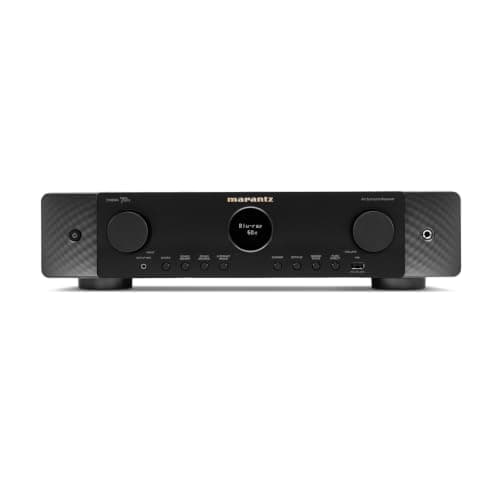 Marantz Cinema 70s A 7.2 receiver in a half-height chassis, which is the entire point — it fits furniture a normal receiver does not. | Slimmest chassis | 7.6 | |
| 2 | 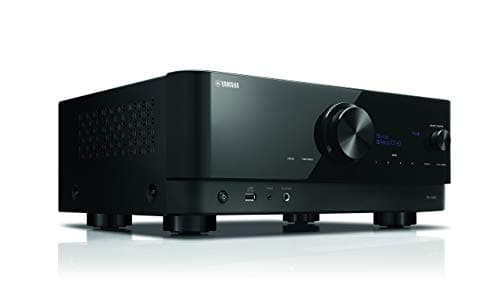 Yamaha RX-V6A The most powerful receiver here on paper — 100 watts a channel rated across the full band — with a phono input and seven HDMI inputs. | Best for music as well as film | 8.2 | |
| 3 | 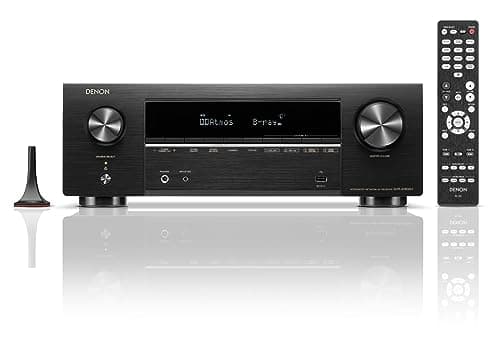 Denon AVR-X1800H Seven channels, 8K passthrough and Audyssey MultEQ XT — the room correction being the feature that actually changes what you hear in a real room. | Best overall under $1,000 | 9.0 | |
| 4 | 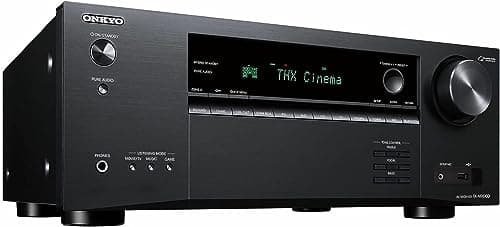 Onkyo TX-NR6100 THX certified with three 4K120 HDMI inputs, which is the specific spec that matters if two consoles and a PC share the same receiver. | Best for gaming | 8.2 | $649.00View on Amazon $899.9928% off |
A pre-out is a line-level copy of a channel, taken after the receiver’s processing and volume control and before its power amplifier. Plug an external amplifier into it and that amplifier drives the speaker instead of the receiver’s own channel. That is the entire feature. The complication is that every receiver has at least one socket labeled pre-out — the subwoofer output is one by definition — and manufacturers count that socket when they print “pre-out” on a feature list.
What a pre-out is for, and the two reasons people want one
The first reason is power. Receivers in the bracket we cover publish 50 to 100 W per channel with two channels driven, and the honest figure with all channels driven is lower and usually unpublished. A front L/R pre-out lets a stereo power amplifier take over the two channels that do most of the work. The second reason is using an amplifier you already own: a stereo integrated with a home-theater bypass, or a power amplifier from a two-channel system, so that the receiver handles decoding and video and the amplifier you trust handles the mains. Both reasons need the same thing, and it is not a subwoofer socket.
A full set of pre-outs — seven channels plus two subwoofers on a 7.2 receiver — goes further: the receiver becomes a processor, and every channel can be driven externally. In the price range we cover exactly one receiver publishes that. Below it, the honest options are two receivers with front L/R pre-outs, and then a drop to subwoofer-only.
How we ranked this
On the published pre-out count, verbatim from each maker’s spec sheet or manual, and on nothing else. Full 7.2 beats front L/R; front L/R with a zone output beats front L/R alone; subwoofer-only is last, and one such receiver is on the list deliberately, because its spec page uses the words “pre-out” and “line-out” in a way that a buyer searching for this feature will misread. Phono stage, power and room correction are covered on the music-receiver page and the under-$1,000 page; this page answers one question.
The five receivers not on this list are excluded by their own documentation. The Denon AVR-S670H publishes “subwoofer only (0.2)”. The Yamaha RX-V4A and RX300A publish two subwoofer pre-outs and no main-channel pre-outs. The Denon AVR-S570BT publishes “0.2 — two subwoofer outputs and nothing else”. The Yamaha RX-V385 publishes subwoofer only. If your budget is a sub-$500 receiver, the honest answer to “cheapest AV receiver with pre-outs” among the models we can verify is that there is not one; at the prices live when this was written, the cheapest is the Yamaha RX-V6A, and the live figures above are the ones to check.
Full 7.2 pre-outs on a slim chassis
The Marantz Cinema 70s publishes full 7.2 pre-outs on its product page — seven channels plus two subwoofers — and it is the only receiver we cover that does. Its own power amplification is the smallest here at 50 W + 50 W into 8 ohms, 20 Hz to 20 kHz at 0.08% THD with two channels driven, which is the cost of the slim chassis. That combination is exactly what full pre-outs are for: a receiver whose processing you keep and whose amplifiers you can replace one pair at a time, starting with the fronts. It publishes an MM phono input with a ± 1 dB RIAA deviation figure, Audyssey MultEQ, and Dolby Atmos and DTS:X decoding. It is also the most expensive receiver on the site, and for a buyer who will never connect an external amplifier the pre-outs are money spent on a feature not used.
Front L/R pre-outs plus a zone output
The Yamaha RX-V6A owner’s manual publishes front L/R pre-outs, two subwoofer pre-outs, and Zone 2 L/R outputs — not a full 7.2. Its own amplification is 100 W per channel into 8 ohms, 20 Hz to 20 kHz at 0.06% THD, two channels driven, the highest full-band rating here. It ranks second because front L/R is the pre-out that answers the first reason above, and at the prices live when this was written it is the cheapest receiver we cover that publishes one. The Zone 2 outputs are a separate thing: a second-room feed at line level, not a copy of the main channels, and they do not add to the pre-out count for the main room. Yamaha’s spec server returned HTTP 403 on our last re-read, so these figures date from 2026-07-17.
2.2 pre-outs, documented as such
Denon’s info sheet for the AVR-X1800H publishes “2.2” pre-outs: front L/R and two subwoofers. It publishes 80 W + 80 W into 8 ohms, 20 Hz to 20 kHz at 0.08% THD, two channels driven, six HDMI inputs of which three are 8K, and the best-documented phono stage in the bracket. It ranks third because it and the Yamaha publish the same usable pre-out set, front L/R plus subwoofers, and the Yamaha adds the zone feed for less money. What makes the Denon worth listing here rather than folding into a footnote is the documentation: Denon prints “2.2” on the info sheet, which is the clearest statement of a partial pre-out set any maker here makes. Our review covers the rest of the receiver.
The one where pre-out means a subwoofer socket
The Onkyo TX-NR6100 is on this page as a warning, and we rank it last on purpose. Onkyo’s spec page publishes two relevant rows: a subwoofer pre-out at 1 V rms / 470 Ω, and a Zone 2 / Zone B line-out at 200 mV rms / 470 Ω. No main-channel pre-out appears anywhere on the page. A search result that lists the TX-NR6100 as having pre-outs is reading one of those two rows. The Zone B line-out is a fixed-level feed for a second system, five times lower in level than the subwoofer output, and it is not a copy of the front channels after the volume control. If you want this receiver, want it for its 100 W FTC-rated channels, its THX certification and its published 65 W idle draw — not for pre-outs it does not have.
gain (dB) = 10 × log10(P_external ÷ P_receiver)
Inputs
- Marantz Cinema 70s, rated power: 50 W per channel (8 Ω, 20 Hz – 20 kHz, 0.08% THD, 2 ch driven) (Marantz owner's manual)
- Yamaha RX-V6A, rated power (as a stand-in for a 100 W external amplifier): 100 W per channel (8 Ω, 20 Hz – 20 kHz, 0.06% THD, 2 ch driven) (Yamaha owner's manual)
Result
Amplifiers for home theater: what to plug into the pre-out
Three kinds of amplifier connect to a front L/R pre-out. A stereo power amplifieris the simplest: line in, speakers out, no volume control of its own, so the receiver’s volume and room correction still apply. The Fosi Audio V3 in our registry is that shape — RCA line inputs only — though its 300 W per channel figure is published at 4 ohms with no distortion condition, and Fosi publishes no 8 ohm figure at all. Our preamp-versus-power-amp page explains what the pre-out is handing over.
An integrated amplifierworks if it has a home-theater bypass or a fixed-gain input; otherwise you are stacking two volume controls, and the receiver’s room correction is being re-scaled by a knob it cannot see. None of the integrateds we cover publishes a bypass input, so we do not recommend one for this job without checking the manual of the unit you own. A streaming amplifier such as the WiiM Amp has an RCA line input and would work as a power stage, but its gain and input sensitivity are unpublished, and it decodes stereo PCM only, so it belongs on the page about skipping the receiver rather than on this one.
When you do not need pre-outs
If the system is five or seven speakers driven by the receiver and it will stay that way, pre-outs are a line item you can ignore, and the under-$1,000 page ranks the same hardware on the specs that matter for that system. If the system is two speakers and a subwoofer with a television, an integrated amplifier with a subwoofer output publishes better two-channel numbers for the money, and that comparison is honest about it. Pre-outs earn their cost when the amplifier you want to use already exists, or when the receiver is the processor you intend to keep while the amplifiers change under it. For that buyer there is one answer here, and it is the Marantz.
Every pick in detail
Every specification below links to the manufacturer document we read it from. Where a manufacturer does not publish a figure, we say so rather than estimating it.
Marantz Cinema 70s
Slimmest chassisPrice as of September 17, 2026. #ad
A 7.2 receiver in a half-height chassis, which is the entire point — it fits furniture a normal receiver does not.
- channels
- 9/10
- room correction
- 9/10
- connectivity
- 9/10
- value for money
- 5/10
- future proofing
- 8/10
| Specification | Published value | Source |
|---|---|---|
| Channels | 7.2 (7 powered channels) | Marantz product page |
| Power output | 50 W + 50 W (8 Ω, 20 Hz – 20 kHz, 0.08% THD, 2 ch driven). The slim chassis costs real power against full-size rivals. | Marantz owner's manual |
| Room correction | Audyssey MultEQ with Dynamic EQ and Dynamic Volume | Marantz product page |
| Dolby Atmos / DTS:X | Yes / Yes | Marantz product page |
| Phono input | Yes — MM, 2.5 mV; RIAA deviation ± 1 dB (20 Hz – 20 kHz) | Marantz owner's manual |
| Pre-outs | Full 7.2 — notable at this tier, where the Denon AVR-X1800H offers only 2.2 | Marantz product page |
Pros
- Half-height chassis fits furniture a normal receiver cannot
- Full 7.2 pre-outs — the Denon AVR-X1800H at a similar tier gives you only 2.2, so this is the one here you can actually add amplification to
- 7.2 channels with Audyssey MultEQ and an MM phono input
Cons
- Well over the $1,000 bracket
- 50 W + 50 W into 8 Ω — the slim chassis costs real power against full-size rivals rated at 80–100 W
- You pay a premium for the height, not the performance
Skip it if your cabinet fits a full-size receiver. The slim chassis is most of the surcharge.
Yamaha RX-V6A
Best for music as well as filmPrice as of September 17, 2026. #ad
The most powerful receiver here on paper — 100 watts a channel rated across the full band — with a phono input and seven HDMI inputs.
- channels
- 9/10
- room correction
- 7/10
- connectivity
- 9/10
- value for money
- 8/10
- future proofing
- 8/10
| Specification | Published value | Source |
|---|---|---|
| Channels | 7.2 | Yamaha spec page |
| Power output | 100 W/ch (8 Ω, 20 Hz – 20 kHz, 0.06% THD, 2 ch driven). Maximum effective output 150 W/ch (1 kHz, 10% THD, 8 Ω) | Yamaha owner's manual |
| Room correction | YPAO with multipoint measurement | Yamaha spec page |
| Dolby Atmos / DTS:X | Yes (with Height Virtualization) / Yes | Yamaha spec page |
| Phono input | Yes — MM, 3.5 mV / 47 kΩ at 1 kHz | Yamaha owner's manual |
| HDMI in / out | 7 in / 1 out (eARC). 8K on inputs 1–3 only | Yamaha spec page |
| Pre-outs | Front L/R + 2 subwoofer, plus Zone 2 L/R — not a full 7.2 pre-out | Yamaha owner's manual |
| Streaming | MusicCast, AirPlay 2, Bluetooth (SBC/AAC), Spotify Connect | Yamaha spec page |
Pros
- 100 W/ch (8 Ω, 20 Hz – 20 kHz, 0.06% THD) — the highest full-band rating in this group
- Seven HDMI inputs, the most here
- MM phono input, 3.5 mV / 47 kΩ
- YPAO with multipoint measurement, plus MusicCast multiroom
Cons
- YPAO is less sophisticated than Audyssey MultEQ XT on the Denon
- 8K is limited to HDMI inputs 1–3
- Pre-outs are front L/R plus subwoofers only — not a full 7.2
Skip it if room correction quality is your priority — Audyssey MultEQ XT on the Denon goes further.
Denon AVR-X1800H
Best overall under $1,000Price as of September 17, 2026. #ad
Seven channels, 8K passthrough and Audyssey MultEQ XT — the room correction being the feature that actually changes what you hear in a real room.
- channels
- 9/10
- room correction
- 9/10
- connectivity
- 9/10
- value for money
- 9/10
- future proofing
- 9/10
| Specification | Published value | Source |
|---|---|---|
| Channels | 7.2 (7 power amplifiers — 7.2 or 5.2.2) | Denon info sheet (PDF) |
| Power output | 80 W + 80 W (8 Ω, 20 Hz – 20 kHz, 0.08% THD, 2 ch driven) | Denon info sheet (PDF) |
| Room correction | Audyssey MultEQ XT, with Dynamic EQ and Dynamic Volume | Denon info sheet (PDF) |
| Dolby Atmos / DTS:X | Yes / Yes | Denon info sheet (PDF) |
| Phono input | Yes — MM, 2.5 mV input sensitivity; RIAA deviation ±1 dB (20 Hz – 20 kHz); S/N 74 dB (IHF-A); distortion 0.03% (1 kHz, 3 V) | Denon owner's manual, audio section |
| Analog input sensitivity | 200 mV; frequency response 10 Hz – 100 kHz (+1, −3 dB, Direct mode); S/N 98 dB (IHF-A, Direct mode) | Denon owner's manual, audio section |
| Power consumption | 430 W. Standby 0.1 W — but only with Network Control set to “Off In Standby” and HDMI Pass Through off; CEC standby is 0.5 W. Denon publishes no idle (powered-on, not playing) figure at all. | Denon owner's manual, general section |
| HDMI in / out | 6 in (3 are 8K) / 1 out (eARC) | Denon info sheet (PDF) |
| Video passthrough | 8K/60 Hz, 4K/120 Hz; VRR, QFT, ALLM | Denon product page |
| Pre-outs | 2.2 only (front L/R + 2 subwoofer) — NOT a full 7.2 pre-out | Denon info sheet (PDF) |
| Streaming | HEOS built-in; AirPlay 2, Spotify Connect, Amazon Music HD, TIDAL | Denon info sheet (PDF) |
Pros
- Audyssey MultEQ XT room correction — a step above the plain MultEQ on the cheaper models
- 7.2 channels — enough for a 5.2.2 Atmos layout
- MM phono input, so a turntable connects without a separate stage
- 8K/60 and 4K/120 passthrough with VRR and ALLM
Cons
- Only 2.2 pre-outs (front L/R plus subwoofers) — you cannot add external amplification to the surround channels later
- Menus are dense
- Runs warm in a closed cabinet
Skip it if you only need 5 channels — the AVR-S670H shares the same core for less.
Onkyo TX-NR6100
Best for gamingTHX certified with three 4K120 HDMI inputs, which is the specific spec that matters if two consoles and a PC share the same receiver.
- channels
- 9/10
- room correction
- 6/10
- connectivity
- 10/10
- value for money
- 8/10
- future proofing
- 8/10
| Specification | Published value | Source |
|---|---|---|
| Channels | 7.2, THX certified | Onkyo product page |
| Power output | 100 W/ch (8 Ω, 20 Hz – 20 kHz, 0.08% THD, 2 ch driven, FTC). The “210 W per channel” figure circulating in search results is a dynamic-power marketing number, not the FTC rating. | Onkyo product page |
| Room correction | AccuEQ with AccuReflex. Dirac Live is NOT available on this model — Onkyo starts Dirac at the TX-NR7100. | Onkyo receiver buying guide |
| Dolby Atmos / DTS:X | Yes / Yes (5.2.2 playback) | Onkyo spec page |
| Phono input | Yes — MM, 3.5 mV rms / 47 kΩ | Onkyo spec page |
| HDMI in / out | 6 in / 2 out. HDMI 2.1 (8K/60, 4K/120) on inputs 1–3 and both outputs; inputs 4–6 are 2.0 up to 4K/60 | Onkyo spec page |
| Streaming | Chromecast built-in, AirPlay 2, DTS Play-Fi, works with Sonos | Onkyo spec page |
| Power consumption | 635 W operating, 65 W idle (on, not playing), 0.1 W standby | Onkyo spec page |
| Pre-outs | Subwoofer pre-out (1 V rms / 470 Ω) and a Zone 2/Zone B line-out (200 mV rms / 470 Ω). No main-channel pre-outs are listed | Onkyo spec page |
Pros
- Three HDMI 2.1 inputs at 8K/60 and 4K/120 — the most console-friendly receiver here
- THX certified
- MM phono input, which is unusual on a gaming-focused receiver
- 100 W/ch FTC-rated into 8 Ω across the full band
Cons
- Room correction is AccuEQ, NOT Dirac Live — Onkyo starts Dirac at the TX-NR7100, and this model has no upgrade path to it
- The “210 W per channel” figure in most search results is dynamic-power marketing; the FTC rating is 100 W
- HDMI inputs 4–6 are only HDMI 2.0, capped at 4K/60
Skip it if you have one source — you are paying for HDMI 2.1 inputs you will never fill.
Frequently asked questions
What is a pre-out on an AV receiver?
Which AV receivers have full pre-outs?
What is the cheapest AV receiver with pre-outs?
Is a Zone 2 line-out the same as a pre-out?
Can I use a stereo amplifier for home theater?
How much louder will an external amplifier make my speakers?
Have you tested these receivers with an external amplifier?
Read next
The Best AV Receivers for Music
The receivers that take two-channel seriously, ranked on pre-outs, published phono specs and a power rating measured across the whole band.
The Best AV Receivers Under $1,000
Five receivers under $1,000, compared on FTC-rated power and the pre-out spec almost nobody mentions.

Preamp vs Power Amp
Voltage versus current, what damping factor tells you in ohms, and the pre-out spec that decides whether you can ever split them later.
Home Theater vs Hi-Fi
Where the two designs actually conflict, where they do not, and the single configuration that lets one room serve both without compromise.
Integrated Amplifier vs Receiver
Two-channel integrated versus multichannel receiver, judged on published power ratings and what each spec actually promises.
Are AV Receivers Worth It?
Four products in one chassis, priced as one. Which of the four you actually need decides whether a receiver is the right purchase at all.
Sources
Every specification on this page was read from one of these documents. If one of them has changed, or we have made an error, tell us — corrections are logged and dated per our editorial policy.
- Marantz Cinema 70s — product page (pre-outs)
- Marantz Cinema 70s — owner's manual (rated power)
- Yamaha RX-V6A — owner's manual (pre-outs, rated power)
- Denon AVR-X1800H — info sheet (PDF, 2.2 pre-outs)
- Onkyo TX-NR6100 — specifications (subwoofer pre-out, Zone 2/B line-out)
- Denon AVR-S670H — info sheet (PDF, subwoofer-only pre-out)
- Yamaha RX-V4A — specifications (subwoofer-only pre-out)