The Best AV Receivers Under $1,000
Five receivers, one marketing wattage that is double the real one, and one spec — pre-outs — that decides whether you can ever upgrade.

The short answer
The best AV receiver under $1,000 is the Denon AVR-X1800H — because Audyssey MultEQ XT is the strongest room correction in the bracket, and room correction changes what you hear far more than any power figure does. It is the pick for someone building a 7.2 or 5.2.2 Atmos system who wants the receiver to be the last thing in the chain they have to think about, and it is also the only receiver here that publishes a RIAA accuracy figure for its phono stage, so it doubles as a record system.
Two caveats worth knowing before you buy it. Its pre-outs are 2.2 — front left/right plus two subwoofers — so adding external amplification later is capped. And its rated power, 80 W per channel, is the third-highest here, which matters less than it sounds: the whole bracket spans 75 W to 100 W, about 1.2 dB. If you are plugging in more than one games console, the Onkyo TX-NR6100 is the better buy for its three HDMI 2.1 inputs and second HDMI output; if you are building a 5.1 system you will never expand, the Yamaha RX-V4A is the cheapest way in and has neither Atmos nor a phono input.
Disclosure: we earn a commission if you buy through the links on this page, at no extra cost to you. It does not influence what we pick — our criteria are published and reproducible, so you can check our work. How we pick · Full disclosure
These picks are spec-and-price analyses, not listening tests. We have not heard this gear and we do not pretend to have: every figure below is sourced to the manufacturer and linked, and every price is live or not shown at all. Here are the rules we followed.
Quick picks
Ranked on the published criteria in How We Pick. Prices are live as of October 15, 2026. Tap any row for the full write-up.
- 9.0
- 8.2
- 8.2$649.00View on Amazon
$899.9928% off
- 7.4
- 7.0
| # | Product | Best for | Score | Price |
|---|---|---|---|---|
| 1 | 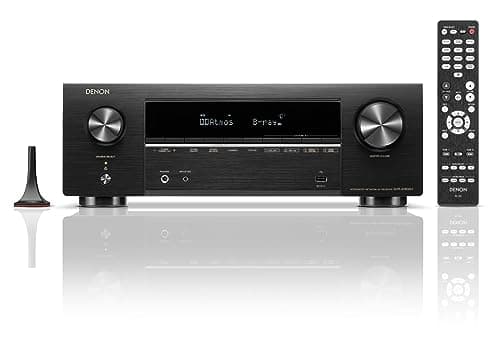 Denon AVR-X1800H Seven channels, 8K passthrough and Audyssey MultEQ XT — the room correction being the feature that actually changes what you hear in a real room. | Best overall under $1,000 | 9.0 | |
| 2 | 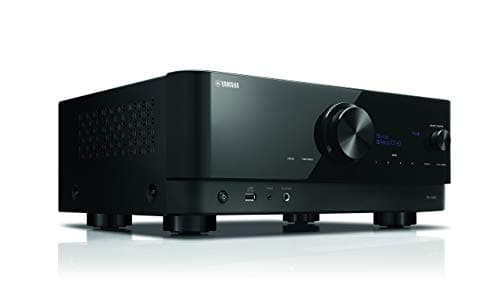 Yamaha RX-V6A The most powerful receiver here on paper — 100 watts a channel rated across the full band — with a phono input and seven HDMI inputs. | Best for music as well as film | 8.2 | |
| 3 | 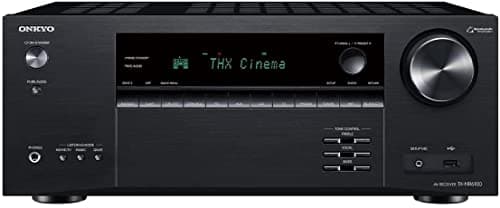 Onkyo TX-NR6100 THX certified with three 4K120 HDMI inputs, which is the specific spec that matters if two consoles and a PC share the same receiver. | Best for gaming | 8.2 | $649.00View on Amazon $899.9928% off |
| 4 | 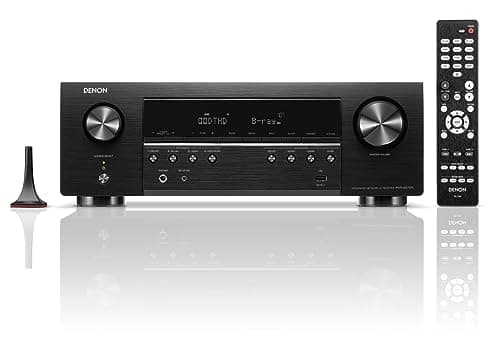 Denon AVR-S670H The X1800H's five-channel sibling: the same 8K plumbing and Audyssey correction, minus the two channels an Atmos height pair would need. | Best 5.2 option | 7.4 | |
| 5 | 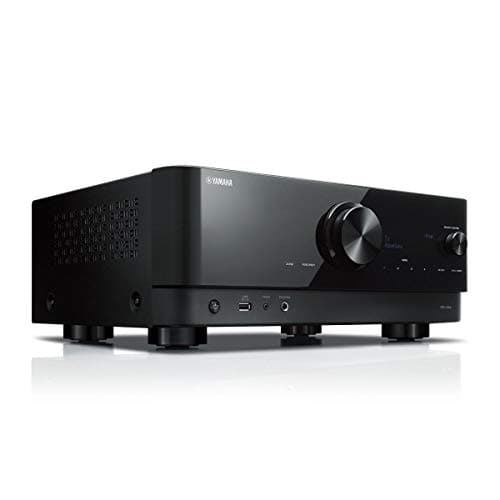 Yamaha RX-V4A Five channels with 8K passthrough and MusicCast, at the point where the price stops being the main objection. | Best budget AV receiver | 7.0 |
Every receiver here will decode everything, pass 8K video, and stream. The specification sheets are dense enough that the differences that actually matter get buried, so we are going to lead with the three that do.
The picks compared, spec by spec
Four columns, because these are the four that reorder the page. Power is here to show that it does not: the spread from top to bottom is about 1.2 dB. The phono input is its own section below, because four of these five have one and the differences between them are more than a yes.
Every figure below is the manufacturer’s own published value and links to the document we read it from. “Not published” means the manufacturer does not publish that figure; an em dash means we have no published figure for that model. Prices are live as of October 15, 2026.
Best overall under $1,000
- Channels
- 7.2 (or 5.2.2)
- Rated power (8 Ω, 2 ch driven)
- 80 W × 2 (0.08% THD)
- Room correction
- Audyssey MultEQ XT
- Pre-outs
- 2.2 (front L/R + 2 sub)
Best for music as well as film
- Channels
- 7.2
- Rated power (8 Ω, 2 ch driven)
- 100 W/ch (0.06% THD)
- Room correction
- YPAO with multipoint measurement
- Pre-outs
- Front L/R + 2 sub + Zone 2
Best for gaming
- Channels
- 7.2 (THX)
- Rated power (8 Ω, 2 ch driven)
- 100 W/ch (0.08% THD, FTC)
- Room correction
- AccuEQ (no Dirac)
- Pre-outs
- Subwoofer + Zone 2 only
Best 5.2 option
- Channels
- 5.2
- Rated power (8 Ω, 2 ch driven)
- 75 W × 2 (0.08% THD)
- Room correction
- Audyssey MultEQ
- Pre-outs
- Subwoofer only
Best budget AV receiver
- Channels
- 5.2
- Rated power (8 Ω, 2 ch driven)
- 80 W/ch (0.06% THD)
- Room correction
- YPAO (no multipoint)
- Pre-outs
- 2 subwoofer only
| Pick | Channels | Rated power (8 Ω, 2 ch driven) | Room correction | Pre-outs | Price |
|---|---|---|---|---|---|
| 1.Denon AVR-X1800HBest overall under $1,000 | 7.2 (or 5.2.2) | 80 W × 2 (0.08% THD) | Audyssey MultEQ XT | 2.2 (front L/R + 2 sub) | |
| 2.Yamaha RX-V6ABest for music as well as film | 7.2 | 100 W/ch (0.06% THD) | YPAO with multipoint measurement | Front L/R + 2 sub + Zone 2 | |
| 3.Onkyo TX-NR6100Best for gaming | 7.2 (THX) | 100 W/ch (0.08% THD, FTC) | AccuEQ (no Dirac) | Subwoofer + Zone 2 only | |
| 4.Denon AVR-S670HBest 5.2 option | 5.2 | 75 W × 2 (0.08% THD) | Audyssey MultEQ | Subwoofer only | |
| 5.Yamaha RX-V4ABest budget AV receiver | 5.2 | 80 W/ch (0.06% THD) | YPAO (no multipoint) | 2 subwoofer only |
Prices as of October 15, 2026; every “Check Price” link goes to Amazon and earns us a commission at no extra cost to you. #ad
1. The Onkyo does not make 210 watts
Search for the TX-NR6100 and you will find “210 W per channel”. It is everywhere.
Onkyo’s FTC-rated figure is 100 W/Ch (8 Ω, 20 Hz–20 kHz, 0.08% THD, 2 channels driven). The 210 W is a dynamic-power marketing number measured under conditions that have nothing to do with playing a film. Both numbers are Onkyo’s; only one is a rating.
On the FTC figures, the honest ranking is: Yamaha RX-V6A and Onkyo TX-NR6100 at 100 W, Denon AVR-X1800H at 80 W, Yamaha RX-V4A at 80 W, Denon AVR-S670H at 75 W. The spread is about 1.2 dB from top to bottom, which is nothing. The arithmetic shows why: doubling power buys 3 dB, so a 25 W difference between receivers is inaudible next to a 6 dB difference between speakers.
2. Every one of these figures is 2-channel driven
Read the conditions. Denon publishes “80 W + 80 W (8 Ω, 20 Hz–20 kHz, 0.08% THD) ” with two channels driven. Yamaha and Onkyo do the same.
A 7-channel action scene drives seven channels simultaneously, from one shared power supply. Nobody at this price publishes an all-channels-driven figure. So the honest position — which we would rather state than paper over — is that the real all-channels-driven output is meaningfully lower than the number on the box, and no manufacturer here will tell you by how much.
This is not a scandal. It is an industry convention. But it means comparing 100 W to 80 W is comparing two numbers that both describe a condition you will never listen in.
3. Pre-outs are the spec nobody mentions and the one that ends upgrades
A pre-out lets you add an external power amplifier later. Here is what these actually have:
- Denon AVR-X1800H: 2.2 — front left/right plus two subwoofers. You can add an amp for the fronts and nothing else.
- Yamaha RX-V6A: front left/right plus two subs, plus Zone 2. Not a full 7.2.
- Denon AVR-S670H and Yamaha RX-V4A: subwoofer outputs only. No path to external amplification at all.
- Onkyo TX-NR6100: subwoofer and Zone 2 line out; no full main-channel pre-outs published.
For contrast, the Marantz Cinema 70s — above this bracket — publishes a full 7.2 pre-out. If “I will add amplification later” is part of your plan, this spec is the plan, and it is buried in a manual on every one of these.
Room correction is the feature that actually changes what you hear
The Denon AVR-X1800H has Audyssey MultEQ XT — a step above the plain MultEQ on the AVR-S670H and the Marantz Cinema 70s. Yamaha has YPAO, with multipoint measurement on the RX-V6A and without it on the RX-V4A. Onkyo has AccuEQ.
The Onkyo does not have Dirac Live. An earlier version of this page said it did, and that was wrong: Onkyo starts Dirac at the TX-NR7100, and the TX-NR6100 has no upgrade path to it. We are noting the correction rather than quietly editing it out, because a page about honest specifications should behave honestly when it gets one wrong.
Audyssey MultEQ XT on the Denon is the strongest correction in the bracket, and that — rather than 20 watts — is why it wins.
4. The Denon AVR-S670H Atmos contradiction
Denon’s own product page for the AVR-S670H is titled “5.2 Ch. 75W 8K AV Receiver Powered by HEOS with Dolby Atmos”. Denon’s own info sheet for the same model lists no Atmos and no DTS:X — it enumerates Dolby TrueHD, Digital, Digital Plus and Pro Logic II, and shows a “Dolby Audio” logo.
Both sources are Denon. They disagree. We lean on the info sheet, because a spec table beats a marketing title — and because a 5.2 receiver has no height channels to put Atmos into regardless of what it decodes. But we are not going to resolve it silently and present a clean answer we do not have. If Atmos is the reason you are buying, verify it before you do.
All but one have a phono input
Worth knowing if this receiver is also your stereo system: the Denon AVR-X1800H (MM, 2.5 mV), Denon AVR-S670H (MM, 2.5 mV), Yamaha RX-V6A (MM, 3.5 mV / 47 kΩ) and Onkyo TX-NR6100 (MM, 3.5 mV) all have one. The Yamaha RX-V4A does not — Yamaha lists it as N/A.
So a turntable can plug directly into four of these five with no separate stage. See do I need a phono preamp.
And exactly one of them specifies that phono stage properly
Input sensitivity tells you the stage will make a sound. It tells you nothing about whether the sound is the right shape. For that you need the RIAA deviation — how closely the equalisation curve matches the one records are cut with — and almost nobody publishes it at any price.
Denon does, in the AVR-X1800H owner’s manual:
- RIAA deviation: ±1 dB (20 Hz to 20 kHz)
- Signal-to-noise ratio: 74 dB (IHF-A)
- Distortion: 0.03% (1 kHz, 3 V)
- Input sensitivity: 2.5 mV
Onkyo publishes 3.5 mV rms and 47 kΩ for the TX-NR6100 and stops there. That is the whole comparison, because nobody else in this bracket publishes a RIAA figure either. It is also more than several dedicated phono products manage — the WiiM Ultra has a phono input and publishes no gain, no RIAA accuracy and no input capacitance for it at all. If the receiver is doubling as your record system, a ±1 dB published curve is a real advantage and it is not on any comparison chart you will find elsewhere.
Count the fast HDMI inputs, not the HDMI inputs
Both of the receivers we re-read for this update advertise six HDMI inputs. On both, only three of the six are the fast ones.
- Denon AVR-X1800H: six inputs, of which three are 8K, and one output with eARC. 8K/60 and 4K/120 pass-through, with VRR, ALLM, QFT and QMS.
- Onkyo TX-NR6100: six inputs and twooutputs. HDMI 2.1 with 8K/60 and 4K/120 on inputs 1–3 and on both outputs; inputs 4–6 stop at 4K/60.
Three fast inputs sounds like plenty until you count what wants one: a PlayStation 5, an Xbox Series X and a gaming PC fill all three, and the next device — a 4K/120 streaming box, a second console, a capture device — is going on a 4K/60 port whether you like it or not. This is the specification that ages a receiver, and “6 HDMI inputs” on the box does not mention it.
The Onkyo’s second HDMI output is worth naming too, because it is the difference between owning a television and owning a television and a projector. The Denon has one output. Our eARC explainer covers what the output has to support for TV audio to come back down the same cable.
The power figure nobody quotes is the one that costs money
Standby consumption is on every box. Idle consumption — switched on, nothing playing — is on almost none of them, and it is roughly a hundred times larger.
Onkyo publishes all three figures for the TX-NR6100: 635 W operating, 65 W idle, 0.1 W standby. Denon publishes two for the AVR-X1800H: 430 W consumption and 0.1 W standby— the latter conditional on Network Control being set to “Off In Standby” and HDMI Pass Through being off, with CEC standby listed separately at 0.5 W. Denon publishes no idle figure at all.
kWh/year = watts × hours per day × 365 ÷ 1,000
Inputs
- Onkyo TX-NR6100 idle (on, not playing): 65 W (Onkyo spec page)
- Onkyo TX-NR6100 standby: 0.1 W (Onkyo spec page)
- Denon AVR-X1800H standby: 0.1 W, with Network Control off in standby and HDMI Pass Through off (Denon owner's manual, general section)
Result
Four hours a day switched on and idle: 65 × 4 × 365 ÷ 1,000 = 94.9 kWh a year
The other twenty hours in standby: 0.1 × 20 × 365 ÷ 1,000 = 0.73 kWh a year
The number every manufacturer advertises accounts for well under one percent of the total. The number Onkyo alone publishes accounts for essentially all of it.
What we re-read for this update, and what we did not
The Denon and Onkyo figures above were re-read from Denon’s product page, the AVR-X1800H owner’s manual and Onkyo’s specification page on 3 September 2026. Yamaha’s specification server refused every request on that pass, so the RX-V6A and RX-V4A numbers on this page are unchanged from our reading of 17 July 2026 and have not been re-confirmed since. We would rather tell you which figures are fresh than re-date the whole page and hope.
On 2 October 2026 we re-opened Onkyo’s specification page and Denon’s AVR-X1800H product page and re-read every figure this page quotes from them. All of them were unchanged: the 100 W/Ch FTC rating and the 635 / 65 / 0.1 W consumption figures on the Onkyo, the 80 W + 80 W rating, Audyssey MultEQ XT, the six-in-three-of-them-8K HDMI count and the ALLM / QMS / QFT / VRR row on the Denon. Yamaha was still unreachable, so those two models carry their July date for a third pass and we are still saying so.
How to choose
If you want height channels, you need seven amplifiers: the AVR-X1800H, RX-V6A or TX-NR6100. If you have consoles, the Onkyo’s three HDMI 2.1 inputs are the most here. If you are building 5.1 and will not expand, the RX-V4A is the cheapest way in and its missing Atmos and phono input may not matter to you at all.
Then read the setup guide, because the layout will make more difference than any of the above. Every receiver here has at least one subwoofer output and most have two, so any of the subwoofers we cover will connect to it.
Our full review of the Denon AVR-X1800H goes deeper on the winner, including the pre-out limitation that decides what you can add later. For the speakers to hang off it, a timbre-matched family beats five well-reviewed strangers. And if you are still deciding whether you need a receiver at all, soundbar versus speakers is the honest version of that comparison.
One spec this bracket page deliberately does not rank on: HDMI. Every receiver here advertises 4K/120, and on most of them that applies to three of six inputs, which only matters if you are plugging in more than one games console. Our gaming roundup ranks the same hardware on that number alone — and it reorders this page completely, because the winner there is the one maker that states which inputs are the fast ones.
Every pick in detail
Every specification below links to the manufacturer document we read it from. Where a manufacturer does not publish a figure, we say so rather than estimating it.
Denon AVR-X1800H
Best overall under $1,000Price as of October 15, 2026. #ad
Seven channels, 8K passthrough and Audyssey MultEQ XT — the room correction being the feature that actually changes what you hear in a real room.
- channels
- 9/10
- room correction
- 9/10
- connectivity
- 9/10
- value for money
- 9/10
- future proofing
- 9/10
| Specification | Published value | Source |
|---|---|---|
| Channels | 7.2 (7 power amplifiers — 7.2 or 5.2.2) | Denon info sheet (PDF) |
| Power output | 80 W + 80 W (8 Ω, 20 Hz – 20 kHz, 0.08% THD, 2 ch driven) | Denon info sheet (PDF) |
| Room correction | Audyssey MultEQ XT, with Dynamic EQ and Dynamic Volume | Denon info sheet (PDF) |
| Dolby Atmos / DTS:X | Yes / Yes | Denon info sheet (PDF) |
| Phono input | Yes — MM, 2.5 mV input sensitivity; RIAA deviation ±1 dB (20 Hz – 20 kHz); S/N 74 dB (IHF-A); distortion 0.03% (1 kHz, 3 V) | Denon owner's manual, audio section |
| Analog input sensitivity | 200 mV; frequency response 10 Hz – 100 kHz (+1, −3 dB, Direct mode); S/N 98 dB (IHF-A, Direct mode) | Denon owner's manual, audio section |
| Power consumption | 430 W. Standby 0.1 W — but only with Network Control set to “Off In Standby” and HDMI Pass Through off; CEC standby is 0.5 W. Denon publishes no idle (powered-on, not playing) figure at all. | Denon owner's manual, general section |
| HDMI in / out | 6 in (3 are 8K) / 1 out (eARC) | Denon info sheet (PDF) |
| Video passthrough | 8K/60 Hz, 4K/120 Hz; VRR, QFT, ALLM | Denon product page |
| HDMI 2.1 gaming features | ALLM / QMS / QFT / VRR — Yes / No / Yes / Yes. Denon does not state which of the six inputs carry them beyond the “3 x 8K” count. | Denon product page |
| Pre-outs | 2.2 only (front L/R + 2 subwoofer) — NOT a full 7.2 pre-out | Denon info sheet (PDF) |
| Streaming | HEOS built-in; AirPlay 2, Spotify Connect, Amazon Music HD, TIDAL | Denon info sheet (PDF) |
Pros
- Audyssey MultEQ XT room correction — a step above the plain MultEQ on the cheaper models
- 7.2 channels — enough for a 5.2.2 Atmos layout
- MM phono input, so a turntable connects without a separate stage
- 8K/60 and 4K/120 passthrough with VRR and ALLM
Cons
- Only 2.2 pre-outs (front L/R plus subwoofers) — you cannot add external amplification to the surround channels later
- Menus are dense
- Runs warm in a closed cabinet
Skip it if you only need 5 channels — the AVR-S670H shares the same core for less.
Yamaha RX-V6A
Best for music as well as filmPrice as of October 15, 2026. #ad
The most powerful receiver here on paper — 100 watts a channel rated across the full band — with a phono input and seven HDMI inputs.
- channels
- 9/10
- room correction
- 7/10
- connectivity
- 9/10
- value for money
- 8/10
- future proofing
- 8/10
| Specification | Published value | Source |
|---|---|---|
| Channels | 7.2 | Yamaha spec page |
| Power output | 100 W/ch (8 Ω, 20 Hz – 20 kHz, 0.06% THD, 2 ch driven). Maximum effective output 150 W/ch (1 kHz, 10% THD, 8 Ω) | Yamaha owner's manual |
| Room correction | YPAO with multipoint measurement | Yamaha spec page |
| Dolby Atmos / DTS:X | Yes (with Height Virtualization) / Yes | Yamaha spec page |
| Phono input | Yes — MM, 3.5 mV / 47 kΩ at 1 kHz | Yamaha owner's manual |
| HDMI in / out | 7 in / 1 out (eARC). 8K on inputs 1–3 only | Yamaha spec page |
| HDMI 2.1 gaming features | Not published in the specification table. Yamaha's HDMI feature list for this model reads “8K, 4K Ultra HD (include 8K/60, 50 Hz, 4K/120, 100 Hz 10-bit), 3D Video, ARC, eARC, HDMI Control (CEC), Auto Lip Sync, Deep Color, x.v.Color, HDR10+, Dolby Vision, Hybrid Log-Gamma, DSC FRL, FRL” and HDCP 1.4/2.3 — VRR, ALLM, QMS and QFT are named nowhere in it, and nowhere on the 4K/8K MODE page either. Yamaha adds ALLM and VRR to this model by firmware and documents that separately from the specification. | Yamaha owner's manual, specifications |
| Pre-outs | Front L/R + 2 subwoofer, plus Zone 2 L/R — not a full 7.2 pre-out | Yamaha owner's manual |
| Streaming | MusicCast, AirPlay 2, Bluetooth (SBC/AAC), Spotify Connect | Yamaha spec page |
Pros
- 100 W/ch (8 Ω, 20 Hz – 20 kHz, 0.06% THD) — the highest full-band rating in this group
- Seven HDMI inputs, the most here
- MM phono input, 3.5 mV / 47 kΩ
- YPAO with multipoint measurement, plus MusicCast multiroom
Cons
- YPAO is less sophisticated than Audyssey MultEQ XT on the Denon
- 8K is limited to HDMI inputs 1–3
- Pre-outs are front L/R plus subwoofers only — not a full 7.2
Skip it if room correction quality is your priority — Audyssey MultEQ XT on the Denon goes further.
Onkyo TX-NR6100
Best for gamingTHX certified with three 4K120 HDMI inputs, which is the specific spec that matters if two consoles and a PC share the same receiver.
- channels
- 9/10
- room correction
- 6/10
- connectivity
- 10/10
- value for money
- 8/10
- future proofing
- 8/10
| Specification | Published value | Source |
|---|---|---|
| Channels | 7.2, THX certified | Onkyo product page |
| Power output | 100 W/ch (8 Ω, 20 Hz – 20 kHz, 0.08% THD, 2 ch driven, FTC). The “210 W per channel” figure circulating in search results is a dynamic-power marketing number, not the FTC rating. | Onkyo product page |
| Room correction | AccuEQ with AccuReflex. Dirac Live is NOT available on this model — Onkyo starts Dirac at the TX-NR7100. | Onkyo receiver buying guide |
| Dolby Atmos / DTS:X | Yes / Yes (5.2.2 playback) | Onkyo spec page |
| Phono input | Yes — MM, 3.5 mV rms / 47 kΩ | Onkyo spec page |
| HDMI in / out | 6 in / 2 out. HDMI 2.1 (8K/60, 4K/120) on inputs 1–3 and both outputs; inputs 4–6 are 2.0 up to 4K/60 | Onkyo spec page |
| Streaming | Chromecast built-in, AirPlay 2, DTS Play-Fi, works with Sonos | Onkyo spec page |
| HDMI 2.1 gaming features | “HDMI 2.1 features are supported on HDMI inputs 1–3, Main Out, and Sub/Zone 2 Out in Sub Mode output including VRR, ALLM, QFT (Quick Frame Transport), DSC (Display Stream Compression), QMS (Quick Media Switching), and eARC (Main Out).” Inputs 4–6 carry HDMI 2.0 features only. | Onkyo spec page |
| Power consumption | 635 W operating, 65 W idle (on, not playing), 0.1 W standby | Onkyo spec page |
| Pre-outs | Subwoofer pre-out (1 V rms / 470 Ω) and a Zone 2/Zone B line-out (200 mV rms / 470 Ω). No main-channel pre-outs are listed | Onkyo spec page |
Pros
- Three HDMI 2.1 inputs at 8K/60 and 4K/120 — the most console-friendly receiver here
- THX certified
- MM phono input, which is unusual on a gaming-focused receiver
- 100 W/ch FTC-rated into 8 Ω across the full band
Cons
- Room correction is AccuEQ, NOT Dirac Live — Onkyo starts Dirac at the TX-NR7100, and this model has no upgrade path to it
- The “210 W per channel” figure in most search results is dynamic-power marketing; the FTC rating is 100 W
- HDMI inputs 4–6 are only HDMI 2.0, capped at 4K/60
Skip it if you have one source — you are paying for HDMI 2.1 inputs you will never fill.
Denon AVR-S670H
Best 5.2 optionPrice as of October 15, 2026. #ad
The X1800H's five-channel sibling: the same 8K plumbing and Audyssey correction, minus the two channels an Atmos height pair would need.
- channels
- 6/10
- room correction
- 9/10
- connectivity
- 8/10
- value for money
- 8/10
- future proofing
- 6/10
| Specification | Published value | Source |
|---|---|---|
| Channels | 5.2 (5 power amplifiers) | Denon info sheet (PDF) |
| Power output | 75 W + 75 W (8 Ω, 20 Hz – 20 kHz, 0.08% THD, 2 ch driven) | Denon info sheet (PDF) |
| Dolby Atmos | Sources conflict. Denon's info sheet lists NO Atmos and NO DTS:X (Dolby Audio logo, TrueHD/Digital Plus/Pro Logic II only); Denon's own product-page TITLE says “with Dolby Atmos”. We trust the info sheet's spec table over the page title — verify before buying if Atmos is the reason you are buying. | Denon info sheet (PDF) |
| Room correction | Audyssey MultEQ, with Dynamic EQ and Dynamic Volume | Denon info sheet (PDF) |
| Phono input | Yes — MM, 2.5 mV input sensitivity | Denon owner's manual |
| Video passthrough | 8K/60 Hz, 4K/120 Hz | Denon product page |
| HDMI in / out | 6 in (3 x 8K) / 1 out (Main, eARC). No front-panel HDMI | Denon product page |
| HDMI 2.1 gaming features | ALLM / QMS / QFT / VRR — Yes / No / Yes / Yes | Denon product page |
| Pre-outs | Subwoofer only (0.2) — no main-channel pre-outs | Denon info sheet (PDF) |
Pros
- 8K/60 passthrough and HEOS streaming at a lower price
- Audyssey MultEQ room correction
- MM phono input, 2.5 mV / 47 kΩ
- Simpler to set up than a 7.2
Cons
- Denon's own sources conflict on Dolby Atmos: their info sheet lists none, their product-page title says it has it. Verify before buying if Atmos is the point.
- 5.2 only — five channels cannot produce height regardless of decoding
- Subwoofer pre-outs only, so no path to external amplification
Skip it if Dolby Atmos matters to you — both because five channels cannot do height, and because Denon's own documentation does not agree on whether this unit decodes it.
Yamaha RX-V4A
Best budget AV receiverPrice as of October 15, 2026. #ad
Five channels with 8K passthrough and MusicCast, at the point where the price stops being the main objection.
- channels
- 6/10
- room correction
- 6/10
- connectivity
- 8/10
- value for money
- 9/10
- future proofing
- 6/10
| Specification | Published value | Source |
|---|---|---|
| Channels | 5.2 | Yamaha spec page |
| Power output | 80 W/ch (8 Ω, 20 Hz – 20 kHz, 0.06% THD, 2 ch driven, US/Canada model) | Yamaha owner's manual |
| Dolby Atmos / DTS:X | No / No — Yamaha's spec table lists both as N/A | Yamaha spec page |
| Room correction | YPAO (no multipoint measurement on this model) | Yamaha spec page |
| Phono input | No — listed as N/A | Yamaha spec page |
| Video passthrough | 8K/60 Hz, 4K/120 Hz | Yamaha owner's manual |
| Pre-outs | 2 subwoofer only — no main-channel pre-outs | Yamaha spec page |
Pros
- Cheapest 8K-capable receiver here
- MusicCast
- Compact for an AVR
Cons
- 5.2 only
- Basic YPAO implementation
- No phono input
Skip it if you want Atmos height channels — this cannot do them.
Frequently asked questions
What is the best AV receiver under $1,000?
The Denon AVR-X1800H, on our criteria — because Audyssey MultEQ XT is the strongest room correction in the bracket, and room correction changes what you hear more than any power figure. It also has an MM phono input. Its real limitation is 2.2 pre-outs, which caps future external amplification.
Is the Onkyo TX-NR6100 really 210W per channel?
No. That is a dynamic-power marketing figure. Onkyo’s FTC rating is 100 W/Ch (8 Ω, 20 Hz–20 kHz, 0.08% THD, 2 channels driven). The FTC figure is the one measured under conditions that mean something.
How much power does an AV receiver need?
Less than the marketing suggests, and the receiver’s figure matters less than your speakers’ sensitivity. The FTC-rated spread across this whole bracket is 75 W to 100 W — about 1.2 dB. A 6 dB difference between two speakers dwarfs it. Run the arithmetic on your actual speakers instead.
What are pre-outs and do I need them?
Pre-outs let you add an external power amplifier later. They matter only if that is part of your plan — and if it is, check carefully: the Denon AVR-X1800H has 2.2, the Yamaha RX-V4A and Denon AVR-S670H have subwoofer outputs only, and none of the receivers in this bracket has a full 7.2 pre-out. The Marantz Cinema 70s does, but it costs more.
Does the Denon AVR-S670H have Dolby Atmos?
Denon’s own sources contradict each other. Their product-page title says “with Dolby Atmos”; their info sheet for the same model lists no Atmos and no DTS:X. We lean on the info sheet — a spec table beats a marketing title — and note that a 5.2 receiver has no height channels regardless. If Atmos is why you are buying, confirm with Denon first.
Do AV receivers have a phono input for a turntable?
Four of these five do: the Denon AVR-X1800H and AVR-S670H (MM, 2.5 mV), the Yamaha RX-V6A (MM, 3.5 mV / 47 kΩ) and the Onkyo TX-NR6100 (MM, 3.5 mV). The Yamaha RX-V4A does not — Yamaha lists it as N/A in their own spec table.
How many HDMI 2.1 inputs do AV receivers under $1,000 have?
Three, on both of the receivers we re-read in September 2026 — and both advertise six HDMI inputs in total. Denon lists the AVR-X1800H as six inputs “3x 8K” with one eARC output; Onkyo puts HDMI 2.1 with 8K/60 and 4K/120 on the TX-NR6100’s inputs 1–3 and both of its outputs, with inputs 4–6 limited to 4K/60. A PS5, an Xbox Series X and a gaming PC use all three fast ports on either receiver.
How much electricity does an AV receiver use?
Far more when it is switched on and idle than in standby, and only one manufacturer in this bracket publishes the idle figure. Onkyo lists 635 W operating, 65 W idle and 0.1 W standby for the TX-NR6100; Denon lists 430 W and a 0.1 W standby for the AVR-X1800H that applies only with network standby and HDMI pass-through switched off. At four hours a day of idle time, 65 W is about 94.9 kWh a year — roughly 130 times the 0.73 kWh the same receiver draws in standby for the other twenty hours.
Which AV receiver under $1,000 has the best phono stage?
The Denon AVR-X1800H, on published data, because it is the only one that publishes anything beyond sensitivity: RIAA deviation of ±1 dB from 20 Hz to 20 kHz, a 74 dB signal-to-noise ratio and 0.03% distortion, at 2.5 mV input sensitivity. Onkyo publishes 3.5 mV / 47 kΩ for the TX-NR6100 and no curve accuracy at all, and neither does anything else in the bracket. RIAA deviation is the figure that describes whether records come out the right tonal shape, which sensitivity does not.
Which AV receivers under $1,000 support Dolby Atmos?
Three of these five cleanly: the Denon AVR-X1800H and the Onkyo TX-NR6100 both list Dolby Atmos and DTS:X, and the Yamaha RX-V6A lists both plus Height Virtualization. The Yamaha RX-V4A lists both as N/A in Yamaha’s own spec table. The Denon AVR-S670H is the awkward one — Denon’s product-page title claims Atmos and Denon’s info sheet for the same model lists none. The pattern underneath is simple: Atmos needs height channels, so it needs seven amplifiers, and the two 5.2 receivers here have five.
Denon AVR-X1800H or Onkyo TX-NR6100 — which should I buy?
Buy the Denon if the room is the problem, and the Onkyo if your HDMI ports are. Denon gives you Audyssey MultEQ XT, a step above the plain MultEQ below it, and the only published RIAA figure in the bracket if a turntable is going into it. Onkyo gives you three HDMI 2.1 inputs plus two outputs — the difference between owning a television and owning a television and a projector — and publishes the idle power draw nobody else will. On rated power they are 80 W and 100 W, which is under 1 dB and should not decide it. Our gaming roundup ranks the same hardware on HDMI alone and comes out in a different order for exactly this reason.
Is a 5.2 receiver enough, or do I need 7.2?
5.2 is enough for a 5.1 system and nothing more. Height channels are the dividing line: Dolby Atmos needs speakers above you, those speakers need their own amplifiers, and a 5.2 receiver has five. The Denon AVR-S670H and Yamaha RX-V4A here are 5.2; the Denon AVR-X1800H, Yamaha RX-V6A and Onkyo TX-NR6100 have seven amplifier channels and can run 7.2 or 5.2.2 — five around you and two overhead. If you are not certain you will ever add height speakers, the honest answer is that 5.2 placed well beats 5.2.2 placed badly, and the layout is in the setup guide.
Can an AV receiver under $1,000 drive a turntable directly?
Four of these five can, with no separate phono stage: the two Denons at MM 2.5 mV and the Yamaha RX-V6A and Onkyo TX-NR6100 at MM 3.5 mV / 47 kΩ. All four are moving-magnet only — a low-output moving-coil cartridge needs far more gain than any of them provide. If your receiver turns out to be the Yamaha RX-V4A, or you move to a moving coil, you need an outboard stage; the phono preamps under $200 are here and this explains why.
Read next
Denon AVR-X1800H vs Onkyo TX-NR6100
The two most-compared receivers under $1,000, split across the four specifications where they actually differ - and the one that is pure marketing.
The Best 7.2 AV Receivers Under $1,000
Four 7.2 receivers under $1,000, ranked on the speaker layouts their own manuals document rather than on the number printed on the box.
Home Theater Setup: The Complete Guide
The complete setup, built on Dolby's published layout angles rather than on vibes — plus what to do when your room disagrees.
Dolby Atmos Speaker Placement
Dolby's published height angles, ceiling versus up-firing, and what each needs from your room.
The Best Bookshelf Speakers Under $500
Six pairs under $500 — and only one publishes a minimum impedance and a recommended amp range.
Will This Amplifier Drive My Speakers?
Two published numbers, one formula, and the answer is almost always less power than you expected.
Denon AVR-X1800H Review
80 W two-channels-driven, Audyssey MultEQ XT, 8K passthrough, MM phono — and only 2.2 pre-outs.
The Best Home Theater Speakers
A timbre-matched 5.1 built from published specs — fronts, center, surrounds and a subwoofer that actually connects.
HDMI eARC and HDMI 2.1, Explained
What eARC carries that optical cannot, and the published per-input tables showing that an 8K receiver is 8K on three ports out of six or seven.
The Best AV Receivers Under $500
Three receivers under $500, compared on the condition attached to each power figure — and all three come out at the same seventy watts.
DAC vs Preamp vs Integrated Amp
The whole signal chain in one page: which of the three boxes does which job, and the gain arithmetic that decides which combination works.
The Best AV Receivers for Gaming
Ranked on published 4K/120 input count and whether VRR is in the maker's spec table, not its ad copy. The receiver with the most HDMI inputs is not on the list, and the reason is the whole page.
Sources
Every specification on this page was read from one of these documents. If one of them has changed, or we have made an error, tell us — corrections are logged and dated per our editorial policy.
- Denon AVR-X1800H info sheet (PDF)
- Denon AVR-X1800H owner's manual — audio section (phono equalizer, RIAA deviation, input sensitivity)
- Denon AVR-X1800H owner's manual — general section (power consumption, standby)
- Denon AVR-X1800H product page — HDMI input counts, 8K/4K120, VRR/ALLM/QFT/QMS
- Onkyo TX-NR6100 specifications — HDMI 2.1 inputs, power consumption, idle draw
- Denon AVR-S670H info sheet — no Atmos listed (PDF)
- Yamaha RX-V6A specifications
- Yamaha RX-V4A specifications
- Onkyo TX-NR6100 specifications
- Onkyo receiver buying guide — Dirac Live availability by model