Denon AVR-X1800H Review
Seven amplifier channels, six HDMI inputs, room correction, a phono stage — and a pre-out arrangement that quietly limits what you can do with it later.

Disclosure: we earn a commission if you buy through the links on this page, at no extra cost to you. It does not influence what we pick — our criteria are published and reproducible, so you can check our work. How we pick · Full disclosure
These picks are spec-and-price analyses, not listening tests. We have not heard this gear and we do not pretend to have: every figure below is sourced to the manufacturer and linked, and every price is live or not shown at all. Here are the rules we followed.
Quick picks
Ranked on the published criteria in How We Pick. Prices are live as of October 15, 2026. Tap any row for the full write-up.
- 9.0
| # | Product | Best for | Score | Price |
|---|---|---|---|---|
| 1 | 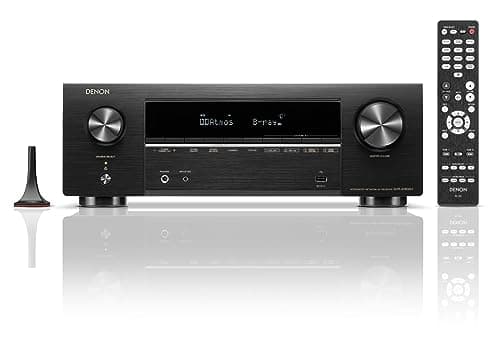 Denon AVR-X1800H Seven channels, 8K passthrough and Audyssey MultEQ XT — the room correction being the feature that actually changes what you hear in a real room. | Best overall under $1,000 | 9.0 |
We have not heard this receiver, and a receiver is arguably the component where that matters least — its job is to decode, switch, correct and amplify accurately, and all four are things specifications describe reasonably well.
What follows is Denon’s published data, read carefully.
80 watts, and the condition attached
Denon publishes 80 W + 80 W into 8 Ω, measured 20 Hz–20 kHz at 0.08% THD, with two channels driven.
That is a properly conditioned rating: full band, stated distortion, stated load, stated number of channels. It is also, unavoidably, a best case — this receiver has seven power amplifiers and a single shared power supply, so what it delivers with seven channels working at once is lower and is not published. Nobody in this category publishes it, and that convention is the core difference between a receiver and an integrated amplifier.
In practice, 80 W into speakers as sensitive as the Klipsch Reference family — 90 to 95 dB — is a great deal of headroom. Pair it with something at 83 dB and the arithmetic changes completely. The power-versus-sensitivity calculation is here and it is worth ten minutes before buying speakers.
The pre-out limitation, which is the real finding
Denon publishes 2.2 pre-outs: front left and right, plus two subwoofer outputs. That is it. There is no full 7.2 pre-out.
This decides what you can do in three years. Adding a stereo power amplifier for the front channels is possible, because those two pre-outs exist. Moving to a separate processor plus multichannel amplification later is not — you would replace the receiver.
For contrast, the Marantz Cinema 70s publishes a full 7.2 pre-out at a similar tier, with only 50 W per channel. That is the trade in its clearest form: Denon gives you more power now, Marantz gives you more options later. The Denon AVR-S670H one step down offers subwoofer pre-outs only.
Nobody hides this and nobody mentions it either. It appears once, in a table, and it is one of the most consequential lines on the sheet.
Audyssey MultEQ XT, and why it is the reason to buy a receiver
The AVR-X1800H includes Audyssey MultEQ XT with Dynamic EQ and Dynamic Volume. MultEQ XT is a step above the plain MultEQ on the AVR-S670H — more filter resolution, more measurement positions.
This is the single feature that most separates a receiver from an integrated amplifier, none of which include room correction at any price we cover. Your room is almost certainly the largest measurable problem in your system, and this is a tool aimed directly at it.
Two honest caveats. Room correction cannot fix a room-mode null — a cancellation where two reflections arrive out of phase — because boosting a frequency the room is actively canceling just wastes amplifier power. And it works best above the transition frequency; below roughly 200 Hz, physical treatment does things DSP cannot. Our treatment guide covers how much you actually need.
Vinyl, which is not an afterthought here
Denon publishes a moving magnet phono input at 2.5 mV sensitivity. That is more gain than the Yamaha A-S501 integrated amplifier’s 3.0 mV, on a receiver, in 2026.
It comfortably handles every cartridge in our cartridge roundup. Denon does not publish an RIAA deviation or an input capacitance — nobody in this class does except Marantz on the Cinema 70s — so you know the stage exists and works, and not how accurately.
If you were choosing between this and an integrated amplifier for a system that does both films and records, the receiver wins on features and loses on published two-channel specifications: Denon publishes no damping factor for it, where Yamaha publishes 240 for the A-S501.
Video and connectivity
Six HDMI inputs, three of them 8K-capable, one eARC output. Video passthrough at 8K/60 Hz and 4K/120 Hz, with VRR, QFT and ALLM — so it does not become the bottleneck in a current-generation gaming setup.
Note the asymmetry: only three of the six inputs are 8K. If you have several high-bandwidth sources, plan which port each one gets. HEOS is built in, with AirPlay 2, Spotify Connect, Amazon Music HD and TIDAL, which means a separate streamer is not required unless you want better published output measurements than Denon provides for this one.
Who should skip it
Anyone who expects to move to separate amplification later. The 2.2 pre-out arrangement is the constraint, and the Marantz Cinema 70s solves it at the cost of power.
Anyone building a two-channel music system. An integrated amplifier at the same price publishes a damping factor, a properly conditioned power rating with all channels driven, and a higher line-stage signal-to-noise ratio.
And anyone who needs more than five channels of real amplification: this is a 7.2 receiver in name and a 5.2.2 or 7.2 in practice, with the two-channels-driven caveat applying to every configuration.
The verdict
The best-specified receiver in its bracket for someone building a complete system now: properly conditioned power, MultEQ XT, current-generation video, and a phono input with a published sensitivity.
The one thing to decide before buying is whether you will ever want external amplification. If yes, look at what the pre-outs allow before the wattage. Our full receiver roundup compares the alternatives. If the shortlist has already come down to two, our head-to-head against the Onkyo TX-NR6100 splits them on the four specifications where they actually diverge — room correction, the phono stage, HDMI, and the 0.97 dB that separates their FTC power ratings.
Every pick in detail
Every specification below links to the manufacturer document we read it from. Where a manufacturer does not publish a figure, we say so rather than estimating it.
Denon AVR-X1800H
Best overall under $1,000Price as of October 15, 2026. #ad
Seven channels, 8K passthrough and Audyssey MultEQ XT — the room correction being the feature that actually changes what you hear in a real room.
- channels
- 9/10
- room correction
- 9/10
- connectivity
- 9/10
- value for money
- 9/10
- future proofing
- 9/10
| Specification | Published value | Source |
|---|---|---|
| Channels | 7.2 (7 power amplifiers — 7.2 or 5.2.2) | Denon info sheet (PDF) |
| Power output | 80 W + 80 W (8 Ω, 20 Hz – 20 kHz, 0.08% THD, 2 ch driven) | Denon info sheet (PDF) |
| Room correction | Audyssey MultEQ XT, with Dynamic EQ and Dynamic Volume | Denon info sheet (PDF) |
| Dolby Atmos / DTS:X | Yes / Yes | Denon info sheet (PDF) |
| Phono input | Yes — MM, 2.5 mV input sensitivity; RIAA deviation ±1 dB (20 Hz – 20 kHz); S/N 74 dB (IHF-A); distortion 0.03% (1 kHz, 3 V) | Denon owner's manual, audio section |
| Analog input sensitivity | 200 mV; frequency response 10 Hz – 100 kHz (+1, −3 dB, Direct mode); S/N 98 dB (IHF-A, Direct mode) | Denon owner's manual, audio section |
| Power consumption | 430 W. Standby 0.1 W — but only with Network Control set to “Off In Standby” and HDMI Pass Through off; CEC standby is 0.5 W. Denon publishes no idle (powered-on, not playing) figure at all. | Denon owner's manual, general section |
| HDMI in / out | 6 in (3 are 8K) / 1 out (eARC) | Denon info sheet (PDF) |
| Video passthrough | 8K/60 Hz, 4K/120 Hz; VRR, QFT, ALLM | Denon product page |
| HDMI 2.1 gaming features | ALLM / QMS / QFT / VRR — Yes / No / Yes / Yes. Denon does not state which of the six inputs carry them beyond the “3 x 8K” count. | Denon product page |
| Pre-outs | 2.2 only (front L/R + 2 subwoofer) — NOT a full 7.2 pre-out | Denon info sheet (PDF) |
| Streaming | HEOS built-in; AirPlay 2, Spotify Connect, Amazon Music HD, TIDAL | Denon info sheet (PDF) |
Pros
- Audyssey MultEQ XT room correction — a step above the plain MultEQ on the cheaper models
- 7.2 channels — enough for a 5.2.2 Atmos layout
- MM phono input, so a turntable connects without a separate stage
- 8K/60 and 4K/120 passthrough with VRR and ALLM
Cons
- Only 2.2 pre-outs (front L/R plus subwoofers) — you cannot add external amplification to the surround channels later
- Menus are dense
- Runs warm in a closed cabinet
Skip it if you only need 5 channels — the AVR-S670H shares the same core for less.
Frequently asked questions
Is the Denon AVR-X1800H worth it?
On published specifications, yes for someone building a complete system now: 80 W into 8 Ω rated 20 Hz–20 kHz at 0.08% THD with two channels driven, Audyssey MultEQ XT room correction, six HDMI inputs with 8K/60 and 4K/120 passthrough, and an MM phono input at 2.5 mV. The limitation to check first is the pre-outs — it publishes only 2.2, so external multichannel amplification later is not an option.
Does the Denon AVR-X1800H have full pre-outs?
No. Denon publishes 2.2 pre-outs — front left and right plus two subwoofer outputs — not a full 7.2. You can add a stereo power amplifier for the front channels, but you cannot move to a separate processor and multichannel amplification without replacing the receiver. The Marantz Cinema 70s publishes a full 7.2 pre-out at a similar tier, with 50 W per channel instead of 80.
Can the Denon AVR-X1800H power a turntable?
Yes — it publishes a moving magnet phono input at 2.5 mV sensitivity, which is more gain than several dedicated integrated amplifiers provide, and it handles every moving magnet cartridge we recommend. Denon does not publish an RIAA deviation figure or an input capacitance for the stage, so its measured accuracy is unknown.
Is 80 watts enough for a home theater?
It depends entirely on your speakers. Into a 90–95 dB sensitive family like the Klipsch Reference range it is a great deal of headroom; into an 83 dB speaker it is a completely different calculation. Remember also that the 80 W figure is rated with two channels driven — with seven channels working at once the shared power supply delivers less, and Denon does not publish that figure.
Read next
Denon AVR-X1800H vs Onkyo TX-NR6100
The two most-compared receivers under $1,000, split across the four specifications where they actually differ - and the one that is pure marketing.
The Best AV Receivers Under $1,000
Five receivers under $1,000, compared on FTC-rated power and the pre-out spec almost nobody mentions.
Home Theater Setup: The Complete Guide
The complete setup, built on Dolby's published layout angles rather than on vibes — plus what to do when your room disagrees.
Integrated Amplifier vs Receiver
Two-channel integrated versus multichannel receiver, judged on published power ratings and what each spec actually promises.
The Best Home Theater Speakers
A timbre-matched 5.1 built from published specs — fronts, center, surrounds and a subwoofer that actually connects.
HDMI eARC and HDMI 2.1, Explained
What eARC carries that optical cannot, and the published per-input tables showing that an 8K receiver is 8K on three ports out of six or seven.
Sources
Every specification on this page was read from one of these documents. If one of them has changed, or we have made an error, tell us — corrections are logged and dated per our editorial policy.