Denon AVR-X1800H vs Yamaha RX-V6A
Two seven-channel receivers at the same money, and the published sheets disagree in opposite directions. Yamaha wins the power row and the HDMI count outright. Denon wins room correction, the phono stage and — by a wide margin — the question of what it is willing to tell you.

The short answer
The Denon AVR-X1800H is the pick, on room correction and disclosure — but the Yamaha wins the two rows most buyers look at first, and we are not going to pretend otherwise. Yamaha publishes 100 W per channel at 0.06% THDacross 20 Hz – 20 kHz against Denon’s 80 W at 0.08%— more power at a tighter distortion limit — plus seven HDMI inputs against six. Denon takes it back with Audyssey MultEQ XT rather than YPAO, four published phono specifications against Yamaha’s one, and an HDMI 2.1 feature table that states yes or no per feature where Yamaha’s specification names none of those features at all. If you will run room correction and play records, buy the Denon. If you want watts and inputs, the Yamaha is the better box.
Disclosure: we earn a commission if you buy through the links on this page, at no extra cost to you. It does not influence what we pick — our criteria are published and reproducible, so you can check our work. How we pick · Full disclosure
These picks are spec-and-price analyses, not listening tests. We have not heard this gear and we do not pretend to have: every figure below is sourced to the manufacturer and linked, and every price is live or not shown at all. Here are the rules we followed.
Quick picks
Ranked on the published criteria in How We Pick. Prices are live as of October 16, 2026. Tap any row for the full write-up.
- 9.0
- 8.2
- 8.2$649.00View on Amazon
$899.9928% off
| # | Product | Best for | Score | Price |
|---|---|---|---|---|
| 1 | 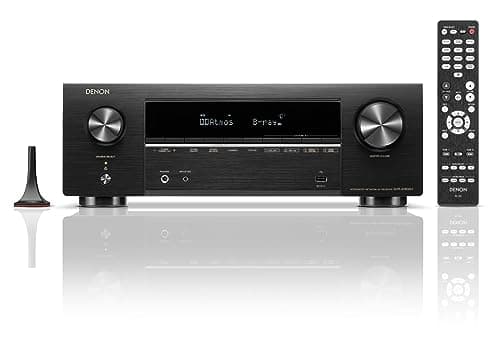 Denon AVR-X1800H Seven channels, 8K passthrough and Audyssey MultEQ XT — the room correction being the feature that actually changes what you hear in a real room. | Best overall under $1,000 | 9.0 | |
| 2 | 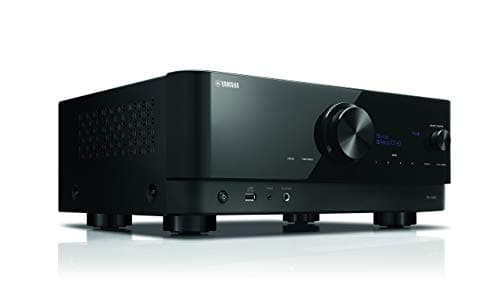 Yamaha RX-V6A The most powerful receiver here on paper — 100 watts a channel rated across the full band — with a phono input and seven HDMI inputs. | Best for music as well as film | 8.2 | |
| 3 | 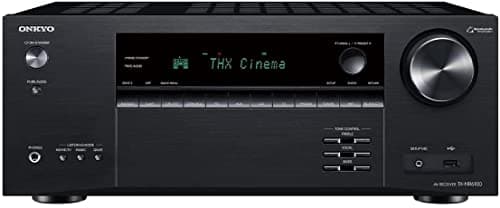 Onkyo TX-NR6100 THX certified with three 4K120 HDMI inputs, which is the specific spec that matters if two consoles and a PC share the same receiver. | Best for gaming | 8.2 | $649.00View on Amazon $899.9928% off |
These two sit in the same bracket and get shortlisted together constantly. We have already put the Denon against the Onkyo TX-NR6100, where the Onkyo won power and gaming and the Denon won room correction. Against the Yamaha the pattern rhymes but the margins move, and one row — what each maker is prepared to print about HDMI 2.1 — is more lopsided than anything in that comparison.
Every row where the sheets disagree
| Published specification | Denon AVR-X1800H | Yamaha RX-V6A |
|---|---|---|
| Channels | 7.2 (7.2 or 5.2.2, stated) | 7.2 |
| Rated power, 8 Ω, 20 Hz – 20 kHz, 2 ch | 80 W at 0.08% THD | 100 W at 0.06% THD |
| Second power figure | None published | 150 W/ch max effective (1 kHz, 10% THD) — a burst number |
| Room correction | Audyssey MultEQ XT, Dynamic EQ, Dynamic Volume | YPAO with multipoint measurement |
| HDMI in / out | 6 in (3 × 8K) / 1 out eARC | 7 in/ 1 out eARC; 8K on inputs 1–3 only |
| HDMI 2.1 gaming features | ALLM / QMS / QFT / VRR stated as Yes / No / Yes / Yes | Not published in the specification table at all |
| Phono input | MM 2.5 mV; RIAA ±1 dB; S/N 74 dB; distortion 0.03% | MM 3.5 mV / 47 kΩ — nothing further |
| Pre-outs | 2.2 (front L/R + 2 sub) | Front L/R + 2 sub + Zone 2 L/R |
| Atmos / DTS:X | Yes / Yes | Yes (with Height Virtualization) / Yes |
| Analog input | 200 mV; 10 Hz – 100 kHz (+1, −3 dB) Direct; S/N 98 dB | Not published |
| Streaming | HEOS, AirPlay 2, Spotify Connect, Amazon Music HD, TIDAL | MusicCast, AirPlay 2, Spotify Connect, Bluetooth |
| Power consumption | 430 W; standby 0.1 W (conditions apply); no idle figure | Not published in our source |
1. Power: Yamaha wins, and it wins the condition too
100 W against 80 W is a 25% difference in rated power, which is about 1 dBof sound pressure level — a real difference, and a small one. What makes the row more interesting than the numbers is that Yamaha’s figure is measured at a tighterdistortion limit: 0.06% against Denon’s 0.08%, both across the full 20 Hz – 20 kHz band with two channels driven. Usually when one maker quotes a bigger number it is because the test was easier. Here it is not, and Yamaha deserves the row.
Yamaha also prints a second figure, 150 W per channel “maximum effective output” at 1 kHz and 10% THD. That is a burst measurement at a distortion level nobody listens at, and it is the number that ends up in product listings. Ignore it. The same trap in a worse form is on the sub-$500 receivers.
2. Room correction: Denon wins the most important row
Audyssey MultEQ XT against YPAO with multipoint measurement. Both measure from several positions; the difference is filter resolution, and XT is the tier Denon reserves for this model and above. This is the row we weight hardest, because room correction changes what you hear more than 1 dB of amplifier headroom ever will — our room-correction explainer sets out why, and what correction cannot fix is a separate page, because the honest answer is that it cannot fix absorption.
3. HDMI: more inputs on the Yamaha, more information from Denon
Seven inputs against six is a genuine convenience win, tempered by 8K being limited to inputs 1 to 3 — the same restriction Denon has, which also puts 8K on three of its six.
The gaming row is not close. Denon prints ALLM, QMS, QFT and VRR as four rows with an explicit Yes or No against each — Yes, No, Yes, Yes — and Yamaha’s specification table names none of those four features anywhere. Yamaha’s HDMI feature list for this model runs to eARC, CEC, Auto Lip Sync, Deep Color, HDR10+, Dolby Vision, HLG, DSC and FRL, and stops. Yamaha does add ALLM and VRR to this model by firmware and documents that separately from the specification, which is why we record this as an absence from the spec table rather than a “No”. If you are buying for a console, our gaming roundup ranks the field on exactly this disclosure — and the Onkyo TX-NR6100, our third pick here, beats both by naming which terminals carry which feature.
4. The phono stage: four specifications against one
Denon publishes 2.5 mV input sensitivity, RIAA deviation of ±1 dB from 20 Hz to 20 kHz, a phono signal-to-noise of 74 dB and 0.03% distortion. Yamaha publishes 3.5 mV / 47 kΩ and nothing else. RIAA deviation is the figure that says whether a record comes out the right shape, and Denon is the only maker in this bracket that prints one.
In Yamaha’s favour: 3.5 mV is the friendlier sensitivity for a hot moving-magnet cartridge. An Ortofon 2M Red at 5.5 mV runs 3.9 dB above the Yamaha’s stated sensitivity and 6.8 dB above the Denon’s, so you sit slightly lower on the Denon’s volume control. Neither is a problem. Both are moving-magnet only, so a moving-coil cartridge rules out both — see our receiver-for-records roundup for the one box on this site that takes one.
5. Pre-outs: a narrow Yamaha win, and neither is good
Denon gives you 2.2 — front left and right plus two subwoofer outputs. Yamaha gives you the same plus a Zone 2 line output, which is a second room rather than more main channels. Neither is a full 7.2 pre-out set, so neither lets you add a power amplifier for the surrounds later. If that matters, the Marantz Cinema 70s in our pre-outs roundup is the only receiver near this money with a complete set.
6. One row only Denon fills in
Denon publishes an analog input specification: 200 mV sensitivity, 10 Hz – 100 kHz at +1 / −3 dB in Direct mode, and a 98 dB signal-to-noise. Yamaha publishes no equivalent. If a two-channel analog source is going into this receiver — a CD player, a separate phono stage, a streamer with analog outputs — the Denon is the only one of the two that has told you how it behaves in the mode you would use for it.
Denon’s honesty has a limit worth printing: it publishes 430 W consumption and a 0.1 W standby figure that only holds with network control off and HDMI pass-through disabled (CEC standby is 0.5 W), and it publishes no idle figure at all — the powered-on, not-playing number. Onkyo is the only maker in our registry that publishes one, at 65 W.
Which should you buy?
The Denon, for most people, because room correction is the feature that changes what you hear and MultEQ XT is the better implementation here; because the phono stage is documented four ways rather than one; and because a maker that prints an explicit No against QMS has earned more trust than one that prints no row at all.
The Yamaha if you need the seventh HDMI input, or if you are driving hard-to-load speakers where 100 W at 0.06% is worth more to you than a filter resolution you will set once. The Onkyo TX-NR6100 is the third pick and the one to read if gaming is the main use, for the per-terminal feature list nobody else writes.
Every pick in detail
Every specification below links to the manufacturer document we read it from. Where a manufacturer does not publish a figure, we say so rather than estimating it.
Denon AVR-X1800H
Best overall under $1,000Price as of October 16, 2026. #ad
Seven channels, 8K passthrough and Audyssey MultEQ XT — the room correction being the feature that actually changes what you hear in a real room.
- channels
- 9/10
- room correction
- 9/10
- connectivity
- 9/10
- value for money
- 9/10
- future proofing
- 9/10
| Specification | Published value | Source |
|---|---|---|
| Channels | 7.2 (7 power amplifiers — 7.2 or 5.2.2) | Denon info sheet (PDF) |
| Power output | 80 W + 80 W (8 Ω, 20 Hz – 20 kHz, 0.08% THD, 2 ch driven) | Denon info sheet (PDF) |
| Room correction | Audyssey MultEQ XT, with Dynamic EQ and Dynamic Volume | Denon info sheet (PDF) |
| Dolby Atmos / DTS:X | Yes / Yes | Denon info sheet (PDF) |
| Phono input | Yes — MM, 2.5 mV input sensitivity; RIAA deviation ±1 dB (20 Hz – 20 kHz); S/N 74 dB (IHF-A); distortion 0.03% (1 kHz, 3 V) | Denon owner's manual, audio section |
| Analog input sensitivity | 200 mV; frequency response 10 Hz – 100 kHz (+1, −3 dB, Direct mode); S/N 98 dB (IHF-A, Direct mode) | Denon owner's manual, audio section |
| Power consumption | 430 W. Standby 0.1 W — but only with Network Control set to “Off In Standby” and HDMI Pass Through off; CEC standby is 0.5 W. Denon publishes no idle (powered-on, not playing) figure at all. | Denon owner's manual, general section |
| HDMI in / out | 6 in (3 are 8K) / 1 out (eARC) | Denon info sheet (PDF) |
| Video passthrough | 8K/60 Hz, 4K/120 Hz; VRR, QFT, ALLM | Denon product page |
| HDMI 2.1 gaming features | ALLM / QMS / QFT / VRR — Yes / No / Yes / Yes. Denon does not state which of the six inputs carry them beyond the “3 x 8K” count. | Denon product page |
| Pre-outs | 2.2 only (front L/R + 2 subwoofer) — NOT a full 7.2 pre-out | Denon info sheet (PDF) |
| Streaming | HEOS built-in; AirPlay 2, Spotify Connect, Amazon Music HD, TIDAL | Denon info sheet (PDF) |
Pros
- Audyssey MultEQ XT room correction — a step above the plain MultEQ on the cheaper models
- 7.2 channels — enough for a 5.2.2 Atmos layout
- MM phono input, so a turntable connects without a separate stage
- 8K/60 and 4K/120 passthrough with VRR and ALLM
Cons
- Only 2.2 pre-outs (front L/R plus subwoofers) — you cannot add external amplification to the surround channels later
- Menus are dense
- Runs warm in a closed cabinet
Skip it if you only need 5 channels — the AVR-S670H shares the same core for less.
Yamaha RX-V6A
Best for music as well as filmPrice as of October 16, 2026. #ad
The most powerful receiver here on paper — 100 watts a channel rated across the full band — with a phono input and seven HDMI inputs.
- channels
- 9/10
- room correction
- 7/10
- connectivity
- 9/10
- value for money
- 8/10
- future proofing
- 8/10
| Specification | Published value | Source |
|---|---|---|
| Channels | 7.2 | Yamaha spec page |
| Power output | 100 W/ch (8 Ω, 20 Hz – 20 kHz, 0.06% THD, 2 ch driven). Maximum effective output 150 W/ch (1 kHz, 10% THD, 8 Ω) | Yamaha owner's manual |
| Room correction | YPAO with multipoint measurement | Yamaha spec page |
| Dolby Atmos / DTS:X | Yes (with Height Virtualization) / Yes | Yamaha spec page |
| Phono input | Yes — MM, 3.5 mV / 47 kΩ at 1 kHz | Yamaha owner's manual |
| HDMI in / out | 7 in / 1 out (eARC). 8K on inputs 1–3 only | Yamaha spec page |
| HDMI 2.1 gaming features | Not published in the specification table. Yamaha's HDMI feature list for this model reads “8K, 4K Ultra HD (include 8K/60, 50 Hz, 4K/120, 100 Hz 10-bit), 3D Video, ARC, eARC, HDMI Control (CEC), Auto Lip Sync, Deep Color, x.v.Color, HDR10+, Dolby Vision, Hybrid Log-Gamma, DSC FRL, FRL” and HDCP 1.4/2.3 — VRR, ALLM, QMS and QFT are named nowhere in it, and nowhere on the 4K/8K MODE page either. Yamaha adds ALLM and VRR to this model by firmware and documents that separately from the specification. | Yamaha owner's manual, specifications |
| Pre-outs | Front L/R + 2 subwoofer, plus Zone 2 L/R — not a full 7.2 pre-out | Yamaha owner's manual |
| Streaming | MusicCast, AirPlay 2, Bluetooth (SBC/AAC), Spotify Connect | Yamaha spec page |
Pros
- 100 W/ch (8 Ω, 20 Hz – 20 kHz, 0.06% THD) — the highest full-band rating in this group
- Seven HDMI inputs, the most here
- MM phono input, 3.5 mV / 47 kΩ
- YPAO with multipoint measurement, plus MusicCast multiroom
Cons
- YPAO is less sophisticated than Audyssey MultEQ XT on the Denon
- 8K is limited to HDMI inputs 1–3
- Pre-outs are front L/R plus subwoofers only — not a full 7.2
Skip it if room correction quality is your priority — Audyssey MultEQ XT on the Denon goes further.
Onkyo TX-NR6100
Best for gamingTHX certified with three 4K120 HDMI inputs, which is the specific spec that matters if two consoles and a PC share the same receiver.
- channels
- 9/10
- room correction
- 6/10
- connectivity
- 10/10
- value for money
- 8/10
- future proofing
- 8/10
| Specification | Published value | Source |
|---|---|---|
| Channels | 7.2, THX certified | Onkyo product page |
| Power output | 100 W/ch (8 Ω, 20 Hz – 20 kHz, 0.08% THD, 2 ch driven, FTC). The “210 W per channel” figure circulating in search results is a dynamic-power marketing number, not the FTC rating. | Onkyo product page |
| Room correction | AccuEQ with AccuReflex. Dirac Live is NOT available on this model — Onkyo starts Dirac at the TX-NR7100. | Onkyo receiver buying guide |
| Dolby Atmos / DTS:X | Yes / Yes (5.2.2 playback) | Onkyo spec page |
| Phono input | Yes — MM, 3.5 mV rms / 47 kΩ | Onkyo spec page |
| HDMI in / out | 6 in / 2 out. HDMI 2.1 (8K/60, 4K/120) on inputs 1–3 and both outputs; inputs 4–6 are 2.0 up to 4K/60 | Onkyo spec page |
| Streaming | Chromecast built-in, AirPlay 2, DTS Play-Fi, works with Sonos | Onkyo spec page |
| HDMI 2.1 gaming features | “HDMI 2.1 features are supported on HDMI inputs 1–3, Main Out, and Sub/Zone 2 Out in Sub Mode output including VRR, ALLM, QFT (Quick Frame Transport), DSC (Display Stream Compression), QMS (Quick Media Switching), and eARC (Main Out).” Inputs 4–6 carry HDMI 2.0 features only. | Onkyo spec page |
| Power consumption | 635 W operating, 65 W idle (on, not playing), 0.1 W standby | Onkyo spec page |
| Pre-outs | Subwoofer pre-out (1 V rms / 470 Ω) and a Zone 2/Zone B line-out (200 mV rms / 470 Ω). No main-channel pre-outs are listed | Onkyo spec page |
Pros
- Three HDMI 2.1 inputs at 8K/60 and 4K/120 — the most console-friendly receiver here
- THX certified
- MM phono input, which is unusual on a gaming-focused receiver
- 100 W/ch FTC-rated into 8 Ω across the full band
Cons
- Room correction is AccuEQ, NOT Dirac Live — Onkyo starts Dirac at the TX-NR7100, and this model has no upgrade path to it
- The “210 W per channel” figure in most search results is dynamic-power marketing; the FTC rating is 100 W
- HDMI inputs 4–6 are only HDMI 2.0, capped at 4K/60
Skip it if you have one source — you are paying for HDMI 2.1 inputs you will never fill.
Frequently asked questions
Is the Denon AVR-X1800H or the Yamaha RX-V6A better?
How much louder is the Yamaha's 100 watts than the Denon's 80?
Does the Yamaha RX-V6A support VRR and ALLM?
Which has the better room correction, Audyssey MultEQ XT or YPAO?
Which is better for a turntable?
Can I add a power amplifier to either of these later?
Have you measured either receiver?
Read next
Denon AVR-X1800H vs Onkyo TX-NR6100
The two most-compared receivers under $1,000, split across the four specifications where they actually differ - and the one that is pure marketing.
The Best AV Receivers Under $1,000
Five receivers under $1,000, compared on FTC-rated power and the pre-out spec almost nobody mentions.
The Best 7.2 AV Receivers Under $1,000
Four 7.2 receivers under $1,000, ranked on the speaker layouts their own manuals document rather than on the number printed on the box.
AV Receiver Room Correction, Honestly
What Audyssey, YPAO and AccuEQ tiers actually publish, the one difference that is documented, and the physics room correction cannot beat.
The Best AV Receivers for Music
The receivers that take two-channel seriously, ranked on pre-outs, published phono specs and a power rating measured across the whole band.
The Best Receivers for a Turntable and a TV
Six registry boxes have both a phono input and HDMI. Ranked on published phono data: only the Onkyo TX-8470 accepts a moving-coil cartridge, and only Denon publishes an RIAA deviation figure.
Sources
Every specification on this page was read from one of these documents. If one of them has changed, or we have made an error, tell us — corrections are logged and dated per our editorial policy.
- Denon AVR-X1800H — owner's manual, audio section (phono, analog input, rated power)
- Denon AVR-X1800H — owner's manual, general section (power consumption, standby)
- Yamaha RX-V6A — owner's manual, specifications (rated power, phono, HDMI list, pre-outs)
- Onkyo TX-NR6100 — spec page (FTC power, per-terminal HDMI 2.1 features, idle power)
- Ortofon 2M Red — specifications (5.5 mV output)