The Best Speakers Under $1,000
This is the band where makers stop rounding and start publishing. One of these six publishes a distortion figure with its measurement condition; three tell you whether the listing is one speaker or two. Those two facts do the ranking.
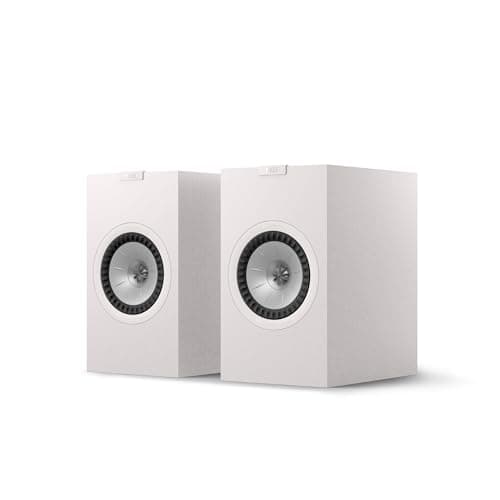
Top pick: KEF Q3 Meta
Best imaging design. #ad Affiliate link — we earn a commission at no extra cost to you.
The short answer
The best speaker under $1,000 is the KEF Q3 Meta — not because we have heard it against the other five, but because it is the only one of them that publishes a harmonic distortion figure with its measurement condition attached, and the only one that publishes both a nominal and a minimum impedance. On a page where nobody can hand you a listening test, the speaker whose maker commits to the most checkable numbers is the one that deserves the top slot. Its cost is real and stated below: a 4 Ω nominal load with a 3.2 Ω minimum is the hardest amplifier job here. The budget pick is the Jamo Studio S 809 — a floorstanding pair for a fraction of the ceiling, with a flatly stated 8 Ω impedance and no “compatible” hedge, which is more than Klipsch, Fluance or Polk will give you at any price.
If you want the most loudspeaker the ceiling will physically buy, it is the Klipsch RP-6000F II: a tower pair in one listing, 96 dB of published sensitivity and a ± 3 dB window down to 38 Hz. If you want the whole system rather than the speakers, it is the Kanto YU6, which has the amplifier and a phono stage inside it. And if you are buying a single-cabinet tower, read the “sold as” section before you read anything else — it is the difference between a $1,000 budget and a $2,000 one.
Disclosure: we earn a commission if you buy through the links on this page, at no extra cost to you. It does not influence what we pick — our criteria are published and reproducible, so you can check our work. How we pick · Full disclosure
These picks are spec-and-price analyses, not listening tests. We have not heard this gear and we do not pretend to have: every figure below is sourced to the manufacturer and linked, and every price is live or not shown at all. Here are the rules we followed.
Quick picks
Ranked on the published criteria in How We Pick. Prices are live as of November 23, 2026. Tap any row for the full write-up.
- 8.0
- 8.4
- 8.3
- 8.5
- 8.2
- 8.0
| # | Product | Best for | Score | Price |
|---|---|---|---|---|
| 1 | KEF Q3 Meta KEF's coaxial Uni-Q driver puts the tweeter at the woofer's acoustic center, and the Meta generation adds a metamaterial absorber behind it — both are engineering changes rather than finish upgrades. | Best imaging design | 8.0 | |
| 2 | 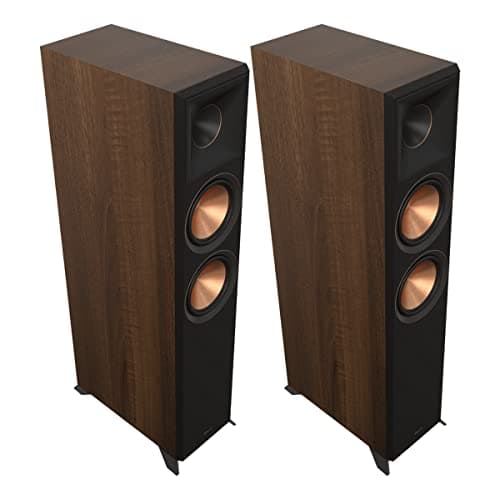 Klipsch RP-6000F II The only pair listing in the bracket and the easiest load in it — with a 96 dB sensitivity figure that carries Klipsch's own half-space asterisk, which is worth reading before you compare it to anything. | Best for a modest amplifier | 8.4 | |
| 3 | 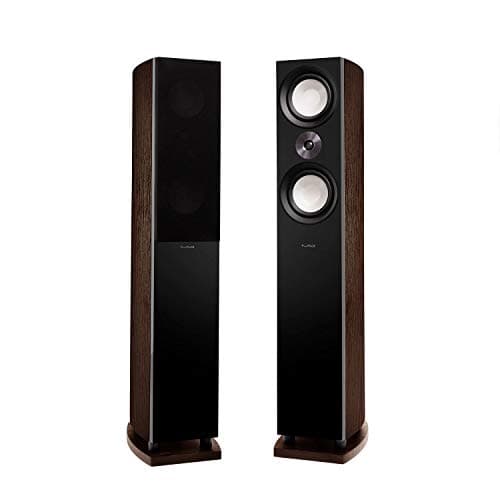 Fluance XL8F Reference The only genuine three-way here, with a dedicated down-firing 8 in woofer and a published 100 Hz crossover — and the price on the listing already buys two of them. | Best true pair price | 8.3 | |
| 4 | 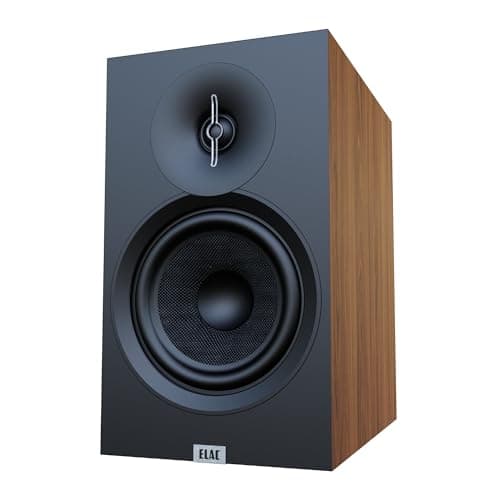 ELAC Debut 3.0 DB63 The Debut 3.0 generation of the same 6.5-inch design, and the first ELAC bookshelf we cover that publishes both a response tolerance and a recommended amplifier range — so the match can be finished rather than estimated. | Best overall under $500 | 8.5 | |
| 5 | 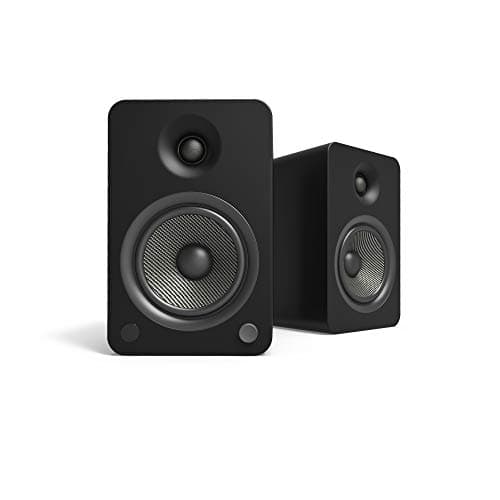 Kanto YU6 Powered speakers with a phono stage already inside, which collapses amp, phono stage and speakers into one purchase and one power cable. | Best all-in-one for a turntable | 8.2 | |
| 6 | 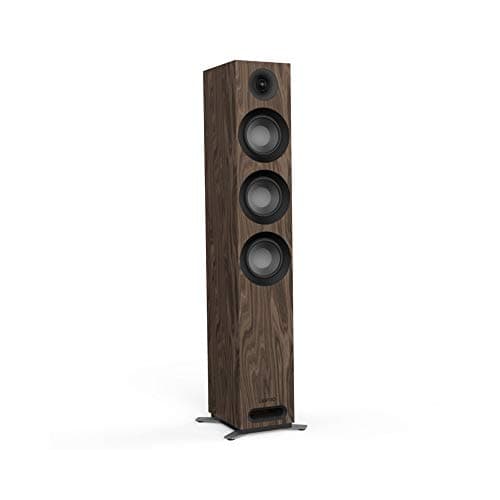 Jamo Studio S 809 The only front-ported tower here, sold as a pair, with a ± 3 dB tolerance on its 37 Hz claim — the answer when the speakers cannot come out into the room. | Best near a wall | 8.0 |
A thousand dollars is the point where loudspeaker specification sheets change character. Below it, you get a sensitivity figure with no measurement condition, a bass number with no tolerance window and the word “compatible” where an impedance should be. Inside this band, some makers start publishing the harder version of each figure — and the ones that still do not are much easier to spot, because their competitors have raised the floor.
So that is what ranks this page. We have not measured these six and we are not going to tell you which sounds better, because we would be making it up. What we can do is put each maker’s own published figures side by side with the condition each was measured under, show where two documents from the same company disagree, and name the rows that are simply absent. Two brackets below this one already exist — our under-$500 roundup and the under-$200 page— and this is the rung above them, not a re-cut of either.
What actually improves between $500 and $1,000
Three things, all of them checkable. First, the measurement condition starts appearing next to the sensitivity figure: KEF, Klipsch, ELAC and Jamo all state 2.83 V / 1 m and Fluance states the harder 1 W / 1 m, where the budget brackets are full of bare decibel numbers. Second, the tolerance window starts appearing next to the bass figure — Jamo publishes 37 Hz at ± 3 dB, Klipsch 38 Hz at ± 3 dB, KEF 49 Hz at ± 3 dB alongside the softer 42 Hz at −6 dB. Third, and rarest, one maker in this band publishes distortion.
That third one is worth dwelling on, because almost no loudspeaker manufacturer at any price publishes a distortion figure with its conditions attached. KEF states under 2% above 110 Hz and under 1% from 135 Hz to 20 kHz, measured at 90 dB at one meter, and adds a 109 dB maximum output. Five of the six speakers here publish none of that. Those are honest gaps rather than oversights — the whole industry leaves the row blank — but when one company fills it in, that is information, and it is the kind that cannot be marketing.
What does notreliably improve in this band is the impedance row. Klipsch still publishes 8 Ω “compatible” rather than a measured nominal figure on the RP-6000F II, and Fluance publishes “8 Ohm Compatible” on the XL8F. Jamo states 8 Ω flatly. KEF states 4 Ω nominal and 3.2 Ω minimum, which is the only complete answer on the page and also the most demanding one.
The six, on the four rows that separate them
Read the first column with its conditions, not as six decibel numbers. Klipsch and KEF both state 2.83 V / 1 m, but Klipsch prints its own asterisk on the RP-6000F II — “SPL at 1 M, half-space anechoic” — which means the measurement was taken against a boundary, and Klipsch publishes no free-space equivalent. Fluance states 1 W / 1 m, the harder condition. The last column is the one most people miss, and the three blanks in it are the reason the next section exists.
Every figure below is the manufacturer’s own published value and links to the document we read it from. “Not published” means the manufacturer does not publish that figure; an em dash means we have no published figure for that model. Prices are live as of November 23, 2026.
Best imaging design
- Sensitivity, with its condition
- 87 dB · 2.83 V / 1 m
- Low-end limit, with its tolerance
- 49 Hz ± 3 dB (42 Hz at −6 dB)
- Amplifier figure — advice or warning?
- 15–150 W recommended
- Sold as
- —
Best for a modest amplifier
- Sensitivity, with its condition
- 96 dB · 2.83 V / 1 m, half-space
- Low-end limit, with its tolerance
- 38 Hz ± 3 dB
- Amplifier figure — advice or warning?
- 125 W continuous handling
Best true pair price
- Sensitivity, with its condition
- 87 dB · 1 W / 1 m
- Low-end limit, with its tolerance
- 35 Hz — no tolerance stated
- Amplifier figure — advice or warning?
- 80–160 W RMS handling
- Sold as
- A matched pair
Best overall under $500
- Sensitivity, with its condition
- 87 dB · 2.83 V / 1 m
- Low-end limit, with its tolerance
- 50 Hz at −3 dB (manual only)
- Amplifier figure — advice or warning?
- 20–140 W recommended
- Sold as
- —
Best all-in-one for a turntable
- Sensitivity, with its condition
- —
- Low-end limit, with its tolerance
- 50 Hz — no tolerance stated
- Amplifier figure — advice or warning?
- 100 W RMS built in
- Sold as
- —
Best near a wall
- Sensitivity, with its condition
- 90 dB · 2.83 V / 1 m
- Low-end limit, with its tolerance
- 37 Hz ± 3 dB
- Amplifier figure — advice or warning?
- 120 W handling
- Sold as
- A pair
| Pick | Sensitivity, with its condition | Low-end limit, with its tolerance | Amplifier figure — advice or warning? | Sold as | Price |
|---|---|---|---|---|---|
| 1.KEF Q3 MetaBest imaging design | 87 dB · 2.83 V / 1 m | 49 Hz ± 3 dB (42 Hz at −6 dB) | 15–150 W recommended | — | |
| 2.Klipsch RP-6000F IIBest for a modest amplifier | 96 dB · 2.83 V / 1 m, half-space | 38 Hz ± 3 dB | 125 W continuous handling | A pair — two speakers, one listing | |
| 3.Fluance XL8F ReferenceBest true pair price | 87 dB · 1 W / 1 m | 35 Hz — no tolerance stated | 80–160 W RMS handling | A matched pair | |
| 4.ELAC Debut 3.0 DB63Best overall under $500 | 87 dB · 2.83 V / 1 m | 50 Hz at −3 dB (manual only) | 20–140 W recommended | — | |
| 5.Kanto YU6Best all-in-one for a turntable | — | 50 Hz — no tolerance stated | 100 W RMS built in | — | |
| 6.Jamo Studio S 809Best near a wall | 90 dB · 2.83 V / 1 m | 37 Hz ± 3 dB | 120 W handling | A pair |
Prices as of November 23, 2026; every “Check Price” link goes to Amazon and earns us a commission at no extra cost to you. #ad
The row that decides whether your ceiling is $1,000 or $2,000
A floorstanding loudspeaker is normally sold one cabinet at a time, and a bookshelf speaker is normally sold two at a time, and almost nothing on a product page tells you which. We keep a “sold as” row in the registry for exactly this reason, and it is published for three of the six speakers here: Klipsch sells the RP-6000F II as a two-speaker pack, Fluance sells the XL8F as a matched pair, and Jamo prices the S 809 per pair on its own store. For those three, one purchase puts a working stereo system in the room.
For the KEF Q3 Meta and the ELAC Debut 3.0 DB63 we have no published row to cite, so we are not going to claim one. Count the cabinets in the listing photograph and read the title before you check out — that is the only reliable answer, and it is the same advice we would give about any speaker on this site. The Kanto YU6 answers the question sideways: Kanto publishes two different weights for it, 11.4 lb for the active cabinet and 8.7 lb for the passive one, which is a stereo pair by construction because only one of the two has the amplifier in it.
This matters more than it sounds. Two speakers we rank elsewhere on the site publish “Each” in that row outright — the ELAC Debut 3.0 DF53 and the JBL Stage 2 280F — and a stereo pair of either is two separate purchases. Neither is on this page for that reason and not because of anything either one publishes. If you are cross-shopping single-cabinet towers against the pair listings above, double the single figure before you compare, every time.
Six decibels of sensitivity, in amplifier watts
The widest honest gap in the first column is between the Klipsch RP-6000F II and the KEF Q3 Meta, both stated at the same 2.83 V / 1 m condition. Here is what that gap costs the amplifier, with the caveat that matters stated immediately after it.
Power ratio = 10^(ΔdB ÷ 10)
Inputs
- Klipsch RP-6000F II sensitivity: 96 dB at 2.83 V / 1 m, with Klipsch's own half-space anechoic asterisk (Klipsch spec sheet (PDF))
- KEF Q3 Meta sensitivity: 87 dB at 2.83 V / 1 m (KEF spec page)
Result
The six, and who each is for
1. KEF Q3 Meta— for the reader who wants the best-documented loudspeaker the band contains. A 6.5-inch aluminum cone with a 1-inch vented aluminum dome at its acoustic center in a Uni-Q array, crossed at 2.0 kHz, 49 Hz to 20 kHz at ± 3 dB, 42 Hz at −6 dB, 15 to 150 W recommended, 4 Ω nominal, 3.2 Ω minimum, 109 dB maximum output, and the distortion figure nobody else here prints. Against it: it is a bookshelf speaker, so a stand is a real additional cost and so is the floor space; 87 dB of sensitivity is the joint-lowest on the page; and a 3.2 Ω minimum is a harder load than anything else here, so check your amplifier before you treat it as a drop-in. It also has no published “sold as” row, so count the cabinets in the listing.
2. Klipsch RP-6000F II— for the reader who wants the ceiling turned into as much cabinet as it will physically buy, in one purchase. Dual 6.5-inch Cerametallic woofers and a 1-inch titanium LTS tweeter on a Tractrix horn, crossed at 1,770 Hz, 38 Hz to 25 kHz at ± 3 dB, 125 W continuous handling, dual binding posts for bi-wiring or bi-amping, 49.4 lb per cabinet, and the only pair listing in the upper half of this band. Against it: the sensitivity figure carries Klipsch’s own half-space asterisk, impedance is 8 Ω “compatible” rather than measured, no minimum impedance is published, the 125 W is a handling limit rather than advice, and it is a two-way with no dedicated midrange despite the cabinet size. It is also nearly a meter tall, which is a furniture decision as much as an audio one.
3. Fluance XL8F Reference— for the reader who wants a genuine three-way and the budget left over to drive it. An isolated down-firing 8-inch bass driver crossed over at 100 Hz, dual 6.5-inch woven glass-fiber midranges, a ferrofluid-cooled silk dome, 47.7 lb per cabinet, sold as a matched pair, and the only published low crossover point on the page — which is what a dedicated bass driver means in practice. It also states its sensitivity at the harder 1 W / 1 m condition rather than at 2.83 V. Against it: “8 Ohm Compatible” rather than a nominal figure, no minimum impedance, 80 to 160 W RMS as handling rather than a recommendation, and a 35 Hz bass claim with no tolerance window at all, which is the loosest number in the second column.
4. ELAC Debut 3.0 DB63— for the reader who wants most of the documentation at roughly half the ceiling. A 6.5-inch aramid-fiber woofer, a 1-inch aluminum dome, a 2 kHz crossover, a dual flared frontport — which is the rarest and most useful thing on its sheet if the speaker has to go near a wall — CARB2-rated 16 mm MDF, five-way binding posts, and a 20 to 140 W recommended amplifier range, which is advice rather than a limit. ELAC publishes 6 Ω on both its product page and its owner’s manual for the bookshelf models, and those two documents do notagree for ELAC’s own DF-series towers, so the agreement is worth something. Against it: ELAC publishes its bass figure twice (42 Hz at −6 dB on the page, 50 Hz at −3 dB in the manual) and its power handling twice (120 W peak against 60 W nominal / 80 W peak). We report both pairs rather than resolve them. Plan to the lower number in each.
5. Kanto YU6— for the reader whose $1,000 has to cover the amplifier too. 100 W total RMS built in, a 5.25-inch Kevlar woofer, a 1-inch silk dome, two optical inputs, Bluetooth with aptX, a subwoofer output, and an RCA input with a phono switch, which means a turntable connects to it directly with nothing in between. On a site about records that is the whole argument for it. Against it, and these are not small: the amplifier is fixed, so the upgrade path is replacement rather than improvement; one cabinet needs mains power and a cable to the other; there is no HDMI, so a TV remote cannot control the volume; and Kanto publishes 50 Hz to 20 kHz with no tolerance attached, which makes the low-end claim one you cannot check. Kanto also publishes no sensitivity or impedance figure — reasonably, since the amplifier is inside, but it does mean this is the one pick the first column cannot rank.
6. Jamo Studio S 809— the budget pick, and the cheapest route to a floorstanding pair on this site. Three 5-inch polyfiber woofers and a 1-inch soft dome with an anti-diffraction waveguide, 37 Hz to 26 kHz at ± 3 dB, 90 dB at 2.83 V / 1 m, a front-firing slot port — the only front-ported tower we cover, which is what makes it workable close to a wall — and an impedance stated flatly as 8 Ω with no “compatible” hedge. Against it: Jamo publishes no crossover frequency at all, which matters because three same-size woofers could be filtered as a two-way, a 2.5-way or a 3.5-way and the sheet does not say which; no minimum impedance; a single binding post, so no bi-wiring; and 120 W as handling rather than a recommended range. One thing worth knowing rather than hiding: Jamo is a Klipsch Group brand, which is why it does not appear on our Klipsch alternatives page.
What the ceiling buys once the amplifier is in the total
Four of these six are passive, which means the budget is not finished when the speakers arrive. The useful question is whether a complete system fits, so here is the budget pick totalled against a real integrated amplifier — the Yamaha A-S501, which publishes 85 W per channel into 8 Ω with its distortion condition attached and has a phono input.
- Jamo Studio S 809$299.00
- Yamaha A-S501$649.95
Total: $948.95
That is $51.05 under the $1,000 ceiling.
If the ceiling has to cover everything and a turntable is involved, the Kanto YU6 does the same job in one box with the phono stage already inside, and leaves more headroom than any passive pair plus amplifier can. If the ceiling is really about the television rather than records, the Klipsch The Fives II crossed into this band recently and is the rank-one pick on our powered speakers for TV roundup because it has HDMI-ARC, which neither the Kanto nor anything passive here can offer.
What $1,000 does not buy
Three things, stated plainly, because a bracket page that pretends the ceiling is generous is useless.
It does not buy a speaker with a published distortion figure andan easy amplifier load. The KEF is the only model here that publishes distortion and it is also the hardest load on the page. You can have the paperwork or the 8 Ω flat statement; at this price you cannot have both.
It does not buy a stereo pair of the single-cabinet towers we rank in the bracket above. That is arithmetic, not opinion, and the $1,000 to $2,000 floorstanding page exists because doubling a single-cabinet price is where this budget runs out.
And it does not buy a center channel worth matching to any of them. The only dedicated center channel we cover is the Klipsch R-52C, and if a television is the real reason you are shopping, a front pair plus a center plus a receiver is a different budget and a different page — our complete system build under $2,000 totals exactly that, live.
Where this page sits in our speaker coverage
This is the top rung of a ladder. The brackets below it are under $500 and under $200; the type-specific head pages are bookshelf speakers and floorstanding speakers, both of which rank across every price. If you have narrowed to one cabinet shape already, those two are the better pages; if the number is the constraint, this one is.
Every pick in detail
Every specification below links to the manufacturer document we read it from. Where a manufacturer does not publish a figure, we say so rather than estimating it.
KEF Q3 Meta
Best imaging designPrice as of November 23, 2026. #ad
KEF's coaxial Uni-Q driver puts the tweeter at the woofer's acoustic center, and the Meta generation adds a metamaterial absorber behind it — both are engineering changes rather than finish upgrades.
- sensitivity
- 7/10
- bass extension
- 9/10
- amp friendliness
- 5/10
- value for money
- 7/10
- build quality
- 9/10
| Specification | Published value | Source |
|---|---|---|
| Sensitivity | 87 dB (2.83 V / 1 m) | KEF spec page |
| Impedance (nominal) | 4 Ω | KEF spec page |
| Minimum impedance | 3.2 Ω | KEF spec page |
| Frequency response | 49 Hz – 20 kHz (± 3 dB); 42 Hz – 20 kHz at −6 dB | KEF spec page |
| Amplifier requirements | 15–150 W | KEF spec page |
| Driver | Uni-Q array: 165 mm (6.5 in) aluminum cone with a 25 mm (1 in) vented aluminum dome and MAT at its acoustic center | KEF spec page |
| Crossover | 2.0 kHz | KEF spec page |
| Harmonic distortion | < 2% at 110 Hz and above; < 1% from 135 Hz – 20 kHz (measured at 90 dB, 1 m) | KEF spec page |
| Maximum output | 109 dB | KEF spec page |
| Dimensions (H × W × D) | 357 × 210 × 305 mm (14.1 × 8.3 × 12.0 in) | KEF spec page |
| Weight (each) | 8.2 kg / 18.1 lb | KEF spec page |
Pros
- Uni-Q coaxial driver — a real design difference, not a trim level
- Publishes both a nominal (4 Ω) and a minimum (3.2 Ω) impedance, plus a harmonic-distortion figure with its measurement condition — almost nobody publishes the last one
- 165 mm driver and a 42 Hz −6 dB figure, the deepest published extension of any bookshelf pair here
Cons
- Well above the $500 bracket at its current price
- 4 Ω nominal dipping to 3.2 Ω — this is a genuinely demanding load, not a nominal-8 Ω speaker that occasionally dips
- 18.1 lb and 12 in deep per speaker, which is a stand rather than a shelf
Skip it if your amplifier does not state a 4 Ω rating. The Q3 Meta is nominally 4 Ω before it dips, which is the hardest load in this registry.
Klipsch RP-6000F II
Best for a modest amplifierPrice as of November 23, 2026. #ad
The only pair listing in the bracket and the easiest load in it — with a 96 dB sensitivity figure that carries Klipsch's own half-space asterisk, which is worth reading before you compare it to anything.
- published data
- 7/10
- sensitivity
- 9/10
- bass extension
- 8/10
- amp friendliness
- 10/10
- value for money
- 9/10
| Specification | Published value | Source |
|---|---|---|
| Design | Two-way bass reflex — no dedicated midrange driver | Klipsch spec sheet (PDF) |
| Sensitivity | 96 dB @ 2.83 V / 1 m, with Klipsch's own asterisk: “SPL at 1 M, half-space anechoic with 2.83V input” | Klipsch spec sheet (PDF) |
| Impedance | 8 Ω “compatible” (Klipsch's wording — not a measured nominal figure) | Klipsch spec sheet (PDF) |
| Minimum impedance | Not published | — |
| Frequency response | 38 Hz – 25 kHz ± 3 dB | Klipsch spec sheet (PDF) |
| Power handling | 125 W continuous / 500 W peak (a handling limit, not a recommended amplifier range) | Klipsch spec sheet (PDF) |
| Tweeter | 1 in titanium LTS vented tweeter on a hybrid cross-section expanded Tractrix horn | Klipsch spec sheet (PDF) |
| Woofers | Dual 6.5 in Cerametallic cone with Faraday rings | Klipsch spec sheet (PDF) |
| Crossover | 1,770 Hz | Klipsch spec sheet (PDF) |
| Enclosure | Internally braced MDF; bass reflex via dual-chamber rear-firing Tractrix ports | Klipsch spec sheet (PDF) |
| Input terminals | Dual binding posts — bi-wire and bi-amp capable | Klipsch spec sheet (PDF) |
| Dimensions (H × W × D) | 39.60 × 9.29 × 17.57 in (100.6 × 23.6 × 44.6 cm) | Klipsch spec sheet (PDF) |
| Weight (each) | 49.4 lb / 22.4 kg | Klipsch spec sheet (PDF) |
| Sold as | A pair — the Amazon listing is a two-speaker pack. The only pair listing in this bracket. | Klipsch product page |
Pros
- Sold as a pair, so the listed price is the price of a stereo front end
- 38 Hz – 25 kHz ± 3 dB — a real tolerance window on the deepest ± 3 dB figure in the bracket
- 8 Ω compatible and high sensitivity: the one speaker here a modest integrated amplifier will drive comfortably
- Dual binding posts for bi-wiring or bi-amping, which the ELACs and the KEF do not offer
- 125 W continuous handling and a divided, internally braced cabinet
Cons
- The 96 dB figure is footnoted “SPL at 1 M, half-space anechoic with 2.83V input” — a half-space measurement is conventionally about 3 dB optimistic against a free-space one, so it is NOT comparable to the KEF's or ELAC's numbers
- A two-way: the 6.5 in woofers cover midrange up to 1,770 Hz, where the ELACs and the KEF hand that band to a dedicated driver
- 17.57 in deep and 49.4 lb each — the deepest cabinet here before port clearance
- Rear-firing Tractrix ports need real space behind them
- Klipsch publishes no minimum impedance, and “8 ohms compatible” is not a measured nominal figure
Skip it if you are ranking on the headline sensitivity number. Read the asterisk first — it is the difference between a fair comparison and a wrong one.
Fluance XL8F Reference
Best true pair pricePrice as of November 23, 2026. #ad
The only genuine three-way here, with a dedicated down-firing 8 in woofer and a published 100 Hz crossover — and the price on the listing already buys two of them.
- sensitivity
- 5/10
- published data
- 7/10
- bass extension
- 9/10
- amp friendliness
- 5/10
- value for money
- 10/10
| Specification | Published value | Source |
|---|---|---|
| Sensitivity | 87 dB @ 1 W / 1 m — Fluance states the condition, and it is the 1-watt condition, not 2.83 V | Fluance spec list |
| Impedance | “8 Ohm Compatible” (Fluance's wording — not a measured nominal figure) | Fluance spec list |
| Minimum impedance | Not published | — |
| Frequency response | 35 Hz – 25 kHz, quoted with no tolerance window | Fluance spec list |
| Power handling | 80 – 160 W RMS | Fluance spec list |
| Tweeter | 1 in neodymium balanced silk dome, ferrofluid cooled | Fluance spec list |
| Midrange | Dual 6.5 in woven glass fiber composite with butyl rubber surrounds | Fluance spec list |
| Woofer | Isolated down-firing 8 in polymer-treated high-excursion driver — the only dedicated bass driver on this page | Fluance spec list |
| Crossover | 100 Hz / 3,000 Hz — a genuine three-way, and the only published low crossover point here | Fluance spec list |
| Enclosure | Tuned rear dual-port bass reflex tower, dampened | Fluance spec list |
| Dimensions (H × W × D) | 45.86 × 9.25 × 12.99 in (116.5 × 23.5 × 33 cm) | Fluance spec list |
| Weight (each) | 47.7 lb / 21.64 kg — the heaviest cabinet on this page by 12 lb | Fluance spec list |
| Sold as | A matched pair. One purchase puts two speakers in the room. | Fluance product page |
Pros
- Sold as a matched pair, so the listed price is the price of a stereo system's front end
- A real three-way: 1 in silk dome, dual 6.5 in midranges and an isolated 8 in down-firing woofer
- Publishes both crossover points (100 Hz and 3,000 Hz), which nobody else on this page does
- 47.7 lb per cabinet — the heaviest and most inert box here by a wide margin
Cons
- 87 dB at 1 W / 1 m is the lowest published sensitivity on this page, so it wants the most amplifier power
- 35 Hz – 25 kHz is published with no tolerance window, which makes the 35 Hz endpoint unverifiable
- 45.86 in tall and 12.99 in deep — physically the largest thing here, and it looks it
- Rear dual ports, so it needs wall clearance despite the down-firing woofer
Skip it if your amplifier is a low-power tube or Class A design. Of everything here this is the one that most wants watts.
ELAC Debut 3.0 DB63
Best overall under $500Price as of November 23, 2026. #ad
The Debut 3.0 generation of the same 6.5-inch design, and the first ELAC bookshelf we cover that publishes both a response tolerance and a recommended amplifier range — so the match can be finished rather than estimated.
- published data
- 9/10
- sensitivity
- 6/10
- bass extension
- 8/10
- amp friendliness
- 6/10
- value for money
- 8/10
| Specification | Published value | Source |
|---|---|---|
| Design | 2-way, bass reflex, dual flared front port | ELAC spec page |
| Sensitivity | 87 dB (2.83 V / 1 m) | ELAC spec page |
| Impedance | 6 Ω (product page and owner's manual agree, which they do not for the DF-series towers) | ELAC owner's manual (PDF) |
| Minimum impedance | Not published | — |
| Frequency response (−3 dB) | 50 Hz – 34 kHz — published in the owner's manual only, 8 Hz above the headline figure | ELAC owner's manual (PDF) |
| Frequency response (−6 dB) | 42 Hz – 38 kHz (the figure ELAC's product page leads with) | ELAC spec page |
| Recommended amplifier power | 20 – 140 W | ELAC spec page |
| Power handling | Product page: 120 W peak. Owner's manual: 60 W nominal / 80 W peak. Two ELAC documents, two answers — plan to the lower pair. | ELAC owner's manual (PDF) |
| Woofer | 6.5 in aramid-fiber cone | ELAC spec page |
| Tweeter | 1 in aluminum dome (the B6.2's was cloth) | ELAC spec page |
| Crossover | 2,000 Hz | ELAC spec page |
| Enclosure | CARB2-rated 16 mm MDF, 5-way metal binding posts | ELAC spec page |
| Dimensions (H × W × D) | 13.3 × 7.7 × 11.7 in (339 × 195 × 298 mm) | ELAC spec page |
| Weight (each) | 17.3 lb / 7.85 kg | ELAC spec page |
Pros
- ELAC publishes a tolerance for this generation: 50 Hz – 34 kHz at −3 dB in the owner's manual, beside the 42 Hz – 38 kHz the product page leads with at −6 dB
- A published recommended amplifier range, 20 – 140 W — the Debut 2.0 generation published only a handling limit, which is a different spec
- Same 87 dB at 2.83 V / 1 m and same 6 Ω as the B6.2, and both ELAC documents agree on the impedance, so every power calculation on this site carries over unchanged
- Front-firing dual flared port, so it tolerates being near a wall better than a rear-ported box
Cons
- The 42 Hz headline is a −6 dB figure. At −3 dB ELAC's own manual says 50 Hz, and only the manual says it
- Still no minimum impedance published, so you cannot see where the load actually dips
- ELAC's two documents disagree on power handling: 120 W peak on the product page, 60 W nominal / 80 W peak in the manual
- Bigger and heavier than the B6.2 it follows — 17.3 lb and 13.3 in tall, which is a lot of 'bookshelf'
Skip it if your amplifier is a low-power desktop unit. At 87 dB into 6 Ω this asks for the same real current the B6.2 did — run the power arithmetic on our amp-matching guide first.
Kanto YU6
Best all-in-one for a turntablePrice as of November 23, 2026. #ad
Powered speakers with a phono stage already inside, which collapses amp, phono stage and speakers into one purchase and one power cable.
- integration
- 10/10
- upgrade path
- 4/10
- value for money
- 8/10
- ease of setup
- 10/10
- connectivity
- 9/10
| Specification | Published value | Source |
|---|---|---|
| Type | Powered (amplifier built in) | Kanto spec page |
| Amplifier output | 100 W total RMS (200 W peak) | Kanto spec page |
| Built-in phono stage | Yes — RCA input with a phono switch; a turntable connects directly | Kanto spec page |
| Frequency response | 50 Hz – 20 kHz (no tolerance published) | Kanto spec page |
| Woofer | 5.25 in Kevlar | Kanto spec page |
| Tweeter | 1 in silk dome | Kanto spec page |
| Weight | Active 11.4 lb / 5.2 kg; passive 8.7 lb / 4.0 kg | Kanto spec page |
| Inputs | 2 × optical (TOSLINK), RCA with phono switch, 3.5 mm aux, Bluetooth 4.0 with Qualcomm aptX. No HDMI | Kanto product page |
| Outputs | Subwoofer out; USB charge port (5 V / 1 A) | Kanto product page |
Pros
- Built-in phono preamp — a turntable plugs straight in with nothing between
- No separate amplifier or phono box to buy, match or house
- Bluetooth and a subwoofer output as well
Cons
- The amplifier is fixed — you cannot upgrade it without replacing the speakers
- One speaker needs mains power and a cable to the other
- Kanto publishes 50 Hz – 20 kHz with no tolerance attached, so the low-end claim is one you cannot check
Skip it if you already own an amplifier. You would be paying for a second one and leaving the first switched off.
Jamo Studio S 809
Best near a wallPrice as of November 23, 2026. #ad
The only front-ported tower here, sold as a pair, with a ± 3 dB tolerance on its 37 Hz claim — the answer when the speakers cannot come out into the room.
- sensitivity
- 8/10
- published data
- 6/10
- bass extension
- 8/10
- amp friendliness
- 8/10
- value for money
- 10/10
| Specification | Published value | Source |
|---|---|---|
| Sensitivity | 90 dB (2.83 V @ 1 m) | Jamo spec table |
| Impedance | 8 Ω — stated flatly, with no “compatible” hedge | Jamo spec table |
| Minimum impedance | Not published | — |
| Frequency response | 37 Hz – 26 kHz ± 3 dB | Jamo spec table |
| Power handling | 120 W / 240 W | Jamo spec table |
| Tweeter | 1 × 25 mm (1 in) soft dome with Anti-Diffraction Waveguide | Jamo spec table |
| Woofers | 3 × 127 mm (5 in) polyfiber | Jamo spec table |
| Crossover frequency | Not published | — |
| Enclosure | Bass reflex via a front-firing slot port — the only front-ported speaker on this page | Jamo spec table |
| Input terminals | Single binding post | Jamo spec table |
| Dimensions (H × W × D) | 41.02 × 7.52 × 9.92 in (1,042 × 191 × 252 mm) | Jamo spec table |
| Weight (each) | 30 lb / 13.6 kg | Jamo spec table |
| Sold as | A pair. Jamo prices the S 809 per pair on its own store, and the Amazon listing is a pair. | Jamo product page |
Pros
- Front-firing slot port — the only speaker on this page that is designed to work close to a back wall
- 37 Hz – 26 kHz ± 3 dB: a tolerance window on the deepest-but-one bass claim here
- 8 Ω stated flatly, with none of the “compatible” hedging Klipsch, Polk and Fluance all use
- Sold as a matched pair, so the listing price is the pair price
Cons
- Jamo publishes NO crossover frequency, so how three 5 in woofers are filtered is undisclosed
- Three 5 in drivers is less cone area than the dual 6.5 in designs it is priced against
- Single binding post — no bi-wiring or bi-amping, which the Polks' 5-way posts allow
- It is the oldest design here, and Jamo's current catalog has moved to other series
Skip it if you want to know how the speaker is filtered. There is no crossover row on Jamo's spec table and no manual figure we can link.
Frequently asked questions
What are the best speakers under $1,000?
Is the price for one speaker or a pair?
Do I need a separate amplifier for these?
Which of these is easiest for a small or cheap amplifier to drive?
Have you listened to these six?
Read next
The Best Speakers Under $500
One budget, three architectures: a full-range floorstanding pair, the best-documented bookshelf pair in the band, and a powered pair with its output published under the FTC rule — all under $500 with live prices.
The Best Bookshelf Speakers
The head of our bookshelf cluster: eight speakers from $179 to $2,500, with every sensitivity figure converted to the same 1 W / 1 m condition so the field can be compared at all.
The Best Floorstanding Speakers
The head of our floorstanding cluster: six towers from the narrowest $200-class cabinet to a three-way at $1,000, ranked on published bass tolerance, cone area, amplifier spec and how many speakers the listing actually ships.
The Best Bookshelf Speakers Under $1,000
Five pairs under $1,000, and the measurement footnote that makes the headline sensitivity figures non-comparable.
The Best Floorstanding Speakers Under $1,000
Six towers that make a stereo pair under $1,000, ranked on sensitivity with its stated condition, bass figures with a tolerance, and where the port fires.
Speaker Sensitivity Explained
2.83 V/1 m versus 1 W/1 m, what the conversion is worth in decibels, and the twelve-decibel spread that means sixteen times the power.
Sources
Every specification on this page was read from one of these documents. If one of them has changed, or we have made an error, tell us — corrections are logged and dated per our editorial policy.