Klipsch Alternatives
People leave Klipsch for two reasons: the horn, or the spec sheet. These five answer one or the other, and two of them answer both.
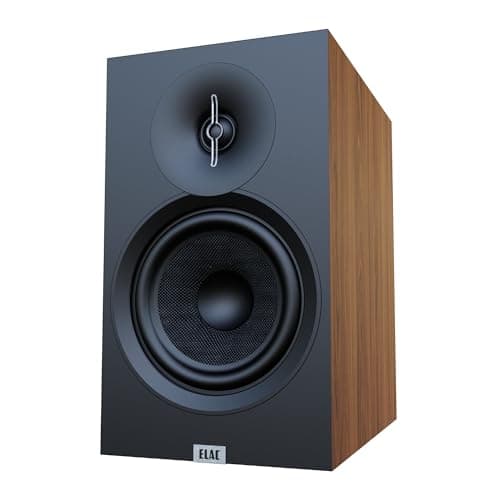
Top pick: ELAC Debut 3.0 DB63
Best overall under $500. #ad Affiliate link — we earn a commission at no extra cost to you.
The short answer
The best alternative to a Klipsch bookshelf speaker is the ELAC Debut 3.0 DB63 — because it is the same shape of speaker (a 6.5-inch two-way in a 13-inch cabinet) and it publishes the three things Klipsch does not: a measured nominal impedance of 6 Ω that its product page and owner’s manual agree on, a recommended amplifier rangeof 20 to 140 W rather than a power handling limit, and a bass figure at −3 dB rather than only at the flattering tolerance. It is for the reader who liked the Klipsch RP-600M II and wants the same job done by a dome tweeter with better paperwork. The budget pick is the Polk Signature Elite ES15 — the cheapest speaker here and the one with the gentlest amplifier requirement at 20 to 100 W per channel. Its cost is stated below: Polk publishes its 88 dB sensitivity with no measurement condition at all, which is the same documentation gap people leave Klipsch over.
If efficiency is the reason you were looking at Klipsch, the answer on this page is the Polk Monitor XT70 — 89 dB published at the harder 1 W / 1 m condition rather than at 2.83 V. If data is the reason you are leaving, the answer is the KEF Q3 Meta, the only speaker here that publishes a harmonic distortion figure with its measurement condition. No Klipsch model we cover publishes distortion at any price.
Disclosure: we earn a commission if you buy through the links on this page, at no extra cost to you. It does not influence what we pick — our criteria are published and reproducible, so you can check our work. How we pick · Full disclosure
These picks are spec-and-price analyses, not listening tests. We have not heard this gear and we do not pretend to have: every figure below is sourced to the manufacturer and linked, and every price is live or not shown at all. Here are the rules we followed.
Quick picks
Ranked on the published criteria in How We Pick. Prices are live as of November 23, 2026. Tap any row for the full write-up.
- 8.5
- 7.8$289.00View on Amazon
$349.0017% off
- 8.0
- 7.0$239.00View on Amazon
$299.0020% off
- 8.3
| # | Product | Best for | Score | Price |
|---|---|---|---|---|
| 1 | ELAC Debut 3.0 DB63 The Debut 3.0 generation of the same 6.5-inch design, and the first ELAC bookshelf we cover that publishes both a response tolerance and a recommended amplifier range — so the match can be finished rather than estimated. | Best overall under $500 | 8.5 | |
| 2 | 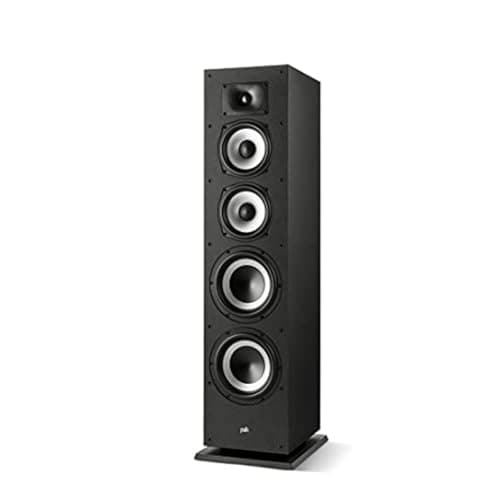 Polk Monitor XT70 Two 6.5 in woofers, two 8 in passive radiators and a 25–200 W recommendation from a maker that tells you what to drive it with — then declines to say what impedance it presents or how the bass figure was measured. | Best published amplifier range | 7.8 | $289.00View on Amazon $349.0017% off |
| 3 | 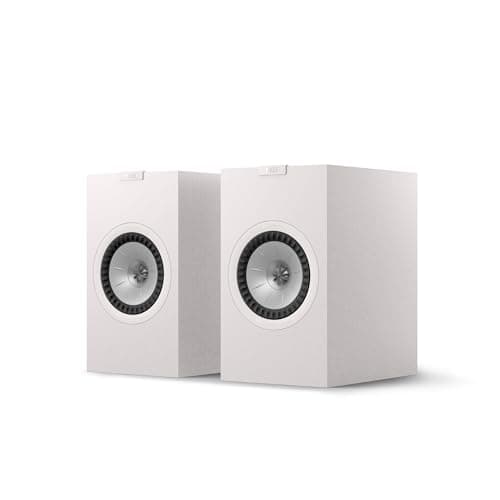 KEF Q3 Meta KEF's coaxial Uni-Q driver puts the tweeter at the woofer's acoustic center, and the Meta generation adds a metamaterial absorber behind it — both are engineering changes rather than finish upgrades. | Best imaging design | 8.0 | |
| 4 | 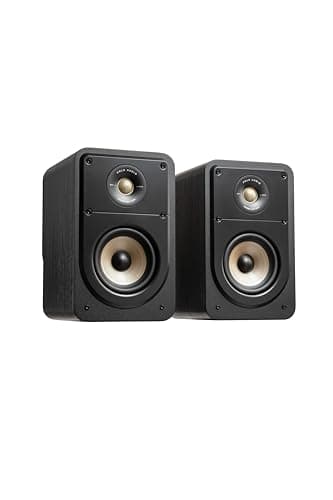 Polk Signature Elite ES15 Voiced and certified to sit in a surround system as easily as a stereo pair, which matters if this room has to do both jobs. | Best for double duty with home theater | 7.0 | $239.00View on Amazon $299.0020% off |
| 5 | 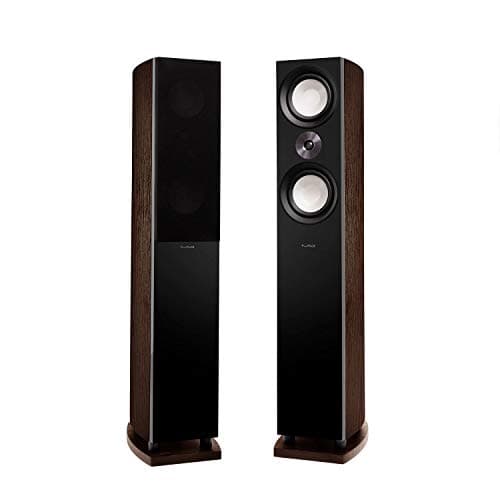 Fluance XL8F Reference The only genuine three-way here, with a dedicated down-firing 8 in woofer and a published 100 Hz crossover — and the price on the listing already buys two of them. | Best true pair price | 8.3 |
Klipsch is the most searched-around brand in this category, and the searches split cleanly in two. One group wants the efficiency — the ability to go loud on a small amplifier — without the horn-loaded tweeter’s presentation. The other group has read a Klipsch spec sheet closely and noticed what is missing from it.
Both are legitimate and this page answers both, so it is worth saying plainly what we are and are not claiming. We have not measured any of these speakers and we are not going to tell you a dome tweeter sounds smoother than a horn, because that is a preference, not a finding. What we can do is put each Klipsch model’s own published figures beside the alternatives and show exactly where the substitution is honest and where it is not. Our Klipsch brand ladder ranks the nine Klipsch products we stock, if you have landed here by accident and want the Klipsch case made properly.
What Klipsch publishes, and what it leaves out
Across the nine Klipsch models in our registry the pattern is consistent. Sensitivity is high and published at 2.83 V / 1 m: 96 dB for the R-620F and RP-6000F II, 95 dB for the R-52C, 94.5 dB for the RP-600M II, 94 dB for the R-610F, 93 dB for the R-51M. Impedance is given as 8 Ω “compatible” — Klipsch’s own wording, not a measured nominal figure — on every single model. Minimum impedance is published on none of them. Harmonic distortion is published on none of them. And where Polk, KEF, ELAC and JBL all publish a recommended amplifier range, every Klipsch sheet publishes power handling instead, which answers a different question.
The two Reference Premiere sheets also add a footnote the Reference sheets do not: “SPL at 1 M, half-space anechoic with 2.83 V input.” Half-space means the measurement was taken against a boundary. Klipsch does not publish the free-space equivalent and we are not going to invent a correction factor for it — but it does mean two Klipsch numbers from two Klipsch product lines are not strictly comparable with each other, let alone with anyone else’s.
The alternatives, on the figures Klipsch is quiet about
The last column is the point of this page. Four of the five alternatives publish no distortion figure either — those em dashes are honest gaps, not oversights — but one does, with its measurement condition attached, and no Klipsch model at any price does. The third column is the other point: four of these five publish a recommended amplifier range, which is advice. Every Klipsch sheet publishes a handling limit, which is a warning.
Every figure below is the manufacturer’s own published value and links to the document we read it from. “Not published” means the manufacturer does not publish that figure; an em dash means we have no published figure for that model. Prices are live as of November 23, 2026.
Best overall under $500
- Sensitivity, with its condition
- 87 dB · 2.83 V / 1 m
- Impedance (what Klipsch will not state)
- 6 Ω — page and manual agree
- Amplifier figure
- 20–140 W recommended
- Distortion published?
- —
Best published amplifier range
- Sensitivity, with its condition
- 89 dB · 1 W / 1 m
- Impedance (what Klipsch will not state)
- “4- and 8-ohm compatible”
- Amplifier figure
- 25–200 W recommended
- Distortion published?
- —
Best imaging design
- Sensitivity, with its condition
- 87 dB · 2.83 V / 1 m
- Impedance (what Klipsch will not state)
- 4 Ω nominal, 3.2 Ω minimum
- Amplifier figure
- 15–150 W recommended
- Distortion published?
- < 1% 135 Hz–20 kHz at 90 dB / 1 m
Best for double duty with home theater
- Sensitivity, with its condition
- 88 dB · no condition stated
- Impedance (what Klipsch will not state)
- “4- and 8-ohm compatible”
- Amplifier figure
- 20–100 W recommended
- Distortion published?
- —
Best true pair price
- Sensitivity, with its condition
- 87 dB · 1 W / 1 m
- Impedance (what Klipsch will not state)
- “8 Ohm Compatible”
- Amplifier figure
- 80–160 W RMS handling
- Distortion published?
- —
| Pick | Sensitivity, with its condition | Impedance (what Klipsch will not state) | Amplifier figure | Distortion published? | Price |
|---|---|---|---|---|---|
| 1.ELAC Debut 3.0 DB63Best overall under $500 | 87 dB · 2.83 V / 1 m | 6 Ω — page and manual agree | 20–140 W recommended | — | |
| 2.Polk Monitor XT70Best published amplifier range | 89 dB · 1 W / 1 m | “4- and 8-ohm compatible” | 25–200 W recommended | — | |
| 3.KEF Q3 MetaBest imaging design | 87 dB · 2.83 V / 1 m | 4 Ω nominal, 3.2 Ω minimum | 15–150 W recommended | < 1% 135 Hz–20 kHz at 90 dB / 1 m | |
| 4.Polk Signature Elite ES15Best for double duty with home theater | 88 dB · no condition stated | “4- and 8-ohm compatible” | 20–100 W recommended | — | |
| 5.Fluance XL8F ReferenceBest true pair price | 87 dB · 1 W / 1 m | “8 Ohm Compatible” | 80–160 W RMS handling | — |
Prices as of November 23, 2026; every “Check Price” link goes to Amazon and earns us a commission at no extra cost to you. #ad
If you wanted the efficiency: what the gap really costs
The honest version of the efficiency question is not “how many decibels” but “how many watts.” Klipsch’s R-620F publishes 96 dB at 2.83 V / 1 m with no half-space footnote; the Polk Monitor XT70 publishes 89 dB at the harder 1 W / 1 m condition. If you take Klipsch’s 8 Ω compatibility wording at face value, 2.83 V into 8 Ω is one watt, and those two figures are the closest thing to a like-for-like comparison this field offers.
Power ratio = 10^(ΔdB ÷ 10)
Inputs
- Klipsch R-620F sensitivity: 96 dB (2.83 V / 1 m), 8 Ω “compatible” (Klipsch spec sheet (PDF))
- Polk Monitor XT70 sensitivity: 89 dB at “1 watt @ 1 meter” (Polk product page)
Result
The five, and who each is for
1. ELAC Debut 3.0 DB63— for the reader cross-shopping the RP-600M II. Same category, same driver size, better paperwork: 6 Ω nominal published identically in two ELAC documents, 20 to 140 W recommended, a 2 kHz crossover, a 6.5-inch aramid-fiber woofer, a 1-inch aluminum dome, a dual flared frontport, and CARB2-rated 16 mm MDF with five-way binding posts. It publishes its bass twice — 42 Hz at −6 dB on the product page, 50 Hz at −3 dB in the manual — and it publishes a power handling conflict between those same two documents (120 W peak against 60 W nominal / 80 W peak) which we report rather than resolve. Plan to the lower pair. What you give up against the Klipsch is about 7 dB of published sensitivity and the dual binding posts.
2. Polk Monitor XT70— for the reader cross-shopping a Klipsch tower who wants the efficiency figure published honestly. 89 dB at 1 W / 1 m, 25 to 200 W recommended, two 6.5-inch bi-laminate woofers plus two 8-inch passive radiators, a 2.7 kHz crossover and a 1-inch Terylene dome. Polk also matches Klipsch’s weakness here rather than fixing it: no nominal impedance, and a 35 Hz bass figure with no tolerance window. It is sold as a single cabinet, exactly as the Klipsch towers are.
3. KEF Q3 Meta— for the reader whose objection is the spec sheet. It publishes harmonic distortion with the condition attached (under 2% above 110 Hz, under 1% from 135 Hz to 20 kHz, measured at 90 dB at one meter), a maximum output of 109 dB, a 4 Ω nominal impedance anda 3.2 Ω minimum, a 15 to 150 W recommendation, a 49 Hz ± 3 dB response alongside the softer 42 Hz −6 dB figure, and a 2 kHz crossover on a Uni-Q array with the tweeter at the midrange’s acoustic center. That is the most completely documented bookshelf speaker we stock. The honest warning: a 4 Ω nominal with a 3.2 Ω minimum is a harder load than anything Klipsch sells, so check your amplifier before you treat this as a drop-in.
4. Polk Signature Elite ES15— the budget pick, and the easiest amplifier match on the page at 20 to 100 W recommended. A 5.25-inch mica-fortified polypropylene woofer, a 1-inch Terylene dome, a 2.5 kHz crossover, 48 Hz of reach and 13 lb per cabinet. It is the cheapest way off Klipsch without dropping to a 4-inch woofer, and it comes with the same caveat as every Polk: an 88 dB sensitivity figure with no measurement condition, no nominal impedance, and no tolerance window on the bass number.
5. Fluance XL8F Reference— for the reader comparing against the RP-6000F II or R-620F on price per pair. It is a genuine three-way with an isolated down-firing 8-inch bass driver crossed over at 100 Hz, dual 6.5-inch woven glass-fibre midranges, a ferrofluid-cooled silk dome, 47.7 lb per cabinet — and Fluance sells it as a matched pair where the Klipsch R-620F listing is one speaker. Its 87 dB sensitivity is stated at the harder 1 W / 1 m condition. Against it: “8 Ohm Compatible” rather than a nominal figure, 80 to 160 W RMS as handling rather than advice, and a 35 Hz bass claim with no tolerance window.
Where the substitution does not work
Two cases, stated plainly, because an alternatives page that pretends the original has no advantages is an advertisement for something else.
If your amplifier is a 10 or 20 watt valve or Class-D box, nothing on this page replaces a Klipsch. The arithmetic above is the reason: a five-times power deficit is not something a better crossover makes up. Buy the Klipsch, or buy a bigger amplifier — our high-sensitivity bookshelf roundup exists for exactly that constraint and three of its four picks are Klipsch for exactly this reason.
And if what you want is a center channel, there is no alternative here at all. The Klipsch R-52C is the only center channel in our registry, it publishes 95 dB at 2.83 V / 1 m and an 89 Hz ± 3 dB lower limit in a sealed cabinet, and we are not going to pad this page with a bookshelf speaker laid on its side. Whether you need one at all is the more useful question.
Every pick in detail
Every specification below links to the manufacturer document we read it from. Where a manufacturer does not publish a figure, we say so rather than estimating it.
ELAC Debut 3.0 DB63
Best overall under $500Price as of November 23, 2026. #ad
The Debut 3.0 generation of the same 6.5-inch design, and the first ELAC bookshelf we cover that publishes both a response tolerance and a recommended amplifier range — so the match can be finished rather than estimated.
- published data
- 9/10
- sensitivity
- 6/10
- bass extension
- 8/10
- amp friendliness
- 6/10
- value for money
- 8/10
| Specification | Published value | Source |
|---|---|---|
| Design | 2-way, bass reflex, dual flared front port | ELAC spec page |
| Sensitivity | 87 dB (2.83 V / 1 m) | ELAC spec page |
| Impedance | 6 Ω (product page and owner's manual agree, which they do not for the DF-series towers) | ELAC owner's manual (PDF) |
| Minimum impedance | Not published | — |
| Frequency response (−3 dB) | 50 Hz – 34 kHz — published in the owner's manual only, 8 Hz above the headline figure | ELAC owner's manual (PDF) |
| Frequency response (−6 dB) | 42 Hz – 38 kHz (the figure ELAC's product page leads with) | ELAC spec page |
| Recommended amplifier power | 20 – 140 W | ELAC spec page |
| Power handling | Product page: 120 W peak. Owner's manual: 60 W nominal / 80 W peak. Two ELAC documents, two answers — plan to the lower pair. | ELAC owner's manual (PDF) |
| Woofer | 6.5 in aramid-fiber cone | ELAC spec page |
| Tweeter | 1 in aluminum dome (the B6.2's was cloth) | ELAC spec page |
| Crossover | 2,000 Hz | ELAC spec page |
| Enclosure | CARB2-rated 16 mm MDF, 5-way metal binding posts | ELAC spec page |
| Dimensions (H × W × D) | 13.3 × 7.7 × 11.7 in (339 × 195 × 298 mm) | ELAC spec page |
| Weight (each) | 17.3 lb / 7.85 kg | ELAC spec page |
Pros
- ELAC publishes a tolerance for this generation: 50 Hz – 34 kHz at −3 dB in the owner's manual, beside the 42 Hz – 38 kHz the product page leads with at −6 dB
- A published recommended amplifier range, 20 – 140 W — the Debut 2.0 generation published only a handling limit, which is a different spec
- Same 87 dB at 2.83 V / 1 m and same 6 Ω as the B6.2, and both ELAC documents agree on the impedance, so every power calculation on this site carries over unchanged
- Front-firing dual flared port, so it tolerates being near a wall better than a rear-ported box
Cons
- The 42 Hz headline is a −6 dB figure. At −3 dB ELAC's own manual says 50 Hz, and only the manual says it
- Still no minimum impedance published, so you cannot see where the load actually dips
- ELAC's two documents disagree on power handling: 120 W peak on the product page, 60 W nominal / 80 W peak in the manual
- Bigger and heavier than the B6.2 it follows — 17.3 lb and 13.3 in tall, which is a lot of 'bookshelf'
Skip it if your amplifier is a low-power desktop unit. At 87 dB into 6 Ω this asks for the same real current the B6.2 did — run the power arithmetic on our amp-matching guide first.
Polk Monitor XT70
Best published amplifier rangeTwo 6.5 in woofers, two 8 in passive radiators and a 25–200 W recommendation from a maker that tells you what to drive it with — then declines to say what impedance it presents or how the bass figure was measured.
- sensitivity
- 6/10
- published data
- 5/10
- bass extension
- 9/10
- amp friendliness
- 7/10
- value for money
- 8/10
| Specification | Published value | Source |
|---|---|---|
| Sensitivity | 89 dB, published by Polk at “1 watt @ 1 meter” — NOT at 2.83 V, so it is not directly comparable to the Klipsch and Jamo figures on this page | Polk product page |
| Impedance | “Compatible with 4- and 8-ohm outputs” — Polk publishes no nominal impedance figure for this speaker | Polk info sheet (PDF) |
| Minimum impedance | Not published | — |
| Frequency response | 35 Hz – 40 kHz, quoted with NO tolerance window — the deepest published figure on this page and the one with the least to back it | Polk info sheet (PDF) |
| Recommended amplification | 25 – 200 W per channel | Polk info sheet (PDF) |
| Woofers | 2 × 6.5 in bi-laminate paper | Polk info sheet (PDF) |
| Bass radiators | 2 × 8 in passive radiators — Polk's feature list claims “deep effortless bass below 35 Hz” | Polk info sheet (PDF) |
| Tweeter | 1 in Terylene dome | Polk info sheet (PDF) |
| Crossover | 2,700 Hz | Polk info sheet (PDF) |
| Input terminals | 5-way nickel-plated binding posts | Polk info sheet (PDF) |
| Passive radiator firing direction | Not published | — |
| Dimensions (H × W × D) | 40.4 × 9.25 × 12.5 in (1,026.6 × 235 × 317.9 mm) | Polk info sheet (PDF) |
| Weight (each) | 35 lb / 15.88 kg | Polk info sheet (PDF) |
| Sold as | One speaker — Polk's Amazon listing is labelled “Single”. A stereo pair is two purchases. | Polk product page |
Pros
- Polk publishes a recommended amplification range (25 – 200 W per channel); Klipsch and Jamo publish handling limits instead
- Dual 8 in passive radiators — the largest radiating area for bass on this page
- 35 Hz is the deepest published low-frequency figure in the bracket
- 9.25 in wide and 40.4 in tall, so it disappears into a room better than its driver count suggests
Cons
- The 89 dB sensitivity is published at 1 watt, not 2.83 V, so it cannot be compared like-for-like with the Klipsch and Jamo numbers
- “Compatible with 4- and 8-ohm outputs” is not a nominal impedance, and no minimum is published
- 35 Hz – 40 kHz carries no tolerance, so the endpoints are unfalsifiable
- Polk never says which face the passive radiators are on, which is the one fact you need to place a radiator-loaded cabinet
- The Amazon listing is one speaker, not a pair
Skip it if you need to know exactly how close to the wall it can go. Polk does not publish the radiator orientation, and we will not guess it.
KEF Q3 Meta
Best imaging designPrice as of November 23, 2026. #ad
KEF's coaxial Uni-Q driver puts the tweeter at the woofer's acoustic center, and the Meta generation adds a metamaterial absorber behind it — both are engineering changes rather than finish upgrades.
- sensitivity
- 7/10
- bass extension
- 9/10
- amp friendliness
- 5/10
- value for money
- 7/10
- build quality
- 9/10
| Specification | Published value | Source |
|---|---|---|
| Sensitivity | 87 dB (2.83 V / 1 m) | KEF spec page |
| Impedance (nominal) | 4 Ω | KEF spec page |
| Minimum impedance | 3.2 Ω | KEF spec page |
| Frequency response | 49 Hz – 20 kHz (± 3 dB); 42 Hz – 20 kHz at −6 dB | KEF spec page |
| Amplifier requirements | 15–150 W | KEF spec page |
| Driver | Uni-Q array: 165 mm (6.5 in) aluminum cone with a 25 mm (1 in) vented aluminum dome and MAT at its acoustic center | KEF spec page |
| Crossover | 2.0 kHz | KEF spec page |
| Harmonic distortion | < 2% at 110 Hz and above; < 1% from 135 Hz – 20 kHz (measured at 90 dB, 1 m) | KEF spec page |
| Maximum output | 109 dB | KEF spec page |
| Dimensions (H × W × D) | 357 × 210 × 305 mm (14.1 × 8.3 × 12.0 in) | KEF spec page |
| Weight (each) | 8.2 kg / 18.1 lb | KEF spec page |
Pros
- Uni-Q coaxial driver — a real design difference, not a trim level
- Publishes both a nominal (4 Ω) and a minimum (3.2 Ω) impedance, plus a harmonic-distortion figure with its measurement condition — almost nobody publishes the last one
- 165 mm driver and a 42 Hz −6 dB figure, the deepest published extension of any bookshelf pair here
Cons
- Well above the $500 bracket at its current price
- 4 Ω nominal dipping to 3.2 Ω — this is a genuinely demanding load, not a nominal-8 Ω speaker that occasionally dips
- 18.1 lb and 12 in deep per speaker, which is a stand rather than a shelf
Skip it if your amplifier does not state a 4 Ω rating. The Q3 Meta is nominally 4 Ω before it dips, which is the hardest load in this registry.
Polk Signature Elite ES15
Best for double duty with home theaterVoiced and certified to sit in a surround system as easily as a stereo pair, which matters if this room has to do both jobs.
- sensitivity
- 7/10
- bass extension
- 7/10
- amp friendliness
- 7/10
- value for money
- 7/10
- build quality
- 7/10
| Specification | Published value | Source |
|---|---|---|
| Sensitivity | 88 dB — Polk publishes NO measurement condition (no 2.83 V/1 m or 1 W/1 m qualifier), so this figure is not directly comparable to the others in this table | Polk info sheet (PDF) |
| Impedance | “Compatible with 4- and 8-ohm outputs” — Polk publishes no nominal impedance value | Polk info sheet (PDF) |
| Minimum impedance | Not published | — |
| Frequency response | 48 Hz – 40 kHz (no tolerance published) | Polk info sheet (PDF) |
| Recommended amplification | 20–100 W per channel | Polk info sheet (PDF) |
| Woofer | 5.25 in mica-fortified polypropylene | Polk info sheet (PDF) |
| Tweeter | 1 in Terylene dome | Polk info sheet (PDF) |
| Crossover | 2.5 kHz | Polk info sheet (PDF) |
| Weight (each) | 13 lb / 5.9 kg | Polk info sheet (PDF) |
Pros
- Designed to integrate with a matching surround range
- Hi-Res certified
- Keyhole mount for wall use
Cons
- Less distinctive than the ELAC or Klipsch at the price
- Rear port
- Not the best pure-stereo value here
Skip it if this is a stereo-only system — the ELAC B6.2 gives more for the money.
Fluance XL8F Reference
Best true pair pricePrice as of November 23, 2026. #ad
The only genuine three-way here, with a dedicated down-firing 8 in woofer and a published 100 Hz crossover — and the price on the listing already buys two of them.
- sensitivity
- 5/10
- published data
- 7/10
- bass extension
- 9/10
- amp friendliness
- 5/10
- value for money
- 10/10
| Specification | Published value | Source |
|---|---|---|
| Sensitivity | 87 dB @ 1 W / 1 m — Fluance states the condition, and it is the 1-watt condition, not 2.83 V | Fluance spec list |
| Impedance | “8 Ohm Compatible” (Fluance's wording — not a measured nominal figure) | Fluance spec list |
| Minimum impedance | Not published | — |
| Frequency response | 35 Hz – 25 kHz, quoted with no tolerance window | Fluance spec list |
| Power handling | 80 – 160 W RMS | Fluance spec list |
| Tweeter | 1 in neodymium balanced silk dome, ferrofluid cooled | Fluance spec list |
| Midrange | Dual 6.5 in woven glass fiber composite with butyl rubber surrounds | Fluance spec list |
| Woofer | Isolated down-firing 8 in polymer-treated high-excursion driver — the only dedicated bass driver on this page | Fluance spec list |
| Crossover | 100 Hz / 3,000 Hz — a genuine three-way, and the only published low crossover point here | Fluance spec list |
| Enclosure | Tuned rear dual-port bass reflex tower, dampened | Fluance spec list |
| Dimensions (H × W × D) | 45.86 × 9.25 × 12.99 in (116.5 × 23.5 × 33 cm) | Fluance spec list |
| Weight (each) | 47.7 lb / 21.64 kg — the heaviest cabinet on this page by 12 lb | Fluance spec list |
| Sold as | A matched pair. One purchase puts two speakers in the room. | Fluance product page |
Pros
- Sold as a matched pair, so the listed price is the price of a stereo system's front end
- A real three-way: 1 in silk dome, dual 6.5 in midranges and an isolated 8 in down-firing woofer
- Publishes both crossover points (100 Hz and 3,000 Hz), which nobody else on this page does
- 47.7 lb per cabinet — the heaviest and most inert box here by a wide margin
Cons
- 87 dB at 1 W / 1 m is the lowest published sensitivity on this page, so it wants the most amplifier power
- 35 Hz – 25 kHz is published with no tolerance window, which makes the 35 Hz endpoint unverifiable
- 45.86 in tall and 12.99 in deep — physically the largest thing here, and it looks it
- Rear dual ports, so it needs wall clearance despite the down-firing woofer
Skip it if your amplifier is a low-power tube or Class A design. Of everything here this is the one that most wants watts.
Frequently asked questions
What is the best alternative to Klipsch speakers?
Why do people look for Klipsch alternatives?
Are there high-sensitivity speakers that are not Klipsch?
Does any speaker publish the distortion data Klipsch leaves out?
Is Jamo a Klipsch alternative?
Read next
The Best Klipsch Speakers
Nine Klipsch speakers across five categories, ranked on Klipsch's own spec sheets — including the sensitivity footnote that only some of those sheets carry.
The Best Bookshelf Speakers
The head of our bookshelf cluster: eight speakers from $179 to $2,500, with every sensitivity figure converted to the same 1 W / 1 m condition so the field can be compared at all.
The Best High-Sensitivity Bookshelf Speakers
The speakers that make a small amplifier sound big, ranked on published sensitivity and the condition each figure was measured under.
Klipsch R-51M vs Polk Monitor XT15
Klipsch for a low-powered amplifier or a 5.1 system; Polk if the budget is the constraint. The tie-breaker is which specification each maker chose to publish.
Speaker Sensitivity Explained
2.83 V/1 m versus 1 W/1 m, what the conversion is worth in decibels, and the twelve-decibel spread that means sixteen times the power.
The Best Floorstanding Speakers
The head of our floorstanding cluster: six towers from the narrowest $200-class cabinet to a three-way at $1,000, ranked on published bass tolerance, cone area, amplifier spec and how many speakers the listing actually ships.
Sources
Every specification on this page was read from one of these documents. If one of them has changed, or we have made an error, tell us — corrections are logged and dated per our editorial policy.
- Klipsch R-620F spec sheet (PDF)
- Klipsch RP-600M II spec sheet (PDF)
- ELAC Debut 3.0 DB63 specifications
- ELAC Debut 3.0 owner's manual (PDF)
- KEF Q3 Meta specifications
- Polk Monitor XT60 / XT70 info sheet (PDF)
- Polk Signature Elite ES15 / ES20 info sheet (PDF)
- Fluance Reference three-way floorstanding specifications