The Best Floorstanding Speakers Under $2,000
One speaker here publishes 46 Hz, 39 Hz and 28 Hz — all three from the same manufacturer, about the same cabinet. Nothing changed but the measurement condition, and that is the whole problem with this bracket.
Disclosure: we earn a commission if you buy through the links on this page, at no extra cost to you. It does not influence what we pick — our criteria are published and reproducible, so you can check our work. How we pick · Full disclosure
These picks are spec-and-price analyses, not listening tests. We have not heard this gear and we do not pretend to have: every figure below is sourced to the manufacturer and linked, and every price is live or not shown at all. Here are the rules we followed.
Quick picks
Ranked on the published criteria in How We Pick. Prices are live as of September 15, 2026. Tap any row for the full write-up.
- 8.5
- 8.4
- 8.0
- 7.8$529.95View on Amazon
$659.9520% off
- 7.5
| # | Product | Best for | Score | Price |
|---|---|---|---|---|
| 1 | 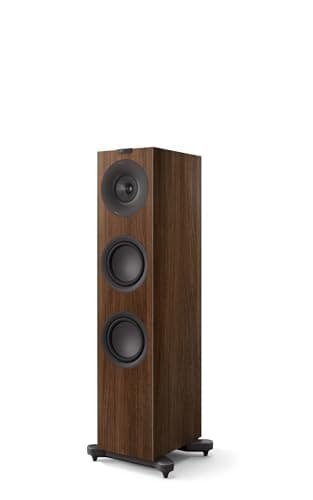 KEF Q7 Meta The only speaker in this bracket whose maker publishes a minimum impedance, and the only one that prints its bass figure at three different conventions so you can see what each is worth. | Best documented | 8.5 | |
| 2 | 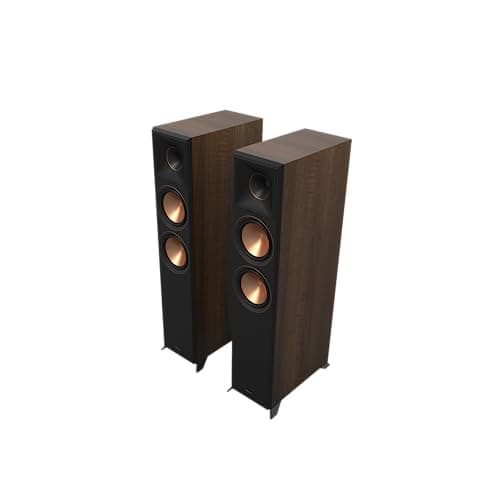 Klipsch RP-6000F II The only pair listing in the bracket and the easiest load in it — with a 96 dB sensitivity figure that carries Klipsch's own half-space asterisk, which is worth reading before you compare it to anything. | Best for a modest amplifier | 8.4 | |
| 3 | 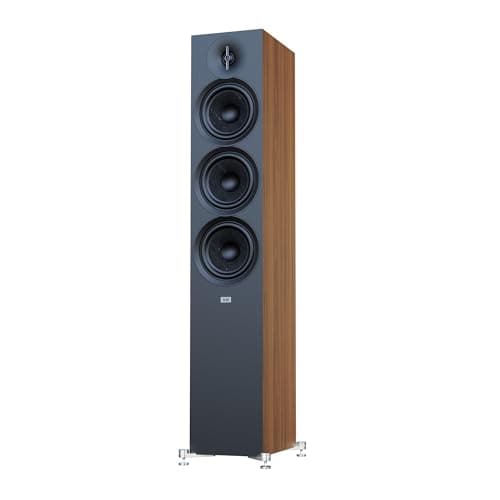 ELAC Debut 3.0 DF63 A genuine three-way with a 6.5-inch driver that does nothing but midrange, published crossover points either side of it — and two ELAC documents that disagree about what impedance it presents. | Best three-way for the money | 8.0 | |
| 4 | 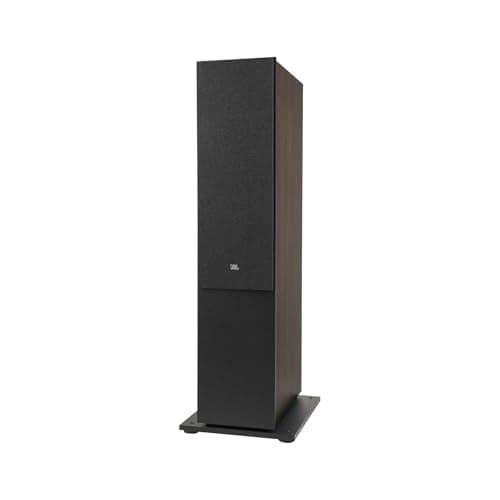 JBL Stage 2 280F Dual 8-inch woofers and a dedicated set of Atmos binding posts — the most air-moving capability in the bracket, published at a tolerance loose enough that its bass figure cannot be compared with anyone else's. | Most cone area | 7.8 | $529.95View on Amazon $659.9520% off |
| 5 | 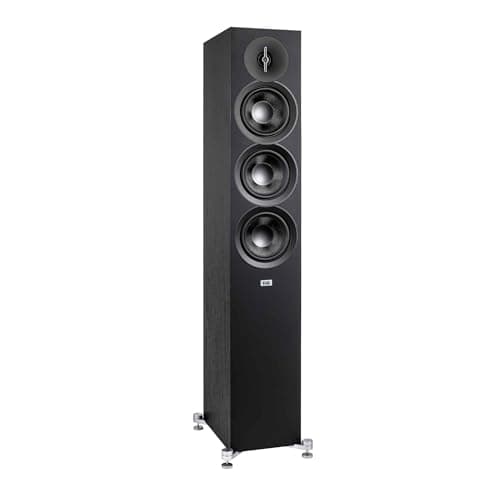 ELAC Debut 3.0 DF53 The same three-way architecture as the DF63 one size down and 6.8 inches wide — and the speaker on this page whose headline bass figure moves furthest once you read ELAC's own stricter measurement. | Narrowest three-way | 7.5 |
Spend the second thousand dollars and the specifications get better-looking and harder to compare at the same time. Every speaker below publishes a low-frequency limit. They are quoted at four different measurement conditions, and the difference between the loosest and the strictest is worth more than the difference between the speakers.
The bracket rule is the same one our under-$1,000 floorstanding roundup uses, and it is not the usual one: “under $2,000” here means a stereo pair under $2,000. Four of the five listings below sell a single cabinet. One sells a pair. That page ranks on which listing sells you two speakers, on the sensitivity measurement condition, and on where the port fires. This one starts where that page stops, because at this price the bass figures are the thing being oversold.
We have not heard any of these speakers and nothing here describes how they sound. Every figure is a published manufacturer number with the document it was read from linked beside it, read on 15 September 2026.
How we ranked these
The rubric is the published one on how we pick. For this bracket, applied in this order:
- What tolerance the bass figure is quoted at — and what that figure becomes once every speaker is put on the same footing. Not whether a tolerance exists, which is the sub-$1,000 question, but which one.
- Whether anything only does midrange. A three-way has a driver that handles voices and nothing else. Three of these have one; one does not; one splits the difference. The published crossover points are how you check rather than trust.
- What the speaker asks of an amplifier — including the minimum. Nominal impedance is an average. Minimum impedance is what your amplifier survives, and exactly one maker here publishes it.
- Whether the maker’s own documents agree with each other. One of them does not, on two separate rows, and the disagreement is material.
- Placement and footprint. Every one of these is rear-ported, so the depth on the spec sheet is not the depth in the room.
1. A bass figure is a measurement condition, not a number
KEF settles this argument by itself, because it publishes three different low-frequency figures for the Q7 Meta and labels each one:
Same cabinet, same drivers — only the stated measurement condition changes
Inputs
- KEF Q7 Meta — Frequency response (± 3 dB): 46 Hz – 20 kHz (KEF spec page)
- KEF Q7 Meta — Frequency range (−6 dB): 39 Hz – 20 kHz (KEF spec page)
- KEF Q7 Meta — Typical in-room bass response (−6 dB): 28 Hz (KEF spec page)
Result
Now apply that to the rest of the bracket. The left column is what each maker leads with. The right column is the same speaker at its maker’s own 3 dB figure — every number below is published by the manufacturer, none is converted or estimated by us:
| Speaker | Headline figure | At the maker’s own 3 dB figure |
|---|---|---|
| Klipsch RP-6000F II | 38 Hz (± 3 dB) | 38 Hz — already quoted there |
| KEF Q7 Meta | 39 Hz (− 6 dB) | 46 Hz |
| ELAC Debut 3.0 DF63 | 31 Hz (− 6 dB) | 46 Hz — owner’s manual only |
| ELAC Debut 3.0 DF53 | 38 Hz (− 6 dB) | 58 Hz — owner’s manual only |
| JBL Stage 2 280F | 33 Hz (± 6 dB) | Not published at any 3 dB figure |
Read the left column and the ELAC DF63 is the deepest speaker in the bracket by 2 Hz. Read the right column and it is tied for second, fifteen hertz behind where its own product page implies, while the Klipsch — mid-pack on the headline numbers — is comfortably the deepest. Nothing about the speakers changed. Only the column did.
Two honest caveats about that table. A −3 dB figure and a ±3 dB figure are not quite the same statement, so the right-hand column is as close to a common footing as published data allows rather than a laboratory equivalence. And the JBL simply cannot be placed: JBL publishes no 3 dB figure for the 280F anywhere, so its 33 Hz sits alone and unrankable, which is a finding about JBL rather than about the speaker.
2. Does anything in the box only do midrange?
This is the engineering question the bracket actually turns on. A two-way asks one driver to cover bass and the entire midrange up to the tweeter. A three-way gives voices their own driver, sized for the job. Both are legitimate; they are different products, and the marketing word “three-way” is only worth something if the maker publishes the crossover points that prove it.
| Speaker | Design | Published crossover points | Dedicated midrange? |
|---|---|---|---|
| KEF Q7 Meta | Three-way bass reflex | 440 Hz, 2.3 kHz | Yes — 100 mm, inside the Uni-Q array |
| ELAC Debut 3.0 DF63 | 3-Way, Bass Reflex | 550 Hz, 2,000 Hz | Yes — 6.5 in aramid fiber |
| ELAC Debut 3.0 DF53 | 3-Way, Bass Reflex | 500 Hz, 2,100 Hz | Yes — 5.25 in aramid fiber |
| JBL Stage 2 280F | 2.5-way | 1.1 kHz, 2.1 kHz | Partly — one woofer rolls off early |
| Klipsch RP-6000F II | Two-way bass reflex | 1,770 Hz | No — the 6.5 in woofers cover it |
Three of the five publish two crossover frequencies, which is what a genuine three-way looks like on paper. The Klipsch publishes one, and says plainly that it is a two-way — no complaint there, it is simply a different design that spends its money on a horn and on sensitivity instead.
The KEF deserves a separate note. Its midrange and tweeter are not merely both present, they are concentric: the 19 mm dome sits at the acoustic center of the 100 mm midrange cone. That means the two drivers do not arrive at your ears at different times as you move off the listening axis, which is the specific failure a conventional vertical driver array has and the reason speaker placement matters as much as it does. Whether you can hear the difference in your room is a question we cannot answer without having heard them, and we have not.
3. What each one asks of your amplifier
Impedance is where this bracket gets demanding, and it is where the best-documented speaker turns out to be the most difficult one.
P = V² ÷ R, at a fixed 28.3 V (which is 100 W into 8 Ω)
Inputs
- Klipsch RP-6000F II — 8 Ω “compatible”: 28.3² ÷ 8 (Klipsch spec sheet (PDF))
- JBL Stage 2 280F — 6 Ω nominal: 28.3² ÷ 6 (JBL spec sheet (PDF))
- ELAC DF53 and DF63 — 4 Ω (owner's manual figure): 28.3² ÷ 4 (ELAC owner's manual (PDF))
- KEF Q7 Meta — 3.2 Ω published minimum: 28.3² ÷ 3.2 (KEF spec page)
Result
Sensitivity compounds this rather than offsetting it. The KEF publishes 87 dB and the ELACs 87.5 dB, both at 2.83 V into a meter; the JBL publishes 91 dB. So the three hardest loads here are also the three quietest speakers per volt, and the easiest load is the loudest. If your amplifier is fixed and modest, that correlation decides the purchase before anything else on this page does.
4. The asterisk on the biggest sensitivity number
Klipsch publishes 96 dB at 2.83 V/1 m for the RP-6000F II, which is the largest sensitivity figure in either floorstanding bracket. It carries an asterisk, and the footnote is on the same page of the same spec sheet: “SPL at 1 M, half-space anechoic with 2.83V input”.
A half-space measurement puts the speaker in an infinite baffle, so all the radiated energy goes forward into a hemisphere rather than spreading into a full sphere. The convention difference is conventionally taken as about 3 dB — the same footnote, and the same reasoning, that we worked through on the RP-600M II. Credit to Klipsch for printing it; they did not have to. But it means the 96 dB cannot be set against KEF’s 87 dB or JBL’s 91 dB as though all three were measured the same way, and none of the other four makers states which space they measured in at all.
The Klipsch is still the easiest speaker here to drive, by a wide margin — an 8-ohm load and a genuinely high-sensitivity horn design. The point is narrower than that: it is that the specific number 96 is not comparable to the specific number 87, and the gap between them is smaller than it looks.
5. When a manufacturer’s own two documents disagree
ELAC publishes the Debut 3.0 specifications in two places: the individual product pages, and a single owner’s manual covering the whole series. On two rows, for both floorstanders, they do not match.
| Row | ELAC product page | ELAC owner’s manual |
|---|---|---|
| Nominal impedance (DF53 and DF63) | 6 Ω | 4 Ω |
| Power handling (DF63) | 140 W peak | 100 W nominal / 150 W peak |
| Power handling (DF53) | 140 W peak | 80 W nominal / 130 W peak |
| Low-frequency figure | −6 dB only | −3 dB and −6 dB rows |
We are not able to tell you which is right, and we are not going to pretend otherwise. What we can say is which way to be wrong. Plan an amplifier for the 4-ohm figure. If the manual is correct you have specified correctly; if the product page is correct you have merely bought more amplifier than you needed. Doing it the other way round risks an amplifier that clips or protects on a load it was never chosen for.
It is also worth noticing what the manual reveals rather than contradicts. ELAC measured a −3 dB figure for these speakers and printed it — 46 Hz for the DF63, 58 Hz for the DF53 — and then led its product pages with the −6 dB number instead. That is not a contradiction, it is a choice about which number to put in front of a buyer, and it is the single most useful thing we found in this bracket.
Placement: the depth on the spec sheet is not the depth in the room
All five of these are rear-ported or rear-vented. None is sealed and none is front-ported, which means the published depth is a floor-space figure and not a clearance figure. The Klipsch is 17.57 in deep before you leave any room behind it; the JBL is 16.5 in deep and 14.1 in wide with its outrigger base fitted. Add the clearance a rear port needs and the real allocation is meaningfully larger than the cabinet — the trade is covered in ported vs sealed speakers.
KEF is the only maker here that ships an answer in the box: a port bung, which lets you stop the port when the speaker has to sit closer to a wall than the design intends. It costs bass extension and it is an honest trade rather than a fix. If your speakers genuinely cannot come out into the room, the front-ported option in this category sits one bracket down, on our under-$1,000 floorstanding page.
What to drive them with
Three of the five want real amplifier power and two of those also want 4-ohm capability. The practical filter is simple: look for an amplifier whose maker publishes a rating into 4 ohms rather than only into 8, because a manufacturer who will not state what happens into 4 ohms is telling you something.
The arithmetic that turns a sensitivity figure and a room size into an actual wattage requirement is worked through in will this amplifier drive my speakers? — and the reason 2.83 V and 1 W are not the same condition is in speaker sensitivity explained. For the Klipsch, almost any competent integrated will do. For the KEF, it is the one speaker on this site we would not pair with a low-power amplifier at all.
Is the second thousand dollars worth it?
Honestly: not always, and the specifications say so. The deepest ±3 dB figure in this bracket is 38 Hz, from the Klipsch. The deepest ±3 dB figure in the bracket below is also 38 Hz, from the Klipsch R-620F. On bass extension alone, measured at a comparable tolerance, the second thousand dollars buys nothing.
What it does buy is real, just not that: a driver that only handles midrange, cabinets that are braced and divided rather than simply boxed, bi-wire terminals, published minimum impedance in one case, and in the JBL’s case substantially more cone area than anything in the cheaper bracket. Those are worth money. A lower number on a marketing page is not.
And the alternative argument still stands: a good bookshelf pair plus a subwoofer puts the bass somewhere other than where the stereo image has to be, which is a thing no tower at any price can do. That case is made with numbers in bookshelf vs floorstanding speakers.
What we left out, and why
Five more towers were researched for this bracket and none of them is above. The Q Acoustics 3050i was on the shortlist and is not here because its listing now reads “Currently unavailable” with no price — it was in stock when we researched the bracket below, ten days earlier, which is a fair illustration of why we re-check availability on the day rather than trusting a prior list.
The Monitor Audio Bronze 200 has a live pair listing at the right price, but every product-page path we tried on monitoraudio.com returned a 404, so there was no manufacturer-hosted specification we could link — and a specification we cannot cite does not render on this site. The Wharfedale Diamond 12.4’s listing title states neither “Each” nor “Pair”, and in a bracket defined by pair pricing that is the one ambiguity we will not publish through. The Polk Reserve R500 is listed but returns no price. And the Klipsch R-605FA is in stock and good, but at its current price a pair clears $1,600 and it is an Atmos-elevation tower — a different question, deserving a different page.
Every pick in detail
Every specification below links to the manufacturer document we read it from. Where a manufacturer does not publish a figure, we say so rather than estimating it.
KEF Q7 Meta
Best documentedPrice as of September 15, 2026. #ad
The only speaker in this bracket whose maker publishes a minimum impedance, and the only one that prints its bass figure at three different conventions so you can see what each is worth.
- published data
- 10/10
- sensitivity
- 5/10
- bass extension
- 8/10
- amp friendliness
- 4/10
- value for money
- 7/10
| Specification | Published value | Source |
|---|---|---|
| Design | Three-way bass reflex | KEF spec page |
| Sensitivity | 87 dB (2.83 V / 1 m) | KEF spec page |
| Impedance (nominal) | 4 Ω | KEF spec page |
| Minimum impedance | 3.2 Ω — the only published minimum in this bracket | KEF spec page |
| Frequency response | 46 Hz – 20 kHz (± 3 dB) | KEF spec page |
| Frequency range | 39 Hz – 20 kHz (−6 dB) — KEF publishes both conventions for the same speaker, 7 Hz apart | KEF spec page |
| Typical in-room bass response | 28 Hz (−6 dB) — a third published figure, 18 Hz below the ± 3 dB one | KEF spec page |
| Amplifier requirements | 15 – 200 W | KEF spec page |
| Uni-Q driver array | HF: 19 mm (0.75 in) vented aluminum dome with MAT; MF: 100 mm (4 in) aluminum cone, mounted at the tweeter's acoustic center | KEF spec page |
| Bass units | 2 × 165 mm (6.5 in) hybrid aluminum cone | KEF spec page |
| Crossover | 440 Hz, 2.3 kHz | KEF spec page |
| Maximum SPL | 110 dB | KEF spec page |
| Enclosure | Bass reflex; a port bung is supplied as an accessory | KEF spec page |
| Dimensions (H × W × D) | 1,001 × 317 × 315 mm (39.4 × 12.5 × 12.4 in) | KEF spec page |
| Weight (each) | 18.4 kg / 40.6 lb | KEF spec page |
| Sold as | One speaker — KEF's Amazon listing is labelled “Each”. A stereo pair is two purchases. | KEF product page |
Pros
- Publishes 46 Hz (± 3 dB), 39 Hz (−6 dB) and 28 Hz in-room for the same speaker — the clearest disclosure on this site
- 3.2 Ω minimum impedance published; nobody else in either floorstanding bracket publishes one at all
- Uni-Q puts the 100 mm midrange and the 19 mm tweeter on one acoustic axis, so the two do not arrive at different times off-axis
- A genuine three-way with both crossover points published (440 Hz, 2.3 kHz)
- A port bung is in the box, which is the manufacturer's own answer to a wall-proximity problem
Cons
- 4 Ω nominal and 3.2 Ω minimum is the hardest amplifier load here — the disclosure is excellent and what it discloses is demanding
- 87 dB is the joint-lowest sensitivity on this page, so the hard load and the low sensitivity compound
- At its current price a pair lands essentially at the top of this bracket, leaving no budget for stands, cable or a subwoofer
- The listing is one speaker, so the real cost of stereo is double the number shown
- 12.4 in deep before you add port clearance behind it
Skip it if your amplifier has no published 4-ohm rating. KEF tells you exactly what it demands, and an amp that will not say what it does into 4 Ω is the wrong partner for it.
Klipsch RP-6000F II
Best for a modest amplifierPrice as of September 15, 2026. #ad
The only pair listing in the bracket and the easiest load in it — with a 96 dB sensitivity figure that carries Klipsch's own half-space asterisk, which is worth reading before you compare it to anything.
- published data
- 7/10
- sensitivity
- 9/10
- bass extension
- 8/10
- amp friendliness
- 10/10
- value for money
- 9/10
| Specification | Published value | Source |
|---|---|---|
| Design | Two-way bass reflex — no dedicated midrange driver | Klipsch spec sheet (PDF) |
| Sensitivity | 96 dB @ 2.83 V / 1 m, with Klipsch's own asterisk: “SPL at 1 M, half-space anechoic with 2.83V input” | Klipsch spec sheet (PDF) |
| Impedance | 8 Ω “compatible” (Klipsch's wording — not a measured nominal figure) | Klipsch spec sheet (PDF) |
| Minimum impedance | Not published | — |
| Frequency response | 38 Hz – 25 kHz ± 3 dB | Klipsch spec sheet (PDF) |
| Power handling | 125 W continuous / 500 W peak (a handling limit, not a recommended amplifier range) | Klipsch spec sheet (PDF) |
| Tweeter | 1 in titanium LTS vented tweeter on a hybrid cross-section expanded Tractrix horn | Klipsch spec sheet (PDF) |
| Woofers | Dual 6.5 in Cerametallic cone with Faraday rings | Klipsch spec sheet (PDF) |
| Crossover | 1,770 Hz | Klipsch spec sheet (PDF) |
| Enclosure | Internally braced MDF; bass reflex via dual-chamber rear-firing Tractrix ports | Klipsch spec sheet (PDF) |
| Input terminals | Dual binding posts — bi-wire and bi-amp capable | Klipsch spec sheet (PDF) |
| Dimensions (H × W × D) | 39.60 × 9.29 × 17.57 in (100.6 × 23.6 × 44.6 cm) | Klipsch spec sheet (PDF) |
| Weight (each) | 49.4 lb / 22.4 kg | Klipsch spec sheet (PDF) |
| Sold as | A pair — the Amazon listing is a two-speaker pack. The only pair listing in this bracket. | Klipsch product page |
Pros
- Sold as a pair, so the listed price is the price of a stereo front end
- 38 Hz – 25 kHz ± 3 dB — a real tolerance window on the deepest ± 3 dB figure in the bracket
- 8 Ω compatible and high sensitivity: the one speaker here a modest integrated amplifier will drive comfortably
- Dual binding posts for bi-wiring or bi-amping, which the ELACs and the KEF do not offer
- 125 W continuous handling and a divided, internally braced cabinet
Cons
- The 96 dB figure is footnoted “SPL at 1 M, half-space anechoic with 2.83V input” — a half-space measurement is conventionally about 3 dB optimistic against a free-space one, so it is NOT comparable to the KEF's or ELAC's numbers
- A two-way: the 6.5 in woofers cover midrange up to 1,770 Hz, where the ELACs and the KEF hand that band to a dedicated driver
- 17.57 in deep and 49.4 lb each — the deepest cabinet here before port clearance
- Rear-firing Tractrix ports need real space behind them
- Klipsch publishes no minimum impedance, and “8 ohms compatible” is not a measured nominal figure
Skip it if you are ranking on the headline sensitivity number. Read the asterisk first — it is the difference between a fair comparison and a wrong one.
ELAC Debut 3.0 DF63
Best three-way for the moneyPrice as of September 15, 2026. #ad
A genuine three-way with a 6.5-inch driver that does nothing but midrange, published crossover points either side of it — and two ELAC documents that disagree about what impedance it presents.
- published data
- 6/10
- sensitivity
- 5/10
- bass extension
- 8/10
- amp friendliness
- 5/10
- value for money
- 9/10
| Specification | Published value | Source |
|---|---|---|
| Design | 3-Way, Bass Reflex — a driver that does nothing but midrange | ELAC spec page |
| Sensitivity | 87.5 dB @ 2.83 V / 1 m | ELAC spec page |
| Impedance (nominal) | ELAC publishes two conflicting figures: 6 Ω on the product page, 4 Ω in the Debut 3.0 owner's manual. Plan an amplifier for 4 Ω — that is the harder load and the safe direction to be wrong in. | ELAC owner's manual (PDF) |
| Minimum impedance | Not published | — |
| Frequency response | 31 Hz – 38 kHz at −6 dB (the figure ELAC's product page leads with) | ELAC spec page |
| Frequency response (−3 dB) | 46 Hz – 34 kHz — published in the owner's manual only, 15 Hz above the headline figure | ELAC owner's manual (PDF) |
| Recommended amplifier power | 30 – 180 W | ELAC spec page |
| Power handling | Product page: 140 W peak. Owner's manual: 100 W nominal / 150 W peak. Another row where the two ELAC documents disagree. | ELAC owner's manual (PDF) |
| Tweeter | 1 in aluminum dome | ELAC spec page |
| Midrange | 6.5 in aramid fiber — a dedicated midrange, not a mid-woofer | ELAC spec page |
| Woofers | 2 × 6.5 in aramid fiber | ELAC spec page |
| Crossover | 550 Hz, 2,000 Hz — two published points, which is what a genuine three-way looks like on paper | ELAC spec page |
| Enclosure | CARB2-rated 16 mm MDF, dual flared ports | ELAC spec page |
| Input terminals | 5-way metal binding posts | ELAC spec page |
| Dimensions (H × W × D) | 43.1 × 7.7 × 10.6 in (1,094 × 195 × 268 mm) | ELAC spec page |
| Weight (each) | 38.8 lb / 17.6 kg | ELAC spec page |
| Sold as | One speaker — ELAC's Amazon listing is labelled “Each”. A stereo pair is two purchases. | ELAC product page |
Pros
- A true three-way at the bottom half of this bracket: 1 in dome, dedicated 6.5 in midrange, dual 6.5 in woofers
- Both crossover points published (550 Hz and 2,000 Hz), which is how you verify a three-way claim rather than trusting it
- 30 – 180 W recommended amplifier range, the widest published window here
- 5-way metal binding posts and a CARB2-rated 16 mm MDF cabinet
- 7.7 in wide — a narrow tower for the cone area it carries
Cons
- ELAC's product page says 6 Ω and ELAC's own owner's manual says 4 Ω. Both are ELAC documents and they do not agree; plan for 4 Ω
- The headline 31 Hz is a −6 dB figure. ELAC's manual publishes 46 Hz at −3 dB for the same speaker — a 15 Hz difference that only appears if you open the manual
- The two documents also disagree on power handling (140 W peak on the page, 100/150 W in the manual)
- 87.5 dB sensitivity, and ELAC publishes the identical figure for the smaller DF53
- The listing is one speaker, not a pair
Skip it if you need to know the impedance with certainty before choosing an amplifier. Until ELAC reconciles its own two documents, the honest planning figure is the harder one.
JBL Stage 2 280F
Most cone areaDual 8-inch woofers and a dedicated set of Atmos binding posts — the most air-moving capability in the bracket, published at a tolerance loose enough that its bass figure cannot be compared with anyone else's.
- published data
- 5/10
- sensitivity
- 7/10
- bass extension
- 8/10
- amp friendliness
- 7/10
- value for money
- 8/10
| Specification | Published value | Source |
|---|---|---|
| Design | 2.5-way floorstanding loudspeaker system | JBL spec sheet (PDF) |
| Sensitivity | 91 dB @ 1 m, 2.83 V | JBL spec sheet (PDF) |
| Impedance (nominal) | 6 Ω | JBL spec sheet (PDF) |
| Minimum impedance | Not published | — |
| Frequency response | 33 Hz – 25 kHz at ± 6 dB — JBL publishes no ± 3 dB figure for this model | JBL spec sheet (PDF) |
| Recommended amplifier power | 20 – 225 W | JBL spec sheet (PDF) |
| Tweeter | 1 in (25 mm) anodized aluminum on a Next Generation HDI waveguide | JBL spec sheet (PDF) |
| Woofers | Dual 8 in (200 mm) polycellulose ribbed cone — the largest cone area in this bracket | JBL spec sheet (PDF) |
| Crossover | 1.1 kHz / 2.1 kHz | JBL spec sheet (PDF) |
| Enclosure | Bass reflex via dual flared racetrack rear-firing tuned ports | JBL spec sheet (PDF) |
| Input terminals | 5-way binding posts, plus a dedicated second set for an Atmos height module (compatible with the JBL 240H) | JBL spec sheet (PDF) |
| Dimensions (H × W × D) | 43.8 × 14.1 × 16.5 in with the base (1,113 × 357 × 420 mm); 43.8 × 9.5 × 16.1 in without it | JBL spec sheet (PDF) |
| Weight (each) | 55.2 lb / 25.1 kg — the heaviest cabinet on this page | JBL spec sheet (PDF) |
| Sold as | One speaker — JBL's own spec sheet states “Shipping Units of Measure: Each”, and the Amazon listing is a single cabinet. | JBL spec sheet (PDF) |
Pros
- Dual 8 in woofers — substantially more cone area than any other speaker in either floorstanding bracket
- Both crossover points published (1.1 kHz and 2.1 kHz) for its 2.5-way arrangement
- A second, dedicated pair of binding posts for a JBL 240H Atmos height module, so the tower doubles as a height-channel base
- 91 dB sensitivity with the drive condition stated, and a 20 – 225 W recommended range
- JBL's spec sheet publishes dimensions both with and without the outrigger base, which almost nobody does
Cons
- 33 Hz is quoted at ± 6 dB and JBL publishes no ± 3 dB figure anywhere, so this is the one bass number on the page that cannot be put on a common footing
- 14.1 in wide with the base fitted and 55.2 lb each — physically the largest and heaviest thing here
- Rear-firing racetrack ports, so it needs clearance despite the size
- No minimum impedance published
- The listing is one speaker — JBL's own sheet says “Shipping Units of Measure: Each”
Skip it if the room is small. Dual 8 in woofers in a near-field room is more output capability than the space can use, and the footprint is real.
ELAC Debut 3.0 DF53
Narrowest three-wayPrice as of September 15, 2026. #ad
The same three-way architecture as the DF63 one size down and 6.8 inches wide — and the speaker on this page whose headline bass figure moves furthest once you read ELAC's own stricter measurement.
- published data
- 6/10
- sensitivity
- 5/10
- bass extension
- 5/10
- amp friendliness
- 5/10
- value for money
- 8/10
| Specification | Published value | Source |
|---|---|---|
| Design | 3-Way, Bass Reflex — a driver that does nothing but midrange | ELAC spec page |
| Sensitivity | 87.5 dB @ 2.83 V / 1 m — ELAC publishes the same figure for the larger DF63 | ELAC spec page |
| Impedance (nominal) | ELAC publishes two conflicting figures: 6 Ω on the product page, 4 Ω in the Debut 3.0 owner's manual. Plan an amplifier for 4 Ω. | ELAC owner's manual (PDF) |
| Minimum impedance | Not published | — |
| Frequency response | 38 Hz – 38 kHz at −6 dB (the figure ELAC's product page leads with) | ELAC spec page |
| Frequency response (−3 dB) | 58 Hz – 34 kHz — published in the owner's manual only. A 20 Hz gap to the headline number, the widest on this page. | ELAC owner's manual (PDF) |
| Recommended amplifier power | 30 – 150 W | ELAC spec page |
| Power handling | Product page: 140 W peak. Owner's manual: 80 W nominal / 130 W peak. | ELAC owner's manual (PDF) |
| Tweeter | 1 in aluminum dome | ELAC spec page |
| Midrange | 5.25 in aramid fiber — a dedicated midrange, not a mid-woofer | ELAC spec page |
| Woofers | 2 × 5.25 in aramid fiber | ELAC spec page |
| Crossover | 500 Hz, 2,100 Hz | ELAC spec page |
| Enclosure | CARB2-rated 16 mm MDF, dual flared ports | ELAC spec page |
| Input terminals | 5-way metal binding posts | ELAC spec page |
| Dimensions (H × W × D) | 40.6 × 6.8 × 9.7 in (1,030 × 172 × 246 mm) — the narrowest tower in this bracket | ELAC spec page |
| Weight (each) | 34.6 lb / 15.7 kg | ELAC spec page |
| Sold as | One speaker — ELAC's Amazon listing is labelled “Each”. A stereo pair is two purchases. | ELAC product page |
Pros
- 6.8 in wide and 40.6 in tall — the narrowest tower in this bracket by nearly an inch
- A genuine three-way with a dedicated 5.25 in midrange and both crossover points published (500 Hz, 2,100 Hz)
- Same 87.5 dB sensitivity and same binding-post hardware as the larger DF63, for meaningfully less money
- 34.6 lb — light enough for one person to position without help
Cons
- The 38 Hz headline is a −6 dB figure; ELAC's own manual publishes 58 Hz at −3 dB. A 20 Hz gap, the widest on this page
- Same unresolved impedance conflict as the DF63 — 6 Ω on the page, 4 Ω in the manual
- Lowest published power handling here (80 W nominal in the manual), and the two ELAC documents disagree on that too
- At a comparable tolerance it is the shallowest speaker in the bracket, so a subwoofer is not optional for film
- The listing is one speaker, not a pair
Skip it if you are buying for bass. At ELAC's own −3 dB figure this stops higher than anything else here, and the DF63 is the same speaker with the low end the DF53 lacks.
Frequently asked questions
Is $2,000 for one floorstanding speaker or a pair?
Why is the KEF Q7 Meta ranked first when it has the lowest sensitivity and the hardest load?
Which of these actually goes deepest?
ELAC lists 6 ohms on its website but 4 ohms in the manual. Which should I use?
Do I need a three-way speaker?
Is a pair of these better than the cheaper floorstanding bracket?
Have you listened to any of these speakers?
Read next
The Best Floorstanding Speakers Under $1,000
Six towers that make a stereo pair under $1,000, ranked on sensitivity with its stated condition, bass figures with a tolerance, and where the port fires.
The Best Bookshelf Speakers Under $1,000
Five pairs under $1,000, and the measurement footnote that makes the headline sensitivity figures non-comparable.
Speaker Impedance Explained
Nominal versus minimum impedance, why 2.83 V is not 1 watt, and how to check your amplifier can cope.
Speaker Sensitivity Explained
2.83 V/1 m versus 1 W/1 m, what the conversion is worth in decibels, and the twelve-decibel spread that means sixteen times the power.
Will This Amplifier Drive My Speakers?
Two published numbers, one formula, and the answer is almost always less power than you expected.
Bookshelf vs Floorstanding Speakers
Cabinet volume buys extension; a subwoofer buys extension you can place independently. The trade, with each maker's own numbers.
Sources
Every specification on this page was read from one of these documents. If one of them has changed, or we have made an error, tell us — corrections are logged and dated per our editorial policy.