The Best Bookshelf Speakers Under $1,000
One speaker here publishes the highest sensitivity in the group and a footnote explaining that it was measured in half space. That footnote is worth about three decibels, and almost nobody reads it.
Disclosure: we earn a commission if you buy through the links on this page, at no extra cost to you. It does not influence what we pick — our criteria are published and reproducible, so you can check our work. How we pick · Full disclosure
These picks are spec-and-price analyses, not listening tests. We have not heard this gear and we do not pretend to have: every figure below is sourced to the manufacturer and linked, and every price is live or not shown at all. Here are the rules we followed.
Quick picks
Ranked on the published criteria in How We Pick. Prices are live as of October 15, 2026. Tap any row for the full write-up.
- 8.6
- 8.2$329.00View on Amazon
$479.0031% off
- 8.2
- 7.0
- 8.4
| # | Product | Best for | Score | Price |
|---|---|---|---|---|
| 1 | 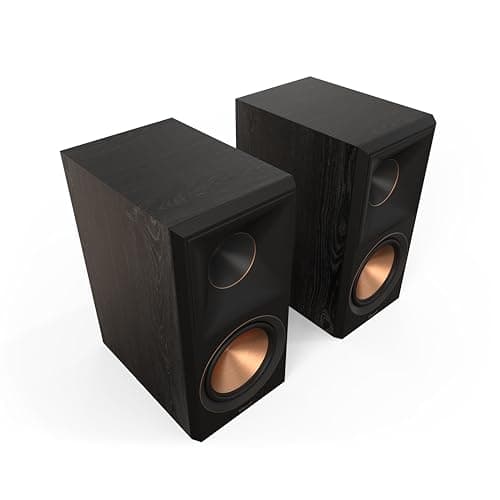 Klipsch RP-600M II Higher sensitivity and a bigger cabinet than the R-51M, which buys headroom rather than a different kind of speaker. | Best step up | 8.6 | |
| 2 | 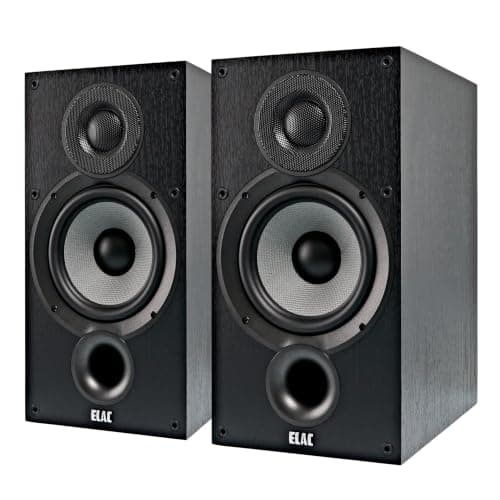 ELAC Debut 2.0 B6.2 A 6.5-inch woofer in a ported cabinet that reaches genuinely low for its size, at the cost of needing an amplifier with real current behind it — and now the outgoing Debut generation rather than the current one. | The outgoing generation, still sold | 8.2 | $329.00View on Amazon $479.0031% off |
| 3 | 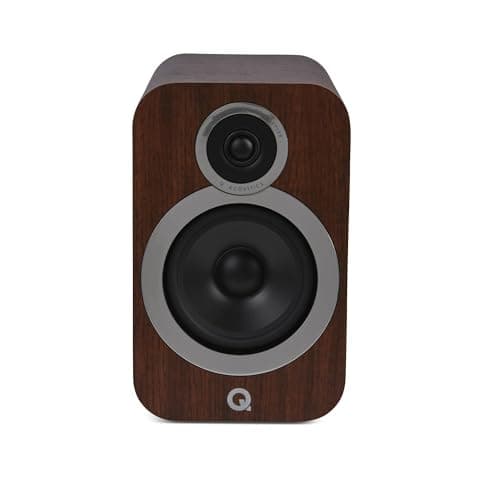 Q Acoustics 3030i The only speaker in this bracket that publishes both a minimum impedance and a recommended amplifier range, on top of a cabinet that is its whole design argument. | Best cabinet | 8.2 | |
| 4 | 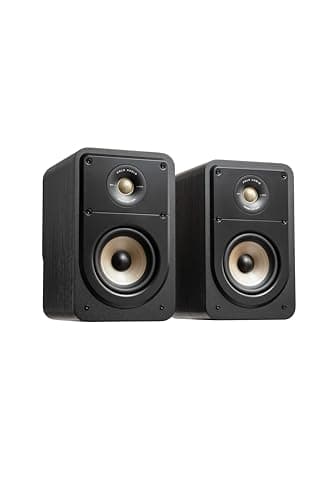 Polk Signature Elite ES15 Voiced and certified to sit in a surround system as easily as a stereo pair, which matters if this room has to do both jobs. | Best for double duty with home theater | 7.0 | |
| 5 | 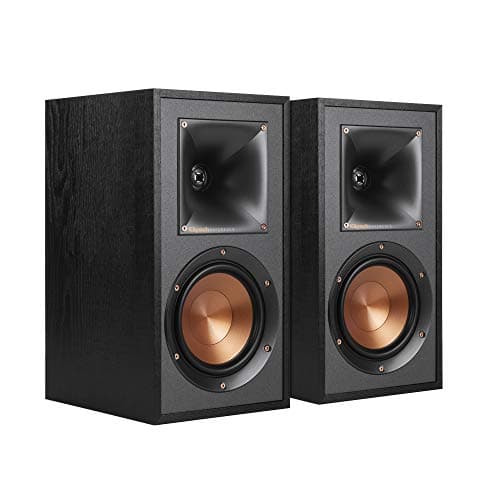 Klipsch R-51M High sensitivity means a modest amplifier drives these to a real volume — the practical answer when the amp is fixed and small. | Best for low-power amplifiers | 8.4 |
Below $500 the game is finding a speaker whose maker publishes enough to check. We covered that bracket separately. Under $1,000 something more interesting happens: the specifications get better, more detailed, and — in one case — footnoted in a way that changes what they mean.
It is also the first bracket where a stereo pair of towers is genuinely on the table, so the alternative to everything below is a real one: six floorstanding speakers that make a pair for under $1,000. Note the stands, though. Every speaker on this page needs a pair of them at seated ear height, and that cost is not in the prices below — which is the part of the comparison bookshelf vs floorstanding speakers works through properly.
The footnote that is worth three decibels
Klipsch publishes 94.5 dB at 2.83 V/1 m for the RP-600M II. That is the highest sensitivity in this group and one of the highest figures on this site.
It also carries a footnote that the R-51M’s 93 dB does not: half-space anechoic.
A half-space measurement puts the speaker in an infinite baffle — flush in a wall — so all the radiated energy goes forward into a hemisphere instead of spreading into a full sphere. The convention difference between half space and full space is conventionally taken as about 3 dB. So a 94.5 dB half-space figure and a 93 dB figure with no stated space are not 1.5 dB apart in any meaningful sense; depending on how the R-51M was measured, the RP-600M II could easily be the less sensitive of the two.
Credit where it is due: Klipsch printed the footnote. They did not have to. But it means the two Klipsch figures on this page cannot be compared to each other, let alone to ELAC’s or Q Acoustics’, and if you were choosing on the headline number you would be choosing on a number that does not mean what you think.
The same footnote reappears further up the range. Klipsch’s RP-6000F II floorstander publishes 96 dB with the identical half-space qualifier, which is why our floorstanding roundup under $2,000 quotes the footnote in full rather than the headline figure — and why that page ends up reordering its bracket once every published number is put on a common footing.
What the extra money actually buys
Compare the RP-600M II to the R-51M, same brand, same driver philosophy, roughly double the price:
- Bass extension.44 Hz ± 3 dB against 62 Hz ± 3 dB. That is nearly half an octave, and it is most of what you are paying for.
- Driver material. A 6.5-inch Cerametallic cone with Faraday rings, against a 5.25-inch spun-copper IMG. Faraday rings reduce the inductance modulation that causes distortion as the voice coil moves — a real engineering answer to a real problem.
- Headroom. 100 W/400 W handling against 85 W/340 W.
- Mass. 18.1 lb each against 11 lb. Cabinet mass is not a specification of sound quality, but it is a proxy for wall thickness and bracing.
What it does notbuy is a published minimum impedance. Klipsch describes both as “8 ohms compatible” and publishes no minimum for either, at any price.
The one that lets you finish the calculation
Q Acoustics publishes, for the 3030i: 88 dB at 2.83 V / 1 m, 6 Ω nominal, 4 Ω minimum, 46 Hz – 30 kHz at +3/−6 dB, and a recommended amplifier range of 25–75 W for a stereo amplifier or 50–145 W for an AV receiver with two channels driven.
That last distinction — separate figures for a stereo amp and a receiver — is a level of care nobody else here shows, and it reflects something true: a multichannel receiver delivers less per channel than its headline suggests when several channels work at once.
The 3030i is the cheapest speaker in this roundup and it ranks third, above two more expensive pairs, entirely because of what its maker publishes. That is our criterion, stated in advance, and this is what it looks like when applied.
The ELAC compromise
The ELAC Debut 2.0 B6.2 publishes 87 dB at 2.83 V/1 m into 6 Ω and reaches 44 Hz — matching the far more expensive RP-600M II’s extension.
Two catches, both real. The first is the impedance conversion: because the ELAC is a 6-ohm speaker, 2.83 V into it is 1.33 W rather than 1 W, so its 87 dB figure is worth about 85.8 dB at a true 1 watt. We run that arithmetic in full on the vinyl page. The second is that ELAC publishes “44 to 35,000 Hz” with no tolerance at all. A frequency response without a ±dB figure is not a specification; it is a range of frequencies at which the speaker does something unspecified.
It is still the deepest-reaching speaker here for the money, and it is still the one we would buy if the amplifier can drive it. The point of saying all this is that “44 Hz” on an ELAC sheet and “44 Hz ± 3 dB” on a Klipsch sheet are different kinds of claim.
Where the sub-$300 speakers sit in this company
The Polk ES15 and the Klipsch R-51M are here for a reason beyond filling a table. In this bracket their limitations become legible: the Polk publishes a bare 88 dB with no condition and no nominal impedance, and the Klipsch publishes 62 Hz where everything above it reaches the mid-40s.
If your amplifier is small, the R-51M remains the pragmatic answer at any price on this page, because sensitivity is the constraint that does not care about your budget. And if your budget is genuinely under $300, that roundup is here and it is not a consolation prize.
The port, the wall, and the money you have already spent
Every passive speaker on this page except the Q Acoustics ships with its port on the back, and the RP-600M II’s 44 Hz extension is a bass-reflex figure — the port is doing part of the work of getting there.
Push a rear-ported cabinet against a wall and you change the loading the designer assumed. The usual result is a lift somewhere in the upper bass and a less controlled bottom end, which reads as “boomy” and gets blamed on the speaker. Q Acoustics supplies port bungs with the 3030i partly for this reason; nobody else here does.
Two practical consequences at this price. First, budget for stands or accept that you will not hear what you paid for — an 18 lb speaker on a bookshelf, backed against a wall, at knee height, is not the speaker on the spec sheet. Second, the extension figures in this bracket are the strongest argument for treating the room before buying up: a 44 Hz speaker in an untreated room with a strong mode at 50 Hz will measure worse than a 62 Hz speaker in a treated one. How much treatment a room actually needs is a calculable question, and the answer is usually cheaper than the difference between these speakers.
How we would spend it
With a real amplifier and a real room: the RP-600M II, for the 44 Hz extension and the Cerametallic driver — with your eyes open about the half-space footnote and the missing minimum impedance.
For the best ratio of published extension to price: the ELAC B6.2. For the buyer who wants to verify the amplifier match before spending: the Q Acoustics 3030i, still the only speaker in this price range whose maker gives you every number you need.
Whichever you choose, run the arithmetic on your own amplifier first. At this level the speaker is rarely the limiting factor — the amplifier and the room are.
Every pick in detail
Every specification below links to the manufacturer document we read it from. Where a manufacturer does not publish a figure, we say so rather than estimating it.
Klipsch RP-600M II
Best step upPrice as of October 15, 2026. #ad
Higher sensitivity and a bigger cabinet than the R-51M, which buys headroom rather than a different kind of speaker.
- sensitivity
- 10/10
- bass extension
- 8/10
- amp friendliness
- 10/10
- value for money
- 7/10
- build quality
- 9/10
| Specification | Published value | Source |
|---|---|---|
| Sensitivity | 94.5 dB (2.83 V / 1 m, half-space anechoic — Klipsch's published footnote) | Klipsch spec sheet (PDF) |
| Impedance | 8 Ω “compatible” (Klipsch's wording) | Klipsch spec sheet (PDF) |
| Minimum impedance | Not published | — |
| Frequency response | 44 Hz – 25 kHz ± 3 dB | Klipsch spec sheet (PDF) |
| Power handling | 100 W continuous / 400 W peak | Klipsch spec sheet (PDF) |
| Woofer | 6.5 in Cerametallic with Faraday rings | Klipsch spec sheet (PDF) |
| Crossover | 1,500 Hz | Klipsch spec sheet (PDF) |
| Weight (each) | 18.1 lb / 8.2 kg | Klipsch spec sheet (PDF) |
Pros
- Very high sensitivity
- Larger cabinet and more extension than the R-51M
- Real wood-veneer finishes
Cons
- Well above the $500 bracket
- Large
- Rear port placement constraints remain
Skip it if you are shopping under $500 — this is a bracket up.
ELAC Debut 2.0 B6.2
The outgoing generation, still soldA 6.5-inch woofer in a ported cabinet that reaches genuinely low for its size, at the cost of needing an amplifier with real current behind it — and now the outgoing Debut generation rather than the current one.
- sensitivity
- 6/10
- bass extension
- 9/10
- amp friendliness
- 6/10
- value for money
- 10/10
- build quality
- 8/10
| Specification | Published value | Source |
|---|---|---|
| Sensitivity | 87 dB (2.83 V / 1 m) | ELAC spec page |
| Impedance | 6 Ω | ELAC spec page |
| Minimum impedance | Not published | — |
| Frequency response | 44 Hz – 35 kHz (no tolerance published) | ELAC spec page |
| Maximum power input | 120 W (a handling limit — ELAC publishes no recommended amplifier range) | ELAC spec page |
| Woofer | 6.5 in woven aramid-fiber cone | ELAC spec page |
| Tweeter | 1 in cloth dome | ELAC spec page |
| Crossover | 2,200 Hz | ELAC spec page |
| Weight (each) | 16.3 lb / 7.4 kg | ELAC spec page |
Pros
- 6.5in woofer reaches genuinely low for a bookshelf
- Front port, so it tolerates being near a wall better than a rear-ported box
- Well-braced cabinet for the price
Cons
- Wants more amplifier than its size suggests — check the arithmetic before pairing
- Large for a 'bookshelf' speaker
- Finish is functional rather than furniture
- The outgoing generation — ELAC's Debut 3.0 DB63 now builds on it, though ELAC publishes the same 87 dB and 6 Ω for both, so our sensitivity arithmetic holds for either
- ELAC publishes no response tolerance and no recommended amplifier range for this generation. The DB63 publishes both, which is the real reason it ranks ahead
Skip it if your amplifier is a low-power desktop unit. Run the power arithmetic on our amp-matching guide first.
Q Acoustics 3030i
Best cabinetNo live price right now. #ad
The only speaker in this bracket that publishes both a minimum impedance and a recommended amplifier range, on top of a cabinet that is its whole design argument.
- sensitivity
- 8/10
- bass extension
- 8/10
- amp friendliness
- 7/10
- value for money
- 8/10
- build quality
- 10/10
| Specification | Published value | Source |
|---|---|---|
| Sensitivity | 88 dB (2.83 V / 1 m) | Q Acoustics spec page |
| Impedance (nominal) | 6 Ω | Q Acoustics spec page |
| Minimum impedance | 4 Ω | Q Acoustics spec page |
| Frequency response | 46 Hz – 30 kHz (+3 dB / −6 dB) | Q Acoustics spec page |
| Recommended amplifier power | 25–75 W (stereo amplifier); 50–145 W (AV receiver, 2 ch driven) | Q Acoustics spec page |
| Bass unit | 165 mm (6.5 in) | Q Acoustics spec page |
| Treble unit | 22 mm (0.9 in) decoupled | Q Acoustics spec page |
| Crossover | 2.4 kHz | Q Acoustics spec page |
| Dimensions (H × W × D) | 325 × 200 × 329 mm (12.8 × 7.9 × 13.0 in), including grille and terminals | Q Acoustics spec page |
| Weight (each) | 6.4 kg / 14.1 lb | Q Acoustics spec page |
Pros
- Publishes a minimum impedance (4 Ω) and a recommended amplifier range (25–75 W) — almost nobody else at this price does
- 88 dB sensitivity, the highest here outside the horn-loaded Klipsch
- Unusually inert cabinet for the price, with P2P bracing
- A published 46 Hz low end, which is real extension rather than a bigger box
Cons
- Dips to 4 Ω, so a weak amplifier will struggle despite the friendly sensitivity figure
- Large and deep for a bookshelf at 325 × 200 × 329 mm and 6.4 kg each — this wants a stand
- Reflex port, so it needs clearance behind it
Skip it if your amplifier is rated only into 8 Ω and says nothing about 4 Ω. This speaker's published 4 Ω minimum is exactly the case that exposes it.
Polk Signature Elite ES15
Best for double duty with home theaterPrice as of October 15, 2026. #ad
Voiced and certified to sit in a surround system as easily as a stereo pair, which matters if this room has to do both jobs.
- sensitivity
- 7/10
- bass extension
- 7/10
- amp friendliness
- 7/10
- value for money
- 7/10
- build quality
- 7/10
| Specification | Published value | Source |
|---|---|---|
| Sensitivity | 88 dB — Polk publishes NO measurement condition (no 2.83 V/1 m or 1 W/1 m qualifier), so this figure is not directly comparable to the others in this table | Polk info sheet (PDF) |
| Impedance | “Compatible with 4- and 8-ohm outputs” — Polk publishes no nominal impedance value | Polk info sheet (PDF) |
| Minimum impedance | Not published | — |
| Frequency response | 48 Hz – 40 kHz (no tolerance published) | Polk info sheet (PDF) |
| Recommended amplification | 20–100 W per channel | Polk info sheet (PDF) |
| Woofer | 5.25 in mica-fortified polypropylene | Polk info sheet (PDF) |
| Tweeter | 1 in Terylene dome | Polk info sheet (PDF) |
| Crossover | 2.5 kHz | Polk info sheet (PDF) |
| Weight (each) | 13 lb / 5.9 kg | Polk info sheet (PDF) |
Pros
- Designed to integrate with a matching surround range
- Hi-Res certified
- Keyhole mount for wall use
Cons
- Less distinctive than the ELAC or Klipsch at the price
- Rear port
- Not the best pure-stereo value here
Skip it if this is a stereo-only system — the ELAC B6.2 gives more for the money.
Klipsch R-51M
Best for low-power amplifiersPrice as of October 15, 2026. #ad
High sensitivity means a modest amplifier drives these to a real volume — the practical answer when the amp is fixed and small.
- sensitivity
- 10/10
- bass extension
- 6/10
- amp friendliness
- 10/10
- value for money
- 9/10
- build quality
- 7/10
| Specification | Published value | Source |
|---|---|---|
| Sensitivity | 93 dB (2.83 V / 1 m) | Klipsch spec sheet (PDF) |
| Impedance | 8 Ω “compatible” (Klipsch's wording — not a measured nominal figure) | Klipsch spec sheet (PDF) |
| Minimum impedance | Not published | — |
| Frequency response | 62 Hz – 21 kHz ± 3 dB | Klipsch spec sheet (PDF) |
| Power handling | 85 W continuous / 340 W peak (a handling limit, not a recommended amplifier range) | Klipsch spec sheet (PDF) |
| Woofer | 5.25 in spun-copper IMG | Klipsch spec sheet (PDF) |
| Tweeter | 1 in aluminum LTS on a 90° × 90° Tractrix horn | Klipsch spec sheet (PDF) |
| Crossover | 1,660 Hz | Klipsch spec sheet (PDF) |
| Weight (each) | 11 lb / 5 kg | Klipsch spec sheet (PDF) |
Pros
- High sensitivity — plays loud on very little power
- The right answer for a low-wattage or tube amplifier
- Horn tweeter gives strong dispersion control
Cons
- Horn presentation is divisive and we cannot tell you how it sounds — we have not heard them
- Rear port needs breathing room from the wall
- Less low-end than the ELAC B6.2
- Previous generation — Klipsch's own page for it now points buyers to the newer Reference R-50M
Skip it if your amp already has power to spare — you are paying for sensitivity you do not need.
Frequently asked questions
What is the best bookshelf speaker under $1000?
On our published criteria, the Klipsch RP-600M II: 44 Hz – 25 kHz ±3 dB, a 6.5-inch Cerametallic woofer with Faraday rings, and 100 W continuous handling. Note that its 94.5 dB sensitivity is footnoted "half-space anechoic", a condition worth roughly 3 dB that the other speakers here do not state — so do not compare that figure directly to anyone else's.
What does "half-space anechoic" mean on a sensitivity spec?
It means the speaker was measured as though flush-mounted in a wall, so all its output radiates forward into a hemisphere rather than spreading into a full sphere. The convention difference between half space and full space is normally taken as about 3 dB. Klipsch publishes this footnote for the RP-600M II and not for the R-51M, which means the two figures cannot be compared to each other as published.
Is it worth spending $1000 on bookshelf speakers?
The measurable gains between the $300 and $1,000 brackets are real: roughly half an octave more bass extension, larger and better-braced cabinets, and driver technologies like Faraday rings that address a specific distortion mechanism. What does not improve is disclosure — no speaker in this bracket publishes a minimum impedance except the Q Acoustics 3030i, which is the cheapest pair on the page.
Why does the Q Acoustics 3030i rank above more expensive speakers?
Because it is the only speaker here whose spec sheet lets you finish the amplifier-match calculation: 88 dB at 2.83 V / 1 m, 6 Ω nominal, a 4 Ω minimum, a ±dB-qualified frequency response, and separate recommended amplifier ranges for a stereo amp (25–75 W) and an AV receiver with two channels driven (50–145 W). That is our published criterion and this is what applying it looks like.
Read next
The Best Bookshelf Speakers Under $500
Six pairs under $500 — and only one publishes a minimum impedance and a recommended amp range.
The Best Floorstanding Speakers Under $1,000
Six towers that make a stereo pair under $1,000, ranked on sensitivity with its stated condition, bass figures with a tolerance, and where the port fires.
The Best Floorstanding Speakers Under $2,000
Five towers that make a stereo pair under $2,000, ranked after putting every published bass figure on a common tolerance — which reorders them.
Will This Amplifier Drive My Speakers?
Two published numbers, one formula, and the answer is almost always less power than you expected.
Speaker Impedance Explained
Nominal versus minimum impedance, why 2.83 V is not 1 watt, and how to check your amplifier can cope.
The Best Bookshelf Speakers for Vinyl
Bookshelf speakers for a turntable, ranked on published sensitivity and impedance — with the amp arithmetic shown.
Bookshelf vs Floorstanding Speakers
Cabinet volume buys extension; a subwoofer buys extension you can place independently. The trade, with each maker's own numbers.
Sources
Every specification on this page was read from one of these documents. If one of them has changed, or we have made an error, tell us — corrections are logged and dated per our editorial policy.