The Best Floorstanding Speakers
Four of these six are sold one cabinet at a time. That single line in the specifications reorders the price ladder more than any sonic difference between them.
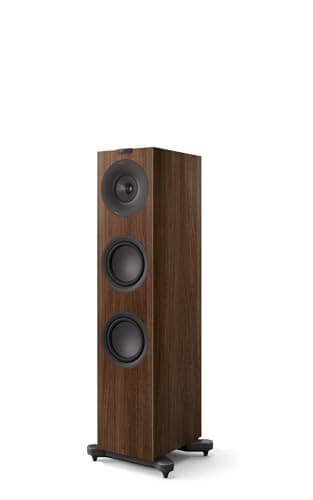
Top pick: KEF Q7 Meta
Best documented. #ad Affiliate link — we earn a commission at no extra cost to you.
The short answer
The best floorstanding speaker for most people is the KEF Q7 Meta — because it is the only tower here that publishes every figure you need to match it and then publishes the awkward ones too: 87 dB at 2.83 V / 1 m, a 4 Ω nominal impedance with a 3.2 Ω minimumbeside it, a 15 to 200 W recommended amplifier range, a 46 Hz ± 3 dB bass figure, and — in the same table — the softer 39 Hz −6 dB and 28 Hz in-room numbers that most brands would have led with instead. It is for the listener who already owns a real amplifier and wants the most completely specified three-way on the page. The budget pick is the Polk Monitor XT60 — the cheapest floorstanding speaker in our registry and, at 7.5 inches wide, the only one that fits a room where a tower is already a compromise. What it gives up is stated plainly below: Polk quotes 38 Hz with no tolerance window at all and publishes no nominal impedance, so two of the three numbers you would use to plan around it cannot be checked.
If you read one section, read the arithmetic. The Klipsch RP-6000F II and the Fluance XL8F are sold as pairs; the KEF, the JBL, and both Polk towers are sold as single cabinets. That is not a detail — it doubles four of the six prices on this page before you have a stereo system, and it is the reason the ranking here does not follow the sticker order.
Disclosure: we earn a commission if you buy through the links on this page, at no extra cost to you. It does not influence what we pick — our criteria are published and reproducible, so you can check our work. How we pick · Full disclosure
These picks are spec-and-price analyses, not listening tests. We have not heard this gear and we do not pretend to have: every figure below is sourced to the manufacturer and linked, and every price is live or not shown at all. Here are the rules we followed.
Quick picks
Ranked on the published criteria in How We Pick. Prices are live as of November 23, 2026. Tap any row for the full write-up.
- 8.5
- 8.4
- 8.3
- 7.8$449.95View on Amazon
$659.9532% off
- 7.8$289.00View on Amazon
$349.0017% off
- 7.3$185.00View on Amazon
$229.0019% off
| # | Product | Best for | Score | Price |
|---|---|---|---|---|
| 1 | KEF Q7 Meta The only speaker in this bracket whose maker publishes a minimum impedance, and the only one that prints its bass figure at three different conventions so you can see what each is worth. | Best documented | 8.5 | |
| 2 | 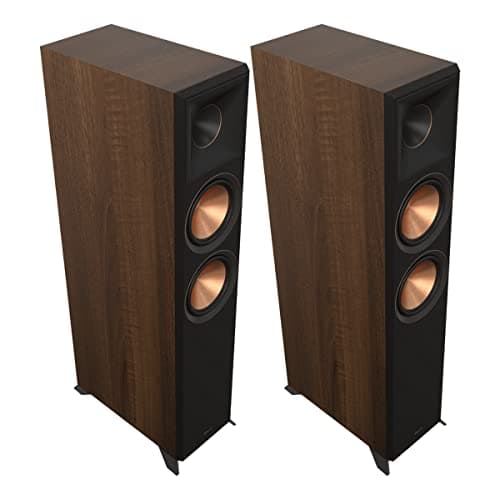 Klipsch RP-6000F II The only pair listing in the bracket and the easiest load in it — with a 96 dB sensitivity figure that carries Klipsch's own half-space asterisk, which is worth reading before you compare it to anything. | Best for a modest amplifier | 8.4 | |
| 3 | 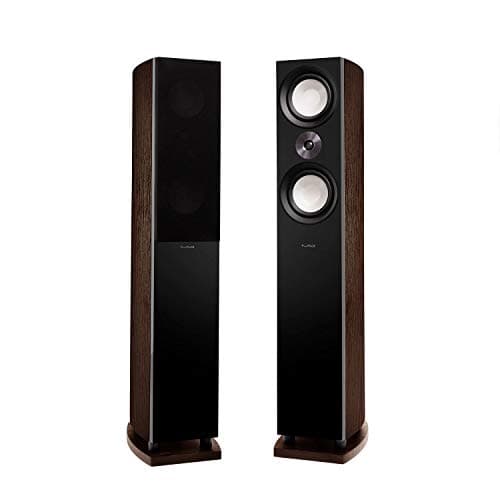 Fluance XL8F Reference The only genuine three-way here, with a dedicated down-firing 8 in woofer and a published 100 Hz crossover — and the price on the listing already buys two of them. | Best true pair price | 8.3 | |
| 4 | 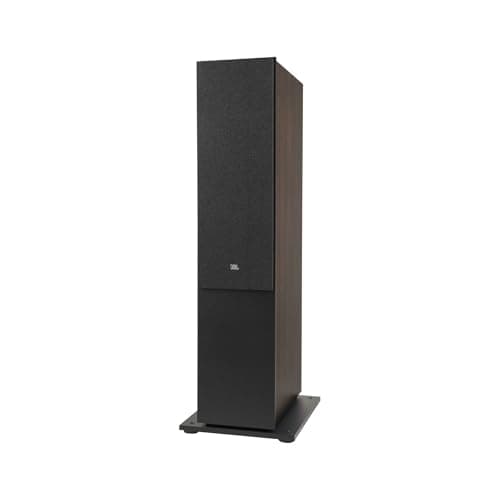 JBL Stage 2 280F Dual 8-inch woofers and a dedicated set of Atmos binding posts — the most air-moving capability in the bracket, published at a tolerance loose enough that its bass figure cannot be compared with anyone else's. | Most cone area | 7.8 | $449.95View on Amazon $659.9532% off |
| 5 | 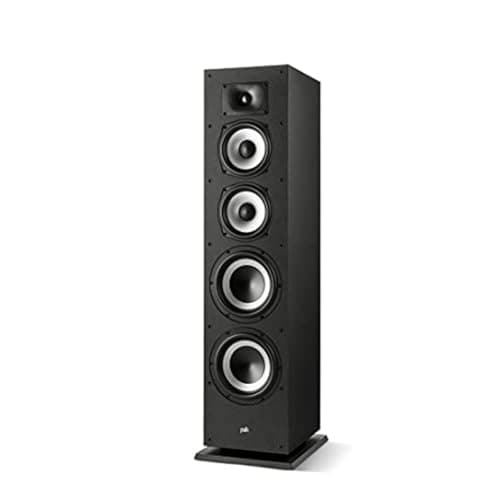 Polk Monitor XT70 Two 6.5 in woofers, two 8 in passive radiators and a 25–200 W recommendation from a maker that tells you what to drive it with — then declines to say what impedance it presents or how the bass figure was measured. | Best published amplifier range | 7.8 | $289.00View on Amazon $349.0017% off |
| 6 | 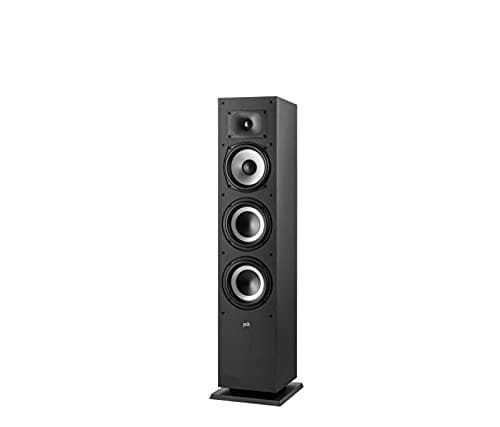 Polk Monitor XT60 7.5 in wide and 20 lb — a tower for a room that has no floor to spare, at the cost of the lowest published sensitivity in the group. | Narrowest footprint | 7.3 | $185.00View on Amazon $229.0019% off |
A floorstanding speaker exists to move air, and almost every floorstanding roundup compares them on the one number that says least about whether they can. Frequency response gets quoted as a single low figure — 33 Hz, 35 Hz, 38 Hz — and the tolerance window that makes it mean something gets dropped, because the window is where the flattering happens.
So this page ranks on four things, in this order. First, bass extension with its published tolerance, because a ± 3 dB figure and a ± 6 dB figure are not the same claim and a figure with no window at all is not a claim. Second, mid and bass cone area, because that is the physical reason to buy a tower rather than a bookshelf pair and a stand. Third, whether the maker publishes a recommended amplifier range — several of these publish a power handling limit instead, which answers a different question. Fourth, how the speaker is sold, because four of the six here ship one cabinet per purchase.
The picks compared, spec by spec
Read the first column and the last one together and the page rewrites itself. The two speakers that publish a ± 3 dB bass figure are the KEF and the Klipsch, and only one of those two also ships as a pair. The three cabinets that quote a bass number with no tolerance window — both Polks and the Fluance — are also the three whose numbers reach deepest, which is the pattern worth noticing: the looser the measurement condition, the lower the published figure tends to go. Each pick’s full spec table further down carries the figures these cells abbreviate, every one linked to the manufacturer document it was read from.
Every figure below is the manufacturer’s own published value and links to the document we read it from. “Not published” means the manufacturer does not publish that figure; an em dash means we have no published figure for that model. Prices are live as of November 23, 2026.
Best documented
- Bass, with its tolerance
- 46 Hz ± 3 dB
- Mid / bass drivers
- 2 × 6.5 in + 4 in Uni-Q mid
- Amplifier figure published
- 15–200 W recommended
- Sold as
- One speaker
Best for a modest amplifier
- Bass, with its tolerance
- 38 Hz ± 3 dB
- Mid / bass drivers
- 2 × 6.5 in Cerametallic
- Amplifier figure published
- 125 W continuous — handling, not advice
- Sold as
- A pair
Best true pair price
- Bass, with its tolerance
- 35 Hz, no tolerance
- Mid / bass drivers
- 8 in down-firing + 2 × 6.5 in mid
- Amplifier figure published
- 80–160 W RMS handling
- Sold as
- A matched pair
Most cone area
- Bass, with its tolerance
- 33 Hz ± 6 dB (no ± 3 dB figure)
- Mid / bass drivers
- 2 × 8 in — largest cone area here
- Amplifier figure published
- 20–225 W recommended
- Sold as
- One speaker
Best published amplifier range
- Bass, with its tolerance
- 35 Hz, no tolerance
- Mid / bass drivers
- 2 × 6.5 in + 2 × 8 in radiators
- Amplifier figure published
- 25–200 W recommended
- Sold as
- One speaker
Narrowest footprint
- Bass, with its tolerance
- 38 Hz, no tolerance
- Mid / bass drivers
- 1 × 6.5 in + 2 × 6.5 in radiators
- Amplifier figure published
- 25–200 W recommended
- Sold as
- One speaker
| Pick | Bass, with its tolerance | Mid / bass drivers | Amplifier figure published | Sold as | Price |
|---|---|---|---|---|---|
| 1.KEF Q7 MetaBest documented | 46 Hz ± 3 dB | 2 × 6.5 in + 4 in Uni-Q mid | 15–200 W recommended | One speaker | |
| 2.Klipsch RP-6000F IIBest for a modest amplifier | 38 Hz ± 3 dB | 2 × 6.5 in Cerametallic | 125 W continuous — handling, not advice | A pair | |
| 3.Fluance XL8F ReferenceBest true pair price | 35 Hz, no tolerance | 8 in down-firing + 2 × 6.5 in mid | 80–160 W RMS handling | A matched pair | |
| 4.JBL Stage 2 280FMost cone area | 33 Hz ± 6 dB (no ± 3 dB figure) | 2 × 8 in — largest cone area here | 20–225 W recommended | One speaker | |
| 5.Polk Monitor XT70Best published amplifier range | 35 Hz, no tolerance | 2 × 6.5 in + 2 × 8 in radiators | 25–200 W recommended | One speaker | |
| 6.Polk Monitor XT60Narrowest footprint | 38 Hz, no tolerance | 1 × 6.5 in + 2 × 6.5 in radiators | 25–200 W recommended | One speaker |
Prices as of November 23, 2026; every “Check Price” link goes to Amazon and earns us a commission at no extra cost to you. #ad
The one line in the specifications that decides the price
Every speaker above is priced per listing, and the listings do not agree on what a listing is. KEF labels its Q7 Meta page “Each.” JBL’s own spec sheet states “Shipping Units of Measure: Each.” Polk labels both Monitor XT towers “Single.” Klipsch sells the RP-6000F II as a two-speaker pack, and Fluance prices the XL8F Reference as a matched pair. So four of these six double before you have stereo, and two do not.
Pair cost = listing price × (sold singly ? 2 : 1)
Inputs
- KEF Q7 Meta — how it is sold: One speaker; KEF's listing is labeled “Each” (KEF product page)
- Klipsch RP-6000F II — how it is sold: A pair; the listing is a two-speaker pack (Klipsch product page)
- Fluance XL8F Reference — how it is sold: A matched pair; one purchase puts two speakers in the room (Fluance product page)
- Polk Monitor XT60 and XT70 — how they are sold: One speaker; Polk's listings are labeled “Single” (Polk product page)
Result
Why the KEF Q7 Meta wins
Not because it is the cheapest, the most sensitive, or the deepest. It wins because it publishes the most and the published numbers are good.
KEF states a three-way bass-reflex design, a 19 mm vented aluminum dome tweeter with Metamaterial Absorption Technology sitting at the acoustic center of a 100 mm aluminum midrange, two 165 mm hybrid aluminum bass units, crossover points at 440 Hz and 2.3 kHz, a 110 dB maximum SPL, and a 15 to 200 W amplifier recommendation. Then it does the thing almost nobody does: it publishes a 4 Ω nominal impedance anda 3.2 Ω minimum. That minimum is the only published minimum impedance figure anywhere in this field, and it is the figure that tells you whether your amplifier is comfortable rather than merely connected.
It also publishes three bass figures for the same speaker — 46 Hz at ± 3 dB, 39 Hz at −6 dB, and a 28 Hz “typical in-room” response — which looks like hedging until you notice that every other maker on this page published only whichever one of those three flattered it most. Publishing all three is a disclosure, not a dodge.
Who should skip it: anyone whose amplifier is honest about 8 Ω and vague about 4 Ω, and anyone pricing a stereo pair against the Klipsch or Fluance pair listings. The Q7 Meta asks to be bought twice.
The cases for the other five
Klipsch RP-6000F II— for a film-first room and a modest amplifier. It publishes the deepest ± 3 dB figure here at 38 Hz and the highest sensitivity at 96 dB, though with Klipsch’s own footnote attached: “SPL at 1 M, half-space anechoic with 2.83 V input.” Half-space is a measurement taken against a boundary, and it reads a few decibels higher than the free-space condition most brands use, so do not put that 96 dB in a column next to anyone else’s number without reading our sensitivity explainer first. Against that, it is the only pair listing among the top two picks and it has dual binding posts for bi-wiring. What it will not tell you is what amplifier it wants: the sheet publishes 125 W continuous / 500 W peak handling and no recommendation at all.
Fluance XL8F Reference— for the listener who wants a genuine three-way pair for one purchase. It is the only speaker on this page with a dedicated bass driver rather than a woofer doing double duty: an isolated down-firing 8-inch polymer-treated cone, crossed over at 100 Hz, with dual 6.5-inch woven glass-fibre midranges above it. A published 100 Hz crossover point is rare at any price and it is the strongest evidence here that the three-way claim is structural rather than marketing. Fluance also states its 87 dB sensitivity at the harder 1 W / 1 m condition rather than at 2.83 V, which makes the number look worse and is the more useful disclosure. The cost is the bass figure: 35 Hz with no tolerance window, and “8 Ohm Compatible” rather than a measured nominal impedance.
JBL Stage 2 280F— for the biggest room here. Dual 8-inch polycellulose cones give it the largest cone area on the page by a clear margin, it is the heaviest cabinet at 55.2 lb, it publishes a 6 Ω nominal impedance as a flat number, and its 20 to 225 W recommendation is the widest amplifier window of the six. It also carries a second set of binding posts for an Atmos height module, which no other speaker here does. It ranks fourth rather than first for one reason: JBL publishes 33 Hz at ± 6 dB and no ± 3 dB figure at all for this model, so its deepest-looking number is also its loosest.
Polk Monitor XT70— for someone who wants a recommended amplifier range in writing. Polk publishes 25 to 200 W per channel, which is advice rather than a limit, and it publishes its 89 dB sensitivity at “1 watt @ 1 meter” — the honest condition. Its two 6.5-inch woofers are helped by two 8-inch passive radiators, and Polk’s feature list claims “deep effortless bass below 35 Hz.” The 35 Hz in the specification table carries no tolerance and no condition, so treat the claim as a claim. Polk also publishes no nominal impedance for it, only “compatible with 4- and 8-ohm outputs,” and does not state which way the passive radiators fire.
Polk Monitor XT60— the budget pick, and the one to buy when the room has already told you a tower is a bad idea. At 36.4 inches tall and 7.5 inches wide it has the smallest footprint of any floorstander we cover, and it keeps the XT70’s 25 to 200 W recommendation and Terylene tweeter while dropping to a single 6.5-inch woofer and two 6.5-inch radiators. Its 86 dB sensitivity is the lowest here, again published at 1 W / 1 m, which means it genuinely wants the middle of that recommended range rather than the bottom of it. Our small-room floorstanding page goes further into the placement problem.
What this page deliberately leaves out
Five floorstanders in our registry are not ranked here: the ELAC Debut 3.0 DF53 and DF63, the Klipsch R-620F and R-610F, and the Jamo Studio S 809. That is not an oversight and it is not a verdict on them. Each is the top pick or a near-top pick on a page whose question is narrower than this one, and duplicating them here would make this page a re-cut of those rather than a head page. The $1,000–$2,000 bracket ranks the two ELACs against the KEF and the JBL on three-way design and cone area, and the under-$1,000 bracket ranks the two Klipsch R-series towers and the Jamo on sensitivity and port geometry. If you have a budget rather than a question, start on one of those.
Two figures are missing from this whole field rather than from our research, and they are worth naming. Only one of these six speakers publishes a minimum impedance, and not one of them publishes a harmonic distortion figure at any level. If a roundup elsewhere gives you distortion numbers for speakers in this price class, they came from somebody measuring, not from the manufacturer — and we do not publish measurements we have not taken.
The “sold as” row that does the ranking here matters even more when a price ceiling is involved: our under-$1,000 roundup uses it to separate the towers whose listing is a pair from the ones whose listing is a single cabinet, which is the difference between one purchase and two.
Every pick in detail
Every specification below links to the manufacturer document we read it from. Where a manufacturer does not publish a figure, we say so rather than estimating it.
KEF Q7 Meta
Best documentedPrice as of November 23, 2026. #ad
The only speaker in this bracket whose maker publishes a minimum impedance, and the only one that prints its bass figure at three different conventions so you can see what each is worth.
- published data
- 10/10
- sensitivity
- 5/10
- bass extension
- 8/10
- amp friendliness
- 4/10
- value for money
- 7/10
| Specification | Published value | Source |
|---|---|---|
| Design | Three-way bass reflex | KEF spec page |
| Sensitivity | 87 dB (2.83 V / 1 m) | KEF spec page |
| Impedance (nominal) | 4 Ω | KEF spec page |
| Minimum impedance | 3.2 Ω — the only published minimum in this bracket | KEF spec page |
| Frequency response | 46 Hz – 20 kHz (± 3 dB) | KEF spec page |
| Frequency range | 39 Hz – 20 kHz (−6 dB) — KEF publishes both conventions for the same speaker, 7 Hz apart | KEF spec page |
| Typical in-room bass response | 28 Hz (−6 dB) — a third published figure, 18 Hz below the ± 3 dB one | KEF spec page |
| Amplifier requirements | 15 – 200 W | KEF spec page |
| Uni-Q driver array | HF: 19 mm (0.75 in) vented aluminum dome with MAT; MF: 100 mm (4 in) aluminum cone, mounted at the tweeter's acoustic center | KEF spec page |
| Bass units | 2 × 165 mm (6.5 in) hybrid aluminum cone | KEF spec page |
| Crossover | 440 Hz, 2.3 kHz | KEF spec page |
| Maximum SPL | 110 dB | KEF spec page |
| Enclosure | Bass reflex; a port bung is supplied as an accessory | KEF spec page |
| Dimensions (H × W × D) | 1,001 × 317 × 315 mm (39.4 × 12.5 × 12.4 in) | KEF spec page |
| Weight (each) | 18.4 kg / 40.6 lb | KEF spec page |
| Sold as | One speaker — KEF's Amazon listing is labelled “Each”. A stereo pair is two purchases. | KEF product page |
Pros
- Publishes 46 Hz (± 3 dB), 39 Hz (−6 dB) and 28 Hz in-room for the same speaker — the clearest disclosure on this site
- 3.2 Ω minimum impedance published; nobody else in either floorstanding bracket publishes one at all
- Uni-Q puts the 100 mm midrange and the 19 mm tweeter on one acoustic axis, so the two do not arrive at different times off-axis
- A genuine three-way with both crossover points published (440 Hz, 2.3 kHz)
- A port bung is in the box, which is the manufacturer's own answer to a wall-proximity problem
Cons
- 4 Ω nominal and 3.2 Ω minimum is the hardest amplifier load here — the disclosure is excellent and what it discloses is demanding
- 87 dB is the joint-lowest sensitivity on this page, so the hard load and the low sensitivity compound
- At its current price a pair lands essentially at the top of this bracket, leaving no budget for stands, cable or a subwoofer
- The listing is one speaker, so the real cost of stereo is double the number shown
- 12.4 in deep before you add port clearance behind it
Skip it if your amplifier has no published 4-ohm rating. KEF tells you exactly what it demands, and an amp that will not say what it does into 4 Ω is the wrong partner for it.
Klipsch RP-6000F II
Best for a modest amplifierPrice as of November 23, 2026. #ad
The only pair listing in the bracket and the easiest load in it — with a 96 dB sensitivity figure that carries Klipsch's own half-space asterisk, which is worth reading before you compare it to anything.
- published data
- 7/10
- sensitivity
- 9/10
- bass extension
- 8/10
- amp friendliness
- 10/10
- value for money
- 9/10
| Specification | Published value | Source |
|---|---|---|
| Design | Two-way bass reflex — no dedicated midrange driver | Klipsch spec sheet (PDF) |
| Sensitivity | 96 dB @ 2.83 V / 1 m, with Klipsch's own asterisk: “SPL at 1 M, half-space anechoic with 2.83V input” | Klipsch spec sheet (PDF) |
| Impedance | 8 Ω “compatible” (Klipsch's wording — not a measured nominal figure) | Klipsch spec sheet (PDF) |
| Minimum impedance | Not published | — |
| Frequency response | 38 Hz – 25 kHz ± 3 dB | Klipsch spec sheet (PDF) |
| Power handling | 125 W continuous / 500 W peak (a handling limit, not a recommended amplifier range) | Klipsch spec sheet (PDF) |
| Tweeter | 1 in titanium LTS vented tweeter on a hybrid cross-section expanded Tractrix horn | Klipsch spec sheet (PDF) |
| Woofers | Dual 6.5 in Cerametallic cone with Faraday rings | Klipsch spec sheet (PDF) |
| Crossover | 1,770 Hz | Klipsch spec sheet (PDF) |
| Enclosure | Internally braced MDF; bass reflex via dual-chamber rear-firing Tractrix ports | Klipsch spec sheet (PDF) |
| Input terminals | Dual binding posts — bi-wire and bi-amp capable | Klipsch spec sheet (PDF) |
| Dimensions (H × W × D) | 39.60 × 9.29 × 17.57 in (100.6 × 23.6 × 44.6 cm) | Klipsch spec sheet (PDF) |
| Weight (each) | 49.4 lb / 22.4 kg | Klipsch spec sheet (PDF) |
| Sold as | A pair — the Amazon listing is a two-speaker pack. The only pair listing in this bracket. | Klipsch product page |
Pros
- Sold as a pair, so the listed price is the price of a stereo front end
- 38 Hz – 25 kHz ± 3 dB — a real tolerance window on the deepest ± 3 dB figure in the bracket
- 8 Ω compatible and high sensitivity: the one speaker here a modest integrated amplifier will drive comfortably
- Dual binding posts for bi-wiring or bi-amping, which the ELACs and the KEF do not offer
- 125 W continuous handling and a divided, internally braced cabinet
Cons
- The 96 dB figure is footnoted “SPL at 1 M, half-space anechoic with 2.83V input” — a half-space measurement is conventionally about 3 dB optimistic against a free-space one, so it is NOT comparable to the KEF's or ELAC's numbers
- A two-way: the 6.5 in woofers cover midrange up to 1,770 Hz, where the ELACs and the KEF hand that band to a dedicated driver
- 17.57 in deep and 49.4 lb each — the deepest cabinet here before port clearance
- Rear-firing Tractrix ports need real space behind them
- Klipsch publishes no minimum impedance, and “8 ohms compatible” is not a measured nominal figure
Skip it if you are ranking on the headline sensitivity number. Read the asterisk first — it is the difference between a fair comparison and a wrong one.
Fluance XL8F Reference
Best true pair pricePrice as of November 23, 2026. #ad
The only genuine three-way here, with a dedicated down-firing 8 in woofer and a published 100 Hz crossover — and the price on the listing already buys two of them.
- sensitivity
- 5/10
- published data
- 7/10
- bass extension
- 9/10
- amp friendliness
- 5/10
- value for money
- 10/10
| Specification | Published value | Source |
|---|---|---|
| Sensitivity | 87 dB @ 1 W / 1 m — Fluance states the condition, and it is the 1-watt condition, not 2.83 V | Fluance spec list |
| Impedance | “8 Ohm Compatible” (Fluance's wording — not a measured nominal figure) | Fluance spec list |
| Minimum impedance | Not published | — |
| Frequency response | 35 Hz – 25 kHz, quoted with no tolerance window | Fluance spec list |
| Power handling | 80 – 160 W RMS | Fluance spec list |
| Tweeter | 1 in neodymium balanced silk dome, ferrofluid cooled | Fluance spec list |
| Midrange | Dual 6.5 in woven glass fiber composite with butyl rubber surrounds | Fluance spec list |
| Woofer | Isolated down-firing 8 in polymer-treated high-excursion driver — the only dedicated bass driver on this page | Fluance spec list |
| Crossover | 100 Hz / 3,000 Hz — a genuine three-way, and the only published low crossover point here | Fluance spec list |
| Enclosure | Tuned rear dual-port bass reflex tower, dampened | Fluance spec list |
| Dimensions (H × W × D) | 45.86 × 9.25 × 12.99 in (116.5 × 23.5 × 33 cm) | Fluance spec list |
| Weight (each) | 47.7 lb / 21.64 kg — the heaviest cabinet on this page by 12 lb | Fluance spec list |
| Sold as | A matched pair. One purchase puts two speakers in the room. | Fluance product page |
Pros
- Sold as a matched pair, so the listed price is the price of a stereo system's front end
- A real three-way: 1 in silk dome, dual 6.5 in midranges and an isolated 8 in down-firing woofer
- Publishes both crossover points (100 Hz and 3,000 Hz), which nobody else on this page does
- 47.7 lb per cabinet — the heaviest and most inert box here by a wide margin
Cons
- 87 dB at 1 W / 1 m is the lowest published sensitivity on this page, so it wants the most amplifier power
- 35 Hz – 25 kHz is published with no tolerance window, which makes the 35 Hz endpoint unverifiable
- 45.86 in tall and 12.99 in deep — physically the largest thing here, and it looks it
- Rear dual ports, so it needs wall clearance despite the down-firing woofer
Skip it if your amplifier is a low-power tube or Class A design. Of everything here this is the one that most wants watts.
JBL Stage 2 280F
Most cone areaDual 8-inch woofers and a dedicated set of Atmos binding posts — the most air-moving capability in the bracket, published at a tolerance loose enough that its bass figure cannot be compared with anyone else's.
- published data
- 5/10
- sensitivity
- 7/10
- bass extension
- 8/10
- amp friendliness
- 7/10
- value for money
- 8/10
| Specification | Published value | Source |
|---|---|---|
| Design | 2.5-way floorstanding loudspeaker system | JBL spec sheet (PDF) |
| Sensitivity | 91 dB @ 1 m, 2.83 V | JBL spec sheet (PDF) |
| Impedance (nominal) | 6 Ω | JBL spec sheet (PDF) |
| Minimum impedance | Not published | — |
| Frequency response | 33 Hz – 25 kHz at ± 6 dB — JBL publishes no ± 3 dB figure for this model | JBL spec sheet (PDF) |
| Recommended amplifier power | 20 – 225 W | JBL spec sheet (PDF) |
| Tweeter | 1 in (25 mm) anodized aluminum on a Next Generation HDI waveguide | JBL spec sheet (PDF) |
| Woofers | Dual 8 in (200 mm) polycellulose ribbed cone — the largest cone area in this bracket | JBL spec sheet (PDF) |
| Crossover | 1.1 kHz / 2.1 kHz | JBL spec sheet (PDF) |
| Enclosure | Bass reflex via dual flared racetrack rear-firing tuned ports | JBL spec sheet (PDF) |
| Input terminals | 5-way binding posts, plus a dedicated second set for an Atmos height module (compatible with the JBL 240H) | JBL spec sheet (PDF) |
| Dimensions (H × W × D) | 43.8 × 14.1 × 16.5 in with the base (1,113 × 357 × 420 mm); 43.8 × 9.5 × 16.1 in without it | JBL spec sheet (PDF) |
| Weight (each) | 55.2 lb / 25.1 kg — the heaviest cabinet on this page | JBL spec sheet (PDF) |
| Sold as | One speaker — JBL's own spec sheet states “Shipping Units of Measure: Each”, and the Amazon listing is a single cabinet. | JBL spec sheet (PDF) |
Pros
- Dual 8 in woofers — substantially more cone area than any other speaker in either floorstanding bracket
- Both crossover points published (1.1 kHz and 2.1 kHz) for its 2.5-way arrangement
- A second, dedicated pair of binding posts for a JBL 240H Atmos height module, so the tower doubles as a height-channel base
- 91 dB sensitivity with the drive condition stated, and a 20 – 225 W recommended range
- JBL's spec sheet publishes dimensions both with and without the outrigger base, which almost nobody does
Cons
- 33 Hz is quoted at ± 6 dB and JBL publishes no ± 3 dB figure anywhere, so this is the one bass number on the page that cannot be put on a common footing
- 14.1 in wide with the base fitted and 55.2 lb each — physically the largest and heaviest thing here
- Rear-firing racetrack ports, so it needs clearance despite the size
- No minimum impedance published
- The listing is one speaker — JBL's own sheet says “Shipping Units of Measure: Each”
Skip it if the room is small. Dual 8 in woofers in a near-field room is more output capability than the space can use, and the footprint is real.
Polk Monitor XT70
Best published amplifier rangeTwo 6.5 in woofers, two 8 in passive radiators and a 25–200 W recommendation from a maker that tells you what to drive it with — then declines to say what impedance it presents or how the bass figure was measured.
- sensitivity
- 6/10
- published data
- 5/10
- bass extension
- 9/10
- amp friendliness
- 7/10
- value for money
- 8/10
| Specification | Published value | Source |
|---|---|---|
| Sensitivity | 89 dB, published by Polk at “1 watt @ 1 meter” — NOT at 2.83 V, so it is not directly comparable to the Klipsch and Jamo figures on this page | Polk product page |
| Impedance | “Compatible with 4- and 8-ohm outputs” — Polk publishes no nominal impedance figure for this speaker | Polk info sheet (PDF) |
| Minimum impedance | Not published | — |
| Frequency response | 35 Hz – 40 kHz, quoted with NO tolerance window — the deepest published figure on this page and the one with the least to back it | Polk info sheet (PDF) |
| Recommended amplification | 25 – 200 W per channel | Polk info sheet (PDF) |
| Woofers | 2 × 6.5 in bi-laminate paper | Polk info sheet (PDF) |
| Bass radiators | 2 × 8 in passive radiators — Polk's feature list claims “deep effortless bass below 35 Hz” | Polk info sheet (PDF) |
| Tweeter | 1 in Terylene dome | Polk info sheet (PDF) |
| Crossover | 2,700 Hz | Polk info sheet (PDF) |
| Input terminals | 5-way nickel-plated binding posts | Polk info sheet (PDF) |
| Passive radiator firing direction | Not published | — |
| Dimensions (H × W × D) | 40.4 × 9.25 × 12.5 in (1,026.6 × 235 × 317.9 mm) | Polk info sheet (PDF) |
| Weight (each) | 35 lb / 15.88 kg | Polk info sheet (PDF) |
| Sold as | One speaker — Polk's Amazon listing is labelled “Single”. A stereo pair is two purchases. | Polk product page |
Pros
- Polk publishes a recommended amplification range (25 – 200 W per channel); Klipsch and Jamo publish handling limits instead
- Dual 8 in passive radiators — the largest radiating area for bass on this page
- 35 Hz is the deepest published low-frequency figure in the bracket
- 9.25 in wide and 40.4 in tall, so it disappears into a room better than its driver count suggests
Cons
- The 89 dB sensitivity is published at 1 watt, not 2.83 V, so it cannot be compared like-for-like with the Klipsch and Jamo numbers
- “Compatible with 4- and 8-ohm outputs” is not a nominal impedance, and no minimum is published
- 35 Hz – 40 kHz carries no tolerance, so the endpoints are unfalsifiable
- Polk never says which face the passive radiators are on, which is the one fact you need to place a radiator-loaded cabinet
- The Amazon listing is one speaker, not a pair
Skip it if you need to know exactly how close to the wall it can go. Polk does not publish the radiator orientation, and we will not guess it.
Polk Monitor XT60
Narrowest footprint7.5 in wide and 20 lb — a tower for a room that has no floor to spare, at the cost of the lowest published sensitivity in the group.
- sensitivity
- 4/10
- published data
- 5/10
- bass extension
- 7/10
- amp friendliness
- 6/10
- value for money
- 8/10
| Specification | Published value | Source |
|---|---|---|
| Sensitivity | 86 dB, published by Polk at “1 watt @ 1 meter” — NOT at 2.83 V, so it is not directly comparable to the Klipsch and Jamo figures on this page | Polk product page |
| Impedance | “Compatible with 4- and 8-ohm outputs” — Polk publishes no nominal impedance figure for this speaker | Polk info sheet (PDF) |
| Minimum impedance | Not published | — |
| Frequency response | 38 Hz – 40 kHz, quoted with NO tolerance window, which leaves both endpoints unverifiable | Polk info sheet (PDF) |
| Recommended amplification | 25 – 200 W per channel (a recommendation, not a handling limit — Polk publishes this where Klipsch publishes handling) | Polk info sheet (PDF) |
| Woofer | 1 × 6.5 in bi-laminate paper | Polk info sheet (PDF) |
| Bass radiators | 2 × 6.5 in passive radiators — Polk's feature list claims “deep effortless bass below 38 Hz” | Polk info sheet (PDF) |
| Tweeter | 1 in Terylene dome | Polk info sheet (PDF) |
| Crossover | 2,200 Hz | Polk info sheet (PDF) |
| Input terminals | 5-way nickel-plated binding posts | Polk info sheet (PDF) |
| Passive radiator firing direction | Not published | — |
| Dimensions (H × W × D) | 36.4 × 7.5 × 9.09 in (925 × 190.5 × 230.8 mm) | Polk info sheet (PDF) |
| Weight (each) | 20 lb / 9.07 kg | Polk info sheet (PDF) |
| Sold as | One speaker — Polk's Amazon listing is labelled “Single”. A stereo pair is two purchases. | Polk product page |
Pros
- 7.5 in wide and 9.09 in deep — by some margin the smallest floor footprint here
- Same 25 – 200 W published amplifier recommendation as the larger XT70
- 1 in Terylene dome tweeter, the same driver family Polk uses further up the range
- 20 lb per cabinet makes it the only speaker here one person can position without help
Cons
- 86 dB is the lowest published sensitivity on this page, and it is quoted at 1 watt rather than 2.83 V
- 38 Hz – 40 kHz with no tolerance window, from a single 6.5 in woofer and two 6.5 in radiators
- No nominal impedance and no minimum impedance published
- Radiator firing direction unpublished, same as the XT70
- The Amazon listing is one speaker, not a pair
Skip it if your amplifier is small. The lowest sensitivity in the group is the wrong end to start from with limited power.
Frequently asked questions
What are the best floorstanding speakers overall?
Are floorstanding speakers sold in pairs or individually?
How much amplifier power do floorstanding speakers need?
Do floorstanding speakers need a subwoofer?
Is a floorstanding speaker better than a bookshelf speaker and a stand?
Read next
The Best Floorstanding Speakers Under $1,000
Six towers that make a stereo pair under $1,000, ranked on sensitivity with its stated condition, bass figures with a tolerance, and where the port fires.
The Best Floorstanding Speakers Under $2,000
Five towers that make a stereo pair under $2,000, ranked after putting every published bass figure on a common tolerance — which reorders them.
The Best Floorstanding Speakers for a Small Room
Four towers for a small room, ranked on published footprint, port direction and the shallowest bass figure — the opposite of what a price bracket rewards.
Bookshelf vs Floorstanding Speakers
Cabinet volume buys extension; a subwoofer buys extension you can place independently. The trade, with each maker's own numbers.
The Best Bookshelf Speakers
The head of our bookshelf cluster: eight speakers from $179 to $2,500, with every sensitivity figure converted to the same 1 W / 1 m condition so the field can be compared at all.
Speaker Sensitivity Explained
2.83 V/1 m versus 1 W/1 m, what the conversion is worth in decibels, and the twelve-decibel spread that means sixteen times the power.
The Best Speakers Under $1,000
Six speakers inside a $1,000 ceiling, ranked on published data rather than adjectives — including the only one here that states its harmonic distortion, and the three that state whether you are buying a pair or a single cabinet.
Sources
Every specification on this page was read from one of these documents. If one of them has changed, or we have made an error, tell us — corrections are logged and dated per our editorial policy.