The Best Speakers Under $200
Two hundred dollars buys a bookshelf pair, one floorstanding cabinet, or a powered pair that needs nothing else. Only two of the five publish a bass figure you can check.
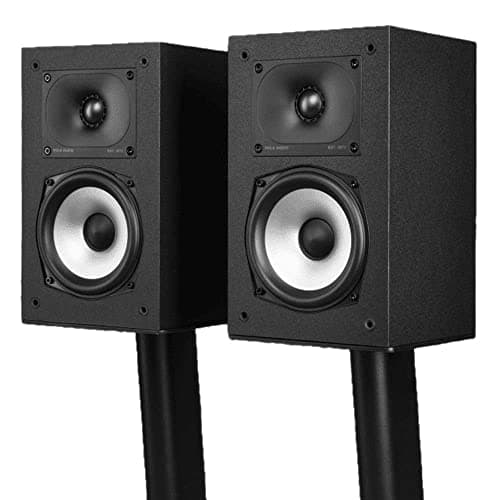
Top pick: Polk Monitor XT15
$179.0017% off
Best all-rounder under $200. #ad Affiliate link — we earn a commission at no extra cost to you.
The short answer
The best speakers under $200 for most people are the Polk Monitor XT15 — because they are a bookshelf pair with the one specification that matters most at this price published as advice rather than as a limit: a 30 to 150 W recommended amplification range, where Klipsch, Micca and Edifier all publish a power handling figure instead. A 5.25-inch bi-laminate paper woofer, a 1-inch Terylene dome, a 2.2 kHz crossover and 48 Hz of published reach make them the best-balanced passive pair in the band. They are for someone who owns, or is about to own, a small integrated amplifier or receiver. The budget pick is the Edifier R1280T— the cheapest product in our registry that makes stereo sound with nothing else attached: 21 W + 21 W RMS, dual RCA in, no amplifier required. The trade is stated below — a 4-inch woofer, a 52 Hz figure with no tolerance published, and no phono stage.
The thing to know before you shop this band: only the two Klipsch models publish a bass figure with a tolerance window attached. Polk, Micca and Edifier all publish a bare number. That is the single biggest difference between the specification sheets at this price, and it is invisible in a search result.
Disclosure: we earn a commission if you buy through the links on this page, at no extra cost to you. It does not influence what we pick — our criteria are published and reproducible, so you can check our work. How we pick · Full disclosure
These picks are spec-and-price analyses, not listening tests. We have not heard this gear and we do not pretend to have: every figure below is sourced to the manufacturer and linked, and every price is live or not shown at all. Here are the rules we followed.
Quick picks
Ranked on the published criteria in How We Pick. Prices are live as of November 23, 2026. Tap any row for the full write-up.
- 7.4$149.00View on Amazon
$179.0017% off
- 7.9
- 7.2$139.99View on Amazon
$189.9926% off
- 7.6$119.00View on Amazon
$149.9921% off
- 6.8$109.99View on Amazon
$149.9927% off
| # | Product | Best for | Score | Price |
|---|---|---|---|---|
| 1 | Polk Monitor XT15 48 Hz of published extension and a stated 30–150 W amplifier range, from a maker who tells you what to drive it with but not how they measured its sensitivity. | Best all-rounder under $200 | 7.4 | $149.00View on Amazon $179.0017% off |
| 2 | 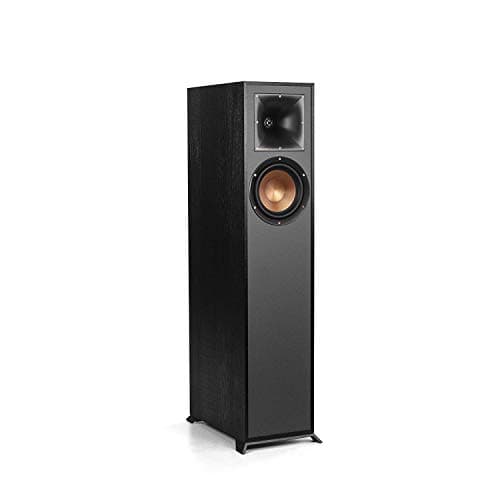 Klipsch R-610F 94 dB at 2.83 V/1 m from the cheapest cabinet here, with Klipsch filling in every field its R-620F sheet leaves blank — and stopping 7 Hz higher for it. | Best for a small room | 7.9 | |
| 3 | 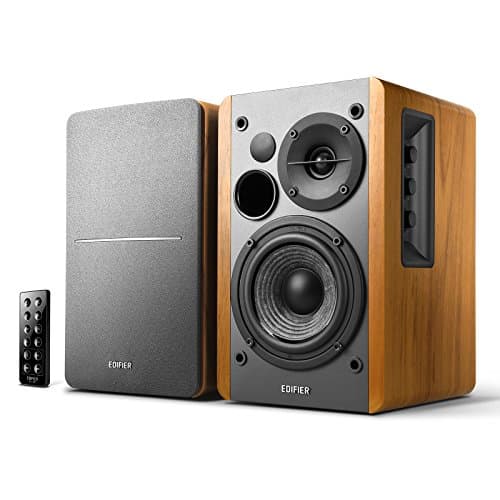 Edifier R1280DB The R1280T plus Bluetooth and optical/coaxial inputs — still no phono stage, but a far more useful set of sockets. | Best budget powered pair with digital inputs | 7.2 | $139.99View on Amazon $189.9926% off |
| 4 | 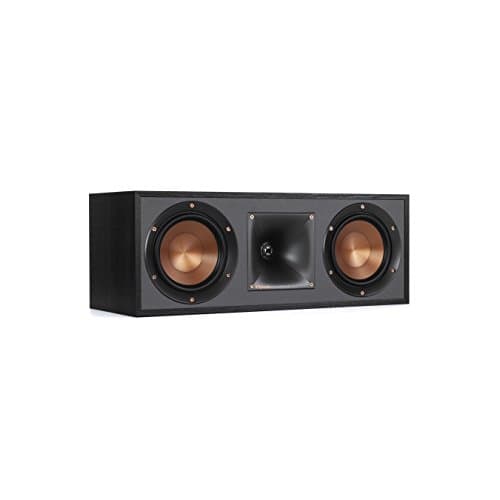 Klipsch R-52C A sealed dual-woofer center with a published 95 dB sensitivity, timbre-matched to the R-41M and R-51M so dialogue does not change character as it pans across the front. | Best center channel | 7.6 | $119.00View on Amazon $149.9921% off |
| 5 | 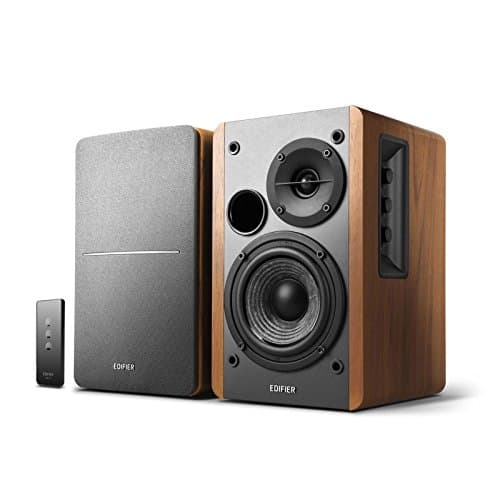 Edifier R1280T The cheapest credible way to get a turntable making sound in a small room, provided the turntable brings its own phono stage. | Best budget powered pair | 6.8 | $109.99View on Amazon $149.9927% off |
Under $200 the question stops being which speaker sounds better and starts being how many boxes you can afford to put in the room. This band holds four genuinely different shapes: a passive bookshelf pair that needs an amplifier, a single floorstanding cabinet that needs an amplifier and a second purchase, a powered pair that needs nothing, and a center channel that needs a receiver. Ranking them against each other on sound alone would be dishonest, so this page ranks them on what they publish and on what else you have to buy.
The criteria, in order: whether the bass figure carries a tolerance window, whether the sensitivity figure carries a measurement condition, whether the maker publishes an amplifier recommendation rather than a handling limit, and what the total purchase actually is.
The picks compared, spec by spec
The em dashes in the last column are absences in the manufacturers’ own documents rather than gaps in our research: neither Polk nor Klipsch publishes a terminal description for the XT15 or the R-52C. Note the Edifier R1280DB row in the first column, which is a disagreement we publish rather than resolve — the US specification table says 55 Hz and Edifier’s global marketing copy says 51 Hz for the same speaker. We quote the table.
Every figure below is the manufacturer’s own published value and links to the document we read it from. “Not published” means the manufacturer does not publish that figure; an em dash means we have no published figure for that model. Prices are live as of November 23, 2026.
Best all-rounder under $200
- Bass, with its tolerance
- 48 Hz, no tolerance
- Sensitivity or amp output
- 86 dB · no condition stated
- Amplifier figure published
- 30–150 W recommended
- Inputs / terminals
- —
Best for a small room
- Bass, with its tolerance
- 45 Hz ± 3 dB
- Sensitivity or amp output
- 94 dB · 2.83 V / 1 m
- Amplifier figure published
- 85 W continuous — handling, not advice
- Inputs / terminals
- Single gold-plated binding posts
Best budget powered pair with digital inputs
- Bass, with its tolerance
- 55 Hz (US table; global site says 51 Hz)
- Sensitivity or amp output
- 21 W + 21 W RMS
- Amplifier figure published
- Powered — none needed
- Inputs / terminals
- Optical, coaxial, Bluetooth, dual RCA
Best center channel
- Bass, with its tolerance
- 89 Hz ± 3 dB — a center, not a main
- Sensitivity or amp output
- 95 dB · 2.83 V / 1 m
- Amplifier figure published
- 100 W continuous — handling, not advice
- Inputs / terminals
- —
Best budget powered pair
- Bass, with its tolerance
- 52 Hz, no tolerance
- Sensitivity or amp output
- 21 W + 21 W RMS
- Amplifier figure published
- Powered — none needed
- Inputs / terminals
- Dual RCA
| Pick | Bass, with its tolerance | Sensitivity or amp output | Amplifier figure published | Inputs / terminals | Price |
|---|---|---|---|---|---|
| 1.Polk Monitor XT15Best all-rounder under $200 | 48 Hz, no tolerance | 86 dB · no condition stated | 30–150 W recommended | — | |
| 2.Klipsch R-610FBest for a small room | 45 Hz ± 3 dB | 94 dB · 2.83 V / 1 m | 85 W continuous — handling, not advice | Single gold-plated binding posts | |
| 3.Edifier R1280DBBest budget powered pair with digital inputs | 55 Hz (US table; global site says 51 Hz) | 21 W + 21 W RMS | Powered — none needed | Optical, coaxial, Bluetooth, dual RCA | |
| 4.Klipsch R-52CBest center channel | 89 Hz ± 3 dB — a center, not a main | 95 dB · 2.83 V / 1 m | 100 W continuous — handling, not advice | — | |
| 5.Edifier R1280TBest budget powered pair | 52 Hz, no tolerance | 21 W + 21 W RMS | Powered — none needed | Dual RCA |
Prices as of November 23, 2026; every “Check Price” link goes to Amazon and earns us a commission at no extra cost to you. #ad
The one Klipsch figure that is not what it looks like
The Klipsch R-610F is the most tempting line in this band: a floorstanding cabinet, 37 inches tall, 94 dB sensitivity published at 2.83 V / 1 m, 45 Hz to 21 kHz at ± 3 dB, a 6.5-inch spun-copper woofer and a 1-inch aluminum LTS tweeter on a 90° × 90° Tractrix horn — all for less than a bookshelf pair. It is also sold one cabinet at a time, which Klipsch states on its own product page.
Pair cost = listing price × 2, because the listing is one cabinet
Inputs
- Klipsch R-610F — how it is sold: One speaker; Klipsch's Amazon listing is a single cabinet (Klipsch product page)
- Klipsch R-610F — published sensitivity and bass: 94 dB (2.83 V / 1 m); 45 Hz – 21 kHz ± 3 dB (Klipsch spec sheet (PDF))
Result
Why the Polk Monitor XT15 wins
Because it is a complete stereo pair for one purchase that publishes an amplifier recommendation, and nothing else in the band does both.
Polk publishes 30 to 150 W per channel recommended amplification, 48 Hz to 40 kHz, 86 dB sensitivity, a 5.25-inch bi-laminate paper woofer, a 1-inch Terylene dome tweeter, a 2,200 Hz crossover, and 9 lb per cabinet. The 30 W lower bound is the useful part: it tells you a 20 W desktop amplifier is not enough, which is precisely the mistake people make at this price. Both Klipsch models publish a power handling limit instead, and a handling limit cannot tell you that.
Two honest deductions. Polk publishes that 86 dB with no measurement condition at all — no 2.83 V / 1 m, no 1 W / 1 m — so it cannot be set beside the Klipsch’s 94 dB in a column and read as an 8 dB difference. And the 48 Hz carries no tolerance window, so its bass claim is softer than the Klipsch’s 45 Hz ± 3 dB even though the numbers look close. Polk also publishes no nominal impedance for it, only “compatible with 4- and 8-ohm outputs.” The XT15 against a Klipsch bookshelf works that comparison through properly.
The other three
Edifier R1280DB— for someone with a TV or a computer and no amplifier. It is the only speaker in the band with optical and coaxial digital inputs as well as Bluetooth and dual RCA, which makes it the one pick here that connects to a modern television directly. 21 W + 21 W RMS, 4-inch woofer, and the published-figure disagreement noted above. Edifier does not state whether a phono stage is built in, so assume none.
Klipsch R-52C— for finishing a system rather than starting one. A center channel with dual 5.25-inch spun-copper woofers, a 1,630 Hz crossover, 95 dB sensitivity — the highest figure of any center channel we cover — and, unusually, a sealed cabinet where the R-41M and R-51M are both ported. Its 89 Hz ± 3 dB lower limit is exactly what a center channel should publish and exactly why it is not a stereo speaker: it expects a subwoofer and a crossover. Whether you need a center channel at all is its own question.
Edifier R1280T— the budget pick, and the floor of this whole site. Same 21 W + 21 W RMS amplifier and 4-inch woofer as the R1280DB, minus the optical, coaxial and Bluetooth inputs, with dual RCA left. A 52 Hz figure published with no tolerance. If the alternative is headphones or a phone speaker, this is the purchase that changes the room.
What $200 does not buy
No speaker in this band publishes a harmonic distortion figure, a minimum impedance, or a nominal impedance you can plan a 4-ohm-shy amplifier around. Three of the five publish a bass figure with no tolerance window. And none of them — including the tower — publishes a figure below 45 Hz, so a subwoofer is a genuine upgrade here rather than a luxury. If the budget can stretch, the $500 bandis where ± 3 dB bass figures, published nominal impedances and FTC-rule amplifier ratings all start appearing at once.
Every pick in detail
Every specification below links to the manufacturer document we read it from. Where a manufacturer does not publish a figure, we say so rather than estimating it.
Polk Monitor XT15
Best all-rounder under $20048 Hz of published extension and a stated 30–150 W amplifier range, from a maker who tells you what to drive it with but not how they measured its sensitivity.
- specs
- 7/10
- sensitivity
- 6/10
- published data
- 6/10
- value for money
- 9/10
- bass extension
- 8/10
| Specification | Published value | Source |
|---|---|---|
| Sensitivity | 86 dB — Polk publishes NO measurement condition (no 2.83 V/1 m or 1 W/1 m qualifier) | Polk info sheet (PDF) |
| Impedance | “Compatible with 4- and 8-ohm outputs” — Polk publishes no nominal impedance value | Polk info sheet (PDF) |
| Minimum impedance | Not published | — |
| Frequency response | 48 Hz – 40 kHz (no tolerance published) | Polk info sheet (PDF) |
| Recommended amplification | 30–150 W per channel | Polk info sheet (PDF) |
| Woofer | 5.25 in bi-laminate paper | Polk info sheet (PDF) |
| Tweeter | 1 in Terylene dome | Polk info sheet (PDF) |
| Crossover | 2,200 Hz | Polk info sheet (PDF) |
| Weight (each) | 9 lb / 4.08 kg | Polk info sheet (PDF) |
Pros
- 48 Hz – 40 kHz published extension, the deepest bass figure in this bracket
- Polk publishes a recommended amplification range (30–150 W), which Klipsch and ELAC do not
- 1 in Terylene dome tweeter, the same driver family as the more expensive Signature Elite ES15
- Explicitly rated for Dolby Atmos height duty as well as stereo, so it does double service
Cons
- The 86 dB sensitivity is published with NO measurement condition, so it cannot honestly be compared to Klipsch's 2.83 V figures
- “Compatible with 4- and 8-ohm outputs” is not a nominal impedance, and no minimum is published
- 48 Hz – 40 kHz is quoted with no tolerance, which makes the endpoints unverifiable
- The 30 W lower bound rules out several of the smallest amplifiers we recommend
Skip it if your amplifier delivers under 30 W. Polk's own recommendation excludes it, and that is Polk's number, not ours.
Klipsch R-610F
Best for a small roomPrice as of November 23, 2026. #ad
94 dB at 2.83 V/1 m from the cheapest cabinet here, with Klipsch filling in every field its R-620F sheet leaves blank — and stopping 7 Hz higher for it.
- sensitivity
- 9/10
- published data
- 9/10
- bass extension
- 5/10
- amp friendliness
- 10/10
- value for money
- 9/10
| Specification | Published value | Source |
|---|---|---|
| Sensitivity | 94 dB (2.83 V / 1 m) | Klipsch spec sheet (PDF) |
| Impedance | 8 Ω “compatible” (Klipsch's wording — not a measured nominal figure) | Klipsch spec sheet (PDF) |
| Minimum impedance | Not published | — |
| Frequency response | 45 Hz – 21 kHz ± 3 dB | Klipsch spec sheet (PDF) |
| Power handling | 85 W continuous / 340 W peak (a handling limit, not a recommended amplifier range) | Klipsch spec sheet (PDF) |
| Woofer | Single 6.5 in spun-copper IMG | Klipsch spec sheet (PDF) |
| Tweeter | 1 in aluminum LTS on a 90° × 90° square Tractrix horn | Klipsch spec sheet (PDF) |
| Crossover | 1,800 Hz | Klipsch spec sheet (PDF) |
| Enclosure | MDF, bass reflex via a rear-firing Tractrix port | Klipsch product page |
| Input terminals | Single gold-plated binding posts | Klipsch spec sheet (PDF) |
| Dimensions (H × W × D) | 37 × 9.4 × 15.1 in (940 × 240 × 384 mm) | Klipsch spec sheet (PDF) |
| Weight (each) | 36 lb / 16.3 kg | Klipsch spec sheet (PDF) |
| Sold as | One speaker. Klipsch's Amazon listing is a single cabinet; a stereo pair is two purchases. | Klipsch product page |
Pros
- 94 dB at 2.83 V / 1 m — a single 6.5 in woofer that still plays loud on very little power
- 45 Hz – 21 kHz ± 3 dB: a tolerance window, unlike either Polk or the Fluance
- Klipsch publishes the weight (36 lb) and the input hardware here, both of which its R-620F sheet omits
- 37 in tall and 36 lb — the smallest real tower in the group
Cons
- 45 Hz is the shallowest published extension on this page, so a subwoofer is not optional for film
- One 6.5 in woofer against the R-620F's two, for less than double the saving
- Rear-firing Tractrix port, so it still needs clearance behind it
- The Amazon listing is one speaker, not a pair
Skip it if the room is large or the system will never have a subwoofer. The R-620F's extra woofer and 7 Hz are worth the step up.
Edifier R1280DB
Best budget powered pair with digital inputsThe R1280T plus Bluetooth and optical/coaxial inputs — still no phono stage, but a far more useful set of sockets.
- integration
- 7/10
- upgrade path
- 3/10
- value for money
- 9/10
- ease of setup
- 9/10
- connectivity
- 8/10
| Specification | Published value | Source |
|---|---|---|
| Type | Powered (amplifier built in) | Edifier spec page |
| Amplifier output | 21 W + 21 W RMS | Edifier spec page |
| Frequency response | 55 Hz – 20 kHz per the US spec table (Edifier's global site markets 51 Hz in body copy — the two disagree) | Edifier US spec page |
| Inputs | Optical, coaxial, Bluetooth, dual RCA | Edifier spec page |
| Built-in phono stage | Not stated either way by Edifier — assume none | Edifier spec page |
| Woofer | 4 in | Edifier spec page |
Pros
- Optical and coaxial digital inputs as well as analog
- Bluetooth
- Still inexpensive
Cons
- NO built-in phono stage
- Same modest drivers as the R1280T
- Bluetooth codec support is basic
Skip it if your turntable has no phono stage of its own.
Klipsch R-52C
Best center channelA sealed dual-woofer center with a published 95 dB sensitivity, timbre-matched to the R-41M and R-51M so dialogue does not change character as it pans across the front.
- specs
- 7/10
- sensitivity
- 10/10
- published data
- 6/10
- value for money
- 9/10
- bass extension
- 2/10
| Specification | Published value | Source |
|---|---|---|
| Sensitivity | 95 dB (2.83 V / 1 m) — the highest figure of any center channel on this site | Klipsch spec sheet (PDF) |
| Impedance | 8 Ω “compatible” (Klipsch's wording) | Klipsch spec sheet (PDF) |
| Minimum impedance | Not published | — |
| Frequency response | 89 Hz – 21 kHz ± 3 dB | Klipsch spec sheet (PDF) |
| Power handling | 100 W continuous / 400 W peak | Klipsch spec sheet (PDF) |
| Woofers | Dual 5.25 in spun-copper IMG | Klipsch spec sheet (PDF) |
| Tweeter | 1 in aluminum LTS on a 90° × 90° Tractrix horn | Klipsch spec sheet (PDF) |
| Crossover | 1,630 Hz | Klipsch spec sheet (PDF) |
| Enclosure | MDF, SEALED (the R-41M and R-51M are both ported) | Klipsch spec sheet (PDF) |
| Weight | 13.5 lb / 6.12 kg | Klipsch spec sheet (PDF) |
Pros
- 95 dB at 2.83 V/1 m — the highest published sensitivity of any center channel on this site
- Sealed enclosure, unlike the ported R-41M and R-51M, so it can sit inside a cabinet without port chuffing
- Same 1 in LTS tweeter and Tractrix horn as the R-series bookshelves, which is what timbre matching actually means
- 100 W continuous handling gives a receiver plenty of headroom for dialogue peaks
Cons
- 89 Hz low-end limit — a center channel this shallow depends entirely on the receiver's bass management
- 18.75 in wide, which will not fit under every television
- “8 ohms compatible” again, with no minimum impedance published
- Only useful in a multichannel system; it does nothing for a stereo setup
- Previous generation — Klipsch's own page for it now points buyers to the newer Reference R-50C
Skip it if you are building a stereo system. A center channel has no role in two-channel listening and adding one is not an upgrade.
Edifier R1280T
Best budget powered pairThe cheapest credible way to get a turntable making sound in a small room, provided the turntable brings its own phono stage.
- integration
- 6/10
- upgrade path
- 3/10
- value for money
- 10/10
- ease of setup
- 9/10
- connectivity
- 6/10
| Specification | Published value | Source |
|---|---|---|
| Type | Powered (amplifier built in) | Edifier spec page |
| Amplifier output | 21 W + 21 W RMS | Edifier spec page |
| Frequency response | 52 Hz – 20 kHz (no tolerance published) | Edifier spec page |
| Inputs | Dual RCA | Edifier spec page |
| Built-in phono stage | Not stated either way by Edifier — assume none and check before buying | Edifier spec page |
| Woofer | 4 in | Edifier spec page |
| Tweeter | 0.5 in | Edifier spec page |
Pros
- Very cheap for a powered pair
- Two RCA inputs
- Tone controls on the cabinet
Cons
- NO built-in phono stage — the turntable must have one or you need a separate box
- Modest power output
- Small drivers, limited extension
Skip it if your turntable has no built-in phono stage — this pair will not make a sound without one.
Frequently asked questions
What are the best speakers under $200?
Can you buy floorstanding speakers for under $200?
Do speakers under $200 need an amplifier?
Are cheap speakers' frequency response figures trustworthy?
Is it better to spend $200 on speakers or save for $500?
Read next
The Best Speakers Under $500
One budget, three architectures: a full-range floorstanding pair, the best-documented bookshelf pair in the band, and a powered pair with its output published under the FTC rule — all under $500 with live prices.
The Best Bookshelf Speakers Under $200
Four bookshelf pairs at the $200 mark, and a seven-decibel sensitivity gap that is worth five times the amplifier power.
The Best Speakers for a Small Room
Four speakers for rooms where the wall is close, chosen on port position, cabinet size and the extension figure each maker publishes.
Passive vs Powered Speakers
Total cost, upgrade path, and why powered speakers correctly refuse to publish a sensitivity figure.
The Best Polk Speakers
Polk's current ladder, from the $179 bookshelf pair to the 12-inch subwoofer: ranked on published sensitivity conditions, recommended amplifier range and the documentation gap between the two subwoofers.

The Best Home Theater System Under $1,000
A four-box build that totals under $1,000 at live prices — and the arithmetic showing why the fifth and sixth speakers are what the ceiling takes away, not the subwoofer.
Sources
Every specification on this page was read from one of these documents. If one of them has changed, or we have made an error, tell us — corrections are logged and dated per our editorial policy.