The Best Home Theater System Under $2,000
Our $1,000 build is a 3.1 system because that is all the ceiling allows. This is what the second thousand dollars buys: the surround pair, a 12-inch subwoofer, and two spare amplifier channels waiting for height speakers.

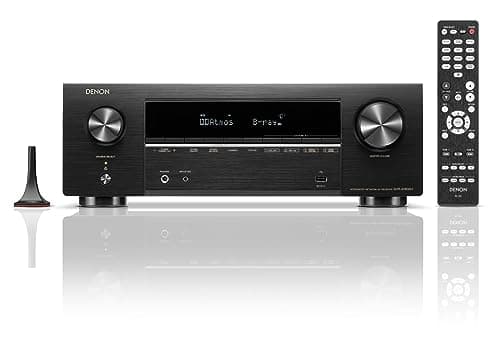
Top pick: Denon AVR-X1800H
$849.0015% off
Best overall under $1,000. #ad Affiliate link — we earn a commission at no extra cost to you.
The short answer
The best home theater system under $2,000 is built on the Denon AVR-X1800H — seven amplifier channels at a published 80 W + 80 W into 8 Ω from 20 Hz to 20 kHz at 0.08% THD, Audyssey MultEQ XT, Dolby Atmos and DTS:X both stated plainly on Denon’s own info sheet, and a phono input whose RIAA deviation Denon actually publishes at ± 1 dB. Around it: a Klipsch R-51M front pair and the Klipsch R-52C center, which cross over 30 Hz apart into the same tweeter on the same horn and are therefore genuinely timbre-matched; an ELAC Debut 2.0 B5.2 pair for surrounds; and the Klipsch R-120SW, a 12-inch subwoofer that publishes 29 Hz at ± 3 dB. The budget component is the ELAC surround pair — the cheapest speakers in the build, deliberately placed where a brand mismatch costs least.
The finding on this page is what the second thousand dollars buys, because our $1,000 build is a 3.1 system and says so: the surround pair is exactly what that ceiling takes away. At $2,000 you get the surrounds, a 12-inch driver instead of a 10-inch one, a receiver with two amplifier channels left over for Atmos height speakers later, and room correction one tier up. What you still do not get is the subwoofer we would rather recommend — and the second live total below shows precisely where that upgrade breaks the ceiling.
Disclosure: we earn a commission if you buy through the links on this page, at no extra cost to you. It does not influence what we pick — our criteria are published and reproducible, so you can check our work. How we pick · Full disclosure
These picks are spec-and-price analyses, not listening tests. We have not heard this gear and we do not pretend to have: every figure below is sourced to the manufacturer and linked, and every price is live or not shown at all. Here are the rules we followed.
Quick picks
Ranked on the published criteria in How We Pick. Prices are live as of November 23, 2026. Tap any row for the full write-up.
- 9.0$719.00View on Amazon
$849.0015% off
- 8.4$229.99View on Amazon
$289.9921% off
- 7.6$119.00View on Amazon
$149.9921% off
- 8.2$265.00View on Amazon
$599.0056% off
- 7.0$269.00View on Amazon
$379.0029% off
- 9.0
| # | Product | Best for | Score | Price |
|---|---|---|---|---|
| 1 | Denon AVR-X1800H Seven channels, 8K passthrough and Audyssey MultEQ XT — the room correction being the feature that actually changes what you hear in a real room. | Best overall under $1,000 | 9.0 | $719.00View on Amazon $849.0015% off |
| 2 | 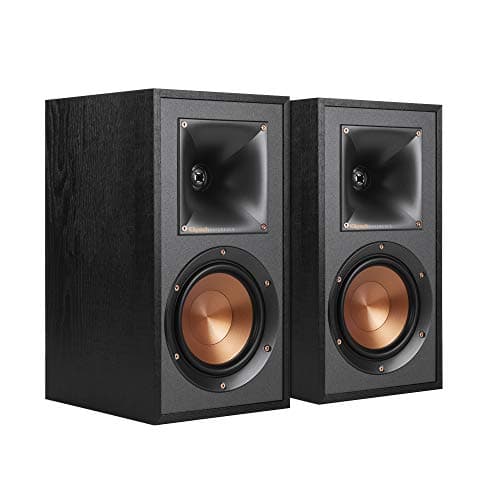 Klipsch R-51M High sensitivity means a modest amplifier drives these to a real volume — the practical answer when the amp is fixed and small. | Best for low-power amplifiers | 8.4 | $229.99View on Amazon $289.9921% off |
| 3 | 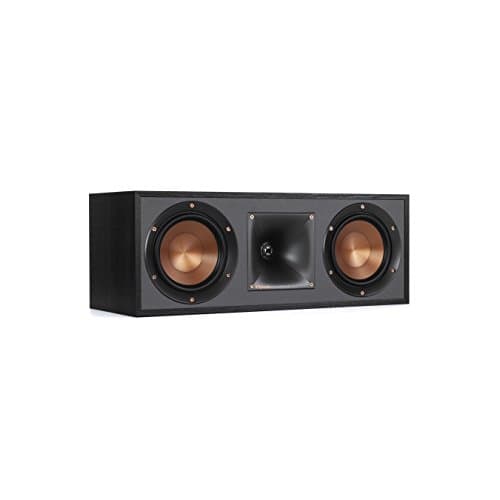 Klipsch R-52C A sealed dual-woofer center with a published 95 dB sensitivity, timbre-matched to the R-41M and R-51M so dialogue does not change character as it pans across the front. | Best center channel | 7.6 | $119.00View on Amazon $149.9921% off |
| 4 | 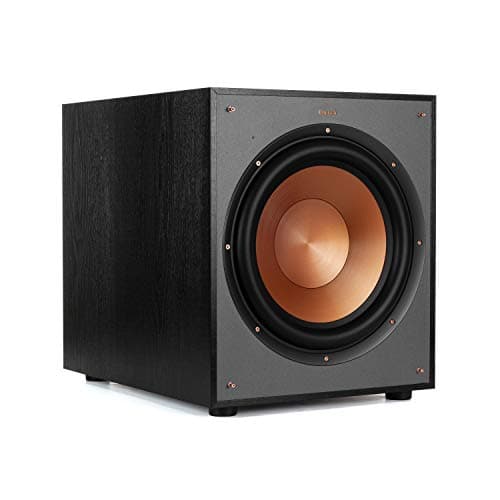 Klipsch R-120SW A 12-inch ported sub whose spec sheet publishes 200 W continuous next to the 400 W peak figure the listings quote — and whose only inputs are RCA, which is the spec that decides whether it works with your amplifier. | Best value 12-inch | 8.2 | $265.00View on Amazon $599.0056% off |
| 5 | 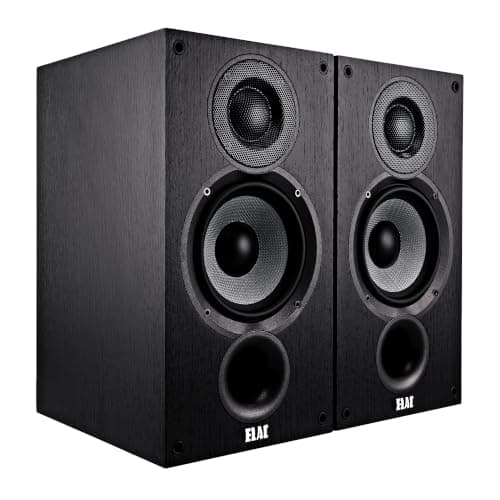 ELAC Debut 2.0 B5.2 The B6.2's smaller sibling — less bass extension in exchange for a cabinet that actually fits on a real bookshelf. | Best for small rooms | 7.0 | $269.00View on Amazon $379.0029% off |
| 6 | 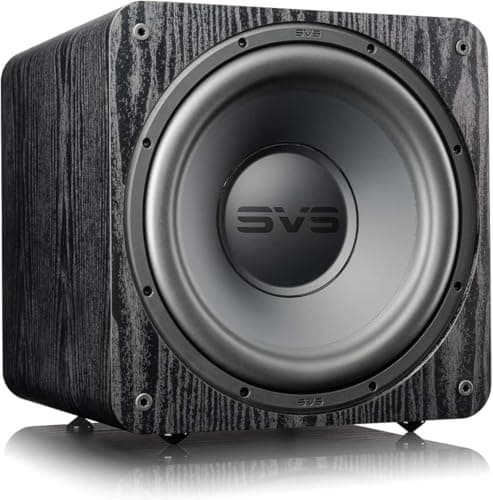 SVS SB-1000 Pro The only subwoofer here whose manufacturer publishes both a continuous power rating and the measurement condition behind its frequency response — 20–270 Hz ± 3 dB at 2 m ground plane — which is what makes its numbers comparable to anything. | Best overall | 9.0 |
A system page has to end in a total, and a total is the one thing this site will not type into a sentence. So both totals on this page are computed when the page loads, from the same price layer that feeds every buy button, with the same “as of” stamp. If a price moves, the total moves. If an item has no live offer, the total is withheld rather than guessed.
The build is five speakers and a subwoofer on a seven-channel receiver. We have not assembled these six products in a room and we are not going to claim to have. What follows is each manufacturer’s own published specification, arithmetic you can reproduce from those figures, and the compromises this ceiling forces — named, not glossed.
What the second thousand dollars actually buys
Four things, and it is worth being specific because “better” is not a purchase decision.
A surround pair. The under-$1,000 build is 3.1 and the page says why: whatever headroom is left after a receiver, a front pair, a center and a subwoofer is less than any speaker pair we cover. This build has the surrounds in it, which is the difference between a wide front image and sound behind your head.
Two spare amplifier channels. The Denon AVR-X1800H has seven power amplifiers and Denon describes the configuration as 7.2 or 5.2.2. Run as 5.1 it leaves two channels unused, which is what a pair of Atmos height speakers plugs into later with no new electronics. Our Atmos placement guide covers what that second step involves.
A bigger driver with a published tolerance. The Klipsch R-120SW is a 12-inch front-firing woofer in a rear-ported cabinet, publishing 29 Hz to 120 Hz at ± 3 dB, 200 W continuous and 400 W peak, and a 116 dB maximum acoustic output. The $1,000 build’s subwoofer is a 10-inch model.
Room correction one tier up. Audyssey MultEQ XT on the X1800H against MultEQ on the cheaper Denons. That matters more here than it would on a matched system, for a reason the arithmetic section makes concrete.
- Denon AVR-X1800H$719.00
- Klipsch R-51M$229.99
- Klipsch R-52C$119.00
- ELAC Debut 2.0 B5.2$269.00
- Klipsch R-120SW$265.00
Total: $1,601.99
That is $398.01 under the $2,000 ceiling.
The receiver, and the conflict that kept the cheaper one out
Denon publishes 80 W + 80 W for the AVR-X1800H into 8 Ω, 20 Hz to 20 kHz, at 0.08% THD with two channels driven. Read all of those conditions: it is a full-bandwidth two-channel rating, which is the honest form, and it is not an all-channels-driven figure, because no receiver in this registry publishes one. Seven amplifier channels, 6 HDMI inputs with three at 8K, one eARC output, 8K/60 and 4K/120 passthrough, HEOS streaming, and Dolby Atmos and DTS:X both answered “Yes” on Denon’s own info sheet.
The cheaper Denon AVR-S670H would have left meaningful room in this budget, and it is not here for a specific reason we publish rather than hide: Denon’s own documents disagree about whether it does Atmos at all. The info sheet’s decoder list enumerates Dolby TrueHD, Digital, Digital Plus and Pro Logic II with a Dolby Audio logo and names neither Atmos nor DTS:X, while Denon’s own product-page title for the same model reads “with Dolby Atmos.” We trust a spec table over a page title, and at a $2,000 ceiling nobody should be buying into that ambiguity. Our Denon ladder lays out the whole range on this and the under-$1,000 receiver roundup ranks the X1800H against its direct rivals.
Two honest marks against the X1800H in this build. Its pre-outs are 2.2 only — front left and right plus two subwoofer outputs, not a full seven-channel set — so adding external power amplification later is limited to the front pair. And Denon’s 0.1 W standby figure holds only with Network Control set to “Off In Standby” and HDMI pass-through off; with CEC standby it is 0.5 W, and Denon publishes no idle figure for a receiver that is powered on and not playing.
One row is worth singling out on a site about records. The X1800H is the only receiver in our registry that publishes a RIAA deviationfigure for its phono stage — ± 1 dB from 20 Hz to 20 kHz, with 74 dB signal-to-noise and 0.03% distortion at 1 kHz into 3 V, at 2.5 mV MM input sensitivity. Most makers tell you a phono input exists. Denon tells you how accurately it bends the curve back. Connecting a turntable to a receiver covers the rest.
The five speakers, on the four rows that decide the build
All three state their sensitivity at the same 2.83 V / 1 m condition, which is rarer than it should be and makes the first column an actual comparison for once. The second column is the timbre argument: the two Klipsch models hand over to the tweeter 30 Hz apart, and the ELAC 540 Hz later into a different kind of dome. The fourth column is why the comparison in the first is still not perfectly clean — 2.83 V is one watt into eight ohms and about one and a third into six.
Every figure below is the manufacturer’s own published value and links to the document we read it from. “Not published” means the manufacturer does not publish that figure; an em dash means we have no published figure for that model. Prices are live as of November 23, 2026.
Best for low-power amplifiers
- Sensitivity, with its condition
- 93 dB · 2.83 V / 1 m
- Crossover — where the seam is
- 1,660 Hz
- Low-end limit, with its tolerance
- 62 Hz ± 3 dB
- Impedance
- 8 Ω “compatible”
Best center channel
- Sensitivity, with its condition
- 95 dB · 2.83 V / 1 m
- Crossover — where the seam is
- 1,630 Hz
- Low-end limit, with its tolerance
- 89 Hz ± 3 dB
- Impedance
- 8 Ω “compatible”
Best for small rooms
- Sensitivity, with its condition
- 86 dB · 2.83 V / 1 m
- Crossover — where the seam is
- 2,200 Hz
- Low-end limit, with its tolerance
- 46 Hz — no tolerance published
- Impedance
- 6 Ω, stated flatly
| Pick | Sensitivity, with its condition | Crossover — where the seam is | Low-end limit, with its tolerance | Impedance | Price |
|---|---|---|---|---|---|
| 2.Klipsch R-51MBest for low-power amplifiers | 93 dB · 2.83 V / 1 m | 1,660 Hz | 62 Hz ± 3 dB | 8 Ω “compatible” | |
| 3.Klipsch R-52CBest center channel | 95 dB · 2.83 V / 1 m | 1,630 Hz | 89 Hz ± 3 dB | 8 Ω “compatible” | |
| 5.ELAC Debut 2.0 B5.2Best for small rooms | 86 dB · 2.83 V / 1 m | 2,200 Hz | 46 Hz — no tolerance published | 6 Ω, stated flatly |
Prices as of November 23, 2026; every “Check Price” link goes to Amazon and earns us a commission at no extra cost to you. #ad
Why the front three are Klipsch and the surrounds are not
The front three carry almost everything you notice. Dialogue lives in the center channel, and a pan from the left speaker across the center to the right crosses two seams on its way. So the front three should be timbre-matched, and in this registry that means Klipsch, because the R-52C is the only dedicated center channel we cover.
The match is unusually clean. The Klipsch R-51M crosses over at 1,660 Hz and the R-52C at 1,630 Hz — 30 Hz apart — into the same 1-inch aluminum LTS tweeter on the same 90° × 90° Tractrix horn, with the same 5.25-inch spun-copper IMG cone below it (two of them in the center). Compare that with the compromise the $1,000 build is forced into, where the center hands over 570 Hz away from the fronts and into a different tweeter technology.
The surrounds are where we spend least on purpose, and the ELAC Debut 2.0 B5.2 is the choice because of what it publishes rather than what it costs: 6 Ω stated flatly rather than “compatible,” 86 dB at the same 2.83 V / 1 m condition as the Klipsch models, a 2,200 Hz crossover, a 1-inch cloth dome, a woven aramid-fiber cone and 13.0 lb per cabinet. Against it: ELAC publishes its 46 Hz low-end figure with no tolerance window, and publishes a 120 W maximum power input, which is a handling limit rather than a recommended amplifier range.
The honest cost of mixing brands is that the ELAC crosses over 540 Hz above the Klipsch center and into a cloth dome rather than a horn, so a sound panning from a front speaker to a surround changes character on the way. That seam exists. It sits behind and beside the listener, where surround channels carry ambience and effects rather than dialogue, which is why this is the right place in a five-speaker build to accept it. The alternative is the fully matched Klipsch family, and the timbre-matched Klipsch surround option is the R-41M, which Amazon now lists only as a two-pair four-speaker pack — a cheaper route per speaker if you are building 7.1, and worth checking against the headroom in the total above.
Seven decibels between the fronts and the surrounds, in watts
This is the one number in the build that a reader can act on, and it is a calibration task rather than a defect. Both figures below are published at the same measurement condition, so the comparison is real.
Power ratio = 10^(ΔdB ÷ 10) · 2.83 V into R ohms = 8 ÷ R watts
Inputs
- Klipsch R-51M sensitivity: 93 dB at 2.83 V / 1 m; impedance published as 8 Ω “compatible” (Klipsch spec sheet (PDF))
- ELAC Debut 2.0 B5.2 sensitivity: 86 dB at 2.83 V / 1 m; impedance published as 6 Ω (ELAC spec page)
Result
Raw gap: 10^(7 ÷ 10) = 5.0×
Load correction: 2.83 V into 6 Ω = 1.33 W against 1.00 W into 8 Ω, which is 10 log₁₀(1.33) = 1.25 dB
Comparable gap: 7 − 1.25 = 5.75 dB → 10^(5.75 ÷ 10) = 3.8×
So the surrounds ask the receiver for roughly four times the powerthe fronts do for the same sound pressure level — not five, once you account for the fact that 2.83 V delivers a third more power into ELAC’s six ohms than into Klipsch’s stated eight. Uncorrected for an uncalibrated system, that is a surround field sitting several decibels quiet. The receiver fixes it: Audyssey MultEQ XT sets a level trim per channel from its own microphone measurement, and this is the main reason the better room correction tier earns its place in this build rather than being a specification to brag about.
The subwoofer, and the upgrade that breaks the ceiling
The build above uses the Klipsch R-120SW, and it is a genuinely strong specification for the money: a 12-inch high-excursion spun-copper IMG woofer, 29 Hz to 120 Hz at ± 3 dB, 200 W continuous and 400 W peak all-digital amplification, and 116 dB of maximum acoustic output. One compatibility trap is worth flagging because it is a single line in the spec sheet: its inputs are line-level and LFE RCA only, with no speaker-level input. That is fine with the Denon, which has subwoofer pre-outs, and a problem with an old integrated amplifier that has none. Klipsch also publishes no low-pass crossover range, only that the control exists.
The subwoofer we would rather put in this build is the SVS SB-1000 Pro, and the reason is not the diameter, because both are twelve inches. SVS publishes 20 Hz to 270 Hz at ± 3 dB with its measurement condition attached— two meters, ground plane, away from reflective structures — and it is the only subwoofer manufacturer in this registry that states the condition at all. It is sealed rather than ported, runs 325 W RMS continuous from a Sledge class-D amplifier, publishes 13.3 mm of Xmax, and carries a 50 MHz DSP with an app offering three presets and three parametric EQ bands each. Nine hertz lower, with the measurement condition published, from a smaller cabinet.
Here is that build totalled against the same ceiling. The comparison is the point: the same five speakers, one component changed.
- Denon AVR-X1800H$719.00
- Klipsch R-51M$229.99
- Klipsch R-52C$119.00
- ELAC Debut 2.0 B5.2$269.00
- SVS SB-1000 Pro$599.00
Total: $1,935.99
That is $64.01 under the $2,000 ceiling.
What $2,000 still does not buy
Three things, stated plainly, because a ceiling page that pretends the ceiling is generous is useless.
It does not buy Atmos height speakers. The receiver decodes Atmos and has the two spare amplifier channels, which is the expensive half of the problem solved — but the speakers, the mounts and the cable are a separate purchase, and this budget has no room for them. Our 5.1 against 7.1 comparison sets out whether the extra pair is worth doing before the height channels.
It does not buy the subwoofer with the published measurement condition, as the two totals above demonstrate rather than assert. If the ceiling is soft by a small margin, that is the single upgrade we would make first — ahead of better surrounds, ahead of a bigger receiver.
And it does not buy external amplification. The X1800H’s pre-outs are 2.2, so the upgrade path that leads to separate power amplifiers starts and ends at the front pair on this receiver. Our pre-outs roundup ranks the receivers that do publish a fuller set, all of them above this budget once the speakers are added.
Where this page sits in our home theater coverage
This is the upper rung of a two-rung ladder. The $1,000 build is the one below it, and its 3.1 finding is the premise of this page rather than a competing recommendation. If you have already settled the speakers and only need the electronics, the under-$1,000 receiver roundup is the better page; if the speakers are the open question, our matched-family roundup and the under-$1,000 speaker bracket both rank on criteria this page only touches.
Every pick in detail
Every specification below links to the manufacturer document we read it from. Where a manufacturer does not publish a figure, we say so rather than estimating it.
Denon AVR-X1800H
Best overall under $1,000Seven channels, 8K passthrough and Audyssey MultEQ XT — the room correction being the feature that actually changes what you hear in a real room.
- channels
- 9/10
- room correction
- 9/10
- connectivity
- 9/10
- value for money
- 9/10
- future proofing
- 9/10
| Specification | Published value | Source |
|---|---|---|
| Channels | 7.2 (7 power amplifiers — 7.2 or 5.2.2) | Denon info sheet (PDF) |
| Power output | 80 W + 80 W (8 Ω, 20 Hz – 20 kHz, 0.08% THD, 2 ch driven) | Denon info sheet (PDF) |
| Room correction | Audyssey MultEQ XT, with Dynamic EQ and Dynamic Volume | Denon info sheet (PDF) |
| Dolby Atmos / DTS:X | Yes / Yes | Denon info sheet (PDF) |
| Phono input | Yes — MM, 2.5 mV input sensitivity; RIAA deviation ±1 dB (20 Hz – 20 kHz); S/N 74 dB (IHF-A); distortion 0.03% (1 kHz, 3 V) | Denon owner's manual, audio section |
| Analog input sensitivity | 200 mV; frequency response 10 Hz – 100 kHz (+1, −3 dB, Direct mode); S/N 98 dB (IHF-A, Direct mode) | Denon owner's manual, audio section |
| Power consumption | 430 W. Standby 0.1 W — but only with Network Control set to “Off In Standby” and HDMI Pass Through off; CEC standby is 0.5 W. Denon publishes no idle (powered-on, not playing) figure at all. | Denon owner's manual, general section |
| HDMI in / out | 6 in (3 are 8K) / 1 out (eARC) | Denon info sheet (PDF) |
| Video passthrough | 8K/60 Hz, 4K/120 Hz; VRR, QFT, ALLM | Denon product page |
| HDMI 2.1 gaming features | ALLM / QMS / QFT / VRR — Yes / No / Yes / Yes. Denon does not state which of the six inputs carry them beyond the “3 x 8K” count. | Denon product page |
| Pre-outs | 2.2 only (front L/R + 2 subwoofer) — NOT a full 7.2 pre-out | Denon info sheet (PDF) |
| Streaming | HEOS built-in; AirPlay 2, Spotify Connect, Amazon Music HD, TIDAL | Denon info sheet (PDF) |
Pros
- Audyssey MultEQ XT room correction — a step above the plain MultEQ on the cheaper models
- 7.2 channels — enough for a 5.2.2 Atmos layout
- MM phono input, so a turntable connects without a separate stage
- 8K/60 and 4K/120 passthrough with VRR and ALLM
Cons
- Only 2.2 pre-outs (front L/R plus subwoofers) — you cannot add external amplification to the surround channels later
- Menus are dense
- Runs warm in a closed cabinet
Skip it if you only need 5 channels — the AVR-S670H shares the same core for less.
Klipsch R-51M
Best for low-power amplifiersHigh sensitivity means a modest amplifier drives these to a real volume — the practical answer when the amp is fixed and small.
- sensitivity
- 10/10
- bass extension
- 6/10
- amp friendliness
- 10/10
- value for money
- 9/10
- build quality
- 7/10
| Specification | Published value | Source |
|---|---|---|
| Sensitivity | 93 dB (2.83 V / 1 m) | Klipsch spec sheet (PDF) |
| Impedance | 8 Ω “compatible” (Klipsch's wording — not a measured nominal figure) | Klipsch spec sheet (PDF) |
| Minimum impedance | Not published | — |
| Frequency response | 62 Hz – 21 kHz ± 3 dB | Klipsch spec sheet (PDF) |
| Power handling | 85 W continuous / 340 W peak (a handling limit, not a recommended amplifier range) | Klipsch spec sheet (PDF) |
| Woofer | 5.25 in spun-copper IMG | Klipsch spec sheet (PDF) |
| Tweeter | 1 in aluminum LTS on a 90° × 90° Tractrix horn | Klipsch spec sheet (PDF) |
| Crossover | 1,660 Hz | Klipsch spec sheet (PDF) |
| Weight (each) | 11 lb / 5 kg | Klipsch spec sheet (PDF) |
Pros
- High sensitivity — plays loud on very little power
- The right answer for a low-wattage or tube amplifier
- Horn tweeter gives strong dispersion control
Cons
- Horn presentation is divisive and we cannot tell you how it sounds — we have not heard them
- Rear port needs breathing room from the wall
- Less low-end than the ELAC B6.2
- Previous generation — Klipsch's own page for it now points buyers to the newer Reference R-50M
Skip it if your amp already has power to spare — you are paying for sensitivity you do not need.
Klipsch R-52C
Best center channelA sealed dual-woofer center with a published 95 dB sensitivity, timbre-matched to the R-41M and R-51M so dialogue does not change character as it pans across the front.
- specs
- 7/10
- sensitivity
- 10/10
- published data
- 6/10
- value for money
- 9/10
- bass extension
- 2/10
| Specification | Published value | Source |
|---|---|---|
| Sensitivity | 95 dB (2.83 V / 1 m) — the highest figure of any center channel on this site | Klipsch spec sheet (PDF) |
| Impedance | 8 Ω “compatible” (Klipsch's wording) | Klipsch spec sheet (PDF) |
| Minimum impedance | Not published | — |
| Frequency response | 89 Hz – 21 kHz ± 3 dB | Klipsch spec sheet (PDF) |
| Power handling | 100 W continuous / 400 W peak | Klipsch spec sheet (PDF) |
| Woofers | Dual 5.25 in spun-copper IMG | Klipsch spec sheet (PDF) |
| Tweeter | 1 in aluminum LTS on a 90° × 90° Tractrix horn | Klipsch spec sheet (PDF) |
| Crossover | 1,630 Hz | Klipsch spec sheet (PDF) |
| Enclosure | MDF, SEALED (the R-41M and R-51M are both ported) | Klipsch spec sheet (PDF) |
| Weight | 13.5 lb / 6.12 kg | Klipsch spec sheet (PDF) |
Pros
- 95 dB at 2.83 V/1 m — the highest published sensitivity of any center channel on this site
- Sealed enclosure, unlike the ported R-41M and R-51M, so it can sit inside a cabinet without port chuffing
- Same 1 in LTS tweeter and Tractrix horn as the R-series bookshelves, which is what timbre matching actually means
- 100 W continuous handling gives a receiver plenty of headroom for dialogue peaks
Cons
- 89 Hz low-end limit — a center channel this shallow depends entirely on the receiver's bass management
- 18.75 in wide, which will not fit under every television
- “8 ohms compatible” again, with no minimum impedance published
- Only useful in a multichannel system; it does nothing for a stereo setup
- Previous generation — Klipsch's own page for it now points buyers to the newer Reference R-50C
Skip it if you are building a stereo system. A center channel has no role in two-channel listening and adding one is not an upgrade.
Klipsch R-120SW
Best value 12-inchA 12-inch ported sub whose spec sheet publishes 200 W continuous next to the 400 W peak figure the listings quote — and whose only inputs are RCA, which is the spec that decides whether it works with your amplifier.
- extension
- 8/10
- published data
- 8/10
- room control
- 4/10
- value for money
- 9/10
- build quality
- 7/10
| Specification | Published value | Source |
|---|---|---|
| Frequency response | 29 Hz – 120 Hz ± 3 dB | Klipsch spec sheet (PDF) |
| Amplifier power (cont/peak) | 200 W / 400 W, all-digital. The 400 W is the peak figure and it is the one the listings quote. | Klipsch spec sheet (PDF) |
| Maximum acoustic output | 116 dB | Klipsch spec sheet (PDF) |
| Driver | 12 in high-excursion spun-copper IMG woofer, front-firing | Klipsch spec sheet (PDF) |
| Enclosure type | Bass-reflex via rear-firing port, MDF | Klipsch spec sheet (PDF) |
| Inputs | Line level / LFE RCA jacks only — NO speaker-level inputs | Klipsch spec sheet (PDF) |
| Controls | Volume, low-pass, 0/180 phase, auto power on | Klipsch spec sheet (PDF) |
| Dimensions | 16.5 in H × 14 in W × 19.2 in D (419 × 356 × 488 mm) | Klipsch spec sheet (PDF) |
| Weight | 31 lb (14.1 kg) | Klipsch spec sheet (PDF) |
| Low-pass crossover range | Not published | — |
Pros
- 200 W continuous IS published, alongside the 400 W peak — Klipsch prints both
- 29 Hz – 120 Hz ± 3 dB, a real tolerance rather than a bare number
- Maximum acoustic output published at 116 dB
- Front-firing driver with a rear port, so it is less fussy about how far it sits from a wall than a down-firing design
Cons
- Line/LFE RCA inputs ONLY — no speaker-level inputs, so an integrated amp with no subwoofer output cannot drive it without a converter
- The 400 W in every listing headline is the peak figure, not the rating
- A large box: 19.2 inches deep, 31 lb
- Klipsch does not publish the low-pass crossover range, only that a low-pass control exists
- Previous generation — Klipsch's own page for it now points buyers to the newer Reference R-121SW
Skip it if your amplifier has no subwoofer output. This one has no speaker-level input, and that is a hard stop rather than an inconvenience.
ELAC Debut 2.0 B5.2
Best for small roomsThe B6.2's smaller sibling — less bass extension in exchange for a cabinet that actually fits on a real bookshelf.
- sensitivity
- 6/10
- bass extension
- 6/10
- amp friendliness
- 6/10
- value for money
- 7/10
- build quality
- 8/10
| Specification | Published value | Source |
|---|---|---|
| Sensitivity | 86 dB (2.83 V / 1 m) | ELAC spec page |
| Impedance | 6 Ω | ELAC spec page |
| Minimum impedance | Not published | — |
| Frequency response | 46 Hz – 35 kHz (no tolerance published) | ELAC spec page |
| Maximum power input | 120 W (a handling limit, not a recommended amplifier range) | ELAC spec page |
| Woofer | 5.25 in woven aramid-fiber cone | ELAC spec page |
| Tweeter | 1 in cloth dome | ELAC spec page |
| Crossover | 2,200 Hz | ELAC spec page |
| Weight (each) | 13.0 lb / 5.9 kg | ELAC spec page |
Pros
- Genuinely shelf-sized
- Same driver and cabinet design language as the B6.2
- Easier to place
Cons
- Less low-end extension than the B6.2
- Still not an easy load
- The outgoing generation — ELAC's Debut 3.0 DB53 now builds on it
Skip it if you have the space for the B6.2. It reaches lower and is a decibel more sensitive, so compare the two live prices before choosing — which one costs less has already flipped once.
SVS SB-1000 Pro
Best overallPrice as of November 23, 2026. #ad
The only subwoofer here whose manufacturer publishes both a continuous power rating and the measurement condition behind its frequency response — 20–270 Hz ± 3 dB at 2 m ground plane — which is what makes its numbers comparable to anything.
- extension
- 9/10
- published data
- 10/10
- room control
- 10/10
- value for money
- 6/10
- build quality
- 9/10
| Specification | Published value | Source |
|---|---|---|
| Frequency response | 20–270 Hz ± 3 dB, measured 2 m ground plane away from reflective structures (quasi-anechoic). SVS is the only manufacturer in this group that publishes the measurement condition. | SVS product page |
| Amplifier power | 325 W RMS continuous (820+ W peak dynamic), Sledge STA-325D class D | SVS product page |
| Driver | 12 in long-throw, 13.3 mm Xmax / 26.9 mm Xmech, 1.5 in voice coil | SVS product page |
| Enclosure type | Sealed, extra-thick MDF front baffle with internal bracing | SVS product page |
| Inputs | Unbalanced stereo RCA in/out (16 kΩ) plus speaker-level stereo input (1 kΩ); 3–12 V AC/DC trigger | SVS product page |
| DSP / app | 50 MHz Analog Devices DSP; Bluetooth app for iOS/Android with 3 nameable presets, 3 parametric EQ bands per preset, adjustable low pass, phase, polarity and room-gain compensation | SVS product page |
| Dimensions (with grille) | 13.5 in H × 13 in W × 14.76 in D (342 × 330 × 375 mm) | SVS product page |
| Weight | 26 lb (11.9 kg) unboxed with grille | SVS product page |
Pros
- 325 W RMS continuous is a continuous rating, not a peak figure dressed as one
- 20–270 Hz ± 3 dB published WITH its measurement condition — nobody else here does that
- App DSP with three parametric EQ bands per preset and room-gain compensation, which is real control over the one band room correction handles worst
- Speaker-level inputs as well as RCA, so an integrated amp with no sub output can still drive it
- Sealed 13-inch cabinet — it fits where a ported 12 will not
Cons
- The most expensive pick here
- Sealed alignment trades raw output near tuning for a gentler roll-off — a ported box of the same size will play louder at 30 Hz
- The app is the interface for the good features; the front panel alone is not
- One of these in a large open-plan room will run out before a bigger ported sub does
Skip it if your room is large and open-plan and output matters more to you than measured accuracy. A ported 12 costs less and moves more air down low.
Frequently asked questions
What is the best home theater system under $2,000?
Can you get a real 5.1 system for under $2,000?
Why not use the cheaper Denon AVR-S670H and spend more on speakers?
Do the surround speakers have to match the front speakers?
Will the receiver drive speakers of different sensitivities?
Have you built and listened to this system?
Read next
The Best Home Theater System Under $1,000
A four-box build that totals under $1,000 at live prices — and the arithmetic showing why the fifth and sixth speakers are what the ceiling takes away, not the subwoofer.
The Best AV Receivers Under $1,000
Five receivers under $1,000, compared on FTC-rated power and the pre-out spec almost nobody mentions.
The Best Subwoofers for a Home Theater
Six subwoofers ranked on continuous power and published response, including two that publish neither.
The Best Home Theater Speakers
A timbre-matched 5.1 built from published specs — fronts, center, surrounds and a subwoofer that actually connects.
How to Set Speaker Levels in a Home Theater
The order of operations for channel levels and distances, what the automatic run decides for you, and the three settings to verify afterwards.
5.1 vs 7.1: Which Should You Build?
Seven channels buy you surround backs OR height speakers, not both. Four of the ten receivers we cover are 5.2 only, and one 7.2 receiver documents no 7.1 layout in its own manual.
Sources
Every specification on this page was read from one of these documents. If one of them has changed, or we have made an error, tell us — corrections are logged and dated per our editorial policy.
- Denon AVR-X1800H info sheet (PDF)
- Denon AVR-X1800H owner's manual — audio specifications
- Denon AVR-S670H info sheet (PDF) — the decoder list
- Klipsch R-51M spec sheet (PDF)
- Klipsch R-52C spec sheet (PDF)
- Klipsch R-41M spec sheet (PDF)
- ELAC Debut 2.0 B5.2 specifications
- Klipsch R-120SW spec sheet (PDF)
- SVS SB-1000 Pro specifications