5.1 vs 7.1: Which Should You Build?
Seven amplifier channels do not mean seven speakers around you. They mean a choice between surround backs and height speakers, made once, in the setup menu — and the right answer is decided by how much floor there is behind your seats, not by the number on the box.

The short answer
Build 5.1.2 rather than 7.1 unless you have at least about four feet of floor behind the seating, and build 5.1 if your receiver only has five channels — it is a complete layout, not a compromised one. Seven amplifier channels are a choice, not an upgrade: the Denon AVR-X1800H states it plainly as “7.2 or 5.2.2”, meaning the sixth and seventh amplifiers drive either surround back speakers or height speakers, and never both. Height wins for most rooms because Atmos and DTS:X content uses it and because surround backs sitting a foot behind your head do the job of the side surrounds you already have. The receiver to do it with is the Denon AVR-X1800H, on Audyssey MultEQ XT.
Disclosure: we earn a commission if you buy through the links on this page, at no extra cost to you. It does not influence what we pick — our criteria are published and reproducible, so you can check our work. How we pick · Full disclosure
These picks are spec-and-price analyses, not listening tests. We have not heard this gear and we do not pretend to have: every figure below is sourced to the manufacturer and linked, and every price is live or not shown at all. Here are the rules we followed.
Quick picks
Ranked on the published criteria in How We Pick. Prices are live as of October 16, 2026. Tap any row for the full write-up.
- 9.0
- 8.2
- 8.2$649.00View on Amazon
$899.9928% off
- 7.4
| # | Product | Best for | Score | Price |
|---|---|---|---|---|
| 1 | 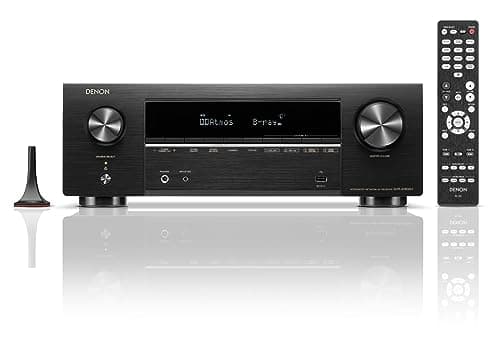 Denon AVR-X1800H Seven channels, 8K passthrough and Audyssey MultEQ XT — the room correction being the feature that actually changes what you hear in a real room. | Best overall under $1,000 | 9.0 | |
| 2 | 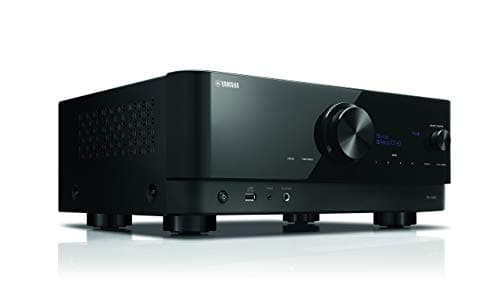 Yamaha RX-V6A The most powerful receiver here on paper — 100 watts a channel rated across the full band — with a phono input and seven HDMI inputs. | Best for music as well as film | 8.2 | |
| 3 | 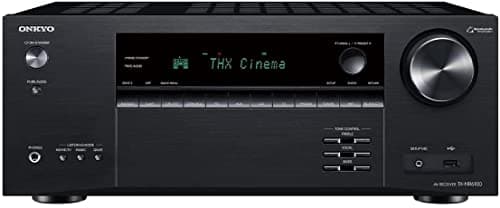 Onkyo TX-NR6100 THX certified with three 4K120 HDMI inputs, which is the specific spec that matters if two consoles and a PC share the same receiver. | Best for gaming | 8.2 | $649.00View on Amazon $899.9928% off |
| 4 | 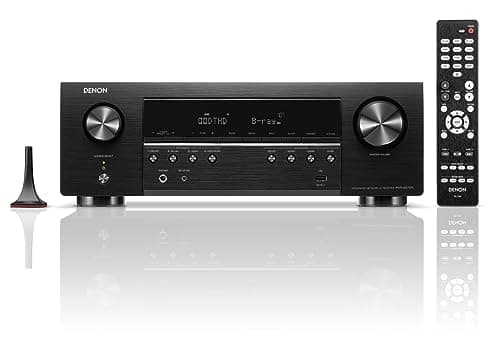 Denon AVR-S670H The X1800H's five-channel sibling: the same 8K plumbing and Audyssey correction, minus the two channels an Atmos height pair would need. | Best 5.2 option | 7.4 |
The numbers mean speakers: the first is how many full-range channels sit around you at ear height, the second how many subwoofers, and a third — as in 5.1.2 — how many height channels. So 5.1 is left, centre, right, two surrounds and a subwoofer; 7.1 adds two surround backs directly behind the seating. The reason this is a decision rather than a ladder is that an affordable seven-channel receiver has seven amplifiers, and both the surround backs and the height speakers want the same two.
What the receivers actually document
| Receiver | Amplifier channels | Documented layouts |
|---|---|---|
| Denon AVR-X1800H | 7 | “7.2 or 5.2.2” — the choice stated explicitly |
| Yamaha RX-V6A | 7 | 7.2; Atmos with Height Virtualization, DTS:X |
| Onkyo TX-NR6100 | 7 | 7.2, THX certified; Atmos listed as 5.2.2 playback |
| Marantz Cinema 70s | 7 | 7.2 powered, with a full 7.2 pre-out set |
| Onkyo TX-NR5100 | 7 | 3.1, 5.1, 3.1.2 and 5.1.2 only — no 7.1 and no 5.1.4 in the manual |
| Denon AVR-S670H | 5 | 5.2 (and an unresolved Atmos conflict — see below) |
| Yamaha RX300A | 5 | 5.2, 5.1 decodable; Atmos yes, DTS:X no |
| Denon AVR-S570BT | 5 | 5.2; neither Atmos nor DTS:X named anywhere |
| Yamaha RX-V4A | 5 | 5.2; Atmos and DTS:X both listed as N/A |
The fifth row is the one to stop on. The Onkyo TX-NR5100 has seven amplifier channels and its own manual publishes no seven-speaker layout at all — the documented arrangements stop at 5.1.2. So “7.2 channels” on a specification sheet is a count of amplifiers, not a promise of a 7.1 setup, and it is worth opening the manual before you buy seven speakers. Our 7.2 receiver roundup ranks four of these on that question specifically.
The decision is room depth, and it is measurable
Surround back speakers only do anything if they are meaningfully behind you. Dolby’s published placement guidance puts side surrounds at roughly 90 to 110 degrees from the screen axis and surround backs at the rear; if your sofa is against the back wall, the surround backs end up within a foot or two of your ears, arriving at nearly the same angle as the side surrounds and adding a second copy of the same information rather than a new direction.
Height channels have no such constraint, because the free dimension in almost every domestic room is up. That is the practical case for 5.1.2 over 7.1 in a normal living room, and it is the layout the Denon names first after 7.2. Our Atmos placement guide has the published angles and the up-firing module requirements; we are not going to restate them here.
The crossover consequence of adding more speakers
More channels means more small speakers, and small speakers mean the subwoofer takes more of the work. The registry makes the arithmetic concrete, because every speaker publishes a low-frequency limit and they do not agree:
set each speaker group's crossover at or above its own published −3 dB point, not at a single default
Inputs
- Klipsch R-52C centre channel response: 89 Hz – 21 kHz ± 3 dB (sealed enclosure) (Klipsch spec sheet (PDF))
- Klipsch R-51M bookshelf response: 62 Hz – 21 kHz ± 3 dB (Klipsch spec sheet (PDF))
- Klipsch R-41M bookshelf response: 68 Hz – 21 kHz ± 3 dB (Klipsch spec sheet (PDF))
- SVS SB-1000 Pro subwoofer extension: 20 Hz ± 3 dB (sealed, 1.50 cu ft external volume) (SVS spec page)
Result
Centre (R-52C): crossover at 90 Hz or above, not 80 Hz
Fronts / surrounds (R-51M): 65–70 Hz
Surround backs or heights (R-41M): 70–80 Hz
Gap at a single 80 Hz setting with an R-52C centre: 9 Hz where dialogue is already 3 dB down
This is the reason the conventional “set everything to 80 Hz” advice misfires on a real speaker set. A sealed centre channel rolling off at 89 Hz handed a crossover of 80 Hz has a band it cannot fill and the subwoofer has not been asked to. Set the centre higher than the fronts; the extra channels in a 7.1 or 5.1.2 build are usually the smallest speakers in the room and want the highest crossover of all.
When 7.1 is genuinely the right answer
Three cases. A long room with real depth behind the seating, where surround backs can be several feet away and arrive from a distinctly different direction. A second row of seats, where the back row’s side surrounds are the front row’s surround backs and seven channels serve both. And a library that is mostly older 7.1 Blu-ray discs rather than Atmos streams, where the content was mixed for the layout.
Outside those, the two extra channels buy more in the vertical plane. Note that two of the five-channel receivers claim Atmos anyway: the Yamaha RX300A lists Atmos and no DTS:X, and the Yamaha RX-V6A offers Atmos Height Virtualization, which processes height cues through the existing speakers rather than adding any. That is not the same thing as a speaker on the ceiling and we would not buy it expecting to be.
The five-channel receivers, and one to read carefully
A 5.1 build with good speakers beats a 7.1 build with cheap ones, every time, and the five-channel receivers here are not toys — the Denon AVR-S670H publishes 75 W across the full band with Audyssey MultEQ. But two of the four have documentation problems worth knowing. Denon’s product title for the AVR-S670H says “with Dolby Atmos” while Denon’s own info sheet for the same model lists none; and the AVR-S570BT names neither Atmos nor DTS:X anywhere, and publishes no room correction at all. The Yamaha RX-V4A lists Atmos and DTS:X both as N/A, which is at least unambiguous.
If you are starting from nothing, our speaker roundup builds a matched 5.1 from one family, and our setup guide covers the order to do it in. Whether you need a centre at all is a separate question with a surprising answer.
What we would do
Buy a seven-channel receiver — they cost little more and the choice stays open — then wire 5.1.2 and put the money that would have gone on two surround backs into the subwoofer instead. Check the manual’s layout list before assuming seven amplifiers means a 7.1 option, because on the Onkyo TX-NR5100 it does not. And set the centre channel’s crossover above the fronts’, whichever layout you land on.
Every pick in detail
Every specification below links to the manufacturer document we read it from. Where a manufacturer does not publish a figure, we say so rather than estimating it.
Denon AVR-X1800H
Best overall under $1,000Price as of October 16, 2026. #ad
Seven channels, 8K passthrough and Audyssey MultEQ XT — the room correction being the feature that actually changes what you hear in a real room.
- channels
- 9/10
- room correction
- 9/10
- connectivity
- 9/10
- value for money
- 9/10
- future proofing
- 9/10
| Specification | Published value | Source |
|---|---|---|
| Channels | 7.2 (7 power amplifiers — 7.2 or 5.2.2) | Denon info sheet (PDF) |
| Power output | 80 W + 80 W (8 Ω, 20 Hz – 20 kHz, 0.08% THD, 2 ch driven) | Denon info sheet (PDF) |
| Room correction | Audyssey MultEQ XT, with Dynamic EQ and Dynamic Volume | Denon info sheet (PDF) |
| Dolby Atmos / DTS:X | Yes / Yes | Denon info sheet (PDF) |
| Phono input | Yes — MM, 2.5 mV input sensitivity; RIAA deviation ±1 dB (20 Hz – 20 kHz); S/N 74 dB (IHF-A); distortion 0.03% (1 kHz, 3 V) | Denon owner's manual, audio section |
| Analog input sensitivity | 200 mV; frequency response 10 Hz – 100 kHz (+1, −3 dB, Direct mode); S/N 98 dB (IHF-A, Direct mode) | Denon owner's manual, audio section |
| Power consumption | 430 W. Standby 0.1 W — but only with Network Control set to “Off In Standby” and HDMI Pass Through off; CEC standby is 0.5 W. Denon publishes no idle (powered-on, not playing) figure at all. | Denon owner's manual, general section |
| HDMI in / out | 6 in (3 are 8K) / 1 out (eARC) | Denon info sheet (PDF) |
| Video passthrough | 8K/60 Hz, 4K/120 Hz; VRR, QFT, ALLM | Denon product page |
| HDMI 2.1 gaming features | ALLM / QMS / QFT / VRR — Yes / No / Yes / Yes. Denon does not state which of the six inputs carry them beyond the “3 x 8K” count. | Denon product page |
| Pre-outs | 2.2 only (front L/R + 2 subwoofer) — NOT a full 7.2 pre-out | Denon info sheet (PDF) |
| Streaming | HEOS built-in; AirPlay 2, Spotify Connect, Amazon Music HD, TIDAL | Denon info sheet (PDF) |
Pros
- Audyssey MultEQ XT room correction — a step above the plain MultEQ on the cheaper models
- 7.2 channels — enough for a 5.2.2 Atmos layout
- MM phono input, so a turntable connects without a separate stage
- 8K/60 and 4K/120 passthrough with VRR and ALLM
Cons
- Only 2.2 pre-outs (front L/R plus subwoofers) — you cannot add external amplification to the surround channels later
- Menus are dense
- Runs warm in a closed cabinet
Skip it if you only need 5 channels — the AVR-S670H shares the same core for less.
Yamaha RX-V6A
Best for music as well as filmPrice as of October 16, 2026. #ad
The most powerful receiver here on paper — 100 watts a channel rated across the full band — with a phono input and seven HDMI inputs.
- channels
- 9/10
- room correction
- 7/10
- connectivity
- 9/10
- value for money
- 8/10
- future proofing
- 8/10
| Specification | Published value | Source |
|---|---|---|
| Channels | 7.2 | Yamaha spec page |
| Power output | 100 W/ch (8 Ω, 20 Hz – 20 kHz, 0.06% THD, 2 ch driven). Maximum effective output 150 W/ch (1 kHz, 10% THD, 8 Ω) | Yamaha owner's manual |
| Room correction | YPAO with multipoint measurement | Yamaha spec page |
| Dolby Atmos / DTS:X | Yes (with Height Virtualization) / Yes | Yamaha spec page |
| Phono input | Yes — MM, 3.5 mV / 47 kΩ at 1 kHz | Yamaha owner's manual |
| HDMI in / out | 7 in / 1 out (eARC). 8K on inputs 1–3 only | Yamaha spec page |
| HDMI 2.1 gaming features | Not published in the specification table. Yamaha's HDMI feature list for this model reads “8K, 4K Ultra HD (include 8K/60, 50 Hz, 4K/120, 100 Hz 10-bit), 3D Video, ARC, eARC, HDMI Control (CEC), Auto Lip Sync, Deep Color, x.v.Color, HDR10+, Dolby Vision, Hybrid Log-Gamma, DSC FRL, FRL” and HDCP 1.4/2.3 — VRR, ALLM, QMS and QFT are named nowhere in it, and nowhere on the 4K/8K MODE page either. Yamaha adds ALLM and VRR to this model by firmware and documents that separately from the specification. | Yamaha owner's manual, specifications |
| Pre-outs | Front L/R + 2 subwoofer, plus Zone 2 L/R — not a full 7.2 pre-out | Yamaha owner's manual |
| Streaming | MusicCast, AirPlay 2, Bluetooth (SBC/AAC), Spotify Connect | Yamaha spec page |
Pros
- 100 W/ch (8 Ω, 20 Hz – 20 kHz, 0.06% THD) — the highest full-band rating in this group
- Seven HDMI inputs, the most here
- MM phono input, 3.5 mV / 47 kΩ
- YPAO with multipoint measurement, plus MusicCast multiroom
Cons
- YPAO is less sophisticated than Audyssey MultEQ XT on the Denon
- 8K is limited to HDMI inputs 1–3
- Pre-outs are front L/R plus subwoofers only — not a full 7.2
Skip it if room correction quality is your priority — Audyssey MultEQ XT on the Denon goes further.
Onkyo TX-NR6100
Best for gamingTHX certified with three 4K120 HDMI inputs, which is the specific spec that matters if two consoles and a PC share the same receiver.
- channels
- 9/10
- room correction
- 6/10
- connectivity
- 10/10
- value for money
- 8/10
- future proofing
- 8/10
| Specification | Published value | Source |
|---|---|---|
| Channels | 7.2, THX certified | Onkyo product page |
| Power output | 100 W/ch (8 Ω, 20 Hz – 20 kHz, 0.08% THD, 2 ch driven, FTC). The “210 W per channel” figure circulating in search results is a dynamic-power marketing number, not the FTC rating. | Onkyo product page |
| Room correction | AccuEQ with AccuReflex. Dirac Live is NOT available on this model — Onkyo starts Dirac at the TX-NR7100. | Onkyo receiver buying guide |
| Dolby Atmos / DTS:X | Yes / Yes (5.2.2 playback) | Onkyo spec page |
| Phono input | Yes — MM, 3.5 mV rms / 47 kΩ | Onkyo spec page |
| HDMI in / out | 6 in / 2 out. HDMI 2.1 (8K/60, 4K/120) on inputs 1–3 and both outputs; inputs 4–6 are 2.0 up to 4K/60 | Onkyo spec page |
| Streaming | Chromecast built-in, AirPlay 2, DTS Play-Fi, works with Sonos | Onkyo spec page |
| HDMI 2.1 gaming features | “HDMI 2.1 features are supported on HDMI inputs 1–3, Main Out, and Sub/Zone 2 Out in Sub Mode output including VRR, ALLM, QFT (Quick Frame Transport), DSC (Display Stream Compression), QMS (Quick Media Switching), and eARC (Main Out).” Inputs 4–6 carry HDMI 2.0 features only. | Onkyo spec page |
| Power consumption | 635 W operating, 65 W idle (on, not playing), 0.1 W standby | Onkyo spec page |
| Pre-outs | Subwoofer pre-out (1 V rms / 470 Ω) and a Zone 2/Zone B line-out (200 mV rms / 470 Ω). No main-channel pre-outs are listed | Onkyo spec page |
Pros
- Three HDMI 2.1 inputs at 8K/60 and 4K/120 — the most console-friendly receiver here
- THX certified
- MM phono input, which is unusual on a gaming-focused receiver
- 100 W/ch FTC-rated into 8 Ω across the full band
Cons
- Room correction is AccuEQ, NOT Dirac Live — Onkyo starts Dirac at the TX-NR7100, and this model has no upgrade path to it
- The “210 W per channel” figure in most search results is dynamic-power marketing; the FTC rating is 100 W
- HDMI inputs 4–6 are only HDMI 2.0, capped at 4K/60
Skip it if you have one source — you are paying for HDMI 2.1 inputs you will never fill.
Denon AVR-S670H
Best 5.2 optionPrice as of October 16, 2026. #ad
The X1800H's five-channel sibling: the same 8K plumbing and Audyssey correction, minus the two channels an Atmos height pair would need.
- channels
- 6/10
- room correction
- 9/10
- connectivity
- 8/10
- value for money
- 8/10
- future proofing
- 6/10
| Specification | Published value | Source |
|---|---|---|
| Channels | 5.2 (5 power amplifiers) | Denon info sheet (PDF) |
| Power output | 75 W + 75 W (8 Ω, 20 Hz – 20 kHz, 0.08% THD, 2 ch driven) | Denon info sheet (PDF) |
| Dolby Atmos | Sources conflict. Denon's info sheet lists NO Atmos and NO DTS:X (Dolby Audio logo, TrueHD/Digital Plus/Pro Logic II only); Denon's own product-page TITLE says “with Dolby Atmos”. We trust the info sheet's spec table over the page title — verify before buying if Atmos is the reason you are buying. | Denon info sheet (PDF) |
| Room correction | Audyssey MultEQ, with Dynamic EQ and Dynamic Volume | Denon info sheet (PDF) |
| Phono input | Yes — MM, 2.5 mV input sensitivity | Denon owner's manual |
| Video passthrough | 8K/60 Hz, 4K/120 Hz | Denon product page |
| HDMI in / out | 6 in (3 x 8K) / 1 out (Main, eARC). No front-panel HDMI | Denon product page |
| HDMI 2.1 gaming features | ALLM / QMS / QFT / VRR — Yes / No / Yes / Yes | Denon product page |
| Pre-outs | Subwoofer only (0.2) — no main-channel pre-outs | Denon info sheet (PDF) |
Pros
- 8K/60 passthrough and HEOS streaming at a lower price
- Audyssey MultEQ room correction
- MM phono input, 2.5 mV / 47 kΩ
- Simpler to set up than a 7.2
Cons
- Denon's own sources conflict on Dolby Atmos: their info sheet lists none, their product-page title says it has it. Verify before buying if Atmos is the point.
- 5.2 only — five channels cannot produce height regardless of decoding
- Subwoofer pre-outs only, so no path to external amplification
Skip it if Dolby Atmos matters to you — both because five channels cannot do height, and because Denon's own documentation does not agree on whether this unit decodes it.
Frequently asked questions
Is 7.1 better than 5.1?
How much space do I need behind my seats for 7.1?
Does a 7.2 receiver always support a 7.1 speaker layout?
What does 5.1.2 mean?
What crossover should I use in a 5.1 or 7.1 system?
Is Dolby Atmos Height Virtualization the same as height speakers?
Can I build 5.1 and add surround backs later?
Read next
Dolby Atmos Speaker Placement
Dolby's published height angles, ceiling versus up-firing, and what each needs from your room.
The Best 7.2 AV Receivers Under $1,000
Four 7.2 receivers under $1,000, ranked on the speaker layouts their own manuals document rather than on the number printed on the box.
The Best Home Theater Speakers
A timbre-matched 5.1 built from published specs — fronts, center, surrounds and a subwoofer that actually connects.
Do I Need a Center Channel Speaker?
Seating width decides it. Plus the finding nobody mentions: the center channel is the least extended speaker in the family it belongs to, so its crossover needs setting by hand.
Home Theater Setup: The Complete Guide
The complete setup, built on Dolby's published layout angles rather than on vibes — plus what to do when your room disagrees.
The Best AV Receivers Under $1,000
Five receivers under $1,000, compared on FTC-rated power and the pre-out spec almost nobody mentions.
Sources
Every specification on this page was read from one of these documents. If one of them has changed, or we have made an error, tell us — corrections are logged and dated per our editorial policy.
- Denon AVR-X1800H — info sheet (7.2 or 5.2.2 layouts, pre-outs, rated power)
- Onkyo TX-NR5100 — owner's manual (documented layouts stop at 5.1.2)
- Onkyo TX-NR6100 — spec page (7.2, 5.2.2 Atmos playback)
- Yamaha RX-V6A — specifications (7.2, Atmos Height Virtualization)
- Yamaha RX-V4A — specifications (5.2; Atmos and DTS:X listed N/A)
- Klipsch R-52C — spec sheet (89 Hz ± 3 dB, sealed)
- Klipsch R-51M — spec sheet (62 Hz ± 3 dB)