How to Connect a Turntable to a Receiver
It is one cable and one screw, and it goes wrong in one of two ways: the deck's stage and the receiver's stage both switched on, or neither. Here is how to tell which input you have and which position the switch belongs in.
Disclosure: we earn a commission if you buy through the links on this page, at no extra cost to you. It does not influence what we pick — our criteria are published and reproducible, so you can check our work. How we pick · Full disclosure
These picks are spec-and-price analyses, not listening tests. We have not heard this gear and we do not pretend to have: every figure below is sourced to the manufacturer and linked, and every price is live or not shown at all. Here are the rules we followed.
Quick picks
Ranked on the published criteria in How We Pick. Prices are live as of September 17, 2026. Tap any row for the full write-up.
- 9.0
- 8.2
- 7.0
- 8.6$179.00View on Amazon
$188.005% off
| # | Product | Best for | Score | Price |
|---|---|---|---|---|
| 1 | 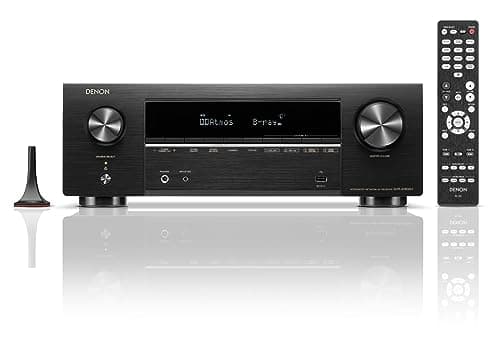 Denon AVR-X1800H Seven channels, 8K passthrough and Audyssey MultEQ XT — the room correction being the feature that actually changes what you hear in a real room. | Best overall under $1,000 | 9.0 | |
| 2 | 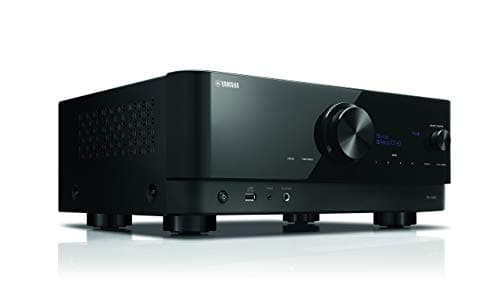 Yamaha RX-V6A The most powerful receiver here on paper — 100 watts a channel rated across the full band — with a phono input and seven HDMI inputs. | Best for music as well as film | 8.2 | |
| 3 | 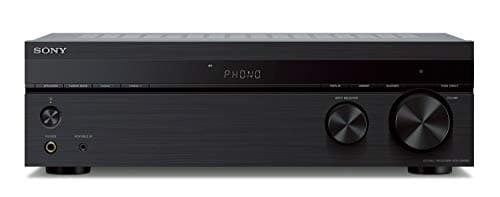 Sony STR-DH190 A stereo receiver with a phono input, Bluetooth and an FM tuner, at roughly half the price of the integrateds above it. | Best budget receiver with a phono input | 7.0 | |
| 4 | 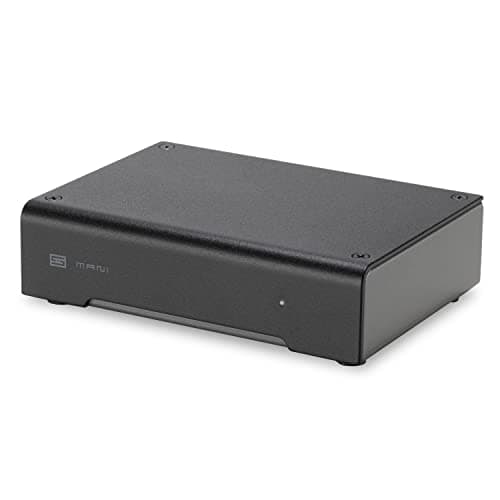 Schiit Mani 2 Four gain settings covering MM, MC and MI cartridges, which means it is the one box here that will still fit whatever cartridge you buy next. | Best overall under $200 | 8.6 | $179.00View on Amazon $188.005% off |
A receiver is the easiest thing to connect a turntable to, provided it has a PHONO input, and the most confusing when it does not. This page is the receiver-specific version of our connection guide: stereo receivers and AV receivers, the PHONO socket, the switch on the back of the deck, the ground screw, and the receivers we cover that have no phono input at all.
Step 1: find out whether the receiver has a PHONO input
Look at the back panel for a pair of RCA sockets labeled PHONO, usually with a small screw terminal marked GND or SIGNAL GND beside them. That socket contains a phono stage: it expects the cartridge’s few millivolts and applies the RIAA curve. Among the receivers we cover, the Denon AVR-X1800H publishes an MM phono input at 2.5 mV sensitivity with a ± 1 dB RIAA deviation figure, the Yamaha RX-V6A publishes MM at 3.5 mV / 47 kΩ, the Denon AVR-S670H publishes MM at 2.5 mV, the Onkyo TX-NR6100 publishes MM at 3.5 mV / 47 kΩ, and the Marantz Cinema 70s publishes MM at 2.5 mV with a ± 1 dB RIAA figure. The Sony STR-DH190 stereo receiver has one, though Sony publishes no figures we can read.
The Yamaha RX-V4A publishes its phono input as N/A — it does not have one. The Yamaha RX300A and RX-V385 and the Denon AVR-S570BT list no phono input in their specification tables at all, and a receiver without a documented PHONO input should be treated as a receiver without one until the manual says otherwise. Those receivers are not ruled out; they need step 4.
Step 2: set the switch on the turntable
If the turntable has a PHONO/LINE switch on the back, it has a built-in phono stage, and the switch decides whether that stage is in the signal path. The rule is that exactly one phono stage should be on. Into a PHONO input, set the deck to PHONO (stage off); into any other input, set it to LINE (stage on). Get it wrong one way and the sound is faint, thin and bass-light — no stage at all. Get it wrong the other way and it is loud, distorted and boomy — two stages. Both mistakes are fixed by the switch. Our built-in-preamp roundup lists which of our decks have the switch; the Fluance RT82 and RT85 and the Pro-Ject Debut Carbon EVO do not, and must go to a PHONO input or an external stage.
margin (dB) = 20 × log10(V_cartridge ÷ V_sensitivity)
Inputs
- AT-VM95E output (supplied on the AT-LP120XUSB): 4.0 mV (1 kHz, 5 cm/sec) (Audio-Technica spec page)
- Denon AVR-X1800H phono input sensitivity: 2.5 mV (MM) (Denon owner's manual)
- Yamaha RX-V6A phono input sensitivity: 3.5 mV / 47 kΩ (MM, 1 kHz) (Yamaha owner's manual)
Result
Step 3: connect the ground wire
The thin wire with a spade or bare end that comes out of most turntables goes under the GND screw next to the PHONO input. It does not carry signal; it ties the deck’s metal parts to the receiver’s chassis so that the two are at the same potential. Leave it off and the usual result is a steady low hum, loudest when nothing is playing. If you are using the deck’s built-in stage into a LINE input and the receiver has no GND screw, most decks still hum less with the wire attached to any chassis screw. Our connection guide has the troubleshooting list for the hums that remain.
Step 4: when the receiver has no PHONO input
Two routes. If the turntable has a built-in stage, set it to LINE and use any line input on the receiver — CD, AUX, or an unused analog input. If the turntable has no stage, add an external one between the deck and a line input: the Schiit Mani 2 publishes four gain settings and a subsonic filter, and the Fluance PA10 publishes 38 dB of gain for moving-magnet cartridges. The ground wire then goes to the external stage’s GND terminal, not to the receiver. Either way, the receiver’s line input expects roughly 200 mV — the Denon AVR-X1800H publishes exactly that figure — and a 36 dB stage on a 4 mV cartridge delivers about 252 mV, so the level lands where the receiver wants it.
AV receivers: three settings that catch people
Sound mode. An AV receiver will happily upmix a record into seven channels. For a stereo source, the direct or pure-direct mode plays the two channels as they are, and on most models it also bypasses the tone controls and, on some, the room correction. Our room-correction guide explains what the correction is doing and why you may want it on for a record anyway.
Subwoofer.If the receiver runs a subwoofer and the mains are set to small, low bass from the record goes to the sub. That is fine, and it is also the route by which a warped record or footfall reaches a driver designed to move a lot of air. A subsonic filter on an external stage — the Mani 2 and PA10 both publish one — is the fix; no receiver we cover publishes one on its phono input.
Input naming. On a receiver with a PHONO input, the input is usually fixed to the phono stage and cannot be reassigned. On one without, the input you choose for a LINE-level deck is just another analog input, and it can be renamed in the menu so the remote says TURNTABLE. Small, but it is the difference between a system the household uses and one only you can operate.
Which receivers we would pick for a turntable
The four products above are the ones this page is about. The Denon AVR-X1800H because it is the only receiver here publishing its phono stage’s RIAA accuracy and signal-to-noise. The Yamaha RX-V6A because it publishes a phono input and front pre-outs on the cheapest chassis that does both at the prices live when this was written. The Sony STR-DH190 because a stereo receiver with a PHONO input is the least expensive receiver route we cover, with the standing caveat that Sony publishes no specifications we can cite. And the Schiit Mani 2 because it is the external stage for every receiver in step 4. The music-receiver roundup ranks the AV receivers on phono parameters in detail, and the integrated-versus-receiver page is honest about when a stereo integrated is the better purchase for a turntable in the first place.
Every pick in detail
Every specification below links to the manufacturer document we read it from. Where a manufacturer does not publish a figure, we say so rather than estimating it.
Denon AVR-X1800H
Best overall under $1,000Price as of September 17, 2026. #ad
Seven channels, 8K passthrough and Audyssey MultEQ XT — the room correction being the feature that actually changes what you hear in a real room.
- channels
- 9/10
- room correction
- 9/10
- connectivity
- 9/10
- value for money
- 9/10
- future proofing
- 9/10
| Specification | Published value | Source |
|---|---|---|
| Channels | 7.2 (7 power amplifiers — 7.2 or 5.2.2) | Denon info sheet (PDF) |
| Power output | 80 W + 80 W (8 Ω, 20 Hz – 20 kHz, 0.08% THD, 2 ch driven) | Denon info sheet (PDF) |
| Room correction | Audyssey MultEQ XT, with Dynamic EQ and Dynamic Volume | Denon info sheet (PDF) |
| Dolby Atmos / DTS:X | Yes / Yes | Denon info sheet (PDF) |
| Phono input | Yes — MM, 2.5 mV input sensitivity; RIAA deviation ±1 dB (20 Hz – 20 kHz); S/N 74 dB (IHF-A); distortion 0.03% (1 kHz, 3 V) | Denon owner's manual, audio section |
| Analog input sensitivity | 200 mV; frequency response 10 Hz – 100 kHz (+1, −3 dB, Direct mode); S/N 98 dB (IHF-A, Direct mode) | Denon owner's manual, audio section |
| Power consumption | 430 W. Standby 0.1 W — but only with Network Control set to “Off In Standby” and HDMI Pass Through off; CEC standby is 0.5 W. Denon publishes no idle (powered-on, not playing) figure at all. | Denon owner's manual, general section |
| HDMI in / out | 6 in (3 are 8K) / 1 out (eARC) | Denon info sheet (PDF) |
| Video passthrough | 8K/60 Hz, 4K/120 Hz; VRR, QFT, ALLM | Denon product page |
| Pre-outs | 2.2 only (front L/R + 2 subwoofer) — NOT a full 7.2 pre-out | Denon info sheet (PDF) |
| Streaming | HEOS built-in; AirPlay 2, Spotify Connect, Amazon Music HD, TIDAL | Denon info sheet (PDF) |
Pros
- Audyssey MultEQ XT room correction — a step above the plain MultEQ on the cheaper models
- 7.2 channels — enough for a 5.2.2 Atmos layout
- MM phono input, so a turntable connects without a separate stage
- 8K/60 and 4K/120 passthrough with VRR and ALLM
Cons
- Only 2.2 pre-outs (front L/R plus subwoofers) — you cannot add external amplification to the surround channels later
- Menus are dense
- Runs warm in a closed cabinet
Skip it if you only need 5 channels — the AVR-S670H shares the same core for less.
Yamaha RX-V6A
Best for music as well as filmPrice as of September 17, 2026. #ad
The most powerful receiver here on paper — 100 watts a channel rated across the full band — with a phono input and seven HDMI inputs.
- channels
- 9/10
- room correction
- 7/10
- connectivity
- 9/10
- value for money
- 8/10
- future proofing
- 8/10
| Specification | Published value | Source |
|---|---|---|
| Channels | 7.2 | Yamaha spec page |
| Power output | 100 W/ch (8 Ω, 20 Hz – 20 kHz, 0.06% THD, 2 ch driven). Maximum effective output 150 W/ch (1 kHz, 10% THD, 8 Ω) | Yamaha owner's manual |
| Room correction | YPAO with multipoint measurement | Yamaha spec page |
| Dolby Atmos / DTS:X | Yes (with Height Virtualization) / Yes | Yamaha spec page |
| Phono input | Yes — MM, 3.5 mV / 47 kΩ at 1 kHz | Yamaha owner's manual |
| HDMI in / out | 7 in / 1 out (eARC). 8K on inputs 1–3 only | Yamaha spec page |
| Pre-outs | Front L/R + 2 subwoofer, plus Zone 2 L/R — not a full 7.2 pre-out | Yamaha owner's manual |
| Streaming | MusicCast, AirPlay 2, Bluetooth (SBC/AAC), Spotify Connect | Yamaha spec page |
Pros
- 100 W/ch (8 Ω, 20 Hz – 20 kHz, 0.06% THD) — the highest full-band rating in this group
- Seven HDMI inputs, the most here
- MM phono input, 3.5 mV / 47 kΩ
- YPAO with multipoint measurement, plus MusicCast multiroom
Cons
- YPAO is less sophisticated than Audyssey MultEQ XT on the Denon
- 8K is limited to HDMI inputs 1–3
- Pre-outs are front L/R plus subwoofers only — not a full 7.2
Skip it if room correction quality is your priority — Audyssey MultEQ XT on the Denon goes further.
Sony STR-DH190
Best budget receiver with a phono inputPrice as of September 17, 2026. #ad
A stereo receiver with a phono input, Bluetooth and an FM tuner, at roughly half the price of the integrateds above it.
- power
- 6/10
- phono stage
- 7/10
- value for money
- 9/10
- build quality
- 5/10
- connectivity
- 8/10
| Specification | Published value | Source |
|---|---|---|
| Published specifications | Unavailable. Sony blocks automated access across every domain it operates, and the official manual for this model returned HTTP 403 on 17 July 2026. The manual is mirrored on third-party sites, but a mirror is not the manufacturer and we do not treat it as one. We publish nothing here rather than something we could not verify at source. | Sony product page (returned 403) |
Pros
- Phono input and Bluetooth at a low price
- FM tuner included
- Speaker A/B switching
Cons
- Lightest build here
- Receiver, not an integrated — the tuner is dead weight if unused
- Modest power
Skip it if you want the best amplifier for the money rather than the most features for the money.
Schiit Mani 2
Best overall under $200Four gain settings covering MM, MC and MI cartridges, which means it is the one box here that will still fit whatever cartridge you buy next.
- flexibility
- 10/10
- noise
- 9/10
- value for money
- 8/10
- build quality
- 8/10
- connectivity
- 7/10
| Specification | Published value | Source |
|---|---|---|
| Gain | 33, 42, 48 or 60 dB (factory default 42 dB) | Schiit spec page |
| Cartridge support | MM, MC or MI | Schiit spec page |
| Loading | Capacitance 47, 100, 150 or 200 pF (default 47 pF); resistive 47 kΩ, 200 Ω, 47 Ω, 38 Ω | Schiit spec page |
| Signal-to-noise | > 108 dB at 33 dB gain; > 98 dB at 42 dB; > 96 dB at 48 dB; > 87 dB at 60 dB (A-weighted, ref 2 V RMS) | Schiit spec page |
| THD | < 0.0003% at 33 dB gain; < 0.0015% at 60 dB | Schiit spec page |
| Subsonic filter | Yes — selectable 6 or 12 dB/octave at 15 Hz, fully passive | Schiit spec page |
| Power | External 16 VAC transformer; dual-filtered regulated ±16 V rails | Schiit manual (PDF) |
Pros
- Four gain settings (33/42/48/60 dB) covering MM, MC and MI
- Four capacitance and four resistance loading options — the most adjustable box here by a distance
- A selectable, fully passive subsonic filter at 15 Hz
- Publishes a full spec sheet including THD and signal-to-noise at every gain setting
Cons
- Gain and loading are set by switches on the underside, so changing them means picking the unit up
- External wall-wart transformer
- Costs roughly double the entry options here
Skip it if you own one moving-magnet cartridge and will never change it — the extra gain settings are the thing you are paying for.
Frequently asked questions
Can I plug a turntable directly into a receiver?
Which input do I use on the receiver for a turntable?
What is the ground wire on a turntable for?
Which AV receivers have a phono input?
Why does my turntable sound distorted through the receiver?
Can I use a moving-coil cartridge with a receiver's phono input?
Read next
How to Connect a Turntable to Speakers
Four working routes from turntable to speakers, the two that do not work, and how to fix the hum.
Do I Need a Phono Preamp?
Yes, unless you already have one — and it might be hiding in your turntable, amplifier or speakers. Check in 30 seconds.

The Best AV Receivers for Music
The receivers that take two-channel seriously, ranked on pre-outs, published phono specs and a power rating measured across the whole band.
Integrated Amplifier vs Receiver
Two-channel integrated versus multichannel receiver, judged on published power ratings and what each spec actually promises.
The Best Turntables With a Built-In Preamp
Six decks with a phono stage inside, ranked on the stage: bypassable or not, published gain and noise, and whether the cartridge it feeds can ever be upgraded.
Do I Need an Amplifier for My Turntable?
The two amplification stages a turntable needs, which components already contain which, and the three routes that let you skip a box.
Sources
Every specification on this page was read from one of these documents. If one of them has changed, or we have made an error, tell us — corrections are logged and dated per our editorial policy.
- Denon AVR-X1800H — owner's manual (phono and line input sensitivity)
- Yamaha RX-V6A — owner's manual (phono input)
- Yamaha RX-V4A — specifications (phono: N/A)
- Onkyo TX-NR6100 — specifications (phono input)
- Marantz Cinema 70s — owner's manual (phono input)
- Audio-Technica AT-VM95E — specifications (output voltage)
- Schiit Mani 2 — specifications
- iFi ZEN Phono 3 — specifications