The Best Subwoofers for a Home Theater
Six subwoofers, one wattage convention that inflates every headline figure, and one spec — the input type — that decides whether it will connect to your amplifier at all.

Disclosure: we earn a commission if you buy through the links on this page, at no extra cost to you. It does not influence what we pick — our criteria are published and reproducible, so you can check our work. How we pick · Full disclosure
These picks are spec-and-price analyses, not listening tests. We have not heard this gear and we do not pretend to have: every figure below is sourced to the manufacturer and linked, and every price is live or not shown at all. Here are the rules we followed.
Quick picks
Ranked on the published criteria in How We Pick. Prices are live as of September 3, 2026. Tap any row for the full write-up.
- 9.0
- 8.2$329.00View on Amazon
$599.0045% off
- 7.6
- 7.0
- 6.6$359.00View on Amazon
$399.0010% off
- 6.0$209.00View on Amazon
$249.0016% off
| # | Product | Best for | Score | Price |
|---|---|---|---|---|
| 1 | 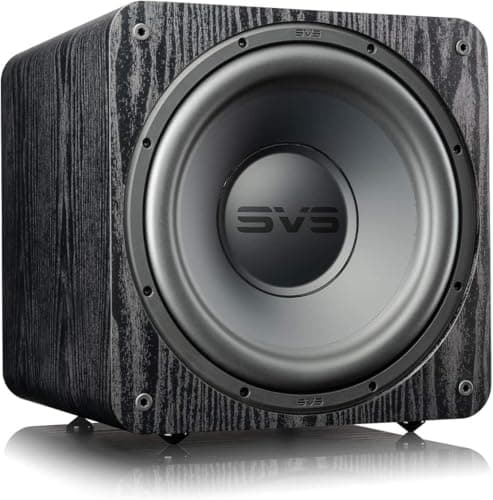 SVS SB-1000 Pro The only subwoofer here whose manufacturer publishes both a continuous power rating and the measurement condition behind its frequency response — 20–270 Hz ± 3 dB at 2 m ground plane — which is what makes its numbers comparable to anything. | Best overall | 9.0 | |
| 2 | 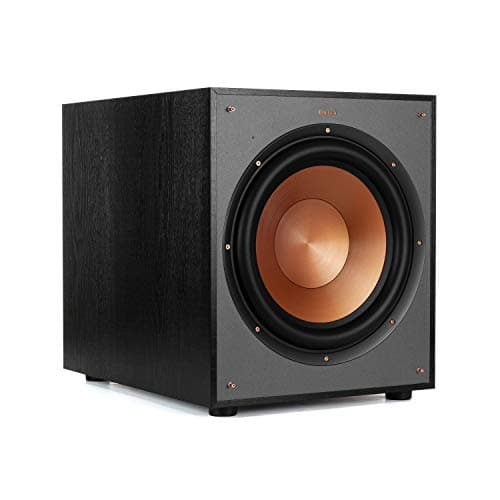 Klipsch R-120SW A 12-inch ported sub whose spec sheet publishes 200 W continuous next to the 400 W peak figure the listings quote — and whose only inputs are RCA, which is the spec that decides whether it works with your amplifier. | Best value 12-inch | 8.2 | $329.00View on Amazon $599.0045% off |
| 3 | 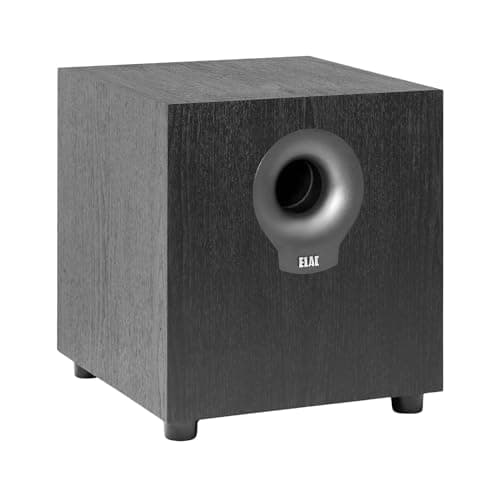 ELAC Debut 2.0 SUB3010 A 10-inch sealed box loaded by a passive radiator instead of a port, with app-driven AutoEQ — the cheapest way here to get measured room correction on the subwoofer itself rather than on the receiver. | Best automatic room EQ | 7.6 | |
| 4 | 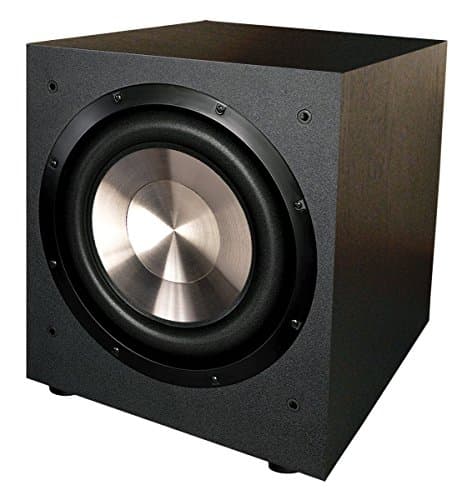 BIC America F12 An old design that does the two things this bracket usually gets wrong: it publishes a continuous power rating next to the peak one, and it takes speaker-level inputs from an amplifier with no subwoofer output. | Best for older amplifiers | 7.0 | |
| 5 | 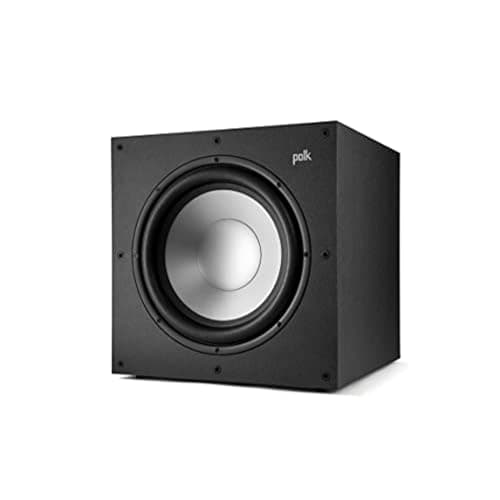 Polk Monitor XT12 A braced, ported 12-inch with line, LFE and binding-post inputs and a published 80–160 Hz crossover — and a manufacturer specification table that lists no amplifier power and no frequency response at all. | Best connectivity | 6.6 | $359.00View on Amazon $399.0010% off |
| 6 | 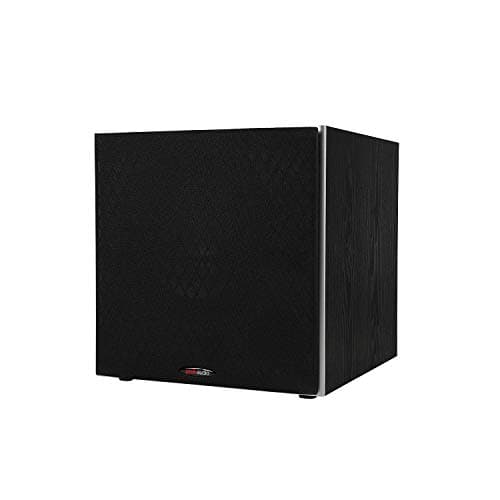 Polk Audio PSW10 The cheapest way into a real .1 channel, and the one where Polk's own page argues with itself — the marketing says 35 Hz, the specification table says the −3 dB point is 40 Hz. | Best for a small room | 6.0 | $209.00View on Amazon $249.0016% off |
The subwoofer is the one home theater component where the marketing number and the engineering number are furthest apart. A box will be advertised at 475 watts and rated at 150. Another will claim bass down to 24 Hz and publish no frequency response at all. A third will quietly omit the input you need.
So this page leads with the criteria, and the criteria are all things a manufacturer either publishes or does not. We have not heard any of these subwoofers — there is no listening room here and we would rather say so. What we can do is read six spec sheets carefully and tell you which numbers survive the reading.
The four criteria, before any picks
1. Continuous power, not peak. Peak or “dynamic” power describes a brief transient into a favorable load. Continuous or RMS power describes what the amplifier will actually sustain. The gap is enormous and it is always in the same direction.
2. A frequency response with a tolerance and a condition. “25 Hz” on its own is not a specification. At what tolerance — ±3 dB, −6 dB, −10 dB? Measured how — anechoic, ground plane, in a room with its gain helping? Two subwoofers quoting the same number under different conventions are not the same subwoofer.
3. Inputs. If your amplifier has no subwoofer output, you need speaker-level inputs. Three of these six have them and three do not, and that single line decides compatibility more often than anything else on the sheet.
4. Control over the bottom two octaves. Below about 80 Hz the room is doing more to the sound than the subwoofer is. Some of these give you parametric EQ to fight back; most give you a volume knob.
1. Two of these six publish no power rating at all
Here is what each manufacturer publishes, in its own words:
| Subwoofer | Continuous | Peak |
|---|---|---|
| SVS SB-1000 Pro | 325 W RMS | 820+ W |
| Klipsch R-120SW | 200 W | 400 W |
| ELAC Debut 2.0 SUB3010 | 200 W RMS | 400 W |
| BIC America F12 | 150 W RMS | 475 W |
| Polk Monitor XT12 | Not published | Not published |
| Polk Audio PSW10 | Not published | 100 W |
The BIC is the clearest case. Its product name is “Formula Series F-12 – 475W” and its Amazon listing title is “12-Inch 475-Watt”. BIC’s own page publishes both figures on one line: 475 watts Dynamic Peak, 150 watts RMS continuous. Nothing is being hidden — the honest number is right there, and every listing quotes the other one.
Klipsch does the same thing more transparently, with a single spec row headed “Amplifier Power (Cont/Peak)” reading 200W/400W. The 400 W is what you will see everywhere.
Polk is the outlier. The Monitor XT12’s own specification table lists an amplifier type — Class A/B — and no wattage whatsoever. Not a peak figure, not a continuous one. The PSW10 publishes 100 W peak and no continuous rating. We have left both as “Not published” in the spec tables below rather than importing a retailer listing’s number, because retailer spec fields are wrong often enough that they are not a source.
2. Only one of them tells you how the response was measured
Every subwoofer here quotes a low-frequency figure. Here is what those figures actually say:
- SVS SB-1000 Pro: 20–270 Hz ±3 dB, with the condition stated — 2 meter ground plane, away from reflective structures, quasi-anechoic. That is the only complete frequency specification on this page.
- Klipsch R-120SW: 29 Hz – 120 Hz ±3 dB. A real tolerance, no measurement condition.
- ELAC SUB3010: 28 to 150 Hz. No tolerance, no condition.
- BIC F12: 25 Hz – 200 Hz. No tolerance, no condition — and the lowest claimed extension of any box here that publishes a response range at all, which is exactly the combination that should make you cautious.
- Polk Monitor XT12: no frequency response in the specification table at all. The “down to 24 Hz” is a marketing bullet.
- Polk PSW10: 40 Hz → 160 Hz as published −3 dB limits — while the marketing copy on the same Polk page says “bass response down to 35 Hz”. Polk contradicts Polk. We publish the spec table, because a spec table beats a marketing line.
Read that list again in order of what is claimed and the ranking inverts: the box claiming 25 Hz publishes no tolerance, and the box publishing a complete, conditioned 20 Hz spec is the one that says the least in its headline. This is why the criteria come first.
3. Sealed, ported, or a passive radiator
Three alignments are represented here and they behave differently in ways worth understanding before you spend anything.
Ported — the Klipsch, the Polks and the BIC. A tuned port reinforces output near the tuning frequency, so a ported box of a given size plays louder down low than a sealed one. Below tuning, output falls away steeply. Ports can also produce audible air noise at high excursion, which is what BIC’s “Venturi” vent geometry is designed to reduce.
Sealed — the SVS. Less output near tuning for the same box size, but a gentle, progressive roll-off rather than a cliff. That gradual slope tends to combine well with room gain, which rises as frequency falls in a small room. SVS says so explicitly, describing the roll-off as “specifically optimized to take maximum advantage of available room gain” and telling you to expect 2–3 Hz deeper extension in a small to mid-size room than the anechoic figure.
Passive radiator — the ELAC. A sealed box with an undriven second cone doing what a port would do, without a port. No air noise, and no minimum distance to a wall for the port to breathe.
None of these is better in the abstract. In a small room a sealed sub often measures flatter at the seat than a ported one that is louder on paper; in a large open-plan space the ported 12 will usually win on sheer output. Your room decides, which brings us to the part that outranks all of it.
4. Placement will beat every one of these differences
Where the subwoofer sits changes its in-room response by more than any specification difference on this page — routinely by 10 dB or more at particular frequencies, because room modes depend on your exact dimensions and you cannot calculate your way out of them.
The fix is free. Put the subwoofer on your listening seat, play something with repetitive bass, and crawl the floor at the positions the sub could actually go. Where the bass sounds most even is where it goes. The full method is in the setup guide, along with the 80 Hz crossover setting that hands bass from your main speakers to the sub.
Then, and only then, is it worth arguing about which box. And when the crawl runs out of improvement, the next thing that helps is not electronics — bass traps do things below 80 Hz that panels and EQ cannot, because down there the problem is physical rather than electrical.
One subwoofer, or two?
Most of these manufacturers will happily sell you a pair, and several build for it. Polk’s own info sheet for the Monitor XT12 lists “add a second MXT12 subwoofer for even more bass and smoother low frequencies” as a feature. SVS builds dual-subwoofer control into its app. Most of the receivers we cover have two subwoofer outputs.
The argument for two is not primarily volume — it is that two sources in different positions excite the room’s modes differently, so the peaks and nulls of one tend to be partly filled by the other, and the seat-to-seat variation across a sofa shrinks. We have not measured this in a room, so take it as the manufacturers’ and the acoustics literature’s position rather than ours.
What we will say plainly is the order of operations: one subwoofer placed properly beats two placed carelessly, and both cost less than the receiver upgrade most people reach for first. Do the crawl, live with it, and only then consider the second box.
5. The input that decides whether it works at all
If your receiver has a subwoofer pre-out, any of these will connect. Every AV receiver in our receiver roundup has at least one, and several have two.
But if the amplifier is a stereo integrated with no subwoofer output — which is most two-channel amps — you need speaker-level inputs, which take the signal from the amplifier’s speaker terminals. Here is who has them:
- Yes: SVS SB-1000 Pro (speaker-level stereo input), Polk Monitor XT12 (5-way binding posts), Polk PSW10 (spring terminals), BIC F12 (high-level inputs).
- No: Klipsch R-120SW — its spec sheet lists “Line level/LFE RCA jacks” and nothing else. ELAC SUB3010 — two RCA inputs only.
That is a hard stop, not an inconvenience, and it is the reason the Klipsch is second here rather than first despite being the better-documented product of the two. If you are running a turntable into an integrated amp, check the back panel of the amp before you buy anything.
6. Room control: an app, or a knob
Two of these give you real control over the bottom two octaves. The SVS app carries three nameable presets with three parametric EQ bands each, plus adjustable low pass, phase, polarity and room-gain compensation. The ELAC runs AutoEQ, correcting itself to the room with what ELAC describes as eight parametric curves.
The other four give you a volume knob, a low-pass control and a 0/180 phase switch. That is not useless — phase alignment between sub and mains genuinely matters — but it is not correction.
This overlaps with your receiver. Audyssey, YPAO and their equivalents already measure and correct, and they do it well above roughly 80 Hz and only adequately below it. A subwoofer with its own parametric EQ is attacking exactly the band the receiver handles worst, which is why it is weighted heavily in our scoring.
How to choose
If you want the numbers to be checkable, the SVS SB-1000 Pro is the only one here that publishes a continuous power rating, a frequency response with a tolerance, and the condition it was measured under. It is also the most expensive, and a sealed 12 will not out-shout a big ported box in a large room.
If you want the most output per dollar and your receiver has a sub out, the Klipsch R-120SW: 200 W continuous published, 29 Hz ±3 dB, a 12-inch driver. Just confirm you never need speaker-level inputs, because it has none.
If the room is small and awkward, the ELAC SUB3010 — automatic room EQ and the shallowest cabinet here, at the cost of a frequency figure you cannot compare to anyone else’s.
If the amplifier is old and has no sub output, the BIC F12 takes speaker-level in and publishes a continuous rating, which is more than most of this bracket manages.
If you are in an apartment, the PSW10 is the honest entry point. Its 40 Hz −3 dB limit is a real limitation for film — the LFE channel goes an octave lower — and Polk publishes it anyway.
Whichever you pick, do the crawl. It costs nothing and it will change more than the difference between any two of these. Bookshelf speakers crossed over at 80 Hz plus one well-placed subwoofer is a better-sounding system than floorstanders in a corner, and usually a cheaper one.
Every pick in detail
Every specification below links to the manufacturer document we read it from. Where a manufacturer does not publish a figure, we say so rather than estimating it.
SVS SB-1000 Pro
Best overallPrice as of September 3, 2026. #ad
The only subwoofer here whose manufacturer publishes both a continuous power rating and the measurement condition behind its frequency response — 20–270 Hz ± 3 dB at 2 m ground plane — which is what makes its numbers comparable to anything.
- extension
- 9/10
- published data
- 10/10
- room control
- 10/10
- value for money
- 6/10
- build quality
- 9/10
| Specification | Published value | Source |
|---|---|---|
| Frequency response | 20–270 Hz ± 3 dB, measured 2 m ground plane away from reflective structures (quasi-anechoic). SVS is the only manufacturer in this group that publishes the measurement condition. | SVS product page |
| Amplifier power | 325 W RMS continuous (820+ W peak dynamic), Sledge STA-325D class D | SVS product page |
| Driver | 12 in long-throw, 13.3 mm Xmax / 26.9 mm Xmech, 1.5 in voice coil | SVS product page |
| Enclosure type | Sealed, extra-thick MDF front baffle with internal bracing | SVS product page |
| Inputs | Unbalanced stereo RCA in/out (16 kΩ) plus speaker-level stereo input (1 kΩ); 3–12 V AC/DC trigger | SVS product page |
| DSP / app | 50 MHz Analog Devices DSP; Bluetooth app for iOS/Android with 3 nameable presets, 3 parametric EQ bands per preset, adjustable low pass, phase, polarity and room-gain compensation | SVS product page |
| Dimensions (with grille) | 13.5 in H × 13 in W × 14.76 in D (342 × 330 × 375 mm) | SVS product page |
| Weight | 26 lb (11.9 kg) unboxed with grille | SVS product page |
Pros
- 325 W RMS continuous is a continuous rating, not a peak figure dressed as one
- 20–270 Hz ± 3 dB published WITH its measurement condition — nobody else here does that
- App DSP with three parametric EQ bands per preset and room-gain compensation, which is real control over the one band room correction handles worst
- Speaker-level inputs as well as RCA, so an integrated amp with no sub output can still drive it
- Sealed 13-inch cabinet — it fits where a ported 12 will not
Cons
- The most expensive pick here
- Sealed alignment trades raw output near tuning for a gentler roll-off — a ported box of the same size will play louder at 30 Hz
- The app is the interface for the good features; the front panel alone is not
- One of these in a large open-plan room will run out before a bigger ported sub does
Skip it if your room is large and open-plan and output matters more to you than measured accuracy. A ported 12 costs less and moves more air down low.
Klipsch R-120SW
Best value 12-inchA 12-inch ported sub whose spec sheet publishes 200 W continuous next to the 400 W peak figure the listings quote — and whose only inputs are RCA, which is the spec that decides whether it works with your amplifier.
- extension
- 8/10
- published data
- 8/10
- room control
- 4/10
- value for money
- 9/10
- build quality
- 7/10
| Specification | Published value | Source |
|---|---|---|
| Frequency response | 29 Hz – 120 Hz ± 3 dB | Klipsch spec sheet (PDF) |
| Amplifier power (cont/peak) | 200 W / 400 W, all-digital. The 400 W is the peak figure and it is the one the listings quote. | Klipsch spec sheet (PDF) |
| Maximum acoustic output | 116 dB | Klipsch spec sheet (PDF) |
| Driver | 12 in high-excursion spun-copper IMG woofer, front-firing | Klipsch spec sheet (PDF) |
| Enclosure type | Bass-reflex via rear-firing port, MDF | Klipsch spec sheet (PDF) |
| Inputs | Line level / LFE RCA jacks only — NO speaker-level inputs | Klipsch spec sheet (PDF) |
| Controls | Volume, low-pass, 0/180 phase, auto power on | Klipsch spec sheet (PDF) |
| Dimensions | 16.5 in H × 14 in W × 19.2 in D (419 × 356 × 488 mm) | Klipsch spec sheet (PDF) |
| Weight | 31 lb (14.1 kg) | Klipsch spec sheet (PDF) |
| Low-pass crossover range | Not published | — |
Pros
- 200 W continuous IS published, alongside the 400 W peak — Klipsch prints both
- 29 Hz – 120 Hz ± 3 dB, a real tolerance rather than a bare number
- Maximum acoustic output published at 116 dB
- Front-firing driver with a rear port, so it is less fussy about how far it sits from a wall than a down-firing design
Cons
- Line/LFE RCA inputs ONLY — no speaker-level inputs, so an integrated amp with no subwoofer output cannot drive it without a converter
- The 400 W in every listing headline is the peak figure, not the rating
- A large box: 19.2 inches deep, 31 lb
- Klipsch does not publish the low-pass crossover range, only that a low-pass control exists
Skip it if your amplifier has no subwoofer output. This one has no speaker-level input, and that is a hard stop rather than an inconvenience.
ELAC Debut 2.0 SUB3010
Best automatic room EQPrice as of September 3, 2026. #ad
A 10-inch sealed box loaded by a passive radiator instead of a port, with app-driven AutoEQ — the cheapest way here to get measured room correction on the subwoofer itself rather than on the receiver.
- extension
- 7/10
- published data
- 6/10
- room control
- 9/10
- value for money
- 6/10
- build quality
- 8/10
| Specification | Published value | Source |
|---|---|---|
| Frequency response | 28 – 150 Hz. ELAC publishes no ± dB tolerance and no measurement condition, so this figure is not directly comparable to the SVS or Klipsch numbers. | ELAC product page |
| Amplifier power | 400 W peak / 200 W RMS, BASH-tracking | ELAC product page |
| Driver | 10 in high-excursion doped paper cone, with a 10 in doped paper passive radiator | ELAC product page |
| Enclosure type | Sealed cabinet loaded by a passive radiator rather than a port — no port to chuff | ELAC product page |
| Crossover frequency | 50 – 150 Hz, continuously adjustable | ELAC product page |
| Inputs | 2 × RCA (L, R/LFE) — no speaker-level inputs | ELAC product page |
| Room EQ | AutoEQ with app control (iOS and Android); ELAC states eight parametric curves | ELAC product page |
| Dimensions | 14.33 in W × 13.5 in H × 13.5 in D (364 × 343 × 343 mm) | ELAC product page |
| Weight | 32.1 lb (14.5 kg) | ELAC product page |
Pros
- AutoEQ with app control corrects the subwoofer to the room, which is the band a receiver's room correction handles least well
- Passive radiator rather than a port — no port to chuff at high excursion, and no minimum wall distance to respect
- 200 W RMS published alongside the 400 W peak
- Crossover continuously adjustable 50–150 Hz, published
- The shallowest cabinet here at 13.5 inches deep
Cons
- The 28–150 Hz figure carries no ± dB tolerance and no measurement condition, so it cannot be compared like-for-like with the SVS or Klipsch numbers
- RCA inputs only — no speaker-level connection
- A 10-inch driver in a small sealed box will not match a 12-inch ported sub for raw output
- Stock is intermittent; this is an older model in ELAC's line
Skip it if you want maximum output per dollar. A 12-inch ported box beats it on volume, and you are paying here for the EQ and the size.
BIC America F12
Best for older amplifiersPrice as of September 3, 2026. #ad
An old design that does the two things this bracket usually gets wrong: it publishes a continuous power rating next to the peak one, and it takes speaker-level inputs from an amplifier with no subwoofer output.
- extension
- 6/10
- published data
- 6/10
- room control
- 3/10
- value for money
- 8/10
- build quality
- 6/10
| Specification | Published value | Source |
|---|---|---|
| Frequency response | 25 Hz – 200 Hz. No ± dB tolerance is published, so treat the 25 Hz as a claim rather than a comparable spec. | BIC America product page |
| Amplifier power | 475 W dynamic peak / 150 W RMS continuous, BASH design. Both figures are BIC's; only the second is a continuous rating. | BIC America product page |
| Driver | 12 in injection-molded long-throw woofer, front-firing | BIC America product page |
| Enclosure type | Vented, with BIC's patented “Venturi” vent | BIC America product page |
| Sensitivity | 90 dB | BIC America product page |
| Inputs | High-level (speaker-level) inputs plus line-level LFE, with automatic signal sensing | BIC America product page |
| Dimensions | 17 in H × 14.75 in W × 17.25 in D | BIC America product page |
| Weight | 42 lb | BIC America product page |
| Low-pass crossover range | Not published | — |
Pros
- 475 W peak AND 150 W RMS continuous both published — the split most listings hide
- High-level (speaker-level) inputs, so it connects to a vintage integrated or a receiver with no sub out
- Automatic signal sensing, so it powers itself up
- 12-inch driver and a published 90 dB sensitivity
Cons
- The 25 Hz – 200 Hz response is published without any ± dB tolerance, so the 25 Hz is a claim rather than a comparable measurement
- BIC does not publish the low-pass crossover range at all
- 42 lb — the heaviest subwoofer here
- A long-running design; the cabinet and finish show it next to the Polk and ELAC
Skip it if you want published data you can check. BIC gives you a continuous power figure and then no tolerance on the frequency response, which is half a spec sheet.
Polk Monitor XT12
Best connectivityA braced, ported 12-inch with line, LFE and binding-post inputs and a published 80–160 Hz crossover — and a manufacturer specification table that lists no amplifier power and no frequency response at all.
- extension
- 5/10
- published data
- 2/10
- room control
- 4/10
- value for money
- 7/10
- build quality
- 8/10
| Specification | Published value | Source |
|---|---|---|
| Amplifier power | Not published | — |
| Frequency response | Not published | — |
| Manufacturer's bass claim | Polk's feature bullet says “smooth low frequency extension down to 24 Hz”. It appears nowhere in the specification table, carries no ± dB tolerance and no measurement condition — so it is a claim, not a spec. | Polk Monitor XT12 info sheet (PDF) |
| Amplifier type | Class A/B | Polk product page |
| Low-pass crossover | 80 Hz – 160 Hz, continuously variable, plus LFE | Polk product page |
| Phase adjustment | 0/180 | Polk product page |
| Driver | 12 in bi-laminate paper cone with foam surround | Polk product page |
| Enclosure type | Bass reflex (ported), braced MDF | Polk product page |
| Inputs | Line level, LFE (single RCA) and speaker level via left/right 5-way binding posts | Polk product page |
| Dimensions | 16 in W × 16.4 in H × 17.9 in D (407 × 418 × 456 mm) | Polk product page |
| Weight | 39 lb (17.7 kg) | Polk product page |
Pros
- Line level, LFE and 5-way binding posts — the most complete input set here alongside the SVS
- Low-pass crossover published as 80–160 Hz continuously variable, with 0/180 phase
- Braced low-resonance MDF cabinet with a removable grille
- A 12-inch driver in a ported box — the alignment that moves the most air for the money
Cons
- Polk's specification table publishes NO amplifier wattage and NO frequency response — the “down to 24 Hz” is a marketing bullet with no tolerance and no measurement condition
- 39 lb and 17.9 inches deep
- No DSP, no app, no room EQ — volume, crossover, phase and nothing else
- Nothing published that lets you compare it against the SVS or the Klipsch on paper
Skip it if you want to check the claim before you buy. There is no published response spec here to check it against.
Polk Audio PSW10
Best for a small roomThe cheapest way into a real .1 channel, and the one where Polk's own page argues with itself — the marketing says 35 Hz, the specification table says the −3 dB point is 40 Hz.
- extension
- 3/10
- published data
- 7/10
- room control
- 3/10
- value for money
- 8/10
- build quality
- 5/10
| Specification | Published value | Source |
|---|---|---|
| Frequency response (−3 dB) | 40 Hz → 160 Hz. Polk's own marketing copy on the same page says “down to 35 Hz”; the specification table says 40 Hz. We publish the table. | Polk product page |
| Amplifier power | 100 W peak, class D. Polk publishes no continuous rating for this model — the 100 W is a peak figure. | Polk product page |
| Amplifier bandwidth / distortion | 40 Hz – 200 Hz, < 1% distortion | Polk product page |
| Driver | 10 in Dynamic Balance polymer composite cone | Polk product page |
| Enclosure type | Vented via front-panel flared port | Polk product page |
| Inputs | Stereo line level (2 × RCA) plus speaker level (2 pairs of gold-plated spring terminals) | Polk product page |
| Dimensions | 14.375 in H × 14 in W × 16.125 in D (36.5 × 35.6 × 41 cm) | Polk product page |
| Weight | 26 lb (11.8 kg) | Polk product page |
Pros
- Polk publishes proper −3 dB limits (40 Hz → 160 Hz), which most sub makers at this price do not
- Line level AND speaker level inputs, so it works with almost anything
- 26 lb and the smallest 10-inch box here — it disappears in an apartment
- Amplifier bandwidth and distortion (< 1%) are published
Cons
- 40 Hz is a genuinely limited bottom end for film — the LFE track goes an octave below that
- Polk's own marketing on the same page claims 35 Hz against its own spec table's 40 Hz
- 100 W is a PEAK figure; Polk publishes no continuous rating for this model
- No DSP, no app, no room correction
Skip it if your room is bigger than a bedroom or you watch action films at volume. This is the entry point, and it is honest about being one.
Frequently asked questions
What is the best subwoofer for a home theater?
On our criteria — published continuous power, a frequency response with a stated tolerance and measurement condition, input flexibility and room control — the SVS SB-1000 Pro. It is the only subwoofer here whose manufacturer publishes all four. It is also the most expensive, and a sealed cabinet gives up some raw output near tuning to a larger ported box.
How many watts does a home theater subwoofer need?
Fewer than the box claims, because the box is usually quoting peak power. The continuous ratings across this whole group run from 150 W to 325 W where they are published at all, and two of the six publish no continuous figure. Room size and placement will affect what you actually hear far more than the difference between 200 W and 325 W.
Is a 12-inch subwoofer better than a 10-inch one?
Not automatically. A larger cone moves more air for the same excursion, so a 12 generally has more headroom — but alignment, cabinet size and amplifier all matter as much. The 10-inch ELAC SUB3010 claims 28 Hz; the 12-inch Polk Monitor XT12 publishes no frequency response at all; and the lowest published figure here, 20 Hz ±3 dB, belongs to the SVS, which fits a 12-inch driver into a sealed cabinet 13 inches wide. Driver size alone predicts very little.
Can I connect a subwoofer to an amplifier with no subwoofer output?
Only if the subwoofer has speaker-level (high-level) inputs. The SVS SB-1000 Pro, Polk Monitor XT12, Polk PSW10 and BIC F12 all do. The Klipsch R-120SW and ELAC SUB3010 do not — both are line-level RCA only, so an amplifier with no subwoofer output cannot drive them without additional hardware. Check the back of your amplifier first.
Sealed or ported subwoofer for home theater?
Ported plays louder near its tuning frequency for a given cabinet size and rolls off steeply below it; sealed gives up some of that output for a gentle slope that tends to combine better with room gain in a small room. SVS says its sealed roll-off is optimized for exactly that and tells you to expect 2 to 3 Hz deeper extension in a small to mid-size room. In a large open-plan space the ported 12 will usually win on output.
Where should I put my subwoofer?
Where the subwoofer crawl says. Put the sub on your listening seat, play repetitive bass, crawl the floor at the candidate positions, and use the spot where the bass is most even. Placement changes in-room response more than any specification difference between these six, and the method costs nothing.
Do I still need bass traps if I have a subwoofer with EQ?
EQ can cut a peak. It cannot fill a null, because a null is cancellation rather than a shortage of energy — turning the level up at that frequency simply feeds more energy into the same cancellation. Bass traps absorb the energy causing both, which is why treatment and EQ are complementary rather than alternatives.
Read next
Home Theater Setup: The Complete Guide
The complete setup, built on Dolby's published layout angles rather than on vibes — plus what to do when your room disagrees.
The Best AV Receivers Under $1,000
Five receivers under $1,000, compared on FTC-rated power and the pre-out spec almost nobody mentions.

Bass Traps vs Acoustic Panels
Same material, different thickness and placement — and that decides whether your room gets fixed or just quieter in the treble.
The Best Bookshelf Speakers Under $500
Five pairs under $500 — and only one publishes a minimum impedance and a recommended amp range.
The Best Home Theater Speakers
A timbre-matched 5.1 built from published specs — fronts, center, surrounds and a subwoofer that actually connects.
The Best Bass Traps
Ranked on published 125 Hz absorption rather than NRC — and only one maker publishes it for a corner trap.
How to Add a Subwoofer to a Stereo Amplifier
Three connection routes, which subs support each, and why a stereo amp adds bass rather than redirecting it.
Ported vs Sealed Speakers
What a port buys in efficiency and extension, what it costs in placement and roll-off, and how the sealed and ported subwoofers we cover actually compare.
Sources
Every specification on this page was read from one of these documents. If one of them has changed, or we have made an error, tell us — corrections are logged and dated per our editorial policy.
- SVS SB-1000 Pro — specifications, amplifier and acoustic data
- Klipsch R-120SW spec sheet (PDF)
- ELAC Debut 2.0 SUB3010 — specifications
- BIC America Formula Series F-12 — specifications
- Polk Monitor XT12 — specifications
- Polk Monitor XT12 info sheet — the “down to 24 Hz” claim (PDF)
- Polk PSW 10 — specifications and −3 dB limits