How to Read an Amplifier Power Rating
Watts is not a specification. Watts under four stated conditions is a specification — and the gap between those two things is where most of the marketing in this category lives.
Disclosure: we earn a commission if you buy through the links on this page, at no extra cost to you. It does not influence what we pick — our criteria are published and reproducible, so you can check our work. How we pick · Full disclosure
These picks are spec-and-price analyses, not listening tests. We have not heard this gear and we do not pretend to have: every figure below is sourced to the manufacturer and linked, and every price is live or not shown at all. Here are the rules we followed.
Quick picks
Ranked on the published criteria in How We Pick. Prices are live as of October 14, 2026. Tap any row for the full write-up.
- 7.8
- 8.6
- 7.8
- 6.0
| # | Product | Best for | Score | Price |
|---|---|---|---|---|
| 1 | 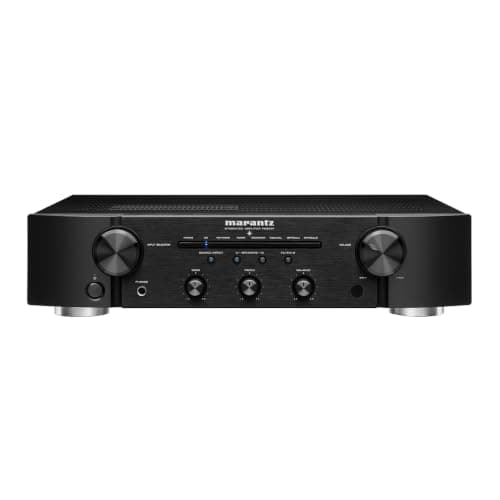 Marantz PM6007 A phono stage plus a proper DAC section in a well-made chassis, at the top of what this bracket will bear. | Best built-in DAC | 7.8 | |
| 2 | 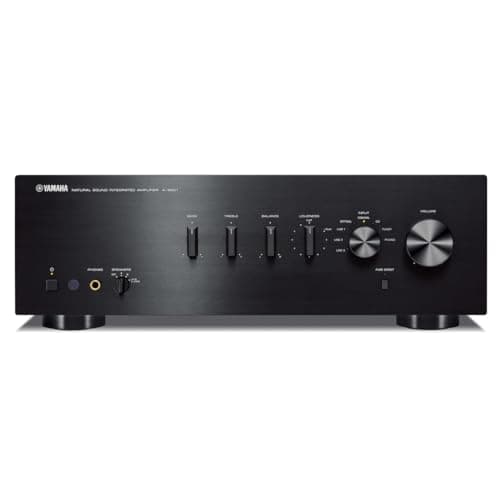 Yamaha A-S501 85 watts per channel into 8 ohms with a damping factor of 240 and an MM phono input fitted — the most amplifier here for the money, provided your speakers are an 8-ohm load. | Best overall under $1,000 | 8.6 | |
| 3 | 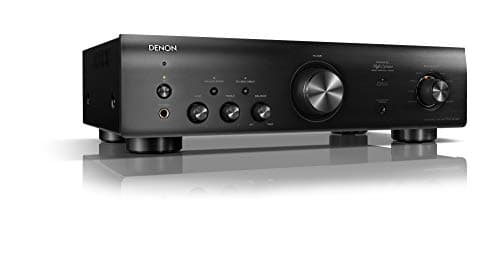 Denon PMA-600NE An integrated with a phono stage, a DAC and Bluetooth in one chassis — the fewest boxes for a mixed vinyl-and-streaming system. | Best with Bluetooth | 7.8 | |
| 4 | 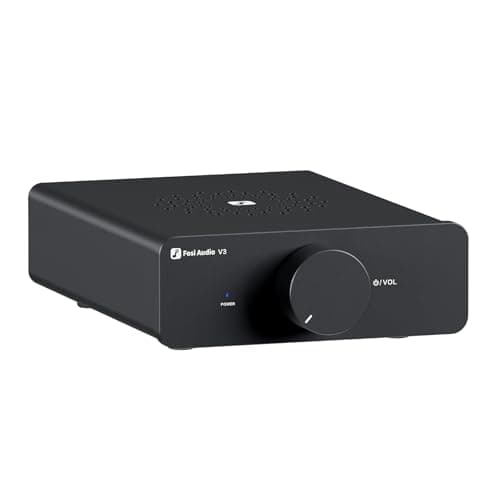 Fosi Audio V3 A class-D power amplifier the size of a paperback whose headline wattage depends entirely on the power supply you feed it. | Best tiny amplifier | 6.0 |
A power rating has to state four things to mean anything: the load impedance, the frequency range, the distortion level, and how many channels were driven. Change any one of them and the same amplifier produces a different number.
This is not a conspiracy. It is that “watts” describes a measurement, and a measurement without its conditions is a number without a meaning. Some manufacturers publish all four. Some publish two. One amplifier on this page publishes a headline figure with no distortion condition at all and no rating for the impedance most people will actually connect.
The four conditions, and what each one does to the number
1. Load impedance
Halving the load impedance roughly doubles the current demand. An amplifier that manages 45 W into 8 Ω may or may not manage 90 W into 4 Ω, depending entirely on its power supply. This is why a 4 Ω rating is the honest one to look for and the one most often absent.
2. Frequency range
A figure measured at 1 kHz only is much easier to achieve than one held across 20 Hz to 20 kHz, because the demanding part of the audio band for an amplifier is the bottom of it, where the power supply is worked hardest.
3. Distortion
Every amplifier makes more power if you accept more distortion. Rating at 10% THD instead of 0.06% can add a third to the headline number without changing a single component.
4. Channels driven
Two channels at once share one power supply. A per-channel figure measured with only one channel running does not describe stereo playback, and a seven-channel receiver measured with two channels driven does not describe a film soundtrack.
How real amplifiers publish it
Every row below is quoted from the manufacturer’s own manual or spec page, linked in the sources at the foot of this page.
| Amplifier | Published 8 Ω rating | Conditions stated |
|---|---|---|
| Marantz PM6007 | 45 W × 2 | All four — 8 Ω, 20 Hz–20 kHz, both channels driven, 0.08% THD |
| Yamaha A-S501 | 85 W + 85 W | 8 Ω, 20 Hz–20 kHz, 0.019% THD, described as minimum RMS |
| Denon PMA-600NE | 45 W + 45 W | 8 Ω, 20 Hz–20 kHz, 0.07% THD |
| Onkyo TX-8470 | 110 W + 110 W | 8 Ω, 20 Hz–20 kHz, 0.08% THD, both channels driven (FTC form) |
| Cambridge Audio AXA35 | 35 W | Impedance only — no bandwidth, no THD condition |
| Fosi Audio V3 | Not published | No 8 Ω rating at all; only 300 W × 2 at 4 Ω, with no THD condition |
| WiiM Amp | 60 W per channel | No THD figure and no “both channels driven” condition published |
Marantz publishes the complete set for both impedances, which is why it heads this page despite having the smallest headline number of the properly-specified amplifiers here. The spec is not the biggest; it is the most checkable.
The 4 Ω rating, where the differences show
This is where publishing habits diverge sharply.
- Marantz PM6007: 60 W × 2 into 4 Ω, rated 20 Hz – 20 kHz with both channels driven — the same demanding condition as its 8 Ω figure. That is a directly comparable number and it is rare.
- Denon PMA-600NE: 70 W + 70 W into 4 Ω — but look at the condition. Denon measures this one at 1 kHz and 0.7% THD, where its 8 Ω figure was 20 Hz – 20 kHz at 0.07%. Ten times the distortion and a single frequency instead of the whole band. Denon states all of that plainly; it is not hidden. It simply means the two numbers on the same page were not measured the same way.
- Yamaha A-S501: no continuous 4 Ω rating exists. See below — this is the trap in the bracket.
- Cambridge AXA35: not published.
Dynamic power, peak power, maximum effective output
These are all names for measurements taken over a short burst rather than continuously. A burst does not empty the power supply the way a sustained tone does, so the number is always higher. None of them is an RMS rating and none is comparable to one.
Yamaha is the clearest example because it publishes both kinds for the same amplifier. For the A-S501:
- Rated: 85 W + 85 W into 8 Ω, 20 Hz – 20 kHz, 0.019% THD
- High Dynamic Power per channel: 130 W into 8 Ω, 150 W into 6 Ω, 185 W into 4 Ω, 220 W into 2 Ω
The “185 W into 4 Ω” figure that circulates for this amplifier is the second list, not the first. Yamaha publishes no continuous 4 Ω rating for it at all. Treating the dynamic number as a continuous one overstates the amplifier by roughly two-fold.
The same pattern appears elsewhere. Yamaha rates the RX-V6A at 100 W/ch (8 Ω, 20 Hz–20 kHz, 0.06% THD, two channels driven) and separately publishes a “maximum effective output” of 150 W/ch at 1 kHz and 10% THD. Onkyo rates the TX-NR6100 at 100 W/ch under the FTC condition, while “210 W per channel” circulates freely in search results — that is a dynamic marketing figure, not the rating.
ΔdB = 10 × log₁₀(P₂ / P₁)
Inputs
- Yamaha A-S501 rated continuous power, 8 Ω: 85 W (20 Hz – 20 kHz, 0.019% THD) (Yamaha spec page)
- Yamaha A-S501 High Dynamic Power, 8 Ω: 130 W (short-burst IHF measurement) (Yamaha spec page)
- Yamaha A-S501 High Dynamic Power, 4 Ω: 185 W (short-burst IHF measurement) (Yamaha spec page)
Result
130 W vs 85 W: 10 × log₁₀(130 / 85) = +1.85 dB
185 W vs 85 W: 10 × log₁₀(185 / 85) = +3.38 dB
The figure that looks like it more than doubles the amplifier is worth about three and a third decibels — and it is not a continuous rating, so you cannot hold it for more than a fraction of a second anyway. Doubling power is always and only 3 dB. That is the whole reason wattage differences matter less than buyers expect, and why speaker sensitivity usually matters more.
Decibels here describe electrical power, which maps to acoustic output only through the speaker’s sensitivity. The full arithmetic — how many watts you need for a given level in a given room — is on will this amplifier drive my speakers.
There is a legal standard, and one maker on this site cites it
Audioengine publishes the A5+’s output as “50 W RMS per channel (measured per 16 C.F.R. § 432.3)”, alongside a separate 75 W peak per channel figure to the AES standard.
Citing the regulation in the spec line is unusual and it is worth noticing. It tells you the number was produced under a defined procedure rather than an in-house one, and it separates the continuous figure from the peak figure explicitly. Most manufacturers do neither.
The two cases where the number is missing entirely
Fosi Audio V3.The headline is 300 W × 2 at 4 Ω, which Fosi also markets as “600 W total”. There is no THD condition attached to it, and there is no 8 Ω rating at all — though Fosi does state a terminating impedance range of 2–8 Ω. So an 8 Ω speaker will see meaningfully less than the headline figure, and Fosi does not say how much less. The number also depends on which power supply you use: Fosi publishes an input range of DC 24–48 V, and lists both 32 V and 48 V supplies. Same amplifier, different box in the wall, different maximum output.
WiiM Amp.60 W into 8 Ω and 120 W into 4 Ω, with no distortion figure and no statement of how many channels were driven. Those are the two conditions that separate a rating from a claim, and both are absent. It is a capable device — but that specification cannot be compared to Marantz’s or Yamaha’s, because it does not describe the same test.
What to actually do with this
- Find the 8 Ω continuous rating with all four conditions. If the page gives you a bare number, that is the finding.
- Check whether a 4 Ω continuous rating exists and whether it was measured under the same conditions as the 8 Ω one. Denon’s was not; Marantz’s was.
- Ignore anything labeled dynamic, peak, maximum or total. They are real measurements of something, and that something is not what your speakers see during a sustained passage.
- Then stop thinking about wattsand go and check your speakers’ sensitivity, because that is the number that decides whether any of this is enough.
The last point is the important one. The published spread across every integrated amplifier we cover is 35 W to 85 W — about 3.9 dB. The published spread in speaker sensitivity across the speakers we cover is 83 dB to 95 dB — twelve decibels, a factor of about sixteen in the power required. The speaker decides this, not the amplifier.
Every pick in detail
Every specification below links to the manufacturer document we read it from. Where a manufacturer does not publish a figure, we say so rather than estimating it.
Marantz PM6007
Best built-in DACPrice as of October 14, 2026. #ad
A phono stage plus a proper DAC section in a well-made chassis, at the top of what this bracket will bear.
- power
- 7/10
- phono stage
- 8/10
- value for money
- 7/10
- build quality
- 9/10
- connectivity
- 8/10
| Specification | Published value | Source |
|---|---|---|
| Power output (8 Ω) | 45 W × 2 (8 Ω, 20 Hz – 20 kHz, both channels driven, 0.08% THD) | Marantz owner's manual |
| Power output (4 Ω) | 60 W × 2 (4 Ω, 20 Hz – 20 kHz, both channels driven) — rated across the full band, unlike most rivals' 1 kHz-only 4 Ω figures | Marantz owner's manual |
| Phono input | Yes — MM only, 2.2 mV / 47 kΩ | Marantz owner's manual |
| Signal-to-noise | 102 dB (line); 83 dB (phono MM) | Marantz owner's manual |
| Damping factor | 100 (8 Ω, 40 Hz – 20 kHz) | Marantz owner's manual |
| Digital inputs | Coaxial and optical | Marantz owner's manual |
| Subwoofer out | Yes — 2.8 V (200 mV input, volume max) | Marantz owner's manual |
Pros
- Good DAC section with optical and coaxial in
- MM phono stage
- Solid build and finish
Cons
- Most expensive here
- No Bluetooth
- Power output is mid-pack for the money
Skip it if you already own a DAC — you are buying a second one.
Yamaha A-S501
Best overall under $1,000Price as of October 14, 2026. #ad
85 watts per channel into 8 ohms with a damping factor of 240 and an MM phono input fitted — the most amplifier here for the money, provided your speakers are an 8-ohm load.
- power
- 9/10
- phono stage
- 8/10
- value for money
- 9/10
- build quality
- 9/10
- connectivity
- 6/10
| Specification | Published value | Source |
|---|---|---|
| Power output (8 Ω) | 85 W + 85 W (8 Ω, 20 Hz – 20 kHz, 0.019% THD) — minimum RMS | Yamaha spec page |
| Power output (4 Ω) | Not published as a continuous rating. Yamaha publishes only “High Dynamic Power/Channel (8/6/4/2 Ω): 130 / 150 / 185 / 220 W” — a short-burst IHF measurement, NOT an RMS rating. The “185 W into 4 Ω” figure circulating for this amp is that dynamic number, and treating it as continuous overstates the amplifier by roughly two-fold. | Yamaha spec page |
| Phono input | Yes — MM, 3.0 mV / 47 kΩ | Yamaha owner's manual (PDF) |
| THD | 0.019% (50 W into 8 Ω, 20 Hz – 20 kHz) | Yamaha spec page |
| Signal-to-noise | 99 dB (CD, input shorted); phono MM 82 dB or more | Yamaha spec page |
| Damping factor | 240 | Yamaha spec page |
| Digital inputs | Yes — optical and coaxial (Yamaha does not publish the DAC part number) | Yamaha spec page |
| Bluetooth | Not published — no Bluetooth row appears in Yamaha's specification table | Yamaha spec page |
| Subwoofer out | Yes | Yamaha spec page |
Pros
- 85 W + 85 W into 8 Ω rated across the full 20 Hz – 20 kHz band at 0.019% THD — a real rating, not a 1 kHz-only one
- Damping factor 240, the highest published here
- MM phono input and optical/coaxial digital inputs included
Cons
- Yamaha publishes NO continuous 4 Ω rating — only a “High Dynamic Power” burst figure, so its behavior into a 4 Ω speaker is genuinely unknown from the spec sheet
- No Bluetooth or network streaming
- Large and heavy
Skip it if your speakers dip to 4 Ω and you want to know what you are getting. Marantz and Denon both publish real 4 Ω ratings; Yamaha does not.
Denon PMA-600NE
Best with BluetoothPrice as of October 14, 2026. #ad
An integrated with a phono stage, a DAC and Bluetooth in one chassis — the fewest boxes for a mixed vinyl-and-streaming system.
- power
- 7/10
- phono stage
- 8/10
- value for money
- 8/10
- build quality
- 7/10
- connectivity
- 9/10
| Specification | Published value | Source |
|---|---|---|
| Power output (8 Ω) | 45 W + 45 W (8 Ω, 20 Hz – 20 kHz, 0.07% THD) | Denon owner's manual |
| Power output (4 Ω) | 70 W + 70 W (4 Ω, 1 kHz, 0.7% THD) — note the softer condition: 1 kHz at 0.7% THD is a much easier test than the 8 Ω figure's 20 Hz – 20 kHz at 0.07% | Denon owner's manual |
| Phono input | Yes — MM only, 2.5 mV / 47 kΩ | Denon owner's manual |
| Signal-to-noise | 105 dB (line, input shorted); phono MM 84 dB | Denon owner's manual |
| Bluetooth | Yes — version 5.1; SBC and AAC codecs | Denon owner's manual |
| Digital inputs | Coaxial and optical, linear PCM | Denon owner's manual |
| Subwoofer out | Yes — pre-out, 1 V / 100 Hz | Denon owner's manual |
| Damping factor | Not published | — |
Pros
- Phono stage, DAC and Bluetooth all included
- Optical and coaxial inputs
- Analog Mode shuts down digital circuits
Cons
- Less power than the Yamaha A-S501
- Bluetooth is receive-only, SBC-class
- Plainer build than its price implies
Skip it if you need maximum power for hard-to-drive speakers.
Fosi Audio V3
Best tiny amplifierPrice as of October 14, 2026. #ad
A class-D power amplifier the size of a paperback whose headline wattage depends entirely on the power supply you feed it.
- power
- 6/10
- phono stage
- 0/10
- value for money
- 10/10
- build quality
- 6/10
- connectivity
- 4/10
| Specification | Published value | Source |
|---|---|---|
| Power output (4 Ω) | 300 W × 2 at 4 Ω (Fosi's headline “600 W total”). No THD condition is attached to this figure, and it depends on the supply: published power input range is DC 24–48 V, with 32 V/5 A and 48 V/5 A supplies listed. | Fosi Audio spec page |
| Power output (8 Ω) | Not published. Fosi publishes a 4 Ω figure only, though it states a terminating impedance of 2–8 Ω — so an 8 Ω speaker will see meaningfully less than the headline number, and Fosi does not say how much less. | Fosi Audio spec page |
| Amplifier chip | TPA3255; TI NE5532 × 2 op-amps | Fosi Audio spec page |
| THD | ≤ 0.003% (measurement condition not published) | Fosi Audio spec page |
| Signal-to-noise | ≥ 110 dB (SINAD ≥ 88 dB) | Fosi Audio spec page |
| Inputs | RCA line level only | Fosi Audio spec page |
| Phono input | None — a turntable needs its own phono stage before this amplifier | Fosi Audio spec page |
Pros
- Very cheap and very small
- Class D efficiency — runs cool
- Genuinely useful power for the size
Cons
- The advertised power figure requires a power supply that may be sold separately — read the fine print
- No phono stage
- Power amp with a volume knob, not a full integrated
Skip it if you need a phono input. This has none, so a turntable needs its own stage before it.
Frequently asked questions
What does RMS power mean on an amplifier?
It refers to a continuous rating — power the amplifier can sustain, rather than deliver in a burst. It only means something with its conditions attached: load impedance, frequency range, distortion level and how many channels were driven. Marantz publishes all four for the PM6007; several manufacturers publish one or two.
Why do amplifiers list two different power figures?
Because one is continuous and the other is a short burst. Yamaha rates the A-S501 at 85 W + 85 W into 8 Ω continuously, and separately publishes High Dynamic Power of 130/150/185/220 W into 8/6/4/2 Ω. The second list is an IHF short-burst measurement. The widely-quoted “185 W into 4 Ω” comes from it, and Yamaha publishes no continuous 4 Ω rating for that amplifier at all.
Is 50 watts enough for a hi-fi amplifier?
Almost always, and the speaker decides it rather than the amplifier. Doubling power is +3 dB, so the entire spread across the integrated amplifiers we cover — 35 W to 85 W — is under 4 dB. The spread in speaker sensitivity across the speakers we cover is 12 dB, which is a factor of roughly sixteen in the power required. Work the sensitivity out first.
Why does an amplifier make more power into 4 ohms?
Halving the impedance doubles the current an amplifier must supply at the same voltage, so an amplifier with a strong power supply produces more power into 4 Ω. Whether yours does is a question about its power supply, which is why the 4 Ω rating is the revealing one — and why several manufacturers, including Yamaha for the A-S501, do not publish a continuous one.
Read next
Will This Amplifier Drive My Speakers?
Two published numbers, one formula, and the answer is almost always less power than you expected.
The Best Integrated Amplifiers Under $1,000
Six amps under $1,000, and the dynamic-power trap that overstates the popular pick by roughly 2x.
Class D vs Class AB Amplifiers
How each topology works, what each one publishes, and the power-supply fine print behind Class D wattage claims.
Preamp vs Power Amp
Voltage versus current, what damping factor tells you in ohms, and the pre-out spec that decides whether you can ever split them later.
Speaker Sensitivity Explained
2.83 V/1 m versus 1 W/1 m, what the conversion is worth in decibels, and the twelve-decibel spread that means sixteen times the power.
Integrated Amplifier vs Receiver
Two-channel integrated versus multichannel receiver, judged on published power ratings and what each spec actually promises.
Sources
Every specification on this page was read from one of these documents. If one of them has changed, or we have made an error, tell us — corrections are logged and dated per our editorial policy.
- Yamaha A-S501 — specifications (rated and High Dynamic Power)
- Onkyo TX-8470 — owner's manual (FTC 110 W rating, subwoofer pre-out) (PDF)
- Marantz PM6007 — owner's manual specifications
- Denon PMA-600NE — owner's manual specifications
- Cambridge Audio AXA35 — specifications
- Fosi Audio V3 — specifications
- WiiM Amp — specifications
- Audioengine A5+ — technical specifications (16 C.F.R. § 432.3)
- Yamaha RX-V6A — owner's manual specifications
- Onkyo TX-NR6100 — product page (FTC rating)