Are AV Receivers Worth It?
A receiver is a decoder, a switch, a room corrector and five amplifiers sold as one appliance. The question is whether you need all four, and for a lot of rooms the answer is no.

Disclosure: we earn a commission if you buy through the links on this page, at no extra cost to you. It does not influence what we pick — our criteria are published and reproducible, so you can check our work. How we pick · Full disclosure
These picks are spec-and-price analyses, not listening tests. We have not heard this gear and we do not pretend to have: every figure below is sourced to the manufacturer and linked, and every price is live or not shown at all. Here are the rules we followed.
Quick picks
Ranked on the published criteria in How We Pick. Prices are live as of October 15, 2026. Tap any row for the full write-up.
- 7.4
- 9.0
- 7.6
| # | Product | Best for | Score | Price |
|---|---|---|---|---|
| 1 | 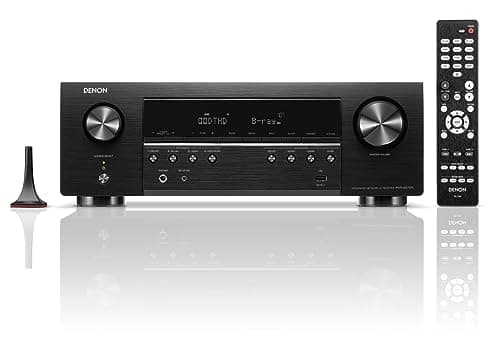 Denon AVR-S670H The X1800H's five-channel sibling: the same 8K plumbing and Audyssey correction, minus the two channels an Atmos height pair would need. | Best 5.2 option | 7.4 | |
| 2 | 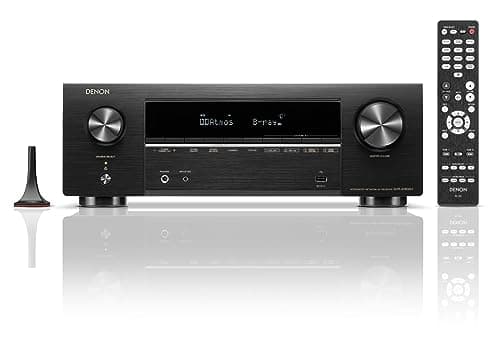 Denon AVR-X1800H Seven channels, 8K passthrough and Audyssey MultEQ XT — the room correction being the feature that actually changes what you hear in a real room. | Best overall under $1,000 | 9.0 | |
| 3 | 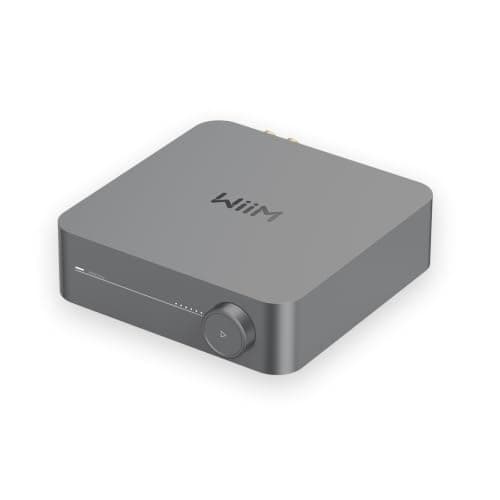 WiiM Amp A streamer with a power amplifier bolted on, which replaces two boxes — and gives up an order of magnitude of measured noise performance to do it. | Best one-box system for passive speakers | 7.6 |
An AV receiver is four separate products in one chassis. Whether it is worth buying depends on how many of the four you need, and that is a question with a checkable answer rather than a matter of taste.
The four products
- A surround decoder. It turns Dolby TrueHD, Dolby Digital Plus, DTS-HD Master Audio and, on some models, Dolby Atmos and DTS:X into discrete channels. Nothing else in a normal system does this.
- An HDMI switch. Multiple sources in, one cable to the television, with the audio pulled off. The Denon AVR-X1800H publishes six inputs and an eARC output; even the entry models publish four.
- A room correction system. Audyssey, YPAO or AccuEQ, with a measurement microphone in the box. This is genuinely difficult to buy any other way at this price.
- Five to seven power amplifiers.Modest ones — 70 to 100 watts per channel across everything we cover — but five of them, which no stereo amplifier offers at any price.
Buying all four separately is not really possible under $1,000. That bundling is the case for a receiver, and it is a strong one if you want all four.
When a receiver is not worth it
If you will never connect more than two speakers. The decoder and four of the amplifier channels are dead weight, and every dollar spent on them is a dollar not spent on the two channels you use. An integrated amplifier publishes better numbers for the same money because it spends none of its budget on video.
If the television is the only source.A modern set with eARC can send a lossless stream over one cable, and a soundbar or a streaming amplifier can receive it. The HDMI switching — product two of the four — is worth nothing to you.
If nobody will run the calibration. Room correction is the feature most often paid for and least often used. It requires putting a microphone on a stand at the listening position and running a ten-minute sweep. If that will not happen, you have bought product three for nothing.
What the alternatives actually replace
| Alternative | Replaces | Does not replace |
|---|---|---|
| Soundbar | Decoder, amplifiers, speakers, all in one box | Discrete channel placement, HDMI switching on cheaper models, any upgrade path |
| Streaming amplifier (e.g. WiiM Amp) | Two amplifier channels, streaming, HDMI ARC in, subwoofer output | Surround decoding entirely — WiiM publishes stereo PCM only over ARC, no Dolby Digital and no DTS |
| Integrated amplifier | Two amplifier channels, usually with a phono stage | Decoding, HDMI switching, room correction, center and surround channels |
The WiiM Amp row is the one that catches people out. It is an excellent two-channel streaming amplifier with an HDMI ARC input, which reads like a television connection — and it is, but WiiM publishes that the ARC input handles stereo PCM only. Feed it a Dolby Digital broadcast and there is nothing to decode it.
The upgrade path argument, checked against the specs
“Buy a receiver because you can grow into it” is true only if the receiver publishes pre-outs, and most do not at the prices people buy them. The Denon AVR-S670H publishes subwoofer pre-outs and nothing else; the Denon AVR-X1800H publishes 2.2. Only the Marantz Cinema 70s publishes a full set.
So the realistic growth path for a mid-priced receiver is: add a subwoofer, add height speakers if the model supports them, and replace the whole box when you outgrow it. That is a fine plan. It is just not the same as the open-ended upgrade path the phrase implies, and the pre-out spec is where to check it.
What each of the four is worth separately
The bundling argument only holds if the parts are individually expensive, so it is worth checking against things we do rank.
- The amplifier channels. A stereo integrated amplifier publishing 60 watts sits comfortably in the under-$500 bracket. Five channels of that is not five times the price, but it is not free either — and no stereo amplifier at any price gives you five.
- The DAC and switching. A capable standalone DAC with multiple digital inputs is a modest purchase. HDMI switching with eARC extraction is not something we rank and is genuinely awkward to buy alone.
- Room correction. This is the one that has no realistic separate purchase at this price. Audyssey, YPAO and AccuEQ ship with the receiver and the microphone is in the box.
- The decoder. Also effectively unbuyable separately. Standalone processors exist and start well above what a complete receiver costs.
So the bundle is genuinely good value if you want all four. What the list also shows is how much of the value is concentrated in the two you cannot buy separately — which is exactly why a two-channel-only listener gets so little from a receiver.
The second-hand argument
Receivers depreciate faster than almost anything else in audio, because the video section dates. A receiver that was current three years ago may have HDMI 2.0 inputs capped at 4K/60, which is exactly the limitation that pushed the Yamaha RX-V385 off our under-$500 page before its listing died: a 4K/60 video section is the one part of a receiver that ages badly.
That depreciation is an opportunity if the video section does not matter to you. A receiver used purely for audio — sources connected directly to the television, audio returned over ARC — does not care how old its HDMI inputs are. The decoder, the amplifiers and the room correction age far more slowly than the video does.
We do not track second-hand prices and cannot rank used equipment, so this is a structural observation rather than a recommendation. The structural point is worth having: the part of a receiver that goes out of date is the part a modern television has already replaced.
The two-question test
Ask whether you will place five speakers in the room. Then ask whether more than one source will be connected. Two yeses and a receiver is the cheapest way to get what you want. Two noes and you are buying four products to use one.
One of each is the interesting case, and the tie-breaker is the television. If it has eARC and everything else plugs into it, the switching is worthless and a two-channel solution plus a subwoofer will do more per dollar. If sources plug into the system rather than the screen, the receiver earns its place on that alone.
Every pick in detail
Every specification below links to the manufacturer document we read it from. Where a manufacturer does not publish a figure, we say so rather than estimating it.
Denon AVR-S670H
Best 5.2 optionPrice as of October 15, 2026. #ad
The X1800H's five-channel sibling: the same 8K plumbing and Audyssey correction, minus the two channels an Atmos height pair would need.
- channels
- 6/10
- room correction
- 9/10
- connectivity
- 8/10
- value for money
- 8/10
- future proofing
- 6/10
| Specification | Published value | Source |
|---|---|---|
| Channels | 5.2 (5 power amplifiers) | Denon info sheet (PDF) |
| Power output | 75 W + 75 W (8 Ω, 20 Hz – 20 kHz, 0.08% THD, 2 ch driven) | Denon info sheet (PDF) |
| Dolby Atmos | Sources conflict. Denon's info sheet lists NO Atmos and NO DTS:X (Dolby Audio logo, TrueHD/Digital Plus/Pro Logic II only); Denon's own product-page TITLE says “with Dolby Atmos”. We trust the info sheet's spec table over the page title — verify before buying if Atmos is the reason you are buying. | Denon info sheet (PDF) |
| Room correction | Audyssey MultEQ, with Dynamic EQ and Dynamic Volume | Denon info sheet (PDF) |
| Phono input | Yes — MM, 2.5 mV input sensitivity | Denon owner's manual |
| Video passthrough | 8K/60 Hz, 4K/120 Hz | Denon product page |
| HDMI in / out | 6 in (3 x 8K) / 1 out (Main, eARC). No front-panel HDMI | Denon product page |
| HDMI 2.1 gaming features | ALLM / QMS / QFT / VRR — Yes / No / Yes / Yes | Denon product page |
| Pre-outs | Subwoofer only (0.2) — no main-channel pre-outs | Denon info sheet (PDF) |
Pros
- 8K/60 passthrough and HEOS streaming at a lower price
- Audyssey MultEQ room correction
- MM phono input, 2.5 mV / 47 kΩ
- Simpler to set up than a 7.2
Cons
- Denon's own sources conflict on Dolby Atmos: their info sheet lists none, their product-page title says it has it. Verify before buying if Atmos is the point.
- 5.2 only — five channels cannot produce height regardless of decoding
- Subwoofer pre-outs only, so no path to external amplification
Skip it if Dolby Atmos matters to you — both because five channels cannot do height, and because Denon's own documentation does not agree on whether this unit decodes it.
Denon AVR-X1800H
Best overall under $1,000Price as of October 15, 2026. #ad
Seven channels, 8K passthrough and Audyssey MultEQ XT — the room correction being the feature that actually changes what you hear in a real room.
- channels
- 9/10
- room correction
- 9/10
- connectivity
- 9/10
- value for money
- 9/10
- future proofing
- 9/10
| Specification | Published value | Source |
|---|---|---|
| Channels | 7.2 (7 power amplifiers — 7.2 or 5.2.2) | Denon info sheet (PDF) |
| Power output | 80 W + 80 W (8 Ω, 20 Hz – 20 kHz, 0.08% THD, 2 ch driven) | Denon info sheet (PDF) |
| Room correction | Audyssey MultEQ XT, with Dynamic EQ and Dynamic Volume | Denon info sheet (PDF) |
| Dolby Atmos / DTS:X | Yes / Yes | Denon info sheet (PDF) |
| Phono input | Yes — MM, 2.5 mV input sensitivity; RIAA deviation ±1 dB (20 Hz – 20 kHz); S/N 74 dB (IHF-A); distortion 0.03% (1 kHz, 3 V) | Denon owner's manual, audio section |
| Analog input sensitivity | 200 mV; frequency response 10 Hz – 100 kHz (+1, −3 dB, Direct mode); S/N 98 dB (IHF-A, Direct mode) | Denon owner's manual, audio section |
| Power consumption | 430 W. Standby 0.1 W — but only with Network Control set to “Off In Standby” and HDMI Pass Through off; CEC standby is 0.5 W. Denon publishes no idle (powered-on, not playing) figure at all. | Denon owner's manual, general section |
| HDMI in / out | 6 in (3 are 8K) / 1 out (eARC) | Denon info sheet (PDF) |
| Video passthrough | 8K/60 Hz, 4K/120 Hz; VRR, QFT, ALLM | Denon product page |
| HDMI 2.1 gaming features | ALLM / QMS / QFT / VRR — Yes / No / Yes / Yes. Denon does not state which of the six inputs carry them beyond the “3 x 8K” count. | Denon product page |
| Pre-outs | 2.2 only (front L/R + 2 subwoofer) — NOT a full 7.2 pre-out | Denon info sheet (PDF) |
| Streaming | HEOS built-in; AirPlay 2, Spotify Connect, Amazon Music HD, TIDAL | Denon info sheet (PDF) |
Pros
- Audyssey MultEQ XT room correction — a step above the plain MultEQ on the cheaper models
- 7.2 channels — enough for a 5.2.2 Atmos layout
- MM phono input, so a turntable connects without a separate stage
- 8K/60 and 4K/120 passthrough with VRR and ALLM
Cons
- Only 2.2 pre-outs (front L/R plus subwoofers) — you cannot add external amplification to the surround channels later
- Menus are dense
- Runs warm in a closed cabinet
Skip it if you only need 5 channels — the AVR-S670H shares the same core for less.
WiiM Amp
Best one-box system for passive speakersPrice as of October 15, 2026. #ad
A streamer with a power amplifier bolted on, which replaces two boxes — and gives up an order of magnitude of measured noise performance to do it.
- measured performance
- 6/10
- connectivity
- 8/10
- features
- 9/10
- value for money
- 9/10
- published data
- 5/10
| Specification | Published value | Source |
|---|---|---|
| Power output | 60 W per channel into 8 Ω · 120 W per channel into 4 Ω | WiiM spec page |
| Rated-power measurement condition (THD figure, both channels driven) | Not published | — |
| Audio output quality | SNR 98 dB · THD+N 0.0025% (−92 dB) — an order of magnitude worse than the Pro Plus's line-out, which is what a Class-D power stage costs you | WiiM spec page |
| Inputs | HDMI ARC · optical · RCA line-in | WiiM spec page |
| Outputs | Passive speaker terminals · subwoofer out with auto cable detection and a user-adjustable 30–250 Hz crossover | WiiM spec page |
| Network | Wi-Fi 802.11 b/g/n/ac dual band · 10/100 Mbps LAN · Bluetooth 5.1 | WiiM spec page |
| Protocols | AirPlay 2, Chromecast, Spotify Connect, TIDAL Connect, Alexa Cast, DLNA, Roon Ready | WiiM spec page |
| EQ | 10-band graphic EQ, 10-band parametric EQ, 26 presets | WiiM spec page |
| Home theater formats | Stereo PCM only — Dolby Digital and DTS are NOT supported | WiiM spec page |
| Dimensions / weight | 190 × 190 × 63 mm; 1.84 kg (4.1 lb) | WiiM spec page |
| Phono input | No | WiiM spec page |
Pros
- 60 W into 8 Ω and 120 W into 4 Ω published, which drives every passive speaker we recommend
- Subwoofer output with a user-adjustable 30–250 Hz crossover, so a 2.1 system needs nothing else
- HDMI ARC in, so a television can feed it directly
- Same app, same EQ, same Roon Ready and AirPlay 2 support as the standalone streamers
Cons
- WiiM publishes the wattage with no THD figure and no “both channels driven” condition, so the rating cannot be compared to a Yamaha or Marantz spec
- 98 dB SNR and 0.0025% THD+N — roughly twenty decibels noisier than the Pro Plus's line-out
- Stereo PCM only over HDMI ARC: no Dolby Digital, no DTS
- No phono input, and no analog preamp output to escape the internal amplifier
Skip it if you already own an amplifier you like. This is a worse DAC than the Pro Plus attached to an amplifier you did not need.
Frequently asked questions
Are AV receivers worth it in 2026?
They are worth it if you want five or more speakers and more than one source connected. An AV receiver bundles a surround decoder, an HDMI switch, a room correction system and five to seven amplifier channels, and buying those separately is not realistic under $1,000. If you only ever use two speakers and one source, most of the box is unused.
Can a streaming amplifier replace an AV receiver?
Only for stereo. The WiiM Amp, for example, has an HDMI ARC input, a subwoofer output and 60 W per channel into 8 ohms — but WiiM publishes that the ARC input accepts stereo PCM only, with no Dolby Digital and no DTS support. It cannot decode a surround soundtrack, which is the receiver’s first job.
Is a soundbar better value than an AV receiver?
For a room where speakers cannot be placed, yes — a soundbar replaces the decoder, the amplifiers and the speakers in one purchase. What it cannot replace is discrete speaker placement, and the surround and height effects it produces are processed from a single location rather than arriving from where the mix put them.
Do AV receivers have an upgrade path?
Only where pre-outs are published. Of the receivers we cover, the Marantz Cinema 70s publishes a full 7.2 pre-out, the Denon AVR-X1800H and Yamaha RX-V6A publish front plus subwoofer, and the Denon AVR-S670H publishes subwoofer only. Without main-channel pre-outs, the internal amplifiers are permanent.
Read next
Soundbar vs Speakers
What a soundbar can and cannot physically do, and the honest case for each format.
The Best AV Receivers Under $500
Three receivers under $500, compared on the condition attached to each power figure — and all three come out at the same seventy watts.

Integrated Amplifier vs Receiver
Two-channel integrated versus multichannel receiver, judged on published power ratings and what each spec actually promises.
Home Theater Setup: The Complete Guide
The complete setup, built on Dolby's published layout angles rather than on vibes — plus what to do when your room disagrees.
AV Receiver Room Correction, Honestly
What Audyssey, YPAO and AccuEQ tiers actually publish, the one difference that is documented, and the physics room correction cannot beat.
Home Theater vs Hi-Fi
Where the two designs actually conflict, where they do not, and the single configuration that lets one room serve both without compromise.
Sources
Every specification on this page was read from one of these documents. If one of them has changed, or we have made an error, tell us — corrections are logged and dated per our editorial policy.