The Best Tube Amplifiers for a Turntable
Home audio, not guitar amps. Four valve and hybrid integrated amplifiers that are currently purchasable, ranked on what their makers publish — and on the one thing all four leave blank, which happens to be the part doing the work on a record.
The short answer
If you want valves doing the amplifying, the Muzishare X7 is the only amplifier here that qualifies — four KT88s in push-pull, a tube rectifier, triode and ultralinear modes on a switch, 4 Ω and 8 Ω transformer taps and a moving-magnet phono input. It also publishes the only A-weighted noise figure in the group (92 dB) and the only frequency response with a tolerance. If that is more amplifier than you want, the Dayton Audio HTA100 is the sensible one: a hybrid, tubes in the preamp only, but the lowest published distortion of the two Daytons and the only maker here that names the tubes it ships with. The Fosi Audio MC331 publishes the best measurements by a factor of ten and has no phono input at all, so budget for a separate phono stage. And across all four, not one maker publishes a single specification about its phono stage — which is the finding this page is really about.
Disclosure: we earn a commission if you buy through the links on this page, at no extra cost to you. It does not influence what we pick — our criteria are published and reproducible, so you can check our work. How we pick · Full disclosure
These picks are spec-and-price analyses, not listening tests. We have not heard this gear and we do not pretend to have: every figure below is sourced to the manufacturer and linked, and every price is live or not shown at all. Here are the rules we followed.
Quick picks
Ranked on the published criteria in How We Pick. Prices are live as of November 12, 2026. Tap any row for the full write-up.
- 6.8
- 6.6
- 6.4
- 6.2
| # | Product | Best for | Score | Price |
|---|---|---|---|---|
| 1 | 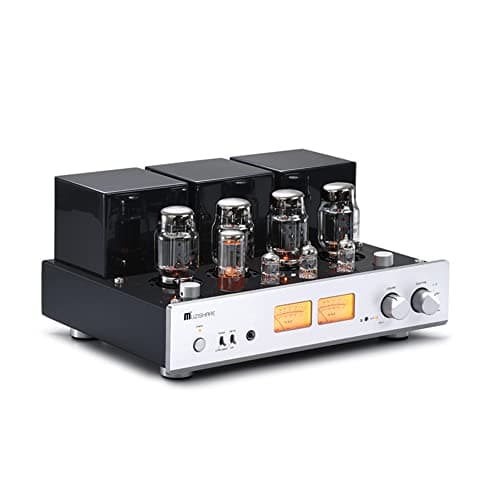 Muzishare X7 Four KT88s in push-pull with a tube rectifier, selectable triode and ultralinear modes, 4 Ω and 8 Ω transformer taps and an MM phono input — the only amplifier here doing the amplifying with valves, and the only one that publishes a weighted noise figure. | The real valve amplifier | 6.8 | |
| 2 | 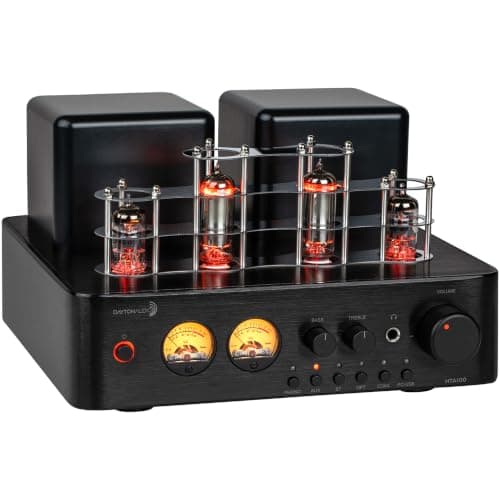 Dayton Audio HTA100 The only amplifier in this group whose maker names the tubes it ships with, and the lowest published distortion figure of the two Daytons — on a box with a phono input, a ground screw and a USB DAC. | Best overall for a turntable | 6.6 | |
| 3 | 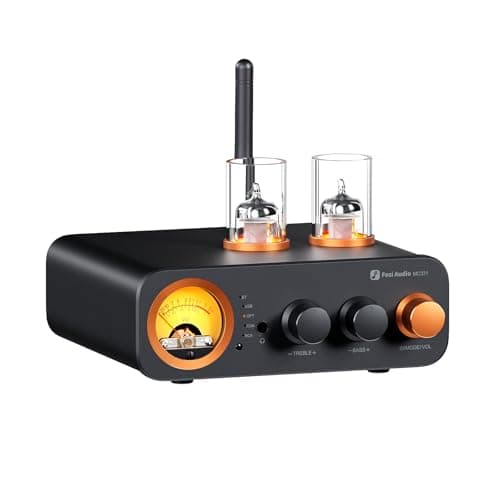 Fosi Audio MC331 The best measured claims in this group by a factor of ten and the cheapest product in it — with no phono input at all, so a turntable needs its own phono stage in front of it. | Cheapest way to hear a valve stage | 6.4 | |
| 4 | 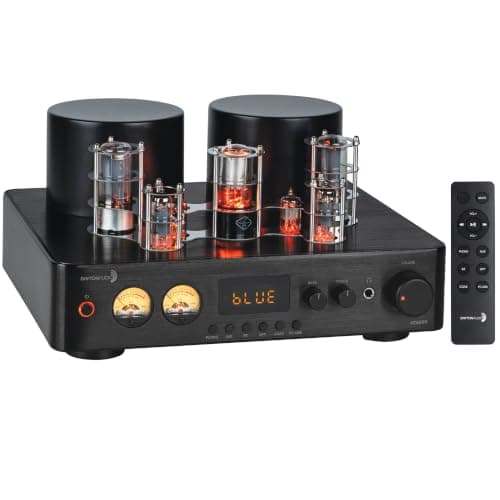 Dayton Audio HTA200 The most thoroughly specified amplifier here — gain, channel separation, idle power, a response tolerance — and the one whose two Dayton documents disagree by 30 W at 8 Ω and whose distortion figure is the highest on this site. | Most power with a phono input | 6.2 |
First, the disambiguation, because the search results for “tube amp” are mostly guitar amplifiers: this page is about home audio. Specifically, about the small set of valve and valve-hybrid integrated amplifiers you can buy today, connect a record player to, and run a pair of speakers from. There are fewer of those than the category implies, and the reason is not price. It is paperwork.
We only cover a product when its maker publishes the specifications we quote, because a spec with no source is a rumor. On that test, four amplifiers qualified out of roughly a dozen live listings. The Willsenton R200 is a genuine EL34 integrated at $799 and we had to leave it out, because no Willsenton publication for it exists. The Yaqin MC-88C Pro has four KT88s and an MM phono input and the same problem. The Juson Audio range is Amazon-only with no maker documentation of any kind. What follows is what survived.
The criteria, in the order they decide it
A record is a quiet, equalized signal. Getting it to a speaker takes two things most amplifier reviews treat as one: a phono stage that applies 40-odd decibels of gain and the inverse RIAA curve, and a power stage that drives your speakers. So:
- Is there a phono input, and what does the maker publish about it? A tube amplifier with no phono input needs a separate box, and that box is a real cost.
- What does it make into the speakers you own?Both Daytons are rated into 4 Ω; most hi-fi speakers are 8 Ω. That gap is not a detail.
- What does the measured sheet say, next to the alternatives? The conventional integrated amplifiers we cover publish 0.019% to 0.08% distortion and 99 to 106 dB of signal-to-noise. These publish 0.03% to 1.5% and 80 to 100 dB.
- Where are the valves? Three of these four are hybrids: tubes in the preamplifier, solid state driving the speakers. One is not.
- What does it cost to keep? Tubes wear out. Four output tubes and a rectifier are a different proposition from two small signal tubes.
The blank row every one of them shares
Here is the finding, and we checked it four times because it seemed too neat: none of these four manufacturers publishes any specification for its phono stage. Not gain. Not input sensitivity. Not loading impedance or capacitance. Not RIAA deviation. Not a phono signal-to-noise figure. Dayton’s HTA200 manual devotes a page to connecting a turntable and its specification table has no phono section at all. Muzishare’s manual says the amplifier “has the function of MM singing and playing” and leaves it there.
Compare that with the solid-state integrated amplifiers already in our registry, which are not high-end products either: the Marantz PM6007 publishes 2.2 mV / 47 kΩ and 83 dB phono signal-to-noise; the Denon PMA-600NE 2.5 mV / 47 kΩ and 84 dB; the Yamaha A-S501 3.0 mV / 47 kΩ and 82 dB or more; the Onkyo TX-8470 publishes a maximum phono input level (70 mV MM, 7 mV MC) and separate MM and MC noise figures. Those numbers are how you work out whether your cartridge suits the input. Our integrated-amplifier roundup for turntables ranks six amplifiers on exactly that data, and it is data no valve amplifier here provides.
What that means in practice: with any of these four you are buying the phono stage unseen. If your cartridge is a normal moving magnet at 3 to 5.5 mV it will almost certainly work. If it is a moving coil at 0.3 to 0.4 mV — the Denon DL-103 or the Audio-Technica OC9X pair we cover — you have no published basis for expecting it to work at all, and the Muzishare is explicit that its stage is MM. Our moving magnet versus moving coil explainer covers the 20-plus decibel gap between those two worlds.
Then the part valve amplifiers really do decide: how loud
Valve amplifiers make less power than solid-state ones at the same money, and the Muzishare is the clearest case: 25 W per channel in triode mode, 45 W in ultralinear. Whether that is plenty or hopeless is not a matter of taste, it is a matter of your speakers’ published sensitivity.
SPL = sensitivity + 10 × log₁₀(watts) − 20 × log₁₀(distance in m)
Inputs
- Muzishare X7 output, triode mode: 25 W + 25 W RMS (no load impedance or bandwidth stated by Muzishare) (Muzishare X7 owner's manual (PDF))
- Klipsch R-620F sensitivity: 96 dB (2.83 V / 1 m) — the highest published figure on this site (Klipsch spec sheet (PDF))
- ELAC Debut 3.0 DF63 sensitivity: 87.5 dB (2.83 V / 1 m) — the least sensitive floorstander we cover (ELAC product page)
Result
25 W into the Klipsch at 3 m: 96 + 14 − 9.5 ≈ 100.5 dB
25 W into the ELAC at 3 m: 87.5 + 14 − 9.5 ≈ 92 dB
Same amplifier, same volume setting, 8.5 dB apart — roughly the difference between loud and polite. Switching the Muzishare from triode to ultralinear adds 45/25, about 2.6 dB, which is less than a quarter of what the speaker choice is worth. The caveat: this is the inverse-square law in a free field, and a real room adds boundary gain, so treat these as a floor rather than a prediction. Note too that Muzishare attaches no load impedance to either power figure, so strictly we are reading a number whose conditions are unstated.
The practical rule this produces: a low-power valve amplifier wants a sensitive speaker. Our sensitivity explainercovers why 2.83 V and “one watt” are not the same claim, and our high-sensitivity roundup is the speaker half of this purchase.
1. Muzishare X7 — the only one with valves in the power stage
Four KT88 output tubes in Class AB push-pull, a 5AR4 rectifier tube, a 12AX7 and two 12AU7s up front, all named in the manual. A switch selects triode (25 W) or ultralinear (45 W). The speaker terminals offer 4 Ω and 8 Ω transformer taps, which is the single most useful thing on this page and something no other amplifier here has: you match the output to the speaker rather than hoping.
It also publishes the best-documented sheet of the four on the figures it does give: 92 dB signal-to-noise, A-weighted — the only weighted noise figure in the group — and 15 Hz to 30 kHz at −1.5 dB, the only response with a tolerance. Plus a balanced XLR input, a remote, and 22.5 kg of iron.
The costs are real. Published distortion is 1% at 1 kHz with no output level stated — about fifty times the Yamaha A-S501’s 0.019% and more than three times the Dayton HTA100’s figure. Neither power figure carries a load or a bandwidth, so neither is an FTC-style rating of the kind our power-rating guide teaches you to look for. Muzishare has no reachable website, so the owner’s manual is the only manufacturer document in existence, and its power requirement line states 115 V / 230 V at 50 Hz with no 60 Hz figure — 60 Hz being what comes out of a US wall. And eight tubes eventually need replacing. It ranks first because it is the only product on this page that actually is what the query asks for.
2. Dayton Audio HTA100 — the sensible hybrid, and the honest spec sheet
A hybrid: tubes in the preamplifier, solid-state Class A/B driving the speakers. Dayton publishes the tube types — 6F1 × 2 and 6P14A × 2 — and it is the only maker in this group that does, which means tube rolling is a decision you can price before you buy. Phono RCA with a ground screw, coaxial and optical digital in, a USB DAC, Bluetooth 5, a headphone socket and a full-range preamp output for a subwoofer. For a desk or a small room it is the entire system.
Its published distortion, < 0.3% at 50 WPC, is about five times better than Dayton publishes for the dearer HTA200 — the cheaper amplifier measures better on its maker’s own sheet, which is worth saying out loud. Against that: there is no 8 Ω power rating at all, only 50 WPC into 4 Ω; the > 80 dB signal-to-noise figure carries no weighting or reference level, so it cannot be placed beside the A-weighted 99 to 106 dB the conventional integrateds publish; the 20 Hz to 20 kHz response has no tolerance; the headphone output has no published power; and the phono stage, as above, is undocumented. The tubes are voicing a line stage, not amplifying your speakers — our tube versus solid state explainer covers why that distinction matters more than the glow suggests.
3. Fosi Audio MC331 — the best numbers, and no phono input
≤ 0.03% THD and ≥ 100 dB signal-to-noise are the best claims on this page by a factor of ten, from the cheapest product on it. Fosi publishes a list of nine compatible 7-pin tube types, so tube rolling is explicitly supported rather than tolerated. There is a pre-out and a 3.5 mm headphone output.
It ranks third because of the row that is missing: there is no phono input.The published input list is Bluetooth, RCA, USB, coaxial and optical. A turntable cannot play through this amplifier without a phono stage in front of it, and that stage costs money this price does not include — our under-$200 phono preamp roundup is where that decision lives. The other caveats are the familiar Fosi ones: 105 W is published as a maximum with no distortion condition, there is no 8 Ω rating despite a stated 4 to 8 Ω terminating range, no frequency response is published at all, and Fosi never says which tube is in the box you receive.
4. Dayton Audio HTA200 — the fullest table, and the worst distortion figure
This is the most thoroughly specified amplifier here. Total gain 29 dB, channel separation 53 dB, line input sensitivity 630 mV, idle consumption 45 W, response 15 Hz to 20 kHz within 1 dB, peak and RMS power quoted separately at both impedances. Bass and treble controls with published turnover frequencies. A five-year warranty on parts and labor, one year on tubes.
Two things drop it to fourth. The first is a conflict inside Dayton’s own documentation: the manual says 80 W × 2 into 8 Ω and the product page says 50 WPC into 8 Ω — same maker, same model, 30 W apart, and we cannot tell you which is right. The second is distortion: < 1.5% THD+N at maximum rated output in the manual, < 1% on the product page, and either way the highest published distortion figure of any amplifier on this site. Its 80 dB noise figure also carries no weighting, and unlike the cheaper HTA100 it does not name its tubes. It has more power and more connections than the HTA100; it does not have better numbers.
If you want valves and good measurements, split the job
There is a route this page would be dishonest not to mention. The gain stage a record needs most is the phono stage — it is where 40 to 60 dB of amplification happens and where the RIAA curve gets applied. So put the valves there, and let a conventional amplifier drive the speakers. The Pro-Ject Tube Box S2is a genuine two-valve phono stage that publishes an RIAA accuracy figure (± 0.4 dB), six capacitance settings and a subsonic filter with a stated slope — all things no amplifier on this page publishes. Pair it with an integrated amplifier that publishes 99 to 106 dB of signal-to-noise and you get valves in the signal path, real numbers on both boxes, and a phono stage whose behavior you can check against your cartridge’s sheet. If you would rather have the measurements than the valves at that end, our Schiit Mani 2 versus iFi ZEN Phono 3 comparison is the same decision fought out on published gain, loading and noise figures. It is less romantic than one glowing box. It is also, on published data, the better system.
How we would choose
Valves actually amplifying, a sensitive speaker, and a budget that absorbs retubing: the Muzishare X7, on the 8 Ω tap, in ultralinear until you have listened to both modes. One box for a record player, a TV and a computer in a small room: the Dayton HTA100. The cheapest way to put a valve stage in a system you already own, with a phono preamp you are buying anyway: the Fosi MC331. The most inputs and the most published power with a turntable socket, accepting the distortion figure: the HTA200. And if what you actually want is the sound of valves on records without giving up measured performance, buy a tube phono stage and a solid-state integrated — our under-$500 integrated roundup has the amplifier end of that.
Every pick in detail
Every specification below links to the manufacturer document we read it from. Where a manufacturer does not publish a figure, we say so rather than estimating it.
Muzishare X7
The real valve amplifierPrice as of November 12, 2026. #ad
Four KT88s in push-pull with a tube rectifier, selectable triode and ultralinear modes, 4 Ω and 8 Ω transformer taps and an MM phono input — the only amplifier here doing the amplifying with valves, and the only one that publishes a weighted noise figure.
- published data
- 7/10
- phono stage
- 5/10
- measured specs
- 4/10
- tube content
- 10/10
- value for money
- 5/10
| Specification | Published value | Source |
|---|---|---|
| Power output | 25 W + 25 W RMS in triode mode; 45 W + 45 W RMS in “super linear” (ultralinear) mode. No load impedance, bandwidth or distortion condition is attached to either figure. | Muzishare X7 owner's manual (PDF) |
| Amplification | All-valve. Four KT88 output tubes in Class AB push-pull with a 5AR4 rectifier and a 12AX7 plus two 12AU7 front end — the only amplifier in this group with valves in the power stage rather than only the preamplifier. | Muzishare X7 owner's manual (PDF) |
| Tube complement | 12AX7 × 1, 12AU7 × 2, KT88 × 4, 5AR4 × 1 | Muzishare X7 owner's manual (PDF) |
| THD | 1% (1 kHz). No output level is stated for the measurement. | Muzishare X7 owner's manual (PDF) |
| Signal-to-noise | 92 dB, A-weighted — the only weighted noise figure published by any amplifier in this group | Muzishare X7 owner's manual (PDF) |
| Frequency response | 15 Hz – 30 kHz (−1.5 dB) — published with a tolerance, which neither Dayton nor Fosi manages | Muzishare X7 owner's manual (PDF) |
| Input sensitivity / impedance | 280 mV (0 dB) line, 520 mV on the pre-in; input impedance 100 kΩ | Muzishare X7 owner's manual (PDF) |
| Output impedance (transformer taps) | 4 Ω / 8 Ω — the only amplifier here that lets you match the tap to the speaker | Muzishare X7 owner's manual (PDF) |
| Phono input | Yes — moving magnet. The manual's feature list says it “has the function of MM singing and playing”, the input selector includes PHONO, and the rear panel labels a vinyl phono input terminal. The specification table publishes no phono gain, sensitivity, loading or RIAA figure. | Muzishare X7 owner's manual (PDF) |
| Other inputs | CD, LINE 1, balanced XLR and PHONO, plus a pre-in; triode / ultralinear switch, mute and infrared remote | Muzishare X7 owner's manual (PDF) |
| Power requirement | 115 V / 230 V ± 5%, stated as 50 Hz only — the manual publishes no 60 Hz figure, which is the US supply frequency. Consumption 260 W. | Muzishare X7 owner's manual (PDF) |
| Dimensions / weight | 410 × 335 × 198 mm (W × D × H); 22.5 kg net — about three times the weight of either Dayton | Muzishare X7 owner's manual (PDF) |
| Phono stage gain, loading and RIAA accuracy | Not published | — |
| Headphone output (none fitted) | Not published | — |
Pros
- Valves in the power stage, not just the preamplifier: KT88 × 4 in Class AB push-pull, a 5AR4 rectifier and a 12AX7 plus two 12AU7 front end, all named in the manual
- Triode (25 W) and ultralinear (45 W) modes on a switch, so the mode is a listening choice rather than a factory decision
- 4 Ω and 8 Ω transformer taps — the only amplifier in this group that lets you match the output to the speaker you own
- The only one here publishing an A-weighted signal-to-noise figure (92 dB) and a frequency response with a tolerance (15 Hz – 30 kHz, −1.5 dB)
- Moving-magnet phono input and a balanced XLR input, on a 22.5 kg chassis with a remote
Cons
- 1% THD at 1 kHz, with no output level stated for the measurement — more than three times the Dayton HTA100 figure and about fifty times the Yamaha A-S501's 0.019%
- 25 W in triode and 45 W in ultralinear, with no load impedance or bandwidth attached to either number, so neither is an FTC-style rating
- Nothing is published about the phono stage: no gain, no sensitivity, no loading, no RIAA deviation — the same gap as the rest of this group, on the most expensive product in it
- Muzishare has no reachable website; the only manufacturer document we could find is the owner's manual, and the power requirement in it states 50 Hz only while US mains is 60 Hz
- Four output tubes, a rectifier tube and three small signal tubes are a replacement bill nobody else here has, and the tubes carry a one-year warranty at best
Skip it if your speakers are not sensitive. 25 W in triode into an 87 dB speaker is a quiet system, and the published data gives you no help with the phono stage you would be relying on.
Dayton Audio HTA100
Best overall for a turntablePrice as of November 12, 2026. #ad
The only amplifier in this group whose maker names the tubes it ships with, and the lowest published distortion figure of the two Daytons — on a box with a phono input, a ground screw and a USB DAC.
- published data
- 6/10
- phono stage
- 4/10
- measured specs
- 4/10
- tube content
- 4/10
- value for money
- 8/10
| Specification | Published value | Source |
|---|---|---|
| Power output | 50 WPC RMS @ 4 Ω (60 W max). Dayton publishes NO 8 Ω rating for this model, and 8 Ω is what most hi-fi speakers present. | Dayton Audio product page |
| Amplification | Vacuum tubes in the preamplifier stage, solid-state Class A/B output stage — a hybrid, not a valve power amplifier | Dayton Audio product page |
| Preamplifier tubes | 6F1 × 2, 6P14A × 2 — the only amplifier in this group whose maker names the tubes it ships with | Dayton Audio product page |
| THD | < 0.3% @ 50 WPC — roughly an order of magnitude worse than the 0.019% to 0.08% the solid-state integrateds on this site publish, and about five times better than its own larger sibling | Dayton Audio product page |
| Signal-to-noise | > 80 dB. No weighting and no reference level are stated, so it is not directly comparable with the A-weighted and IHF-A figures elsewhere on this site. | Dayton Audio product page |
| Frequency response | 20 – 20,000 Hz. No ± dB tolerance published. | Dayton Audio product page |
| Minimum speaker impedance | 4 Ω | Dayton Audio product page |
| Phono input | Yes — phono RCA with a built-in preamp and a ground terminal for a turntable. Dayton publishes no cartridge type, no gain, no input sensitivity, no loading and no RIAA figure for it. | Dayton Audio product page |
| Other inputs / outputs | Line in, coaxial and optical digital, USB DAC, Bluetooth 5 (SBC, AAC); full-range preamplifier (sub) output and a front headphone output | Dayton Audio product page |
| Digital sample rate | Up to 16-bit / 48 kHz | Dayton Audio product page |
| Dimensions / weight | 10.6 × 6.6 × 11.5 in; 13.4 lb | Dayton Audio product page |
| Phono stage gain, loading and RIAA accuracy | Not published | — |
| Headphone output power | Not published | — |
| Channel separation | Not published | — |
Pros
- Dayton names the preamplifier tubes — 6F1 × 2 and 6P14A × 2 — so a tube swap is a decision you can make before you buy rather than after you open it
- < 0.3% THD at 50 WPC is about five times better than Dayton publishes for the larger HTA200, from the cheaper amplifier
- Phono RCA input and a ground terminal, so a turntable with no built-in stage connects with no second box
- Coaxial, optical, USB and Bluetooth 5 as well, which makes it the whole system for a desk or a small room
Cons
- Dayton publishes no 8 Ω power rating at all — only 50 WPC into 4 Ω, and 8 Ω is what most hi-fi speakers present
- Not one figure is published about the phono stage: no cartridge type, no gain, no input sensitivity, no loading, no RIAA deviation
- The > 80 dB signal-to-noise figure carries no weighting and no reference level, so it cannot be set beside the 99 to 106 dB A-weighted figures the solid-state integrateds on this site publish
- 20 – 20,000 Hz is published with no ± dB tolerance, and the headphone output has no published power at all
- The tubes are in the preamplifier only — the output stage is solid-state Class A/B, which is what the “hybrid” in the name means
Skip it if you want valves doing the amplifying rather than the voicing, or your speakers are 8 Ω and you want to know what the amplifier makes into them. For the first, the Muzishare X7 below; for the second, any of the solid-state integrateds we cover.
Fosi Audio MC331
Cheapest way to hear a valve stagePrice as of November 12, 2026. #ad
The best measured claims in this group by a factor of ten and the cheapest product in it — with no phono input at all, so a turntable needs its own phono stage in front of it.
- published data
- 5/10
- phono stage
- 0/10
- measured specs
- 8/10
- tube content
- 3/10
- value for money
- 9/10
| Specification | Published value | Source |
|---|---|---|
| Power output | 105 W × 2 at 4 Ω, published as a MAXIMUM output. No distortion condition is attached and no 8 Ω rating is published at all. | Fosi Audio product page |
| Amplification | Hybrid — a valve preamplifier stage feeding a solid-state Class D output stage. Fosi does not name the output chip on the product page. | Fosi Audio product page |
| THD | ≤ 0.03%, with no measurement condition stated — the best distortion claim in this group by a factor of ten, and the one with the least information attached | Fosi Audio product page |
| Signal-to-noise | ≥ 100 dB. No weighting stated. | Fosi Audio product page |
| Terminating impedance | 4 – 8 Ω | Fosi Audio product page |
| Phono input | None. The published input list is Bluetooth, RCA, USB, coaxial and optical — a turntable needs its own phono stage in front of this amplifier. | Fosi Audio product page |
| Outputs | Passive speaker output, pre-out and a 3.5 mm headphone output | Fosi Audio product page |
| Tubes | Fosi publishes a list of compatible 7-pin types — 5654W, 6AK5, 6AK5W, 6Zh1P, 6J1, 6J1P, WE-403A, 403B, EF95 — but does not state which tube the unit ships with | Fosi Audio product page |
| Bluetooth | Codecs SBC and AAC. No Bluetooth version is published. | Fosi Audio product page |
| Power supply | 24 V / 4.5 A external adapter | Fosi Audio product page |
| Dimensions | 10 × 2 × 2.7 in | Fosi Audio product page |
| Frequency response | Not published | — |
| Headphone output power | Not published | — |
| Weight | Not published | — |
Pros
- ≤ 0.03% THD and ≥ 100 dB signal-to-noise are the best numbers published by any amplifier on this page, at the lowest price on it
- Fosi publishes a list of nine compatible 7-pin tube types, which makes tube rolling an explicitly supported thing rather than a gamble
- Pre-out and a 3.5 mm headphone output, so it works as a desk amplifier as well as a speaker amplifier
- 105 W × 2 at 4 Ω from a box 10 inches wide running on a 24 V adapter
Cons
- No phono input. A turntable needs a separate phono stage, which adds cost this price does not include
- 105 W is published as a MAXIMUM with no distortion condition, and there is no 8 Ω rating at all despite a stated 4 – 8 Ω terminating range
- No frequency response is published, and neither is the weight or the Bluetooth version
- Fosi lists the tubes it is compatible with but never says which tube is in the box you receive
- A valve preamplifier in front of a Class D output stage is the thinnest tube content here — the valve is voicing a line stage, not amplifying your speakers
Skip it if you want one box between your turntable and your speakers. Add a phono stage and this is a fine, cheap system; without one it cannot play a record at all.
Dayton Audio HTA200
Most power with a phono inputPrice as of November 12, 2026. #ad
The most thoroughly specified amplifier here — gain, channel separation, idle power, a response tolerance — and the one whose two Dayton documents disagree by 30 W at 8 Ω and whose distortion figure is the highest on this site.
- published data
- 7/10
- phono stage
- 4/10
- measured specs
- 3/10
- tube content
- 4/10
- value for money
- 6/10
| Specification | Published value | Source |
|---|---|---|
| Power output (RMS) | 100 W × 2 @ 4 Ω and 80 W × 2 @ 8 Ω in the user manual's specification table — but Dayton's own product page publishes “100 WPC RMS @ 4 ohms, 50 WPC RMS @ 8 ohms”. Same maker, two documents, 30 W apart at 8 Ω. | Dayton Audio user manual (PDF) |
| Power output (peak) | 260 W × 2 @ 4 Ω, 130 W × 2 @ 8 Ω. The “200 watt” in the product name is neither of the RMS figures. | Dayton Audio user manual (PDF) |
| Amplification | Class A/B solid-state output stage with vacuum tubes in the preamplifier input section — Dayton's own description of the HTA series | Dayton Audio user manual (PDF) |
| THD+N | < 1.5% at maximum rated output in the manual; the product page states “< 1% @ 100 WPC”. Either way it is the highest published distortion figure of any amplifier on this site. | Dayton Audio user manual (PDF) |
| Signal-to-noise | 80 dB. No weighting or reference level stated. | Dayton Audio user manual (PDF) |
| Frequency response | 15 Hz – 20,000 Hz (1 dB) | Dayton Audio user manual (PDF) |
| Channel separation | 53 dB | Dayton Audio user manual (PDF) |
| Total gain | 29 dB, with a line input sensitivity of 630 mV | Dayton Audio user manual (PDF) |
| Minimum speaker impedance | 4 Ω | Dayton Audio user manual (PDF) |
| Phono input | Yes — a dedicated PHONO RCA input and a ground terminal; the manual's instruction is to set the turntable to phono output and connect it directly. No cartridge type, gain, sensitivity, loading or RIAA figure appears in the manual or on the product page. | Dayton Audio user manual (PDF) |
| Other inputs / outputs | AUX line in, SPDIF LPCM (to 48 kHz / 16-bit), PC-USB (to 16-bit / 48 kHz), Bluetooth 5.0; full-range preamplifier (sub) output, headphone output, and bass and treble controls at 6 dB/octave around 200 Hz and 4 kHz | Dayton Audio user manual (PDF) |
| Idle power consumption | 45 W — published, and the highest idle figure of any stereo amplifier on this site | Dayton Audio user manual (PDF) |
| Dimensions / weight | 13-1/8 × 6-1/2 × 12-1/2 in (333 × 165 × 318 mm); 16.4 lb (7.44 kg) | Dayton Audio user manual (PDF) |
| Tube complement | Not published | — |
| Phono stage gain, loading and RIAA accuracy | Not published | — |
Pros
- The fullest specification table of the four: total gain (29 dB), channel separation (53 dB), input sensitivity (630 mV), idle consumption (45 W) and a response tolerance
- The only Dayton here with a published 8 Ω rating, and both of its figures (80 W or 50 WPC) beat the HTA100 into 4 Ω
- Phono RCA plus ground, bass and treble controls with published turnover points, and a full-range preamplifier output for a subwoofer
- A five-year parts and labor warranty, with one year on the tubes, published on Dayton's own page
Cons
- Dayton's manual says 80 W × 2 into 8 Ω and Dayton's product page says 50 WPC into 8 Ω — same maker, two documents, 30 W apart, and we cannot tell you which is right
- < 1.5% THD+N at rated output (or < 1% on the product page) is the highest published distortion of any amplifier on this site by a wide margin
- 80 dB signal-to-noise with no weighting stated, on a box that costs more than several integrateds here that publish over 100 dB
- Dayton does not name the tubes in this one, although it names them for the cheaper HTA100
- 45 W of idle power draw, published — more than some of these speakers will ever need from it
Skip it if distortion figures matter to you, or you need to know the real 8 Ω power before you buy. The HTA100 publishes a distortion figure five times lower, and the conventional integrateds we cover publish 0.019% to 0.08%.
Frequently asked questions
What is the best tube amplifier for a turntable?
Do tube amplifiers have a phono input for a record player?
How many watts does a tube amplifier need for a turntable?
Is a hybrid tube amplifier a real tube amplifier?
Why is the distortion so much higher on tube amplifiers?
Can I use a moving coil cartridge with a tube amplifier's phono input?
Have you listened to these amplifiers?
Read next
The Best Tube Phono Preamps for a Turntable
Three tube phono stages ranked on published RIAA accuracy, loading and gain: Pro-Ject's ± 0.4 dB against Douk's ± 3 dB, with one maker refusing to put a number on it at all - and a note on which of the three has a live offer today.
Tube vs Solid State Amplifiers
What actually differs in measurable terms, what is preference, and where we have to stop.
The Best Integrated Amplifiers for a Turntable
Amplifiers with a phono stage inside, ranked on published MM sensitivity and phono signal-to-noise — not watts.
Do I Need a Phono Preamp?
Yes, unless you already have one — and it might be hiding in your turntable, amplifier or speakers. Check in 30 seconds.
The Best Phono Preamps Under $500
Six phono stages from $249 to $499, ranked on published RIAA accuracy and whether the loading can be matched to your cartridge.
Speaker Sensitivity Explained
2.83 V/1 m versus 1 W/1 m, what the conversion is worth in decibels, and the twelve-decibel spread that means sixteen times the power.
How to Read an Amplifier Power Rating
Impedance, bandwidth, distortion, channels driven — the four conditions that turn a watts number into a spec, and which manufacturers publish all four.
Sources
Every specification on this page was read from one of these documents. If one of them has changed, or we have made an error, tell us — corrections are logged and dated per our editorial policy.
- Dayton Audio HTA100 — product page (50 WPC @ 4 Ω, < 0.3% THD, 6F1 and 6P14A tubes)
- Dayton Audio HTA200 — user manual (80 W @ 8 Ω, < 1.5% THD+N, 29 dB gain, 45 W idle)
- Dayton Audio HTA200 — product page (the conflicting 50 WPC @ 8 Ω and < 1% THD figures)
- Muzishare X7 — owner's manual (25/45 W, 1% THD, 92 dB A-weighted, KT88 × 4, MM phono)
- Fosi Audio MC331 — product page (105 W × 2 @ 4 Ω max, ≤ 0.03% THD, ≥ 100 dB, no phono in)
- Klipsch R-620F — spec sheet (96 dB sensitivity, used in the loudness arithmetic)
- Marantz PM6007 — owner's manual (2.2 mV phono sensitivity, 83 dB phono S/N, for contrast)
- Pro-Ject Tube Box S2 — product page (± 0.4 dB RIAA, the tube phono stage alternative)