The Best Integrated Amplifiers for a Turntable
Every amplifier here has a PHONO socket. Only some of their makers will tell you anything at all about what is behind it, and that is the whole ranking.
Disclosure: we earn a commission if you buy through the links on this page, at no extra cost to you. It does not influence what we pick — our criteria are published and reproducible, so you can check our work. How we pick · Full disclosure
These picks are spec-and-price analyses, not listening tests. We have not heard this gear and we do not pretend to have: every figure below is sourced to the manufacturer and linked, and every price is live or not shown at all. Here are the rules we followed.
Quick picks
Ranked on the published criteria in How We Pick. Prices are live as of October 15, 2026. Tap any row for the full write-up.
- 7.8
- 8.6
- 7.8
- 8.8
- 7.2
- 7.0
| # | Product | Best for | Score | Price |
|---|---|---|---|---|
| 1 | 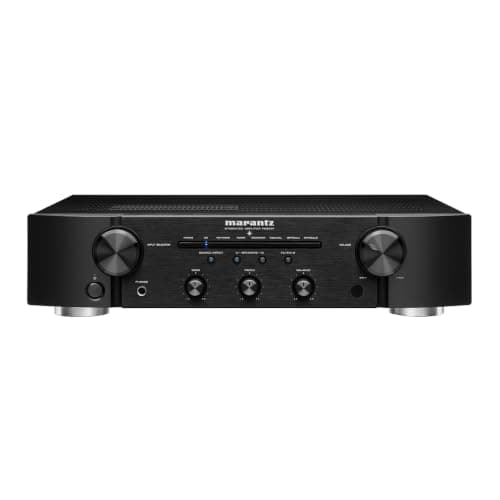 Marantz PM6007 A phono stage plus a proper DAC section in a well-made chassis, at the top of what this bracket will bear. | Best built-in DAC | 7.8 | |
| 2 | 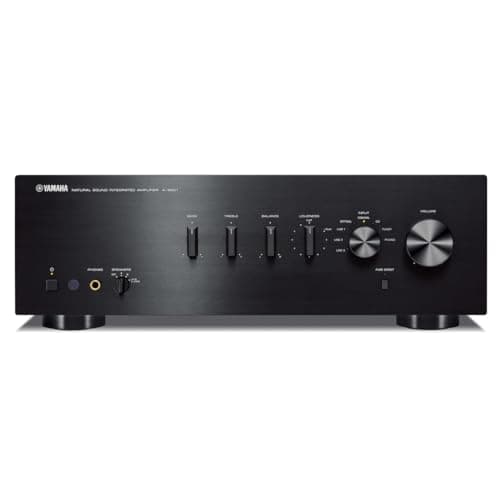 Yamaha A-S501 85 watts per channel into 8 ohms with a damping factor of 240 and an MM phono input fitted — the most amplifier here for the money, provided your speakers are an 8-ohm load. | Best overall under $1,000 | 8.6 | |
| 3 | 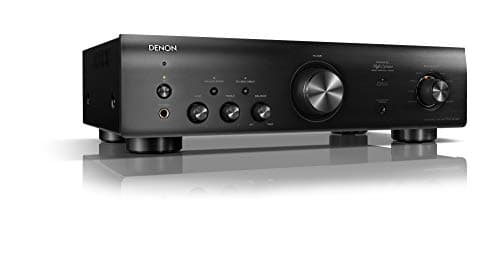 Denon PMA-600NE An integrated with a phono stage, a DAC and Bluetooth in one chassis — the fewest boxes for a mixed vinyl-and-streaming system. | Best with Bluetooth | 7.8 | |
| 4 | 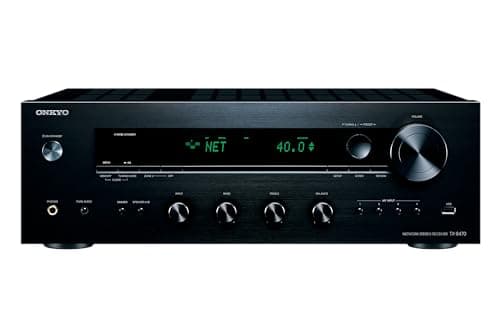 Onkyo TX-8470 The only amplifier we can verify under $500 with a moving-coil phono position as well as a moving-magnet one, and the only one whose maker states its power the FTC way. | Best phono stage under $500 | 8.8 | |
| 5 | 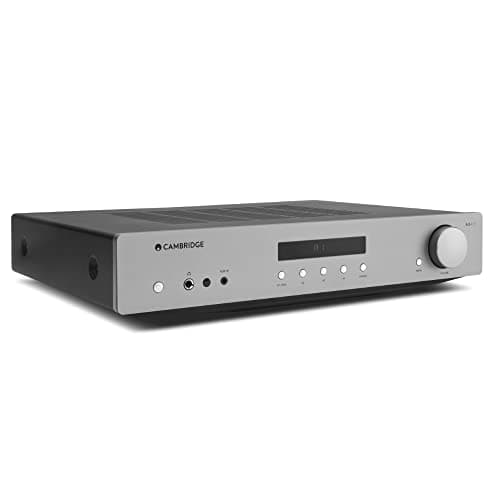 Cambridge Audio AXA35 A deliberately plain integrated with a phono stage and a headphone output, aimed at a turntable and nothing more complicated. | Best simple amplifier for a turntable | 7.2 | |
| 6 | 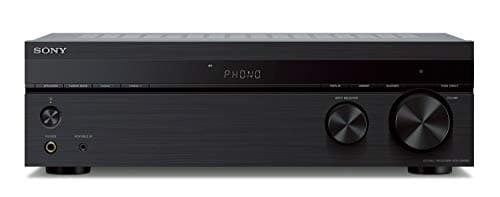 Sony STR-DH190 A stereo receiver with a phono input, Bluetooth and an FM tuner, at roughly half the price of the integrateds above it. | Best budget receiver with a phono input | 7.0 |
Buying an amplifier with a phono stage built in removes a box, a pair of interconnects and a purchase decision. It is, for most vinyl systems, exactly the right move.
The trouble is that “has a phono input” is a binary that hides a very large range. A phono stage is a high-gain, RIAA-equalized circuit amplifying a signal of a few thousandths of a volt — the most demanding small-signal job in the whole amplifier — and manufacturers publish wildly different amounts about it. This page ranks on what they publish about the phono stage specifically, not on wattage. Wattage is the subject of our main amplifier roundup.
What every phono stage should publish, and who does
| Amplifier | MM sensitivity | Phono SNR | RIAA deviation |
|---|---|---|---|
| Marantz PM6007 | 2.2 mV / 47 kΩ | 83 dB | Not published |
| Yamaha A-S501 | 3.0 mV / 47 kΩ | 82 dB or more | Not published |
| Denon PMA-600NE | 2.5 mV / 47 kΩ | 84 dB | Not published |
| Cambridge AXA35 | Not published | Not published separately | Not published |
| Onkyo TX-8470 | Not published — Onkyo gives a maximum input instead, 70 mV on MM and 7 mV on MC | 76 dB (MM) · 60 dB (MC) | Not published |
| Sony STR-DH190 | No specifications available — Sony blocks automated access to every domain it operates, and we do not use retailer mirrors as a source | ||
Not one of these publishes an RIAA deviation figure. That is the specification that tells you how accurately the stage undoes the equalization curve applied at the cutting lathe, and it is the closest thing to a fidelity measurement a phono stage has. For context, Marantz doespublish it on the Cinema 70s AV receiver — ±1 dB from 20 Hz to 20 kHz — so the number exists in their engineering department. It simply does not appear on the integrated amplifier’s sheet.
What input sensitivity actually tells you
The MM sensitivity figure is the input voltage that produces the amplifier’s rated output. Lower means more gain.
The Marantz’s 2.2 mV means it needs less signal than the Yamaha’s 3.0 mV to reach the same level — roughly 2.7 dB more gain. With a cartridge like the Audio-Technica AT-VM95ML at 3.5 mV both are comfortable. With a lower-output cartridge, the extra gain starts to matter.
Every one that publishes an input impedance at all specifies 47 kΩ, which is the moving-magnet standard and exactly what every cartridge in our roundup asks for. None publishes an input capacitance, which is the other half of MM loading — Audio-Technica specifies 100–200 pF and Ortofon 150–300 pF for their cartridges, and none of these amplifiers tells you what it presents. The cable contributes to that total too, which is why it is worth knowing.
Why the Marantz ranks first here
Three published reasons, in order of importance.
It publishes the highest phono gain here (2.2 mV) alongside a solid 83 dB phono signal-to-noise ratio. It publishes a 4-ohm power rating — 60 W × 2 into 4 Ω across 20 Hz–20 kHz with both channels driven — which is the honest way to do it, and which Yamaha does not do for the A-S501 here. And it publishes a damping factor of 100 measured across 40 Hz–20 kHz, a stated band rather than a bare number.
It is also the most expensive amplifier in this group, and if your speakers are an easy 8-ohm load the Yamaha A-S501’s 85 W into 8 Ω at 0.019% THD is a stronger 8-ohm specification. This ranking is about the phono stage; the general-purpose ranking is on the main roundup, and the Yamaha wins there.
The Denon’s 4-ohm asterisk
Denon publishes 45 W + 45 W into 8 Ω measured 20 Hz–20 kHz at 0.07% THD, and 70 W + 70 W into 4 Ω — but the 4-ohm figure is measured at 1 kHz at 0.7% THD.
That is a much softer test. A single frequency instead of the full band, and ten times the allowable distortion. The 70 W number is not wrong, but it was not earned under the same conditions as the 45 W number, and reading them as a straightforward “more power into 4 ohms” comparison overstates what the amplifier does.
Denon deserves credit for publishing a 4-ohm figure at all — Yamaha publishes none, and Cambridge publishes none. Publishing a softened figure is more useful than publishing nothing, provided you read the condition.
The Cambridge case: a good amplifier with a quiet spec sheet
Cambridge publishes a built-in moving magnet phono stage on the AXA35, 35 W into 8 Ω, THD below 0.01% at 1 kHz, a signal-to-noise ratio above 82 dB unweighted, and a damping factor above 50.
What it does not publish is any phono-specific figure at all: no input sensitivity, no separate phono signal-to-noise, no loading. So you know the stage exists and nothing else. It also has no digital inputs, which at this price is a real omission when the Marantz and Denon both include optical and coaxial.
It is the simplest amplifier here and the one with the fewest ways to go wrong. On our published-data criterion it ranks fifth because of what is missing from the sheet, not because of anything we know about the circuit — the Onkyo TX-8470 above it publishes no phono sensitivity either, but it does publish a phono signal-to-noise for both a moving magnet and a moving coil, and that is one more phono figure than Cambridge gives.
The Onkyo, and the one figure it withholds
The TX-8470 replaced the Yamaha A-S301 in this group in September 2026, when the Yamaha stopped being buyable. It publishes more about its phono stage than anything here except the Marantz and the Denon: a switched moving-magnet or moving-coil input on an isolated board, a maximum input of 70 mV on MM and 7 mV on MC, and a signal-to-noise of 76 dB and 60 dB respectively.
What it withholds is the one figure this page ranks on first — MM input sensitivity. Onkyo gives a maximum input voltage instead, which tells you when the stage clips rather than how much gain it applies, and those are different questions. That is why it sits fourth and not higher, on a receiver that otherwise out-publishes the field.
The Sony, and why it is last
The STR-DH190 is a stereo receiver with a phono input and a reputation as a bargain. We rank it last for one reason: we cannot read its specifications.
Sony blocks automated access across every domain it operates, and the official manual returned an error when we tried to read it. The manual is mirrored on third-party sites, but a mirror is not the manufacturer and we do not treat it as one. So we publish nothing rather than something we could not verify at source.
That is not a claim that the amplifier is bad. It is a statement about what we could confirm, and it is the rule this site operates by, applied even when it costs a popular product its place.
Do you actually need one?
Not if your turntable has a built-in stage — most decks in the under-$300 bracket do. In that case any amplifier with a line input works, and the money is better spent on watts or on the cartridge.
Do need one if your deck omits a stage. The Fluance RT85and the Pro-Ject Debut Carbon EVO both do, deliberately, and Pro-Ject’s datasheet actively recommends a separate stage. In that case an amplifier with a phono input saves a box — or you buy a dedicated stage, which will publish more than any of these do.
How we would choose
For a vinyl-first system with speakers that dip below 8 ohms: the Marantz PM6007, for the phono gain and the honestly-measured 4-ohm rating.
For an easy 8-ohm speaker load and the most power for the money: the Yamaha A-S501, with the caveat that its 4-ohm behavior is unpublished. For Bluetooth as well as vinyl, the Denon PMA-600NE. And if you already own a phono stage you like, ignore this page — buy on power and run the speaker-matching arithmetic instead. And if you are not sure you need an amplifier at all — some turntables and most powered speakers change that answer — start with the do-I-need-one guide.
Every pick in detail
Every specification below links to the manufacturer document we read it from. Where a manufacturer does not publish a figure, we say so rather than estimating it.
Marantz PM6007
Best built-in DACPrice as of October 15, 2026. #ad
A phono stage plus a proper DAC section in a well-made chassis, at the top of what this bracket will bear.
- power
- 7/10
- phono stage
- 8/10
- value for money
- 7/10
- build quality
- 9/10
- connectivity
- 8/10
| Specification | Published value | Source |
|---|---|---|
| Power output (8 Ω) | 45 W × 2 (8 Ω, 20 Hz – 20 kHz, both channels driven, 0.08% THD) | Marantz owner's manual |
| Power output (4 Ω) | 60 W × 2 (4 Ω, 20 Hz – 20 kHz, both channels driven) — rated across the full band, unlike most rivals' 1 kHz-only 4 Ω figures | Marantz owner's manual |
| Phono input | Yes — MM only, 2.2 mV / 47 kΩ | Marantz owner's manual |
| Signal-to-noise | 102 dB (line); 83 dB (phono MM) | Marantz owner's manual |
| Damping factor | 100 (8 Ω, 40 Hz – 20 kHz) | Marantz owner's manual |
| Digital inputs | Coaxial and optical | Marantz owner's manual |
| Subwoofer out | Yes — 2.8 V (200 mV input, volume max) | Marantz owner's manual |
Pros
- Good DAC section with optical and coaxial in
- MM phono stage
- Solid build and finish
Cons
- Most expensive here
- No Bluetooth
- Power output is mid-pack for the money
Skip it if you already own a DAC — you are buying a second one.
Yamaha A-S501
Best overall under $1,000Price as of October 15, 2026. #ad
85 watts per channel into 8 ohms with a damping factor of 240 and an MM phono input fitted — the most amplifier here for the money, provided your speakers are an 8-ohm load.
- power
- 9/10
- phono stage
- 8/10
- value for money
- 9/10
- build quality
- 9/10
- connectivity
- 6/10
| Specification | Published value | Source |
|---|---|---|
| Power output (8 Ω) | 85 W + 85 W (8 Ω, 20 Hz – 20 kHz, 0.019% THD) — minimum RMS | Yamaha spec page |
| Power output (4 Ω) | Not published as a continuous rating. Yamaha publishes only “High Dynamic Power/Channel (8/6/4/2 Ω): 130 / 150 / 185 / 220 W” — a short-burst IHF measurement, NOT an RMS rating. The “185 W into 4 Ω” figure circulating for this amp is that dynamic number, and treating it as continuous overstates the amplifier by roughly two-fold. | Yamaha spec page |
| Phono input | Yes — MM, 3.0 mV / 47 kΩ | Yamaha owner's manual (PDF) |
| THD | 0.019% (50 W into 8 Ω, 20 Hz – 20 kHz) | Yamaha spec page |
| Signal-to-noise | 99 dB (CD, input shorted); phono MM 82 dB or more | Yamaha spec page |
| Damping factor | 240 | Yamaha spec page |
| Digital inputs | Yes — optical and coaxial (Yamaha does not publish the DAC part number) | Yamaha spec page |
| Bluetooth | Not published — no Bluetooth row appears in Yamaha's specification table | Yamaha spec page |
| Subwoofer out | Yes | Yamaha spec page |
Pros
- 85 W + 85 W into 8 Ω rated across the full 20 Hz – 20 kHz band at 0.019% THD — a real rating, not a 1 kHz-only one
- Damping factor 240, the highest published here
- MM phono input and optical/coaxial digital inputs included
Cons
- Yamaha publishes NO continuous 4 Ω rating — only a “High Dynamic Power” burst figure, so its behavior into a 4 Ω speaker is genuinely unknown from the spec sheet
- No Bluetooth or network streaming
- Large and heavy
Skip it if your speakers dip to 4 Ω and you want to know what you are getting. Marantz and Denon both publish real 4 Ω ratings; Yamaha does not.
Denon PMA-600NE
Best with BluetoothPrice as of October 15, 2026. #ad
An integrated with a phono stage, a DAC and Bluetooth in one chassis — the fewest boxes for a mixed vinyl-and-streaming system.
- power
- 7/10
- phono stage
- 8/10
- value for money
- 8/10
- build quality
- 7/10
- connectivity
- 9/10
| Specification | Published value | Source |
|---|---|---|
| Power output (8 Ω) | 45 W + 45 W (8 Ω, 20 Hz – 20 kHz, 0.07% THD) | Denon owner's manual |
| Power output (4 Ω) | 70 W + 70 W (4 Ω, 1 kHz, 0.7% THD) — note the softer condition: 1 kHz at 0.7% THD is a much easier test than the 8 Ω figure's 20 Hz – 20 kHz at 0.07% | Denon owner's manual |
| Phono input | Yes — MM only, 2.5 mV / 47 kΩ | Denon owner's manual |
| Signal-to-noise | 105 dB (line, input shorted); phono MM 84 dB | Denon owner's manual |
| Bluetooth | Yes — version 5.1; SBC and AAC codecs | Denon owner's manual |
| Digital inputs | Coaxial and optical, linear PCM | Denon owner's manual |
| Subwoofer out | Yes — pre-out, 1 V / 100 Hz | Denon owner's manual |
| Damping factor | Not published | — |
Pros
- Phono stage, DAC and Bluetooth all included
- Optical and coaxial inputs
- Analog Mode shuts down digital circuits
Cons
- Less power than the Yamaha A-S501
- Bluetooth is receive-only, SBC-class
- Plainer build than its price implies
Skip it if you need maximum power for hard-to-drive speakers.
Onkyo TX-8470
Best phono stage under $500Price as of October 15, 2026. #ad
The only amplifier we can verify under $500 with a moving-coil phono position as well as a moving-magnet one, and the only one whose maker states its power the FTC way.
- power
- 9/10
- phono stage
- 9/10
- value for money
- 8/10
- build quality
- 8/10
- connectivity
- 10/10
| Specification | Published value | Source |
|---|---|---|
| Power output (8 Ω) | 110 W + 110 W — “With 8 ohm loads, both channels driven, from 20 Hz – 20 kHz; rated 110 watts per channel minimum RMS power, with no more than 0.08% total harmonic distortion from 250 milliwatts to rated output” (FTC form, North American models) | Onkyo owner's manual (PDF) |
| Power output (4 Ω) | Not published as a continuous rating for the North American model. The only other North American figure on Onkyo's table is 210 W at 6 Ω, 1 kHz, 2 ch driven at 10% THD — a maximum-output burst measurement, not an RMS rating. | Onkyo owner's manual (PDF) |
| Phono input | Yes — MM or MC on a rear-panel switch, on a dedicated isolated phono board. Maximum input 70 mV (MM, 1 kHz, 0.5%) and 7 mV (MC, 1 kHz, 0.5%). | Onkyo owner's manual (PDF) |
| Phono signal-to-noise | 76 dB (IHF-A, MM 5 mV in, speaker out) · 60 dB (IHF-A, MC 0.5 mV in, speaker out) | Onkyo owner's manual (PDF) |
| THD | 0.08% (20 Hz – 20,000 Hz, at rated output power) | Onkyo owner's manual (PDF) |
| Damping factor | Not published | — |
| DAC | AKM AK4452, 32-bit / 768 kHz stereo; Class G amplifier stage | Onkyo product page |
| Digital inputs | 3 — one coaxial and two optical — plus 4 HDMI in / 1 HDMI out with ARC and 8K passthrough | Onkyo spec sheet (PDF) |
| Subwoofer out | Yes — one subwoofer pre-out, plus a main pre-out L/R and a Zone 2 pre/line out | Onkyo owner's manual (PDF) |
| Signal-to-noise (line) | 106 dB (IHF-A, line in, speaker out) | Onkyo owner's manual (PDF) |
| Dimensions and weight | 435 × 149.5 × 329 mm; 9 kg (19.8 lb) | Onkyo owner's manual (PDF) |
Pros
- 110 W per channel rated the strict way — 8 Ω, 20 Hz to 20 kHz, both channels driven, 0.08% THD — which nothing else in this bracket publishes
- MM and MC phono on a rear-panel switch, with a published signal-to-noise for each: 76 dB on MM and 60 dB on MC
- Four HDMI inputs with ARC, one coaxial and two optical digital inputs, and an AKM AK4452 32-bit/768 kHz DAC
- Subwoofer pre-out, main pre-out and a Zone 2 pre/line out all published
Cons
- Onkyo publishes no damping factor for it anywhere we can find
- The second figure on Onkyo's own North American table — 210 W at 6 Ω, 1 kHz, 10% THD — is a burst measurement at a distortion level nobody listens at
- It is a receiver: an AM/FM tuner and a second zone are part of what you are paying for whether you use them or not
- 9 kg and 435 mm wide, so it needs a rack shelf rather than a desk
Skip it if you want the shortest signal path your money will buy. This is a networked receiver with a tuner, HDMI switching and two zones, and a plain integrated puts more of the budget into the amplifier.
Cambridge Audio AXA35
Best simple amplifier for a turntablePrice as of October 15, 2026. #ad
A deliberately plain integrated with a phono stage and a headphone output, aimed at a turntable and nothing more complicated.
- power
- 6/10
- phono stage
- 8/10
- value for money
- 8/10
- build quality
- 7/10
- connectivity
- 6/10
| Specification | Published value | Source |
|---|---|---|
| Power output (8 Ω) | 35 W into 8 Ω | Cambridge Audio spec page |
| Power output (4 Ω) | Not published | — |
| Phono input | Yes — built-in moving magnet phono stage | Cambridge Audio spec page |
| THD | < 0.01% at 1 kHz (80% of rated power); < 0.15% 20 Hz – 20 kHz | Cambridge Audio spec page |
| Signal-to-noise | > 82 dB (unweighted, ref 1 W) | Cambridge Audio spec page |
| Damping factor | > 50 | Cambridge Audio spec page |
| Inputs | 4 × RCA, 1 × phono, 1 × 3.5 mm front aux | Cambridge Audio spec page |
| Digital inputs / DAC | None published | Cambridge Audio spec page |
Pros
- Built-in phono stage
- Headphone output
- Simple, uncluttered front panel
Cons
- Modest power output
- No digital inputs
- No remote on the base model
Skip it if your speakers are power-hungry — check the arithmetic first.
Sony STR-DH190
Best budget receiver with a phono inputPrice as of October 15, 2026. #ad
A stereo receiver with a phono input, Bluetooth and an FM tuner, at roughly half the price of the integrateds above it.
- power
- 6/10
- phono stage
- 7/10
- value for money
- 9/10
- build quality
- 5/10
- connectivity
- 8/10
| Specification | Published value | Source |
|---|---|---|
| Published specifications | Unavailable. Sony blocks automated access across every domain it operates, and the official manual for this model returned HTTP 403 on 17 July 2026. The manual is mirrored on third-party sites, but a mirror is not the manufacturer and we do not treat it as one. We publish nothing here rather than something we could not verify at source. | Sony product page (returned 403) |
Pros
- Phono input and Bluetooth at a low price
- FM tuner included
- Speaker A/B switching
Cons
- Lightest build here
- Receiver, not an integrated — the tuner is dead weight if unused
- Modest power
Skip it if you want the best amplifier for the money rather than the most features for the money.
Frequently asked questions
What is the best amplifier for a turntable?
On published phono specifications, the Marantz PM6007: 2.2 mV MM input sensitivity into 47 kΩ — the highest phono gain here — an 83 dB phono signal-to-noise ratio, and a 4-ohm power rating measured properly across 20 Hz–20 kHz with both channels driven. If your speakers are an easy 8-ohm load, the Yamaha A-S501's 85 W at 0.019% THD is the stronger 8-ohm specification.
Does an amplifier with a phono input replace a separate phono preamp?
Functionally yes — a PHONO socket is a phono stage, and that is the whole difference between it and the AUX sockets beside it. Whether it replaces a good separate stage is unanswerable from published data, because none of these manufacturers publishes an RIAA deviation figure or an input capacitance for their built-in stages. Dedicated phono preamps generally publish more.
What does MM input sensitivity mean on an amplifier?
It is the input voltage needed to drive the amplifier to its rated output, so a lower number means more gain. The Marantz PM6007's 2.2 mV is about 2.7 dB more gain than the Yamaha A-S501's 3.0 mV. With a typical 3.5–5.5 mV moving magnet cartridge both are comfortable; with a lower-output cartridge the extra gain starts to matter.
Do all of these amplifiers work with any cartridge?
With any moving magnet cartridge, yes — all of them specify the standard 47 kΩ input impedance. Low-output moving coil cartridges need substantially more gain than any of these provide; none of these amplifiers publishes an MC input. None publishes an input capacitance either, which is the other half of MM loading and the thing your cartridge manufacturer specifies.
Read next
Do I Need a Phono Preamp?
Yes, unless you already have one — and it might be hiding in your turntable, amplifier or speakers. Check in 30 seconds.
The Best Integrated Amplifiers Under $1,000
Six amps under $1,000, and the dynamic-power trap that overstates the popular pick by roughly 2x.
Will This Amplifier Drive My Speakers?
Two published numbers, one formula, and the answer is almost always less power than you expected.
How to Connect a Turntable to Speakers
Four working routes from turntable to speakers, the two that do not work, and how to fix the hum.
How to Add a Subwoofer to a Stereo Amplifier
Three connection routes, which subs support each, and why a stereo amp adds bass rather than redirecting it.
Yamaha A-S501 Review
85 W into 8 Ω, damping factor 240, an MM phono input — and the 4-ohm rating Yamaha does not publish.
Sources
Every specification on this page was read from one of these documents. If one of them has changed, or we have made an error, tell us — corrections are logged and dated per our editorial policy.
- Marantz PM6007 owner's manual — phono sensitivity, SNR, 4 Ω rating
- Yamaha A-S501 specifications
- Denon PMA-600NE owner's manual — 4 Ω rating measured at 1 kHz / 0.7% THD
- Cambridge Audio AXA35 specifications
- Onkyo TX-8470 owner's manual — phono maximum input and MM/MC signal-to-noise (PDF)
- Marantz Cinema 70s owner's manual — RIAA deviation ± 1 dB published