The Best Integrated Amplifiers Under $500
A 35-watt amplifier, a 110-watt receiver, a 300-watt amplifier and a receiver whose maker publishes nothing at all. Only one of those four numbers arrives with every condition attached.
Disclosure: we earn a commission if you buy through the links on this page, at no extra cost to you. It does not influence what we pick — our criteria are published and reproducible, so you can check our work. How we pick · Full disclosure
These picks are spec-and-price analyses, not listening tests. We have not heard this gear and we do not pretend to have: every figure below is sourced to the manufacturer and linked, and every price is live or not shown at all. Here are the rules we followed.
Quick picks
Ranked on the published criteria in How We Pick. Prices are live as of October 15, 2026. Tap any row for the full write-up.
- 8.8
- 7.2
- 6.0
- 7.0
| # | Product | Best for | Score | Price |
|---|---|---|---|---|
| 1 | 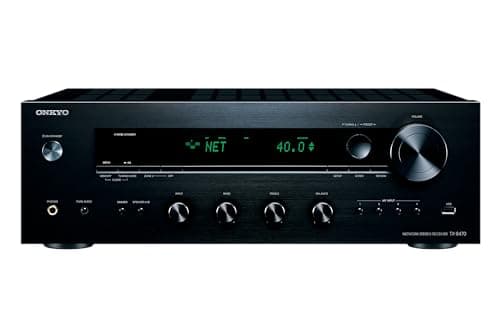 Onkyo TX-8470 The only amplifier we can verify under $500 with a moving-coil phono position as well as a moving-magnet one, and the only one whose maker states its power the FTC way. | Best phono stage under $500 | 8.8 | |
| 2 | 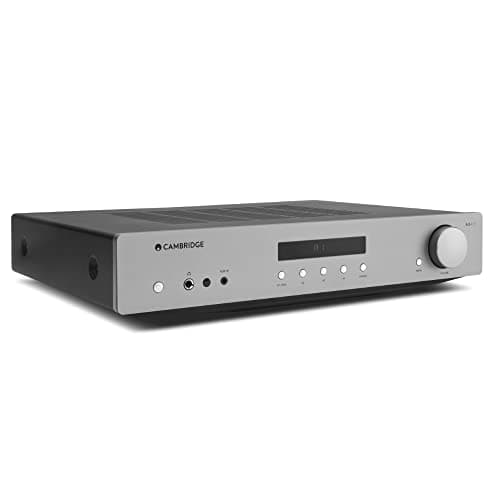 Cambridge Audio AXA35 A deliberately plain integrated with a phono stage and a headphone output, aimed at a turntable and nothing more complicated. | Best simple amplifier for a turntable | 7.2 | |
| 3 | 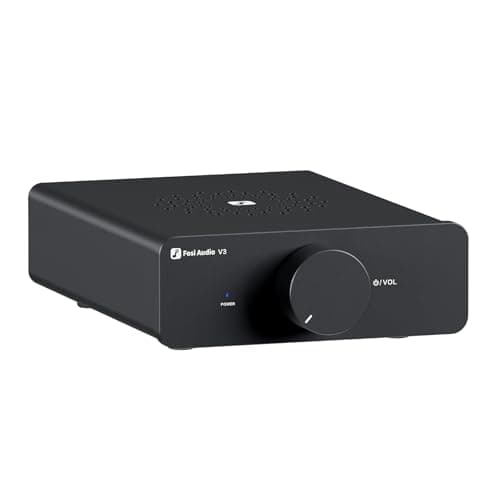 Fosi Audio V3 A class-D power amplifier the size of a paperback whose headline wattage depends entirely on the power supply you feed it. | Best tiny amplifier | 6.0 | |
| 4 | 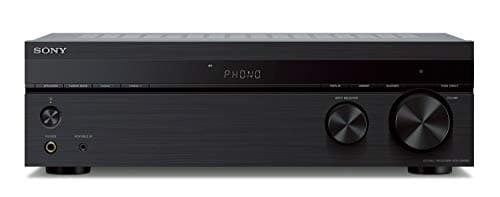 Sony STR-DH190 A stereo receiver with a phono input, Bluetooth and an FM tuner, at roughly half the price of the integrateds above it. | Best budget receiver with a phono input | 7.0 |
The headline numbers in this bracket run from 35 watts to 300, and the 300-watt amplifier is not eight times the amplifier the 35-watt one is. Reading the conditions attached to each figure takes about a minute and reorders the list completely.
What each maker publishes
| Amplifier | 8 Ω rating | 4 Ω rating | Phono | Damping factor |
|---|---|---|---|---|
| Onkyo TX-8470 | 110 W, 20 Hz – 20 kHz, 0.08% THD, both channels driven | Not published as continuous | MM and MC, switched | Not published |
| Cambridge AXA35 | 35 W into 8 Ω | Not published | MM, built in | > 50 |
| Fosi Audio V3 | Not published | 300 W × 2, no THD condition | None | Not published |
| Sony STR-DH190 | No specifications available | — | — | — |
Two rows on that table need explaining before the ranking makes sense.
The 300-watt amplifier
Fosi publishes 300 W × 2 at 4 Ω for the V3, headlined as “600 W total”. Three things about that figure are published by Fosi themselves and none of them appears on the box.
- There is no THD condition attached. A power figure with no distortion limit is not a rating; it is a maximum before something unspecified happens.
- It depends on the power supply you feed it. Fosi publishes an input range of DC 24–48 V, and lists 32 V/5 A and 48 V/5 A supplies. The headline number assumes the larger one.
- There is no 8-ohm rating at all.Fosi states a terminating impedance of 2–8 Ω but publishes power only into 4 Ω, so an 8-ohm speaker sees meaningfully less — and Fosi does not say how much less.
None of that makes the V3 a bad amplifier. It makes the 300 unusable as a comparison against Onkyo’s 110, which carries a frequency range, a distortion figure, an impedance and a statement that both channels were driven while it was measured. What class D changes and what it does not covers the topology honestly; this is a specification problem, not a topology one.
The amplifier with no specifications
The Sony STR-DH190 is a stereo receiver with a phono input at a price that makes it a genuine option, and we cannot tell you a single thing about its measured performance.
Sony blocks automated access across every domain it operates. The official manual for this model returned HTTP 403 on 17 July 2026, sony.com and docs.sony.com are crawler-blocked, and there is no Help Guide for it. The manual exists on third-party mirrors, and a mirror is not the manufacturer. So we publish nothing rather than something we could not verify at source.
It stays on the list at fourth because it is a real product people buy, and because “this is what we could not verify” is more useful than omitting it silently.
What 35 watts is actually worth
The Cambridge AXA35 is the least powerful amplifier here on paper and the one most often dismissed for it. Against a sensitive speaker the dismissal does not survive the arithmetic.
SPL = sensitivity + 10 × log₁₀(P) − 20 × log₁₀(distance ÷ 1 m)
Inputs
- Cambridge AXA35 published power: 35 W into 8 Ω (Cambridge Audio spec page)
- Klipsch R-51M published sensitivity: 93 dB (2.83 V / 1 m) (Klipsch spec sheet (PDF))
- Micca RB42 published sensitivity: 83 dB (1 W / 1 m) (Micca spec page)
Result
10 × log₁₀(35) = 15.4 dB · distance loss at 3 m = 9.5 dB
With the Klipsch: 93 + 15.4 − 9.5 = 99 dB per speaker
With the Micca: 83 + 15.4 − 9.5 = 89 dB per speaker
Ninety-nine decibels from one speaker is louder than anyone plays music at home for long. Eighty-nine is comfortable listening with no headroom for peaks. Same amplifier, ten decibels apart — the speaker decided the outcome, not the amplifier.
The two sensitivity figures were measured under different conditions (2.83 V / 1 m versus the harder 1 W / 1 m), so the real gap is a little under 10 dB. Converting between the conditions needs an impedance figure Micca publishes only as a range. Free-field arithmetic also ignores room reinforcement, which adds a few decibels back at low frequencies.
The phono question splits the field
Three of the four have a phono input, and only Onkyo publishes what its one does: a switched moving-magnet or moving-coil stage on an isolated board, with a maximum input of 70 mV on MM and 7 mV on MC, and a signal-to-noise of 76 dB on MM and 60 dB on MC. That is the only moving-coil input we can verify under $500. Cambridge publishes that the AXA35 has a moving-magnet stage and nothing further. Fosi publishes that the V3 has none at all — RCA line level only.
If a turntable is the source, this is the deciding spec and we rank the whole field on it separately. If the V3 is otherwise the amplifier you want, a separate phono stage is a real extra line item.
Damping factor, and why the gap is bigger than it looks
Cambridge publishes “> 50” for the AXA35. Onkyo and Fosi publish nothing at all, which is the one place the Onkyo’s otherwise complete specification has a hole in it — and it is worth naming, because the Yamaha A-S301 that used to hold the top of this page published 210.
A greater-than figure is a floor, not a value: the AXA35 could be 55 or 150 and Cambridge has told you neither. And by the time either amplifier reaches the speaker, cable resistance has usually done more damage to the number than the design difference did — 25 feet of 14 AWG turns a published 240 into about 50. Treat damping factor as a disclosure-quality signal here rather than a performance ranking.
What we would buy
The Onkyo TX-8470.It is the only machine in the bracket whose maker states the power the strict way — 110 watts per channel into 8 ohms, 20 Hz to 20 kHz, both channels driven, at no more than 0.08% distortion — and the only one with a moving-coil phono position as well as a moving-magnet one, each with its own published signal-to-noise. Two caveats it earns honestly: Onkyo publishes no damping factor anywhere we can find, and the 210 W figure on the same table is measured at 6 ohms, 1 kHz and ten percent distortion, which is a burst number rather than a rating.
The Cambridge AXA35 if you want the simplest possible amplifier and your speakers are sensitive. Thirty-five watts into a 93 dB speaker is not a compromise, and the arithmetic above says so.
The Fosi V3 if the budget is the constraint and you already have a phono stage or a digital source. Just do not buy it because of the 300, and do budget for the larger power supply if you want anything like it.
The Sony STR-DH190 only with your eyes open. It may be excellent; we cannot verify a single figure about it at source.
Every pick in detail
Every specification below links to the manufacturer document we read it from. Where a manufacturer does not publish a figure, we say so rather than estimating it.
Onkyo TX-8470
Best phono stage under $500Price as of October 15, 2026. #ad
The only amplifier we can verify under $500 with a moving-coil phono position as well as a moving-magnet one, and the only one whose maker states its power the FTC way.
- power
- 9/10
- phono stage
- 9/10
- value for money
- 8/10
- build quality
- 8/10
- connectivity
- 10/10
| Specification | Published value | Source |
|---|---|---|
| Power output (8 Ω) | 110 W + 110 W — “With 8 ohm loads, both channels driven, from 20 Hz – 20 kHz; rated 110 watts per channel minimum RMS power, with no more than 0.08% total harmonic distortion from 250 milliwatts to rated output” (FTC form, North American models) | Onkyo owner's manual (PDF) |
| Power output (4 Ω) | Not published as a continuous rating for the North American model. The only other North American figure on Onkyo's table is 210 W at 6 Ω, 1 kHz, 2 ch driven at 10% THD — a maximum-output burst measurement, not an RMS rating. | Onkyo owner's manual (PDF) |
| Phono input | Yes — MM or MC on a rear-panel switch, on a dedicated isolated phono board. Maximum input 70 mV (MM, 1 kHz, 0.5%) and 7 mV (MC, 1 kHz, 0.5%). | Onkyo owner's manual (PDF) |
| Phono signal-to-noise | 76 dB (IHF-A, MM 5 mV in, speaker out) · 60 dB (IHF-A, MC 0.5 mV in, speaker out) | Onkyo owner's manual (PDF) |
| THD | 0.08% (20 Hz – 20,000 Hz, at rated output power) | Onkyo owner's manual (PDF) |
| Damping factor | Not published | — |
| DAC | AKM AK4452, 32-bit / 768 kHz stereo; Class G amplifier stage | Onkyo product page |
| Digital inputs | 3 — one coaxial and two optical — plus 4 HDMI in / 1 HDMI out with ARC and 8K passthrough | Onkyo spec sheet (PDF) |
| Subwoofer out | Yes — one subwoofer pre-out, plus a main pre-out L/R and a Zone 2 pre/line out | Onkyo owner's manual (PDF) |
| Signal-to-noise (line) | 106 dB (IHF-A, line in, speaker out) | Onkyo owner's manual (PDF) |
| Dimensions and weight | 435 × 149.5 × 329 mm; 9 kg (19.8 lb) | Onkyo owner's manual (PDF) |
Pros
- 110 W per channel rated the strict way — 8 Ω, 20 Hz to 20 kHz, both channels driven, 0.08% THD — which nothing else in this bracket publishes
- MM and MC phono on a rear-panel switch, with a published signal-to-noise for each: 76 dB on MM and 60 dB on MC
- Four HDMI inputs with ARC, one coaxial and two optical digital inputs, and an AKM AK4452 32-bit/768 kHz DAC
- Subwoofer pre-out, main pre-out and a Zone 2 pre/line out all published
Cons
- Onkyo publishes no damping factor for it anywhere we can find
- The second figure on Onkyo's own North American table — 210 W at 6 Ω, 1 kHz, 10% THD — is a burst measurement at a distortion level nobody listens at
- It is a receiver: an AM/FM tuner and a second zone are part of what you are paying for whether you use them or not
- 9 kg and 435 mm wide, so it needs a rack shelf rather than a desk
Skip it if you want the shortest signal path your money will buy. This is a networked receiver with a tuner, HDMI switching and two zones, and a plain integrated puts more of the budget into the amplifier.
Cambridge Audio AXA35
Best simple amplifier for a turntablePrice as of October 15, 2026. #ad
A deliberately plain integrated with a phono stage and a headphone output, aimed at a turntable and nothing more complicated.
- power
- 6/10
- phono stage
- 8/10
- value for money
- 8/10
- build quality
- 7/10
- connectivity
- 6/10
| Specification | Published value | Source |
|---|---|---|
| Power output (8 Ω) | 35 W into 8 Ω | Cambridge Audio spec page |
| Power output (4 Ω) | Not published | — |
| Phono input | Yes — built-in moving magnet phono stage | Cambridge Audio spec page |
| THD | < 0.01% at 1 kHz (80% of rated power); < 0.15% 20 Hz – 20 kHz | Cambridge Audio spec page |
| Signal-to-noise | > 82 dB (unweighted, ref 1 W) | Cambridge Audio spec page |
| Damping factor | > 50 | Cambridge Audio spec page |
| Inputs | 4 × RCA, 1 × phono, 1 × 3.5 mm front aux | Cambridge Audio spec page |
| Digital inputs / DAC | None published | Cambridge Audio spec page |
Pros
- Built-in phono stage
- Headphone output
- Simple, uncluttered front panel
Cons
- Modest power output
- No digital inputs
- No remote on the base model
Skip it if your speakers are power-hungry — check the arithmetic first.
Fosi Audio V3
Best tiny amplifierPrice as of October 15, 2026. #ad
A class-D power amplifier the size of a paperback whose headline wattage depends entirely on the power supply you feed it.
- power
- 6/10
- phono stage
- 0/10
- value for money
- 10/10
- build quality
- 6/10
- connectivity
- 4/10
| Specification | Published value | Source |
|---|---|---|
| Power output (4 Ω) | 300 W × 2 at 4 Ω (Fosi's headline “600 W total”). No THD condition is attached to this figure, and it depends on the supply: published power input range is DC 24–48 V, with 32 V/5 A and 48 V/5 A supplies listed. | Fosi Audio spec page |
| Power output (8 Ω) | Not published. Fosi publishes a 4 Ω figure only, though it states a terminating impedance of 2–8 Ω — so an 8 Ω speaker will see meaningfully less than the headline number, and Fosi does not say how much less. | Fosi Audio spec page |
| Amplifier chip | TPA3255; TI NE5532 × 2 op-amps | Fosi Audio spec page |
| THD | ≤ 0.003% (measurement condition not published) | Fosi Audio spec page |
| Signal-to-noise | ≥ 110 dB (SINAD ≥ 88 dB) | Fosi Audio spec page |
| Inputs | RCA line level only | Fosi Audio spec page |
| Phono input | None — a turntable needs its own phono stage before this amplifier | Fosi Audio spec page |
Pros
- Very cheap and very small
- Class D efficiency — runs cool
- Genuinely useful power for the size
Cons
- The advertised power figure requires a power supply that may be sold separately — read the fine print
- No phono stage
- Power amp with a volume knob, not a full integrated
Skip it if you need a phono input. This has none, so a turntable needs its own stage before it.
Sony STR-DH190
Best budget receiver with a phono inputPrice as of October 15, 2026. #ad
A stereo receiver with a phono input, Bluetooth and an FM tuner, at roughly half the price of the integrateds above it.
- power
- 6/10
- phono stage
- 7/10
- value for money
- 9/10
- build quality
- 5/10
- connectivity
- 8/10
| Specification | Published value | Source |
|---|---|---|
| Published specifications | Unavailable. Sony blocks automated access across every domain it operates, and the official manual for this model returned HTTP 403 on 17 July 2026. The manual is mirrored on third-party sites, but a mirror is not the manufacturer and we do not treat it as one. We publish nothing here rather than something we could not verify at source. | Sony product page (returned 403) |
Pros
- Phono input and Bluetooth at a low price
- FM tuner included
- Speaker A/B switching
Cons
- Lightest build here
- Receiver, not an integrated — the tuner is dead weight if unused
- Modest power
Skip it if you want the best amplifier for the money rather than the most features for the money.
Frequently asked questions
What is the best integrated amplifier under $500?
The Onkyo TX-8470 on published data. It is the only machine in the bracket that publishes a full-band 8-ohm rating with both channels driven and a distortion condition attached (110 W, 20 Hz – 20 kHz, 0.08% THD), and the only one with a moving-coil phono position as well as a moving-magnet one, each with its own signal-to-noise figure. It publishes no damping factor, which the Cambridge AXA35 at least gives as a floor. The AXA35 is the simpler alternative if your speakers are sensitive.
Is a 300 watt amplifier under $500 too good to be true?
The number is real; the condition is missing. Fosi publishes 300 W × 2 at 4 ohms for the V3 with no THD condition attached, no 8-ohm rating at all, and a power-supply dependency — the published input range is DC 24–48 V. It is a capable amplifier whose headline figure cannot be compared to the Onkyo’s 110 W, which carries an impedance, a frequency range, a distortion limit and both channels driven.
Is 35 watts enough for bookshelf speakers?
With a sensitive speaker, comfortably. The Cambridge AXA35’s 35 watts into a Klipsch R-51M at its published 93 dB produces about 99 dB per speaker at three meters. Into a Micca RB42 at its published 83 dB the same amplifier reaches about 89 dB — still adequate, with far less headroom. Speaker sensitivity decides this, not the amplifier.
Which amplifiers under $500 have a phono input?
The Onkyo TX-8470 (switched MM or MC, 70 mV and 7 mV maximum input, phono S/N 76 dB and 60 dB) and the Cambridge AXA35 (moving magnet, no further parameters published). The Fosi V3 has none — RCA line level only, so a turntable needs its own phono stage. Sony publishes no accessible specifications for the STR-DH190 at all.
What happened to the Yamaha A-S301?
It held the top of this page and it is no longer buyable — the listing reads “currently unavailable” and there is no live one under any other listing. The cheapest Yamaha integrated still in stock is the A-S501 at around $650, which is outside this bracket, so there is no like-for-like Yamaha to move to. The Onkyo TX-8470 takes the slot on the same criterion the A-S301 won it with: it is the machine here whose maker states the power with every condition attached. Yamaha’s spec page is still up, so the figures we published for the A-S301 — 60 W full band, damping factor 210, MM at 3.0 mV / 47 kΩ — stand on the record. We simply will not keep a buy link pointed at a dead page.
Read next
The Best Integrated Amplifiers Under $1,000
Six amps under $1,000, and the dynamic-power trap that overstates the popular pick by roughly 2x.
How to Read an Amplifier Power Rating
Impedance, bandwidth, distortion, channels driven — the four conditions that turn a watts number into a spec, and which manufacturers publish all four.
Will This Amplifier Drive My Speakers?
Two published numbers, one formula, and the answer is almost always less power than you expected.
The Best Integrated Amplifiers for a Turntable
Amplifiers with a phono stage inside, ranked on published MM sensitivity and phono signal-to-noise — not watts.
Class D vs Class AB Amplifiers
How each topology works, what each one publishes, and the power-supply fine print behind Class D wattage claims.
The Best High-Sensitivity Bookshelf Speakers
The speakers that make a small amplifier sound big, ranked on published sensitivity and the condition each figure was measured under.
Sources
Every specification on this page was read from one of these documents. If one of them has changed, or we have made an error, tell us — corrections are logged and dated per our editorial policy.
- Onkyo TX-8470 — owner's manual (FTC 110 W rating, phono max input and S/N, no damping factor)
- Onkyo TX-8470 — spec sheet (Class G, 4 HDMI in, MM/MC phono, subwoofer out)
- Onkyo TX-8470 — product page (AKM AK4452 DAC, network features)
- Yamaha A-S301 — spec page (the model we removed; figures remain on the record)
- Cambridge Audio AXA35 — spec page (35 W, damping factor > 50, phono)
- Fosi Audio V3 — spec page (4 Ω figure, DC 24–48 V input range, no phono)
- Sony STR-DH190 — product page (returned HTTP 403; no specifications obtainable)