The Best Tube Phono Preamps for a Turntable
Everything written about tube phono stages is about the tubes. The specification that actually changes what you hear is the published RIAA tolerance, and across three boxes it varies by a factor of seven and a half.
The short answer
On published data the Pro-Ject Tube Box S2 wins this page outright and it is not close — ± 0.4 dB RIAA accuracy, four resistive loads, six capacitance settings, a subsonic filter with a stated 18 dB/octave slope, and distortion and noise published per gain setting. On 31 October 2026 it also had no live Amazon offer, so the box we are telling you to buy today is the Fosi Audio Box X2. The Fosi Box X2is a genuinely sensible purchase rather than a consolation: three published gain settings covering the range a moving-magnet cartridge actually needs, ≤ 0.1% THD, ≥ 98 dB signal-to-noise, and socketed tubes Fosi lists five replacements for — at a fraction of the Pro-Ject’s price. What it does not have is any loading adjustment at all, any published RIAA tolerance, or a named factory tube. The Tube Box S2is second on availability, not on merit; if you can buy one from a Pro-Ject dealer, it is the better-specified box by a wide margin, and Pro-Ject’s own figures still show it measuring roughly 38 times worse than its solid-state sibling — so buy it because you want valves, not better numbers. The Douk Audio T4 PRO is the cheapest way to put a valve in the phono path and the only one here with a real headphone output, and its published ± 3 dB RIAA conformance is why it is third: a 6 dB window across the audio band is an equalization error you cannot switch off.
Disclosure: we earn a commission if you buy through the links on this page, at no extra cost to you. It does not influence what we pick — our criteria are published and reproducible, so you can check our work. How we pick · Full disclosure
These picks are spec-and-price analyses, not listening tests. We have not heard this gear and we do not pretend to have: every figure below is sourced to the manufacturer and linked, and every price is live or not shown at all. Here are the rules we followed.
Quick picks
Ranked on the published criteria in How We Pick. Prices are live as of November 12, 2026. Tap any row for the full write-up.
- 7.4$119.98View on Amazon
$149.9820% off
- 7.0
- 6.6$84.99View on Amazon
$94.9811% off
| # | Product | Best for | Score | Price |
|---|---|---|---|---|
| 1 | 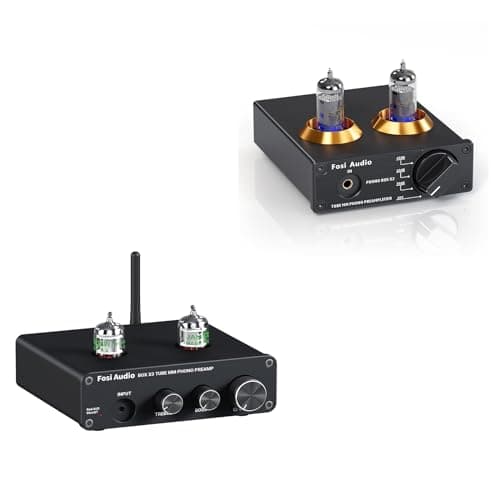 Fosi Audio Box X2 Two valves, three published gain settings and the best published THD and signal-to-noise of any tube phono stage we could verify under $150 — with no loading adjustment of any kind and no named factory tube. | Best tube phono stage you can buy today | 7.4 | $119.98View on Amazon $149.9820% off |
| 2 | 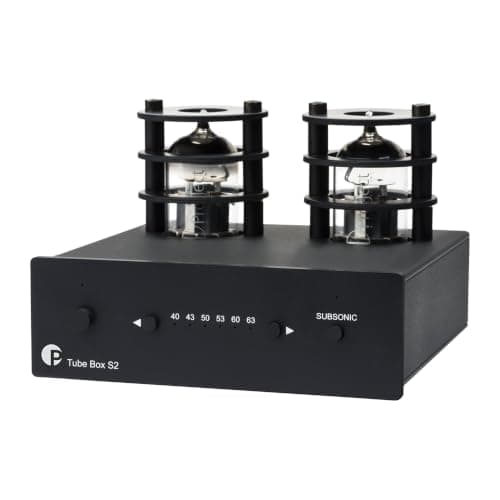 Pro-Ject Tube Box S2 A genuine two-valve phono stage with six capacitance settings and the only subsonic filter here with a published slope — and, on Pro-Ject's own figures, roughly 38 times the distortion of its solid-state sibling. | The valve option, with the trade stated | 7.0 | |
| 3 | 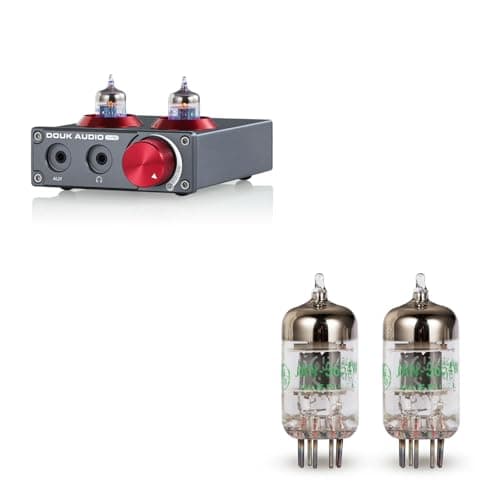 Douk Audio T4 PRO The only tube phono stage here with a real headphone output and a published power figure for it — and the only one whose published RIAA tolerance is ± 3 dB, which is the single widest equalization error published by anything in this registry. | Best if you listen on headphones | 6.6 | $84.99View on Amazon $94.9811% off |
A phono stage does two jobs. It raises a cartridge’s few thousandths of a volt up to something an amplifier can use, and it undoes the RIAA equalization curve that was applied when the record was cut — bass cut and treble boosted on the way in, so the playback stage has to put roughly 20 dB of bass back and take roughly 20 dB of treble out. Get the gain wrong and the record is quiet. Get the curve wrong and the record is a different record.
Which is why the specification that decides this page is the one almost nobody writing about tube phono stages mentions: published RIAA tolerance. Across the three boxes here it runs from a 0.8 dB window to a 6 dB window, and one of the three publishes no number at all. Six dB is a factor of two in amplitude. That is not a subtle valve character, it is a tone control soldered in place.
All three were confirmed as currently purchasable on 31 October 2026 and every figure below was read from the manufacturer’s own page the same day. We have not measured any of them and we do not claim to have listened to them side by side; this page ranks what the makers are willing to be held to, which in this category turns out to be plenty to go on.
What a tube does and does not do in a phono stage
Worth being blunt, because the category is sold on romance. A valve in a phono stage is a gain device, the same as a transistor, with different and usually worse measured behavior: higher distortion, higher noise, a warm-up period, parameters that drift with age, and a part you eventually replace. Our tube versus solid state comparison works through that honestly for power amplifiers and the same physics applies here.
There are two legitimate reasons to want one anyway. The first is that you like the result, which is a preference and needs no defense. The second is tube rolling: if the tubes are socketed and the maker names compatible types, the sound of the stage becomes something you can change for the price of a pair of valves rather than the price of a new box. Two of the three here support that explicitly. One of them will not even tell you which tube it shipped.
What a tube does not do is fix a mismatched cartridge, and it does not make loading or RIAA accuracy matter less. Everything on the cartridge-matching page still applies.
The criteria, in the order they decide it
- Published RIAA tolerance.In dB, across a stated band. Without a number, “conforms to RIAA” is a claim about intent.
- Gain, published as a number per setting. Cartridges publish their output in mV; a stage that publishes its gain in dB lets you check the pair before you buy. One of these publishes none.
- Loading — resistance and capacitance.If your cartridge’s maker states a load, you want to be able to meet it. Audio-Technica states 47 kΩ and 100–200 pF for the AT-VM95E, for instance, and only one stage here can be set to anything.
- Distortion and noise with a measurement condition. A THD figure with no frequency or input level attached cannot be compared with one that has both.
- Tube disclosure. Named factory tube, socketed or not, compatible replacements listed. On a product bought for its valves this is not a footnote.
The three, on the numbers that separate them
Four figures, because these are the four that decide it. Loading, noise, cartridge support and the published dimensions are in each stage’s full spec table further down the page — and loading is the one where the gap is widest: the Pro-Ject publishes four resistive settings and six capacitance settings, and neither of the other two publishes any adjustment at all.
The picks compared, spec by spec
Every figure below is the manufacturer’s own published value and links to the document we read it from. “Not published” means the manufacturer does not publish that figure; an em dash means we have no published figure for that model. Prices are live as of November 12, 2026.
Best tube phono stage you can buy today
- RIAA accuracy
- “Standard RIAA”, no figure
- Gain
- 39 / 42 / 45 dB
- Tubes
- 2 ×, type not named
The valve option, with the trade stated
- RIAA accuracy
- ± 0.4 dB, 20 Hz–20 kHz
Best if you listen on headphones
- RIAA accuracy
- ± 3 dB
- Gain
- Not published
| Pick | RIAA accuracy | Gain | THD | Tubes | Price |
|---|---|---|---|---|---|
| 1.Fosi Audio Box X2Best tube phono stage you can buy today | “Standard RIAA”, no figure | 39 / 42 / 45 dB | ≤ 0.1%, no condition | 2 ×, type not named | |
| 2.Pro-Ject Tube Box S2The valve option, with the trade stated | ± 0.4 dB, 20 Hz–20 kHz | 40 / 43 / 50 / 60 / 63 dB | < 0.02% at 40 dB gain | 2 × ECC83 / 12AX7A, named | |
| 3.Douk Audio T4 PROBest if you listen on headphones | ± 3 dB | Not published | 0.2% at 1 kHz | 2 ×, “may vary by batch” |
Prices as of November 12, 2026; every “Check Price” link goes to Amazon and earns us a commission at no extra cost to you. #ad
How much a ± 3 dB RIAA tolerance actually is
This is the arithmetic the category never shows you, and it is why the cheapest box on this page is third rather than first.
window = 2 × tolerance · amplitude ratio = 10^(dB ÷ 20)
Inputs
- Pro-Ject Tube Box S2 — RIAA accuracy: ± 0.4 dB (20 Hz – 20 kHz) (Pro-Ject product page)
- Douk Audio T4 PRO — phono response: Conforms to RIAA characteristics (± 3 dB) (Douk Audio parameters table)
- Fosi Audio Box X2 — frequency response: “Standard RIAA” (no tolerance published) (Fosi Audio product page)
Result
1. Fosi Audio Box X2 — the one to buy today
It is first on this page for a reason we would rather not have: it is the best-specified tube phono stage here that you can actually buy through a verified listing today. On published figures the Pro-Ject below it is better in almost every way. On availability, this is the one with a live offer, and a recommendation you cannot act on is not a recommendation.
Two socketed valves, three published gain settings (39 / 42 / 45 dB), THD at ≤ 0.1%, signal-to-noise at ≥ 98 dB, and 600 mV out at a 3 mV input. A 3.5 mm AUX input sits alongside the phono input, so one small box can feed a turntable and a phone into one amplifier channel — genuinely useful if your amplifier is short of inputs, which is the situation that sends most people to the do-I-need-one question in the first place.
The gain range is the right range. An ordinary moving-magnet cartridge wants somewhere around 40 dB, and 39/42/45 dB brackets it properly rather than offering one setting and hoping. Fosi also lists five compatible replacement tube types (6K4, 6J1, 6J4, GE5654, 6AK5), which means rolling is supported rather than merely possible.
Three real problems. First, there is no loading adjustment at all: no resistance switch, no capacitance switch, nothing. If your cartridge’s maker publishes a load — and the common Audio-Technica and Ortofon moving magnets do — you cannot meet it. Second, Fosi does not name the tube in the box anywhere on the product page, on a product whose entire premise is the tube. Third, the RIAA figure is the phrase “Standard RIAA” with no dB attached, and neither the THD nor the SNR figure carries a measurement condition — no frequency, no input level, no statement of whether the 98 dB is A-weighted.
And one oddity worth printing: Fosi’s own two gain-related figures do not agree.
gain (dB) = 20 × log10(output ÷ input)
Inputs
- Fosi Box X2 — output level: 600 mV at a 3 mV input, 1 kHz (Fosi Audio product page)
- Fosi Box X2 — gain settings: 39 / 42 / 45 dB (3 switchable modes) (Fosi Audio product page)
Result
2. Pro-Ject Tube Box S2 — the only one specified like a hi-fi component
Two ECC83 / 12AX7Avalves, named, in the signal path. Four MM resistive loading options and six input capacitance settings from 47 pF to 587 pF — more loading granularity than anything else in this registry, tubes or not. Gain settings at 40, 43, 50, 60 and 63 dB, covering moving magnet through high-output moving coil. A subsonic filter published as 20 Hz at 18 dB/octave, the only one on this page with a stated slope. And ± 0.4 dBRIAA accuracy from 20 Hz to 20 kHz — identical to the tolerance Pro-Ject publishes for its own solid-state Phono Box S2 Ultra.
It also publishes distortion and noise per gain setting, which is the detail that makes the figures usable: < 0.02% THD at 40 dB, < 0.05% at 50 and 63 dB; an 80 dB(A) noise floor at 40 dB falling to 75 dB(A) at the higher settings. You can see the cost of gain instead of guessing at it.
The honest cons are substantial and this site has published them before. That < 0.02% is roughly 38 times the 0.00052% Pro-Ject publishes for the Phono Box S2 Ultra, a cheaper box from the same maker with the same RIAA tolerance and the same adjustability. Pro-Ject publishes a noise floorrather than a signal-to-noise ratio, so its noise figure cannot be compared with the SNR numbers the other two publish — different quantities, not different values. Its page claims five MM loading settings and then lists four, and asterisks the 587 pF capacitance without explaining the asterisk. And it is by far the most expensive stage here.
It is second only because of the offer, not the engineering: on 31 October 2026 its Amazon listing returned an image and no price, and a fresh resolution found no other listing that cleared our brand-and-model guard. Pro-Ject still publishes the product, so this reads as Amazon stock rather than a discontinuation — the buy row below falls back to a tagged Amazon search, and a Pro-Ject dealer is the more reliable route while that lasts. If what you want is the best measured phono stage for the money, the answer is not a tube stage at all, and the under-$500 bracket page says so in its ranking.
3. Douk Audio T4 PRO — cheapest in, and the headphone one
The T4 PRO is the only tube phono stage here with a real headphone output and a published power figure for it: 150 mW at 32 Ω, with a stated supported range of 32–300 Ω, and Douk says the line and headphone outputs run at the same time. It publishes the highest signal-to-noise figure on this page (≥ 105 dB), it has a 3.5 mm AUX input as well as the phono input, and it costs a fraction of the Pro-Ject. If what you want is a valve in the phono path and a pair of headphones plugged into the same box, nothing else here does it.
It is third because of one number. ± 3 dB is the published phono response tolerance, the widest in this registry, and the arithmetic above shows what that permits. Its THD is 0.2% at 1 kHz— ten times the Pro-Ject’s figure at 40 dB gain. No gain figure is published at all, so you cannot check it against a 2.5 mV or a 5 mV cartridge before buying; the 0.775 V “input sensitivity” on the spec table is a line-level figure for the AUX input and says nothing about the phono path. There is no loading, no capacitance setting and no subsonic filter.
Douk also states that the included tube brand and model may vary by batch. That is honest of them and it is a genuine limitation: on a product bought for its valves, you do not know which valves you are buying, and two units may not match. The feature copy calls them “Dual GE Tubes”; the specification table names nothing. One last small thing, printed because it is printed: the net weight is published as “300 g / 0.73 lb”, and those two figures do not convert to each other (300 g is 0.66 lb).
Why the Bellari VP130 is not ranked here
It should be. It is the one classic American all-tube phono stage in this price territory, it is on Amazon today at a live price, and Rolls publishes a proper spec sheet for it: RIAA ± 1.5 dB from 20 Hz to 20 kHz, THD 0.02% at 1 kHz, S/N > 80 dB unweighted, a 20 Hz rumble filter, a 12AX7 tube, 8 Ω headphone and 100 Ω line output impedances. On RIAA accuracy that would place it second on this page.
Two things stop it, and both are about not misleading you:
- Rolls states the VP130 is discontinued and replaced by the VP130 MKII. The MKII has no Amazon listing that clears our brand-and-model guard, so the unit we could actually send you to is the superseded one. Recommending a reader into an end-of-line product because that is the version our network carries is the kind of thing this site exists not to do. If you want a Bellari, buy the MKII from a dealer that stocks it.
- Its published gain is 30 dBat 47 kΩ, which is low enough to be a practical problem with most moving-magnet cartridges. The arithmetic is below.
output = input × 10^(gain dB ÷ 20)
Inputs
- Bellari VP130 — input sensitivity / gain: 30 dB gain at 1 kHz, 47 kΩ input (Rolls VP130 spec sheet)
- Audio-Technica AT-VM95E — output: 4.0 mV (1 kHz, 5 cm/sec) (Audio-Technica spec page)
- Pro-Ject Tube Box S2 — lowest gain setting: 40 dB (Pro-Ject product page)
Result
Four more candidates were resolved and dropped on the same day: the Pro-Ject Tube Box DS2 (every hit that cleared the model tokens was a power supply for it, so there is no verified listing), the Fosi Box X5 (its only hit was caught by the accessory guard, and a second Fosi box in a three-pick roundup would be padding rather than choice), and the Little Bear T11 and Nobsound tube phono stages, where no returned title cleared the model guard at all. A short roundup is better than a padded one.
Should you buy a tube phono stage at all?
On measured performance, no. Pro-Ject’s own numbers make the case against its own product: the solid-state Phono Box S2 Ultra publishes the same ± 0.4 dB RIAA accuracy, the same kind of adjustability and about 1/38th of the distortion, for less money. Every stage on this page is beaten on paper by a transistor box at or below its price, and the under-$200 bracket is full of them.
Buy a tube phono stage if you want a tube in the phono path and you want to be able to change it — that is a legitimate thing to want and nobody needs to justify a preference with a measurement. Just buy it knowing which number you are trading away, and do not expect the valve to make up for a loading mismatch or a loose playback curve. If the appeal is valves in general rather than valves in the phono stage specifically, the money usually goes further one box downstream: a tube amplifier for a turntable puts the valve where it is doing the most work.
And whatever you buy, the speakers see the result. If this is part of a larger upgrade, our bookshelf-for-vinyl roundup and the high-end bookshelf tier are the two ends of where that signal ends up.
Every pick in detail
Every specification below links to the manufacturer document we read it from. Where a manufacturer does not publish a figure, we say so rather than estimating it.
Fosi Audio Box X2
Best tube phono stage you can buy todayTwo valves, three published gain settings and the best published THD and signal-to-noise of any tube phono stage we could verify under $150 — with no loading adjustment of any kind and no named factory tube.
- published data
- 6/10
- tube disclosure
- 5/10
- gain range
- 8/10
- adjustability
- 3/10
- value for money
- 9/10
| Specification | Published value | Source |
|---|---|---|
| Tubes | 2 × vacuum tubes included. Fosi does not name the factory tube anywhere in its spec table; the product details list 6K4, 6J1, 6J4, GE5654 and 6AK5 as compatible replacements | Fosi Audio product page |
| Gain | 3 switchable modes: 39 / 42 / 45 dB. Published in the product details rather than in the spec table | Fosi Audio product page |
| Cartridge support | Moving magnet only. No MC mode and no MC loading is published | Fosi Audio product page |
| Inputs / outputs | RCA phono in plus a 3.5 mm AUX in; RCA line out | Fosi Audio product page |
| RIAA accuracy | Published only as “Standard RIAA”, with no dB tolerance attached to it | Fosi Audio product page |
| THD | ≤ 0.1%. Fosi does not state the measurement frequency or input level for this figure | Fosi Audio product page |
| Signal-to-noise | ≥ 98 dB. Fosi does not state whether this is A-weighted | Fosi Audio product page |
| Output level | 600 mV at a 3 mV input, 1 kHz | Fosi Audio product page |
| Power | DC 12 V / 1.5 A external supply | Fosi Audio product page |
| Dimensions / weight | 4.66 × 3.85 × 1.29 in; 300 g / 0.66 lb | Fosi Audio product page |
| RIAA accuracy in dB | Not published | — |
| Resistive loading options | Not published | — |
| Input capacitance options | Not published | — |
| Factory tube type | Not published | — |
| Subsonic filter | Not published | — |
Pros
- Three published gain settings (39 / 42 / 45 dB), which is the range an ordinary moving-magnet cartridge actually needs
- THD published at ≤ 0.1% and signal-to-noise at ≥ 98 dB — the best pair of figures of any sub-$150 tube stage verified here
- 600 mV output at a 3 mV input, so the figure can be checked against your cartridge's own published output
- A 3.5 mm AUX input alongside the phono input, so one box feeds a phone and a turntable into one amplifier channel
- Tubes are socketed and Fosi lists five compatible replacement types, so rolling them is supported rather than tolerated
Cons
- No resistive loading and no capacitance setting at all. If your cartridge's maker states a load, you cannot meet it
- Fosi does not name the tube that ships in the box anywhere on the product page — on a product bought for its tubes
- RIAA conformance is published as the words 'Standard RIAA' with no dB tolerance, so it cannot be compared with any stage that publishes one
- No subsonic filter and no measurement condition attached to either the THD or the signal-to-noise figure
- MM only — no moving-coil mode, and no MC loading published
Skip it if your cartridge's maker publishes a load impedance or capacitance you are trying to hit. Nothing on this box is adjustable except gain.
Pro-Ject Tube Box S2
The valve option, with the trade statedNo live price right now. #ad
A genuine two-valve phono stage with six capacitance settings and the only subsonic filter here with a published slope — and, on Pro-Ject's own figures, roughly 38 times the distortion of its solid-state sibling.
- published data
- 6/10
- riaa accuracy
- 8/10
- cartridge support
- 7/10
- adjustability
- 9/10
- value for money
- 5/10
| Specification | Published value | Source |
|---|---|---|
| Tubes | 2 × ECC83 (12AX7A) | Pro-Ject product page |
| Gain | 40, 43 / 50, 60 and 63 dB. Pro-Ject prints the MM and MC groupings ambiguously and references only the 40, 50 and 63 dB settings in its noise and distortion figures. | Pro-Ject product page |
| Cartridge support | MM, plus high-output MC at a fixed 47 kΩ | Pro-Ject product page |
| Loading | MM impedance 10 Ω / 100 Ω / 1 kΩ / 2 kΩ — Pro-Ject's page says five variable settings and then lists four. MC fixed at 47 kΩ. Capacitance 47 / 147 / 267 / 367 / 487 / 587 pF, the last asterisked without explanation. | Pro-Ject product page |
| THD | < 0.02% at 40 dB gain; < 0.05% at 50 and 63 dB — roughly 38 times the 0.00052% Pro-Ject publishes for its own Phono Box S2 Ultra | Pro-Ject product page |
| Noise floor | 80 dB (A-weighted) at 40 dB gain; 75 dB (A-weighted) at 50 and 63 dB. This is a noise floor, NOT a signal-to-noise ratio — it cannot be set beside the Phono Box S2 Ultra's 89 dB V figure. | Pro-Ject product page |
| RIAA accuracy | ± 0.4 dB (20 Hz – 20 kHz) — identical to the solid-state Phono Box S2 Ultra | Pro-Ject product page |
| Subsonic filter | 20 Hz at 18 dB/octave — the only subsonic filter in this bracket with a published slope | Pro-Ject product page |
| Power | External 18 V / 1,000 mA DC; consumption 470 mA DC, under 1 W standby | Pro-Ject product page |
| Dimensions / weight | 103 × 73 × 131 mm; 410 g without the power supply | Pro-Ject product page |
| True signal-to-noise ratio | Not published | — |
| Output voltage or maximum output level | Not published | — |
| Overload margin | Not published | — |
Pros
- Two ECC83 / 12AX7A valves in the signal path, swappable, which is the entire reason this category exists
- Six input capacitance settings (47 pF to 587 pF) — more loading granularity than anything else on this page
- Subsonic filter published as 20 Hz at 18 dB/octave, the only one here with a stated slope
- RIAA accuracy ± 0.4 dB, identical to Pro-Ject's solid-state Phono Box S2 Ultra
Cons
- Published THD of < 0.02% at 40 dB gain against 0.00052% for the Phono Box S2 Ultra — about 38 times higher, by the same maker's own measurement
- Pro-Ject publishes a noise FLOOR (80 dB A-weighted) rather than a signal-to-noise ratio, so it cannot be compared with any other stage on this page
- The page claims five MM loading settings and lists four, and asterisks the 587 pF figure without explaining the asterisk
- The most expensive stage in the bracket and the worst-measuring one; valves also drift and eventually need replacing
Skip it if you want the best measured performance for the money, which is most people — the Phono Box S2 Ultra is cheaper, adjustable in the same way and far lower in distortion. Buy this one because you want valves, not because you expect better numbers.
Douk Audio T4 PRO
Best if you listen on headphonesThe only tube phono stage here with a real headphone output and a published power figure for it — and the only one whose published RIAA tolerance is ± 3 dB, which is the single widest equalization error published by anything in this registry.
- published data
- 5/10
- tube disclosure
- 4/10
- gain range
- 3/10
- adjustability
- 3/10
- value for money
- 7/10
| Specification | Published value | Source |
|---|---|---|
| Tubes | 2 × vacuum tubes, described in the feature copy as “Dual GE Tubes”. Douk states the included tube brand and model MAY VARY BY BATCH — unusual to publish, and material on a product bought for its tubes | Douk Audio parameters table |
| Cartridge support | Moving magnet only — Douk states the unit is built for MM turntables and publishes no MC mode | Douk Audio parameters table |
| Inputs / outputs | MM phono and 3.5 mm AUX in; stereo RCA and 3.5 mm headphone out | Douk Audio parameters table |
| RIAA accuracy | “Conforms to RIAA characteristics (± 3 dB)” — the loosest RIAA tolerance published by any phono stage in this registry, and seven and a half times the ± 0.4 dB Pro-Ject publishes for the Tube Box S2 | Douk Audio parameters table |
| THD | 0.2% at 1 kHz | Douk Audio parameters table |
| Signal-to-noise | ≥ 105 dB. Douk does not state whether this is A-weighted or which input it applies to | Douk Audio parameters table |
| Output level | 1.5 V, at a published input sensitivity of 0.775 V. Note that 0.775 V is a LINE-level input figure, not a cartridge-level one, so it does not describe the phono stage's gain | Douk Audio parameters table |
| AUX frequency response | 20 Hz – 20 kHz (± 0.3 dB) — this applies to the LINE input, not to the phono path | Douk Audio parameters table |
| Headphone output | 150 mW at 32 Ω; supported headphone impedance 32–300 Ω | Douk Audio parameters table |
| Power | DC 12 V / ≥ 1.5 A external supply | Douk Audio parameters table |
| Dimensions / weight | 95 × 117 × 30 mm (3.74 × 4.61 × 1.18 in); net weight published as “300 g / 0.73 lb”, two figures that do not convert to one another — 300 g is 0.66 lb. We print what Douk prints | Douk Audio parameters table |
| Gain | Not published | — |
| Resistive loading options | Not published | — |
| Input capacitance options | Not published | — |
| Output impedance | Not published | — |
| Subsonic filter | Not published | — |
Pros
- 150 mW at 32 Ω published for the headphone output, with a stated 32-300 Ω supported range — no other tube phono stage here publishes a headphone power figure
- ≥ 105 dB signal-to-noise, the highest published figure of the three stages on this page
- Phono and 3.5 mm AUX in, RCA and headphone out, and Douk states the line and headphone outputs run simultaneously
- Cheapest tube phono stage we could verify as currently purchasable, by a wide margin
- Douk publishes the tube-variance caveat openly instead of implying a fixed tube
Cons
- RIAA conformance published as ± 3 dB. That is a 6 dB window across the audio band and seven and a half times the ± 0.4 dB Pro-Ject publishes — the one specification on this page that can change what a record sounds like
- 0.2% THD at 1 kHz, ten times the Bellari's published figure and four times the Pro-Ject's worst setting
- No gain figure published at all, so you cannot tell whether it suits a 2.5 mV or a 5 mV cartridge before you buy
- The included tube brand and model may vary by batch, by Douk's own statement
- No loading, no capacitance, no subsonic filter, and the published 0.775 V input sensitivity is a line-level figure that says nothing about the phono path
Skip it if accurate RIAA equalization matters to you, which for most record collections it should. ± 3 dB is a tone control you cannot switch off.
Frequently asked questions
Does a tube phono preamp sound better than a solid-state one?
What does ± 3 dB RIAA accuracy mean in practice?
How much gain do I need from a phono preamp?
Can I replace the tubes in these preamps?
Why isn't the Bellari VP130 on this list?
Read next
The Best Phono Preamps Under $500
Six phono stages from $249 to $499, ranked on published RIAA accuracy and whether the loading can be matched to your cartridge.
Do I Need a Phono Preamp?
Yes, unless you already have one — and it might be hiding in your turntable, amplifier or speakers. Check in 30 seconds.
The Best Phono Preamps Under $200
Phono stages under $200 ranked on published gain, loading flexibility and noise — including one we would actively skip.
Tube vs Solid State Amplifiers
What actually differs in measurable terms, what is preference, and where we have to stop.
The Best Tube Amplifiers for a Turntable
Four purchasable tube and hybrid integrated amplifiers for a record player, ranked on published power, distortion and noise. Not one maker publishes anything at all about its phono stage, and the page says so.
Cartridge and Tonearm Matching: Do the Arithmetic
One equation, two published numbers, and the compliance caveat that changes the answer. Worked through with real specs.
Sources
Every specification on this page was read from one of these documents. If one of them has changed, or we have made an error, tell us — corrections are logged and dated per our editorial policy.
- Pro-Ject Tube Box S2 — product and specification page
- Fosi Audio Box X2 — product page and spec table
- Douk Audio T4 PRO — product page and parameters table
- Rolls / Bellari VP130 — specification sheet (discontinued model)
- Pro-Ject Phono Box S2 Ultra — the solid-state comparison
- Audio-Technica AT-VM95E — cartridge output and loading