Schiit Mani 2 vs iFi ZEN Phono 3
Two of the most recommended budget phono stages, compared only on what Schiit and iFi publish. One wins on loading, noise and distortion; the other wins on raw gain, and that is not the same argument.
The short answer
For almost every cartridge, the Schiit Mani 2: it publishes four resistive loading settings against iFi’s none, better noise and distortion at every comparable gain step, and a subsonic filter with a stated corner and slope. The iFi ZEN Phono 3 wins exactly one argument, and it is a real one — it reaches 72 dB of gain where the Mani 2 stops at 60 dB, which matters if you own a very low-output moving coil. But iFi publishes that top setting’s noise at 78.6 dB(A), the worst figure on either box, and publishes no distortion figure for it at all. So: moving magnet, moving iron, or a moving coil at 0.3 mV and above, buy the Mani 2. Something quieter than that, or a cartridge whose maker states no load impedance anyway, and the ZEN Phono 3 earns its place.
Disclosure: we earn a commission if you buy through the links on this page, at no extra cost to you. It does not influence what we pick — our criteria are published and reproducible, so you can check our work. How we pick · Full disclosure
These picks are spec-and-price analyses, not listening tests. We have not heard this gear and we do not pretend to have: every figure below is sourced to the manufacturer and linked, and every price is live or not shown at all. Here are the rules we followed.
Quick picks
Ranked on the published criteria in How We Pick. Prices are live as of November 12, 2026. Tap any row for the full write-up.
- 8.6
- 8.4
| # | Product | Best for | Score | Price |
|---|---|---|---|---|
| 1 | 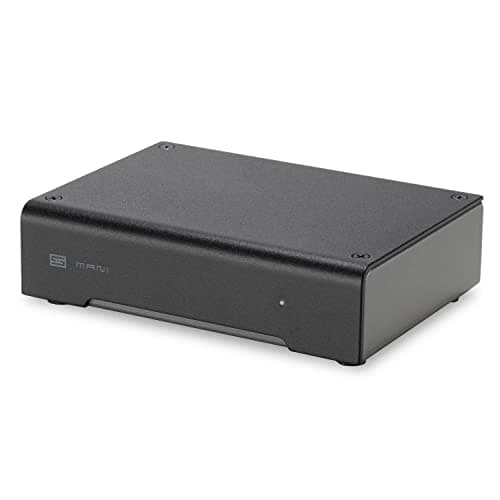 Schiit Mani 2 Four gain settings covering MM, MC and MI cartridges, which means it is the one box here that will still fit whatever cartridge you buy next. | Best overall under $200 | 8.6 | |
| 2 | 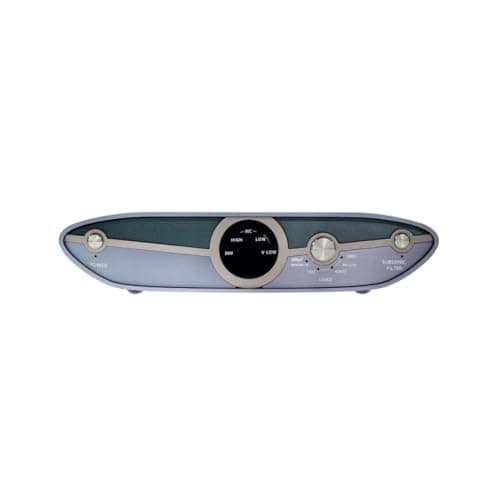 iFi ZEN Phono 3 72 dB of gain at its highest setting — the only box here that will lift a genuinely low-output moving-coil cartridge without a step-up transformer. | Best for very low-output cartridges | 8.4 |
These two turn up on the same shortlist constantly, at roughly the same money, and the usual comparison is a paragraph about house sound. Both makers publish real specifications instead, so this page is a reading of those sheets — gain, loading, noise, distortion, filter, power — and nothing else. We have not listened to either one, and we are not going to tell you which sounds warmer.
Gain: four steps each, 12 dB apart at the top
Schiit publishes 33, 42, 48 and 60 dB, with 42 dB as the factory default. iFi publishes 36 dB for moving magnet and 48, 60 and 72 dB for its three moving-coil positions. At the bottom the Schiit goes 3 dB lower, which is useful for a hot cartridge into a sensitive input; at the top the iFi goes 12 dB higher, which is the headline difference between the two boxes.
Output = cartridge output × 10^(gain dB ÷ 20)
Inputs
- Ortofon 2M Red output: 5.5 mV (1 kHz, 5 cm/s) — the highest-output cartridge we cover (Ortofon spec page)
- Denon DL-103 output: 0.3 mV — the lowest-output cartridge we cover (Denon spec page)
- Schiit Mani 2 gain settings: 33, 42, 48 or 60 dB (default 42 dB) (Schiit spec page)
- iFi ZEN Phono 3 gain settings: 36 dB (MM), 48 dB (MC High), 60 dB (MC Low), 72 dB (MC V-Low) (iFi spec page)
Result
2M Red at 5.5 mV: 42 dB (Mani 2) → ~690 mV · 36 dB (ZEN) → ~350 mV
DL-103 at 0.3 mV: 60 dB (either) → ~300 mV · 72 dB (ZEN only) → ~1.2 V
Line level is loosely 300 mV to 2 V, so both boxes handle a normal moving magnet with room to spare. The difference is at the bottom of the output range: a 0.3 mV cartridge through 60 dB lands at the very bottom of line level, and you make up the rest with the volume control — which raises the noise floor along with the music. The iFi’s 72 dB setting lifts the same cartridge to about 1.2 V instead. That is the case for it, and it is a good one. The arithmetic is just decibels into a voltage ratio; the cartridge figures are measured at 1 kHz and 5 cm/s, which is the convention both makers assume.
Loading: the gap that decides most purchases
A cartridge is loaded by the resistance and capacitance the phono stage presents, and some cartridge makers state what they want. Audio-Technica specifies “min. 100 Ω” for the AT-OC9XML moving coil, in its own words. Grado specifies a 10 kΩ to 47 kΩ input load for the Green4. Ortofon asks for 47 kΩ with 150–300 pF for the 2M Red.
Schiit publishes four resistive loading options — 47 kΩ, 200 Ω, 47 Ω and 38 Ω — and four capacitance settings: 47, 100, 150 and 200 pF. iFi publishes no resistive loading at all, only 100/200 pF for its MM and MC High positions. That is not a small difference in a spec table; it is the difference between being able to meet a cartridge maker’s stated requirement and having to hope. With the Mani 2 an AT-OC9XML can sit on the 200 Ω setting, comfortably above its stated 100 Ω minimum. With the ZEN Phono 3 there is no published figure to check it against.
The Mani 2 also supports moving iron explicitly — Schiit lists MM, MC and MI — and iFi lists MM and MC only. If your cartridge is a Grado, that is worth knowing; our guide to swapping cartridges covers why moving iron sits awkwardly between the two camps.
One piece of perspective before the numbers get finer: both of these boxes publish per-setting noise and distortion and at least some loading data, which is more than the phono stage built into any tube or hybrid amplifier we cover manages — not one of those four publishes a single phono figure. Arguing over decibels between two documented stages is a luxury.
Noise and distortion: the Schiit wins every comparable step
Both makers publish A-weighted noise figures, so for once these can be read side by side. Schiit: greater than 108 dB at 33 dB gain, 98 dB at 42 dB, 96 dB at 48 dB and 87 dB at 60 dB, referenced to 2 V RMS. iFi: 91 dB(A) for MM at 36 dB, 81 dB(A) for MC High at 48 dB, 89.6 dB(A) for MC Low at 60 dB and 78.6 dB(A) for MC V-Low at 72 dB.
At the two comparable settings the Schiit is ahead by a wide margin: 96 dB against 81 dB at 48 dB of gain, and 87 dB against 89.6 dB at 60 dB — where iFi does take the round by 2.6 dB. Note the oddity on iFi’s own sheet, which we have not seen explained: MC High at 48 dB is noisier than MC Low at 60 dB, by 8.6 dB. Higher gain, lower published noise. We are not going to invent a mechanism for it, but it is the kind of thing that makes a middle setting hard to recommend.
Distortion goes the same way. Schiit publishes less than 0.0003% at 33 dB and less than 0.0015% at 60 dB — both exceptionally low. iFi publishes less than 0.0027% for MM, less than 0.0095% for MC High and less than 0.031% for MC Low, which at the 60 dB position is roughly twenty times the Schiit’s figure. For the 72 dB V-Low setting iFi publishes no distortion figure at all — so the one capability that makes the ZEN Phono 3 the right answer is also the one setting its maker describes least.
The subsonic filter, and what a published slope is worth
Both have one. Schiit publishes its corner and its slope and makes both switchable: 15 Hz at either 6 or 12 dB per octave, fully passive. iFi calls its circuit an “Intelligent Subsonic Filter” and publishes neither a corner frequency nor a slope.
This matters more than it sounds. A subsonic filter exists to remove warp and rumble energy below the music, and how much of the bottom octave it takes with it depends entirely on where it starts and how steeply it falls. A published 15 Hz at 6 dB per octave is a calculable effect. A named feature is a promise. The only other stage we cover that publishes a slope is the Pro-Ject Tube Box S2, at 20 Hz and 18 dB per octave, which is far more aggressive than either of these.
Power supply and the practical stuff
Schiit uses an external 16 V AC transformer feeding dual-filtered regulated ±16 V rails, published in the manual. iFi uses an external 5 V DC supply at 0.5 A. Higher rails give a circuit more room before it clips, which is consistent with the Schiit’s distortion figures, though neither maker publishes a maximum output level and we are not going to extrapolate one. Practically: the Schiit needs its specific AC wall unit, while the iFi runs from a common 5 V supply.
Neither publishes an RIAA accuracy figure, which is the specification that says whether records come out the right shape and the one we most wish both would state. Among the stages we cover, only Cambridge Audio (± 0.3 dB on the Alva Duo), NAD and Pro-Ject publish it — our $250–$500 roundup ranks on exactly that.
Which one, by what you own
- A moving magnet (AT-VM95E at 4.0 mV, Ortofon 2M Red at 5.5 mV, Nagaoka MP-110): the Mani 2. Lower noise at the gain you will use, four capacitance settings to match the cartridge sheet, and distortion two orders of magnitude lower than iFi publishes for its MM position.
- A Grado or another moving iron cartridge: the Mani 2, because Schiit lists MI support and iFi does not.
- A moving coil at 0.3–0.4 mV (Denon DL-103, AT-OC9XML, AT-OC9XEN): either, and the deciding factor is loading. If your cartridge maker states a load impedance, the Mani 2 can be set to it and the ZEN Phono 3 cannot be verified against it. If it does not, the iFi’s 72 dB position gives you a healthier output level than 60 dB does.
- A cartridge below 0.3 mV: the ZEN Phono 3 by default, accepting its 78.6 dB(A) noise and its unpublished distortion at that setting. Below about 0.2 mV, consider a step-up transformer instead and read our moving magnet versus moving coil explainer first.
One buying note before you click
Schiit sells direct as well as through Amazon, and on the day we last refreshed prices (17 October 2026) our price feed returned a live Amazon price for the ZEN Phono 3 and no Amazon buy-box price at all for the Mani 2 — the listing exists, the buy box did not. That is why the Mani 2 button below says “check price” rather than showing a number: we will not print a figure we cannot verify today. It is a stock condition, not a verdict, and it does not change the specification comparison above.
What we did not compare
Sound. Neither of us has heard these two in the same system on the same cartridge, and the figures above do not entitle anyone to a verdict about it. Also absent from both sheets: RIAA accuracy, maximum output level, overload margin and input impedance for the iFi. Those are the four specs that would settle the remaining questions, and neither maker publishes them. If you want a phono stage that documents its playback curve, that is a different bracket and our under-$200 roundup is where these two sit within their own.
Every pick in detail
Every specification below links to the manufacturer document we read it from. Where a manufacturer does not publish a figure, we say so rather than estimating it.
Schiit Mani 2
Best overall under $200No live price right now. #ad
Four gain settings covering MM, MC and MI cartridges, which means it is the one box here that will still fit whatever cartridge you buy next.
- flexibility
- 10/10
- noise
- 9/10
- value for money
- 8/10
- build quality
- 8/10
- connectivity
- 7/10
| Specification | Published value | Source |
|---|---|---|
| Gain | 33, 42, 48 or 60 dB (factory default 42 dB) | Schiit spec page |
| Cartridge support | MM, MC or MI | Schiit spec page |
| Loading | Capacitance 47, 100, 150 or 200 pF (default 47 pF); resistive 47 kΩ, 200 Ω, 47 Ω, 38 Ω | Schiit spec page |
| Signal-to-noise | > 108 dB at 33 dB gain; > 98 dB at 42 dB; > 96 dB at 48 dB; > 87 dB at 60 dB (A-weighted, ref 2 V RMS) | Schiit spec page |
| THD | < 0.0003% at 33 dB gain; < 0.0015% at 60 dB | Schiit spec page |
| Subsonic filter | Yes — selectable 6 or 12 dB/octave at 15 Hz, fully passive | Schiit spec page |
| Power | External 16 VAC transformer; dual-filtered regulated ±16 V rails | Schiit manual (PDF) |
Pros
- Four gain settings (33/42/48/60 dB) covering MM, MC and MI
- Four capacitance and four resistance loading options — the most adjustable box here by a distance
- A selectable, fully passive subsonic filter at 15 Hz
- Publishes a full spec sheet including THD and signal-to-noise at every gain setting
Cons
- Gain and loading are set by switches on the underside, so changing them means picking the unit up
- External wall-wart transformer
- Costs roughly double the entry options here
Skip it if you own one moving-magnet cartridge and will never change it — the extra gain settings are the thing you are paying for.
iFi ZEN Phono 3
Best for very low-output cartridgesPrice as of November 12, 2026. #ad
72 dB of gain at its highest setting — the only box here that will lift a genuinely low-output moving-coil cartridge without a step-up transformer.
- flexibility
- 9/10
- noise
- 9/10
- value for money
- 7/10
- build quality
- 8/10
- connectivity
- 9/10
| Specification | Published value | Source |
|---|---|---|
| Gain | 36 dB (MM), 48 dB (MC High), 60 dB (MC Low), 72 dB (MC V-Low) | iFi spec page |
| Cartridge support | MM and MC (MI not listed) | iFi spec page |
| Loading | 100/200 pF (MM and MC High) | iFi spec page |
| Signal-to-noise | MM: 91 dB(A); MC High: 81 dB(A); MC Low: 89.6 dB(A); MC V-Low: 78.6 dB(A) | iFi spec page |
| THD | MM: < 0.0027%; MC High: < 0.0095%; MC Low: < 0.031% | iFi spec page |
| Subsonic filter | Yes — “Intelligent Subsonic Filter” | iFi spec page |
| Power | External DC 5 V / 0.5 A (center positive) | iFi spec page |
Pros
- 72 dB gain on its MC V-Low setting — 12 dB more than the Mani 2's maximum, which is the difference between working and not with a very low-output cartridge
- Four gain settings covering MM through low-output MC, plus a subsonic filter
- Balanced output on a phono stage at this price is unusual
Cons
- Above the $200 bracket at its current live price
- Only 100/200 pF loading — the Mani 2 offers four capacitance and four resistance options
- Curved case does not stack with anything
Skip it if your cartridge is a moving magnet. You would be paying for 36 dB of gain you will never switch on — and the Mani 2 loads more flexibly for less.
Frequently asked questions
Is the Schiit Mani 2 better than the iFi ZEN Phono 3?
Which has more gain, the Mani 2 or the ZEN Phono 3?
Can the iFi ZEN Phono 3 load a moving coil cartridge correctly?
Does either one work with a moving iron cartridge like a Grado?
Why is iFi's MC High setting noisier than its MC Low setting?
Do either of these publish an RIAA accuracy figure?
Read next
The Best Phono Preamps Under $200
Phono stages under $200 ranked on published gain, loading flexibility and noise — including one we would actively skip.
Do I Need a Phono Preamp?
Yes, unless you already have one — and it might be hiding in your turntable, amplifier or speakers. Check in 30 seconds.
Moving Magnet vs Moving Coil Cartridges
The whole MM/MC argument reduces to output voltage — and Schiit's own published noise figures show exactly what the extra gain costs.
The Best Phono Preamps Under $500
Six phono stages from $249 to $499, ranked on published RIAA accuracy and whether the loading can be matched to your cartridge.
Are Turntable Cartridges Interchangeable?
Three compatibility checks — mount, mass and loading — and the decks where the answer is simply no.
The Best Integrated Amplifiers for a Turntable
Amplifiers with a phono stage inside, ranked on published MM sensitivity and phono signal-to-noise — not watts.
Sources
Every specification on this page was read from one of these documents. If one of them has changed, or we have made an error, tell us — corrections are logged and dated per our editorial policy.
- Schiit Mani 2 — specifications (gain steps, four resistive loads, noise and THD per setting, 15 Hz filter)
- Schiit Mani 2 — owner's manual (16 VAC supply, ±16 V regulated rails)
- iFi ZEN Phono 3 — specifications (36/48/60/72 dB gain, noise per setting, capacitance only)
- Ortofon 2M Red — specifications (5.5 mV output, 47 kΩ / 150–300 pF recommended load)
- Denon DL-103 — specifications (0.3 mV output, 40 Ω output impedance)
- Audio-Technica AT-OC9XML — specifications (0.4 mV output, “min. 100 Ω” recommended load)
- Grado Green4 — specifications (moving iron, 4 mV, 10 k–47 kΩ input load)