Audio-Technica AT-LP120XUSB Review
The most connected turntable under $500, and the one whose spec sheet omits exactly the number you would need to plan a cartridge upgrade.
Disclosure: we earn a commission if you buy through the links on this page, at no extra cost to you. It does not influence what we pick — our criteria are published and reproducible, so you can check our work. How we pick · Full disclosure
These picks are spec-and-price analyses, not listening tests. We have not heard this gear and we do not pretend to have: every figure below is sourced to the manufacturer and linked, and every price is live or not shown at all. Here are the rules we followed.
Quick picks
Ranked on the published criteria in How We Pick. Prices are live as of October 15, 2026. Tap any row for the full write-up.
- 8.6$349.00View on Amazon
$449.0022% off
| # | Product | Best for | Score | Price |
|---|---|---|---|---|
| 1 | 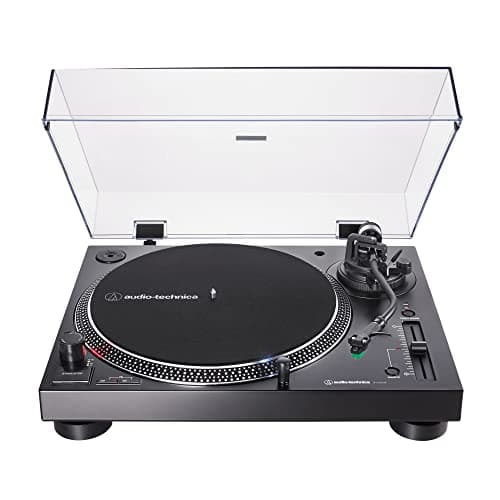 Audio-Technica AT-LP120XUSB A direct-drive deck with a switchable phono stage and USB out, which means it works with any amplifier you already own and needs nothing else on day one. | Best overall under $500 | 8.6 | $349.00View on Amazon $449.0022% off |
We have not heard this turntable. We say that on every page, and it matters more on a review than anywhere else, so here it is up front: what follows is an assessment of what Audio-Technica publishes, what it implies, and what they leave out. It is not a listening impression, and nothing below describes how this deck sounds.
What it is, on paper, is the most connected turntable in its bracket. A direct-drive motor, a switchable built-in phono stage, a USB output, 78 rpm, a removable headshell, adjustable tracking force and anti-skate. Very little at this price does all of that at once, and the list is the argument for the deck.
Direct drive, and what it actually buys
The AT-LP120XUSB uses a DC servo-controlled direct-drive motor. Every other deck in our under-$500 roundup is belt driven, and the difference is structural rather than a matter of degree.
A belt is a compliant coupling: it isolates motor vibration from the platter, and it stretches. A direct drive bolts the platter to the motor: nothing isolates the vibration, and nothing stretches. Which is better depends on which problem you would rather have — Audio-Technica publishes < 0.2% WRMS wow and flutter at 33 rpm, against Fluance’s measured 0.07% on the belt-driven RT82.
Read those two numbers carefully, because they are not the same kind of claim. Audio-Technica publishes a limit — the deck will not be worse than 0.2%. Fluance publishes a measurement. The Audio-Technica’s real figure could be anywhere under its ceiling, and the spec sheet does not say. What direct drive does guarantee is that the speed will not drift as a rubber loop ages, and that there is no consumable in the drive path.
The phono stage: a real feature with a real number
The manual specifies the built-in stage as switchable PHONO/LINE with a 36 dB nominal gain and RIAA equalization. That figure is worth having, because it lets you compare it to a separate stage rather than treating “built-in preamp” as a feature with no properties.
36 dB is squarely in the normal range for a moving magnet stage — the standalone stages in our phono preamp roundupmostly land between 36 and 42 dB. With the bundled AT-VM95E’s 4.0 mV output, 36 dB gives roughly 250 mV, comfortably into line-level territory for any amplifier.
The switch also means the stage genuinely gets out of the way. If you buy a better external stage later, you set the switch to PHONO and the internal circuit is bypassed. That is the right implementation, and it is not universal at this price.
The removable headshell is the real upgrade story
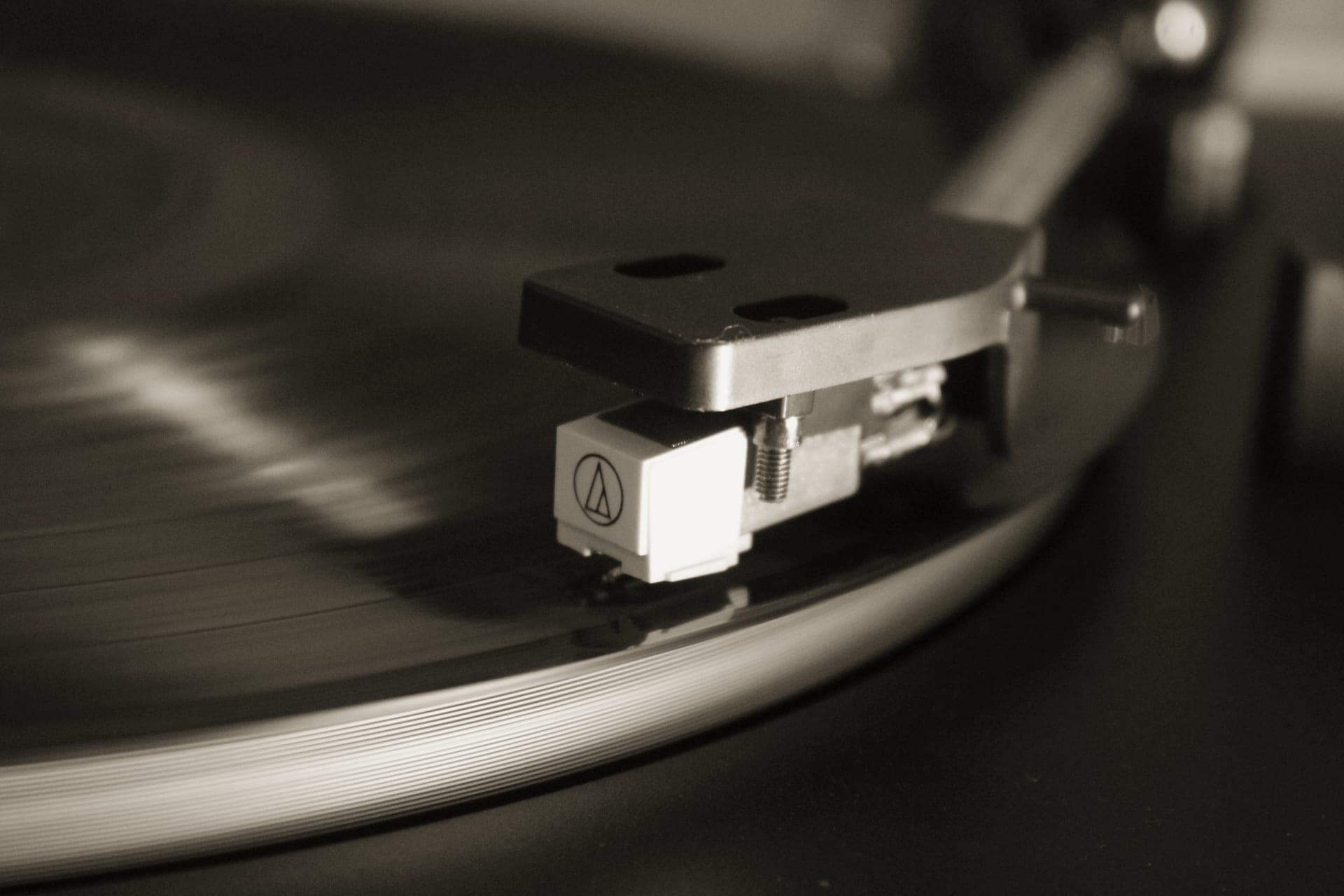
The AT-LP120XUSB ships with an AT-VM95E on an AT-HS6 headshell, and both come off.
That single design decision puts every cartridge in our under-$200 cartridge roundup within reach — and because the VM95 body accepts the whole VM95 stylus range, the cheapest meaningful upgrade here is not a cartridge at all. Pull the VM95E stylus off, push an AT-VMN95ML on, and you have a MicroLinear line-contact profile with no alignment work whatsoever. Thirty seconds, no protractor.
Compare that to the Pro-Ject Debut Carbon EVO, whose one-piece carbon arm has no removable headshell — cartridge changes there are a bench job. We put the two decks head to head here.
The gap: no tonearm effective mass
Here is what Audio-Technica does not publish, on this deck or any other in their range: the tonearm’s effective mass.
That is not a trivia spec. It is one of the two numbers — the other being cartridge compliance — needed to work out the arm/cartridge resonant frequency, which should land between 8 and 12 Hz. Our matching guide runs the arithmetic, and on this deck it cannot be run, because the input is missing.
In practice this matters most if you are considering a high-compliance cartridge. Pro-Ject publishes 6.0 g for the Debut Carbon EVO’s arm and that is enough to finish the calculation; Audio-Technica gives you nothing to work with. It is a genuine gap in the documentation of an otherwise well-specified product, and the practical workaround is to stay within the VM95 range Audio-Technica themselves ship on this arm.
USB, and who it is for
The USB output runs at 16-bit, 44.1 or 48 kHz selectable, over USB 1.1. That is CD resolution, and for digitizing a record collection it is entirely adequate — the noise floor of a vinyl record sits far above the point where 16-bit quantization matters.
It is worth being clear about what this does and does not replace. It is a convenience feature for archiving, not a route to a high-resolution transfer, and if archiving is your main purpose there are better-specified interfaces — though not higher-resolution ones: every USB phono stage we could verify is the same 16-bit, 48 kHz ceiling, and our USB phono preamp roundup ranks them on the stage, the filter and the level control instead. If it is an occasional need, having it built in saves buying anything.
Who should not buy this
Anyone who already owns a good phono stage. You are paying for a circuit you will switch off — and the same money spent on the Fluance RT82, which omits the stage and includes an Ortofon OM 10, puts more of your budget into the part that reads the groove.
Anyone who wants the smallest possible footprint. This is a heavy, full-size deck with a pitch fader and a target light, and its visual language is DJ booth rather than sideboard.
And anyone who wants a fully automatic deck. This one is manual: you cue the arm, and you lift it at the end of the side. If that worries you, the beginner roundup has automatic options.
The verdict
On published specifications this is the most capable deck in its bracket, and the removable headshell gives it the longest useful life of anything at the price. The reservations are real but narrow: a wow-and-flutter limit rather than a measurement, no published arm mass, and a built-in phono stage that some buyers will never switch on.
If you are buying a first serious turntable and you do not already own an amplifier with a PHONO input, this is the one we would put the money on. The deck most often set against it is the belt-drive Fluance RT82, and our head-to-head compares the two directly — including the fact that Fluance’s better-looking 0.07% wow-and-flutter figure carries no measurement condition at all.
Every pick in detail
Every specification below links to the manufacturer document we read it from. Where a manufacturer does not publish a figure, we say so rather than estimating it.
Audio-Technica AT-LP120XUSB
Best overall under $500A direct-drive deck with a switchable phono stage and USB out, which means it works with any amplifier you already own and needs nothing else on day one.
- specs
- 8/10
- upgrade path
- 9/10
- value for money
- 9/10
- ease of setup
- 7/10
- connectivity
- 10/10
| Specification | Published value | Source |
|---|---|---|
| Drive type | Direct drive (DC servo motor) | Audio-Technica manual (PDF) |
| Wow and flutter | < 0.2% WRMS (33 rpm) at 3 kHz | Audio-Technica manual (PDF) |
| Signal-to-noise | > 50 dB | Audio-Technica manual (PDF) |
| Speeds | 33⅓, 45, 78 rpm | Audio-Technica manual (PDF) |
| Cartridge included | AT-VM95E (VM type) on an AT-HS6 headshell | Audio-Technica manual (PDF) |
| Tonearm effective mass | Not published | — |
| Built-in phono stage | Yes — switchable PHONO/LINE, 36 dB nominal gain, RIAA equalized | Audio-Technica manual (PDF) |
| USB output | Yes — 16-bit, 44.1 or 48 kHz selectable, USB 1.1 | Audio-Technica manual (PDF) |
| Tracking force | Arm adjusts 0–4 g; the included AT-VM95E tracks 1.8–2.2 g (2.0 g standard) | Audio-Technica manual (PDF) |
Pros
- Switchable built-in phono stage — works with an amp that has no phono input
- Direct drive, so speed is locked without a belt to stretch or replace
- USB output for digitizing records without a separate interface
- Adjustable tracking force, anti-skate and a removable headshell
Cons
- Heavier and larger than the belt-drive decks in this bracket
- The bundled AT-VM95E is a competent cartridge, not an endgame one
- Removable headshell adds a mechanical joint some purists avoid
Skip it if you want the smallest possible footprint, or you already own a good phono stage and would rather put the money into the cartridge.
Frequently asked questions
Is the Audio-Technica AT-LP120XUSB worth it?
On published specifications it is the most capable deck in its bracket: direct drive, a switchable 36 dB phono stage, USB out, 78 rpm and a removable headshell. The removable headshell is what earns it the score — it means every standard cartridge fits, and the bundled AT-VM95E body accepts the whole VM95 stylus range. If you already own a good phono stage, a deck without one puts more of your money into the cartridge instead.
Does the AT-LP120XUSB need a phono preamp?
No. Audio-Technica's manual specifies a switchable built-in phono stage with 36 dB nominal gain and RIAA equalization, so it connects to any line input. The switch also bypasses that circuit properly, so you can add a better external stage later without fighting the internal one.
What cartridge does the AT-LP120XUSB come with, and can I upgrade it?
It ships with an AT-VM95E on an AT-HS6 headshell. Both are removable, so any standard half-inch cartridge fits. The cheapest real upgrade is not a cartridge at all: the VM95 body accepts every stylus in the VM95 range, so an AT-VMN95ML MicroLinear pushes straight on with no alignment work.
Is direct drive better than belt drive?
Neither is better in the abstract. Direct drive locks the speed with a servo and has no consumable in the drive path; belt drive puts a compliant coupling between motor and platter, which isolates vibration but stretches with age. Audio-Technica publishes a < 0.2% wow and flutter limit for this deck while Fluance publishes a measured 0.07% for the belt-driven RT82 — but a limit and a measurement are different kinds of claim and should not be read as a direct comparison.
Read next
The Best Turntables Under $500
Five decks under $500, ranked on published specs and total cost — including the phono stage two of them make you buy separately.
The Best Turntable Cartridges Under $200
Six cartridges under $200, ranked on stylus profile, published compliance and output — with the unit-conversion trap explained.
Pro-Ject vs Audio-Technica
Debut Carbon EVO against AT-LP120XUSB: arm versus features, and the one published spec that settles it.
Cartridge and Tonearm Matching: Do the Arithmetic
One equation, two published numbers, and the compliance caveat that changes the answer. Worked through with real specs.
How to Digitize Vinyl Records
USB deck, external ADC, or streamer — and why the USB route tops out at 16-bit/44.1 kHz per Audio-Technica's own manual.
Belt Drive vs Direct Drive Turntables
Seven decks, two drive types, and published wow-and-flutter figures that refuse to line up the way the internet says they should.
Fluance RT85 Review
Acrylic platter, measured 0.07% wow and flutter, an Ortofon 2M Blue — and a phono stage you have to supply.
The Best Phono Preamps With a USB Output
Four USB phono stages and the one deck that skips the box, ranked on what each maker publishes about the stage that feeds the converter — because every converter here is the same 16-bit, 48 kHz ceiling.
Sources
Every specification on this page was read from one of these documents. If one of them has changed, or we have made an error, tell us — corrections are logged and dated per our editorial policy.