How to Digitize Vinyl Records
There are three ways to do this and they are not equivalent. The convenient one has a ceiling its manufacturer publishes and almost nobody reads.
Disclosure: we earn a commission if you buy through the links on this page, at no extra cost to you. It does not influence what we pick — our criteria are published and reproducible, so you can check our work. How we pick · Full disclosure
These picks are spec-and-price analyses, not listening tests. We have not heard this gear and we do not pretend to have: every figure below is sourced to the manufacturer and linked, and every price is live or not shown at all. Here are the rules we followed.
Quick picks
Ranked on the published criteria in How We Pick. Prices are live as of October 15, 2026. Tap any row for the full write-up.
- 8.6$349.00View on Amazon
$449.0022% off
- 8.4
- 8.6
| # | Product | Best for | Score | Price |
|---|---|---|---|---|
| 1 | 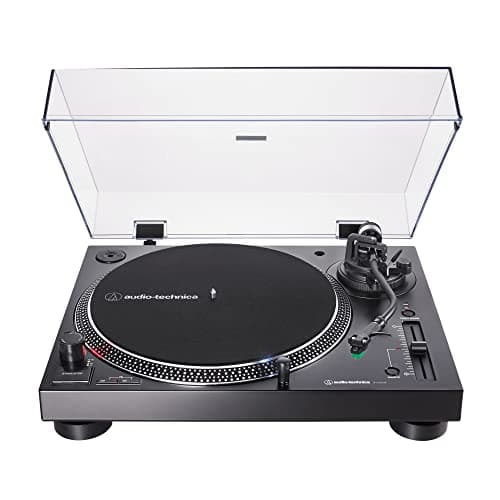 Audio-Technica AT-LP120XUSB A direct-drive deck with a switchable phono stage and USB out, which means it works with any amplifier you already own and needs nothing else on day one. | Best overall under $500 | 8.6 | $349.00View on Amazon $449.0022% off |
| 2 | 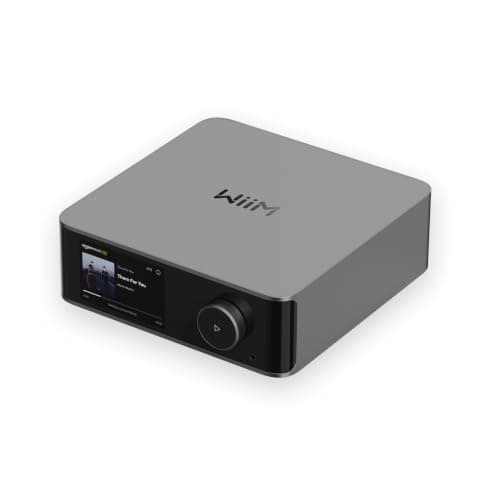 WiiM Ultra The only streamer here with a phono input and a touchscreen — and the only one whose maker publishes nothing at all about how that phono stage performs. | Best for a turntable and a streamer in one box | 8.4 | |
| 3 | 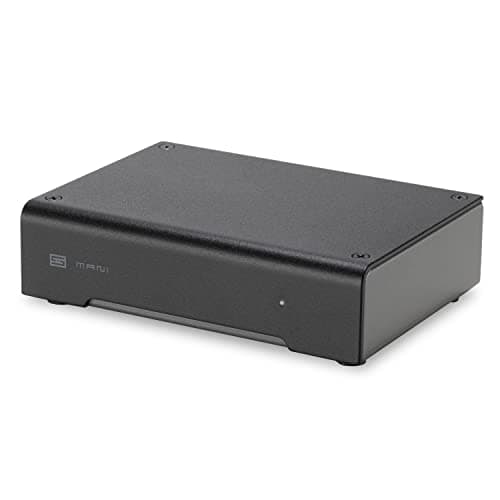 Schiit Mani 2 Four gain settings covering MM, MC and MI cartridges, which means it is the one box here that will still fit whatever cartridge you buy next. | Best overall under $200 | 8.6 |
Digitizing a record means getting a line-level, RIAA-corrected analog signal into an analog-to-digital converter. Everything else is a detail about which box does which part.
There are three routes. They differ in convenience, in what they cost, and — critically — in the resolution ceiling each one imposes, which is a published number on all three.
Route 1: a turntable with a USB output
The simplest path. The deck contains a phono stage and an analog-to-digital converter, and appears to your computer as a recording device. One cable, no additional purchase.
Here is the specification almost nobody looks up. Audio-Technica’s own manual for the AT-LP120XUSB publishes its USB output as:
“16-bit, 44.1 or 48 kHz selectable, USB 1.1”
Sixteen bits, at CD sample rates, over USB 1.1. That is the ceiling of the convenient route, and it is stated plainly in the document that came in the box.
Two things follow from it. First, no amount of software will extract a 24-bit file from this path — the converter is 16-bit and the format is fixed at the hardware. Second, and more usefully: for most records, 16 bits is not the limiting factor anyway. The arithmetic below says why.
Dynamic range (dB) ≈ 6.02 × N + 1.76 · N = bit depth
Inputs
- AT-LP120XUSB published USB output format: 16-bit, 44.1 or 48 kHz, USB 1.1 (Audio-Technica manual (PDF))
- AT-LP120XUSB published signal-to-noise ratio: > 50 dB (Audio-Technica manual (PDF))
- Best turntable signal-to-noise we have a source for (Fluance RT85): 69 dB (weighted) (Fluance spec page)
Result
16-bit theoretical dynamic range = 6.02 × 16 + 1.76 = 98.1 dB
24-bit theoretical dynamic range = 6.02 × 24 + 1.76 = 146.2 dB
Best published turntable signal-to-noise on this site = 69 dB
The 16-bit format has roughly 29 dB more dynamic range than the quietest turntable we can cite actually delivers. The source runs out long before the format does. Recording that at 24-bit captures the same surface noise with more headroom above it — which is a real benefit while you are setting levels, and no benefit at all in the finished file.
6.02N + 1.76 is the theoretical figure for an ideal converter with no dither. Real converters fall short of it, and the turntable figures above are quoted under different weighting conventions by each manufacturer. The comparison holds anyway because the gap is nearly thirty decibels wide — it does not depend on the fine print.
Route 2: separate phono stage into a separate ADC
Turntable → phono stage → an analog-to-digital converter. More boxes, more control, and the route that removes the 16-bit ceiling.
There is a one-box version of this route: a phono stage with the converter built in and a USB socket on the back. Every one we could verify converts at 16-bit and stops at 48 kHz — the same ceiling as the USB turntable — so those boxes are bought for the stage, the filter and the level control rather than for resolution. Our USB phono preamp roundup ranks four of them on exactly that.
The reason to do it is not bit depth, though. It is the phono stage. A dedicated stage gives you things the converter inside a USB turntable does not:
- A subsonic filter. Warped records produce large, inaudible sub-20 Hz excursions that eat digital headroom and force you to record at a lower level. Schiit publishes a selectable 6 or 12 dB/octave filter at 15 Hz on the Mani 2; ART publishes a switchable low-cut at −3 dB at 22 Hz on the DJPRE II; Fluance publishes a selectable high-pass below 20 Hz on the PA10. This is the single most useful feature for digitizing and it is on the cheapest stages.
- Selectable gain. The Mani 2 publishes 33, 42, 48 and 60 dB. Being able to drop to 33 dB when your converter is clipping, or lift to 48 dB for a quiet cartridge, is how you set a sensible recording level without touching the signal digitally.
- Correct loading. Cartridge makers publish capacitance recommendations that disagree with one another — 100–200 pF for Audio-Technica, 150–300 pF for Ortofon, 100 pF for Nagaoka. A stage with selectable capacitance can match yours; a fixed one cannot. See moving magnet vs moving coil for what loading actually does.
Route 3: a streamer with an analog input
Two of the devices we cover will digitize an analog signal as part of their normal operation, which turns the job into a network task rather than a computer one.
The WiiM Pro Plus publishes a line input digitized by a TI Burr-Brown PCM1861 at 192 kHz/24-bit. That is a considerably higher ceiling than the USB turntable route — but it is a line input, so a turntable still needs a phono stage in front of it.
The WiiM Ultra publishes a dedicated phono input, which removes that requirement. It is also the one place we have to flag a gap: WiiM publishes no gain figure, no RIAA accuracy, no input capacitance and no MC capability for that phono stage. It is the feature that justifies the price step over a Pro Plus, and there is no published number attached to it. We are recommending the box for what it does; we cannot tell you how well that particular part performs, because nobody has said.
The three settings that actually matter when you record
Recording level
Aim for peaks somewhere below the ceiling rather than as close to it as possible. Digital clipping is not a soft limit — it is a hard one, and a clipped transient on a record you have already recorded means recording the side again. Given that the source’s own noise floor is around 69 dB at best, there is nothing to gain from crowding the top.
Sample rate
If your route can exceed 44.1 kHz, using 96 kHz costs disk space and buys headroom for any filtering or processing you do afterwards. If your route cannot — the USB turntable path cannot — this decision is already made for you and it does not matter much.
Do not apply noise reduction on the way in
Click removal and hiss reduction are destructive and irreversible. Record flat, keep that file, and do any cleanup on a copy. The whole point of digitizing is that you now have something you can copy.
Clean the record first
This is the one step that changes the result more than any setting on this page. Surface noise you record is surface noise you have permanently. Brushing a side before you record it takes ten seconds — the method is in how to clean vinyl records, and it is free.
The same applies to setup. A stylus tracking at the wrong force or with anti-skate set badly produces distortion that no post-processing removes, and you will be recording it into a permanent file. Set the deck up properly first.
The honest summary
Buy a USB turntable if digitizing is a main reason you are buying a deck at all, and accept 16-bit/44.1 kHz as the ceiling — Audio-Technica publishes that ceiling and it sits about 29 dB below where the record itself gives up.
Use a separate phono stage into an external converter if you already own a deck you like, and buy the phono stage for its subsonic filter and selectable gain rather than for its bit depth.
Either way, the thing that will most improve your files is the ten seconds with a brush before you press record.
Every pick in detail
Every specification below links to the manufacturer document we read it from. Where a manufacturer does not publish a figure, we say so rather than estimating it.
Audio-Technica AT-LP120XUSB
Best overall under $500A direct-drive deck with a switchable phono stage and USB out, which means it works with any amplifier you already own and needs nothing else on day one.
- specs
- 8/10
- upgrade path
- 9/10
- value for money
- 9/10
- ease of setup
- 7/10
- connectivity
- 10/10
| Specification | Published value | Source |
|---|---|---|
| Drive type | Direct drive (DC servo motor) | Audio-Technica manual (PDF) |
| Wow and flutter | < 0.2% WRMS (33 rpm) at 3 kHz | Audio-Technica manual (PDF) |
| Signal-to-noise | > 50 dB | Audio-Technica manual (PDF) |
| Speeds | 33⅓, 45, 78 rpm | Audio-Technica manual (PDF) |
| Cartridge included | AT-VM95E (VM type) on an AT-HS6 headshell | Audio-Technica manual (PDF) |
| Tonearm effective mass | Not published | — |
| Built-in phono stage | Yes — switchable PHONO/LINE, 36 dB nominal gain, RIAA equalized | Audio-Technica manual (PDF) |
| USB output | Yes — 16-bit, 44.1 or 48 kHz selectable, USB 1.1 | Audio-Technica manual (PDF) |
| Tracking force | Arm adjusts 0–4 g; the included AT-VM95E tracks 1.8–2.2 g (2.0 g standard) | Audio-Technica manual (PDF) |
Pros
- Switchable built-in phono stage — works with an amp that has no phono input
- Direct drive, so speed is locked without a belt to stretch or replace
- USB output for digitizing records without a separate interface
- Adjustable tracking force, anti-skate and a removable headshell
Cons
- Heavier and larger than the belt-drive decks in this bracket
- The bundled AT-VM95E is a competent cartridge, not an endgame one
- Removable headshell adds a mechanical joint some purists avoid
Skip it if you want the smallest possible footprint, or you already own a good phono stage and would rather put the money into the cartridge.
WiiM Ultra
Best for a turntable and a streamer in one boxPrice as of October 15, 2026. #ad
The only streamer here with a phono input and a touchscreen — and the only one whose maker publishes nothing at all about how that phono stage performs.
- measured performance
- 9/10
- connectivity
- 10/10
- features
- 10/10
- value for money
- 7/10
- published data
- 6/10
| Specification | Published value | Source |
|---|---|---|
| DAC | ESS ES9038 Q2M | WiiM spec page |
| Analog out SNR | 121 dB (A-weighted) | WiiM spec page |
| Analog out THD+N | −116 dB (0.00015%) | WiiM spec page |
| Line-out level | 2.1 Vrms maximum | WiiM spec page |
| Headphone amplifier | TI TPA6120A2 — SNR 119 dB, THD+N −99 dB into 300 Ω falling to −92 dB into 32 Ω | WiiM spec page |
| Phono input | Yes — a dedicated input for turntables without a built-in preamp | WiiM spec page |
| Other inputs | HDMI ARC (PCM and Dolby Digital 5.1) · optical TOSLINK to 192 kHz/24-bit · RCA line-in · USB storage | WiiM spec page |
| Outputs | RCA line-out · subwoofer out · coaxial and optical S/PDIF (192 kHz/24-bit) · USB audio out (UAC 2.0, 192 kHz/24-bit) · 3.5 mm headphone | WiiM spec page |
| Network | Wi-Fi 6 (WiiM states a future Wi-Fi 6E software update) · Bluetooth 5.3 · Ethernet | WiiM spec page |
| Protocols | Spotify Connect, TIDAL Connect, Google Cast Audio, Alexa built-in, DLNA, Squeezelite, Roon Ready | WiiM spec page |
| Display | 3.5 in glass-covered color touchscreen | WiiM spec page |
| Dimensions / weight | 211 × 200 × 72 mm; 1.42 kg (3.13 lb) | WiiM spec page |
| Phono stage gain, RIAA accuracy, input capacitance or MC support | Not published | — |
Pros
- A dedicated phono input, which no other streamer on this page has
- ESS ES9038 Q2M with a published 121 dB SNR and −116 dB THD+N, the best analog figures here
- 3.5 in touchscreen, so it is usable without reaching for a phone
- HDMI ARC, subwoofer out, headphone amp and USB audio out — it can be the hub of a whole system
Cons
- WiiM publishes NO gain, RIAA accuracy, input capacitance or MC capability for the phono stage — the single feature that justifies the price step
- Meaningfully larger and heavier than the Pro Plus for the same core streaming function
- The headphone amp's THD+N degrades from −99 dB into 300 Ω to −92 dB into 32 Ω, so low-impedance headphones get the worse figure
- Wi-Fi 6E is promised via a future software update rather than shipping today
Skip it if you already own a phono stage you like. Without that feature this is a Pro Plus with a screen, at a considerable premium.
Schiit Mani 2
Best overall under $200No live price right now. #ad
Four gain settings covering MM, MC and MI cartridges, which means it is the one box here that will still fit whatever cartridge you buy next.
- flexibility
- 10/10
- noise
- 9/10
- value for money
- 8/10
- build quality
- 8/10
- connectivity
- 7/10
| Specification | Published value | Source |
|---|---|---|
| Gain | 33, 42, 48 or 60 dB (factory default 42 dB) | Schiit spec page |
| Cartridge support | MM, MC or MI | Schiit spec page |
| Loading | Capacitance 47, 100, 150 or 200 pF (default 47 pF); resistive 47 kΩ, 200 Ω, 47 Ω, 38 Ω | Schiit spec page |
| Signal-to-noise | > 108 dB at 33 dB gain; > 98 dB at 42 dB; > 96 dB at 48 dB; > 87 dB at 60 dB (A-weighted, ref 2 V RMS) | Schiit spec page |
| THD | < 0.0003% at 33 dB gain; < 0.0015% at 60 dB | Schiit spec page |
| Subsonic filter | Yes — selectable 6 or 12 dB/octave at 15 Hz, fully passive | Schiit spec page |
| Power | External 16 VAC transformer; dual-filtered regulated ±16 V rails | Schiit manual (PDF) |
Pros
- Four gain settings (33/42/48/60 dB) covering MM, MC and MI
- Four capacitance and four resistance loading options — the most adjustable box here by a distance
- A selectable, fully passive subsonic filter at 15 Hz
- Publishes a full spec sheet including THD and signal-to-noise at every gain setting
Cons
- Gain and loading are set by switches on the underside, so changing them means picking the unit up
- External wall-wart transformer
- Costs roughly double the entry options here
Skip it if you own one moving-magnet cartridge and will never change it — the extra gain settings are the thing you are paying for.
Frequently asked questions
What quality do you get from a USB turntable?
On the Audio-Technica AT-LP120XUSB, exactly 16-bit at 44.1 or 48 kHz over USB 1.1 — Audio-Technica publishes that in its own manual. That is a hardware ceiling; no software setting produces a 24-bit file from it. In practice it is rarely the limiting factor: 16 bits gives about 98 dB of theoretical dynamic range, and the quietest turntable signal-to-noise figure we can cite is 69 dB.
Should I record vinyl at 24-bit/96 kHz?
If your recording chain supports it, yes — mainly for headroom while setting levels and for any processing you do afterwards, not because the record contains more than 16 bits can hold. The best published turntable signal-to-noise on this site is 69 dB, roughly 29 dB inside what 16-bit already provides.
Do I need a phono preamp to digitize records?
You need one somewhere in the chain, because a cartridge outputs millivolts with the RIAA curve still applied. A USB turntable has one built in. A separate converter or a streamer’s line input does not — the WiiM Pro Plus digitizes at 192 kHz/24-bit but its input is line level. The WiiM Ultra has a dedicated phono input, though WiiM publishes no specifications for it at all.
What is the best phono preamp feature for recording vinyl?
A subsonic filter. Warped records produce large inaudible excursions below 20 Hz that consume digital headroom and force you to record quieter. Schiit publishes a selectable 6 or 12 dB/octave filter at 15 Hz on the Mani 2, ART a low-cut at −3 dB at 22 Hz on the DJPRE II, and Fluance a selectable high-pass below 20 Hz on the PA10.
Read next
Audio-Technica AT-LP120XUSB Review
Direct drive, a switchable 36 dB phono stage, USB and 78 rpm — reviewed against Audio-Technica's own manual.
Hi-Res Audio Explained
24-bit implies 146 dB of dynamic range; the best published DAC figure here is 126 dB, or about 20.6 bits. The arithmetic, and what it means.
Do I Need a Phono Preamp?
Yes, unless you already have one — and it might be hiding in your turntable, amplifier or speakers. Check in 30 seconds.
How to Connect a Turntable to Speakers
Four working routes from turntable to speakers, the two that do not work, and how to fix the hum.
The Best Music Streamers With a Built-In DAC
Four streamers with built-in DACs, ranked on published output performance, inputs and protocol support.
How to Clean Vinyl Records
The brush-before-every-play habit, the wet method, and the three techniques that damage records — with no product recommendation, deliberately.
The Best Phono Preamps With a USB Output
Four USB phono stages and the one deck that skips the box, ranked on what each maker publishes about the stage that feeds the converter — because every converter here is the same 16-bit, 48 kHz ceiling.
Sources
Every specification on this page was read from one of these documents. If one of them has changed, or we have made an error, tell us — corrections are logged and dated per our editorial policy.