Pro-Ject vs Audio-Technica
Two decks, two philosophies, and one of them publishes a number the other refuses to — which turns out to decide the whole argument.
Disclosure: we earn a commission if you buy through the links on this page, at no extra cost to you. It does not influence what we pick — our criteria are published and reproducible, so you can check our work. How we pick · Full disclosure
These picks are spec-and-price analyses, not listening tests. We have not heard this gear and we do not pretend to have: every figure below is sourced to the manufacturer and linked, and every price is live or not shown at all. Here are the rules we followed.
Quick picks
Ranked on the published criteria in How We Pick. Prices are live as of October 15, 2026. Tap any row for the full write-up.
- 8.0
- 8.6$349.00View on Amazon
$449.0022% off
| # | Product | Best for | Score | Price |
|---|---|---|---|---|
| 1 | 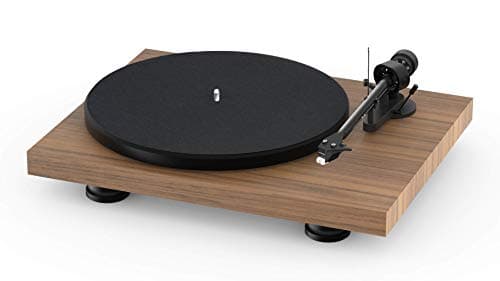 Pro-Ject Debut Carbon EVO A one-piece carbon-fiber tonearm and electronic speed change, on a deck whose whole design argument is the arm rather than the platter. | Best tonearm under $1,000 | 8.0 | |
| 2 | 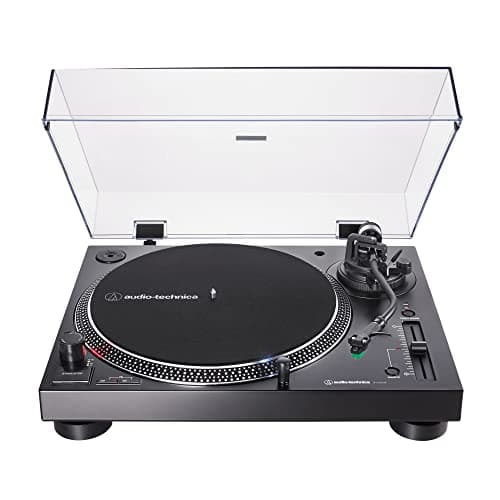 Audio-Technica AT-LP120XUSB A direct-drive deck with a switchable phono stage and USB out, which means it works with any amplifier you already own and needs nothing else on day one. | Best overall under $500 | 8.6 | $349.00View on Amazon $449.0022% off |
These two decks do not compete on price and they are still the comparison people actually want, because they represent the two coherent ways to spend money on a turntable. One puts everything into the tonearm and expects you to bring the rest. The other puts everything into features and expects you to bring nothing.
Neither is wrong. But one of them lets you finish a calculation the other does not, and on this site that carries weight.
The specification that settles it
Pro-Ject publishes “Effective arm length/mass: 218.5 mm / 6.0 g” for the Debut Carbon EVO. That is an unambiguous, plainly labeled effective mass figure, and it is the only one in this entire hub.
Audio-Technica publishes no effective mass for the AT-LP120XUSB, or for any deck in their range. Fluance publishes something under that heading whose value — 27.5 g — sits so far outside the normal 8–14 g window that we do not trust it.
F = 1000 / (2π · √(M · C)) where M = arm mass + cartridge mass (g), C = compliance (×10⁻⁶ cm/dyne at 10 Hz)
Inputs
- Pro-Ject Debut Carbon EVO effective arm mass: 6.0 g (Pro-Ject datasheet)
- Ortofon 2M Red cartridge weight: 7.2 g (Ortofon)
- Ortofon 2M Red compliance (dynamic, lateral): 20 µm/mN (Ortofon)
- Audio-Technica AT-LP120XUSB effective arm mass: Not published (Audio-Technica manual)
Result
Pro-Ject + 2M Red: M = 6.0 + 7.2 = 13.2 g, C = 20
F = 1000 / (2π · √(13.2 × 20)) = 1000 / (6.283 × 16.25) = 9.8 Hz
Comfortably inside the 8–12 Hz window, which is exactly what you would expect from a factory-fitted pairing. The point is not the answer — it is that the answer exists.
Audio-Technica AT-LP120XUSB + any cartridge: the calculation cannot be performed. The arm figure does not exist in any Audio-Technica publication.
This arithmetic takes Ortofon’s 20 µm/mN as a 10 Hz figure, which is what the formula expects — but Ortofon does not publish the frequency it was measured at, and if it is a 100 Hz figure the answer moves to about 7.4 Hz, below target. We work that ambiguity through in full here. The calculation also ignores mounting hardware and headshell mass, which on a removable-headshell deck is a further unpublished variable.
Where the money goes
Pro-Ject: the arm.A one-piece carbon fiber tonearm, stiffer than the alloy arms at this price, with no joints to introduce resonance. Electronic speed change between 33 and 45, height-adjustable feet, and an Ortofon 2M Red pre-adjusted at the factory. No phono stage — Pro-Ject’s own datasheet says “it is always better to opt for a separate phono stage”.
Audio-Technica: the feature list. Direct drive, a switchable 36 dB phono stage, USB output at 16-bit/44.1 or 48 kHz, 78 rpm, a removable headshell, adjustable tracking force and anti-skate, and an AT-VM95E in the box.
Both decks publish a signal-to-noise ratio: Pro-Ject 68 dB, Audio-Technica “greater than 50 dB”. Again, one is a figure and one is a floor. On wow and flutter Pro-Ject publishes ±0.17% at 33 rpm and ±0.15% at 45, against Audio-Technica’s “less than 0.2% WRMS”. Those are close enough that the difference is not the reason to choose either.
The headshell trade
This one runs the other way, and it is the strongest argument for the Audio-Technica.
The AT-LP120XUSB’s AT-HS6 headshell comes off. Swapping cartridges is a two-minute job, and you can keep two cartridges on two headshells and change between them. The Pro-Ject’s one-piece carbon arm has no removable headshell, which is precisely what makes it stiff — and it means changing a cartridge is a bench job with a protractor and a steady hand.
So: stiffness or convenience. Pro-Ject chose stiffness deliberately and it is a defensible choice, but if you enjoy trying cartridges, that is a real cost you will pay repeatedly.
The total system price
This is where the sticker prices mislead. The Pro-Ject needs a phono stage; the Audio-Technica does not. Add a competent separate stage to the Pro-Ject and the gap widens beyond what the two price tags suggest.
Unless, of course, you already own an amplifier with a PHONO input — in which case the Audio-Technica’s built-in stage is a circuit you will switch off, and the comparison flips again.
Which one we would buy
If you own an amplifier with a phono input and you intend to keep one cartridge for years: the Pro-Ject. It is the better-engineered arm, it is the only deck here whose specifications let you verify a cartridge match, and the factory-fitted 2M Red is a good cartridge in its own right.
If you are building a system from nothing, or you want to digitize records, or you expect to experiment with cartridges: the Audio-Technica. The removable headshell and the built-in stage between them remove two purchases and one skill requirement, and our full review of it goes deeper.
Every pick in detail
Every specification below links to the manufacturer document we read it from. Where a manufacturer does not publish a figure, we say so rather than estimating it.
Pro-Ject Debut Carbon EVO
Best tonearm under $1,000Price as of October 15, 2026. #ad
A one-piece carbon-fiber tonearm and electronic speed change, on a deck whose whole design argument is the arm rather than the platter.
- specs
- 9/10
- upgrade path
- 8/10
- value for money
- 7/10
- ease of setup
- 6/10
- connectivity
- 5/10
| Specification | Published value | Source |
|---|---|---|
| Drive type | Belt drive with electronic speed control | Pro-Ject datasheet (PDF) |
| Wow and flutter | 33 rpm: ±0.17%; 45 rpm: ±0.15% | Pro-Ject datasheet (PDF) |
| Signal-to-noise | 68 dB | Pro-Ject datasheet (PDF) |
| Speeds | 33, 45 electronically; 78 via the included round belt | Pro-Ject datasheet (PDF) |
| Cartridge included | Ortofon 2M Red, pre-adjusted | Pro-Ject datasheet (PDF) |
| Tonearm effective mass | 6.0 g (published as “Effective arm length/mass: 218.5 mm / 6.0 g”) | Pro-Ject datasheet (PDF) |
| Built-in phono stage | No — Pro-Ject's datasheet says “it is always better to opt for a separate phono stage” | Pro-Ject datasheet (PDF) |
Pros
- One-piece carbon tonearm — stiffer than the alloy arms at this price
- Electronic speed change; no belt to move by hand between 33 and 45
- Height-adjustable feet and a heavier steel platter
Cons
- No built-in phono stage
- Carbon arm has no removable headshell, so cartridge swaps are fiddlier
- Costs more than the RT85 while including a lesser cartridge
- Discontinued — Pro-Ject has removed its product page, and the maker's current turntable range lists the Debut EVO 2 rather than this deck, so what is on sale is remaining stock
Skip it if you swap cartridges often — the fixed headshell makes that a bench job rather than a two-minute one.
Audio-Technica AT-LP120XUSB
Best overall under $500A direct-drive deck with a switchable phono stage and USB out, which means it works with any amplifier you already own and needs nothing else on day one.
- specs
- 8/10
- upgrade path
- 9/10
- value for money
- 9/10
- ease of setup
- 7/10
- connectivity
- 10/10
| Specification | Published value | Source |
|---|---|---|
| Drive type | Direct drive (DC servo motor) | Audio-Technica manual (PDF) |
| Wow and flutter | < 0.2% WRMS (33 rpm) at 3 kHz | Audio-Technica manual (PDF) |
| Signal-to-noise | > 50 dB | Audio-Technica manual (PDF) |
| Speeds | 33⅓, 45, 78 rpm | Audio-Technica manual (PDF) |
| Cartridge included | AT-VM95E (VM type) on an AT-HS6 headshell | Audio-Technica manual (PDF) |
| Tonearm effective mass | Not published | — |
| Built-in phono stage | Yes — switchable PHONO/LINE, 36 dB nominal gain, RIAA equalized | Audio-Technica manual (PDF) |
| USB output | Yes — 16-bit, 44.1 or 48 kHz selectable, USB 1.1 | Audio-Technica manual (PDF) |
| Tracking force | Arm adjusts 0–4 g; the included AT-VM95E tracks 1.8–2.2 g (2.0 g standard) | Audio-Technica manual (PDF) |
Pros
- Switchable built-in phono stage — works with an amp that has no phono input
- Direct drive, so speed is locked without a belt to stretch or replace
- USB output for digitizing records without a separate interface
- Adjustable tracking force, anti-skate and a removable headshell
Cons
- Heavier and larger than the belt-drive decks in this bracket
- The bundled AT-VM95E is a competent cartridge, not an endgame one
- Removable headshell adds a mechanical joint some purists avoid
Skip it if you want the smallest possible footprint, or you already own a good phono stage and would rather put the money into the cartridge.
Frequently asked questions
Is Pro-Ject better than Audio-Technica?
They optimize for different things. The Pro-Ject Debut Carbon EVO puts its budget into a one-piece carbon tonearm and publishes a 6.0 g effective mass — the only unambiguous arm figure in this category, and the one that lets you verify a cartridge match. The Audio-Technica AT-LP120XUSB puts its budget into features: direct drive, a built-in phono stage, USB, 78 rpm and a removable headshell. If you already own a phono stage, the Pro-Ject; if you are starting from nothing, the Audio-Technica.
Does the Pro-Ject Debut Carbon EVO have a phono preamp?
No. Pro-Ject's datasheet is explicit that "it is always better to opt for a separate phono stage". You will need either an amplifier with a PHONO input or a separate phono preamp, and that cost should be part of your comparison against decks that include one.
Can you change the cartridge on a Pro-Ject Debut Carbon EVO?
Yes, but it is a bench job. The one-piece carbon arm has no removable headshell — which is what makes it stiff — so a cartridge change means working directly on the arm with an alignment protractor. The Audio-Technica AT-LP120XUSB's AT-HS6 headshell simply unplugs, which makes swapping cartridges a two-minute task.
Read next
Audio-Technica AT-LP120XUSB Review
Direct drive, a switchable 36 dB phono stage, USB and 78 rpm — reviewed against Audio-Technica's own manual.
Cartridge and Tonearm Matching: Do the Arithmetic
One equation, two published numbers, and the compliance caveat that changes the answer. Worked through with real specs.
The Best Turntables Under $1,000
Four decks under $1,000, judged on where the money went — and only one publishes a tonearm effective mass you can actually use.
The Best Turntables Under $500
Five decks under $500, ranked on published specs and total cost — including the phono stage two of them make you buy separately.
Belt Drive vs Direct Drive Turntables
Seven decks, two drive types, and published wow-and-flutter figures that refuse to line up the way the internet says they should.
Sources
Every specification on this page was read from one of these documents. If one of them has changed, or we have made an error, tell us — corrections are logged and dated per our editorial policy.