Cartridge and Tonearm Matching: Do the Arithmetic
Whether a cartridge suits an arm is not a matter of taste. It is one equation, two published numbers, and one caveat that most people never mention.
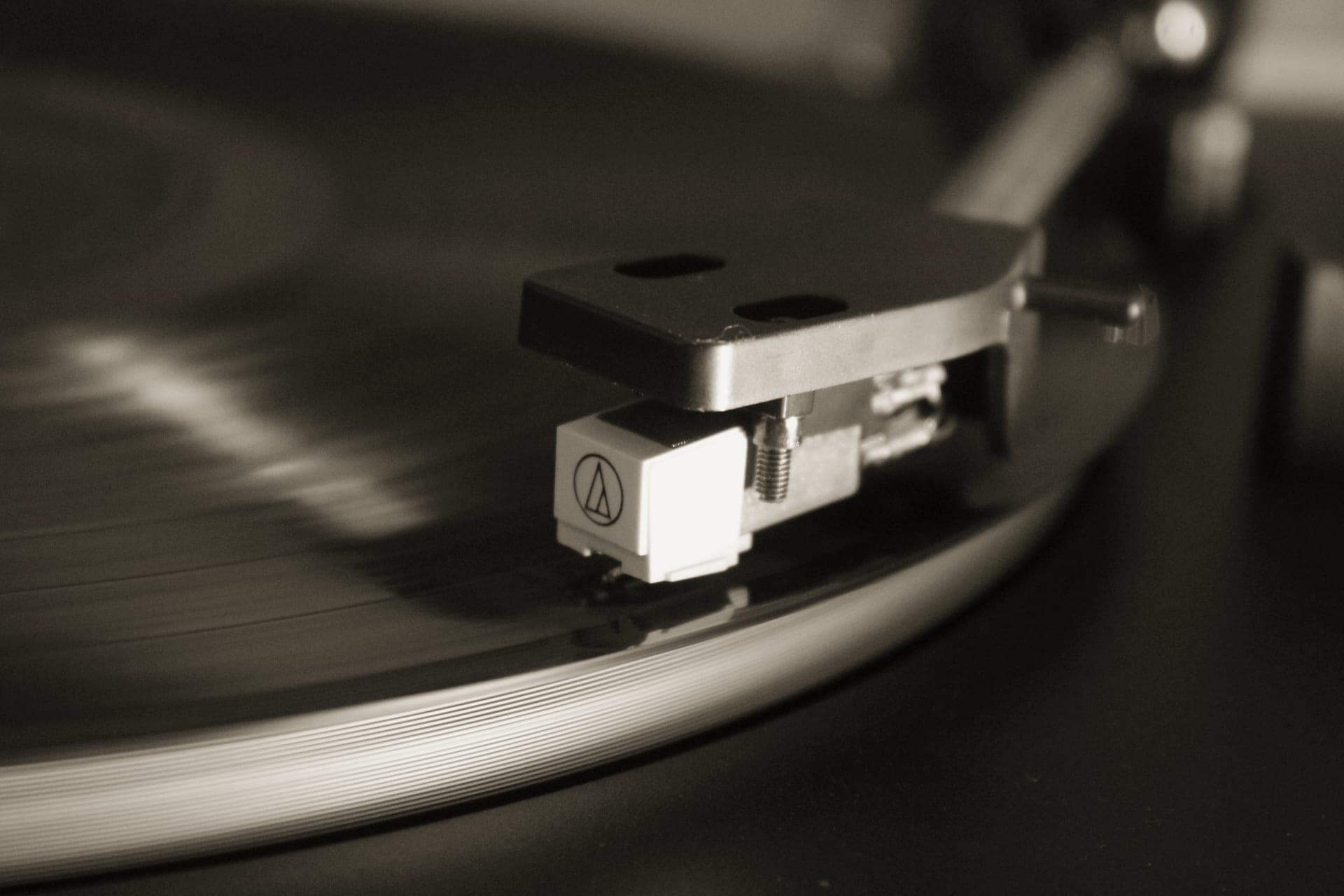
A cartridge and tonearm match when their combined resonant frequency lands between 8 and 12 Hz. You can calculate it from two published numbers: the arm’s effective mass and the cartridge’s compliance. Here is the formula, a worked example, and the reason the answer is less certain than everyone pretends.
Why 8 to 12 Hz
The arm and cartridge form a mass on a spring. The cartridge’s suspension is the spring; the arm plus cartridge is the mass. Like any such system it has a frequency at which it prefers to move, and at that frequency it moves a lot.
You want that frequency in a gap. Below about 8 Hz it starts overlapping with record warps (typically 0.5–6 Hz) and footfall, so the arm gets excited by things that are not music — that is the woofer-pumping you sometimes see. Above about 12 Hz it starts creeping toward the lowest musical content on the record, around 20 Hz. Between 8 and 12 Hz, it is bothered by neither.
The formula
F = 1000 / (2π × √(M × C)), where M is the total effective mass in grams — the arm’s effective mass plus the cartridge’s mass plus its mounting hardware — and C is the cartridge’s dynamic compliance in µm/mN.
F = 1000 / (2π × √(M_total × C))
Inputs
- Tonearm effective mass: 6.0 g (Pro-Ject datasheet)
- Cartridge mass: 7.2 g (Ortofon)
- Dynamic compliance: 20 µm/mN (Ortofon)
- Fixings (assumed): ≈ 0.5 g (our assumption, stated)
Result
M_total = 6.0 + 7.2 + 0.5 = 13.7 g
13.7 × 20 = 274 → √274 = 16.55
F = 1000 / (2π × 16.55) = 1000 / 104.0 = 9.6 Hz — inside the window.
Ortofon does not publish the frequency their compliance figure was measured at, and it changes the answer. Compliance is quoted at either 10 Hz or 100 Hz depending on the manufacturer, and the 100 Hz figure for a given cartridge is roughly 1.7× lower than its 10 Hz figure. The resonance formula needs the 10 Hz value.
If Ortofon’s 20 µm/mN is a 10 Hz figure: 9.6 Hz — correct. If it is a 100 Hz figure, the 10 Hz equivalent is about 34 µm/mN, giving F = 1000 / (2π × √(13.7 × 34)) = 7.4 Hz — below the window.
We do not know which. Neither does anyone else quoting this calculation at you without mentioning it.
The conversion nobody explains
Audio-Technica publishes cartridge compliance at 100 Hz. Most resonance calculators expect a 10 Hz figure. The commonly used conversion is to multiply the 100 Hz figure by approximately 1.7 to estimate the 10 Hz value.
Note the word approximately. This is a rule of thumb, not a physical law — the real relationship depends on the cartridge’s suspension damping, which nobody publishes. Anyone presenting a ×1.7 conversion as an exact result is showing you more confidence than the input data supports. It is a useful estimate. It is not a measurement.
The uncomfortable part: most manufacturers do not publish effective mass
Here is what we found looking for this number across every turntable we recommend:
- Pro-Ject publishes it unambiguously: 6.0 g for the Debut Carbon EVO, labeled as effective mass.
- Audio-Technica publishes it for none of the AT-LP120XUSB, AT-LP70X or AT-LP60XBT. Their manuals cover tracking force, wow and flutter and signal-to-noise, but not this.
- Fluance publishes a figure under that heading — 21.8 g for the RT82, 27.5 g for the RT85, 28.2 g for the RT81. A genuine effective-mass figure normally falls between about 8 and 14 g. These are two to three times that, which strongly suggests the number is total arm mass rather than effective mass. We have not run the calculation on it, because a formula fed a number that means something else produces a confident wrong answer, and a confident wrong answer is worse than no answer.
- Music Hall publishes a tonearm effective length for the mmf-1.5 — 230 mm — and no effective mass. Length is not the number this calculation needs.
So for most decks, on most days, this calculation cannot honestly be completed from published data. That is a real limitation, and we would rather tell you than fabricate a number to fill the gap.
What to do when the number does not exist
Use the manufacturer’s own pairing as evidence. If a deck ships with a cartridge pre-installed and pre-aligned, the maker has already solved this problem for you — the RT85 with its 2M Blue, the Debut Carbon EVO with its 2M Red. Staying within the same compliance range when you upgrade keeps you in the window without needing the arm figure at all.
This is why the 2M Red to 2M Blue upgrade is unusually safe: Ortofon publishes both at 7.2 g and both at 20 µm/mN. Identical mass, identical compliance, identical resonance. You can swap them without recalculating anything.
The same trick extends further up the range than people expect. Ortofon publishes 7.2 g and 22 µm/mN for both the 2M Bronze and the 2M Black, so either one lands within half a hertz of a 2M Red or Blue on the same arm — the resonance question is already answered before you buy. Our under-$1,000 cartridge roundup runs this calculation for all eight cartridges in that bracket on the Debut Carbon EVO’s published 6.0 g arm, and shows how far the unstated-convention problem moves each answer: the Bronze reads 9.2 Hz if Ortofon’s figure is a 10 Hz figure and 7.0 Hz if it is a 100 Hz one, and nothing Ortofon publishes tells you which.
And if you are shopping rather than upgrading, this is a genuine argument for the Debut Carbon EVO: not that its arm is better, but that Pro-Ject tells you what it is.
Frequently asked questions
Are turntable cartridges interchangeable?
Mechanically, mostly — the half-inch two-screw mount is near-universal. Whether theysuitthe arm is the real question, and it is answered by the resonance formula above: aim for 8–12 Hz. A very high-compliance cartridge in a heavy arm, or a stiff one in a light arm, will land outside that window. Note that some decks restrict this physically: the AT-LP70X’s cartridge body is non-removable, and the AT-LP60XBT uses an integrated headshell.
What is a good tonearm resonance frequency?
Between 8 and 12 Hz. Below 8 Hz the arm starts responding to record warps and footfall; above 12 Hz it approaches the lowest musical frequencies on the record. Around 10 Hz is the middle of the gap.
How do I convert cartridge compliance from 100Hz to 10Hz?
Multiply the 100 Hz figure by approximately 1.7. Audio-Technica publishes at 100 Hz; resonance calculators want 10 Hz. But treat it as an estimate, not a conversion — the true relationship depends on suspension damping, which is not published, so the ×1.7 rule is a convention rather than a physical constant.
What if my calculated resonance is outside 8 to 12 Hz?
You can shift it. Adding mass to the headshell lowers the frequency; a lighter cartridge or headshell raises it. Some headshells accept small weights for exactly this. But before you start, check whether your inputs are trustworthy — as this page shows, the effective-mass figure you are feeding the formula may not be an effective-mass figure at all.
Does cartridge compliance matter more than tonearm mass?
Neither dominates — they multiply. In the formula the two appear as a product (M × C) under a square root, so a 2× change in either moves the resonance by the same amount: down by a factor of √2, roughly 30%. That is precisely why you cannot judge a pairing by either number alone, and why the arithmetic is worth doing.
Read next
The Best Turntables Under $1,000
Four decks under $1,000, judged on where the money went — and only one publishes a tonearm effective mass you can actually use.
The Best Phono Preamps Under $200
Phono stages under $200 ranked on published gain, loading flexibility and noise — including one we would actively skip.
How to Set Up a Turntable
Nine steps, and the two everyone gets wrong. Both have a published number you can set them to.
The Best Turntables Under $500
Five decks under $500, ranked on published specs and total cost — including the phono stage two of them make you buy separately.
The Best Turntable Cartridges Under $200
Six cartridges under $200, ranked on stylus profile, published compliance and output — with the unit-conversion trap explained.
The Best Turntable Cartridges Under $1,000
Eight cartridges from $200 to $1,000, gated on output voltage and load, then ranked on whether the price step buys a difference the maker publishes. Two of them do not.
Pro-Ject vs Audio-Technica
Debut Carbon EVO against AT-LP120XUSB: arm versus features, and the one published spec that settles it.
Moving Magnet vs Moving Coil Cartridges
The whole MM/MC argument reduces to output voltage — and Schiit's own published noise figures show exactly what the extra gain costs.
Sources
Every specification on this page was read from one of these documents. If one of them has changed, or we have made an error, tell us — corrections are logged and dated per our editorial policy.