The Best Turntable Cartridges Under $200
The cheapest genuine upgrade in vinyl, and the one where the specification you most need is published in two incompatible units — or, for one cartridge here, not published at all.
Disclosure: we earn a commission if you buy through the links on this page, at no extra cost to you. It does not influence what we pick — our criteria are published and reproducible, so you can check our work. How we pick · Full disclosure
These picks are spec-and-price analyses, not listening tests. We have not heard this gear and we do not pretend to have: every figure below is sourced to the manufacturer and linked, and every price is live or not shown at all. Here are the rules we followed.
Quick picks
Ranked on the published criteria in How We Pick. Prices are live as of October 15, 2026. Tap any row for the full write-up.
- 8.8
- 8.2$99.00View on Amazon
$109.9910% off
- 8.4$63.25View on Amazon
$74.0015% off
- 7.8$147.99View on Amazon
$159.007% off
- 6.8
- 6.8
| # | Product | Best for | Score | Price |
|---|---|---|---|---|
| 1 | 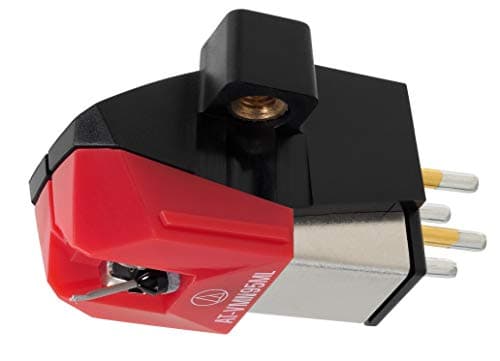 Audio-Technica AT-VM95ML A MicroLinear diamond on the same body as the $65 VM95E, with the highest published compliance and the tightest channel balance of any cartridge here. | Best stylus profile under $200 | 8.8 | |
| 2 | 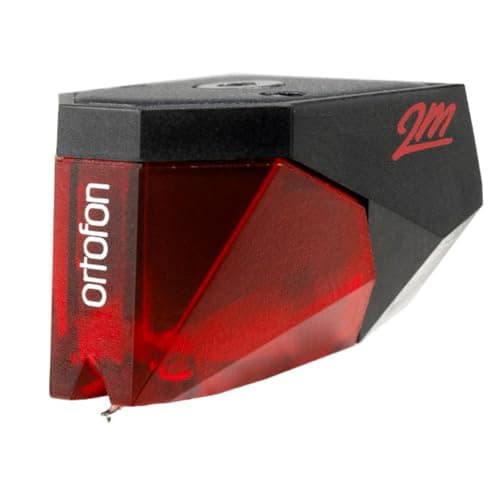 Ortofon 2M Red The only cartridge here whose maker publishes a frequency response with a tolerance and a tracking-ability figure, which makes it the one you can actually verify a claim against. | Best published data | 8.2 | $99.00View on Amazon $109.9910% off |
| 3 | 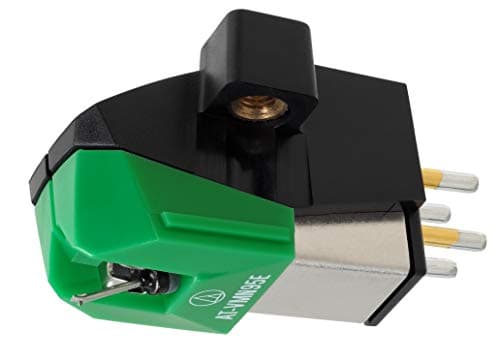 Audio-Technica AT-VM95E The cheapest way into a cartridge body that accepts seven different styli, so every later upgrade costs a stylus rather than a cartridge. | Best first upgrade | 8.4 | $63.25View on Amazon $74.0015% off |
| 4 | 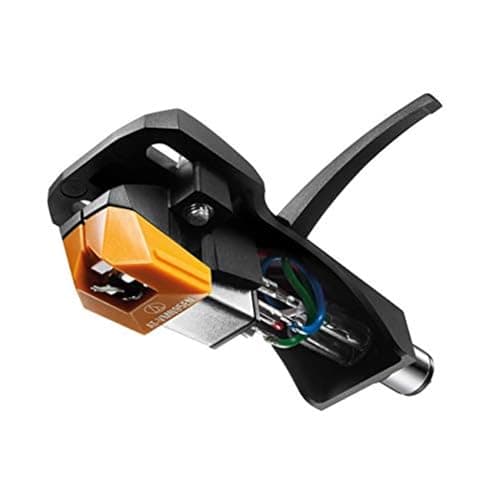 Audio-Technica AT-VM95EN/H The nude-stylus VM95 supplied already mounted and aligned on an AT-HS6 headshell, which removes the single most error-prone step in fitting a cartridge. | Best for a removable headshell | 7.8 | $147.99View on Amazon $159.007% off |
| 5 | 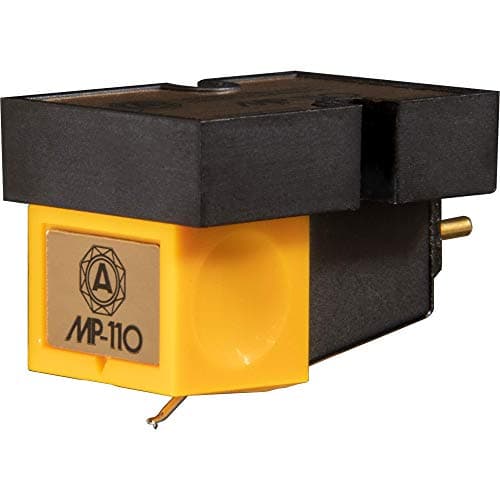 Nagaoka MP-110 A moving-permalloy cartridge with a published 5 mV output and a tracking force range that starts lower than anything else here — and no published compliance at all. | Best for a heavy tonearm | 6.8 | |
| 6 | 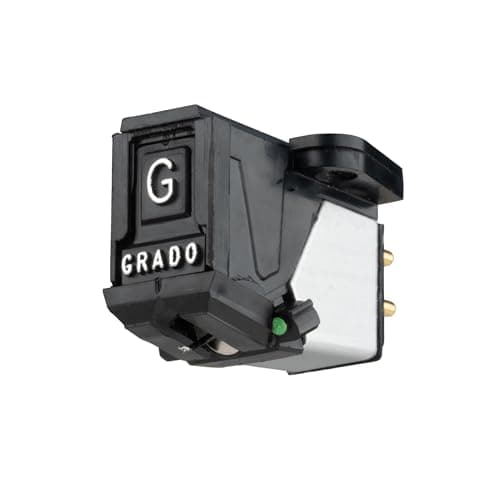 Grado Prestige Green4 A moving-iron design rather than a moving magnet, made in Brooklyn, with a published compliance high enough to matter on a light arm. | The different design | 6.8 |
A cartridge is the only part of a hi-fi system that touches the music physically. Everything downstream is moving a voltage around; this is a diamond in a groove, and it is the point at which the information either enters the system or does not. That is why a $150 cartridge on a $300 deck changes more than a $150 amplifier upgrade does.
It is also the component where the specification that matters most is published in two different units by different manufacturers, and where one cartridge on this page does not publish it at all.
The compliance trap, and how to get it right
Compliance measures how springy the cantilever suspension is. It matters because the cartridge and the tonearm together form a mass-on-a-spring, and that system has a resonant frequency. Put it too high and it lands in the audible band; put it too low and it lands where warped records and footfall live. We work through the whole calculation on our matching page, and the target is 8–12 Hz.
Here is the part almost nobody flags. Audio-Technica publishes compliance in cm/dyne × 10⁻⁶ and states the measurement frequency: 100 Hz. Ortofon and Grado publish a µm/mN figure and state no measurement frequency at all.
The units themselves are numerically identical — 1 cm/dyne × 10⁻⁶ is 1 µm/mN — but the measurement frequency is not a detail. A cartridge measures substantially higher at 10 Hz than at 100 Hz, and the resonance formula wants the 10 Hz value. So for the Audio-Technicas you know exactly what you have and must convert; for the Ortofons and the Grado you have a number and no way to tell which convention produced it.
Compliance is quoted at either 10 Hz or 100 Hz. The resonance formula wants the 10 Hz value; the commonly used conversion is to multiply a 100 Hz figure by approximately 1.7.
Inputs
- AT-VM95ML dynamic compliance: 10 × 10⁻⁶ cm/dyne, stated at 100 Hz (Audio-Technica)
- Ortofon 2M Red compliance (dynamic, lateral): 20 µm/mN — no measurement frequency published (Ortofon)
- Grado Green4 compliance: 20 µm/mN — no measurement frequency published (Grado)
- Nagaoka MP-110 compliance: Not published at all (Nagaoka)
Result
AT-VM95ML: 10 at 100 Hz → estimated 10 Hz equivalent ≈ 10 × 1.7 = ~17
2M Red / Green4: 20, convention unstated
Taken raw, the Ortofon looks twice as compliant as the Audio-Technica. Once the Audio-Technica figure is put on the same footing it is not — the two land in broadly the same territory. Which is the whole point: the raw comparison is the one people make, and it is wrong.
Two caveats, and both matter. The 1.7× factor is a widely used estimate, not a published measurement — Audio-Technica has not published a 10 Hz figure, so treat the ~17 above as an estimate rather than a spec. And neither Ortofon nor Grado states which frequency their 20 µm/mN was measured at, so the comparison cannot be closed from the other side either. Our matching page shows how much that ambiguity moves the resonance answer — it is the difference between 9.6 Hz and 7.4 Hz on the same arm.
Stylus profile is the thing you are actually buying
Every cartridge here has the same basic job. What separates them at this price is the shape of the diamond and whether it is bonded or nude.
- Conical — a simple round tip. None of our picks use one, because at this budget you can do better.
- Elliptical, bonded— the diamond is glued to a metal carrier. The AT-VM95E (0.3 × 0.7 mil), the Ortofon 2M Red (r/R 8/18 µm) and the Nagaoka MP-110 (0.4 × 0.7 mil) are all here. Bonding adds mass at the tip, which is the thing the groove has to accelerate.
- Elliptical, nude— the whole tip is diamond, so there is less mass to move. The AT-VM95EN uses a nude round shank against the VM95E’s bonded one; the geometry is identical and the execution is not.
- MicroLinear— a line-contact profile. Audio-Technica publishes 2.2 × 0.12 mil for the VM95ML, and that 0.12 figure is the point: a contact radius roughly a fifth of the elliptical’s sits deeper in the groove and reads detail an elliptical rides over.
The catch with line contact is alignment. A conical stylus is nearly indifferent to being a degree out; a MicroLinear is not. If you are fitting one yourself, use a protractor — this is the profile where doing it properly actually pays.
The output voltage question your phono stage cares about
Every cartridge here is high output — 3.5 mV to 5.5 mV — which means every one works with any MM phono stage, including the switchable ones built into the decks in our under-$300 roundup. None of these need the extra gain that a low-output-capable stage provides.
The spread still matters at the edges. The Ortofons and the Nagaoka publish 5–5.5 mV; the Audio-Technica MicroLinear and nude elliptical publish 3.5 mV. That is roughly a 4 dB difference, so on a phono stage with marginal gain the Audio-Technicas will sit slightly quieter and you will reach for the volume knob. On any competent stage it is a non-issue.
Which specs each maker will and will not give you
This is where the ranking actually comes from, because we cannot tell you how any of these sound — we have not heard them, and we say so on every page.
- Ortofonpublishes the most: a frequency response with a real tolerance (+3/−1 dB for the Red, +2/−1 dB for the Blue), a tracking-ability figure at 315 Hz, compliance, internal impedance and inductance, and a recommended load capacitance. Nobody else on this page publishes tracking ability at all. Their one gap is the compliance measurement frequency, which they leave unstated.
- Audio-Technica publishes both static and dynamic compliance, channel balance, coil impedance and inductance, and a recommended load range — but no tolerance on the frequency response.
- Gradopublishes a 10–55,000 Hz response with no tolerance whatsoever, which makes the widest-looking number on the page also the least checkable. They do publish compliance, inductance and DC resistance.
- Nagaoka publishes no compliance figure at all, which means the arm-matching calculation simply cannot be completed for the MP-110. Their documentation is also Japanese-language only.
The upgrade path nobody mentions
Two of these are not really cartridge purchases at all.
The whole AT-VM95 range shares one body. If you own an AT-LP120XUSB, a VM95E came in the box — which means the VM95ML at the top of this page is, for you, a stylus swap. No screws, no protractor, no alignment. It pulls off and the new one pushes on. That is the single best-value upgrade on this site and it is why the ML ranks first despite costing nearly three times the VM95E.
Ortofon works the same way: the 2M Blue stylus fits the 2M Red body. So if you expect to reach the Blue eventually, buying the Red first and upgrading the stylus later costs more in total than starting at Blue — worth doing the arithmetic before you order.
What we would actually buy
If you already own any VM95 cartridge: the AT-VM95ML stylus, without hesitating. It is the cheapest genuine step up available to you and it takes thirty seconds to fit.
If you are starting from a deck with a generic bundled cartridge and a standard half-inch mount: the Ortofon 2M Red, because it is the cartridge here whose maker has published enough for you to check every claim.
If your deck has a removable headshell and you have never aligned a cartridge: the AT-VM95EN/H, which arrives already mounted. And if your deck has an integrated headshell — most fully automatic decks do — then none of the half-inch mount cartridges here will fit, and a new deck is the upgrade, not a new cartridge.
If this bracket already feels like the wrong one — if you have a deck worth more than the cartridge on it and a phono stage you chose rather than inherited — the $200 to $1,000 bracket is ranked on a different axis entirely: output voltage and recommended load as a compatibility gate, because that is where the low-output moving coils arrive and a standard 47 kΩ phono input stops being enough. It shares no picks with this page, and its headline finding is that two of the price steps in it buy nothing the manufacturer will write down.
Every pick in detail
Every specification below links to the manufacturer document we read it from. Where a manufacturer does not publish a figure, we say so rather than estimating it.
Audio-Technica AT-VM95ML
Best stylus profile under $200Price as of October 15, 2026. #ad
A MicroLinear diamond on the same body as the $65 VM95E, with the highest published compliance and the tightest channel balance of any cartridge here.
- specs
- 9/10
- upgrade path
- 10/10
- value for money
- 7/10
- tracking ability
- 9/10
- published data
- 9/10
| Specification | Published value | Source |
|---|---|---|
| Type | VM stereo dual magnet (moving magnet) | Audio-Technica spec page |
| Frequency response | 20–25,000 Hz (no tolerance published) | Audio-Technica spec page |
| Channel separation | 23 dB (1 kHz) | Audio-Technica spec page |
| Output voltage | 3.5 mV (1 kHz, 5 cm/sec) | Audio-Technica spec page |
| Output channel balance | 1.5 dB (1 kHz) — the tightest of any VM95 | Audio-Technica spec page |
| Stylus | 2.2 × 0.12 mil MicroLinear, nude square shank | Audio-Technica spec page |
| Cantilever | Aluminum pipe | Audio-Technica spec page |
| Dynamic compliance | 10 × 10⁻⁶ cm/dyne (100 Hz) | Audio-Technica spec page |
| Static compliance | 20 × 10⁻⁶ cm/dyne | Audio-Technica spec page |
| Tracking force | 1.8–2.2 g (2.0 g standard) | Audio-Technica spec page |
| Recommended load | 47,000 Ω, 100–200 pF | Audio-Technica spec page |
| Mount / weight | Half-inch mount, 6.1 g | Audio-Technica spec page |
| Replacement stylus | AT-VMN95ML | Audio-Technica spec page |
Pros
- 2.2 × 0.12 mil MicroLinear — a line-contact profile that sits deeper in the groove than any elliptical here
- 10 × 10⁻⁶ cm/dyne dynamic compliance, the highest published figure in this group
- 1.5 dB channel balance and 23 dB separation, both the best Audio-Technica figures here
- It is a stylus, not a cartridge — if you own any VM95 body it drops in with no alignment at all
Cons
- The most expensive cartridge here, and it shares its body with a $65 one
- A line-contact tip is less forgiving of alignment error than an elliptical
- 3.5 mV output, lower than the VM95E's 4.0 mV
- Higher compliance narrows the range of arms it suits — high compliance plus a heavy arm is the classic mismatch
Skip it if your tonearm's effective mass is unpublished and heavy-looking. High compliance on a heavy arm drops the resonance below the safe window, and most makers will not tell you the arm figure.
Ortofon 2M Red
Best published dataThe only cartridge here whose maker publishes a frequency response with a tolerance and a tracking-ability figure, which makes it the one you can actually verify a claim against.
- specs
- 8/10
- upgrade path
- 8/10
- value for money
- 8/10
- tracking ability
- 7/10
- published data
- 10/10
| Specification | Published value | Source |
|---|---|---|
| Type | Moving magnet, quad-coils with split pole pins and OFC coil wire | Ortofon spec page |
| Frequency response | 20 Hz – 20 kHz, +3 / −1 dB | Ortofon spec page |
| Channel separation | 22 dB (1 kHz) | Ortofon spec page |
| Channel balance | 1.5 dB (1 kHz) | Ortofon spec page |
| Output voltage | 5.5 mV (1 kHz, 5 cm/sec) | Ortofon spec page |
| Tracking ability at 315 Hz | 70 µm | Ortofon spec page |
| Stylus | Elliptical, tip radius r/R 8/18 µm, aluminum cantilever | Ortofon spec page |
| Compliance (dynamic, lateral) | 20 µm/mN | Ortofon spec page |
| Tracking force | 1.6–2.0 g (16–20 mN); 1.8 g recommended | Ortofon spec page |
| Tracking angle | 20° | Ortofon spec page |
| Internal impedance / inductance | 1.3 kΩ DC resistance, 700 mH | Ortofon spec page |
| Recommended load | 47 kΩ, 150–300 pF | Ortofon spec page |
| Weight | 7.2 g | Ortofon spec page |
Pros
- 20 Hz – 20 kHz at +3/−1 dB — a real tolerance, which neither Audio-Technica nor Nagaoka publish
- 70 µm tracking ability at 315 Hz published, a spec almost nobody else quotes
- 5.5 mV output, the highest here, so quiet phono stages have an easier job
- The 2M Blue stylus drops straight into this body, so the upgrade is a stylus swap
Cons
- 22 dB separation is mid-pack, and the Blue's 25 dB shows what the same body can do
- A bonded elliptical stylus at this price, where the Blue's is nude
- 7.2 g is the heaviest cartridge in this group — it matters on a light arm
- Ortofon quotes compliance at the 10 Hz convention while Audio-Technica quotes 100 Hz; the two numbers are not directly comparable
Skip it if you plan to buy the 2M Blue within a year. The Blue is the same body with a better stylus, so buying Red first and upgrading costs more in total than starting at Blue.
Audio-Technica AT-VM95E
Best first upgradeThe cheapest way into a cartridge body that accepts seven different styli, so every later upgrade costs a stylus rather than a cartridge.
- specs
- 7/10
- upgrade path
- 10/10
- value for money
- 10/10
- tracking ability
- 6/10
- published data
- 9/10
| Specification | Published value | Source |
|---|---|---|
| Type | VM stereo dual magnet (moving magnet) | Audio-Technica spec page |
| Frequency response | 20–22,000 Hz (no tolerance published) | Audio-Technica spec page |
| Channel separation | 20 dB (1 kHz) | Audio-Technica spec page |
| Output voltage | 4.0 mV (1 kHz, 5 cm/sec) | Audio-Technica spec page |
| Output channel balance | 2.0 dB (1 kHz) | Audio-Technica spec page |
| Stylus | 0.3 × 0.7 mil elliptical, bonded round shank | Audio-Technica spec page |
| Cantilever | Aluminum pipe | Audio-Technica spec page |
| Dynamic compliance | 7 × 10⁻⁶ cm/dyne (100 Hz) | Audio-Technica spec page |
| Static compliance | 17 × 10⁻⁶ cm/dyne | Audio-Technica spec page |
| Tracking force | 1.8–2.2 g (2.0 g standard) | Audio-Technica spec page |
| Recommended load | 47,000 Ω, 100–200 pF | Audio-Technica spec page |
| Mount / weight | Half-inch mount, 6.1 g | Audio-Technica spec page |
| Replacement stylus | AT-VMN95E — the whole VM95 stylus range drops into this same body | Audio-Technica spec page |
Pros
- The VM95 body takes the entire VM95 stylus range — conical through Shibata — so the upgrade path costs a stylus, not a cartridge
- 4.0 mV output is the highest of any Audio-Technica cartridge here, so it suits low-gain phono stages
- Audio-Technica publishes both static and dynamic compliance, which is what arm matching needs
- Already fitted to several decks we recommend, so you may own one without knowing
Cons
- A bonded round-shank stylus — the diamond is glued to a metal carrier rather than being solid, which adds tip mass
- 20 dB channel separation is the lowest figure in this group
- 2.0 dB channel balance is the loosest here; the ML is 1.5 dB
- Audio-Technica publishes no tolerance on the 20–22,000 Hz response
Skip it if your deck already ships with a VM95E — several do, and buying a second one changes nothing. Buy a better stylus for the body you own instead.
Audio-Technica AT-VM95EN/H
Best for a removable headshellThe nude-stylus VM95 supplied already mounted and aligned on an AT-HS6 headshell, which removes the single most error-prone step in fitting a cartridge.
- specs
- 8/10
- upgrade path
- 9/10
- value for money
- 7/10
- tracking ability
- 7/10
- published data
- 8/10
| Specification | Published value | Source |
|---|---|---|
| Type | VM stereo dual magnet (moving magnet), supplied pre-mounted on an AT-HS6 headshell | Audio-Technica spec page |
| Frequency response | 20–23,000 Hz (no tolerance published) | Audio-Technica spec page |
| Channel separation | 22 dB (1 kHz) | Audio-Technica spec page |
| Output voltage | 3.5 mV (1 kHz, 5 cm/sec) | Audio-Technica spec page |
| Stylus | 0.3 × 0.7 mil elliptical, NUDE round shank (the VM95E's is bonded) | Audio-Technica spec page |
| Cantilever | Aluminum pipe | Audio-Technica spec page |
| Dynamic compliance | 7 × 10⁻⁶ cm/dyne (100 Hz) | Audio-Technica spec page |
| Static compliance | 20 × 10⁻⁶ cm/dyne | Audio-Technica spec page |
| Tracking force | 1.8–2.2 g (2.0 g standard) | Audio-Technica spec page |
| Recommended load | 47,000 Ω, 100–200 pF | Audio-Technica spec page |
| Mount / cartridge weight | Half-inch mount, 6.1 g (cartridge alone) | Audio-Technica spec page |
| Combined cartridge + AT-HS6 headshell mass | Not published | — |
| Replacement stylus | AT-VMN95EN | Audio-Technica spec page |
Pros
- Arrives mounted and aligned on an AT-HS6 headshell — no protractor, no overhang setting, no shaky hands
- A NUDE round-shank diamond, where the VM95E's is bonded: less tip mass for the groove to move
- 22 dB separation and 20 × 10⁻⁶ cm/dyne static compliance, both better than the VM95E
- Drops straight onto any deck with a standard removable headshell, including the AT-LP120XUSB
Cons
- Useless on a fixed-headshell deck — you are paying for a part you cannot fit
- Audio-Technica does not publish the combined cartridge-plus-headshell mass, which is exactly the number arm-resonance arithmetic needs
- 3.5 mV output rather than the VM95E's 4.0 mV
- You pay for a headshell you may already own
Skip it if your turntable has an integrated headshell. On an AT-LP70X or AT-LP60XBT this cannot be fitted at all.
Nagaoka MP-110
Best for a heavy tonearmPrice as of October 15, 2026. #ad
A moving-permalloy cartridge with a published 5 mV output and a tracking force range that starts lower than anything else here — and no published compliance at all.
- specs
- 7/10
- upgrade path
- 6/10
- value for money
- 7/10
- tracking ability
- 7/10
- published data
- 4/10
| Specification | Published value | Source |
|---|---|---|
| Type | MP (moving permalloy) stereo cartridge | Nagaoka spec page |
| Frequency response | 20 Hz – 20,000 Hz (no tolerance published) | Nagaoka spec page |
| Channel separation | 23 dB (1 kHz) | Nagaoka spec page |
| Channel balance | 1.5 dB or less | Nagaoka spec page |
| Output voltage | 5 mV (5 cm/sec) | Nagaoka spec page |
| Stylus | 0.4 × 0.7 mil bonded elliptical diamond, aluminum-alloy cantilever | Nagaoka spec page |
| Dynamic compliance | Not published | — |
| Tracking force | 1.5–2.0 g | Nagaoka spec page |
| Recommended load | 47 kΩ, 100 pF | Nagaoka spec page |
| Weight | 6.5 g (16.5 g mounted on Nagaoka's headshell) | Nagaoka spec page |
Pros
- 1.5 g minimum tracking force is the lightest published figure in this group
- 5 mV output, effectively tied with the Ortofons for the easiest load on a phono stage
- 23 dB separation beats both Audio-Technica ellipticals here
- The MP-110 body accepts the MP-100 and MP-110 stylus assemblies
Cons
- Nagaoka publishes NO compliance figure — so you cannot compute the arm/cartridge resonance, which is the whole point of the spec
- 0.4 × 0.7 mil bonded elliptical is a coarser tip than the AT-VM95ML's MicroLinear
- No tolerance published on the 20–20,000 Hz response
- Nagaoka's own documentation is Japanese-language only
Skip it if you are trying to do the resonance arithmetic properly. Without a compliance figure the calculation cannot be completed, and no amount of searching fixes that.
Grado Prestige Green4
The different designPrice as of October 15, 2026. #ad
A moving-iron design rather than a moving magnet, made in Brooklyn, with a published compliance high enough to matter on a light arm.
- specs
- 6/10
- upgrade path
- 7/10
- value for money
- 7/10
- tracking ability
- 7/10
- published data
- 5/10
| Specification | Published value | Source |
|---|---|---|
| Type | Moving iron, user-replaceable stylus assembly | Grado spec page |
| Frequency response | 10–55,000 Hz — Grado publishes no tolerance, so this figure is not comparable to Ortofon's ±dB-qualified numbers | Grado spec page |
| Channel separation | Average 25 dB, 10–30,000 Hz | Grado spec page |
| Output voltage | 4 mV at 5 cm/sec (45°) | Grado spec page |
| Stylus | Elliptical diamond | Grado spec page |
| Compliance | 20 µm/mN | Grado spec page |
| Tracking force | 1.6–1.9 g | Grado spec page |
| Input load / inductance / DC resistance | 10 k–47 kΩ · 50 mH · 660 Ω | Grado spec page |
| Mount / weight | P-mount or ½-inch screw mount, 6 g | Grado spec page |
| Recommended load capacitance | Not published | — |
Pros
- Moving iron rather than moving magnet — a genuinely different transducer topology at this price
- 20 µm/mN compliance published, matching the Ortofons and suiting low-mass arms
- Available in both P-mount and half-inch screw mount, which no other cartridge here offers
- 6 g is the lightest body in this group
Cons
- The 10–55,000 Hz response is published with no tolerance at all, so it cannot be compared to Ortofon's ±dB figure
- Grado publishes no recommended load capacitance, which is the spec that decides whether a long cable dulls the top end
- Elliptical, but Grado does not state whether the diamond is nude or bonded
- Grado cartridges are known to be sensitive to motor hum on some direct-drive decks — a design characteristic, not a defect
Skip it if you own a direct-drive turntable with an unshielded motor. Grado's moving-iron generator is the one on this page most likely to pick up hum from it.
Frequently asked questions
What is the best turntable cartridge under $200?
On our published criteria, the Audio-Technica AT-VM95ML: a 2.2 × 0.12 mil MicroLinear line-contact stylus, 10 × 10⁻⁶ cm/dyne dynamic compliance, 23 dB channel separation and 1.5 dB channel balance — the best Audio-Technica figures in the range. If you want the cartridge whose maker publishes the most verifiable data, the Ortofon 2M Red is the one with a real frequency-response tolerance and a published tracking-ability figure.
Will a new cartridge fit my turntable?
Only if your deck takes a standard half-inch mount. Fully automatic turntables often use an integrated headshell where the cartridge body is not user-replaceable — the Audio-Technica AT-LP60XBT is one, and the AT-LP70X's VM95C body is fixed too, though its stylus does swap. Check your manual before ordering. If the cartridge is fixed, a stylus upgrade is the only path available.
Is a $150 cartridge worth it on a $300 turntable?
Usually yes, provided the deck can take one and your tonearm and the cartridge are a sensible match. The cartridge is the transducer — it is where the information enters the system — so it changes more than an equivalently priced amplifier upgrade. The caveat is arm matching: a high-compliance cartridge on a heavy arm drops the resonance below the safe window, and most manufacturers do not publish the arm figure you would need to check.
What does cartridge compliance mean, and why do the numbers not match?
Compliance is how springy the cantilever suspension is, and it sets the resonant frequency of the arm-and-cartridge system. The numbers do not match because compliance is quoted at either 10 Hz or 100 Hz and the same cartridge reads much lower at 100 Hz. Audio-Technica states 100 Hz on its spec pages; Ortofon and Grado publish a µm/mN figure with no measurement frequency at all. The units are numerically identical, so a raw comparison looks valid and is not.
Do I need a new phono preamp for these cartridges?
No. Every cartridge here is a high-output moving magnet or moving iron design putting out 3.5–5.5 mV, which any standard MM phono stage handles — including the switchable ones built into most entry-level decks. Low-output moving coil cartridges are the ones that need extra gain, and none of these are that.
Read next
The Best Turntable Cartridges Under $1,000
Eight cartridges from $200 to $1,000, gated on output voltage and load, then ranked on whether the price step buys a difference the maker publishes. Two of them do not.
Cartridge and Tonearm Matching: Do the Arithmetic
One equation, two published numbers, and the compliance caveat that changes the answer. Worked through with real specs.
The Best Turntables Under $500
Five decks under $500, ranked on published specs and total cost — including the phono stage two of them make you buy separately.
How to Set Up a Turntable
Nine steps, and the two everyone gets wrong. Both have a published number you can set them to.
Do I Need a Phono Preamp?
Yes, unless you already have one — and it might be hiding in your turntable, amplifier or speakers. Check in 30 seconds.
Moving Magnet vs Moving Coil Cartridges
The whole MM/MC argument reduces to output voltage — and Schiit's own published noise figures show exactly what the extra gain costs.
How to Clean Vinyl Records
The brush-before-every-play habit, the wet method, and the three techniques that damage records — with no product recommendation, deliberately.
The Best Turntables Under $300
Three verified decks under $300, ranked on published wow and flutter, drive type and whether the cartridge can ever be changed.
Sources
Every specification on this page was read from one of these documents. If one of them has changed, or we have made an error, tell us — corrections are logged and dated per our editorial policy.