The Best Phono Preamps With a USB Output
Every box on this page converts at 16 bits and tops out at 48 kHz, so the converter cannot tell them apart. What can is the phono stage in front of it, and how much of it the maker is prepared to write down.
Disclosure: we earn a commission if you buy through the links on this page, at no extra cost to you. It does not influence what we pick — our criteria are published and reproducible, so you can check our work. How we pick · Full disclosure
These picks are spec-and-price analyses, not listening tests. We have not heard this gear and we do not pretend to have: every figure below is sourced to the manufacturer and linked, and every price is live or not shown at all. Here are the rules we followed.
Quick picks
Ranked on the published criteria in How We Pick. Prices are live as of September 20, 2026. Tap any row for the full write-up.
- 7.4
- 7.8
- 6.5
- 5.6$47.00View on Amazon
$49.996% off
- 8.6$349.00View on Amazon
$399.0013% off
| # | Product | Best for | Score | Price |
|---|---|---|---|---|
| 1 | 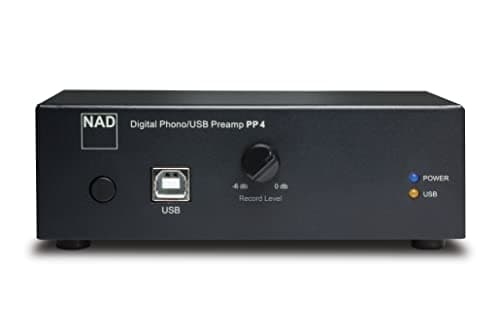 NAD PP 4 The only USB phono stage here with a moving-coil position, a published RIAA tolerance and a noise figure that says what it is referenced to — and the one whose spec table has a distortion row with nothing printed beside it. | Most published about the stage | 7.4 | |
| 2 | 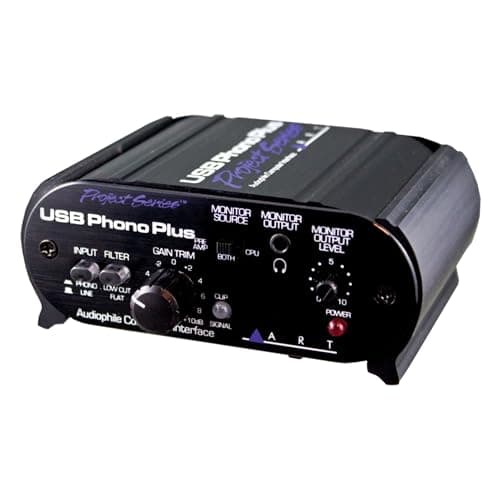 ART USB Phono Plus PS The one box on this page built around the act of recording: a gain trim with a clip LED, a low-cut filter with a published corner, a zero-latency monitor output, and a line out that stays live so it works as a plain phono stage the rest of the week. | Best for actually recording | 7.8 | |
| 3 | 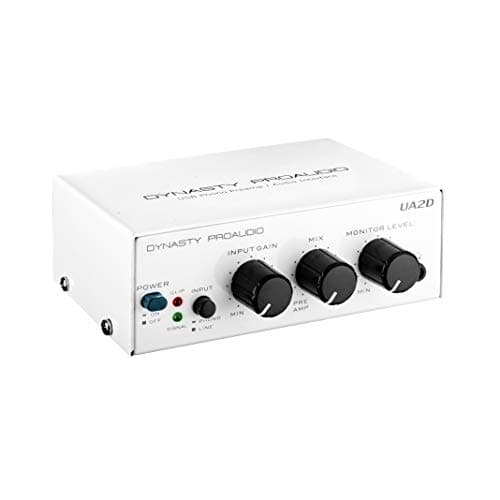 Dynasty ProAudio UA2D A cheaper box whose published figures track the ART's line for line — same 40 mV input ceiling, same +19 dBu line figure, same 16-bit converter — minus the two rows that describe the phono stage itself. | Cheapest with a preamp line out | 6.5 | |
| 4 | 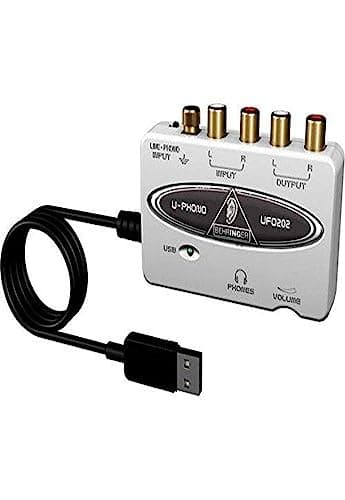 Behringer U-PHONO UFO202 The cheapest USB phono interface we can verify, with a proper converter spec table — and a phono stage Behringer publishes nothing about: no gain, no loading, no filter, and no level control on the box. | Cheapest way to get a record into a computer | 5.6 | $47.00View on Amazon $49.996% off |
| 5 | 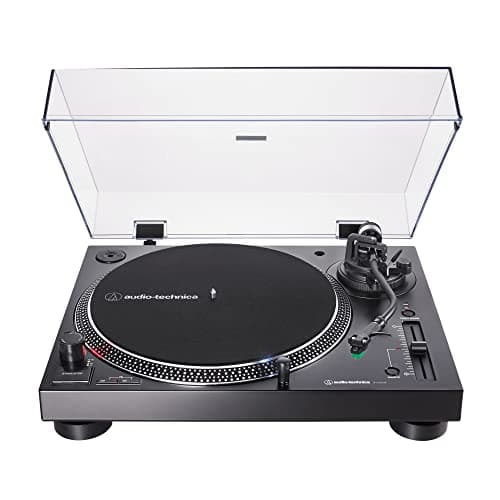 Audio-Technica AT-LP120XUSB A direct-drive deck with a switchable phono stage and USB out, which means it works with any amplifier you already own and needs nothing else on day one. | Best overall under $500 | 8.6 | $349.00View on Amazon $399.0013% off |
A phono preamp with a USB output is two things in one box: a phono stage that lifts the cartridge’s few millivolts to line level and applies the RIAA curve, and an analog-to-digital converter that sends the result to a computer. Our digitizing guide describes that as route 2 — a separate stage into a separate converter — and stops short of naming hardware. This page is the hardware: four boxes we could verify as purchasable, and the one turntable in our registry that makes the box unnecessary.
The first thing the research turned up is the thing that decides how this page is ranked. Every converter here is 16-bit, and none goes above 48 kHz. NAD publishes 16-bit at 48 kHz. ART publishes 16-bit at 44.1 or 48 kHz. Dynasty ProAudio publishes 16-bit at 44.1 or 48 kHz. Behringer publishes 16-bit at 32, 44.1 or 48 kHz. The Audio-Technica AT-LP120XUSB’s built-in USB output is 16-bit at 44.1 or 48 kHz. That is one ceiling, shared by the cheapest interface here and one costing several times as much, and it is the same ceiling the digitizing guide already showed sits about 29 dB above the noise floor of the quietest turntable we can cite. So the converter is not the reason to pick one of these over another. The phono stage is.
What to look for in a USB phono stage
What the maker publishes about the stage itself. Gain, input impedance and capacitance, a noise figure with its reference stated, an RIAA tolerance, an overload figure. These are the numbers that say whether your cartridge will be loaded correctly and how much of the record’s dynamic range survives the stage. NAD publishes all of them. ART publishes gain, loading, a maximum input level and a noise figure referenced to clipping. Dynasty publishes the input level and the noise figure but no gain and no loading. Behringer’s specification table has a Line In section and no Phono In section at all. That spread is the ranking.
A subsonic filter with a published corner. Warped records produce large sub-20 Hz swings that eat digital headroom and force you to record quieter. A filter that removes them is the single most useful feature for digitizing, and it only counts if the maker says where it acts. ART publishes a switchable low-cut at −3 dB, 22 Hz. NAD publishes an infrasonic filter as −14 dB at 5 Hz, with no slope, which means its effect at 20 Hz cannot be worked out from the figure given. Dynasty and Behringer publish no filter.
A level control on the box, with a clip indicator. Digital clipping is a hard limit; a clipped transient means recording the side again. The ART has a −10 to +10 dB gain trim and a signal/clip LED in front of the converter. NAD publishes a record level control with a 0 to −6 dB range. Behringer has no control on the unit, and its manual tells you to set the recording program’s input sensitivity instead — which is after the converter, where a clipped signal is already clipped.
A line output that stays live.The box will be a USB interface for a few weekends and a phono stage for years. ART states its preamp line out is “always connected to the input preamp signal”; Dynasty states its line out “can be used as a stand-alone Phono Preamp”; NAD publishes a line output impedance of 100 Ω and runs from an external supply, so it does not need a computer to be powered. Behringer’s line out has a published impedance and level, but the manual does not say whether it carries the phono signal with no computer attached, and the box has no power input other than USB.
Moving-coil support, if you need it.One box here has it. The NAD PP 4 publishes 58 dB of gain into 100 Ω for MC. Behringer states moving magnet only; Dynasty states moving magnet; ART’s manual never says either, though its 47 kΩ / 100 pF loading and 45 dB ceiling are moving-magnet figures. If your cartridge is a moving coil, our MM vs MC explainer covers why the gain difference is not optional.
How the ranking works
Published phono-stage data first; a filter with a stated corner second; a level control before the converter third; stand-alone use and how the box is powered fourth; moving-coil support fifth. Price does not move the order, which is why a box costing several times as much ranks above one that we would, for most moving-magnet owners, tell you to buy instead — that recommendation is at the end of the page, and it is made on price, not on the criteria. The converter does not appear in the list at all, because it is the same on every unit.
| Unit | Published phono gain | Cartridge | Subsonic filter | Level control on box | Converter |
|---|---|---|---|---|---|
| NAD PP 4 | 35 dB MM / 58 dB MC | MM and MC | −14 dB at 5 Hz (no slope) | 0 to −6 dB | 16-bit, 48 kHz |
| ART USB Phono Plus PS | 45 dB max, ±10 dB trim | Not stated (MM figures) | −3 dB at 22 Hz, switchable | −10 to +10 dB, clip LED | 16-bit, 44.1 / 48 kHz |
| Dynasty ProAudio UA2D | Not published | MM | Not published | Not published | 16-bit, 44.1 / 48 kHz |
| Behringer U-PHONO UFO202 | Not published | MM only | Not published | None | 16-bit, 32 / 44.1 / 48 kHz |
| Audio-Technica AT-LP120XUSB (deck) | 36 dB nominal | MM (supplied AT-VM95E) | Not published | None | 16-bit, 44.1 / 48 kHz |
16-bit theoretical dynamic range = 6.02 × 16 + 1.76 = 98.1 dB
Inputs
- NAD PP 4 signal-to-noise, MM, A-weighted, with cartridge connected: 76 dB (NAD spec page)
- NAD PP 4 USB output: 16-bit linear PCM, 48 kHz (NAD spec page)
- AT-LP120XUSB USB output format: 16-bit, 44.1 or 48 kHz, USB 1.1 (Audio-Technica user manual (PDF))
Result
The stage with everything written down, and one row left blank
The NAD PP 4 publishes 35 dB of gain for moving magnet and 58 dB for moving coil at 1 kHz, loading of 47 kΩ + 200 pF and 100 Ω + 180 pF respectively, input sensitivity of 5 mV and 0.38 mV for a 200 mV output, signal-to-noise of 76 and 78 dB A-weighted with the cartridge connected, input overload at three frequencies, RIAA accuracy of ±0.3 dB, dynamic range of 89 and 86 dB, and a record level control from 0 to −6 dB. It also has a separate line input with its own published loading for cassette transfers, so tape never goes through the phono stage. It ranks first because it is the only unit on the page whose noise figure states what it is referenced to and how it is weighted, the only one with a published RIAA tolerance, and the only one with an MC position.
Its cons are real. The USB output is 48 kHz only, so a CD-rate file means resampling on the computer. The infrasonic filter is published as −14 dB at 5 Hz with no slope and no corner, so we cannot say what it does at 20 Hz. The row on NAD’s own spec table labeled “Rated Distortion (THD 20Hz – 20kHz)” has no value beside it, for MM or MC — a heading with nothing under it. There is no headphone or monitor output. No weight is published. And it costs four to eight times what the other boxes here do, for the same 16-bit converter. What that money buys is documentation and a moving-coil position, and if you need neither, the next pick is the one to read.
The box built around the act of recording
The ART USB Phono Plus PS publishes 45 dB of maximum phono gain with a front-panel trim of −10 to +10 dB and a signal/clip LED, 47 kΩ / 100 pF loading, a 40 mV rms maximum phono input, THD below 0.01% at 1 kHz, a switchable low-cut filter at −3 dB, 22 Hz, a monitor output with a preamp / computer / both switch for zero-latency listening, TOSLINK and coaxial digital inputs to USB, and a preamp line out that the manual says is “always connected to the input preamp signal”. It runs on USB bus power or an optional external 7–12 V supply that overrides the bus. It ranks second because it publishes less about the stage than NAD does — no RIAA tolerance, no overload figure at 20 Hz or 20 kHz, and a noise figure referenced to clipping rather than to a cartridge level — and first on every criterion after that: the only filter with a published corner, the only trim with a clip LED in front of the converter, and a line out with a documented always-on path.
Three things in its manual deserve flagging. The frequency response is printed as “10 Hz – 50 kHz, +/- 0.5%” — a percentage tolerance on a frequency response, which is not a convention we know how to convert to decibels, so we quote it as printed and use it for nothing. The manual never says moving magnet or moving coil; the loading and gain are MM figures and we treat it as an MM stage. And the digital inputs go only to the computer — the manual’s own FAQ says they cannot be converted to analog — so the optical and coaxial sockets make it a second interface for a CD transport or a TV, not a DAC.
headroom (dB) = 20 × log10(V_max ÷ V_cartridge)
Inputs
- AT-VM95E output (supplied on the AT-LP120XUSB and AT-LP70X): 4.0 mV (1 kHz, 5 cm/sec) (Audio-Technica spec page)
- NAD PP 4 input overload, MM, 1 kHz: 100 mV (NAD spec page)
- ART USB Phono Plus PS maximum input level, phono, 1 kHz: 40 mV rms (ART user's manual (PDF))
Result
The same figures as the ART, minus the two that describe the stage
The Dynasty ProAudio UA2D publishes a 40 mV rms maximum phono input at 1 kHz, +19 dBu on the line input, hum and noise greater than 89 dB below clipping, THD of 0.01% at 1 kHz, a 10 Hz – 20 kHz ±0.5 dB response, a 16-bit converter at 44.1 or 48 kHz, an RCA preamp line out that the maker states can be used as a stand-alone phono stage, and a monitor/headphone mini-jack. Read beside ART’s table those figures track it line for line, one decibel apart on noise. What is missing is the gain and the loading — the two rows that say what the stage does to the cartridge — and any mention of a filter. It ranks third: above Behringer because it publishes a phono input ceiling, a noise figure and a stand-alone claim for the line out, and below ART because it publishes nothing about gain or impedance and has no documented control on the box. Amazon returned a price but no availability string when we resolved it; the maker’s own store listed it in stock the same day.
The cheapest way in, and the stage nobody described
The Behringer U-PHONO UFO202 publishes a proper converter table: 16-bit at 32, 44.1 or 48 kHz, A/D signal-to-noise of 89 dB and D/A of 96 dB at 1 kHz A-weighted, THD of 0.05% at −10 dBV, crosstalk of −77 dB, and a ±1 dB frequency response at each sample rate. It runs from USB bus power alone, weighs about 100 g, has a ground screw and a headphone output, and costs less than anything else on the page. It ranks fourth because the table that describes the converter so carefully has no phono section: no gain, no input impedance, no capacitance, no RIAA figure and no filter. The manual’s only statement about the stage is that it supports moving-magnet cartridges. There is no level control on the unit; the instruction is to adjust the recording program’s input sensitivity, which is on the far side of the converter. USB is 1.1 on a captive cable. And while the RCA line out has a published 400 Ω impedance and 2 dBV maximum, Behringer does not say whether it carries the phono signal with nothing on the USB end, so we cannot tell you it works as a stand-alone stage.
The live listing is Behringer’s own UFO202-BK SKU, which Behringer titles a “Vinyl Recording Bundle” — the unit with its bundled software, not a third-party kit. We name it because “bundle” in a listing title usually means something else.
The turntable that makes the box unnecessary
The Audio-Technica AT-LP120XUSB is ranked outside the criteria above, because it is not a phono preamp. It is here because it answers the question a reader of this page is actually asking — how do I get a record into a computer — without buying a second box. Its manual publishes a switchable 36 dB nominal phono stage and a USB output at 16-bit, 44.1 or 48 kHz over USB 1.1: the same ceiling as every stage on this page, on a deck with a removable headshell and an AT-VM95E on it. What it lacks is everything the boxes above compete on: no filter, no level control, no published noise figure for the stage alone (Audio-Technica publishes 50 dB for the deck), and no moving-coil position. Our full review covers the deck; the honest summary for this page is that if you are buying a turntable anyway and digitizing is an occasional need, the built-in USB output makes every box here optional. If you already own a deck you like, it does not.
Why the noise figures on this page cannot be lined up
NAD publishes 76 dB A-weighted with the cartridge connected, which is a figure referenced to the input — to a 5 mV cartridge signal. ART and Dynasty publish noise as more than 90 and 89 dB “below clipping”, which is referenced to the output ceiling. Behringer publishes 89 dB for the converter and nothing for the stage. Three references, three different questions. A clipping-referenced figure is always the larger number, because it measures down from the loudest signal the stage can pass rather than up from the quiet one a cartridge actually delivers; on the ART, with a 40 mV input ceiling and a 4 mV cartridge, roughly 20 dB of that 90 dB is headroom the record never uses. We publish each figure as its maker states it and rank NAD’s above the others not because 76 is bigger than 90 — it is not — but because it is the only one that can be checked against the cartridge you own.
Three we could not include
The Pro-Ject Record Box E is still on Pro-Ject’s site with a full specification — 40 dB MM and 60 dB MC, a 16-bit Burr-Brown converter at 32, 44.1 or 48 kHz, 94 dB A-weighted noise for MM — and on published data it would have ranked first or second. Every Amazon listing we could find for it, four ASINs, returned “Currently unavailable” on 2026-09-20, and we do not ship a buy button that cannot exist. The Rega Fono Mini A2D MK2 publishes 16-bit at 44.1 kHz (48 kHz maximum) and a 78 dBA noise figure, and has no Amazon listing at all; the only hits are third-party power adapters “compatible with” it. The Reloop iPhono 2 was live at Amazon on the same day and is marked “This Product is discontinued” on Reloop’s own page, with a specification that lists a 16-bit converter and no sample rate, no gain and no noise figure. Two units in stock of a product its maker has ended is not a pick.
What we would buy
For a moving-magnet cartridge, the ART USB Phono Plus PS. It publishes the loading, the gain and the input ceiling, it is the only box with a filter that says where it acts and a trim that lets you set the level before the converter, and its line out is documented as always live. It ranks second on the criteria and first on price for what it publishes. For a moving-coil cartridge, or if a published RIAA tolerance and an input-referenced noise figure are what you are paying for, the NAD PP 4 — knowing that its files will be 48 kHz and that its own distortion row is blank. If the budget is the Behringer and nothing else, it will put a record into a computer; you will just be doing it with a stage nobody has described and a level control you do not have. And if the deck is not bought yet, the AT-LP120XUSB on our under-$500 page gives you the same 16-bit ceiling with no second box at all. Whichever route, the settings that matter — level, sample rate, no noise reduction on the way in — are in the digitizing guide, and the stages with no USB output at all are ranked on the under-$200 phono preamp page.
Every pick in detail
Every specification below links to the manufacturer document we read it from. Where a manufacturer does not publish a figure, we say so rather than estimating it.
NAD PP 4
Most published about the stagePrice as of September 20, 2026. #ad
The only USB phono stage here with a moving-coil position, a published RIAA tolerance and a noise figure that says what it is referenced to — and the one whose spec table has a distortion row with nothing printed beside it.
- flexibility
- 8/10
- noise
- 8/10
- value for money
- 5/10
- build quality
- 8/10
- connectivity
- 7/10
| Specification | Published value | Source |
|---|---|---|
| Gain (1 kHz) | 35 dB (MM), 58 dB (MC) | NAD spec page |
| Cartridge support | MM and MC — the only box on this page with a moving-coil position | NAD spec page |
| Loading | MM: 47 kΩ + 200 pF. MC: 100 Ω + 180 pF. Neither is adjustable. | NAD spec page |
| Input sensitivity (ref. 200 mV output) | 5 mV (MM), 0.38 mV (MC) | NAD spec page |
| Signal-to-noise | 76 dB (MM), 78 dB (MC) — A-weighted, with cartridge connected. The only noise figure on this page that states its reference and its weighting. | NAD spec page |
| Input overload (20 Hz / 1 kHz / 20 kHz) | MM: 10 / 100 / 900 mV. MC: 0.65 / 6.5 / 60 mV. | NAD spec page |
| THD | The row “Rated Distortion (THD 20Hz – 20kHz)” is printed on NAD's own spec table with no value beside it, for both MM and MC. | NAD spec page |
| RIAA accuracy | ± 0.3 dB — the only RIAA tolerance published on this page | NAD spec page |
| Subsonic filter | Infrasonic filter, −14 dB at 5 Hz. No slope and no −3 dB corner are published, so its effect at 20 Hz cannot be calculated. | NAD spec page |
| USB output | 16-bit linear PCM at 48 kHz. 44.1 kHz is not listed — a CD-rate file means resampling on the computer. | NAD spec page |
| Dynamic range | 89 dB (MM), 86 dB (MC) | NAD spec page |
| Record level control | 0 dB to −6 dB | NAD spec page |
| Line input | 47 kΩ + 180 pF, 5.3 V maximum — for cassette decks and other line sources | NAD spec page |
| Line output | 100 Ω, 5.3 V maximum — RCA, usable as a stand-alone phono stage | NAD spec page |
| Headphone / monitor output | Not published | — |
| Power | External supply — NAD describes an energy-efficient “green” supply with auto power-down; no voltage or current figure is in the spec table | NAD product page |
| Dimensions (W × H × D) | 135 × 49 × 72 mm (5 5⁄16 × 1 15⁄16 × 2 7⁄8 in), excluding the power supply | NAD spec page |
| Weight | Not published | — |
Pros
- MM and MC on one box — 35 dB and 58 dB — where every other unit here is moving-magnet only or does not say
- Publishes RIAA accuracy (± 0.3 dB), input overload at three frequencies, sensitivity and a signal-to-noise figure that names its weighting and its reference
- A separate line input with its own published loading, so cassette transfers do not go through the phono stage
- A stand-alone RCA line output with a published 100 Ω source impedance
Cons
- Four to eight times the price of the other boxes for the same 16-bit converter
- USB runs at 48 kHz only — no 44.1 kHz — so a CD-rate file means resampling on the computer
- The “Rated Distortion (THD 20Hz – 20kHz)” row on NAD's own spec table is printed with no value
- The infrasonic filter is published as −14 dB at 5 Hz with no slope, so what it does at 20 Hz cannot be worked out
- No headphone or monitor output, and no weight published
- Two left in stock at the time of writing
Skip it if you own a moving-magnet cartridge and want files at 44.1 kHz. You would be paying for an MC position you will not use and resampling every file you make.
ART USB Phono Plus PS
Best for actually recordingPrice as of September 20, 2026. #ad
The one box on this page built around the act of recording: a gain trim with a clip LED, a low-cut filter with a published corner, a zero-latency monitor output, and a line out that stays live so it works as a plain phono stage the rest of the week.
- flexibility
- 7/10
- noise
- 7/10
- value for money
- 9/10
- build quality
- 7/10
- connectivity
- 9/10
| Specification | Published value | Source |
|---|---|---|
| Gain (1 kHz) | Maximum 45 dB (phono), 6 dB (line); front-panel gain trim −10 to +10 dB | ART user's manual (PDF) |
| Cartridge support | Not stated. 47 kΩ / 100 pF loading and 45 dB maximum gain are moving-magnet figures; the manual never mentions moving coil. | ART user's manual (PDF) |
| Loading | 47 kΩ / 100 pF (phono), 270 kΩ (line). Not adjustable. | ART user's manual (PDF) |
| Maximum input level | 40 mV rms at 1 kHz (phono), +19 dBu (line) | ART user's manual (PDF) |
| Hum and noise | > 90 dB below clipping. ART references noise to the clipping point, not to a cartridge input level, so this is not comparable with NAD's 76 dB. | ART user's manual (PDF) |
| THD | < 0.01% typical at 1 kHz | ART user's manual (PDF) |
| Frequency response | 10 Hz – 50 kHz, “+/- 0.5%” as printed — a percentage tolerance on a frequency response, which is not a convention we can convert to dB | ART user's manual (PDF) |
| Subsonic filter | Yes — switchable high-pass (LOW CUT), −3 dB at 22 Hz. The only filter on this page with a published corner frequency. | ART user's manual (PDF) |
| A/D and D/A | 16-bit, 44.1 or 48 kHz, selected from the computer; 0.4 ms A/D latency at 44.1 kHz | ART user's manual (PDF) |
| USB | USB 2.0 compliant, class compliant (no driver); asynchronous mode for recording, adaptive for playback | ART user's manual (PDF) |
| Digital inputs and outputs | TOSLINK in to USB, S/PDIF coaxial in to USB, TOSLINK out from USB. Digital inputs pass only to the computer — the manual states they cannot be converted to analog. | ART user's manual (PDF) |
| Analog outputs | RCA preamp line out, “always connected to the input preamp signal” — usable as a stand-alone phono stage; 1⁄8 in monitor/headphone out, +6 dBu (1.4 V rms) maximum | ART user's manual (PDF) |
| Monitoring | Three-position source switch — preamp (zero latency), computer, or both — with its own level control | ART user's manual (PDF) |
| Power | USB bus powered, or an optional external 7–12 V DC / 9–12 V AC supply at 150 mA (not included). External power overrides bus power. | ART user's manual (PDF) |
| Dimensions (H × W × D) | 1.85 × 4.6 × 4.5 in (47 × 117 × 114 mm) | ART user's manual (PDF) |
| Weight | 1.35 lb (0.61 kg) | ART user's manual (PDF) |
Pros
- 45 dB maximum gain with a −10 to +10 dB front-panel trim and a signal/clip LED — the only unit here that lets you set the level before the converter, on the box
- Switchable low-cut filter with a published corner: −3 dB at 22 Hz
- Preamp line out is “always connected to the input preamp signal”, so it is a stand-alone phono stage with no computer attached
- Zero-latency monitor/headphone output with a preamp / computer / both switch
- Optical and coaxial digital inputs to USB — a second use for the box once the records are done
- USB bus powered, with an optional external supply that overrides the bus
Cons
- Noise is published relative to clipping (> 90 dB below), not to a cartridge input level — it cannot be set beside NAD's 76 dB
- The frequency-response tolerance is printed as a percentage, which is not a convention we can convert
- The manual never says moving magnet or moving coil; the 47 kΩ / 100 pF loading and 45 dB ceiling are MM figures
- Loading is fixed; no capacitance or resistance options
- The external supply is optional and not in the box
Skip it if your cartridge is a moving coil. Nothing on this box is documented for one, and the NAD PP 4 is the only USB stage here that is.
Dynasty ProAudio UA2D
Cheapest with a preamp line outPrice as of September 20, 2026. #ad
A cheaper box whose published figures track the ART's line for line — same 40 mV input ceiling, same +19 dBu line figure, same 16-bit converter — minus the two rows that describe the phono stage itself.
- flexibility
- 5/10
- noise
- 6/10
- value for money
- 8/10
- build quality
- 6/10
- connectivity
- 7/10
| Specification | Published value | Source |
|---|---|---|
| Gain | Not published | — |
| Cartridge support | Moving magnet | Dynasty ProAudio product page |
| Loading (input impedance / capacitance) | Not published | — |
| Maximum input level | 40 mV rms at 1 kHz (phono), +19 dBu (line) — the same two figures ART publishes | Dynasty ProAudio product page |
| Hum and noise | > 89 dB below clipping (referenced to clipping, as ART's is) | Dynasty ProAudio product page |
| THD | 0.01% typical at 1 kHz | Dynasty ProAudio product page |
| Frequency response | 10 Hz – 20 kHz, ± 0.5 dB | Dynasty ProAudio product page |
| Subsonic filter | Not published | — |
| A/D and D/A | 16-bit, 44.1 or 48 kHz, USB selectable | Dynasty ProAudio product page |
| USB | “USB 2.0 compliant” | Dynasty ProAudio product page |
| Analog outputs | RCA preamp line output — the maker states it “can be used as a stand-alone Phono Preamp”; 1⁄8 in mini-jack USB monitor/headphone output | Dynasty ProAudio product page |
| Level control | Not published | — |
| Power | Not published | — |
| Dimensions (L × W × H) | 113 × 73 × 40 mm | Dynasty ProAudio product page |
| Weight | 0.22 kg | Dynasty ProAudio product page |
Pros
- Publishes a maximum phono input level (40 mV rms), THD and a noise figure — more than Behringer publishes about its phono path
- RCA preamp line out that the maker states can be used as a stand-alone phono stage
- 1⁄8 in monitor/headphone output
- In stock at the maker's own store as well as at Amazon
Cons
- No gain figure, no input impedance and no capacitance published — the two numbers that say whether a cartridge is loaded correctly
- No subsonic filter published, and no filter mentioned
- Noise is referenced to clipping, as ART's is, so it cannot be compared with a stage that references its input
- No power figure published; the maker's page lists only “USB cables included”
- Amazon's listing returned a price but no availability string when we resolved it
Skip it if you want to know what the stage is doing to your cartridge. It publishes no loading and no gain, and the ART costs a little more and publishes both.
Behringer U-PHONO UFO202
Cheapest way to get a record into a computerThe cheapest USB phono interface we can verify, with a proper converter spec table — and a phono stage Behringer publishes nothing about: no gain, no loading, no filter, and no level control on the box.
- flexibility
- 3/10
- noise
- 6/10
- value for money
- 8/10
- build quality
- 5/10
- connectivity
- 5/10
| Specification | Published value | Source |
|---|---|---|
| Gain | Not published. Behringer's specification table has a Line In section and no Phono In section at all — no gain, no input impedance, no RIAA figure for the phono stage. | Behringer user manual (PDF) |
| Cartridge support | Moving magnet only — “The PHONO inputs only support moving magnet cartridges” | Behringer user manual (PDF) |
| Loading (phono input impedance / capacitance) | Not published | — |
| Line input | RCA, unbalanced; approx. 27 kΩ; 2 dBV maximum | Behringer user manual (PDF) |
| Signal-to-noise | A/D 89 dB typical, D/A 96 dB typical — at 1 kHz, A-weighted. These are converter figures, not phono-stage figures. | Behringer user manual (PDF) |
| THD | 0.05% typical at −10 dBV, 1 kHz | Behringer user manual (PDF) |
| Crosstalk | −77 dB at 0 dBV, 1 kHz | Behringer user manual (PDF) |
| Frequency response | 10 Hz – 20 kHz ± 1 dB at 44.1 kHz; 10 Hz – 22 kHz ± 1 dB at 48 kHz | Behringer user manual (PDF) |
| Subsonic filter | Not published | — |
| Converter | 16-bit; 32, 44.1 or 48 kHz | Behringer user manual (PDF) |
| USB | USB 1.1, type A connector on an attached cable | Behringer user manual (PDF) |
| Level control | None on the unit. The manual's instruction is to “adjust the input sensitivity of the recording program”. | Behringer user manual (PDF) |
| Analog outputs | RCA line out, approx. 400 Ω, 2 dBV maximum; 1⁄8 in TRS headphone out, approx. 50 Ω, −2 dBu (2 × 3.7 mW into 100 Ω). Behringer does not state whether the line out carries the phono stage's signal with no computer connected. | Behringer user manual (PDF) |
| Power | USB bus only — 5 V, 100 mA maximum. No external power input. | Behringer user manual (PDF) |
| Dimensions (H × W × D) | approx. 22 × 88 × 60 mm (0.9 × 3.5 × 2.4 in) | Behringer user manual (PDF) |
| Weight | approx. 0.10 kg (0.2 lb) | Behringer user manual (PDF) |
| Sold as | The live listing is Behringer's UFO202-BK (black) SKU, which Behringer titles a “Vinyl Recording Bundle” — the unit with its bundled software, not a third-party kit | Behringer product page |
Pros
- The lowest price on this page by a wide margin
- The only unit here that publishes the converter's own signal-to-noise with a weighting (A/D 89 dB, A-weighted) plus THD at a stated level, crosstalk and a ± 1 dB frequency response
- Runs on USB bus power alone; nothing else to plug in
- Ground screw and a headphone output, on a box that weighs 100 g
Cons
- Behringer's specification table has a Line In section and no Phono In section — the phono stage has no published gain, impedance, capacitance or RIAA figure
- Moving magnet only, by the manual's own note
- No level control on the unit; the manual's instruction is to set the recording program's input sensitivity
- USB 1.1 on a captive cable
- Behringer does not state whether the line outputs carry the phono signal with no computer attached, so stand-alone use is unverified
- The live listing is the UFO202-BK SKU, titled by Behringer as a “Vinyl Recording Bundle”
Skip it if you need to set a recording level at the box, or you want to know what the phono stage is doing. Neither is published.
Audio-Technica AT-LP120XUSB
Best overall under $500A direct-drive deck with a switchable phono stage and USB out, which means it works with any amplifier you already own and needs nothing else on day one.
- specs
- 8/10
- upgrade path
- 9/10
- value for money
- 9/10
- ease of setup
- 7/10
- connectivity
- 10/10
| Specification | Published value | Source |
|---|---|---|
| Drive type | Direct drive (DC servo motor) | Audio-Technica manual (PDF) |
| Wow and flutter | < 0.2% WRMS (33 rpm) at 3 kHz | Audio-Technica manual (PDF) |
| Signal-to-noise | > 50 dB | Audio-Technica manual (PDF) |
| Speeds | 33⅓, 45, 78 rpm | Audio-Technica manual (PDF) |
| Cartridge included | AT-VM95E (VM type) on an AT-HS6 headshell | Audio-Technica manual (PDF) |
| Tonearm effective mass | Not published | — |
| Built-in phono stage | Yes — switchable PHONO/LINE, 36 dB nominal gain, RIAA equalized | Audio-Technica manual (PDF) |
| USB output | Yes — 16-bit, 44.1 or 48 kHz selectable, USB 1.1 | Audio-Technica manual (PDF) |
| Tracking force | Arm adjusts 0–4 g; the included AT-VM95E tracks 1.8–2.2 g (2.0 g standard) | Audio-Technica manual (PDF) |
Pros
- Switchable built-in phono stage — works with an amp that has no phono input
- Direct drive, so speed is locked without a belt to stretch or replace
- USB output for digitizing records without a separate interface
- Adjustable tracking force, anti-skate and a removable headshell
Cons
- Heavier and larger than the belt-drive decks in this bracket
- The bundled AT-VM95E is a competent cartridge, not an endgame one
- Removable headshell adds a mechanical joint some purists avoid
Skip it if you want the smallest possible footprint, or you already own a good phono stage and would rather put the money into the cartridge.
Frequently asked questions
What is a phono preamp with a USB output?
Do I need a phono preamp with USB, or can I use my turntable's USB output?
What resolution do USB phono preamps record at?
Which USB phono preamp supports moving-coil cartridges?
Which one has a subsonic filter?
Can I use a USB phono preamp without a computer?
Why is the Pro-Ject Record Box E not on this page?
Have you listened to or recorded with any of these?
Read next
How to Digitize Vinyl Records
USB deck, external ADC, or streamer — and why the USB route tops out at 16-bit/44.1 kHz per Audio-Technica's own manual.
The Best Phono Preamps Under $200
Phono stages under $200 ranked on published gain, loading flexibility and noise — including one we would actively skip.
Do I Need a Phono Preamp?
Yes, unless you already have one — and it might be hiding in your turntable, amplifier or speakers. Check in 30 seconds.
Audio-Technica AT-LP120XUSB Review
Direct drive, a switchable 36 dB phono stage, USB and 78 rpm — reviewed against Audio-Technica's own manual.
Hi-Res Audio Explained
24-bit implies 146 dB of dynamic range; the best published DAC figure here is 126 dB, or about 20.6 bits. The arithmetic, and what it means.
Moving Magnet vs Moving Coil Cartridges
The whole MM/MC argument reduces to output voltage — and Schiit's own published noise figures show exactly what the extra gain costs.
Sources
Every specification on this page was read from one of these documents. If one of them has changed, or we have made an error, tell us — corrections are logged and dated per our editorial policy.
- NAD PP 4 — product page and specification table
- ART USB Phono Plus Project Series — user's manual (PDF). artproaudio.com returned a Cloudflare challenge from our network; the same document was read from the Internet Archive's 2024-12-05 capture.
- ART USB Phono Plus Project Series — user's manual, Internet Archive capture (2024-12-05)
- Dynasty ProAudio UA2D — product page and specifications
- Behringer U-PHONO UFO202 — user manual (PDF)
- Behringer UFO202 — product page
- Audio-Technica AT-LP120XUSB — user manual (PDF)
- Audio-Technica AT-VM95E — specifications
- Pro-Ject Record Box E — product page (not included: no live Amazon listing)
- Rega Fono Mini A2D — product page (not included: no Amazon listing)
- Reloop iPhono 2 — product page (not included: marked discontinued by Reloop)