Fluance RT85 Review
Most of what you are paying for on this deck is bolted to the end of the tonearm — and the sticker price is missing a component you still have to buy.
Disclosure: we earn a commission if you buy through the links on this page, at no extra cost to you. It does not influence what we pick — our criteria are published and reproducible, so you can check our work. How we pick · Full disclosure
These picks are spec-and-price analyses, not listening tests. We have not heard this gear and we do not pretend to have: every figure below is sourced to the manufacturer and linked, and every price is live or not shown at all. Here are the rules we followed.
Quick picks
Ranked on the published criteria in How We Pick. Prices are live as of October 14, 2026. Tap any row for the full write-up.
- 8.4
| # | Product | Best for | Score | Price |
|---|---|---|---|---|
| 1 | 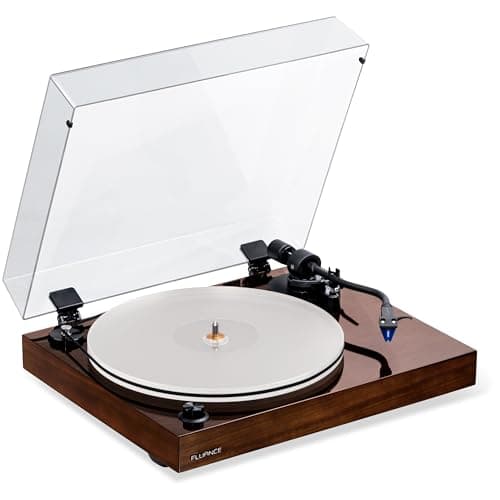 Fluance RT85 An acrylic platter and an Ortofon 2M Blue — the cartridge alone accounts for a large share of the price, which is the right place for the money to go. | Best overall under $1,000 | 8.4 |
We have not heard this turntable, and this review does not pretend to. What follows is what Fluance publishes, what it means, and what the price tag is quietly leaving out.
Start with the honest framing: a substantial share of the RT85’s price is the Ortofon 2M Blue on the end of the arm. That is not a criticism. It is the correct place for the money to go, because the cartridge is the transducer and the transducer is where the information enters the system. But it does mean this deck should be judged as a cartridge with a turntable attached, rather than the other way round.
The 2M Blue, and why it is the story
Ortofon publishes the 2M Blue at 5.5 mV output, 25 dB channel separation at 1 kHz, a frequency response of 20–20,000 Hz at +2/−1 dB, and 80 µm tracking ability at 315 Hz. The stylus is a nude elliptical — the whole tip is diamond rather than a chip bonded to a metal carrier.
Compare that to the 2M Red, which Fluance’s cheaper decks and the Pro-Ject Debut Carbon EVO ship: same body, same 5.5 mV, same 20 µm/mN compliance, but 22 dB separation, +3/−1 dB response, 70 µm tracking ability and a bonded stylus. The Blue is the same generator with a better diamond and tighter tolerances, and Ortofon publishes every one of those differences.
This has a consequence worth planning around: the 2M Blue’s stylus is the expensive consumable in this system. When it wears, replacing it costs a meaningful fraction of the deck. That is normal for a cartridge at this level, and it is a running cost that the decks in the under-$500 bracket largely do not have.
The acrylic platter
Fluance fits an acrylic platter, and it does two things a steel platter does not.
It damps rather than rings — acrylic has a much less resonant character than a thin steel disc, which is why steel platters are almost always sold with a felt or rubber mat on top. And its acoustic impedance is closer to vinyl’s, which is the usual argument for running a record directly on acrylic with no mat at all.
We can report that Fluance fits one and that Fluance publishes a measured 0.07% wow and flutter and a 69 dB weighted signal-to-noise ratio for this deck. We cannot tell you how much of that figure the platter is responsible for, and neither can anyone else without a controlled comparison.
The number that is missing from the price
Fluance states it plainly on their own spec sheet: “Separate Phono Preamp Required”. There is no built-in stage.
So the real cost of owning an RT85 is the deck plus a phono stage, unless your amplifier has a PHONO input — and if you are unsure, the 30-second check is here. In practice that is another $50 to $250 depending on how far you want to go; our phono stage roundup covers the range.
We think the omission is the right call at this price. A built-in stage on a deck of this caliber would be a compromise circuit sitting next to a $250 cartridge, and the buyer for this deck is very likely to bypass it. But it does mean a straight sticker-price comparison against a deck with a stage built in is not comparing the same purchase.
The tonearm mass figure, and our caution about it
Fluance publishes “0.97 oz (27.5 g)” under tonearm effective mass, and they deserve credit for publishing anything at all — Audio-Technica publishes nothing under that heading on any deck.
But we do not trust the number, and we would rather say so than quietly compute a resonance figure on it. Effective mass figures for arms of this type normally land between 8 and 14 g. 27.5 g is roughly double the top of that range, which suggests Fluance may be publishing total arm mass rather than effective mass — a different quantity that happens to share a label. Pro-Ject, for comparison, publishes 6.0 g for the Debut Carbon EVO’s arm.
If the figure is total mass, the resonance arithmetic on our matching page cannot be run on this deck either. We are not accusing Fluance of anything; we are telling you the number does not behave like the number it is labeled as, and that you should not build a cartridge decision on it.
Who should skip it
Anyone whose total budget is the deck price. Add the phono stage and, if you do not own them, speakers and an amplifier, and the RT85 is the smallest line item in a much larger bill.
Anyone who wants USB or automatic operation. This deck has neither. It is manual — you cue the arm and lift it at the end of the side.
And anyone who changes cartridges frequently for the fun of it. The 2M Blue that comes fitted is good enough that swapping it out is a step sideways, and the money is already spent.
The verdict
The RT85 spends its budget in the right order: cartridge first, platter second, features last. If you already own an amplifier with a phono input, or you have budgeted for a separate stage, it is the deck in its bracket we would choose on published specifications.
If you have not budgeted for the phono stage, budget for it now — and note that the money you would spend adding one to an RT85 is roughly the difference between this deck and a cheaper one with a stage inside.
Every pick in detail
Every specification below links to the manufacturer document we read it from. Where a manufacturer does not publish a figure, we say so rather than estimating it.
Fluance RT85
Best overall under $1,000Price as of October 14, 2026. #ad
An acrylic platter and an Ortofon 2M Blue — the cartridge alone accounts for a large share of the price, which is the right place for the money to go.
- specs
- 9/10
- upgrade path
- 9/10
- value for money
- 8/10
- ease of setup
- 6/10
- connectivity
- 5/10
| Specification | Published value | Source |
|---|---|---|
| Drive type | Belt drive | Fluance spec page |
| Wow and flutter | 0.07% | Fluance spec page |
| Signal-to-noise | 69 dB (weighted) | Fluance spec page |
| Cartridge included | Ortofon 2M Blue, pre-installed | Fluance spec page |
| Tonearm effective mass | 0.97 oz (27.5 g) as published — same caution as the RT82 and RT81. | Fluance spec page |
| Built-in phono stage | No — Fluance states “Separate Phono Preamp Required” | Fluance spec page |
Pros
- Ortofon 2M Blue included — a genuinely good cartridge, not a starter one
- Acrylic platter needs no separate mat and damps better than steel
- Isolated motor and a machined aluminum tonearm
Cons
- No built-in phono stage — a separate one is mandatory
- No USB
- The 2M Blue's stylus is the expensive consumable here
Skip it if you need a phono stage and speakers too. At this price the total system cost is what bites, not the deck.
Frequently asked questions
Does the Fluance RT85 need a phono preamp?
Yes. Fluance states "Separate Phono Preamp Required" on their own spec sheet — there is no built-in stage. Either your amplifier has a PHONO input, or you buy a separate stage. Budget roughly $50–$250 for one on top of the deck price.
Is the Fluance RT85 worth the extra over the RT82?
The core difference is the cartridge and the platter: the RT85 ships an Ortofon 2M Blue on an acrylic platter, the RT82 an Ortofon OM 10 on aluminum. Ortofon publishes 25 dB separation, +2/−1 dB response and a nude elliptical stylus for the Blue against 22 dB, +3/−1 dB and a bonded elliptical for the Red one tier down. Both decks publish 0.07% wow and flutter. If you would eventually buy a better cartridge anyway, the RT85 gets you there in one purchase.
Does an acrylic platter need a mat?
Fluance supplies the RT85 to be used without one. The usual argument for acrylic is that it damps rather than rings and that its acoustic impedance is closer to vinyl than steel is — which is why steel platters are almost always sold with a felt or rubber mat on top. We can confirm Fluance fits acrylic and publishes 0.07% wow and flutter; we cannot tell you how much of that number the platter is responsible for.
What is the Fluance RT85 tonearm effective mass?
Fluance publishes 0.97 oz (27.5 g), and we would treat that figure with caution. Effective mass for an arm of this type normally falls between 8 and 14 g, so 27.5 g looks more like total arm mass than effective mass. Pro-Ject publishes 6.0 g for the Debut Carbon EVO by comparison. We would not run cartridge-resonance arithmetic on the Fluance number.
Read next
The Best Turntables Under $1,000
Four decks under $1,000, judged on where the money went — and only one publishes a tonearm effective mass you can actually use.
The Best Phono Preamps Under $200
Phono stages under $200 ranked on published gain, loading flexibility and noise — including one we would actively skip.
The Best Turntable Cartridges Under $200
Six cartridges under $200, ranked on stylus profile, published compliance and output — with the unit-conversion trap explained.
Pro-Ject vs Audio-Technica
Debut Carbon EVO against AT-LP120XUSB: arm versus features, and the one published spec that settles it.
Belt Drive vs Direct Drive Turntables
Seven decks, two drive types, and published wow-and-flutter figures that refuse to line up the way the internet says they should.
Sources
Every specification on this page was read from one of these documents. If one of them has changed, or we have made an error, tell us — corrections are logged and dated per our editorial policy.