The Best Amplifiers for Bookshelf Speakers
A bookshelf speaker asks an amplifier for three things: a published 4-ohm rating, a subwoofer output, and a way to solve your source. Most spec sheets answer one of the three.
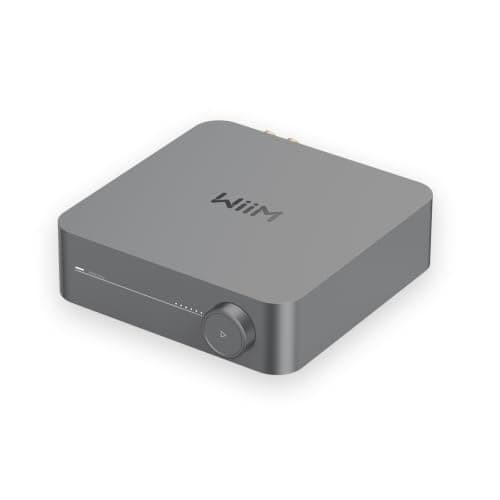
Top pick: WiiM Amp
Best one-box system for passive speakers. #ad Affiliate link — we earn a commission at no extra cost to you.
The short answer
The best amplifier for bookshelf speakers is the WiiM Amp — because it is the only box here that publishes a full-band power rating into both impedances a bookshelf pair presents (60 W per channel into 8 Ω, 120 W into 4 Ω) and pairs it with a subwoofer output carrying a user-adjustable 30–250 Hz crossover, which is the single most useful feature on this page for a small two-way. It is the pick for someone whose sources are streaming and a television, who wants one box on the shelf and the crossover set in an app rather than guessed at. The budget pick is the Fosi Audio V3— the cheapest amplifier we rank, a 300 W-into-4 Ω class-D power stage the size of a paperback. Two honest caveats on it: Fosi publishes no 8 Ω rating at all, and the headline wattage depends on a power supply that may be sold separately, so read the listing before you buy.
If your source is a turntable, the WiiM Amp is the wrong answer — WiiM publishes “phono input: no” for it. The Marantz PM6007 (MM at 2.2 mV / 47 kΩ), the Onkyo TX-8470 (MM and MC on a rear switch, with published signal-to-noise for both) and the Dayton HTA100 all have one, and our turntable amplifier page ranks the field on that specific question. If your speakers are Klipsch, the high-sensitivity case changes the ranking and that page is the one to read.
Disclosure: we earn a commission if you buy through the links on this page, at no extra cost to you. It does not influence what we pick — our criteria are published and reproducible, so you can check our work. How we pick · Full disclosure
These picks are spec-and-price analyses, not listening tests. We have not heard this gear and we do not pretend to have: every figure below is sourced to the manufacturer and linked, and every price is live or not shown at all. Here are the rules we followed.
Quick picks
Ranked on the published criteria in How We Pick. Prices are live as of November 12, 2026. Tap any row for the full write-up.
- 7.6
- 7.8
- 8.8
- 6.6
- 7.0
- 6.0
| # | Product | Best for | Score | Price |
|---|---|---|---|---|
| 1 | WiiM Amp A streamer with a power amplifier bolted on, which replaces two boxes — and gives up an order of magnitude of measured noise performance to do it. | Best one-box system for passive speakers | 7.6 | |
| 2 | 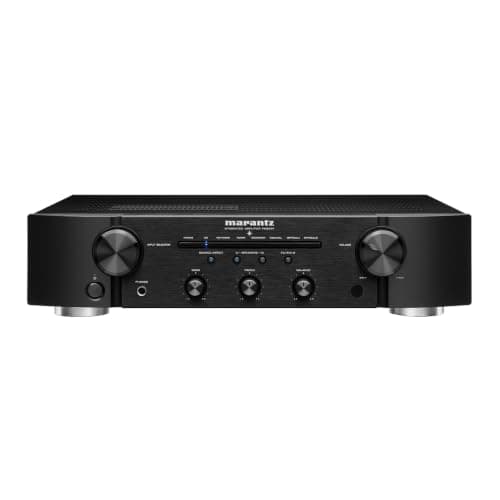 Marantz PM6007 A phono stage plus a proper DAC section in a well-made chassis, at the top of what this bracket will bear. | Best built-in DAC | 7.8 | |
| 3 | 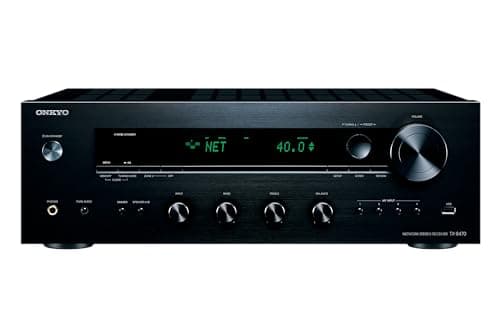 Onkyo TX-8470 The only amplifier we can verify under $500 with a moving-coil phono position as well as a moving-magnet one, and the only one whose maker states its power the FTC way. | Best phono stage under $500 | 8.8 | |
| 4 | 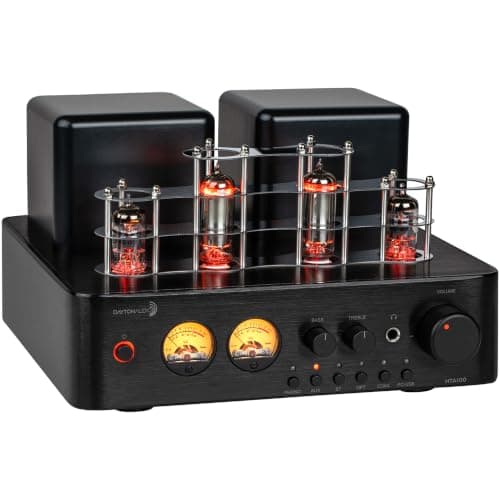 Dayton Audio HTA100 The only amplifier in this group whose maker names the tubes it ships with, and the lowest published distortion figure of the two Daytons — on a box with a phono input, a ground screw and a USB DAC. | Best overall for a turntable | 6.6 | |
| 5 | 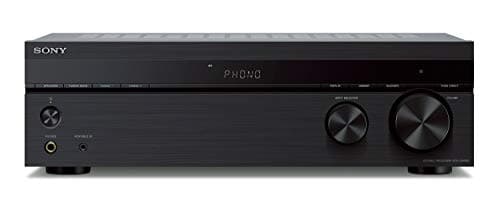 Sony STR-DH190 A stereo receiver with a phono input, Bluetooth and an FM tuner, at roughly half the price of the integrateds above it. | Best budget receiver with a phono input | 7.0 | |
| 6 | 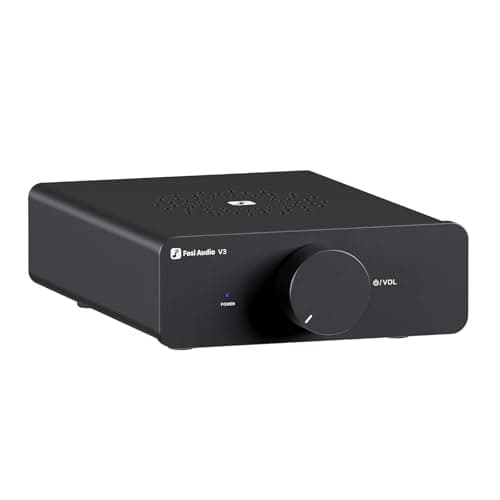 Fosi Audio V3 A class-D power amplifier the size of a paperback whose headline wattage depends entirely on the power supply you feed it. | Best tiny amplifier | 6.0 |
A bookshelf speaker is a small sealed or ported box with a 4 to 6 in woofer, and it asks an amplifier for different things than a floorstander does. It needs less raw power, because it cannot usefully convert much of it into bass. It needs an amplifier that does not mind a dipping impedance, because a small two-way crossover usually has one. And it almost always needs a way to hand the bottom octave to something with a bigger cone.
So this page ignores headline wattage, which is the spec everyone sorts on and the one that matters least here. Our guide to reading a power rating explains why a number with no load, bandwidth and distortion condition attached is not a rating at all — and two of the six amplifiers below publish exactly that kind of number.
The picks compared, spec by spec
Four columns, and the second one is the one almost no maker answers properly. A bookshelf speaker that dips to 3.2 Ω — which is what KEF publishes for the Q3 Meta — is asking the amplifier a question that only two boxes here answer with a full-band continuous figure. Every row carries its own live price and buy link.
Every figure below is the manufacturer’s own published value and links to the document we read it from. “Not published” means the manufacturer does not publish that figure; an em dash means we have no published figure for that model. Prices are live as of November 12, 2026.
Best one-box system for passive speakers
- Published power
- 60 W/ch at 8 Ω · 120 W at 4 Ω
- 4 Ω rating
- 120 W per channel
- Subwoofer out
- Yes, 30–250 Hz crossover
- Phono input
- No
Best built-in DAC
- Published power
- 45 W × 2 (8 Ω, full band, 0.08%)
- 4 Ω rating
- 60 W × 2, full band
- Subwoofer out
- Yes, 2.8 V
- Phono input
- MM only, 2.2 mV / 47 kΩ
Best phono stage under $500
- Published power
- 110 W × 2 (8 Ω, FTC form)
- 4 Ω rating
- Not published as continuous
- Subwoofer out
- Yes, plus main and Zone 2 pre-out
- Phono input
- MM and MC, switchable
Best overall for a turntable
- Published power
- 50 WPC at 4 Ω; no 8 Ω rating
- 4 Ω rating
- 4 Ω minimum
- Subwoofer out
- Full-range pre-out only
- Phono input
- Yes, no parameters published
Best budget receiver with a phono input
- Published power
- Not obtainable — Sony returns 403
- 4 Ω rating
- —
- Subwoofer out
- —
- Phono input
- —
Best tiny amplifier
- Published power
- Not published at 8 Ω
- 4 Ω rating
- 300 W × 2, no THD condition
- Subwoofer out
- —
- Phono input
- None
| Pick | Published power | 4 Ω rating | Subwoofer out | Phono input | Price |
|---|---|---|---|---|---|
| 1.WiiM AmpBest one-box system for passive speakers | 60 W/ch at 8 Ω · 120 W at 4 Ω | 120 W per channel | Yes, 30–250 Hz crossover | No | |
| 2.Marantz PM6007Best built-in DAC | 45 W × 2 (8 Ω, full band, 0.08%) | 60 W × 2, full band | Yes, 2.8 V | MM only, 2.2 mV / 47 kΩ | |
| 3.Onkyo TX-8470Best phono stage under $500 | 110 W × 2 (8 Ω, FTC form) | Not published as continuous | Yes, plus main and Zone 2 pre-out | MM and MC, switchable | |
| 4.Dayton Audio HTA100Best overall for a turntable | 50 WPC at 4 Ω; no 8 Ω rating | 4 Ω minimum | Full-range pre-out only | Yes, no parameters published | |
| 5.Sony STR-DH190Best budget receiver with a phono input | Not obtainable — Sony returns 403 | — | — | — | |
| 6.Fosi Audio V3Best tiny amplifier | Not published at 8 Ω | 300 W × 2, no THD condition | — | None |
Prices as of November 12, 2026; every “Check Price” link goes to Amazon and earns us a commission at no extra cost to you. #ad
The 4 ohm question, and who actually answers it
Nominal impedance is a marketing convenience; minimum impedance is the load. KEF publishes 3.2 Ω minimum for the Q3 Meta and the Q Concerto Meta, 3.5 Ω for the LS50 Meta; Q Acoustics publishes 3.3 Ω for the 5020. Those are all bookshelf speakers, and all four spend part of the audio band presenting less than half the impedance their nominal rating implies.
Two amplifiers here publish a continuous 4 Ω rating across the full band. WiiM publishes 120 W per channel into 4 Ω against 60 W into 8 Ω — a clean doubling, which is what a well-behaved amplifier does. Marantz publishes 60 W × 2 into 4 Ω from 20 Hz–20 kHz with both channels driven, which is unusual: most makers who quote a 4 Ω figure at all quote it at 1 kHz only, and Marantz rates it across the band.
The others are vaguer, and in two cases that is the finding. Onkyo publishes a proper FTC 110 W × 2 at 8 Ω but no continuous 4 Ω rating — the only other North American figure on its table is 210 W at 6 Ω, 1 kHz, 10% THD, which is a maximum-output burst measurement and not a rating. Fosi publishes a 4 Ω figure and no 8 Ω figure, states a terminating impedance range of 2–8 Ω, and does not say how much less an 8 Ω speaker will see. And Sony publishes nothing we could read: sony.com returned HTTP 403 to every request, the manual is mirrored on third-party sites, and a mirror is not the manufacturer. Our 4-ohm amplifier guide goes further into what the doubling test does and does not prove.
Why the subwoofer output is the most valuable feature on this page
A 5.25 in woofer in a small cabinet cannot produce the bottom octave of music. That is not a criticism of bookshelf speakers; it is the physics of displacement. The published ± 3 dB low corners of the bookshelf speakers we rank run from about 49 Hz at the expensive end to 62 Hz on the Klipsch R-51M, and real bass goes an octave below that.
So the honest upgrade path for a bookshelf system is a subwoofer crossed at 80 Hz, which relieves the small woofers of the work they are worst at and lets them play louder and cleaner above the crossover. When that is worth doing is its own page.
What separates these amplifiers is how much control they give you over that handover. The WiiM Amp publishes a user-adjustable 30–250 Hz crossover on its subwoofer output with automatic cable detection, which is a genuine high-pass filter you can set. Marantz publishes a 2.8 V subwoofer output at maximum volume, which is a level figure for a full-range feed. Onkyo publishes a subwoofer pre-out plus a main L/R pre-out and a Zone 2 output. Dayton publishes a full-range preamplifier output, which will drive a subwoofer but does not filter the main speakers. Fosi publishes none at all. Our guide to adding a subwoofer to a stereo amplifier covers what to do when the amplifier has no high-pass filter, which is the usual case.
displacement required ∝ 1 ÷ frequency² (for constant SPL)
Inputs
- Klipsch R-51M published low corner: 62 Hz (± 3 dB) (Klipsch spec sheet (PDF))
- WiiM Amp subwoofer crossover range: 30–250 Hz, user adjustable (WiiM spec page)
Result
The one-box argument, and what it costs
The WiiM Amp is first on this page partly because it is not only an amplifier. WiiM publishes HDMI ARC, optical and RCA line-in on the input side; Wi-Fi 802.11 b/g/n/ac dual band, Ethernet and Bluetooth 5.1 on the network side; AirPlay 2, Chromecast, Spotify Connect, TIDAL Connect, Alexa Cast, DLNA and Roon Ready on the protocol side; and a 10-band graphic plus 10-band parametric EQ with 26 presets. For a bookshelf pair in a living room, that is the whole system in one 190 mm box.
Two costs, both published by WiiM. Its output measures worse than a conventional integrated: SNR 98 dB and THD+N 0.0025%, which is roughly an order of magnitude behind the line output of WiiM’s own Pro Plus streamer and well behind Marantz’s 102 dB line signal-to-noise. That is what a class-D power stage in a small box costs. And its home-theater support is stereo PCM only — Dolby Digital and DTS are explicitly not supported — so it takes a TV’s ARC output but will not decode a film soundtrack.
The valve option, stated honestly
The Dayton Audio HTA100 is ranked fourth and it is the most interesting box here for one reason: Dayton names the tubes it ships with, 6F1 × 2 and 6P14A × 2, which makes a tube swap a decision you can make before you buy rather than after you open it. It is a hybrid — valves in the preamplifier stage, solid-state class A/B output — not a valve power amplifier, and Dayton says so.
It is ranked fourth and not higher because of three published figures. Its distortion is below 0.3% at 50 WPC, roughly an order of magnitude behind the solid-state integrateds here. Its 50 WPC is rated at 4 Ω with no 8 Ω figure published, and 8 Ω is what most bookshelf speakers nominally are. And its signal-to-noise is stated as better than 80 dB with no weighting and no reference level, so it cannot be set beside Marantz’s 102 dB. It does have a phono input with a ground terminal, a USB DAC, Bluetooth 5 and a headphone output — and Dayton publishes no cartridge type, gain, sensitivity, loading or RIAA figure for that phono stage, which is worth knowing before you rely on it. Our valve versus solid-state comparison covers what a hybrid is actually doing.
What to buy if the budget is the constraint
Two routes, and they diverge sharply. The Fosi V3 is a power amplifier with a volume knob rather than a full integrated: RCA line level in, nothing else, no phono stage, no subwoofer output, and a headline 300 W into 4 Ω with no distortion condition and a dependence on which power supply you feed it. For a desk fed by a DAC it is a lot of amplifier for very little money, and it is ranked last here because a bookshelf system usually needs the things it does not have.
The other route is to skip the amplifier entirely and buy a powered pair under $500, where the amplifier is already matched to the drivers and the box count is one. You give up the upgrade path and, on every pair in that band, the subwoofer output — which brings you back to the same trade this page started with. Passive versus powered is the page that settles it.
Every pick in detail
Every specification below links to the manufacturer document we read it from. Where a manufacturer does not publish a figure, we say so rather than estimating it.
WiiM Amp
Best one-box system for passive speakersPrice as of November 12, 2026. #ad
A streamer with a power amplifier bolted on, which replaces two boxes — and gives up an order of magnitude of measured noise performance to do it.
- measured performance
- 6/10
- connectivity
- 8/10
- features
- 9/10
- value for money
- 9/10
- published data
- 5/10
| Specification | Published value | Source |
|---|---|---|
| Power output | 60 W per channel into 8 Ω · 120 W per channel into 4 Ω | WiiM spec page |
| Rated-power measurement condition (THD figure, both channels driven) | Not published | — |
| Audio output quality | SNR 98 dB · THD+N 0.0025% (−92 dB) — an order of magnitude worse than the Pro Plus's line-out, which is what a Class-D power stage costs you | WiiM spec page |
| Inputs | HDMI ARC · optical · RCA line-in | WiiM spec page |
| Outputs | Passive speaker terminals · subwoofer out with auto cable detection and a user-adjustable 30–250 Hz crossover | WiiM spec page |
| Network | Wi-Fi 802.11 b/g/n/ac dual band · 10/100 Mbps LAN · Bluetooth 5.1 | WiiM spec page |
| Protocols | AirPlay 2, Chromecast, Spotify Connect, TIDAL Connect, Alexa Cast, DLNA, Roon Ready | WiiM spec page |
| EQ | 10-band graphic EQ, 10-band parametric EQ, 26 presets | WiiM spec page |
| Home theater formats | Stereo PCM only — Dolby Digital and DTS are NOT supported | WiiM spec page |
| Dimensions / weight | 190 × 190 × 63 mm; 1.84 kg (4.1 lb) | WiiM spec page |
| Phono input | No | WiiM spec page |
Pros
- 60 W into 8 Ω and 120 W into 4 Ω published, which drives every passive speaker we recommend
- Subwoofer output with a user-adjustable 30–250 Hz crossover, so a 2.1 system needs nothing else
- HDMI ARC in, so a television can feed it directly
- Same app, same EQ, same Roon Ready and AirPlay 2 support as the standalone streamers
Cons
- WiiM publishes the wattage with no THD figure and no “both channels driven” condition, so the rating cannot be compared to a Yamaha or Marantz spec
- 98 dB SNR and 0.0025% THD+N — roughly twenty decibels noisier than the Pro Plus's line-out
- Stereo PCM only over HDMI ARC: no Dolby Digital, no DTS
- No phono input, and no analog preamp output to escape the internal amplifier
Skip it if you already own an amplifier you like. This is a worse DAC than the Pro Plus attached to an amplifier you did not need.
Marantz PM6007
Best built-in DACPrice as of November 12, 2026. #ad
A phono stage plus a proper DAC section in a well-made chassis, at the top of what this bracket will bear.
- power
- 7/10
- phono stage
- 8/10
- value for money
- 7/10
- build quality
- 9/10
- connectivity
- 8/10
| Specification | Published value | Source |
|---|---|---|
| Power output (8 Ω) | 45 W × 2 (8 Ω, 20 Hz – 20 kHz, both channels driven, 0.08% THD) | Marantz owner's manual |
| Power output (4 Ω) | 60 W × 2 (4 Ω, 20 Hz – 20 kHz, both channels driven) — rated across the full band, unlike most rivals' 1 kHz-only 4 Ω figures | Marantz owner's manual |
| Phono input | Yes — MM only, 2.2 mV / 47 kΩ | Marantz owner's manual |
| Signal-to-noise | 102 dB (line); 83 dB (phono MM) | Marantz owner's manual |
| Damping factor | 100 (8 Ω, 40 Hz – 20 kHz) | Marantz owner's manual |
| Digital inputs | Coaxial and optical | Marantz owner's manual |
| Subwoofer out | Yes — 2.8 V (200 mV input, volume max) | Marantz owner's manual |
Pros
- Good DAC section with optical and coaxial in
- MM phono stage
- Solid build and finish
Cons
- Most expensive here
- No Bluetooth
- Power output is mid-pack for the money
Skip it if you already own a DAC — you are buying a second one.
Onkyo TX-8470
Best phono stage under $500Price as of November 12, 2026. #ad
The only amplifier we can verify under $500 with a moving-coil phono position as well as a moving-magnet one, and the only one whose maker states its power the FTC way.
- power
- 9/10
- phono stage
- 9/10
- value for money
- 8/10
- build quality
- 8/10
- connectivity
- 10/10
| Specification | Published value | Source |
|---|---|---|
| Power output (8 Ω) | 110 W + 110 W — “With 8 ohm loads, both channels driven, from 20 Hz – 20 kHz; rated 110 watts per channel minimum RMS power, with no more than 0.08% total harmonic distortion from 250 milliwatts to rated output” (FTC form, North American models) | Onkyo owner's manual (PDF) |
| Power output (4 Ω) | Not published as a continuous rating for the North American model. The only other North American figure on Onkyo's table is 210 W at 6 Ω, 1 kHz, 2 ch driven at 10% THD — a maximum-output burst measurement, not an RMS rating. | Onkyo owner's manual (PDF) |
| Phono input | Yes — MM or MC on a rear-panel switch, on a dedicated isolated phono board. Maximum input 70 mV (MM, 1 kHz, 0.5%) and 7 mV (MC, 1 kHz, 0.5%). | Onkyo owner's manual (PDF) |
| Phono signal-to-noise | 76 dB (IHF-A, MM 5 mV in, speaker out) · 60 dB (IHF-A, MC 0.5 mV in, speaker out) | Onkyo owner's manual (PDF) |
| THD | 0.08% (20 Hz – 20,000 Hz, at rated output power) | Onkyo owner's manual (PDF) |
| Damping factor | Not published | — |
| DAC | AKM AK4452, 32-bit / 768 kHz stereo; Class G amplifier stage | Onkyo product page |
| Digital inputs | 3 — one coaxial and two optical — plus 4 HDMI in / 1 HDMI out with ARC and 8K passthrough | Onkyo spec sheet (PDF) |
| Subwoofer out | Yes — one subwoofer pre-out, plus a main pre-out L/R and a Zone 2 pre/line out | Onkyo owner's manual (PDF) |
| Signal-to-noise (line) | 106 dB (IHF-A, line in, speaker out) | Onkyo owner's manual (PDF) |
| Dimensions and weight | 435 × 149.5 × 329 mm; 9 kg (19.8 lb) | Onkyo owner's manual (PDF) |
Pros
- 110 W per channel rated the strict way — 8 Ω, 20 Hz to 20 kHz, both channels driven, 0.08% THD — which nothing else in this bracket publishes
- MM and MC phono on a rear-panel switch, with a published signal-to-noise for each: 76 dB on MM and 60 dB on MC
- Four HDMI inputs with ARC, one coaxial and two optical digital inputs, and an AKM AK4452 32-bit/768 kHz DAC
- Subwoofer pre-out, main pre-out and a Zone 2 pre/line out all published
Cons
- Onkyo publishes no damping factor for it anywhere we can find
- The second figure on Onkyo's own North American table — 210 W at 6 Ω, 1 kHz, 10% THD — is a burst measurement at a distortion level nobody listens at
- It is a receiver: an AM/FM tuner and a second zone are part of what you are paying for whether you use them or not
- 9 kg and 435 mm wide, so it needs a rack shelf rather than a desk
Skip it if you want the shortest signal path your money will buy. This is a networked receiver with a tuner, HDMI switching and two zones, and a plain integrated puts more of the budget into the amplifier.
Dayton Audio HTA100
Best overall for a turntablePrice as of November 12, 2026. #ad
The only amplifier in this group whose maker names the tubes it ships with, and the lowest published distortion figure of the two Daytons — on a box with a phono input, a ground screw and a USB DAC.
- published data
- 6/10
- phono stage
- 4/10
- measured specs
- 4/10
- tube content
- 4/10
- value for money
- 8/10
| Specification | Published value | Source |
|---|---|---|
| Power output | 50 WPC RMS @ 4 Ω (60 W max). Dayton publishes NO 8 Ω rating for this model, and 8 Ω is what most hi-fi speakers present. | Dayton Audio product page |
| Amplification | Vacuum tubes in the preamplifier stage, solid-state Class A/B output stage — a hybrid, not a valve power amplifier | Dayton Audio product page |
| Preamplifier tubes | 6F1 × 2, 6P14A × 2 — the only amplifier in this group whose maker names the tubes it ships with | Dayton Audio product page |
| THD | < 0.3% @ 50 WPC — roughly an order of magnitude worse than the 0.019% to 0.08% the solid-state integrateds on this site publish, and about five times better than its own larger sibling | Dayton Audio product page |
| Signal-to-noise | > 80 dB. No weighting and no reference level are stated, so it is not directly comparable with the A-weighted and IHF-A figures elsewhere on this site. | Dayton Audio product page |
| Frequency response | 20 – 20,000 Hz. No ± dB tolerance published. | Dayton Audio product page |
| Minimum speaker impedance | 4 Ω | Dayton Audio product page |
| Phono input | Yes — phono RCA with a built-in preamp and a ground terminal for a turntable. Dayton publishes no cartridge type, no gain, no input sensitivity, no loading and no RIAA figure for it. | Dayton Audio product page |
| Other inputs / outputs | Line in, coaxial and optical digital, USB DAC, Bluetooth 5 (SBC, AAC); full-range preamplifier (sub) output and a front headphone output | Dayton Audio product page |
| Digital sample rate | Up to 16-bit / 48 kHz | Dayton Audio product page |
| Dimensions / weight | 10.6 × 6.6 × 11.5 in; 13.4 lb | Dayton Audio product page |
| Phono stage gain, loading and RIAA accuracy | Not published | — |
| Headphone output power | Not published | — |
| Channel separation | Not published | — |
Pros
- Dayton names the preamplifier tubes — 6F1 × 2 and 6P14A × 2 — so a tube swap is a decision you can make before you buy rather than after you open it
- < 0.3% THD at 50 WPC is about five times better than Dayton publishes for the larger HTA200, from the cheaper amplifier
- Phono RCA input and a ground terminal, so a turntable with no built-in stage connects with no second box
- Coaxial, optical, USB and Bluetooth 5 as well, which makes it the whole system for a desk or a small room
Cons
- Dayton publishes no 8 Ω power rating at all — only 50 WPC into 4 Ω, and 8 Ω is what most hi-fi speakers present
- Not one figure is published about the phono stage: no cartridge type, no gain, no input sensitivity, no loading, no RIAA deviation
- The > 80 dB signal-to-noise figure carries no weighting and no reference level, so it cannot be set beside the 99 to 106 dB A-weighted figures the solid-state integrateds on this site publish
- 20 – 20,000 Hz is published with no ± dB tolerance, and the headphone output has no published power at all
- The tubes are in the preamplifier only — the output stage is solid-state Class A/B, which is what the “hybrid” in the name means
Skip it if you want valves doing the amplifying rather than the voicing, or your speakers are 8 Ω and you want to know what the amplifier makes into them. For the first, the Muzishare X7 below; for the second, any of the solid-state integrateds we cover.
Sony STR-DH190
Best budget receiver with a phono inputPrice as of November 12, 2026. #ad
A stereo receiver with a phono input, Bluetooth and an FM tuner, at roughly half the price of the integrateds above it.
- power
- 6/10
- phono stage
- 7/10
- value for money
- 9/10
- build quality
- 5/10
- connectivity
- 8/10
| Specification | Published value | Source |
|---|---|---|
| Published specifications | Unavailable. Sony blocks automated access across every domain it operates, and the official manual for this model returned HTTP 403 on 17 July 2026. The manual is mirrored on third-party sites, but a mirror is not the manufacturer and we do not treat it as one. We publish nothing here rather than something we could not verify at source. | Sony product page (returned 403) |
Pros
- Phono input and Bluetooth at a low price
- FM tuner included
- Speaker A/B switching
Cons
- Lightest build here
- Receiver, not an integrated — the tuner is dead weight if unused
- Modest power
Skip it if you want the best amplifier for the money rather than the most features for the money.
Fosi Audio V3
Best tiny amplifierPrice as of November 12, 2026. #ad
A class-D power amplifier the size of a paperback whose headline wattage depends entirely on the power supply you feed it.
- power
- 6/10
- phono stage
- 0/10
- value for money
- 10/10
- build quality
- 6/10
- connectivity
- 4/10
| Specification | Published value | Source |
|---|---|---|
| Power output (4 Ω) | 300 W × 2 at 4 Ω (Fosi's headline “600 W total”). No THD condition is attached to this figure, and it depends on the supply: published power input range is DC 24–48 V, with 32 V/5 A and 48 V/5 A supplies listed. | Fosi Audio spec page |
| Power output (8 Ω) | Not published. Fosi publishes a 4 Ω figure only, though it states a terminating impedance of 2–8 Ω — so an 8 Ω speaker will see meaningfully less than the headline number, and Fosi does not say how much less. | Fosi Audio spec page |
| Amplifier chip | TPA3255; TI NE5532 × 2 op-amps | Fosi Audio spec page |
| THD | ≤ 0.003% (measurement condition not published) | Fosi Audio spec page |
| Signal-to-noise | ≥ 110 dB (SINAD ≥ 88 dB) | Fosi Audio spec page |
| Inputs | RCA line level only | Fosi Audio spec page |
| Phono input | None — a turntable needs its own phono stage before this amplifier | Fosi Audio spec page |
Pros
- Very cheap and very small
- Class D efficiency — runs cool
- Genuinely useful power for the size
Cons
- The advertised power figure requires a power supply that may be sold separately — read the fine print
- No phono stage
- Power amp with a volume knob, not a full integrated
Skip it if you need a phono input. This has none, so a turntable needs its own stage before it.
Frequently asked questions
How many watts do bookshelf speakers need?
Do I need an amplifier with a 4 ohm rating?
Which of these works with a turntable?
Is a subwoofer output essential?
Read next
Will This Amplifier Drive My Speakers?
Two published numbers, one formula, and the answer is almost always less power than you expected.
The Best Integrated Amplifiers Under $500
Four amplifiers under $500, ranked on the power figure each maker actually publishes — and on which of them will drive a 4-ohm speaker.
The Best Amplifiers for Klipsch Speakers
Klipsch's 90-96 dB sensitivity settles the watts question at about 35 W, so this ranks on published signal-to-noise and damping factor instead. The Onkyo TX-8470's 106 dB is the highest on the site.
Amplifiers for 4 Ohm Speakers: Which Ones Publish a Real Rating
What a 4 ohm speaker asks of an amplifier, the four kinds of 4 ohm rating makers publish, and which of ours states a real one.
The Best Powered Speakers Under $500
Five active pairs under $500, ranked on published amplifier power and its measurement condition — including the only maker here citing 16 CFR 432.3.
Do You Need a Subwoofer With Bookshelf Speakers?
Decided by your speakers' own published figure, not by taste. Includes the overlap arithmetic and the connection trap that stops two of the six subwoofers we cover working with a stereo amplifier.
How to Add a Subwoofer to a Stereo Amplifier
Three connection routes, which subs support each, and why a stereo amp adds bass rather than redirecting it.
Sources
Every specification on this page was read from one of these documents. If one of them has changed, or we have made an error, tell us — corrections are logged and dated per our editorial policy.