The Best Bookshelf Speakers Under $300
Ten decibels separate the most and least sensitive speakers here, which is a tenfold difference in the amplifier each one needs. One maker quotes that figure honestly and it costs them the top spot.
Disclosure: we earn a commission if you buy through the links on this page, at no extra cost to you. It does not influence what we pick — our criteria are published and reproducible, so you can check our work. How we pick · Full disclosure
These picks are spec-and-price analyses, not listening tests. We have not heard this gear and we do not pretend to have: every figure below is sourced to the manufacturer and linked, and every price is live or not shown at all. Here are the rules we followed.
Quick picks
Ranked on the published criteria in How We Pick. Prices are live as of October 15, 2026. Tap any row for the full write-up.
- 7.4$149.00View on Amazon
$179.0017% off
- 8.4
- 7.2
- 7.0
- 7.0
| # | Product | Best for | Score | Price |
|---|---|---|---|---|
| 1 | 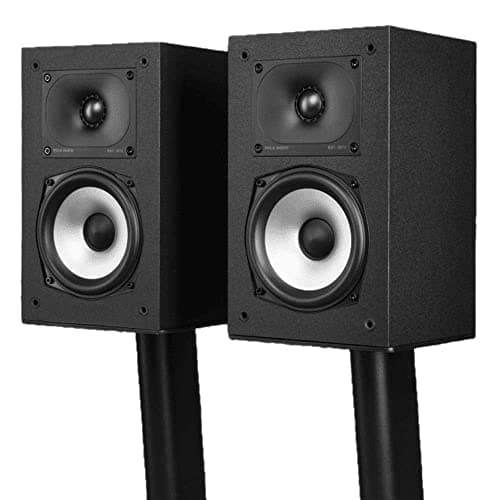 Polk Monitor XT15 48 Hz of published extension and a stated 30–150 W amplifier range, from a maker who tells you what to drive it with but not how they measured its sensitivity. | Best all-rounder under $200 | 7.4 | $149.00View on Amazon $179.0017% off |
| 2 | 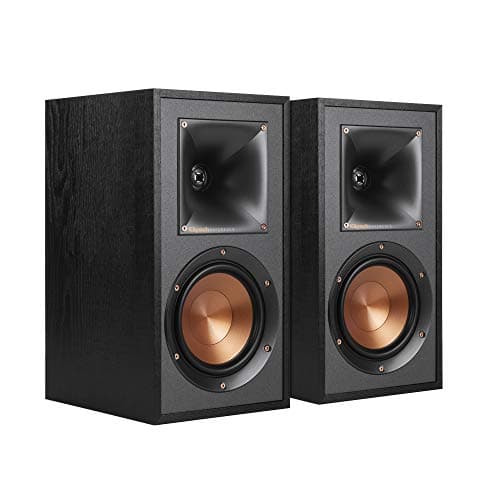 Klipsch R-51M High sensitivity means a modest amplifier drives these to a real volume — the practical answer when the amp is fixed and small. | Best for low-power amplifiers | 8.4 | |
| 3 | 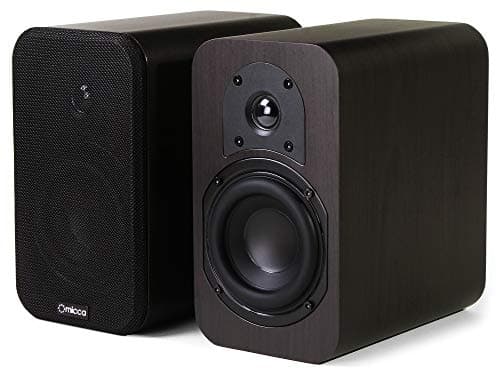 Micca RB42 A 4-inch speaker that publishes 50 Hz of extension and an honest 83 dB at 1 W — the two facts are the same fact, and Micca is unusual in showing you both. | Most bass from the smallest box | 7.2 | |
| 4 | 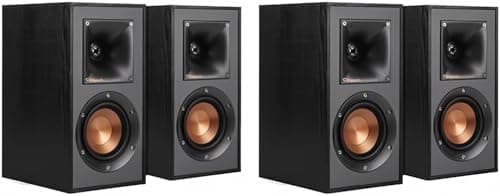 Klipsch R-41M A 4-inch two-way with a published 90 dB sensitivity, which means it goes loud on an amplifier that would embarrass most of its competition. | Best for a very small amplifier | 7.0 | |
| 5 | 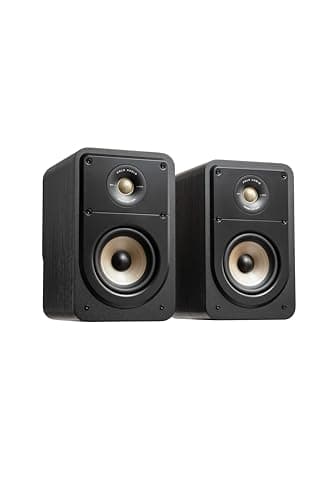 Polk Signature Elite ES15 Voiced and certified to sit in a surround system as easily as a stereo pair, which matters if this room has to do both jobs. | Best for double duty with home theater | 7.0 |
This is the bracket where the specification sheets stop being merely uneven and start being actively misleading — not because anyone is lying, but because the same word means different things on different pages.
The five pairs here publish sensitivity figures from 83 dB to 93 dB. That looks like a ten decibel spread, which would be a tenfold difference in the amplifier power each needs. It is not actually a ten decibel spread, and working out what it really is takes the rest of this page.
The condition, not the number
A sensitivity figure is meaningless without the condition it was measured under. Three conditions are in play across these five speakers:
- 2.83 V / 1 m — the industry default. Klipsch uses it for both the R-51M (93 dB) and the R-41M (90 dB). It equals 1 watt only into 8 ohms; into a lower impedance it is more than a watt, which flatters the number.
- 1 W / 1 m — the harder condition. Micca uses it for the RB42 (83 dB), and it is the only maker here that does.
- Unstated— Polk publishes 86 dB for the Monitor XT15 and 88 dB for the Signature Elite ES15 with no measurement condition attached at all. Depending on which convention they used, those figures could be comparable to Klipsch’s or a decibel or so optimistic.
So the Micca’s 83 dB is, if anything, the most trustworthy figure on this page and the one that costs it the most. It is being penalized in every comparison for publishing the harder number. The conversion between the two conditions is arithmetic, and it depends on an impedance figure that three of these five do not publish.
What a 7 dB gap actually costs you
Take the two extremes as published: the Klipsch R-51M at 93 dB and the Micca RB42 at 83 dB. Every 3 dB of sensitivity is a doubling of amplifier power for the same volume, so a 10 dB gap is a factor of ten.
In practice that means a 20-watt amplifier driving the Klipsch to a given level would need roughly 200 watts to drive the Micca to the same one. That is not a subtlety. It is the difference between the Cambridge AXA35’s 35 watts being ample and being marginal, and it is the single most consequential thing on this page.
Micca hedges usefully here: they publish a power handling range of 15–100 W each, and that 15 W lower bound functions as a minimum amplifier recommendation. Polk goes further and publishes an actual recommended amplification range for the XT15 — 30 to 150 W per channel — which is the most useful single spec any manufacturer on this page provides. Klipsch publishes power handling (50 W/200 W for the R-41M, 85 W/340 W for the R-51M) and no recommendation at all. Handling tells you what will break the speaker, not what will drive it.
The two Polks, and a finding
The Monitor XT15 and the Signature Elite ES15 sit in different Polk lines at meaningfully different prices. Here is what Polk publishes for each:
| Spec | Monitor XT15 | Signature Elite ES15 |
|---|---|---|
| Sensitivity | 86 dB (no condition) | 88 dB (no condition) |
| Frequency response | 48 Hz – 40 kHz (no tolerance) | 48 Hz – 40 kHz (no tolerance) |
| Impedance | “Compatible with 4- and 8-ohm outputs” | “Compatible with 4- and 8-ohm outputs” |
| Recommended amplification | 30–150 W | 20–100 W |
| Woofer | 5.25 in bi-laminate paper | 5.25 in mica-fortified polypropylene |
| Tweeter | 1 in Terylene dome | 1 in Terylene dome |
| Crossover | 2,200 Hz | 2,500 Hz |
Identical extension, identical tweeter material, identical impedance description, two decibels of unqualified sensitivity between them, and a different woofer cone. That is what Polk publishes. We are not saying the ES15 is not the better speaker — we have not heard either, and cone material and cabinet bracing are real engineering that does not show up in these rows. We are saying that nothing Polk publishes justifies the price difference, and if you are buying on published data, the XT15 is the one that makes sense.
The R-41M question: how small is too small?
The Klipsch R-41M publishes 68 Hz ± 3 dB. That is the shallowest bass extension of any speaker on this site, and it is worth being blunt about what it means: the bottom octave and a half of most music simply is not there.
It buys you two things in exchange. It is the smallest cabinet here by a wide margin — 11.3 inches tall, 7 lb — and it publishes 90 dB sensitivity, which makes it playable on a genuinely small amplifier. For a desk, a bedroom, or a second system, that trade can be exactly right.
For a main system it usually is not, unless you add a subwoofer — at which point the 68 Hz rolloff stops mattering and the small cabinet becomes an advantage. Our subwoofer roundup covers that route, and the crossover point you would want is right about where the R-41M gives up.
The specs nobody here publishes
Not one of these five publishes a minimum impedance. That is the number that tells you where an amplifier actually struggles — a speaker whose nominal 8 ohms dips to 3 ohms somewhere in the bass asks for more than twice the current at that frequency.
Klipsch describes both its speakers as “8 ohms compatible”, which is a compatibility claim rather than a measurement. Polk says “compatible with 4- and 8-ohm outputs” for both of its. Micca publishes “4–8 ohms”, a range rather than a nominal figure. In the bracket above this one, Q Acoustics publishes an actual 4 Ω minimum — which is a large part of why it ranks so highly there.
And Micca publishes the crossover slope — 18 dB/octave, with an unusually detailed description of a ten-element network using film capacitors and air-core coils — but not the crossover frequency. That is an odd omission from an otherwise unusually forthcoming page.
How to choose
Start from your amplifier, not the speaker. Find what it publishes into the impedance you are about to hand it, then run the power arithmetic at your listening distance.
If the answer is comfortable: buy the Polk Monitor XT15, which reaches lowest and comes with the manufacturer’s own amplifier recommendation attached. If the answer is marginal, buy sensitivity — the Klipsch R-51M. If your room is very small and you have a subwoofer or plan to get one, the R-41M is the honest cheap answer. And if you have real power and want the most cabinet engineering per dollar, the Micca RB42 is the one whose maker tells you the most about how it was built.
If none of these fit, the next step up is worth reading: the under-$500 roundup is where a published minimum impedance finally appears.
Two narrower questions have their own pages. If these speakers are going on an AV receiver rather than a stereo amplifier, the criteria change — our home-theater bookshelf roundup ranks on the measurement condition attached to each sensitivity figure, published minimum impedance, and whether a timbre-matched center channel exists. And if the shortlist is down to the two most-recommended pairs, our R-51M against Monitor XT15 head-to-head settles it on the five figures where they diverge.
Every pick in detail
Every specification below links to the manufacturer document we read it from. Where a manufacturer does not publish a figure, we say so rather than estimating it.
Polk Monitor XT15
Best all-rounder under $20048 Hz of published extension and a stated 30–150 W amplifier range, from a maker who tells you what to drive it with but not how they measured its sensitivity.
- specs
- 7/10
- sensitivity
- 6/10
- published data
- 6/10
- value for money
- 9/10
- bass extension
- 8/10
| Specification | Published value | Source |
|---|---|---|
| Sensitivity | 86 dB — Polk publishes NO measurement condition (no 2.83 V/1 m or 1 W/1 m qualifier) | Polk info sheet (PDF) |
| Impedance | “Compatible with 4- and 8-ohm outputs” — Polk publishes no nominal impedance value | Polk info sheet (PDF) |
| Minimum impedance | Not published | — |
| Frequency response | 48 Hz – 40 kHz (no tolerance published) | Polk info sheet (PDF) |
| Recommended amplification | 30–150 W per channel | Polk info sheet (PDF) |
| Woofer | 5.25 in bi-laminate paper | Polk info sheet (PDF) |
| Tweeter | 1 in Terylene dome | Polk info sheet (PDF) |
| Crossover | 2,200 Hz | Polk info sheet (PDF) |
| Weight (each) | 9 lb / 4.08 kg | Polk info sheet (PDF) |
Pros
- 48 Hz – 40 kHz published extension, the deepest bass figure in this bracket
- Polk publishes a recommended amplification range (30–150 W), which Klipsch and ELAC do not
- 1 in Terylene dome tweeter, the same driver family as the more expensive Signature Elite ES15
- Explicitly rated for Dolby Atmos height duty as well as stereo, so it does double service
Cons
- The 86 dB sensitivity is published with NO measurement condition, so it cannot honestly be compared to Klipsch's 2.83 V figures
- “Compatible with 4- and 8-ohm outputs” is not a nominal impedance, and no minimum is published
- 48 Hz – 40 kHz is quoted with no tolerance, which makes the endpoints unverifiable
- The 30 W lower bound rules out several of the smallest amplifiers we recommend
Skip it if your amplifier delivers under 30 W. Polk's own recommendation excludes it, and that is Polk's number, not ours.
Klipsch R-51M
Best for low-power amplifiersPrice as of October 15, 2026. #ad
High sensitivity means a modest amplifier drives these to a real volume — the practical answer when the amp is fixed and small.
- sensitivity
- 10/10
- bass extension
- 6/10
- amp friendliness
- 10/10
- value for money
- 9/10
- build quality
- 7/10
| Specification | Published value | Source |
|---|---|---|
| Sensitivity | 93 dB (2.83 V / 1 m) | Klipsch spec sheet (PDF) |
| Impedance | 8 Ω “compatible” (Klipsch's wording — not a measured nominal figure) | Klipsch spec sheet (PDF) |
| Minimum impedance | Not published | — |
| Frequency response | 62 Hz – 21 kHz ± 3 dB | Klipsch spec sheet (PDF) |
| Power handling | 85 W continuous / 340 W peak (a handling limit, not a recommended amplifier range) | Klipsch spec sheet (PDF) |
| Woofer | 5.25 in spun-copper IMG | Klipsch spec sheet (PDF) |
| Tweeter | 1 in aluminum LTS on a 90° × 90° Tractrix horn | Klipsch spec sheet (PDF) |
| Crossover | 1,660 Hz | Klipsch spec sheet (PDF) |
| Weight (each) | 11 lb / 5 kg | Klipsch spec sheet (PDF) |
Pros
- High sensitivity — plays loud on very little power
- The right answer for a low-wattage or tube amplifier
- Horn tweeter gives strong dispersion control
Cons
- Horn presentation is divisive and we cannot tell you how it sounds — we have not heard them
- Rear port needs breathing room from the wall
- Less low-end than the ELAC B6.2
- Previous generation — Klipsch's own page for it now points buyers to the newer Reference R-50M
Skip it if your amp already has power to spare — you are paying for sensitivity you do not need.
Micca RB42
Most bass from the smallest boxNo live price right now. #ad
A 4-inch speaker that publishes 50 Hz of extension and an honest 83 dB at 1 W — the two facts are the same fact, and Micca is unusual in showing you both.
- specs
- 7/10
- sensitivity
- 3/10
- published data
- 7/10
- value for money
- 8/10
- bass extension
- 8/10
| Specification | Published value | Source |
|---|---|---|
| Sensitivity | 83 dB (1 W / 1 m) — note the condition: this is the TRUE 1 W figure, not the flattering 2.83 V one most brands quote | Micca spec page |
| Impedance | 4–8 Ω (Micca publishes a range rather than a nominal value) | Micca spec page |
| Minimum impedance | Not published | — |
| Frequency response | 50 Hz – 20 kHz, stated as “typical in-room” — an in-room figure is not an anechoic one and carries no tolerance | Micca spec page |
| Power handling | 15–100 W each — Micca's lower bound doubles as a de facto minimum amplifier recommendation | Micca spec page |
| Woofer | 4 in coated paper cone, rubber surround | Micca spec page |
| Tweeter | 0.75 in silk dome | Micca spec page |
| Crossover | 18 dB/octave slope — Micca publishes the SLOPE but not the crossover FREQUENCY | Micca spec page |
| Dimensions | 8.7 in H × 4.9 in W × 7.9 in D | Micca spec page |
| Weight | Not published | — |
Pros
- Micca quotes sensitivity at 1 W/1 m, the harder and more honest condition — most brands quote 2.83 V, which flatters a low-impedance speaker
- 50 Hz from a 4-inch driver in an 8.7-inch cabinet is genuinely unusual
- A 10-element crossover with film capacitors and air-core coils, described in detail on Micca's own page
- Micca publishes a 15 W lower power bound, which functions as a minimum amplifier recommendation
Cons
- 83 dB is the lowest sensitivity on this site — it needs roughly five times the power of the Klipsch R-41M for the same level
- The 50 Hz figure is qualified “typical in-room”, which is not an anechoic measurement and carries no tolerance
- Micca publishes the crossover SLOPE (18 dB/octave) but not the crossover FREQUENCY
- “4–8 ohms” is a range, not a nominal impedance, and no minimum is published
Skip it if your amplifier is small. A 20 W amp that drives the Klipsch R-41M to a satisfying level will not do the same job here — the arithmetic is on our amp-matching page and it is not close.
Klipsch R-41M
Best for a very small amplifierPrice as of October 15, 2026. #ad
A 4-inch two-way with a published 90 dB sensitivity, which means it goes loud on an amplifier that would embarrass most of its competition.
- specs
- 6/10
- sensitivity
- 9/10
- published data
- 6/10
- value for money
- 9/10
- bass extension
- 3/10
| Specification | Published value | Source |
|---|---|---|
| Sensitivity | 90 dB (2.83 V / 1 m) | Klipsch spec sheet (PDF) |
| Impedance | 8 Ω “compatible” (Klipsch's wording — not a measured nominal figure) | Klipsch spec sheet (PDF) |
| Minimum impedance | Not published | — |
| Frequency response | 68 Hz – 21 kHz ± 3 dB | Klipsch spec sheet (PDF) |
| Power handling | 50 W continuous / 200 W peak (a handling limit, not a recommended amplifier range) | Klipsch spec sheet (PDF) |
| Woofer | Single 4 in spun-copper IMG | Klipsch spec sheet (PDF) |
| Tweeter | 1 in aluminum LTS on a 90° × 90° Tractrix horn | Klipsch spec sheet (PDF) |
| Crossover | 1,730 Hz | Klipsch spec sheet (PDF) |
| Enclosure | MDF, bass-reflex via rear-firing ports | Klipsch spec sheet (PDF) |
| Weight (each) | 7 lb / 3.2 kg | Klipsch spec sheet (PDF) |
Pros
- 90 dB at 2.83 V/1 m — seven decibels more sensitive than the Micca RB42, which is about five times less amplifier for the same volume
- Klipsch publishes a real ±3 dB tolerance on the frequency response
- 7 lb each and 11.3 in tall: the smallest cabinet here by a clear margin
- Timbre-matched to the R-51M and R-52C if you later build a surround system around it
Cons
- 68 Hz is the shallowest bass extension of any speaker on this site
- “8 ohms compatible” is not a measured nominal impedance, and no minimum impedance is published
- Rear-ported, so it needs clearance behind it — an actual bookshelf will change its bass
- Klipsch publishes power handling, not a recommended amplifier range; those are different specs
- Amazon no longer lists a single pair: the live listing is a two-pair, four-speaker pack, so the price shown here buys four speakers
- Previous generation — Klipsch's own page for it now points buyers to the newer Reference R-40M
Skip it if you listen to anything with real low end and have no subwoofer. 68 Hz means the bottom octave and a half simply is not there.
Polk Signature Elite ES15
Best for double duty with home theaterPrice as of October 15, 2026. #ad
Voiced and certified to sit in a surround system as easily as a stereo pair, which matters if this room has to do both jobs.
- sensitivity
- 7/10
- bass extension
- 7/10
- amp friendliness
- 7/10
- value for money
- 7/10
- build quality
- 7/10
| Specification | Published value | Source |
|---|---|---|
| Sensitivity | 88 dB — Polk publishes NO measurement condition (no 2.83 V/1 m or 1 W/1 m qualifier), so this figure is not directly comparable to the others in this table | Polk info sheet (PDF) |
| Impedance | “Compatible with 4- and 8-ohm outputs” — Polk publishes no nominal impedance value | Polk info sheet (PDF) |
| Minimum impedance | Not published | — |
| Frequency response | 48 Hz – 40 kHz (no tolerance published) | Polk info sheet (PDF) |
| Recommended amplification | 20–100 W per channel | Polk info sheet (PDF) |
| Woofer | 5.25 in mica-fortified polypropylene | Polk info sheet (PDF) |
| Tweeter | 1 in Terylene dome | Polk info sheet (PDF) |
| Crossover | 2.5 kHz | Polk info sheet (PDF) |
| Weight (each) | 13 lb / 5.9 kg | Polk info sheet (PDF) |
Pros
- Designed to integrate with a matching surround range
- Hi-Res certified
- Keyhole mount for wall use
Cons
- Less distinctive than the ELAC or Klipsch at the price
- Rear port
- Not the best pure-stereo value here
Skip it if this is a stereo-only system — the ELAC B6.2 gives more for the money.
Frequently asked questions
What is the best bookshelf speaker under $300?
On our published criteria, the Polk Monitor XT15: 48 Hz – 40 kHz extension, a 2,200 Hz crossover and — uniquely in this bracket — a manufacturer-stated amplifier recommendation of 30–150 W per channel. If your amplifier is small, the Klipsch R-51M's 93 dB at 2.83 V/1 m makes it the more practical choice, because sensitivity is what decides whether a modest amp is enough.
Why is the Micca RB42 sensitivity so low?
Partly physics and partly honesty. It is a 4-inch driver reaching 50 Hz, and getting a small cone that low costs efficiency. But Micca also quotes its 83 dB figure at 1 W/1 m, which is the harder condition — most brands quote 2.83 V/1 m, which equals 1 W only into 8 ohms and flatters a lower-impedance speaker. So the gap to the Klipsch figures is real but smaller than the raw numbers suggest.
Is the Polk Monitor XT15 or the Signature Elite ES15 better?
On published specifications there is very little between them: identical 48 Hz – 40 kHz extension with no tolerance, the same 1-inch Terylene tweeter, the same "compatible with 4- and 8-ohm outputs" impedance description, and two decibels of unqualified sensitivity. The ES15 uses a mica-fortified polypropylene cone against the XT15's bi-laminate paper. Nothing Polk publishes accounts for the price difference, so on published data the XT15 is the better buy.
How many watts do I need for bookshelf speakers under $300?
It depends entirely on which pair, and the spread here is large. Polk recommends 30–150 W for the Monitor XT15 and Micca publishes a 15 W lower bound for the RB42. Klipsch publishes no recommendation at all for either of its models — only power handling, which tells you what will damage the speaker rather than what will drive it. Given the Klipsch models are the two most sensitive here, a small amplifier will go furthest with them.
Read next
Speaker Impedance Explained
Nominal versus minimum impedance, why 2.83 V is not 1 watt, and how to check your amplifier can cope.
Will This Amplifier Drive My Speakers?
Two published numbers, one formula, and the answer is almost always less power than you expected.
The Best Bookshelf Speakers Under $500
Six pairs under $500 — and only one publishes a minimum impedance and a recommended amp range.
Passive vs Powered Speakers
Total cost, upgrade path, and why powered speakers correctly refuse to publish a sensitivity figure.
Speaker Sensitivity Explained
2.83 V/1 m versus 1 W/1 m, what the conversion is worth in decibels, and the twelve-decibel spread that means sixteen times the power.
Sources
Every specification on this page was read from one of these documents. If one of them has changed, or we have made an error, tell us — corrections are logged and dated per our editorial policy.