Do You Need a Subwoofer With Bookshelf Speakers?
Look up one number — your speakers' published low-frequency limit — and compare it with the lowest note on a bass guitar. Then check that your amplifier can connect to a subwoofer at all, because two of the ones we cover need an output most stereo amps do not have.
The short answer
If your bookshelf speakers’ published low-frequency limit is above about 50 Hz and you listen to anything with a bass guitar, a kick drum or a church organ in it, yes — and the SVS SB-1000 Pro is the one we would buy, partly because it takes speaker-level inputs and will therefore connect to a stereo amplifier that has no subwoofer output. If your speakers reach into the mid-40s and you listen mostly to voices, small ensembles and guitar music, a subwoofer is an optional improvement rather than a missing piece. The cheapest route that still connects to anything is the Polk PSW10. The Klipsch R-120SW is the third pick and the cautionary one: it is line-level only.
Disclosure: we earn a commission if you buy through the links on this page, at no extra cost to you. It does not influence what we pick — our criteria are published and reproducible, so you can check our work. How we pick · Full disclosure
These picks are spec-and-price analyses, not listening tests. We have not heard this gear and we do not pretend to have: every figure below is sourced to the manufacturer and linked, and every price is live or not shown at all. Here are the rules we followed.
Quick picks
Ranked on the published criteria in How We Pick. Prices are live as of October 10, 2026. Tap any row for the full write-up.
- 9.0
- 6.0
- 8.2$265.05View on Amazon
$599.0056% off
| # | Product | Best for | Score | Price |
|---|---|---|---|---|
| 1 | 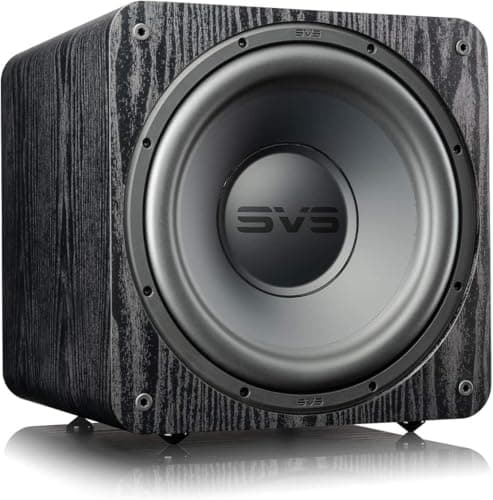 SVS SB-1000 Pro The only subwoofer here whose manufacturer publishes both a continuous power rating and the measurement condition behind its frequency response — 20–270 Hz ± 3 dB at 2 m ground plane — which is what makes its numbers comparable to anything. | Best overall | 9.0 | |
| 2 | 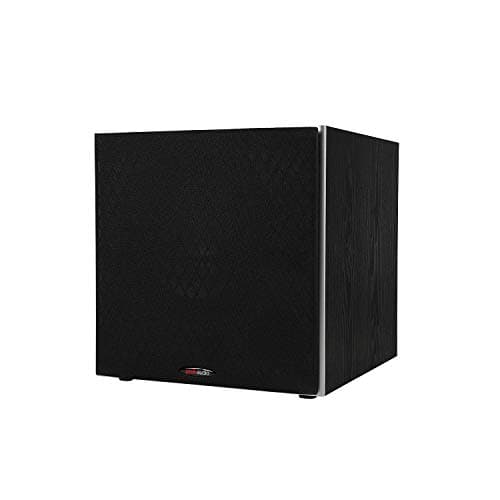 Polk Audio PSW10 The cheapest way into a real .1 channel, and the one where Polk's own page argues with itself — the marketing says 35 Hz, the specification table says the −3 dB point is 40 Hz. | Best for a small room | 6.0 | |
| 3 | 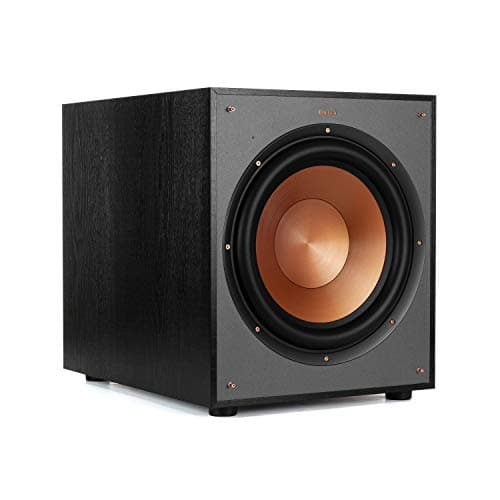 Klipsch R-120SW A 12-inch ported sub whose spec sheet publishes 200 W continuous next to the 400 W peak figure the listings quote — and whose only inputs are RCA, which is the spec that decides whether it works with your amplifier. | Best value 12-inch | 8.2 | $265.05View on Amazon $599.0056% off |
This question usually gets answered with taste — whether you “like” bass. It can be answered with two numbers instead: the lowest frequency your speakers are specified to reproduce, and the lowest frequency the music you play actually contains. If the first is above the second, there is a hole, and you can hear it whether or not you think of yourself as a bass person.
Step one: look up your speakers’ own figure
Here are the published low-frequency limits of every bookshelf speaker we cover, with whatever tolerance the maker attached:
| Speaker | Published low end | Tolerance |
|---|---|---|
| ELAC Debut 2.0 B5.2 | 46 Hz | None published |
| Q Acoustics 3030i | 46 Hz | +3 / −6 dB |
| Polk Monitor XT15 | 48 Hz | None published |
| Polk Signature Elite ES15 | 48 Hz | None published |
| Micca RB42 | 50 Hz | “Typical in-room” — not an anechoic figure |
| Klipsch R-51M | 62 Hz | ± 3 dB |
| Klipsch R-41M | 68 Hz | ± 3 dB |
Two things to take from that table before going further. First, the spread is only 22 Hz, so every bookshelf speaker here is in the same broad situation. Second, and more importantly, most of them publish no tolerance, which means their numbers are not comparable with Klipsch’s or Q Acoustics’. A 46 Hz figure that might be 10 dB down is a worse speaker at 46 Hz than a 62 Hz figure that is 3 dB down, and nothing in the published data lets you tell. Q Acoustics is the only maker here that publishes an asymmetric tolerance (+3 / −6 dB), which is the most complete statement in the group and the least flattering.
Step two: what is actually down there
Musical pitch is arithmetic, and it is arithmetic you can check. From the A4 = 440 Hz tuning standard, each semitone is a factor of 2 ^ (1/12) and each octave halves:
- Low E on a 4-string bass guitar (E1):440 ÷ 2³ × 2 ^ (−5/12) ≈ 41.2 Hz
- Low B on a 5-string bass (B0): ≈ 30.9 Hz
- Lowest note on a grand piano (A0):440 ÷ 2⁴ = 27.5 Hz
- Kick drum fundamental:typically in the 50–60 Hz region, depending entirely on the drum and the tuning
So: a speaker that is 3 dB down at 62 Hz is already losing level at every note a bass guitar plays, and has nothing at all to say about the bottom octave of a piano. That is not a subtlety. It is also why these speakers do not sound thin — the harmonics of a 41 Hz note are at 82 Hz, 123 Hz and upwards, and your ear reconstructs a convincing impression of the fundamental from them. What you lose is the weight of it, not the note.
This arithmetic is the tuning standard, not a manufacturer specification, and the kick drum figure is a range rather than a value because it depends on the instrument. Both are stated that way deliberately.
Step three: the connection, which stops the whole plan for some people
Before buying anything: most stereo integrated amplifiers do not have a subwoofer output. Of the integrated amplifiers and receivers we cover, the subwoofer route is a preamp output or nothing, and our connection guide walks every option. What matters when choosing the subwoofer is which inputs it accepts:
- SVS SB-1000 Pro:unbalanced stereo RCA in and out (16 kΩ) plusspeaker-level stereo input (1 kΩ). Works either way.
- Polk PSW10: stereo line level plus speaker-level spring terminals. Works either way, and it is the cheapest that does.
- BIC America F12: high-level (speaker-level) inputs plus line-level LFE, with automatic signal sensing.
- Polk Monitor XT12: line level, LFE, and speaker level via binding posts.
- Klipsch R-120SW: line level / LFE RCA only— no speaker-level inputs.
- ELAC SUB3010: two RCA inputs, no speaker-level inputs.
If your amplifier has no subwoofer or preamp output, the last two cannot be connected without adding a device, and the first four can be wired from the speaker terminals. It is the most consequential specification on this page and the one nobody checks first.
Step four: where to hand over, and the trap in the crossover range
A subwoofer with bookshelf speakers should take over near the speakers’ own roll-off, not well above it, or there is a band covered twice and it will sound thick. Which means the subwoofer’s low-pass range has to reach down to where your speakers stop. Only two of the subwoofers we cover publish that range at all.
overlap = subwoofer's lowest low-pass setting − speaker's published −3 dB point
Inputs
- Polk Monitor XT12 low-pass crossover: 80 Hz – 160 Hz, continuously variable, plus LFE (Polk product page)
- ELAC SUB3010 crossover frequency: 50 – 150 Hz, continuously adjustable (ELAC product page)
- ELAC Debut 2.0 B5.2 frequency response: 46 Hz – 35 kHz (no tolerance published) (ELAC spec page)
Result
What a subwoofer will not fix
It will not fix a room. Adding 20 Hz of extension to a system in a small rectangular room adds energy exactly where the room’s standing waves are worst, and the usual outcome is one note that booms and the one below it that disappears — which is a room problem that was there before and is now louder. Our bass-trap evidence page covers what can actually be done about that, and the small-room guide has the modal arithmetic. It also will not fix placement: a subwoofer in a corner is loaded by three boundaries and measures far louder than the same box a third of the way along a wall.
And it does not substitute for a bigger speaker in the midrange. If what you actually want is more body in voices and guitars, that is the 100–300 Hz region, a subwoofer crossed over at 60 Hz does not touch it, and a floorstanding speaker is the honest answer.
So, do you need one?
Yes if: your speakers’ published limit is 60 Hz or above (both Klipsch bookshelf models here), or you listen to electronic music, film soundtracks, organ or anything with a five-string bass in it, and your amplifier can connect to one. Optional if: your speakers reach the mid-40s with a stated tolerance and you mostly play voices and small groups. No if: the only place the subwoofer can physically go is a corner you cannot then adjust for, or your amplifier has no output for one and you are not willing to wire from the speaker terminals — in which case spend the money on a better pair of speakers and read the placement guide, which is free and does more than most upgrades.
Every pick in detail
Every specification below links to the manufacturer document we read it from. Where a manufacturer does not publish a figure, we say so rather than estimating it.
SVS SB-1000 Pro
Best overallPrice as of October 10, 2026. #ad
The only subwoofer here whose manufacturer publishes both a continuous power rating and the measurement condition behind its frequency response — 20–270 Hz ± 3 dB at 2 m ground plane — which is what makes its numbers comparable to anything.
- extension
- 9/10
- published data
- 10/10
- room control
- 10/10
- value for money
- 6/10
- build quality
- 9/10
| Specification | Published value | Source |
|---|---|---|
| Frequency response | 20–270 Hz ± 3 dB, measured 2 m ground plane away from reflective structures (quasi-anechoic). SVS is the only manufacturer in this group that publishes the measurement condition. | SVS product page |
| Amplifier power | 325 W RMS continuous (820+ W peak dynamic), Sledge STA-325D class D | SVS product page |
| Driver | 12 in long-throw, 13.3 mm Xmax / 26.9 mm Xmech, 1.5 in voice coil | SVS product page |
| Enclosure type | Sealed, extra-thick MDF front baffle with internal bracing | SVS product page |
| Inputs | Unbalanced stereo RCA in/out (16 kΩ) plus speaker-level stereo input (1 kΩ); 3–12 V AC/DC trigger | SVS product page |
| DSP / app | 50 MHz Analog Devices DSP; Bluetooth app for iOS/Android with 3 nameable presets, 3 parametric EQ bands per preset, adjustable low pass, phase, polarity and room-gain compensation | SVS product page |
| Dimensions (with grille) | 13.5 in H × 13 in W × 14.76 in D (342 × 330 × 375 mm) | SVS product page |
| Weight | 26 lb (11.9 kg) unboxed with grille | SVS product page |
Pros
- 325 W RMS continuous is a continuous rating, not a peak figure dressed as one
- 20–270 Hz ± 3 dB published WITH its measurement condition — nobody else here does that
- App DSP with three parametric EQ bands per preset and room-gain compensation, which is real control over the one band room correction handles worst
- Speaker-level inputs as well as RCA, so an integrated amp with no sub output can still drive it
- Sealed 13-inch cabinet — it fits where a ported 12 will not
Cons
- The most expensive pick here
- Sealed alignment trades raw output near tuning for a gentler roll-off — a ported box of the same size will play louder at 30 Hz
- The app is the interface for the good features; the front panel alone is not
- One of these in a large open-plan room will run out before a bigger ported sub does
Skip it if your room is large and open-plan and output matters more to you than measured accuracy. A ported 12 costs less and moves more air down low.
Polk Audio PSW10
Best for a small roomPrice as of October 10, 2026. #ad
The cheapest way into a real .1 channel, and the one where Polk's own page argues with itself — the marketing says 35 Hz, the specification table says the −3 dB point is 40 Hz.
- extension
- 3/10
- published data
- 7/10
- room control
- 3/10
- value for money
- 8/10
- build quality
- 5/10
| Specification | Published value | Source |
|---|---|---|
| Frequency response (−3 dB) | 40 Hz → 160 Hz. Polk's own marketing copy on the same page says “down to 35 Hz”; the specification table says 40 Hz. We publish the table. | Polk product page |
| Amplifier power | 100 W peak, class D. Polk publishes no continuous rating for this model — the 100 W is a peak figure. | Polk product page |
| Amplifier bandwidth / distortion | 40 Hz – 200 Hz, < 1% distortion | Polk product page |
| Driver | 10 in Dynamic Balance polymer composite cone | Polk product page |
| Enclosure type | Vented via front-panel flared port | Polk product page |
| Inputs | Stereo line level (2 × RCA) plus speaker level (2 pairs of gold-plated spring terminals) | Polk product page |
| Dimensions | 14.375 in H × 14 in W × 16.125 in D (36.5 × 35.6 × 41 cm) | Polk product page |
| Weight | 26 lb (11.8 kg) | Polk product page |
Pros
- Polk publishes proper −3 dB limits (40 Hz → 160 Hz), which most sub makers at this price do not
- Line level AND speaker level inputs, so it works with almost anything
- 26 lb and the smallest 10-inch box here — it disappears in an apartment
- Amplifier bandwidth and distortion (< 1%) are published
Cons
- 40 Hz is a genuinely limited bottom end for film — the LFE track goes an octave below that
- Polk's own marketing on the same page claims 35 Hz against its own spec table's 40 Hz
- 100 W is a PEAK figure; Polk publishes no continuous rating for this model
- No DSP, no app, no room correction
Skip it if your room is bigger than a bedroom or you watch action films at volume. This is the entry point, and it is honest about being one.
Klipsch R-120SW
Best value 12-inchA 12-inch ported sub whose spec sheet publishes 200 W continuous next to the 400 W peak figure the listings quote — and whose only inputs are RCA, which is the spec that decides whether it works with your amplifier.
- extension
- 8/10
- published data
- 8/10
- room control
- 4/10
- value for money
- 9/10
- build quality
- 7/10
| Specification | Published value | Source |
|---|---|---|
| Frequency response | 29 Hz – 120 Hz ± 3 dB | Klipsch spec sheet (PDF) |
| Amplifier power (cont/peak) | 200 W / 400 W, all-digital. The 400 W is the peak figure and it is the one the listings quote. | Klipsch spec sheet (PDF) |
| Maximum acoustic output | 116 dB | Klipsch spec sheet (PDF) |
| Driver | 12 in high-excursion spun-copper IMG woofer, front-firing | Klipsch spec sheet (PDF) |
| Enclosure type | Bass-reflex via rear-firing port, MDF | Klipsch spec sheet (PDF) |
| Inputs | Line level / LFE RCA jacks only — NO speaker-level inputs | Klipsch spec sheet (PDF) |
| Controls | Volume, low-pass, 0/180 phase, auto power on | Klipsch spec sheet (PDF) |
| Dimensions | 16.5 in H × 14 in W × 19.2 in D (419 × 356 × 488 mm) | Klipsch spec sheet (PDF) |
| Weight | 31 lb (14.1 kg) | Klipsch spec sheet (PDF) |
| Low-pass crossover range | Not published | — |
Pros
- 200 W continuous IS published, alongside the 400 W peak — Klipsch prints both
- 29 Hz – 120 Hz ± 3 dB, a real tolerance rather than a bare number
- Maximum acoustic output published at 116 dB
- Front-firing driver with a rear port, so it is less fussy about how far it sits from a wall than a down-firing design
Cons
- Line/LFE RCA inputs ONLY — no speaker-level inputs, so an integrated amp with no subwoofer output cannot drive it without a converter
- The 400 W in every listing headline is the peak figure, not the rating
- A large box: 19.2 inches deep, 31 lb
- Klipsch does not publish the low-pass crossover range, only that a low-pass control exists
- Previous generation — Klipsch's own page for it now points buyers to the newer Reference R-121SW
Skip it if your amplifier has no subwoofer output. This one has no speaker-level input, and that is a hard stop rather than an inconvenience.
Frequently asked questions
Do I need a subwoofer with bookshelf speakers?
What frequency do bookshelf speakers actually reach?
How low does a bass guitar actually go?
Can I connect a subwoofer to a stereo amplifier with no subwoofer output?
What crossover should I set between a subwoofer and bookshelf speakers?
Will a subwoofer make my speakers sound bigger?
Have you measured any of this?
Read next
How to Add a Subwoofer to a Stereo Amplifier
Three connection routes, which subs support each, and why a stereo amp adds bass rather than redirecting it.

What Size Subwoofer Do You Need for a Home Theater?
Cone diameter is the wrong number. Cabinet volume and the stated measurement condition decide how low a subwoofer actually goes — with the cubic-foot arithmetic to prove it.
The Best Bookshelf Speakers for a Home Theater
Ranked on AV receiver duty rather than hi-fi criteria: the measurement condition on each sensitivity figure, published minimum impedance, and whether a timbre-matched center channel exists.
Bookshelf vs Floorstanding Speakers
Cabinet volume buys extension; a subwoofer buys extension you can place independently. The trade, with each maker's own numbers.
The Best Subwoofers for a Home Theater
Six subwoofers ranked on continuous power and published response, including two that publish neither.
Do Bass Traps Actually Work?
A qualified yes. One trap publishes a 1.30 coefficient at 125 Hz against a flat panel's 0.12 — and the wavelength arithmetic shows why nobody publishes a figure below that.
Sources
Every specification on this page was read from one of these documents. If one of them has changed, or we have made an error, tell us — corrections are logged and dated per our editorial policy.
- Klipsch R-51M — spec sheet (PDF)
- ELAC Debut 2.0 B5.2 — spec page
- Q Acoustics 3030i — spec page (asymmetric tolerance)
- SVS SB-1000 Pro — product page (inputs, including speaker level)
- Polk Audio PSW10 — product page (inputs, amplifier bandwidth)
- Klipsch R-120SW — spec sheet (PDF, line-level inputs only)
- ELAC Debut 2.0 SUB3010 — product page (crossover range)
- Polk Monitor XT12 — product page (low-pass range)