The Best Floorstanding Speakers for Vinyl
A turntable system usually runs on a 35 to 85 watt integrated amplifier with a phono stage, and it puts a vibration-sensitive pickup on the same rack as the speakers. Both facts change which tower is the right one.
Disclosure: we earn a commission if you buy through the links on this page, at no extra cost to you. It does not influence what we pick — our criteria are published and reproducible, so you can check our work. How we pick · Full disclosure
These picks are spec-and-price analyses, not listening tests. We have not heard this gear and we do not pretend to have: every figure below is sourced to the manufacturer and linked, and every price is live or not shown at all. Here are the rules we followed.
Quick picks
Ranked on the published criteria in How We Pick. Prices are live as of September 17, 2026. Tap any row for the full write-up.
- 8.4
- 8.6
- 8.0
- 8.5
- 8.0
| # | Product | Best for | Score | Price |
|---|---|---|---|---|
| 1 | 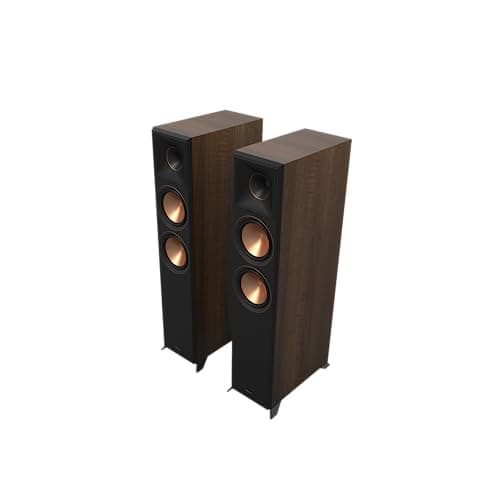 Klipsch RP-6000F II The only pair listing in the bracket and the easiest load in it — with a 96 dB sensitivity figure that carries Klipsch's own half-space asterisk, which is worth reading before you compare it to anything. | Best for a modest amplifier | 8.4 | |
| 2 | 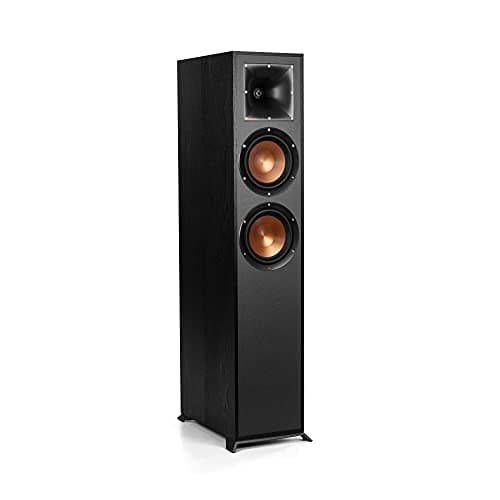 Klipsch R-620F 96 dB at 2.83 V/1 m and 38 Hz with a ±3 dB tolerance attached — the only speaker here that pairs the highest published sensitivity with a bass figure you can actually hold Klipsch to. | Best overall | 8.6 | |
| 3 | 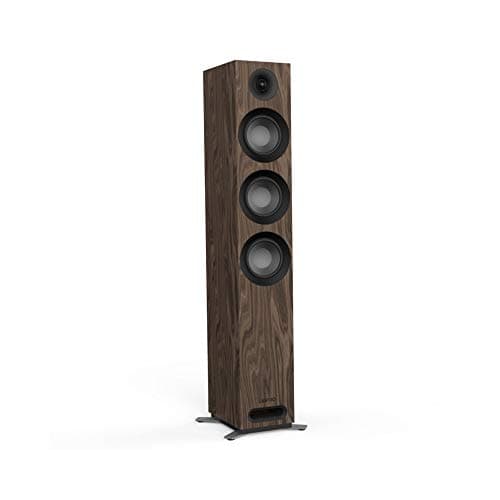 Jamo Studio S 809 The only front-ported tower here, sold as a pair, with a ± 3 dB tolerance on its 37 Hz claim — the answer when the speakers cannot come out into the room. | Best near a wall | 8.0 | |
| 4 | 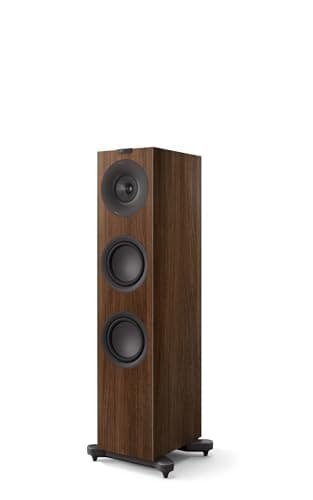 KEF Q7 Meta The only speaker in this bracket whose maker publishes a minimum impedance, and the only one that prints its bass figure at three different conventions so you can see what each is worth. | Best documented | 8.5 | |
| 5 | 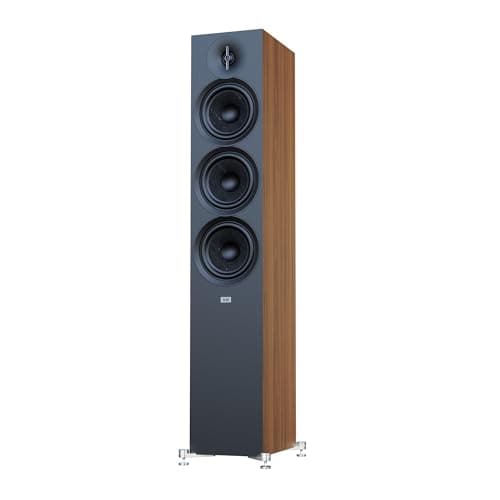 ELAC Debut 3.0 DF63 A genuine three-way with a 6.5-inch driver that does nothing but midrange, published crossover points either side of it — and two ELAC documents that disagree about what impedance it presents. | Best three-way for the money | 8.0 |
Our two floorstanding brackets rank towers by price. This page ranks them by the system a record player lives in. That system has two features a streaming setup does not: the amplifier is almost always a stereo integrated with a phono stage, which in the models we cover means 35 to 85 watts into 8 ohms, and the source is a mechanical pickup that responds to vibration. A tower that looks best on a bracket page can be the wrong tower here.
What a turntable system asks of a floorstanding speaker
Three things, in this order. First, it asks for sensitivity, because the amplifier is modest. The integrateds on our turntable-amplifier roundup publish 35 W (Cambridge AXA35), 45 W (Marantz PM6007 and Denon PMA-600NE), 60 W (Yamaha A-S301) and 85 W (Yamaha A-S501) into 8 ohms. Those are honest full-band ratings, and none of them is large. Every 3 dB of speaker sensitivity you buy is worth a doubling of amplifier power you do not have to buy.
Second, it asks for an impedance you can plan against. Only one of the five amplifiers above publishes a continuous 4 ohm rating across the full band (the Marantz, at 60 W). Yamaha publishes only a short-burst dynamic figure at 4 ohms, and Cambridge publishes nothing. So a speaker that is genuinely a 4 ohm load narrows your amplifier choice to one, and a speaker whose maker will not commit to a figure at all makes the choice a guess.
Third, it asks where the port fires. A turntable is a stylus riding a groove a few microns wide, and the rack it sits on is usually against the same wall the speakers stand near. A rear-firing port puts the speaker’s low-frequency output against that wall. That does not make rear ports wrong — four of our five picks have them — but it makes placement a real part of the purchase rather than an afterthought, and it is why the only front-ported tower we stock ranks above two speakers with better documentation.
How the ranking works
We ranked on published sensitivity at its stated condition, then on whether a nominal impedance is actually stated (and whether a minimum is), then on port direction, then on whether the listing is a pair or a single cabinet. Bass extension — the number the bracket pages spend most of their time on — is deliberately last. On a suspended wooden floor with a turntable in the room, the deepest tower is not automatically the best one, and we say so under each pick rather than pretending the trade-off does not exist.
The eleven floorstanders in our registry are the candidate pool. Six of them are on the under-$1,000 page and five on the under-$2,000 page; the five here are drawn from both, and the ranking is different from either, because the question is different.
SPL at 1 m ≈ sensitivity + 10 × log10(amplifier watts)
Inputs
- Klipsch RP-6000F II sensitivity: 96 dB @ 2.83 V / 1 m (Klipsch's own note: half-space anechoic) (Klipsch spec sheet (PDF))
- KEF Q7 Meta sensitivity: 87 dB @ 2.83 V / 1 m (KEF product page)
- Marantz PM6007 rated power: 45 W × 2 into 8 Ω, 20 Hz – 20 kHz, 0.08% THD (Marantz owner's manual)
Result
Sensitivity: the two Klipsch towers, and why the pair listing wins
The RP-6000F II and the R-620F both publish 96 dB at 2.83 V / 1 m, the highest figures in the registry, and both are quoted as “8 ohm compatible”, which is Klipsch’s wording rather than a measured nominal figure. Both publish 38 Hz at ± 3 dB. On the numbers that matter for a small phono integrated they are the same speaker in two sizes of cabinet.
The RP-6000F II ranks first for two reasons that have nothing to do with sound. Its Amazon listing is a two-speaker pack, so one purchase is a stereo pair, where the R-620F is sold one cabinet at a time. And its spec sheet is the one that carries the half-space qualifier on the sensitivity figure in print; the R-620F’s does not, so you cannot tell whether the two 96 dB figures were measured the same way. A published caveat beats an absent one. It also has dual binding posts and an internally braced cabinet at nearly 50 lb, which the R-620F’s sheet does not claim.
The R-620F ranks second because it is the cheapest route to that sensitivity, and because, as the under-$1,000 page explains, its 1 in LTS tweeter and 90° × 90° Tractrix horn are the same parts Klipsch uses in the R-51M bookshelf and R-52C center — useful if the turntable system doubles as a film system later. Its cons are real: Klipsch’s own product page now points buyers to a newer Reference generation, no minimum impedance is published, and it is a single-cabinet listing.
Placement: the only front port in the registry
The Jamo Studio S 809 publishes 90 dB at 2.83 V / 1 m and states its impedance as 8 ohms flatly, with no “compatible” hedge — the only tower in either bracket to do so. It reaches 37 Hz at ± 3 dB from three 5 in woofers, it is sold as a pair, and it is the one floorstander we stock with a front-firing slot port.
That last fact is why it ranks above two speakers with better documentation. A front port lets the cabinet stand close to the wall a turntable rack is against without firing bass at that wall, and it removes one variable from a setup that already has several. Jamo publishes no crossover frequency and no minimum impedance, and 90 dB is 6 dB behind the Klipsch pair, which is four times the amplifier power. But for a small room, a modest integrated, and a rack against the wall, it is the placement-proof pick.
Documentation: the tower whose maker publishes a minimum impedance
The KEF Q7 Meta is the best-documented floorstander on this site and it ranks fourth here, which needs explaining. KEF publishes 87 dB at 2.83 V / 1 m, a 4 ohm nominal impedance and — uniquely in the registry — a 3.2 ohm minimum. It publishes its bass figure at three conditions (46 Hz at ± 3 dB, 39 Hz at − 6 dB, 28 Hz typical in-room), it publishes both crossover points of a genuine three-way, and it ships a port bung so the rear port can be closed for near-wall placement. Nobody else here tells you this much.
It ranks fourth because of what that documentation says. A 4 ohm nominal load with a 3.2 ohm minimum narrows the phono integrateds we cover to the one that publishes a full-band 4 ohm rating, the Marantz PM6007 at 60 W, and 60 W into an 87 dB speaker is a quiet system compared with the Klipsch on the same amplifier. If your amplifier is bigger than a phono integrated — a receiver, or an integrated from above our brackets — the KEF moves up this list. Our impedance guide covers why the published minimum matters more than the nominal figure.
The three-way that will not tell you its impedance
The ELAC Debut 3.0 DF63 is a true three-way with a dedicated 6.5 in midrange and two published crossover points, 550 Hz and 2,000 Hz. It publishes 87.5 dB and a recommended amplifier range of 30 to 180 W, and it is priced per cabinet. It ranks fifth for one reason: ELAC’s product page says 6 ohms and ELAC’s owner’s manual says 4 ohms for the same speaker, and the under-$2,000 page documents the conflict. For a turntable system, where the amplifier is small and the 4 ohm rating is the exception rather than the rule, that ambiguity is the whole problem. Plan for 4 ohms, which again means the Marantz, and accept that the ELAC’s headline 31 Hz is a − 6 dB figure that becomes 46 Hz at − 3 dB in the manual.
What we left out, and why
Six registry towers did not make this page. The Polk Monitor XT70 and XT60 publish sensitivity at 1 W rather than 2.83 V and publish no nominal impedance at all (“compatible with 4- and 8-ohm outputs”), which fails the second test outright. The Fluance XL8F is a genuine three-way with a down-firing 8 in woofer, but its 87 dB is a 1 W figure and its rear dual ports plus its 35 Hz claim with no tolerance make it the tower we would least want near a turntable rack on a wooden floor. The Klipsch R-610F is on our small-room page instead. The JBL Stage 2 280F publishes no ± 3 dB figure anywhere, and the ELAC DF53 shares the DF63’s impedance conflict with a shallower bass figure.
Bookshelf or floorstanding for a record player?
If the room is small or the floor is suspended timber, the honest answer is often a bookshelf pair on stands, and our bookshelf-for-vinyl roundup is the page for that. A stand-mounted speaker with a 44 Hz bottom end puts less energy into the floor a turntable stands on than a 38 Hz tower does, and the ELAC B6.2 on that page is sold as a pair. The towers here are the right call when the room is large enough that a bookshelf pair runs out of output, or when the same system has to serve a television — in which case our comparison lays out the trade-off with numbers.
Setting the system up so the speakers do not fight the deck
Whichever tower you choose, three things keep bass out of the stylus. Put the turntable on a rack that stands on the floor rather than on a shelf attached to the wall behind the speakers. Keep the speakers off the same section of floorboard as the rack where you can. And if the amplifier or phono stage has a subsonic filter — the Schiit Mani 2 and Fluance PA10 both publish one — use it, because a rumble the speakers reproduce is a rumble the stylus picks up again. Our setup guide covers the rest.
Every pick in detail
Every specification below links to the manufacturer document we read it from. Where a manufacturer does not publish a figure, we say so rather than estimating it.
Klipsch RP-6000F II
Best for a modest amplifierPrice as of September 17, 2026. #ad
The only pair listing in the bracket and the easiest load in it — with a 96 dB sensitivity figure that carries Klipsch's own half-space asterisk, which is worth reading before you compare it to anything.
- published data
- 7/10
- sensitivity
- 9/10
- bass extension
- 8/10
- amp friendliness
- 10/10
- value for money
- 9/10
| Specification | Published value | Source |
|---|---|---|
| Design | Two-way bass reflex — no dedicated midrange driver | Klipsch spec sheet (PDF) |
| Sensitivity | 96 dB @ 2.83 V / 1 m, with Klipsch's own asterisk: “SPL at 1 M, half-space anechoic with 2.83V input” | Klipsch spec sheet (PDF) |
| Impedance | 8 Ω “compatible” (Klipsch's wording — not a measured nominal figure) | Klipsch spec sheet (PDF) |
| Minimum impedance | Not published | — |
| Frequency response | 38 Hz – 25 kHz ± 3 dB | Klipsch spec sheet (PDF) |
| Power handling | 125 W continuous / 500 W peak (a handling limit, not a recommended amplifier range) | Klipsch spec sheet (PDF) |
| Tweeter | 1 in titanium LTS vented tweeter on a hybrid cross-section expanded Tractrix horn | Klipsch spec sheet (PDF) |
| Woofers | Dual 6.5 in Cerametallic cone with Faraday rings | Klipsch spec sheet (PDF) |
| Crossover | 1,770 Hz | Klipsch spec sheet (PDF) |
| Enclosure | Internally braced MDF; bass reflex via dual-chamber rear-firing Tractrix ports | Klipsch spec sheet (PDF) |
| Input terminals | Dual binding posts — bi-wire and bi-amp capable | Klipsch spec sheet (PDF) |
| Dimensions (H × W × D) | 39.60 × 9.29 × 17.57 in (100.6 × 23.6 × 44.6 cm) | Klipsch spec sheet (PDF) |
| Weight (each) | 49.4 lb / 22.4 kg | Klipsch spec sheet (PDF) |
| Sold as | A pair — the Amazon listing is a two-speaker pack. The only pair listing in this bracket. | Klipsch product page |
Pros
- Sold as a pair, so the listed price is the price of a stereo front end
- 38 Hz – 25 kHz ± 3 dB — a real tolerance window on the deepest ± 3 dB figure in the bracket
- 8 Ω compatible and high sensitivity: the one speaker here a modest integrated amplifier will drive comfortably
- Dual binding posts for bi-wiring or bi-amping, which the ELACs and the KEF do not offer
- 125 W continuous handling and a divided, internally braced cabinet
Cons
- The 96 dB figure is footnoted “SPL at 1 M, half-space anechoic with 2.83V input” — a half-space measurement is conventionally about 3 dB optimistic against a free-space one, so it is NOT comparable to the KEF's or ELAC's numbers
- A two-way: the 6.5 in woofers cover midrange up to 1,770 Hz, where the ELACs and the KEF hand that band to a dedicated driver
- 17.57 in deep and 49.4 lb each — the deepest cabinet here before port clearance
- Rear-firing Tractrix ports need real space behind them
- Klipsch publishes no minimum impedance, and “8 ohms compatible” is not a measured nominal figure
Skip it if you are ranking on the headline sensitivity number. Read the asterisk first — it is the difference between a fair comparison and a wrong one.
Klipsch R-620F
Best overallPrice as of September 17, 2026. #ad
96 dB at 2.83 V/1 m and 38 Hz with a ±3 dB tolerance attached — the only speaker here that pairs the highest published sensitivity with a bass figure you can actually hold Klipsch to.
- sensitivity
- 10/10
- published data
- 7/10
- bass extension
- 8/10
- amp friendliness
- 10/10
- value for money
- 9/10
| Specification | Published value | Source |
|---|---|---|
| Sensitivity | 96 dB (2.83 V / 1 m) — the highest published figure on this site | Klipsch spec sheet (PDF) |
| Impedance | 8 Ω “compatible” (Klipsch's wording — not a measured nominal figure) | Klipsch spec sheet (PDF) |
| Minimum impedance | Not published | — |
| Frequency response | 38 Hz – 21 kHz ± 3 dB | Klipsch spec sheet (PDF) |
| Power handling | 100 W continuous / 400 W peak (a handling limit, not a recommended amplifier range) | Klipsch spec sheet (PDF) |
| Woofers | Dual 6.5 in spun-copper IMG | Klipsch spec sheet (PDF) |
| Tweeter | 1 in aluminum LTS on a 90° × 90° square Tractrix horn | Klipsch spec sheet (PDF) |
| Crossover | 2,000 Hz | Klipsch spec sheet (PDF) |
| Enclosure | MDF, bass reflex via rear-firing Tractrix ports | Klipsch product page |
| Input terminals | Not published | — |
| Dimensions (H × W × D) | 40 × 9.4 × 15.2 in (1,017 × 240 × 386 mm) | Klipsch spec sheet (PDF) |
| Weight (each) | Not published | — |
| Sold as | One speaker. Klipsch's Amazon listing is a single cabinet; a stereo pair is two purchases. | Klipsch product page |
Pros
- 96 dB at 2.83 V / 1 m — the highest published sensitivity of any speaker on this site
- 38 Hz – 21 kHz is quoted ± 3 dB, so both endpoints mean something
- 100 W continuous / 400 W peak handling, published as handling rather than as a recommendation
- Dual 6.5 in woofers in a 40 in cabinet that is still under 9.5 in wide
Cons
- Klipsch's own spec sheet leaves the weight and the input-terminal fields BLANK — the R-610F sheet fills both in, so this is an omission, not an oversight on our part
- Rear-firing Tractrix ports need clearance behind them, which rules out a tight alcove
- The horn presentation is divisive and we cannot tell you how it sounds — we have not heard them
- The Amazon listing is one speaker, so the real cost of a stereo pair is double the number shown
- Previous generation — Klipsch's own page for it now points buyers to the newer Reference R-600F
Skip it if the speakers have to sit within a few inches of a back wall. Rear ports and a wall are a poor combination, and the front-ported Jamo exists for exactly that room.
Jamo Studio S 809
Best near a wallPrice as of September 17, 2026. #ad
The only front-ported tower here, sold as a pair, with a ± 3 dB tolerance on its 37 Hz claim — the answer when the speakers cannot come out into the room.
- sensitivity
- 8/10
- published data
- 6/10
- bass extension
- 8/10
- amp friendliness
- 8/10
- value for money
- 10/10
| Specification | Published value | Source |
|---|---|---|
| Sensitivity | 90 dB (2.83 V @ 1 m) | Jamo spec table |
| Impedance | 8 Ω — stated flatly, with no “compatible” hedge | Jamo spec table |
| Minimum impedance | Not published | — |
| Frequency response | 37 Hz – 26 kHz ± 3 dB | Jamo spec table |
| Power handling | 120 W / 240 W | Jamo spec table |
| Tweeter | 1 × 25 mm (1 in) soft dome with Anti-Diffraction Waveguide | Jamo spec table |
| Woofers | 3 × 127 mm (5 in) polyfiber | Jamo spec table |
| Crossover frequency | Not published | — |
| Enclosure | Bass reflex via a front-firing slot port — the only front-ported speaker on this page | Jamo spec table |
| Input terminals | Single binding post | Jamo spec table |
| Dimensions (H × W × D) | 41.02 × 7.52 × 9.92 in (1,042 × 191 × 252 mm) | Jamo spec table |
| Weight (each) | 30 lb / 13.6 kg | Jamo spec table |
| Sold as | A pair. Jamo prices the S 809 per pair on its own store, and the Amazon listing is a pair. | Jamo product page |
Pros
- Front-firing slot port — the only speaker on this page that is designed to work close to a back wall
- 37 Hz – 26 kHz ± 3 dB: a tolerance window on the deepest-but-one bass claim here
- 8 Ω stated flatly, with none of the “compatible” hedging Klipsch, Polk and Fluance all use
- Sold as a matched pair, so the listing price is the pair price
Cons
- Jamo publishes NO crossover frequency, so how three 5 in woofers are filtered is undisclosed
- Three 5 in drivers is less cone area than the dual 6.5 in designs it is priced against
- Single binding post — no bi-wiring or bi-amping, which the Polks' 5-way posts allow
- It is the oldest design here, and Jamo's current catalog has moved to other series
Skip it if you want to know how the speaker is filtered. There is no crossover row on Jamo's spec table and no manual figure we can link.
KEF Q7 Meta
Best documentedPrice as of September 17, 2026. #ad
The only speaker in this bracket whose maker publishes a minimum impedance, and the only one that prints its bass figure at three different conventions so you can see what each is worth.
- published data
- 10/10
- sensitivity
- 5/10
- bass extension
- 8/10
- amp friendliness
- 4/10
- value for money
- 7/10
| Specification | Published value | Source |
|---|---|---|
| Design | Three-way bass reflex | KEF spec page |
| Sensitivity | 87 dB (2.83 V / 1 m) | KEF spec page |
| Impedance (nominal) | 4 Ω | KEF spec page |
| Minimum impedance | 3.2 Ω — the only published minimum in this bracket | KEF spec page |
| Frequency response | 46 Hz – 20 kHz (± 3 dB) | KEF spec page |
| Frequency range | 39 Hz – 20 kHz (−6 dB) — KEF publishes both conventions for the same speaker, 7 Hz apart | KEF spec page |
| Typical in-room bass response | 28 Hz (−6 dB) — a third published figure, 18 Hz below the ± 3 dB one | KEF spec page |
| Amplifier requirements | 15 – 200 W | KEF spec page |
| Uni-Q driver array | HF: 19 mm (0.75 in) vented aluminum dome with MAT; MF: 100 mm (4 in) aluminum cone, mounted at the tweeter's acoustic center | KEF spec page |
| Bass units | 2 × 165 mm (6.5 in) hybrid aluminum cone | KEF spec page |
| Crossover | 440 Hz, 2.3 kHz | KEF spec page |
| Maximum SPL | 110 dB | KEF spec page |
| Enclosure | Bass reflex; a port bung is supplied as an accessory | KEF spec page |
| Dimensions (H × W × D) | 1,001 × 317 × 315 mm (39.4 × 12.5 × 12.4 in) | KEF spec page |
| Weight (each) | 18.4 kg / 40.6 lb | KEF spec page |
| Sold as | One speaker — KEF's Amazon listing is labelled “Each”. A stereo pair is two purchases. | KEF product page |
Pros
- Publishes 46 Hz (± 3 dB), 39 Hz (−6 dB) and 28 Hz in-room for the same speaker — the clearest disclosure on this site
- 3.2 Ω minimum impedance published; nobody else in either floorstanding bracket publishes one at all
- Uni-Q puts the 100 mm midrange and the 19 mm tweeter on one acoustic axis, so the two do not arrive at different times off-axis
- A genuine three-way with both crossover points published (440 Hz, 2.3 kHz)
- A port bung is in the box, which is the manufacturer's own answer to a wall-proximity problem
Cons
- 4 Ω nominal and 3.2 Ω minimum is the hardest amplifier load here — the disclosure is excellent and what it discloses is demanding
- 87 dB is the joint-lowest sensitivity on this page, so the hard load and the low sensitivity compound
- At its current price a pair lands essentially at the top of this bracket, leaving no budget for stands, cable or a subwoofer
- The listing is one speaker, so the real cost of stereo is double the number shown
- 12.4 in deep before you add port clearance behind it
Skip it if your amplifier has no published 4-ohm rating. KEF tells you exactly what it demands, and an amp that will not say what it does into 4 Ω is the wrong partner for it.
ELAC Debut 3.0 DF63
Best three-way for the moneyPrice as of September 17, 2026. #ad
A genuine three-way with a 6.5-inch driver that does nothing but midrange, published crossover points either side of it — and two ELAC documents that disagree about what impedance it presents.
- published data
- 6/10
- sensitivity
- 5/10
- bass extension
- 8/10
- amp friendliness
- 5/10
- value for money
- 9/10
| Specification | Published value | Source |
|---|---|---|
| Design | 3-Way, Bass Reflex — a driver that does nothing but midrange | ELAC spec page |
| Sensitivity | 87.5 dB @ 2.83 V / 1 m | ELAC spec page |
| Impedance (nominal) | ELAC publishes two conflicting figures: 6 Ω on the product page, 4 Ω in the Debut 3.0 owner's manual. Plan an amplifier for 4 Ω — that is the harder load and the safe direction to be wrong in. | ELAC owner's manual (PDF) |
| Minimum impedance | Not published | — |
| Frequency response | 31 Hz – 38 kHz at −6 dB (the figure ELAC's product page leads with) | ELAC spec page |
| Frequency response (−3 dB) | 46 Hz – 34 kHz — published in the owner's manual only, 15 Hz above the headline figure | ELAC owner's manual (PDF) |
| Recommended amplifier power | 30 – 180 W | ELAC spec page |
| Power handling | Product page: 140 W peak. Owner's manual: 100 W nominal / 150 W peak. Another row where the two ELAC documents disagree. | ELAC owner's manual (PDF) |
| Tweeter | 1 in aluminum dome | ELAC spec page |
| Midrange | 6.5 in aramid fiber — a dedicated midrange, not a mid-woofer | ELAC spec page |
| Woofers | 2 × 6.5 in aramid fiber | ELAC spec page |
| Crossover | 550 Hz, 2,000 Hz — two published points, which is what a genuine three-way looks like on paper | ELAC spec page |
| Enclosure | CARB2-rated 16 mm MDF, dual flared ports | ELAC spec page |
| Input terminals | 5-way metal binding posts | ELAC spec page |
| Dimensions (H × W × D) | 43.1 × 7.7 × 10.6 in (1,094 × 195 × 268 mm) | ELAC spec page |
| Weight (each) | 38.8 lb / 17.6 kg | ELAC spec page |
| Sold as | One speaker — ELAC's Amazon listing is labelled “Each”. A stereo pair is two purchases. | ELAC product page |
Pros
- A true three-way at the bottom half of this bracket: 1 in dome, dedicated 6.5 in midrange, dual 6.5 in woofers
- Both crossover points published (550 Hz and 2,000 Hz), which is how you verify a three-way claim rather than trusting it
- 30 – 180 W recommended amplifier range, the widest published window here
- 5-way metal binding posts and a CARB2-rated 16 mm MDF cabinet
- 7.7 in wide — a narrow tower for the cone area it carries
Cons
- ELAC's product page says 6 Ω and ELAC's own owner's manual says 4 Ω. Both are ELAC documents and they do not agree; plan for 4 Ω
- The headline 31 Hz is a −6 dB figure. ELAC's manual publishes 46 Hz at −3 dB for the same speaker — a 15 Hz difference that only appears if you open the manual
- The two documents also disagree on power handling (140 W peak on the page, 100/150 W in the manual)
- 87.5 dB sensitivity, and ELAC publishes the identical figure for the smaller DF53
- The listing is one speaker, not a pair
Skip it if you need to know the impedance with certainty before choosing an amplifier. Until ELAC reconciles its own two documents, the honest planning figure is the harder one.
Frequently asked questions
Do floorstanding speakers cause feedback with a turntable?
How much amplifier power do I need for these with a turntable?
Which of these speakers is 4 ohms?
Why is the KEF Q7 Meta ranked fourth here but first on the under-$2,000 page?
Should the port face the front or the back for a turntable system?
Are these priced per speaker or per pair?
Have you listened to these speakers with a turntable?
Read next
The Best Floorstanding Speakers Under $1,000
Six towers that make a stereo pair under $1,000, ranked on sensitivity with its stated condition, bass figures with a tolerance, and where the port fires.
The Best Floorstanding Speakers Under $2,000
Five towers that make a stereo pair under $2,000, ranked after putting every published bass figure on a common tolerance — which reorders them.
The Best Bookshelf Speakers for Vinyl
Bookshelf speakers for a turntable, ranked on published sensitivity and impedance — with the amp arithmetic shown.
The Best Integrated Amplifiers for a Turntable
Amplifiers with a phono stage inside, ranked on published MM sensitivity and phono signal-to-noise — not watts.
Will This Amplifier Drive My Speakers?
Two published numbers, one formula, and the answer is almost always less power than you expected.
How to Set Up a Turntable
Nine steps, and the two everyone gets wrong. Both have a published number you can set them to.
Sources
Every specification on this page was read from one of these documents. If one of them has changed, or we have made an error, tell us — corrections are logged and dated per our editorial policy.
- Klipsch RP-6000F II — spec sheet (PDF)
- Klipsch R-620F — product page and specifications
- Jamo Studio S 809 — specifications
- KEF Q7 Meta — specifications
- ELAC Debut 3.0 DF63 — specifications
- ELAC Debut 3.0 series — owner's manual (PDF, the 4 Ω and −3 dB figures)
- Marantz PM6007 — owner's manual (rated power, 8 Ω and 4 Ω)